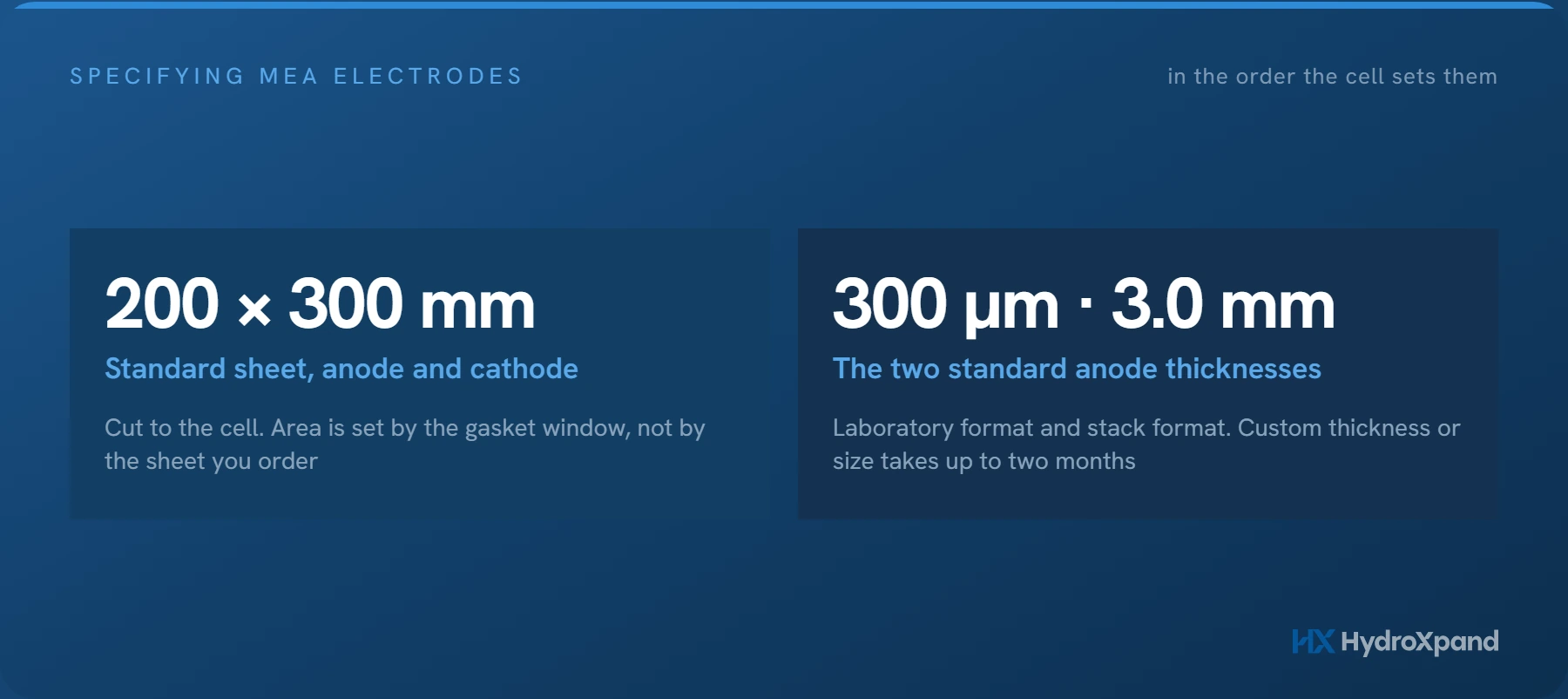
Specifying electrodes for an MEA: area, thickness and catalyst loading, in the order the cell sets them
Most electrode enquiries stall on the specification rather than the price. Area and thickness come from the cell the electrode goes into, the catalyst comes from the test, and only then does it make sense to choose between a standard sheet and a custom format. This is that order, with the figures for our anode and cathode.
Read →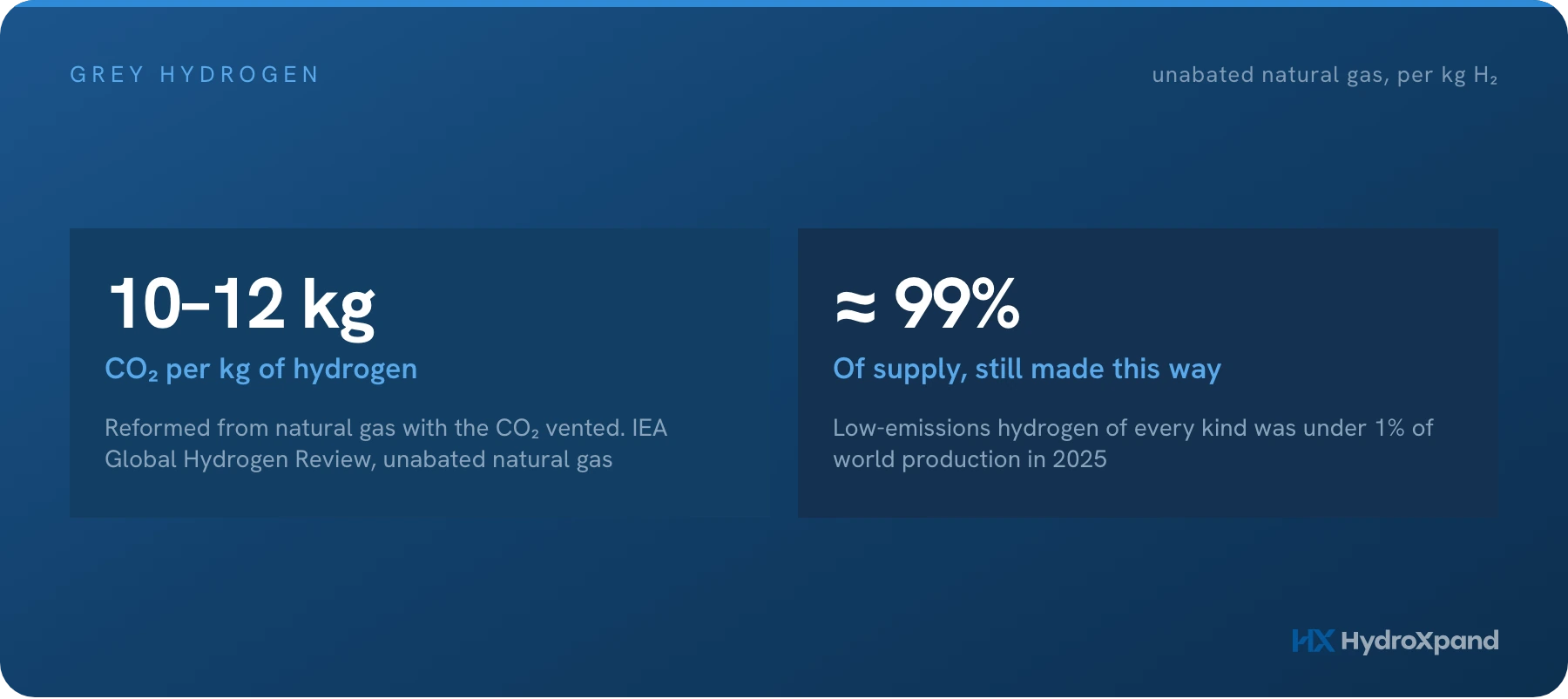
Grey hydrogen: how it is made, what it emits, and why it still dominates
Grey hydrogen is hydrogen pulled out of natural gas with steam, with the carbon dioxide released to the air. It is almost all of the hydrogen the world makes today, and the reason is price. This is how the process works, what it emits per kilogram, and what the two routes away from it look like.
Read →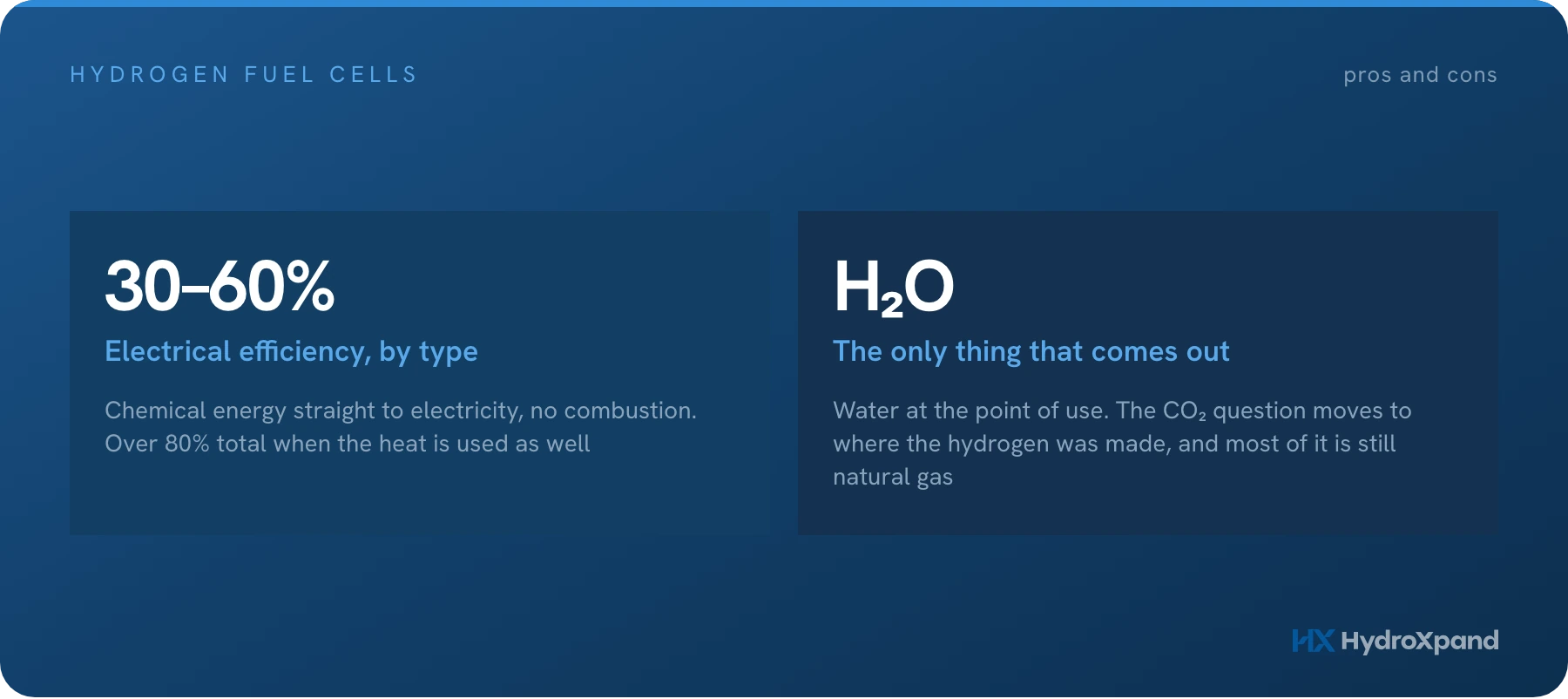
Hydrogen fuel cell pros and cons: four strengths in the cell, four limits around it
A hydrogen fuel cell turns hydrogen and oxygen into electricity, heat and water, with nothing burned and nothing spinning. Its four strengths are properties of the cell. Its four limits are the cost, the refuelling network, the hydrogen it is fed and its lifetime. This article sets out all eight, and what each one depends on.
Read →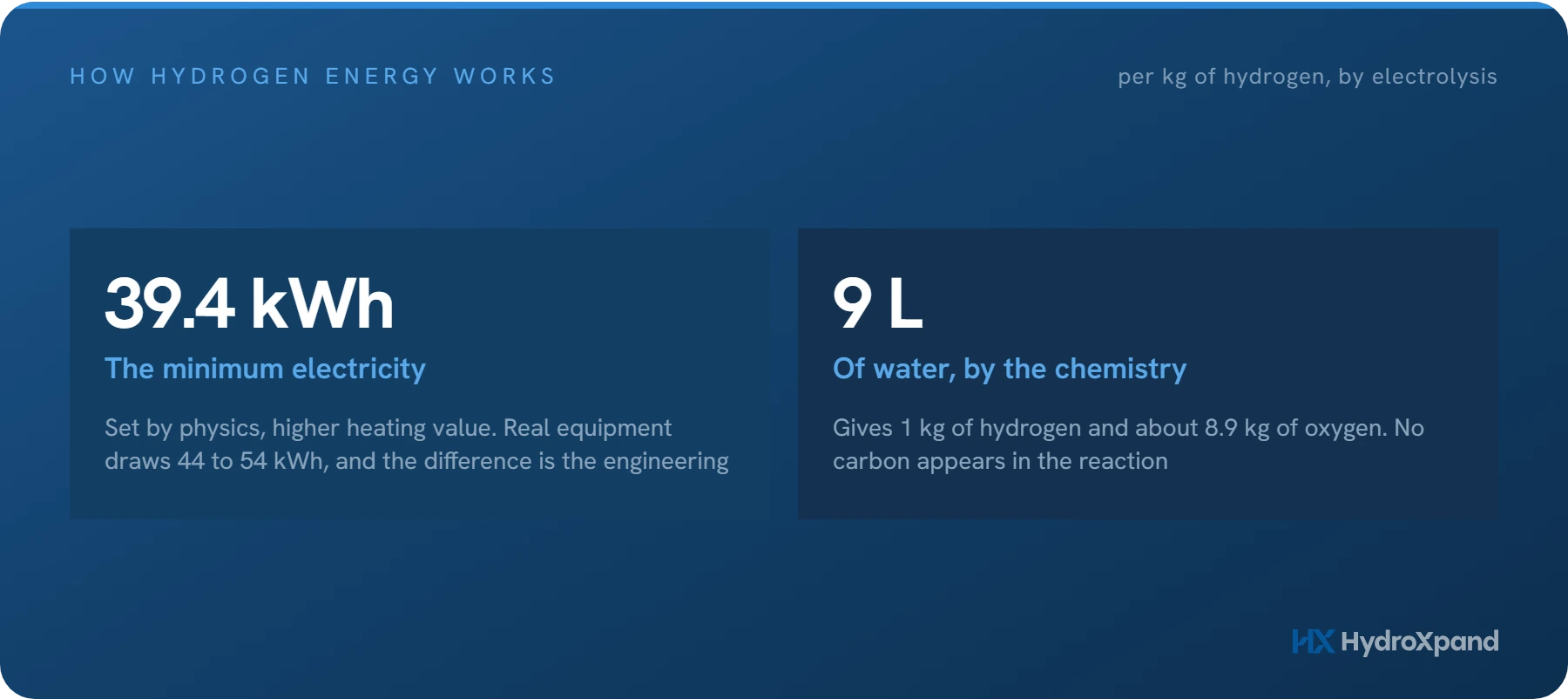
How hydrogen energy works: three ways to make it, and the way back to electricity
Hydrogen is not an energy source that is found. It is one that has to be made, by separating it from water or methane, and that single fact explains most of what follows: why there are three ways to make it, why only one of them is clean, why 39.4 kWh per kilogram is a floor no electrolyzer can go under, and why a fuel cell is the same reaction run backwards.
Read →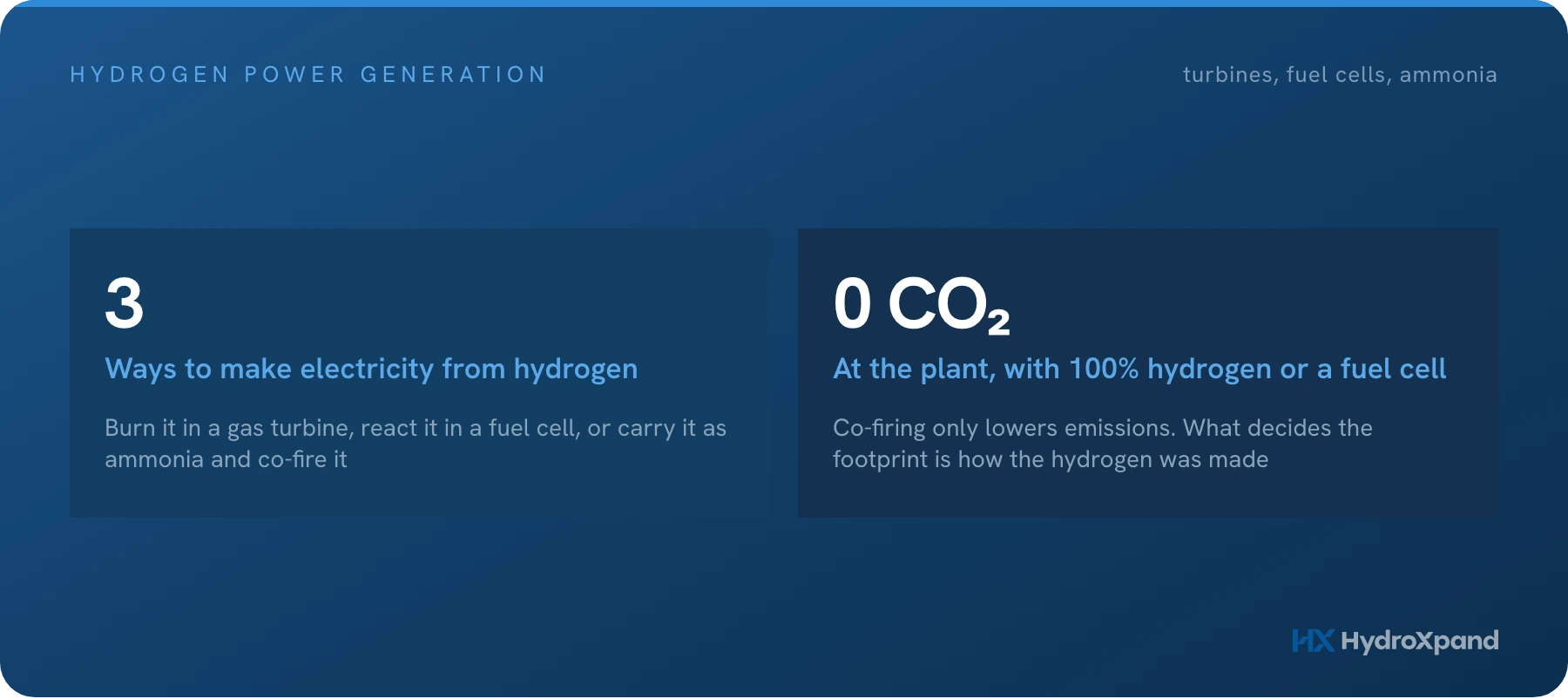
Hydrogen power generation: turbines, fuel cells and ammonia, and what they all need
Hydrogen power generation means making electricity with hydrogen as the fuel, either by burning it in a gas turbine or by reacting it in a fuel cell. Governments expect power to be the largest use of hydrogen. This article sets out the three methods, what each is for, what stands in the way, how Korea's auctions buy hydrogen power, and why the whole thing comes back to the price of clean hydrogen.
Read →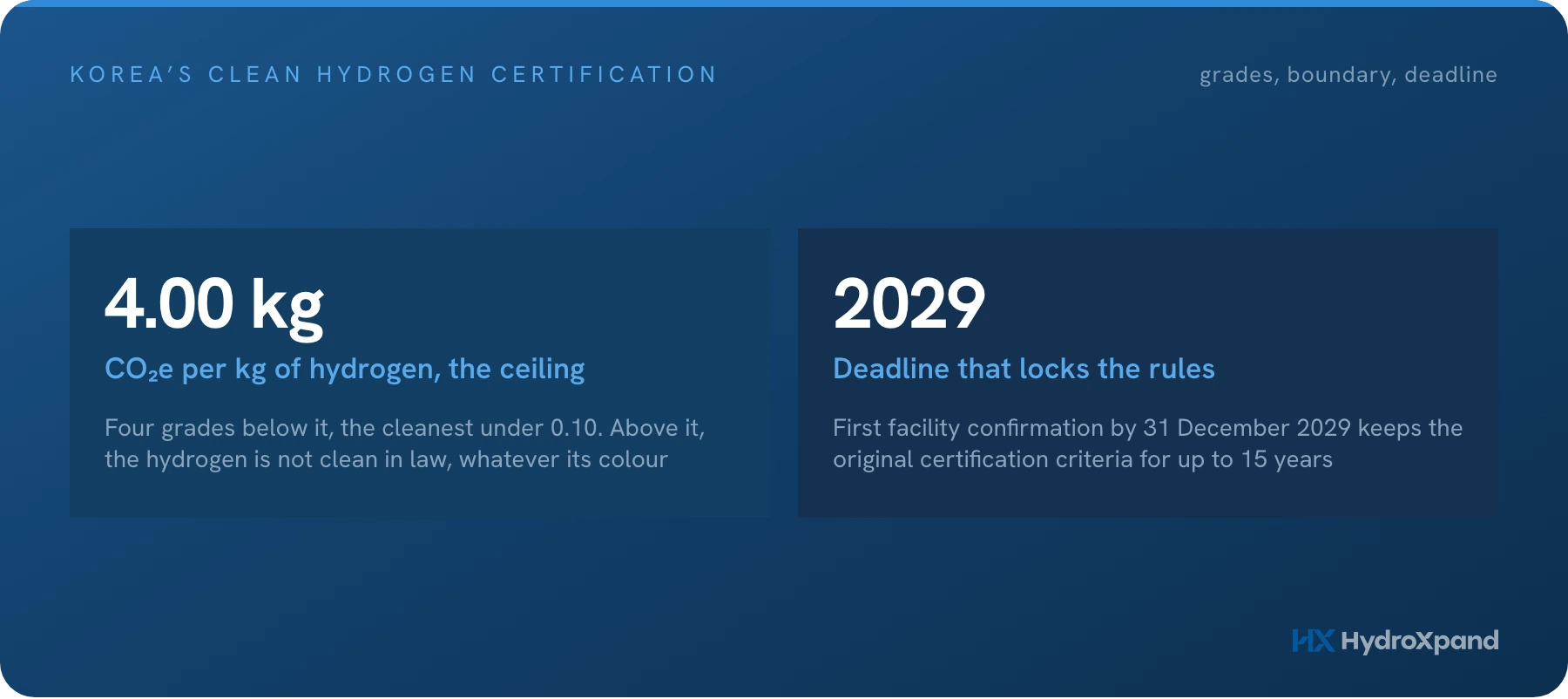
Korea's clean hydrogen certification: four grades, one number, and a 2029 deadline
Korea defines clean hydrogen by a number, not a colour: at most 4.00 kg of CO₂ equivalent per kilogram of hydrogen, split into four grades. This article sets out what the law defines, how the grades and the accounting boundary work, the two conditions electrolysis power has to meet, when and how a plant applies, and why 31 December 2029 matters to anyone building an electrolyzer in Korea.
Read →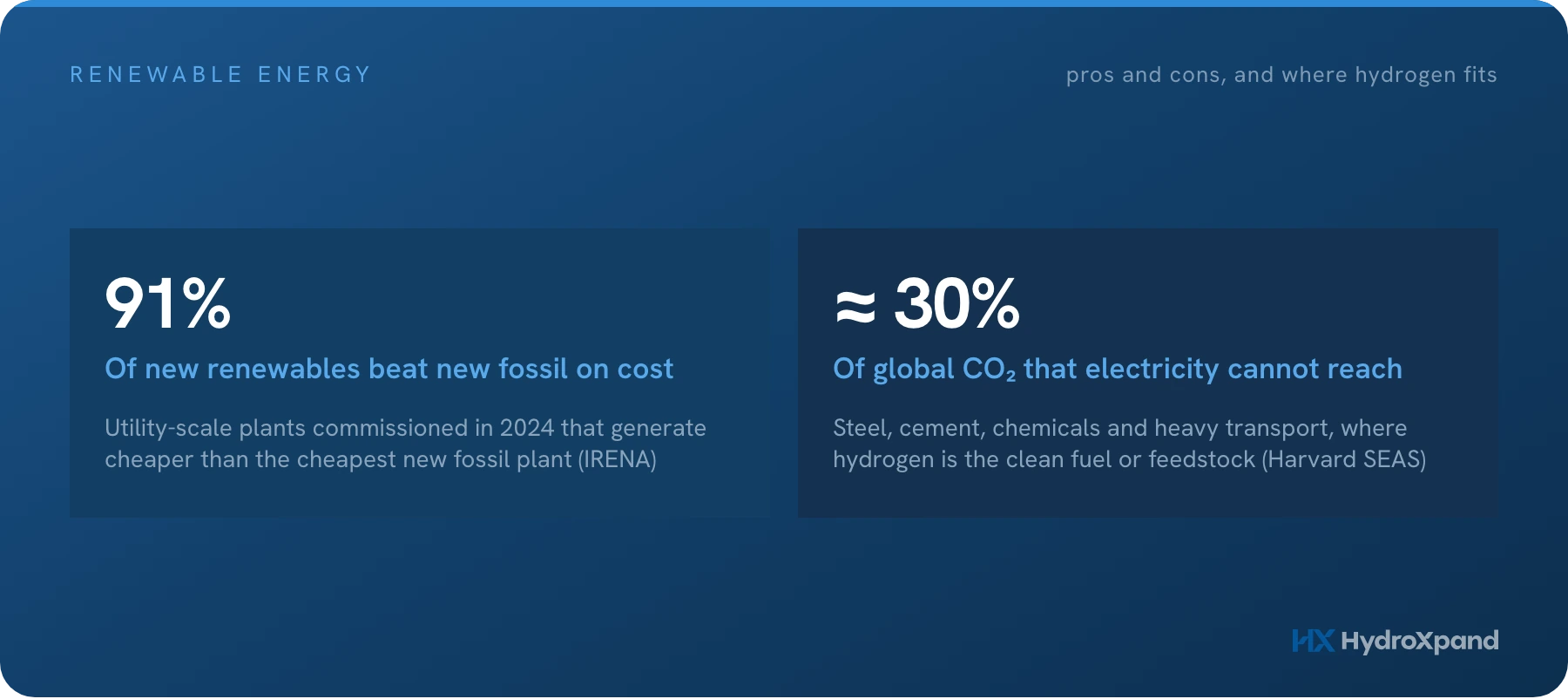
Renewable energy pros and cons: four advantages, four limits, and where hydrogen fits
Solar and wind now make the cheapest new electricity there is, and they still cannot make it when it is needed. This article sets out the four advantages and four limits of renewable energy with the numbers behind each, compares Korea's position with the world's, and explains the two gaps electricity cannot close on its own, which is where hydrogen, and the electrolyzer, come in.
Read →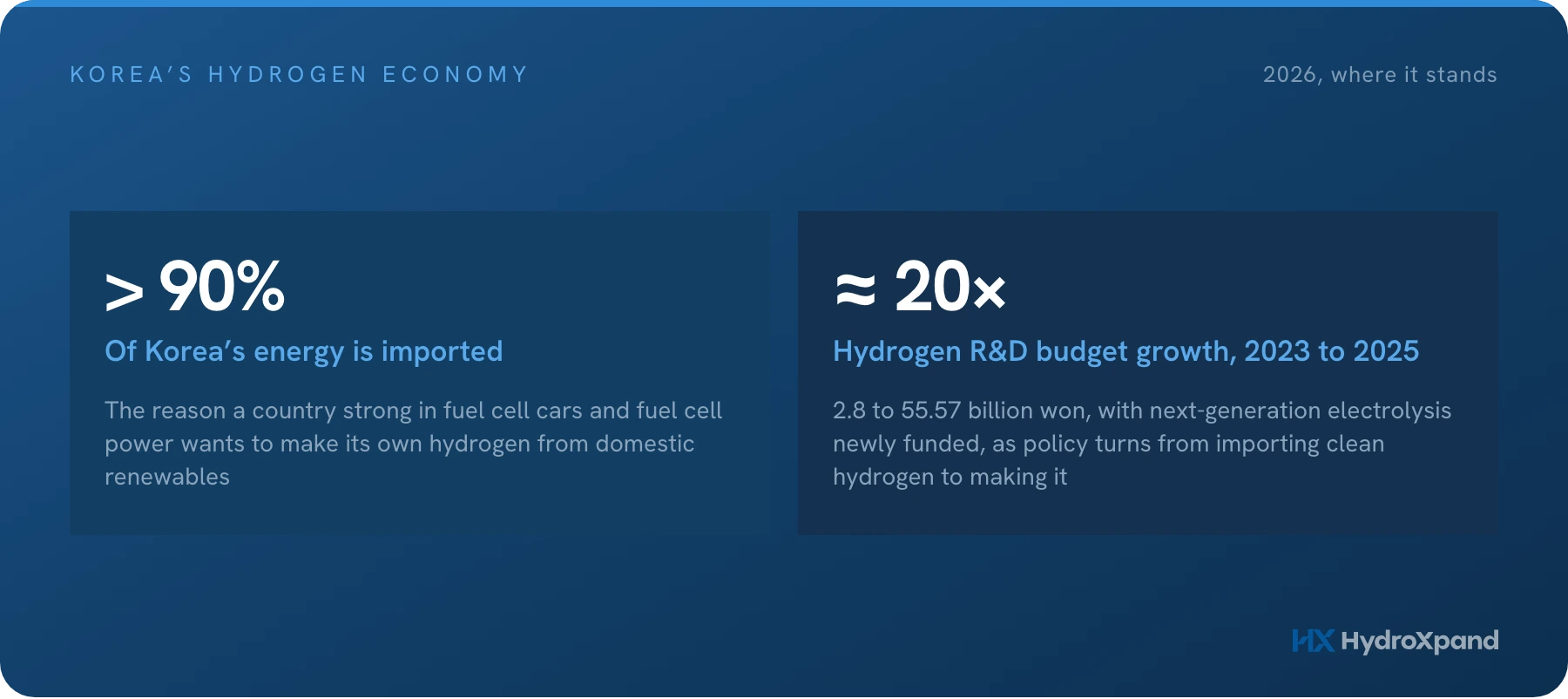
Korea's hydrogen economy in 2026: a leader in using hydrogen, a latecomer in making it
Korea passed the world's first hydrogen act, sells the world's best-selling fuel cell car and runs the largest fuel cell power market, and still makes only hundreds of tonnes of green hydrogen a year. This article sets out why Korea is betting on hydrogen, where it leads and where it lags, why its green hydrogen costs about twice the global average, and how policy turned in 2025 from importing clean hydrogen towards making it.
Read →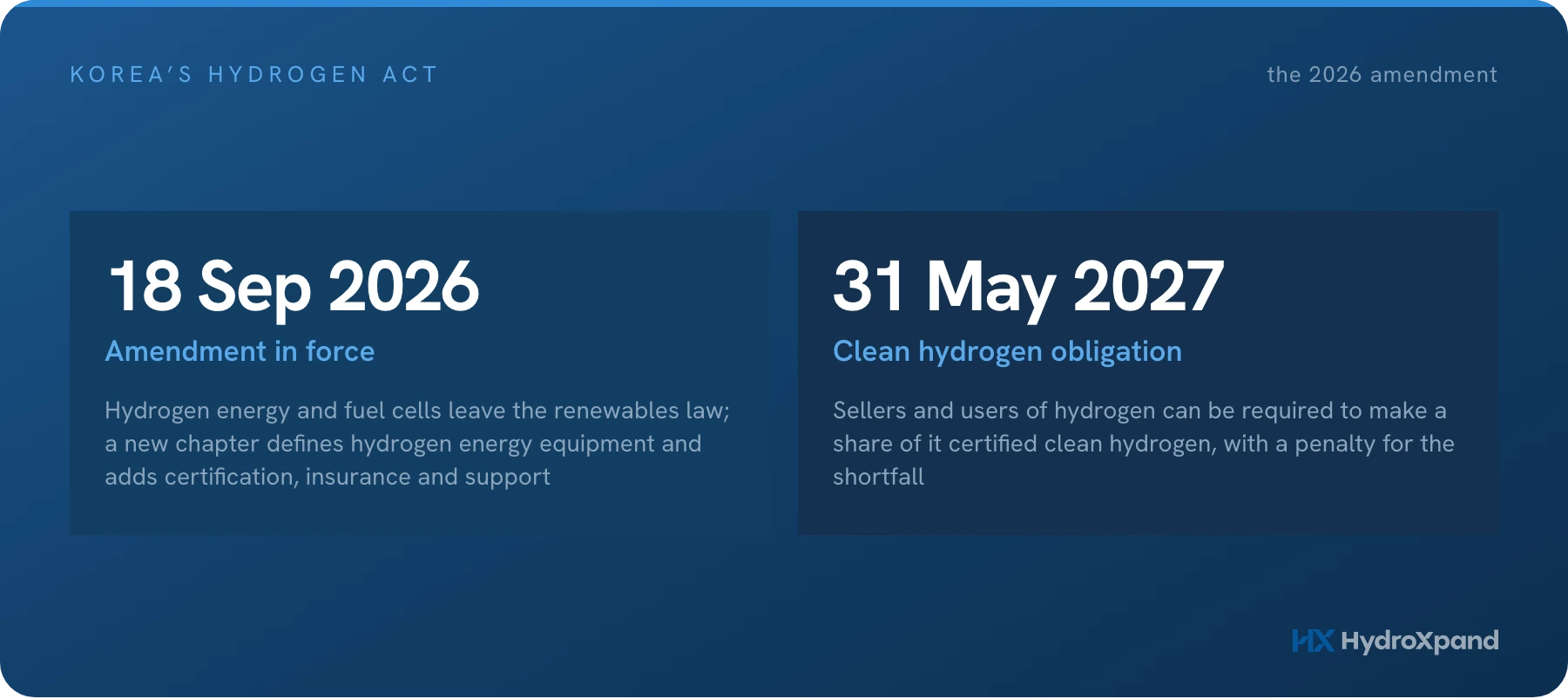
Korea's Hydrogen Act: what the 2026 amendment changes for electrolyzer makers and buyers
Korea passed the world's first stand-alone hydrogen law in 2020, and an amendment that took effect on 18 September 2026 moves hydrogen energy out of the renewables law and into it. This article explains what the Act covers, what the amendment adds, whether an electrolyzer counts as hydrogen energy equipment, what equipment certification gives and demands, and the clean hydrogen obligation that arrives in May 2027.
Read →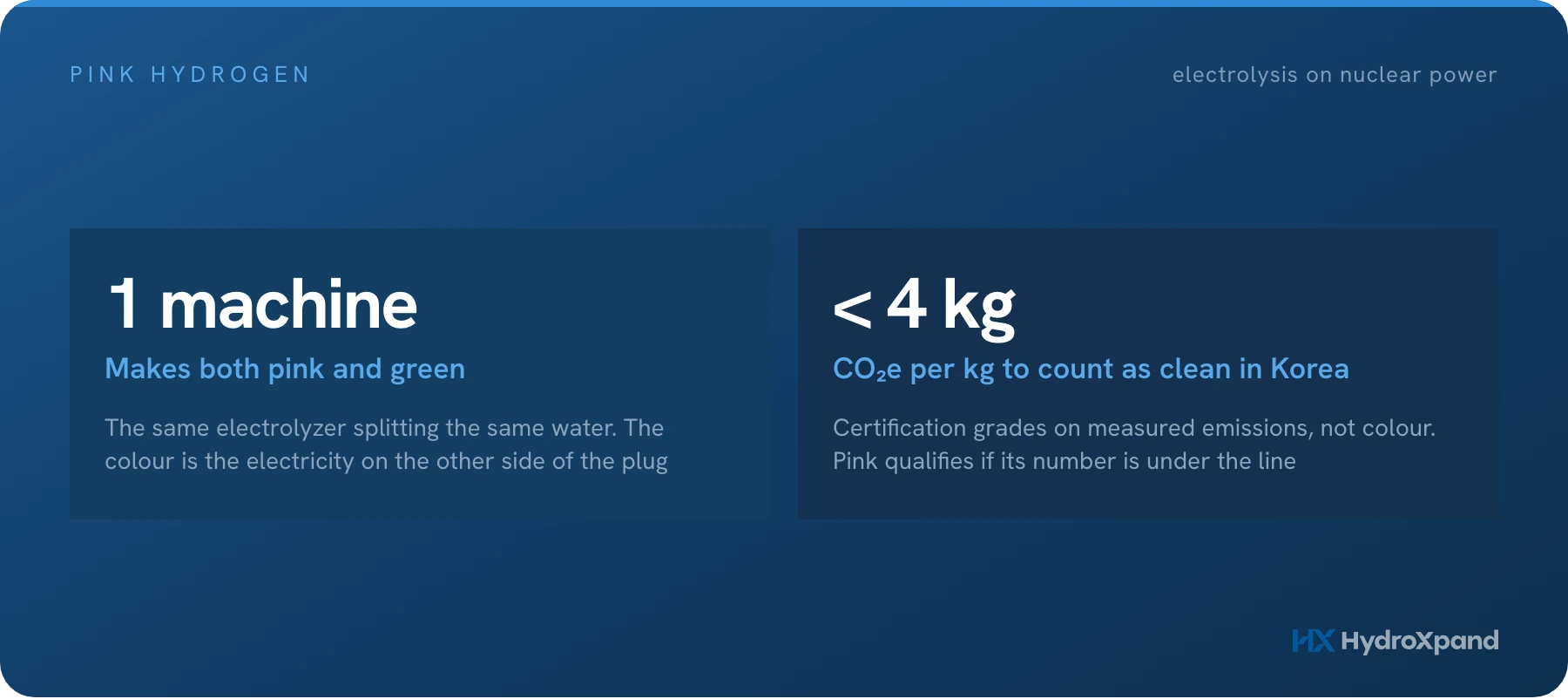
Pink hydrogen: electrolysis on nuclear power, and why the colour is the electricity, not the machine
Pink hydrogen is hydrogen made by splitting water with electricity from a nuclear plant. The process is the same electrolysis that makes green hydrogen; only the power source differs. This article sets out what pink hydrogen is, how it differs from red and purple nuclear hydrogen and from green, its advantages and limits, where it stands in Korea's certification scheme, and how different countries treat it.
Read →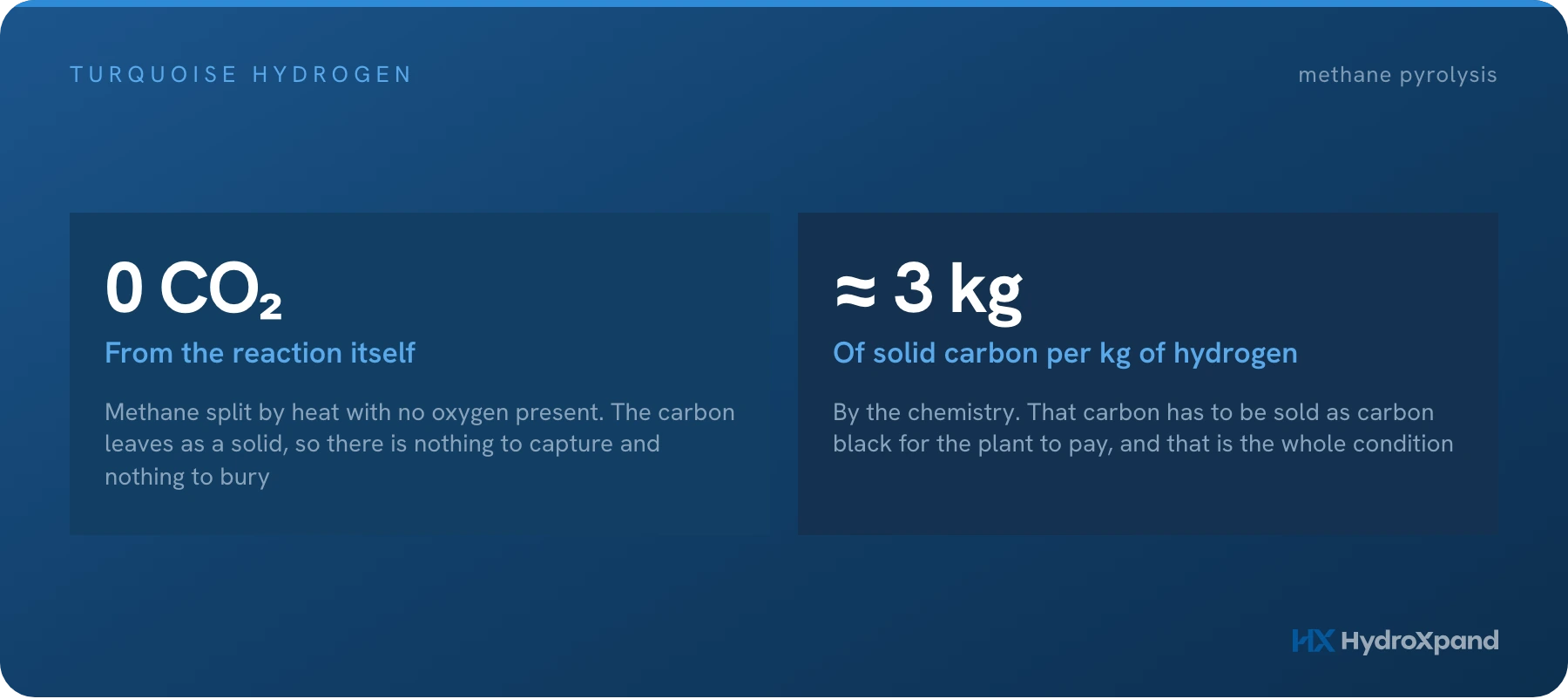
Turquoise hydrogen: methane pyrolysis, solid carbon, and the condition that makes it pay
Turquoise hydrogen is made by heating methane with no oxygen present, so the molecule splits into hydrogen and solid carbon instead of hydrogen and CO₂. That removes the capture-and-storage step that blue hydrogen depends on, and it adds a condition of its own: the carbon has to be sold. This article sets out how the process works, where it sits among the colours, what it offers, what it requires, and what is still unresolved.
Read →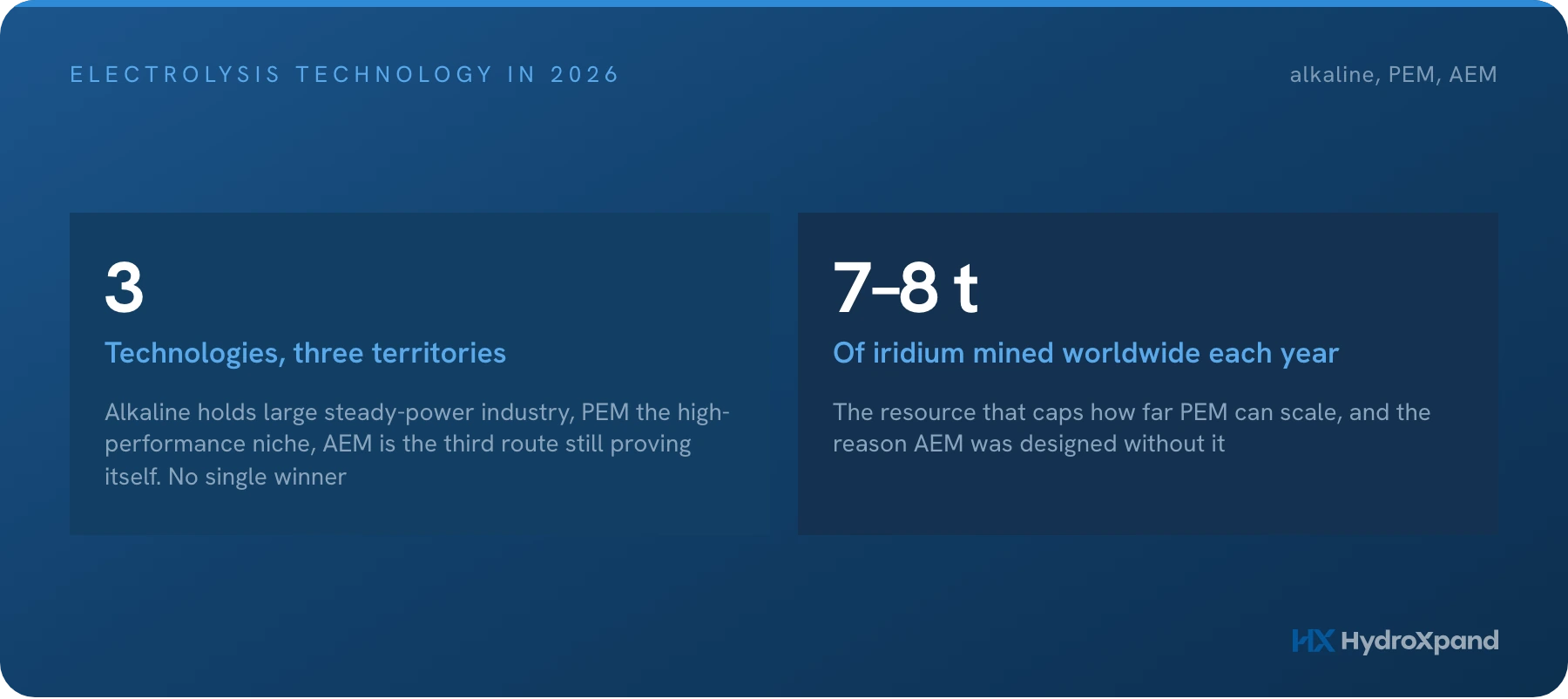
Electrolysis technology in 2026: where alkaline, PEM and AEM each stand, and how to choose
The question buyers ask first is which electrolysis technology will win. The market is answering a different question: which technology fits which application. Alkaline holds large steady-power industry, PEM holds the high-performance niche and is capped by iridium and PFAS rules, and AEM is the third route with three things still to prove. This article maps the territories as they stand in 2026 and gives the four questions that narrow the choice.
Read →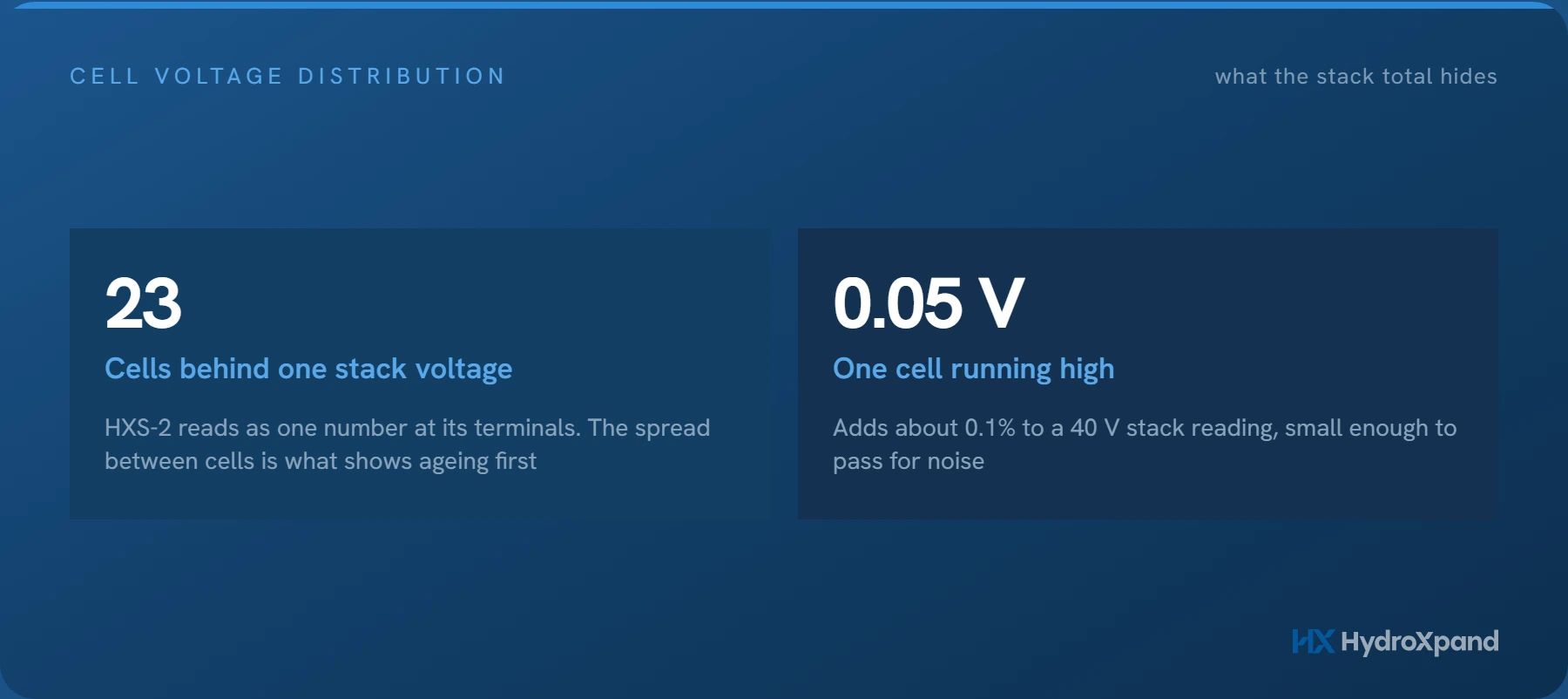
Cell voltage distribution: what a stack voltage hides, and what to ask for
Most stack performance data gives one voltage and a run time. That voltage is the sum of every cell in the stack, and the cell that moves first is invisible in it. Here is why the spread matters and what to ask a supplier for.
Read →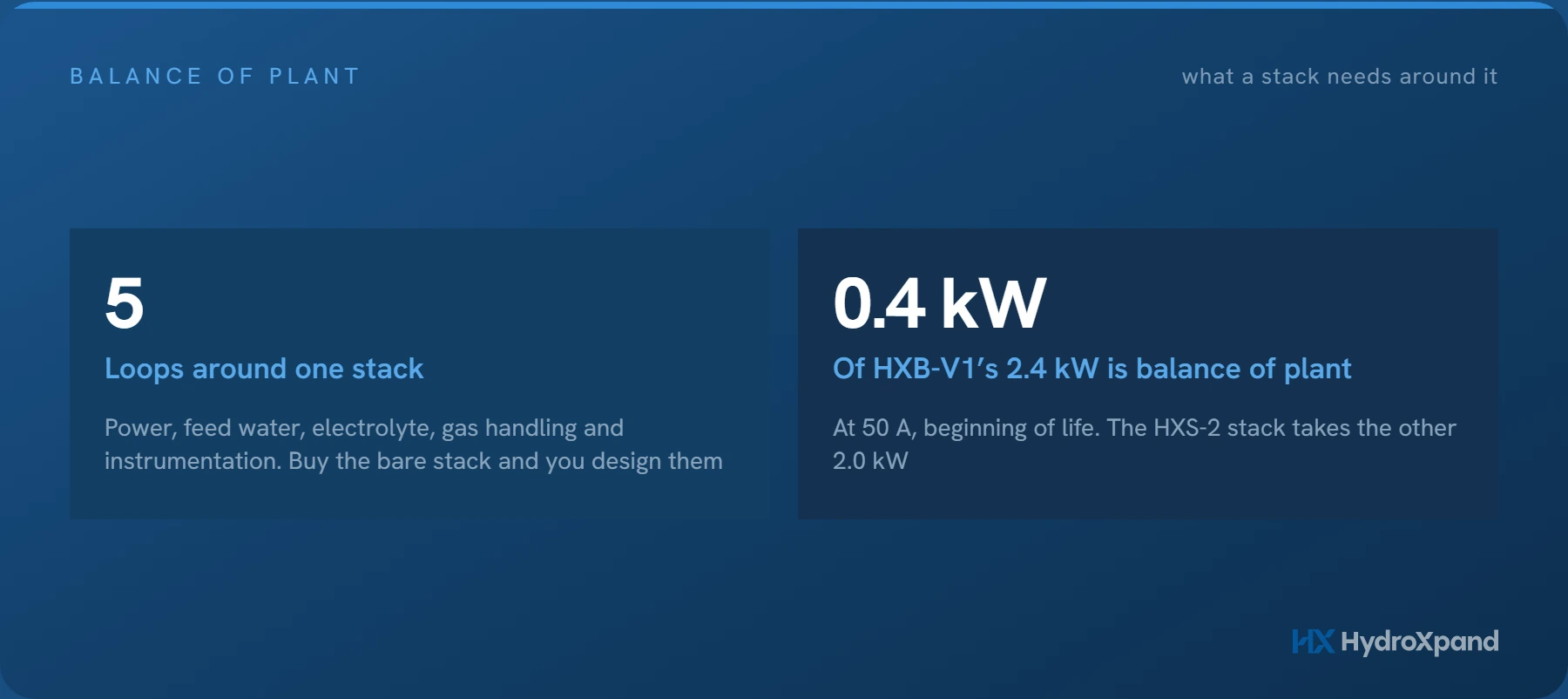
Balance of plant: what an electrolyzer stack needs around it
A stack connected to a power supply does not make hydrogen. It needs the right DC current, water of a set quality, electrolyte at a steady temperature, somewhere to send wet gas, and something watching all of it. That surrounding equipment is the balance of plant. This is what each part has to decide, written for teams building it around a bare stack.
Read →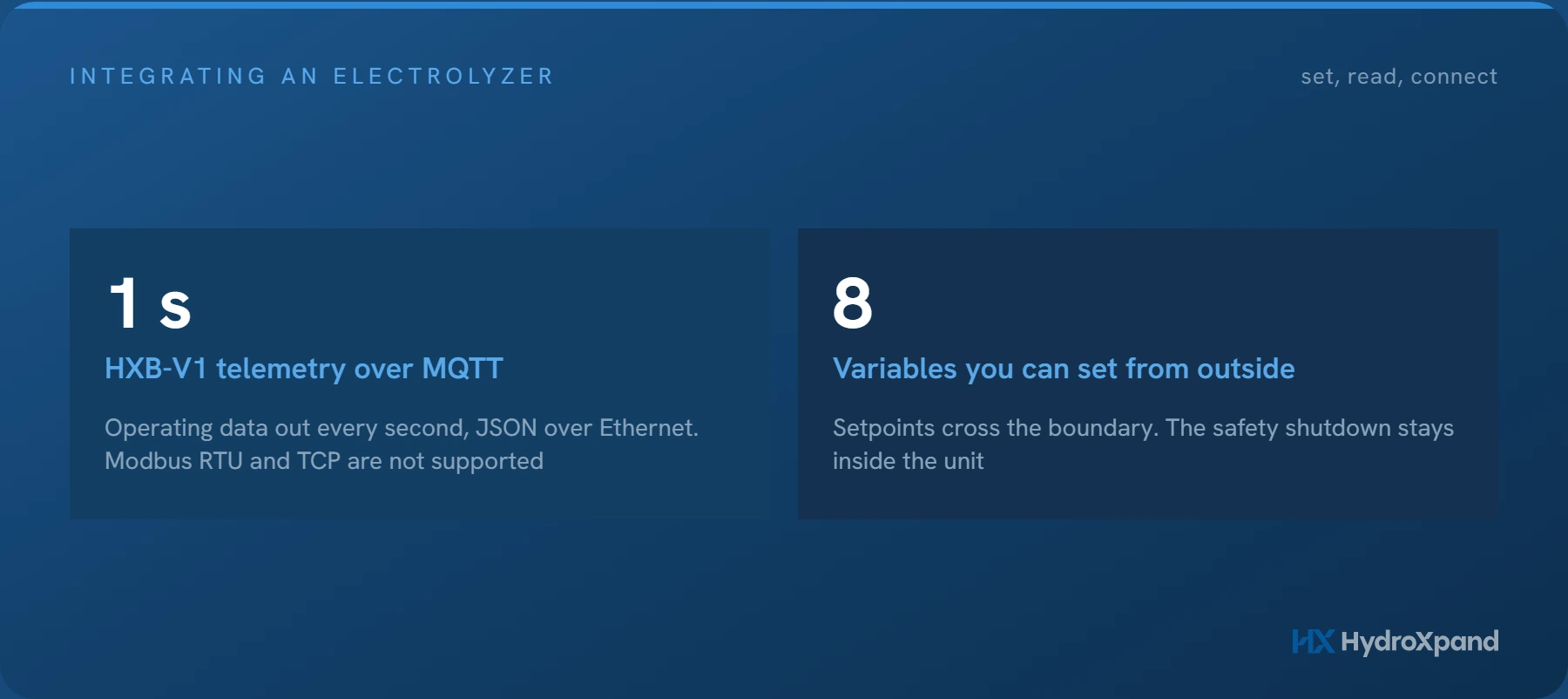
Putting an electrolyzer inside your own plant: what you can set, read and connect
Engineers integrating an electrolyzer into their own equipment ask about control before output. This walks through what our 2 kW system lets you set and record, how several units share one screen, how it talks to a site control system, and what changes when you buy only the stack.
Read →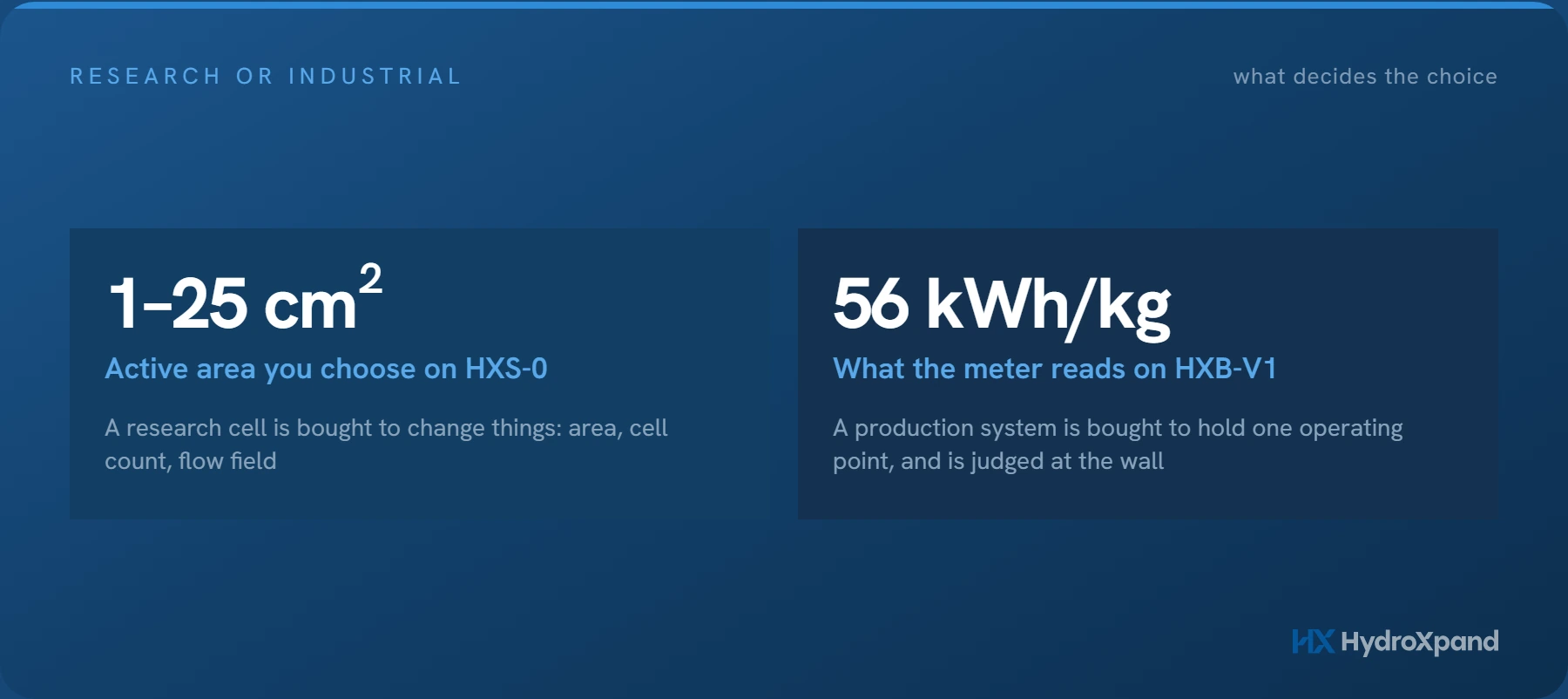
Research or industrial electrolyzer: what decides the choice, and what each one includes
Enquiries often start with the wrong question: which model for the lab, or whether a test rig can simply be scaled up. Research and industrial equipment differ in more than size. One is bought to produce data and the other to produce hydrogen, and that decides what to check, what arrives in the box and how long it takes.
Read →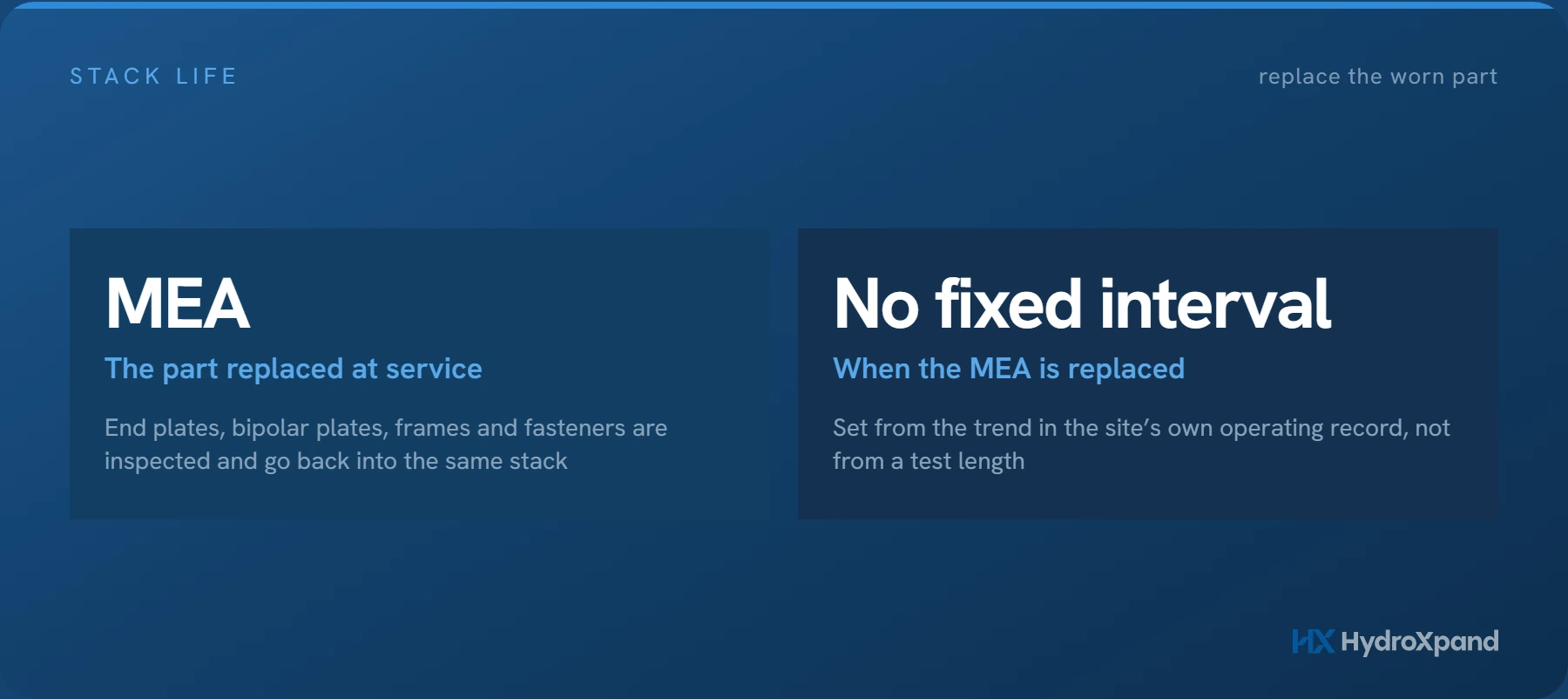
Electrolyzer stack life: what changes when only the worn part is replaced
A long durability test is not a replacement interval, and no stack holds its performance forever. What sets the multi-year cost is the unit of replacement: the whole stack, or only the MEA that wears. How that works on HXS-2, where the warranty stops, and what opening a stack yourself takes.
Read →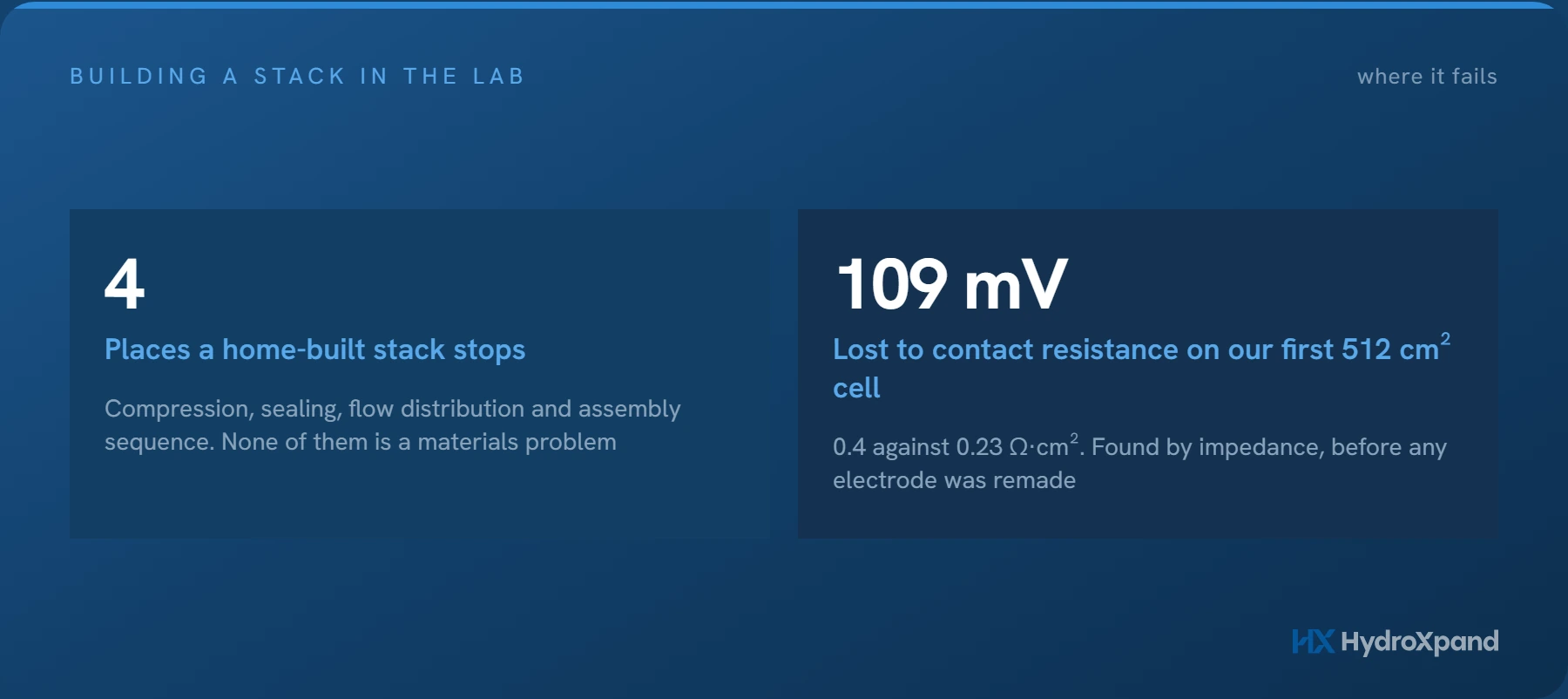
Building an electrolyzer stack in the lab: where it fails, and how to tell which part
A laboratory that has made its own electrodes and membranes usually wants to stack them next, and that is where many projects stop. None of the four usual failure points is a materials problem. Each one shows up in the data in its own way, and the first job is to find out which one you have.
Read →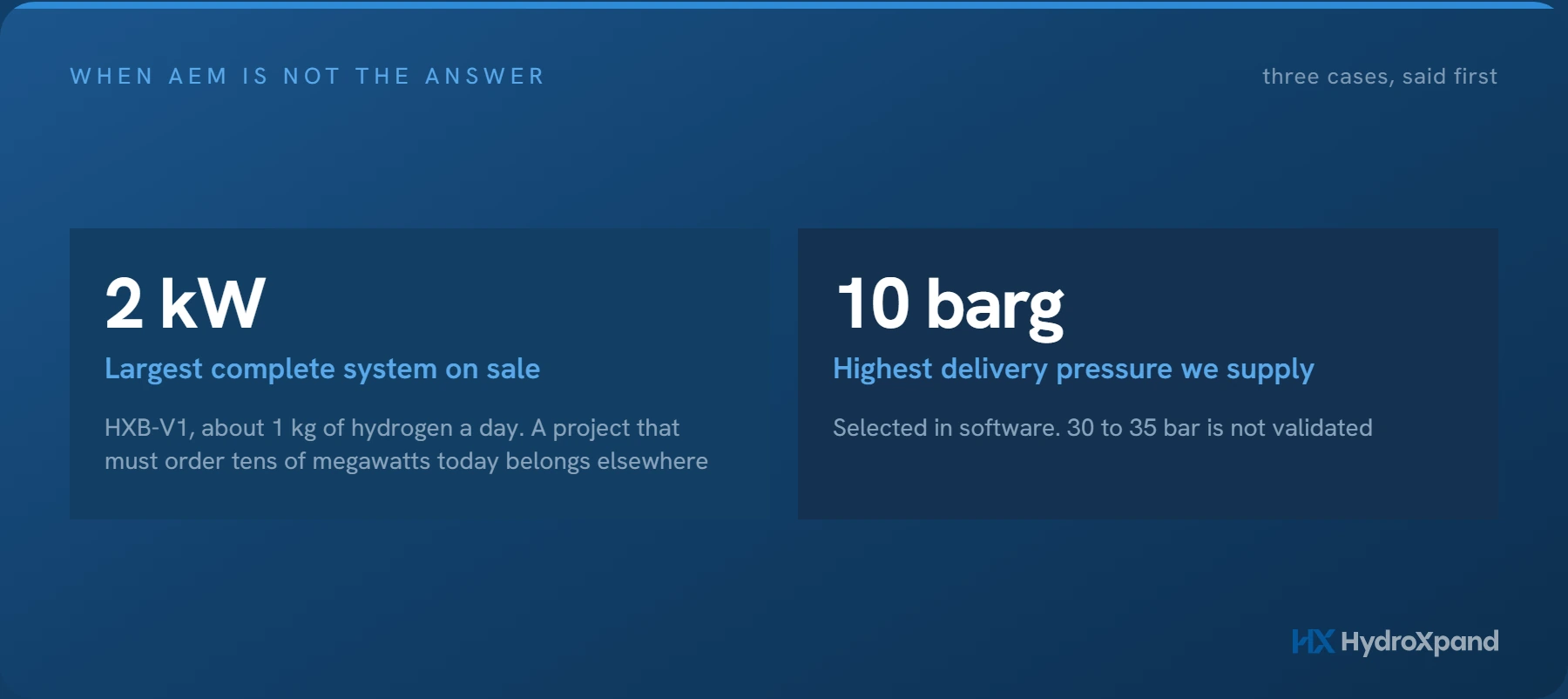
When AEM is not the answer: three kinds of project we turn down
The question we hear most is whether PEM or AEM suits a project. Comparisons of the technologies already exist, so this goes the other way: the projects our products do not suit, why we say so in the first reply, and the conditions that remain once those are removed.
Read →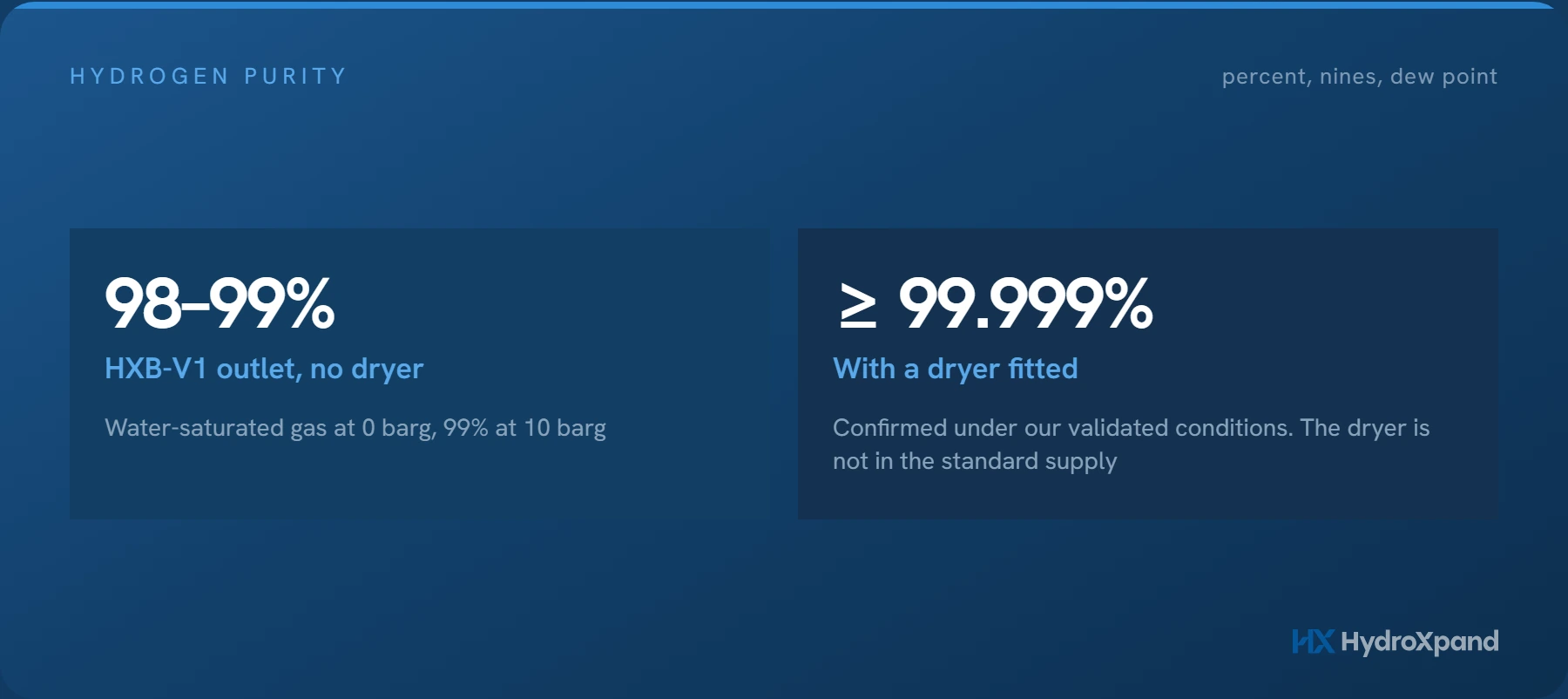
Reading a hydrogen purity specification: percent, nines, dew point, and the dryer behind them
Hydrogen straight from an electrolyzer stack is saturated with water and carries trace oxygen. Whether that matters depends on the use. Here is how to read the purity figures a specification will ask for, why a dew point is not a purity, and where the dryer comes in.
Read →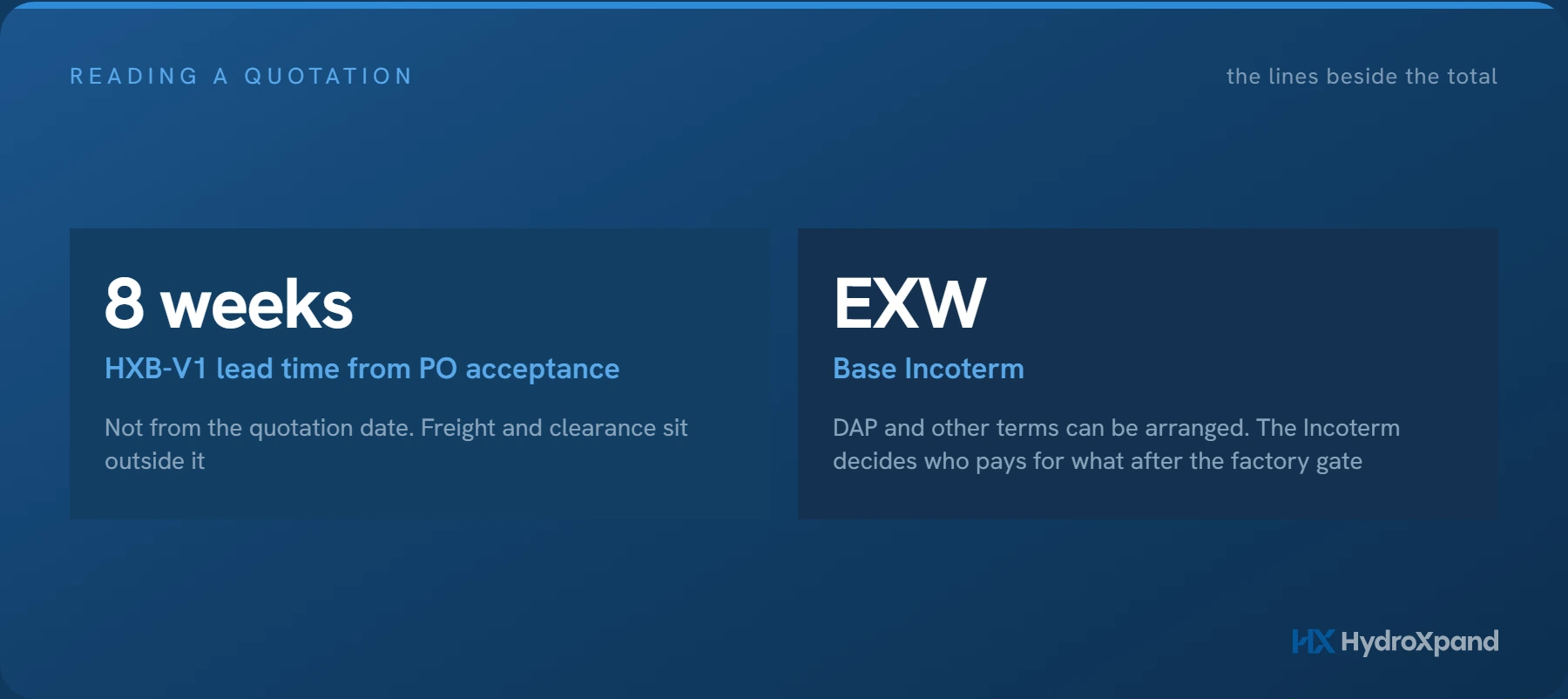
Reading an electrolyzer quotation: the lines that matter more than the total
Two quotations for electrolysis equipment can carry similar totals and still describe different purchases. The difference is rarely the unit price. It is in the lines beside it: which tier is supplied, when the lead time starts, which Incoterm the total is written on, and which item the warranty covers.
Read →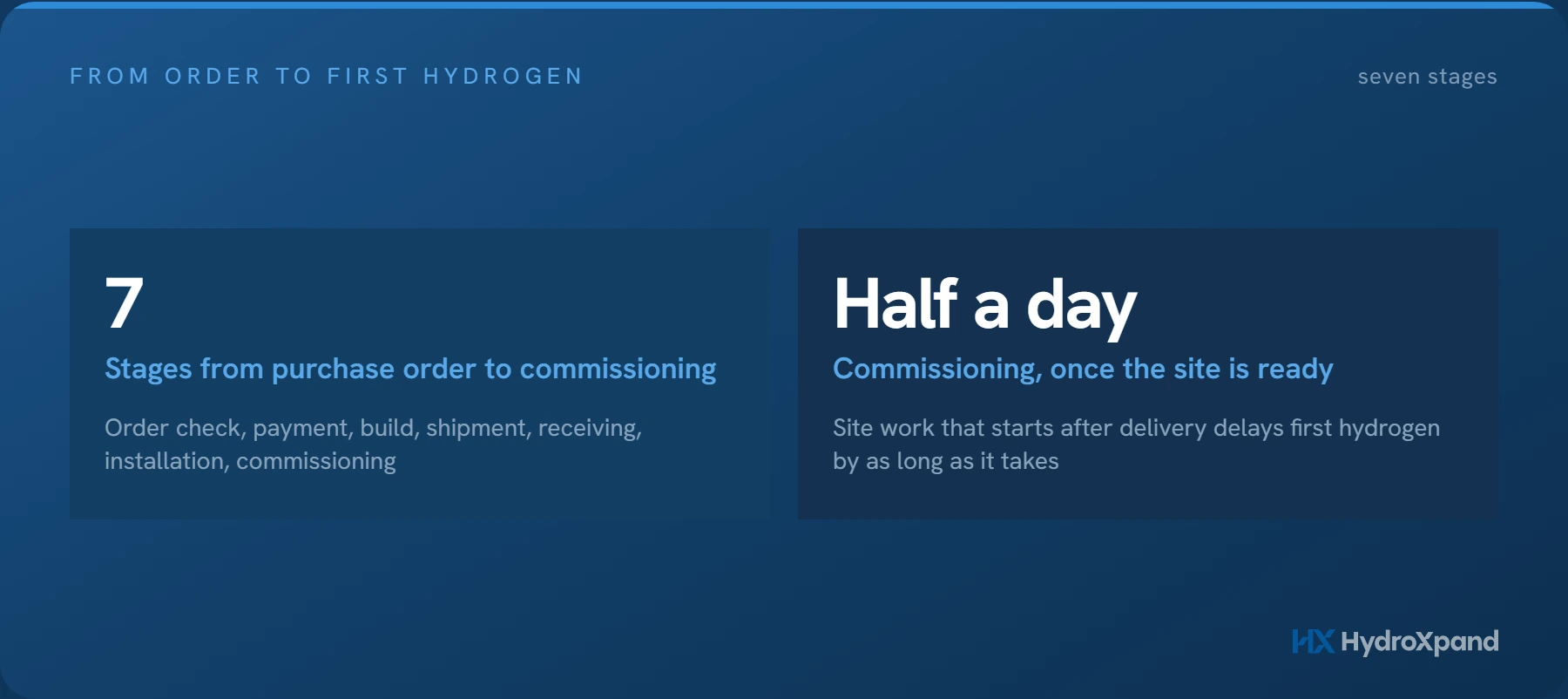
After the purchase order: seven stages from ordering an electrolyzer to first hydrogen
Ordering an electrolyzer sets off seven stages, from the order check to the commissioning record. Most of the waiting happens during the build, which is exactly when the site should be getting ready. What each stage settles, and what you do while it runs.
Read →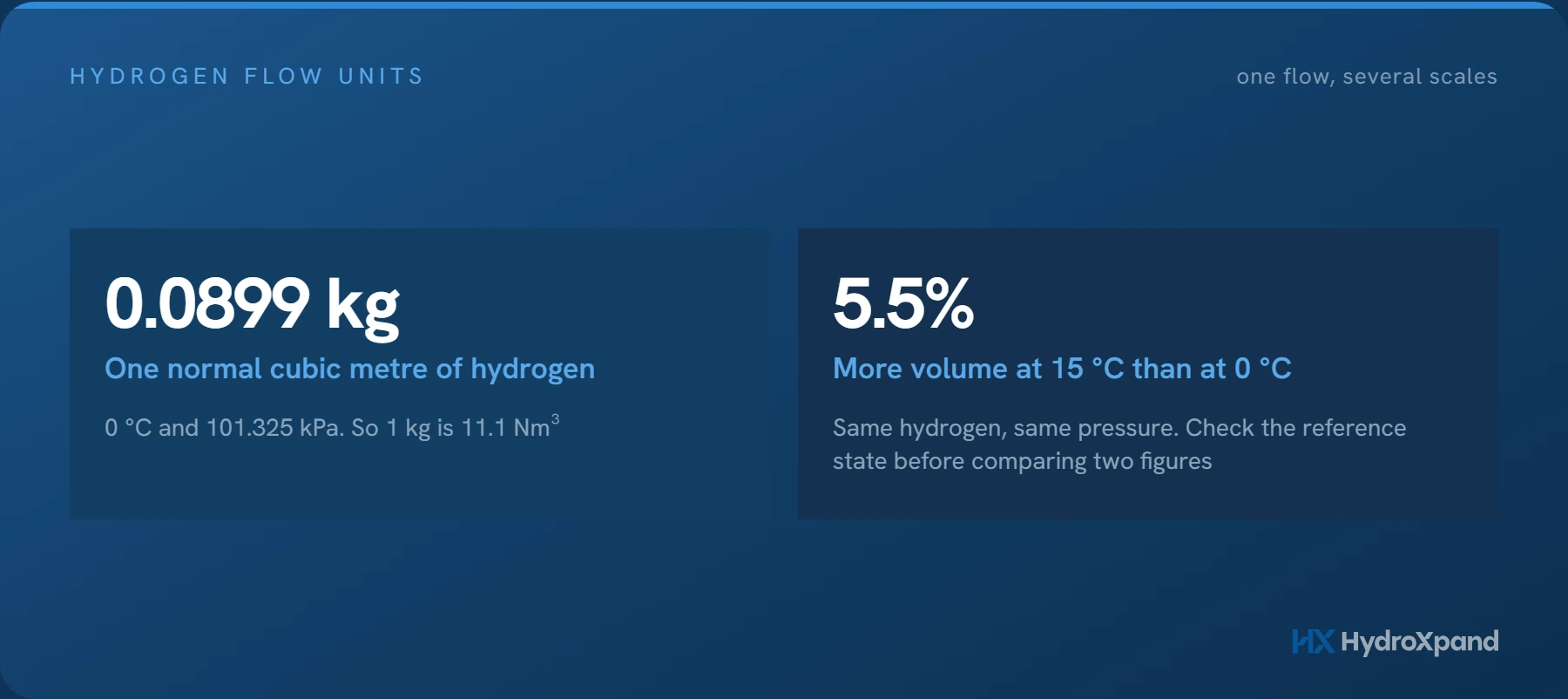
Nm³/h, NL/min, SCFH or kg/day: reading a hydrogen flow figure
One datasheet says 480 normal litres an hour, another says a kilogram a day, a third quotes SCFH. They can describe the same machine. Converting between them is simple arithmetic once you know three things about the number: whether it is volume or mass, over what time, and at which reference temperature and pressure.
Read →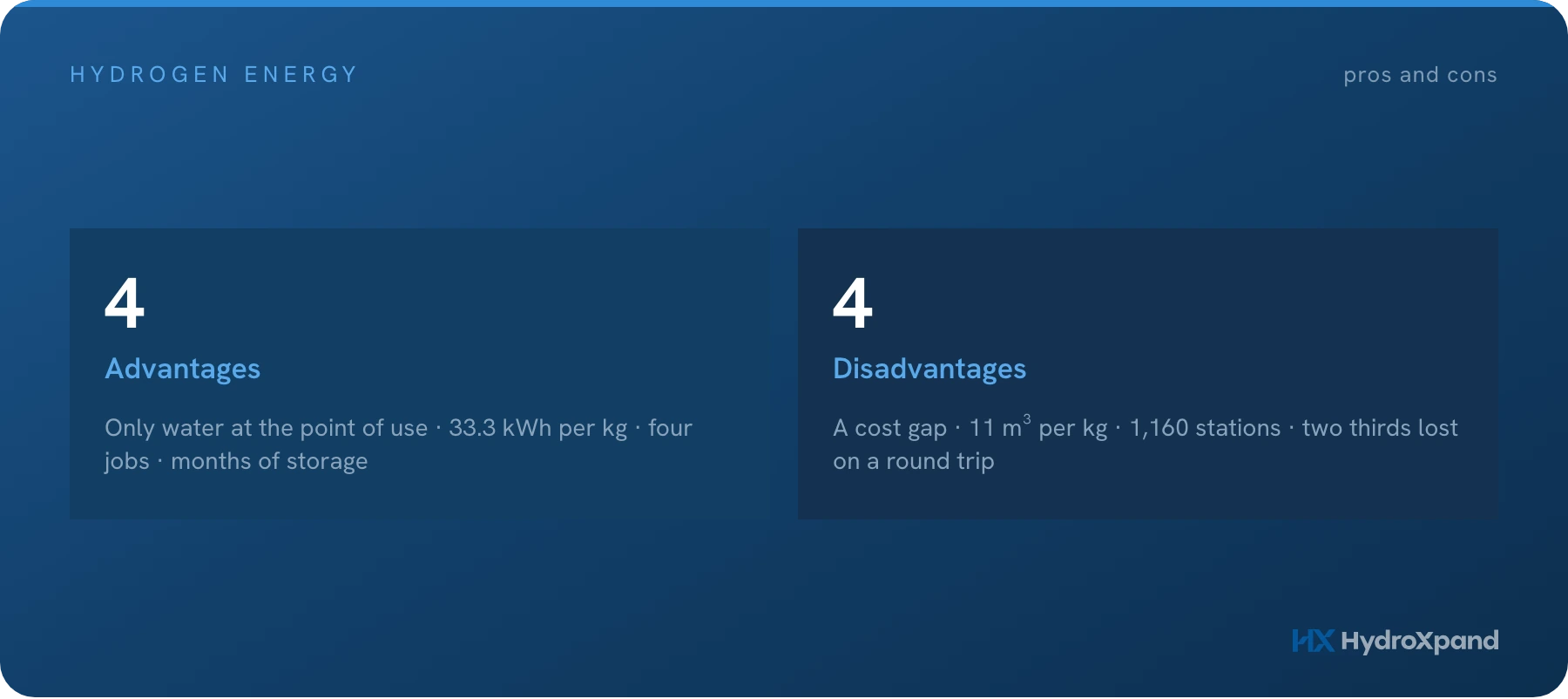
Hydrogen energy pros and cons: what physics fixes, and what cost still decides
Hydrogen is not an energy source. It is a way of carrying energy that has to be made first, and every argument for or against it follows from that. Four of its eight defining points are fixed by physics and will not change. The other four are cost, infrastructure and policy, and they are moving.
Read →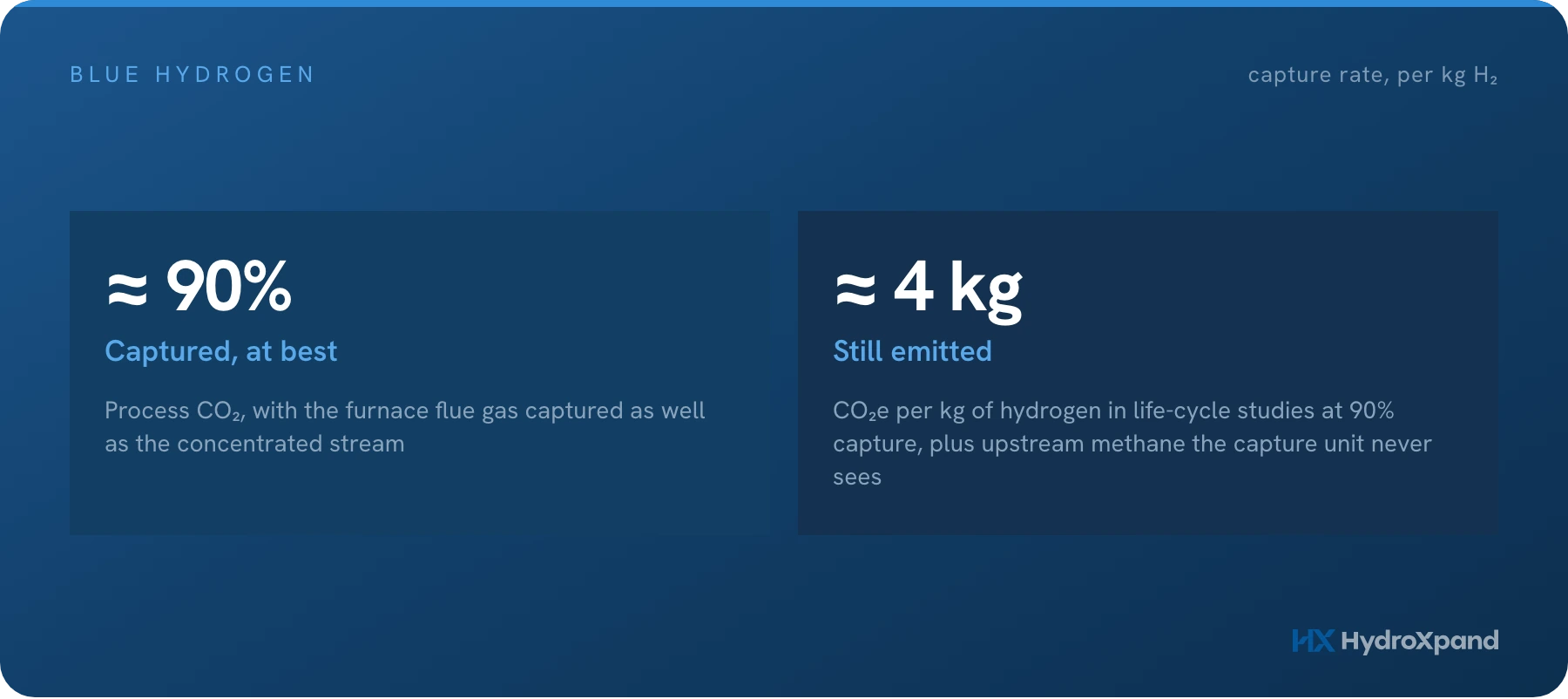
Blue hydrogen: what carbon capture removes, and what it leaves behind
Blue hydrogen is the grey hydrogen process with a carbon capture unit added. The word covers a wide range of outcomes, because the capture rate, the methane that leaks upstream and the cost of the capture unit are all set plant by plant. This is what each of those three decides.
Read →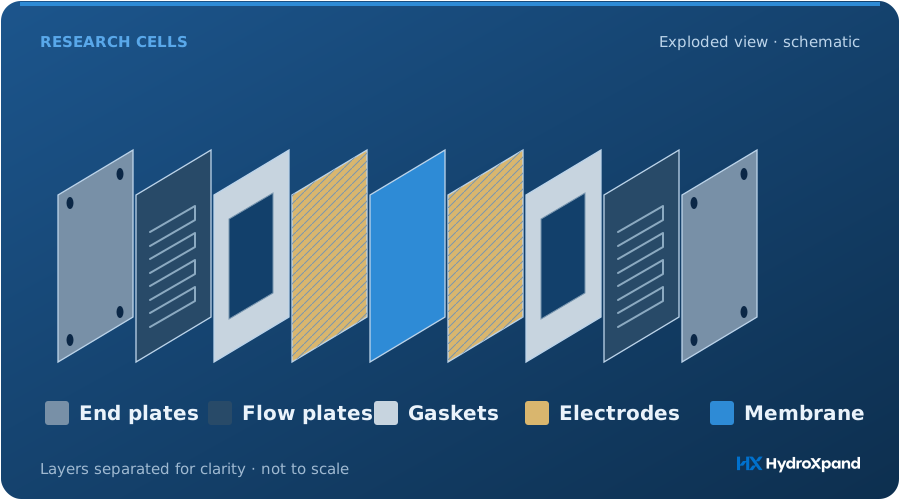
Choosing an AEM test cell for membrane and electrode research
Active area is only the first specification. The sample also has to fit the gasket, make reliable electrical contact and work with the equipment in your laboratory. Here is how to turn those requirements into a test-cell order.
Read →
Why your AEM electrolyzer test does not match the datasheet
A different voltage does not yet tell you what went wrong. First check whether the reference curve and your experiment describe the same materials, operating conditions and measurement.
Read →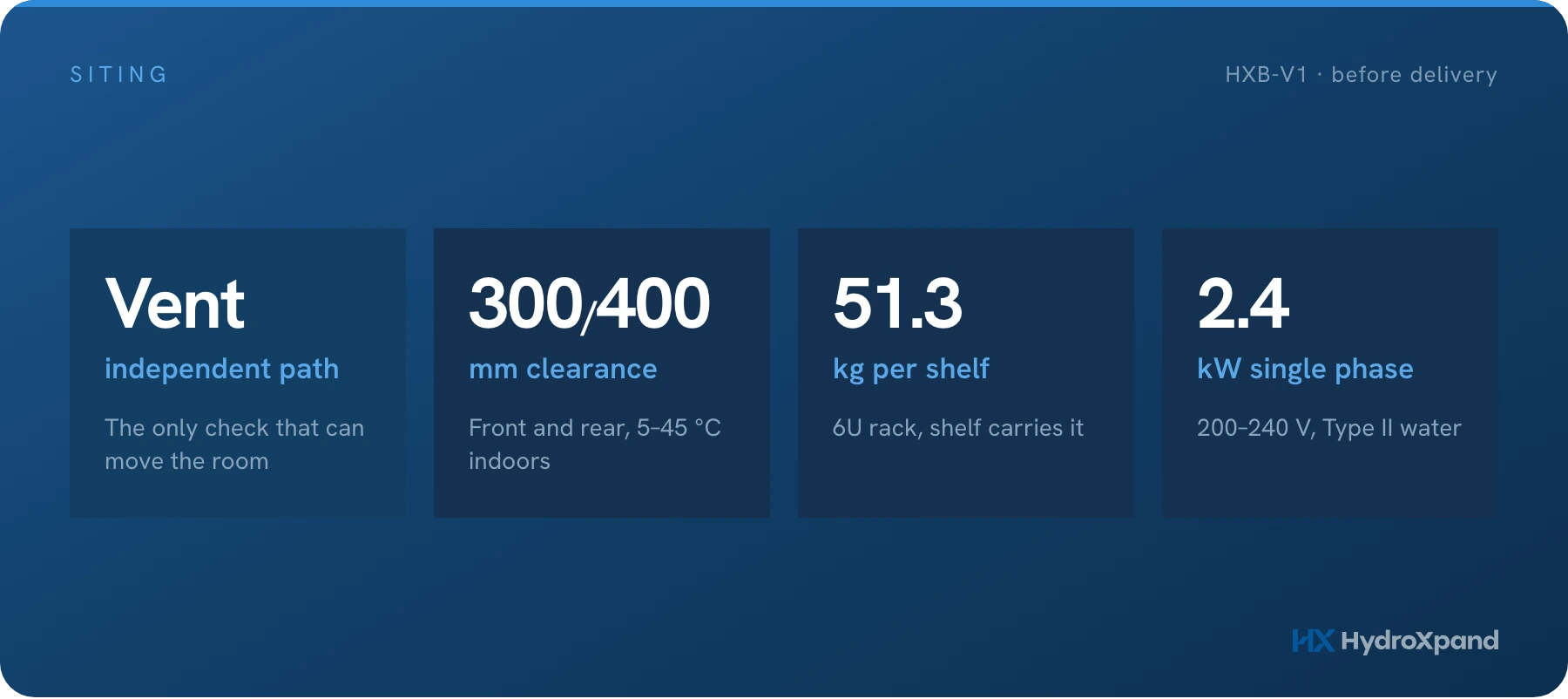
Before the electrolyzer arrives: the site checks that decide your schedule
A research institute in Europe took delivery of our system and could not switch it on for months. Nothing was wrong with the equipment. The room they had chosen shared an exhaust duct with other chemistry, and that is not something you can find out after delivery. Here is what to check while the site is still a choice.
Read →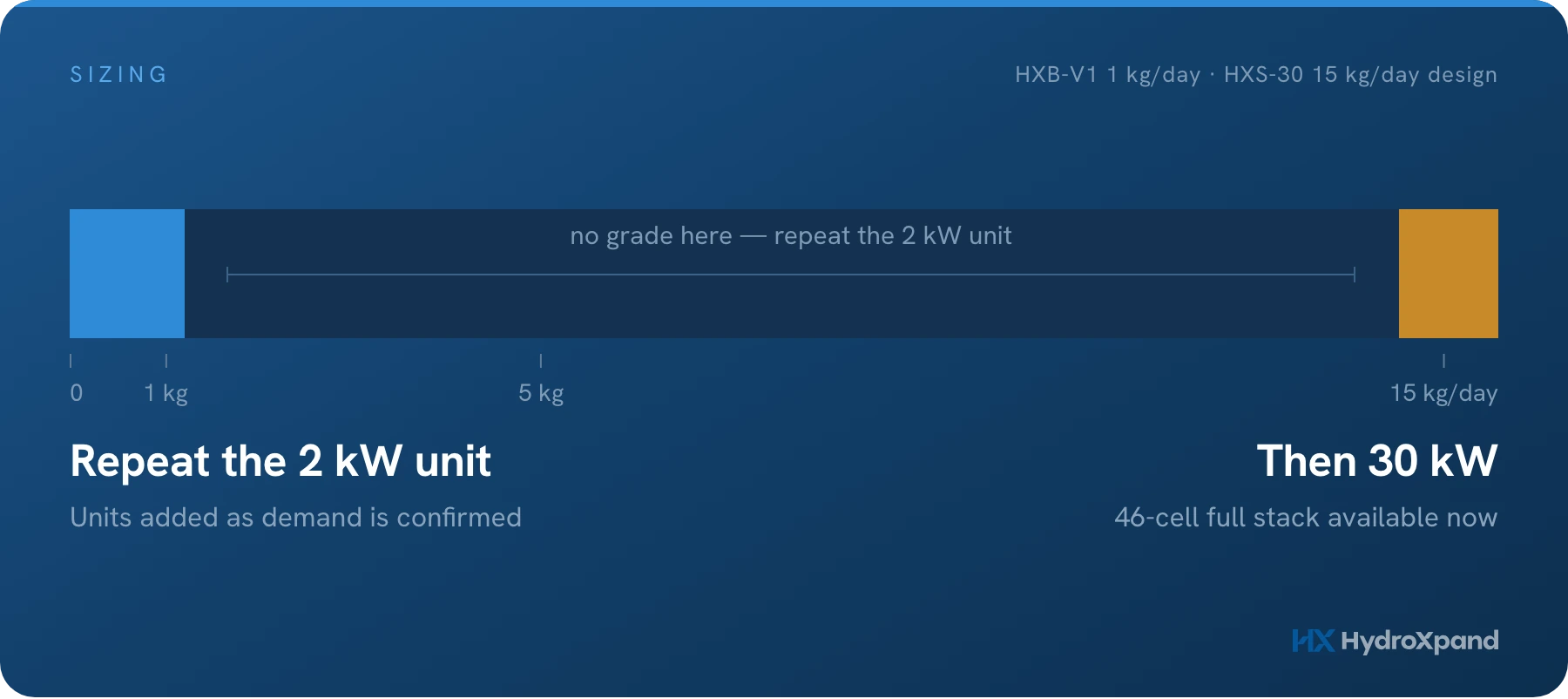
Between one and fifteen kilograms a day: parallel units or a bigger stack
Electrolyzer product grades are not closely spaced. Ours step from about 1 kg a day to a 15 kg design, and most enquiries land somewhere in between. Repeating the small unit fills that range, and what it actually changes is operation rather than output.
Read →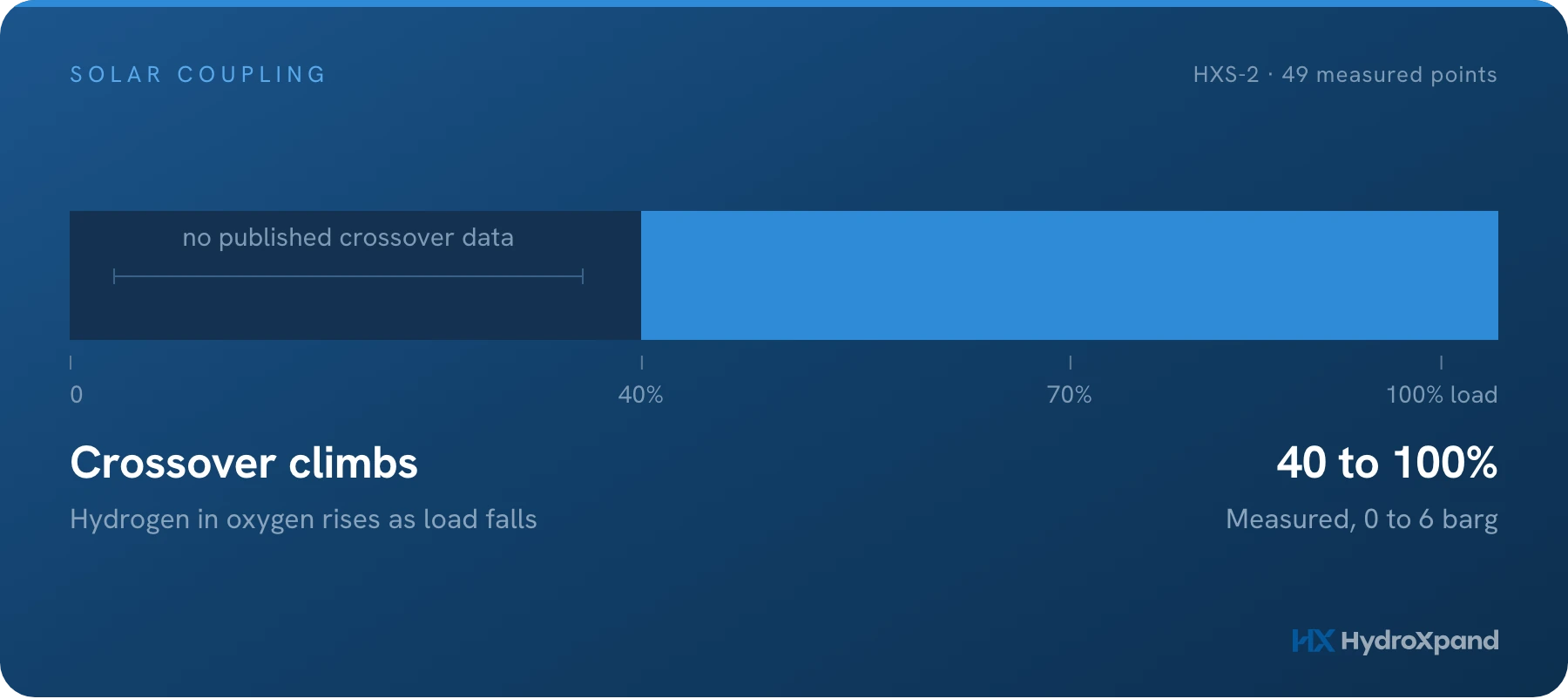
Running an electrolyzer on solar: how far down can you turn it?
Coupling an electrolyzer to a solar array is usually discussed as a question of response speed. The harder question is the floor: how far the load can drop before something other than efficiency stops you. On our own stack that limit is gas crossover, and we have 49 measured points that show where it sits.
Read →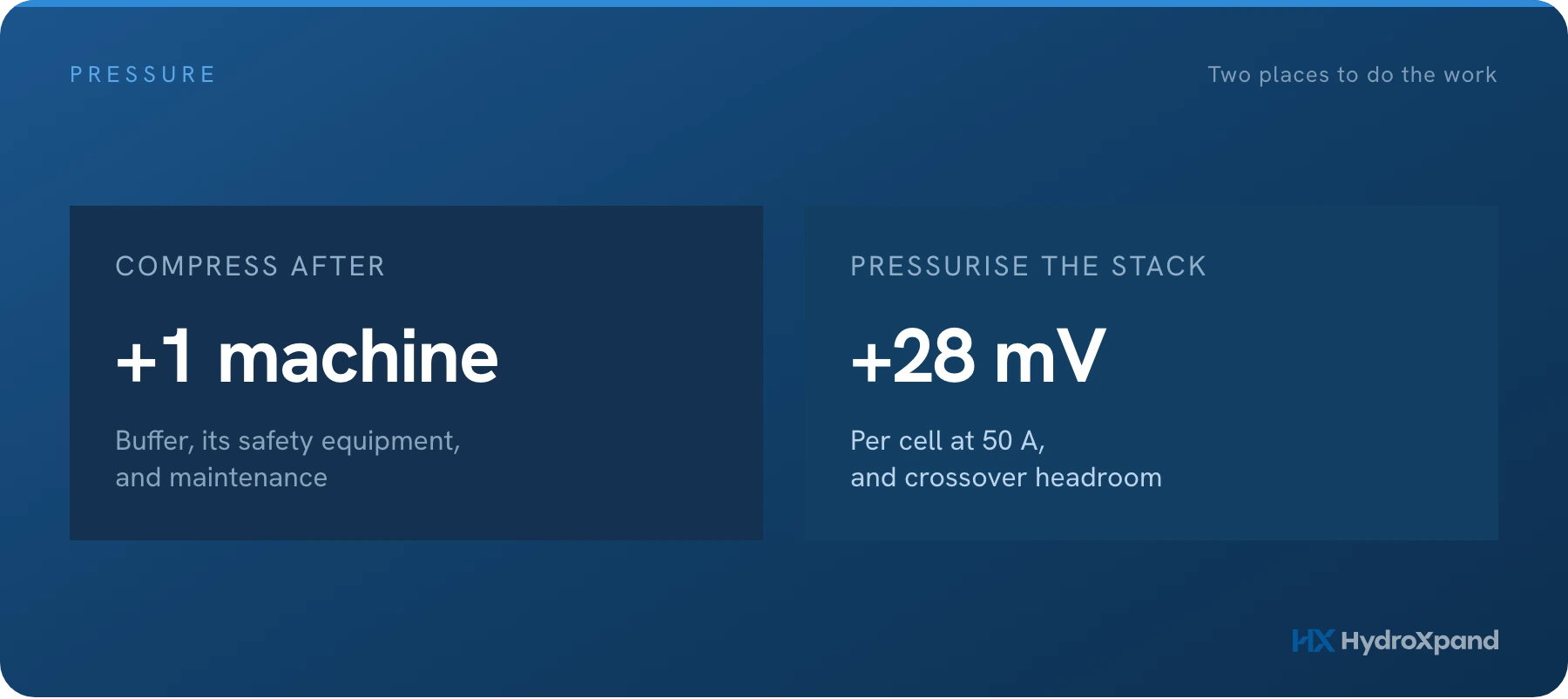
Do you need a compressor? What pressurised output covers, and what it does not
Pressurising the stack instead of compressing after it removes a rotating machine, a buffer and its safety equipment. The price is 28 mV per cell and, more importantly, crossover headroom at low load. Where that trade works, and where a compressor is still unavoidable.
Read →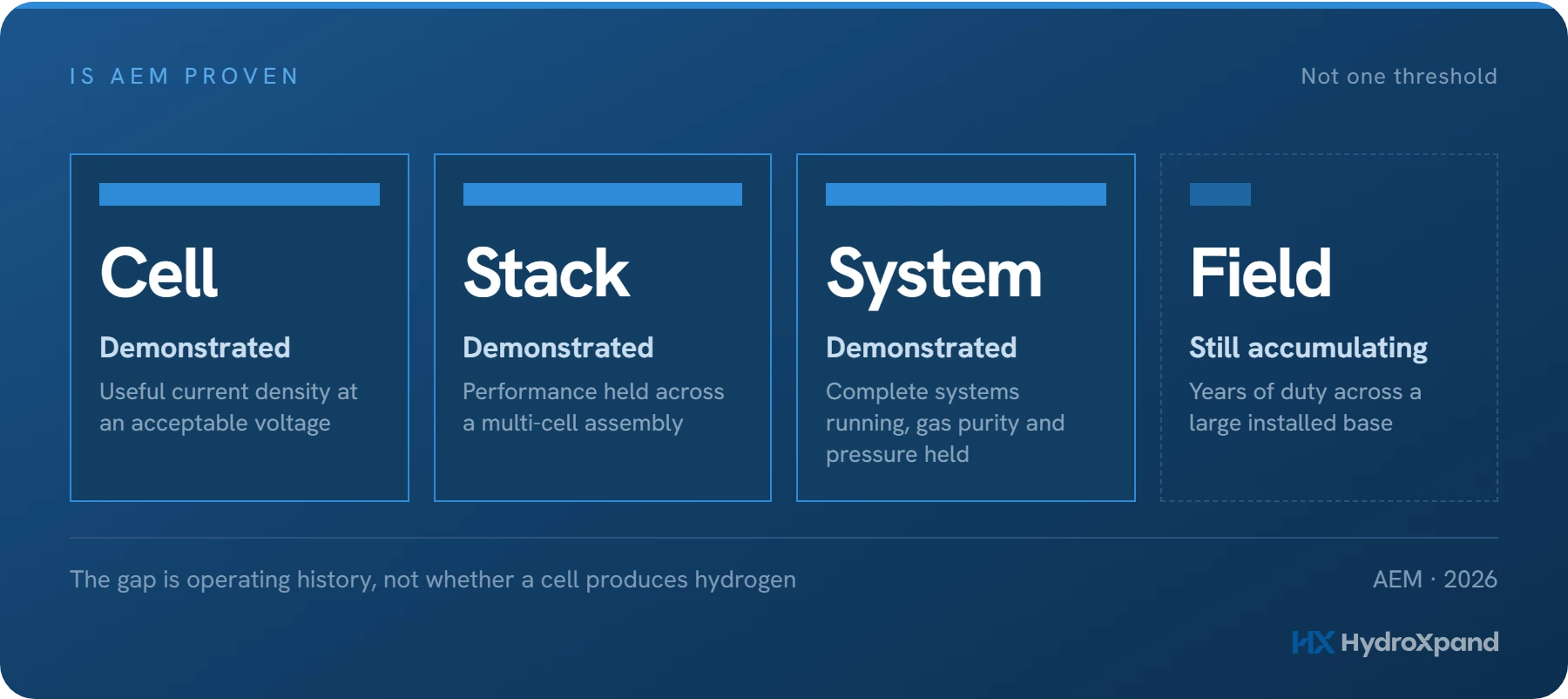
Is AEM Electrolysis Proven?
AEM is no longer confined to single-cell laboratory demonstrations. What it does not yet have is the field history that alkaline and PEM have accumulated. The useful question for a project is what has been demonstrated at the scale, conditions and duty cycle it requires.
Read →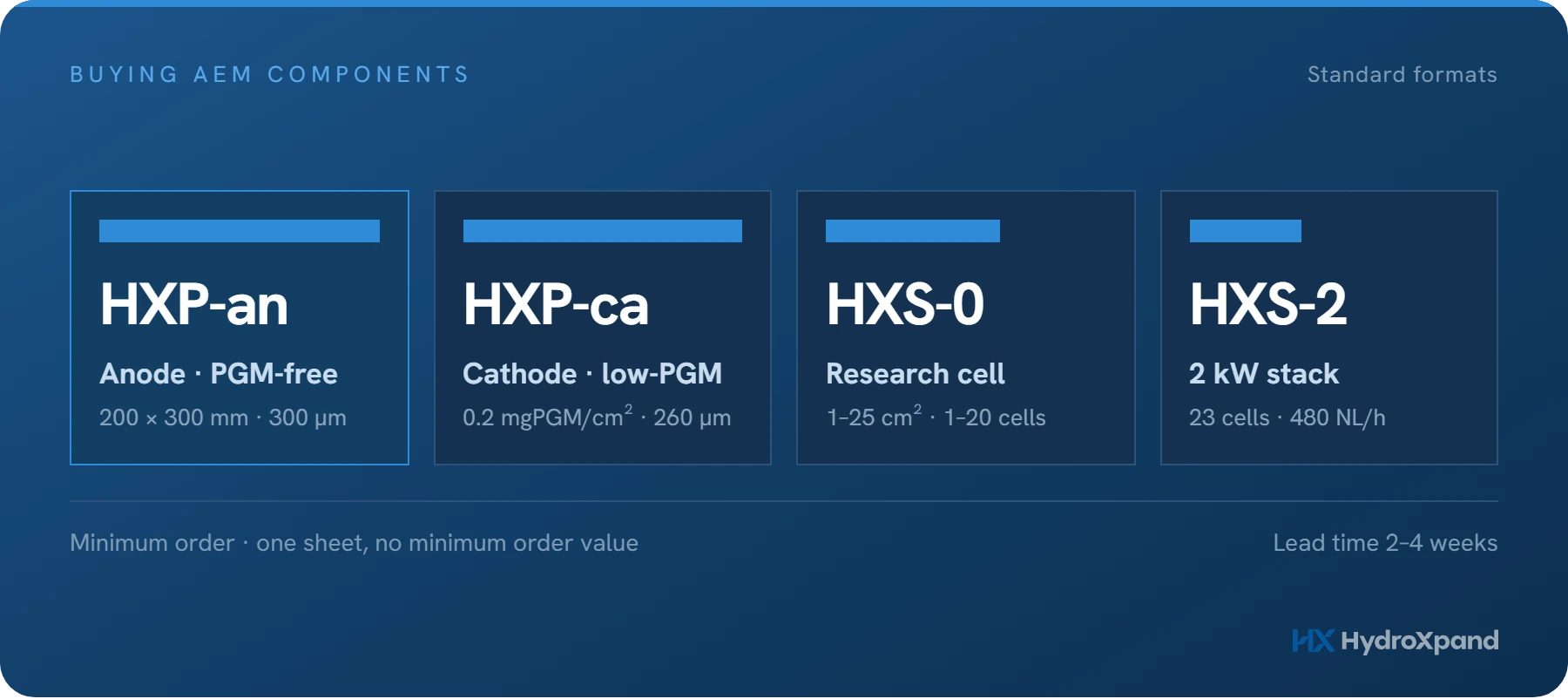
Buying AEM electrodes and cells as components
Most electrolyzer suppliers sell a finished machine. A laboratory evaluating materials, or a group building its own cell hardware, needs the pieces instead. This is what buying AEM components involves: what is specified, what arrives in the box, and which part of the build stays yours.
Read →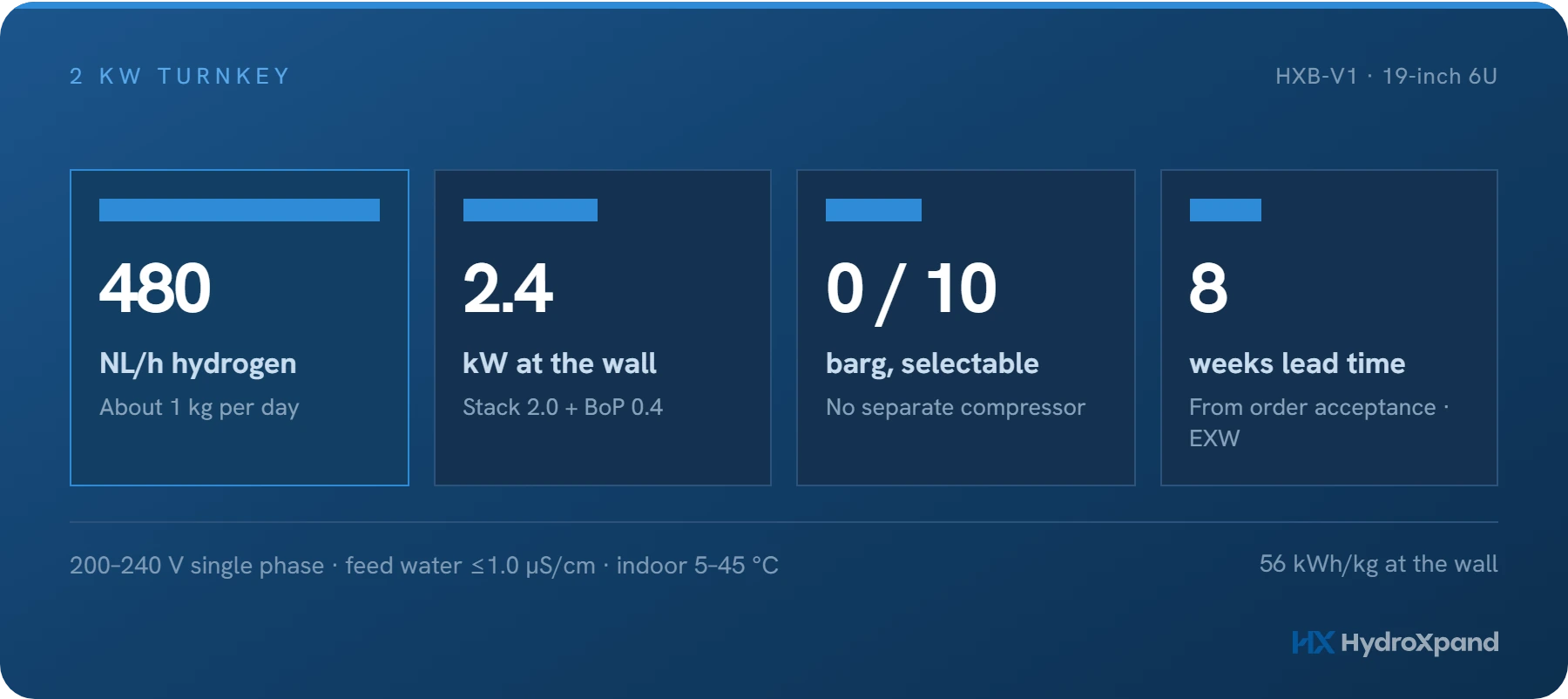
What turnkey includes in a 2 kW electrolyzer
A turnkey system is supposed to be the easy purchase: state an output and take delivery. What varies between suppliers is where the box stops. These are the questions worth settling before an order, using our own 2 kW system as the worked example.
Read →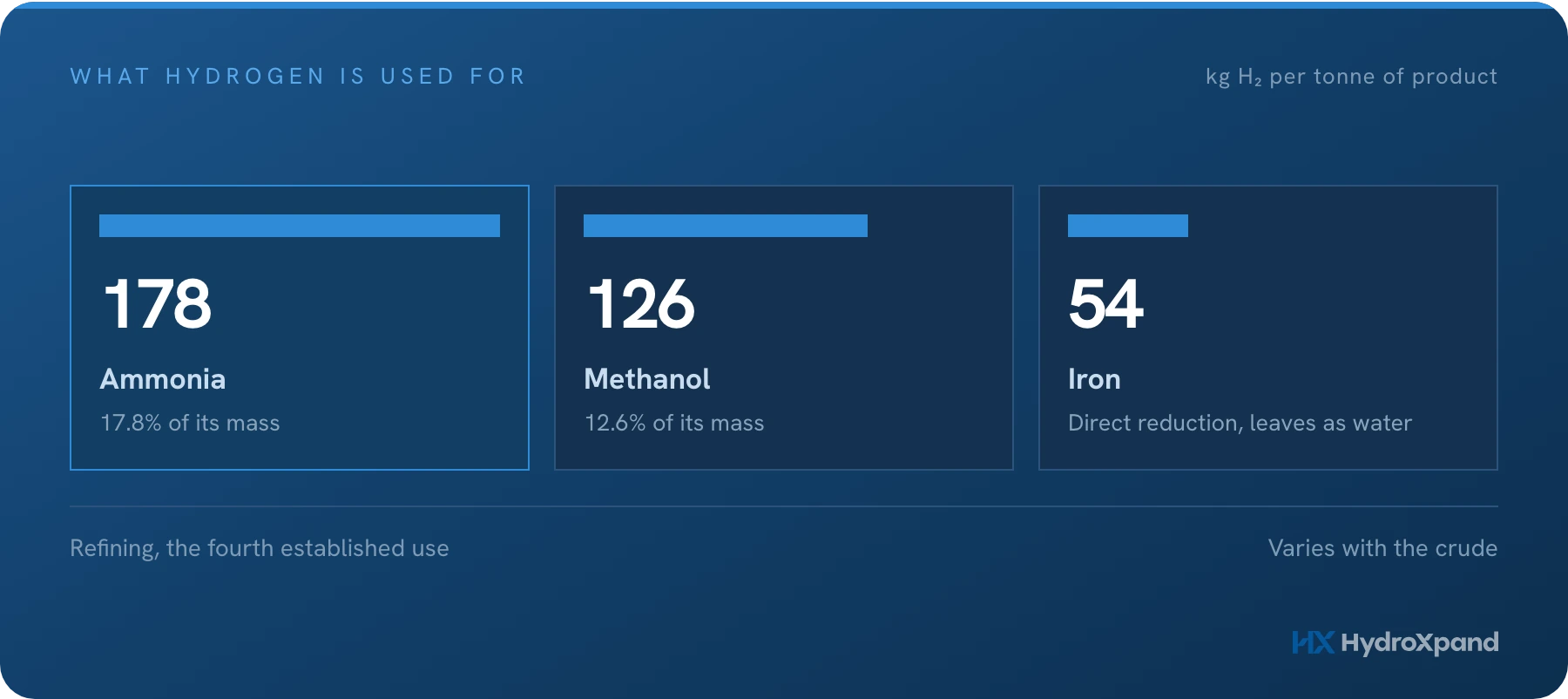
What hydrogen is actually used for
Almost 100 million tonnes a year goes into refining, ammonia, methanol and iron ore. What each process does with the hydrogen, how much it takes per tonne of product, and why the uses everyone talks about add up to less than one percent.
Read →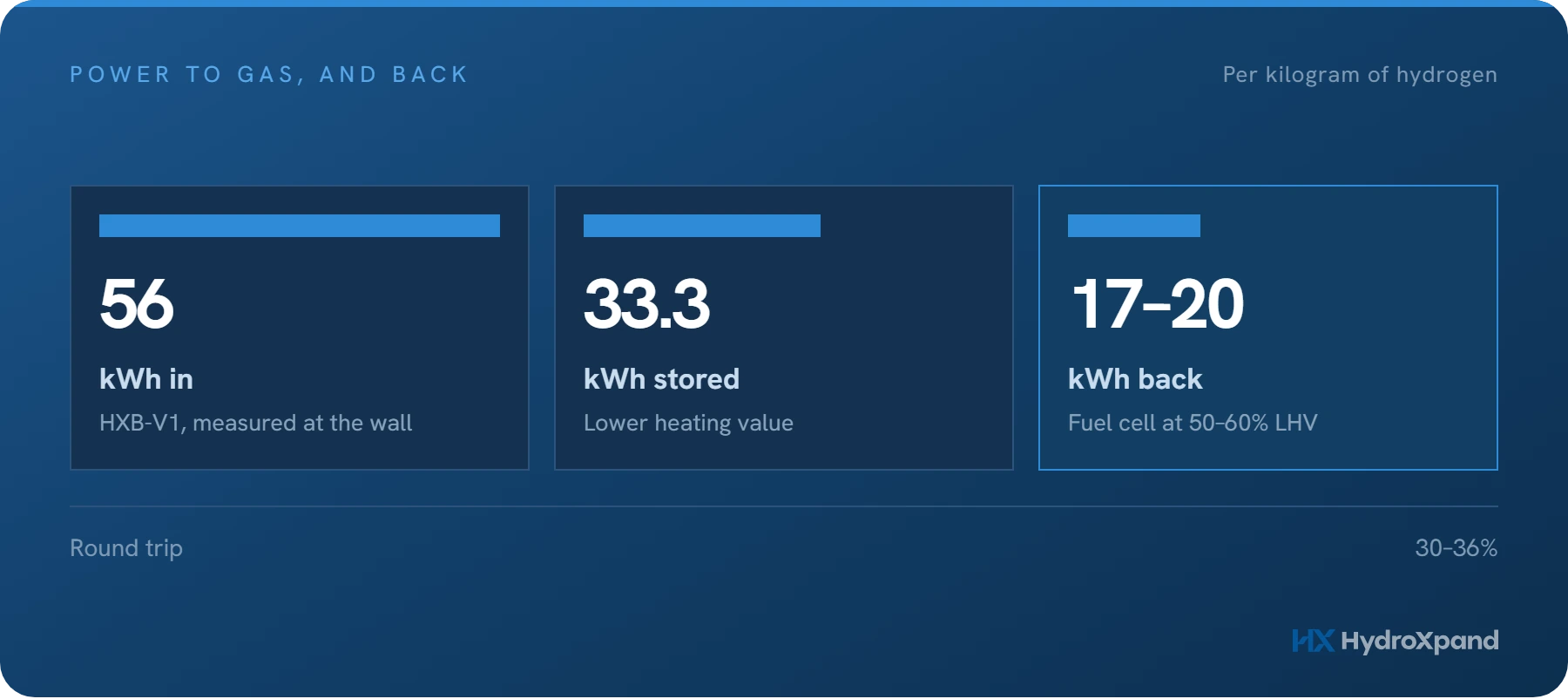
Power to gas, and back again
The outward leg costs about 56 kWh per kilogram on our own measured system. The return leg gives back roughly a third of what went in, which is why the uses worth building for are the ones that never turn the hydrogen back into electricity.
Read →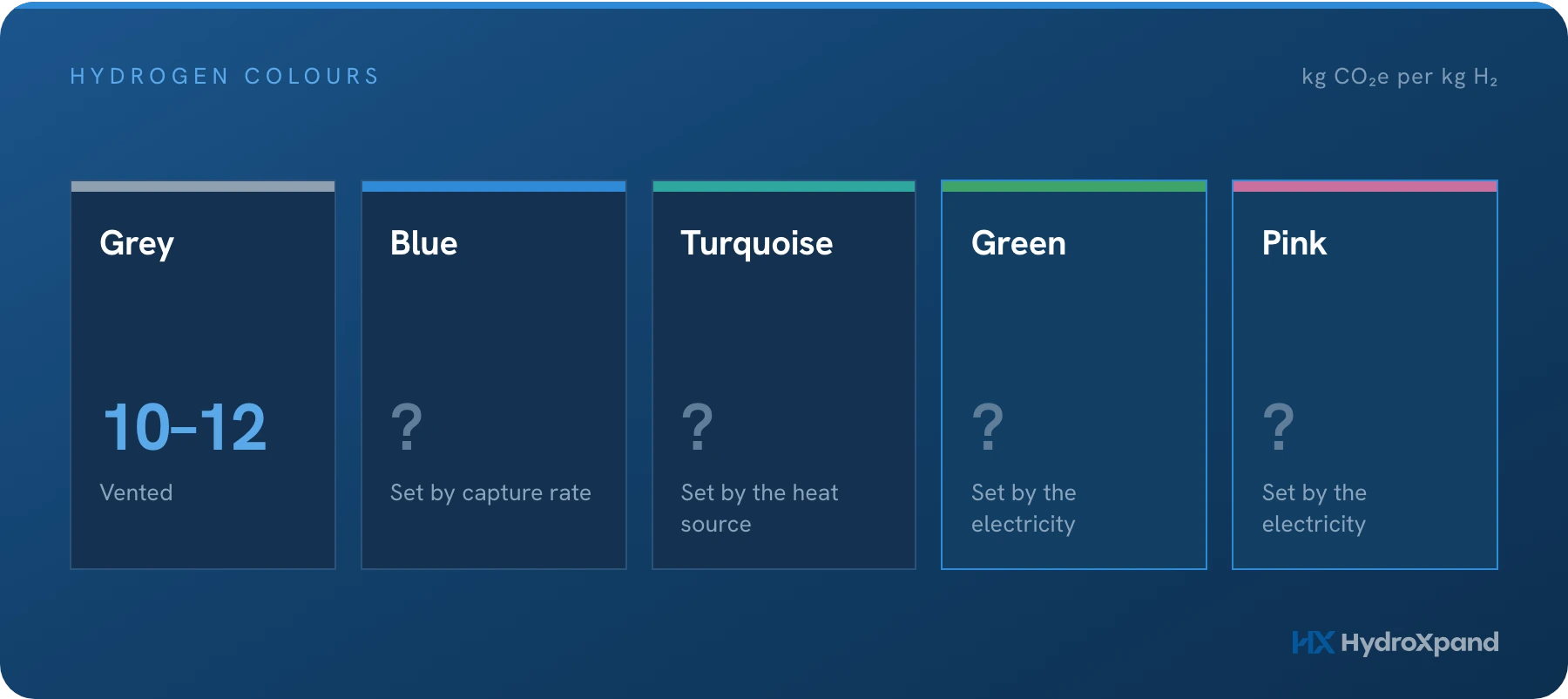
Green, grey, blue, turquoise, pink: what the hydrogen colours leave out
Five colour names, one identical molecule. The colour tells you what a kilogram of hydrogen was made from and what powered it, and nothing else. Certification schemes have already moved past the colours to the number underneath them.
Read →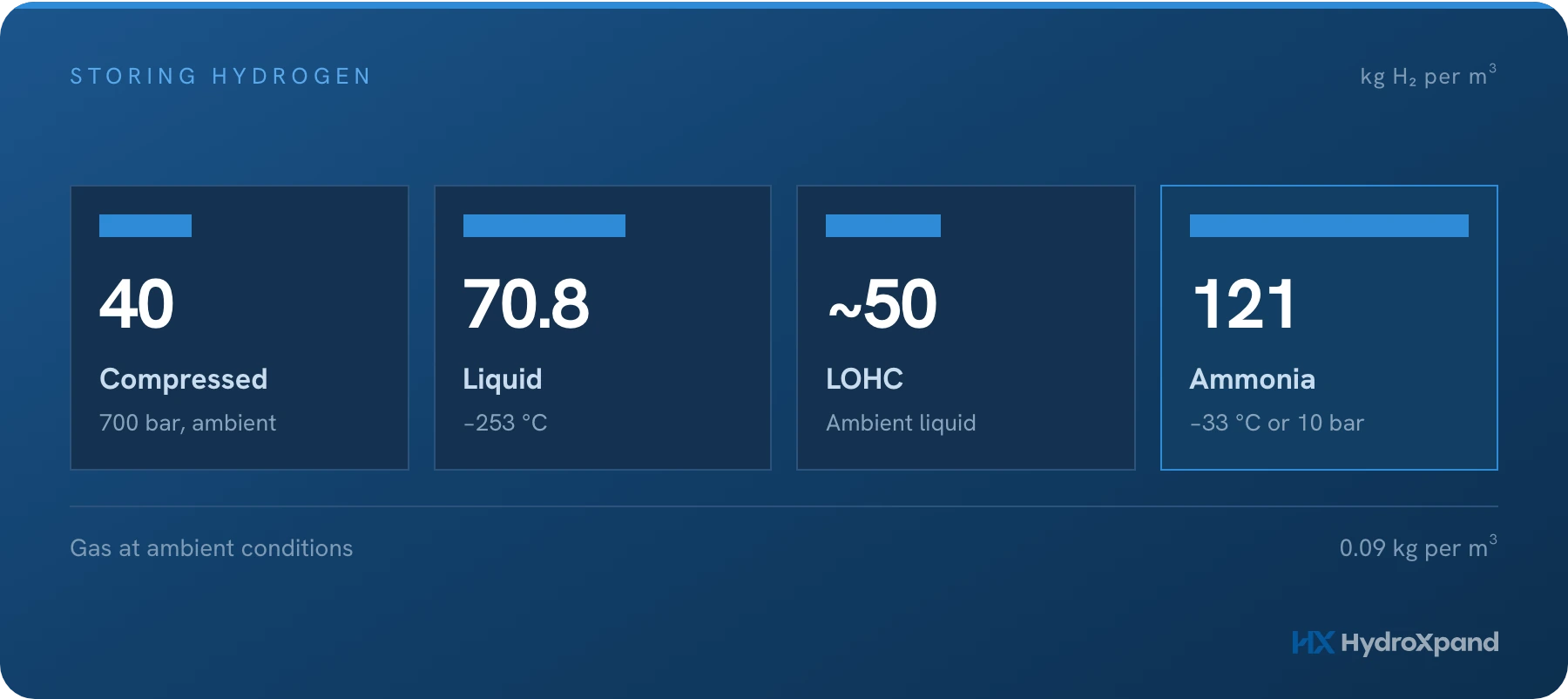
Storing hydrogen: four routes, and what each one charges
A kilogram of hydrogen occupies about 11 cubic metres at ambient conditions, which is why it is never stored that way. Every method of shrinking it charges a fee, and the fee is paid in a fraction of the hydrogen's own energy.
Read →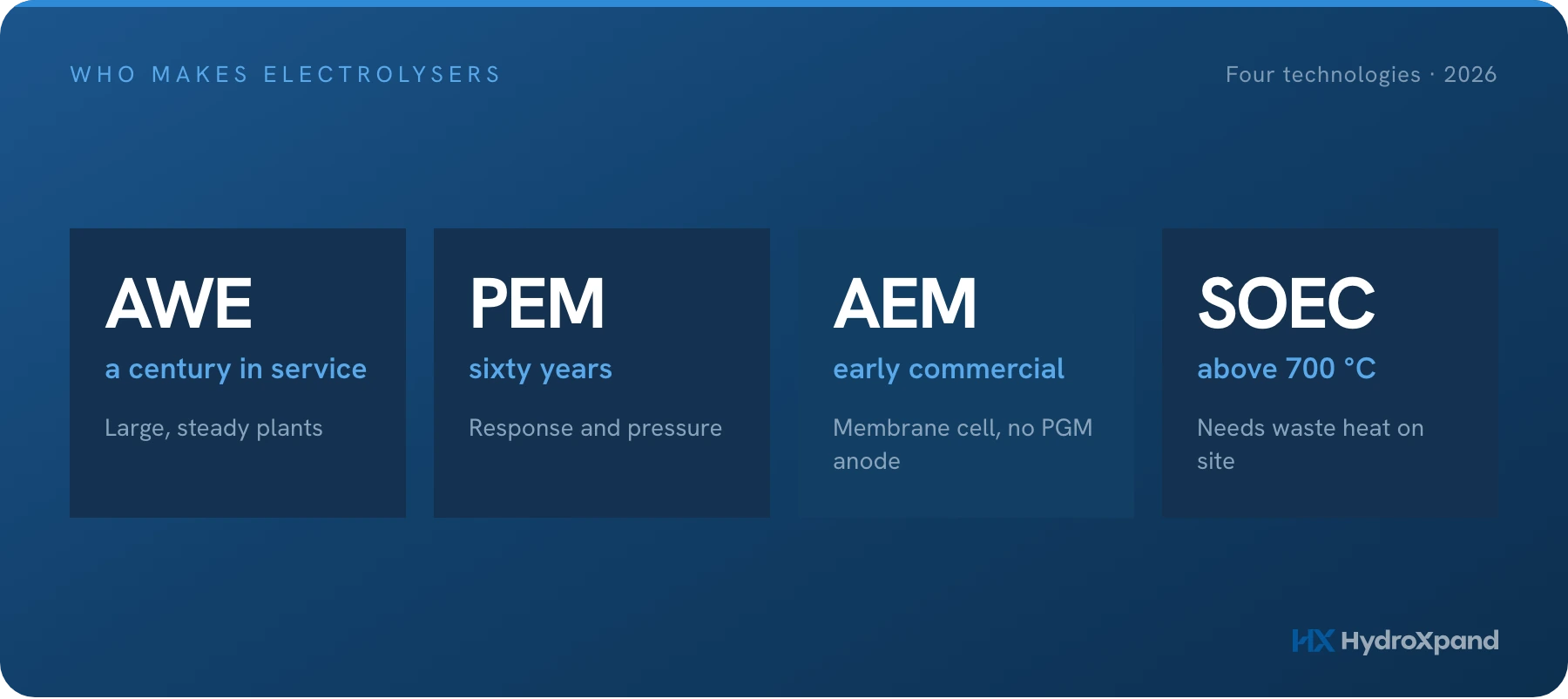
Who actually makes water electrolyzers in 2026
Once you know how water electrolysis works, the next question is who builds it. This is a map of the manufacturers by technology, and a reading of what the list itself tells you about where the industry is.
Read →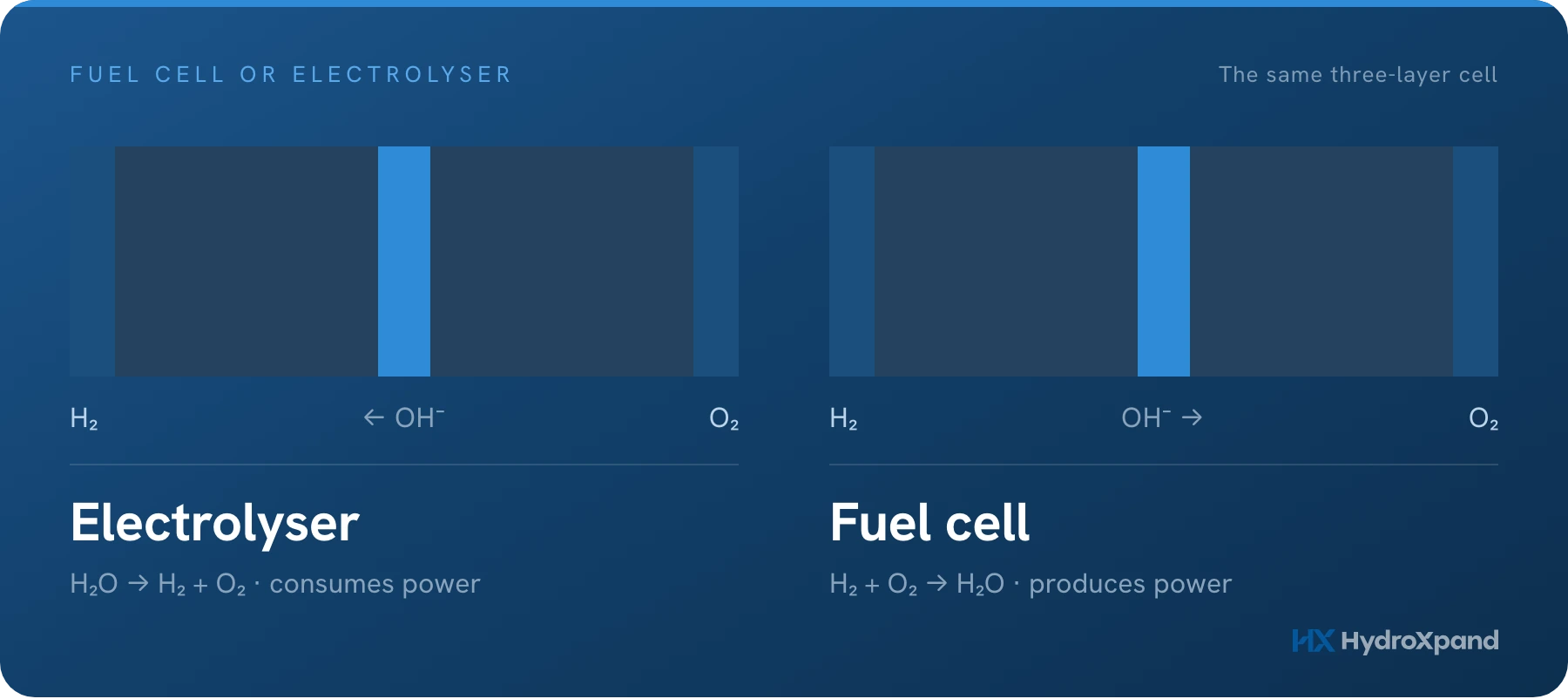
Fuel cell vs electrolyzer: how the reactions and equipment differ
They share a three layer cell, a catalyst vocabulary and even the technology names. One consumes hydrogen to make electricity, the other consumes electricity to make hydrogen. Why that single reversal changes almost every design decision.
Read →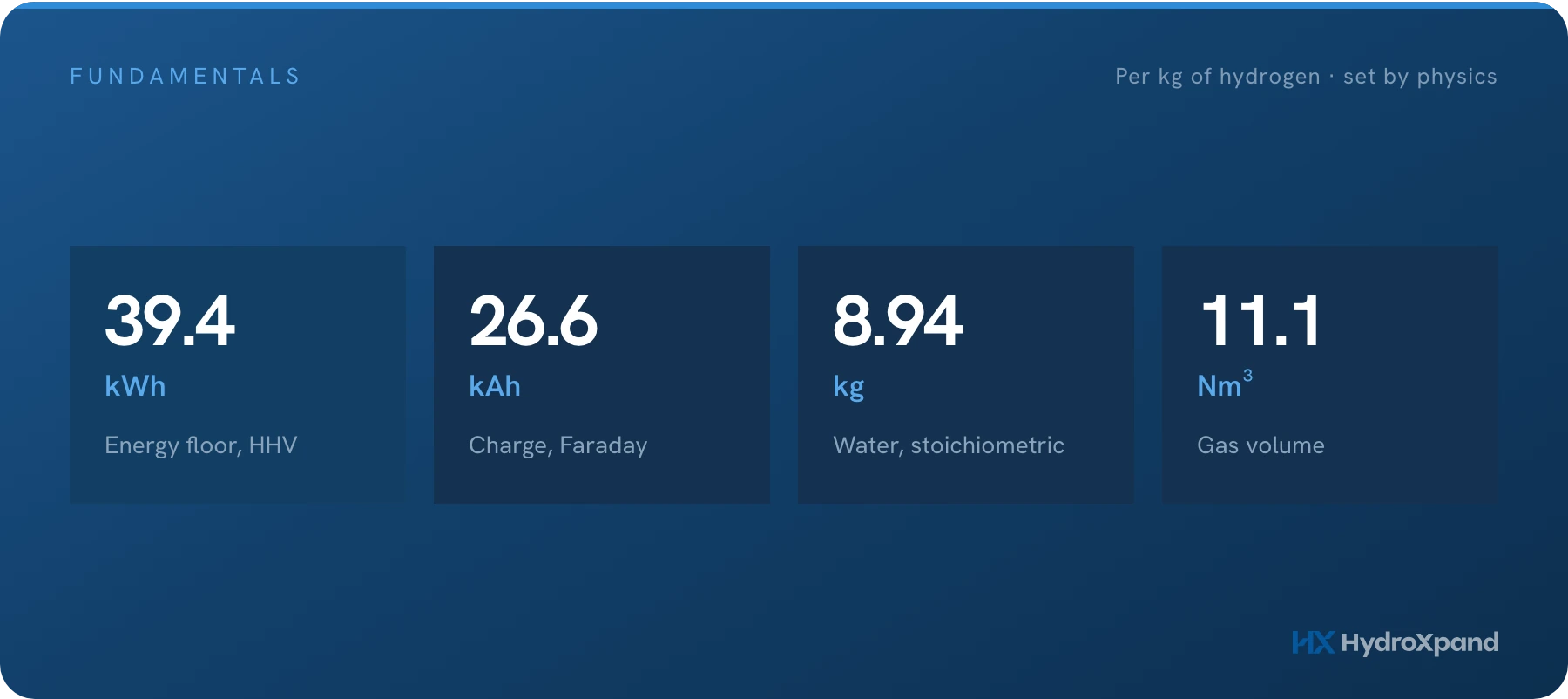
What water electrolysis is, and the four numbers that describe any electrolyzer
Water electrolysis is one reaction with a fixed price. Thermodynamics sets the floor for the energy, Faraday's law sets the charge, and stoichiometry sets the water. Everything a supplier can influence is the gap between those floors and the machine you buy.
Read →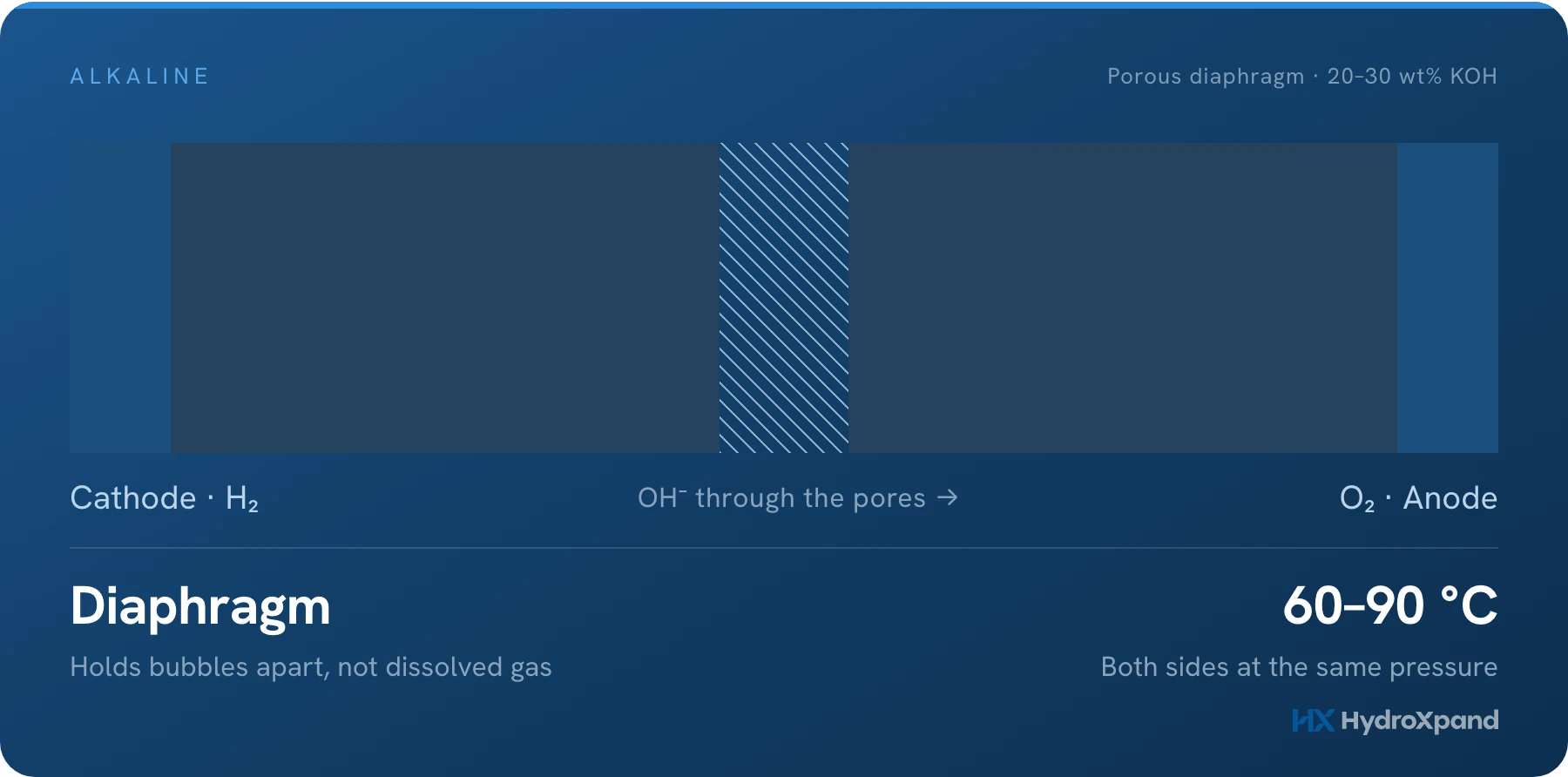
Alkaline water electrolysis: a century of industrial use, and the two limits that remain
Alkaline electrolysis is the only water electrolysis technology with a hundred years of industrial operation behind it, and it reached that position without a single noble metal. What separates it from the membrane technologies is not the chemistry but the separator, and almost every limit people attribute to alkaline electrolysis comes back to that one component.
Read →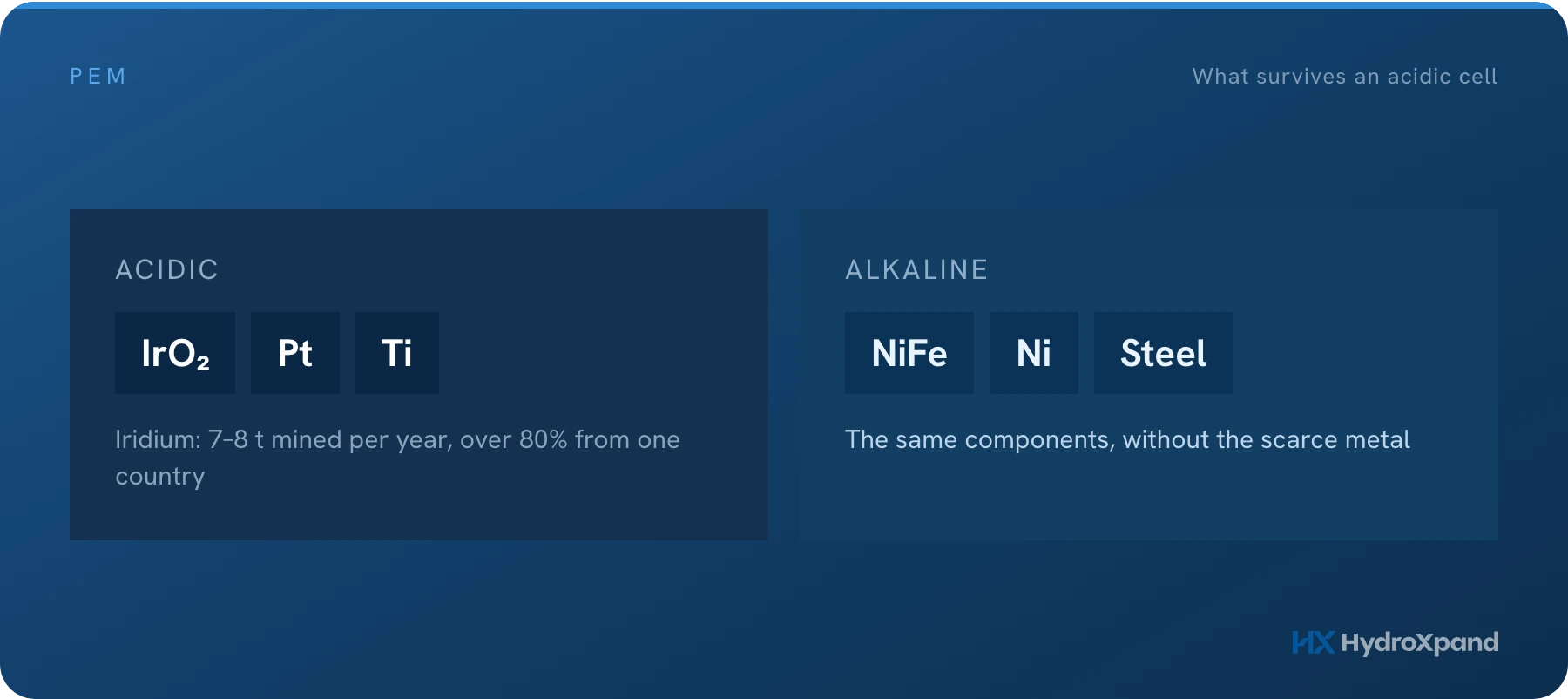
PEM water electrolysis: what the acidic membrane buys, and what it costs
PEM electrolyzers do things a liquid alkaline plant cannot: hold a large pressure difference, follow a variable power input, and deliver hydrogen that is already pure. All of it follows from one decision, a solid acidic membrane, and so does the bill that comes with it.
Read →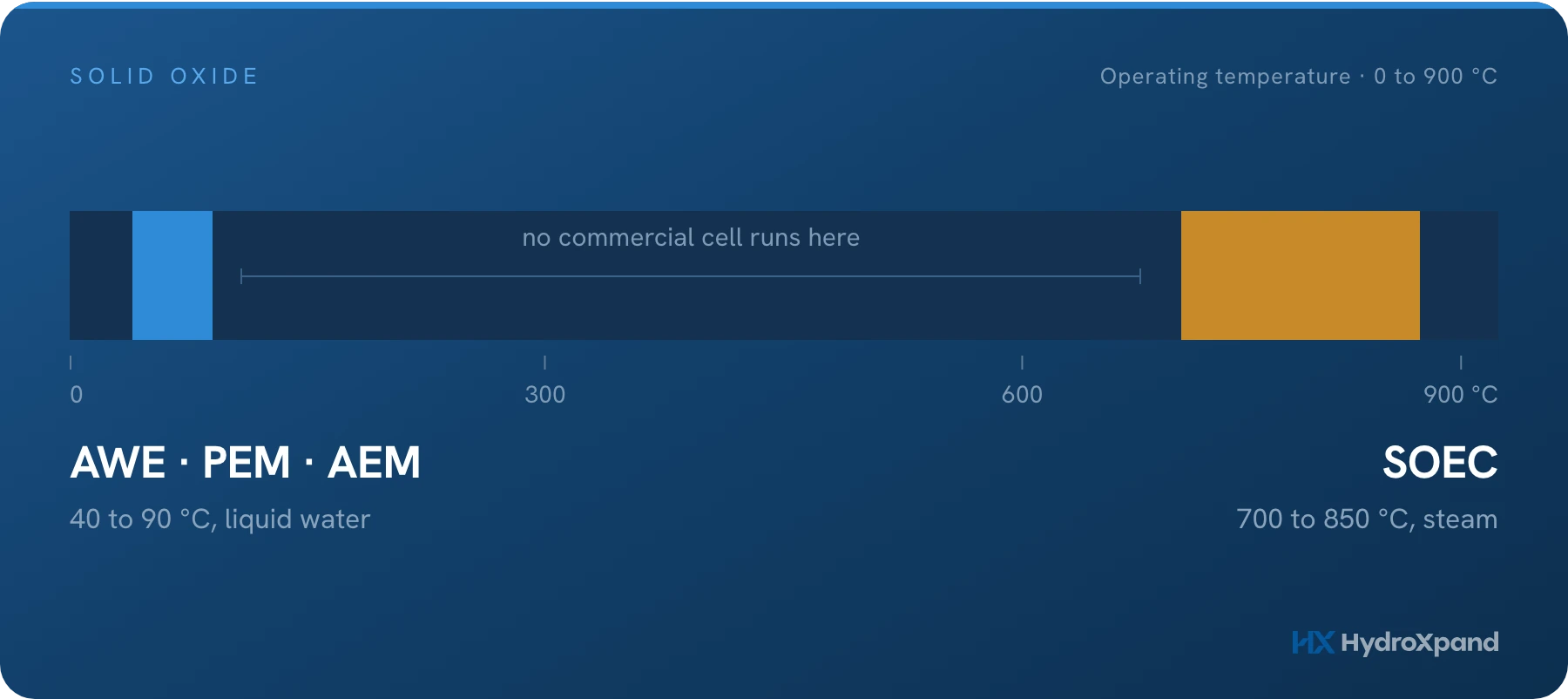
Solid oxide electrolysis: what running at 800 °C actually changes
Solid oxide electrolysis does not beat the other technologies by being a better cell. It changes the accounting, paying for part of the reaction with heat instead of electricity. Whether that is an advantage depends entirely on where the heat comes from.
Read →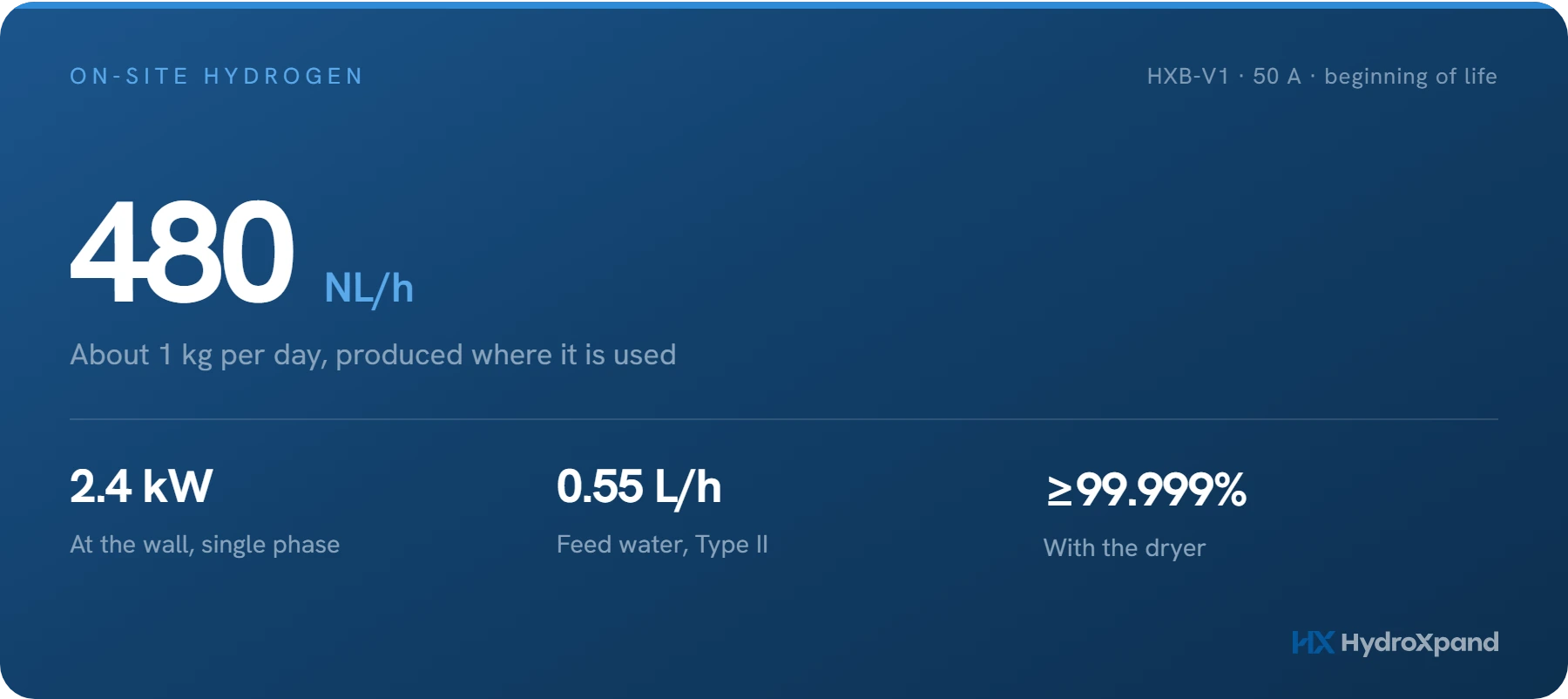
Hydrogen generators: how to size one, and what the specification has to tell you
A hydrogen generator makes hydrogen where it is used, from water and electricity, instead of having it delivered. Sizing one is not a matter of picking a model. It is a matter of turning what you consume into a rate, and then checking five numbers against your site.
Read →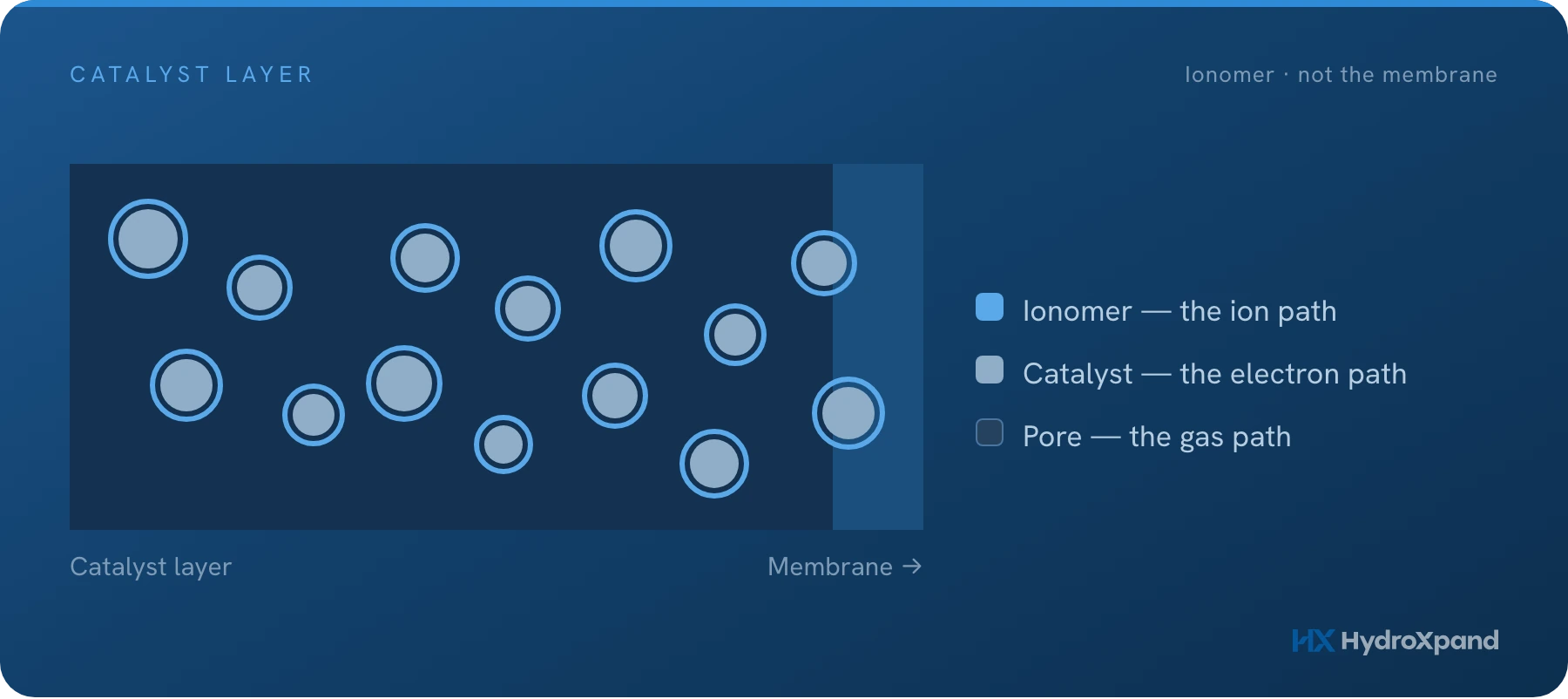
The ionomer: the polymer inside the catalyst layer, and why its amount decides performance
Two polymers do different jobs in the same cell. The membrane separates the gases. The ionomer sits inside the catalyst layer and carries ions the last few micrometres to the catalyst surface. Too little and the layer has no ion path. Too much and the gas has no way out.
Read →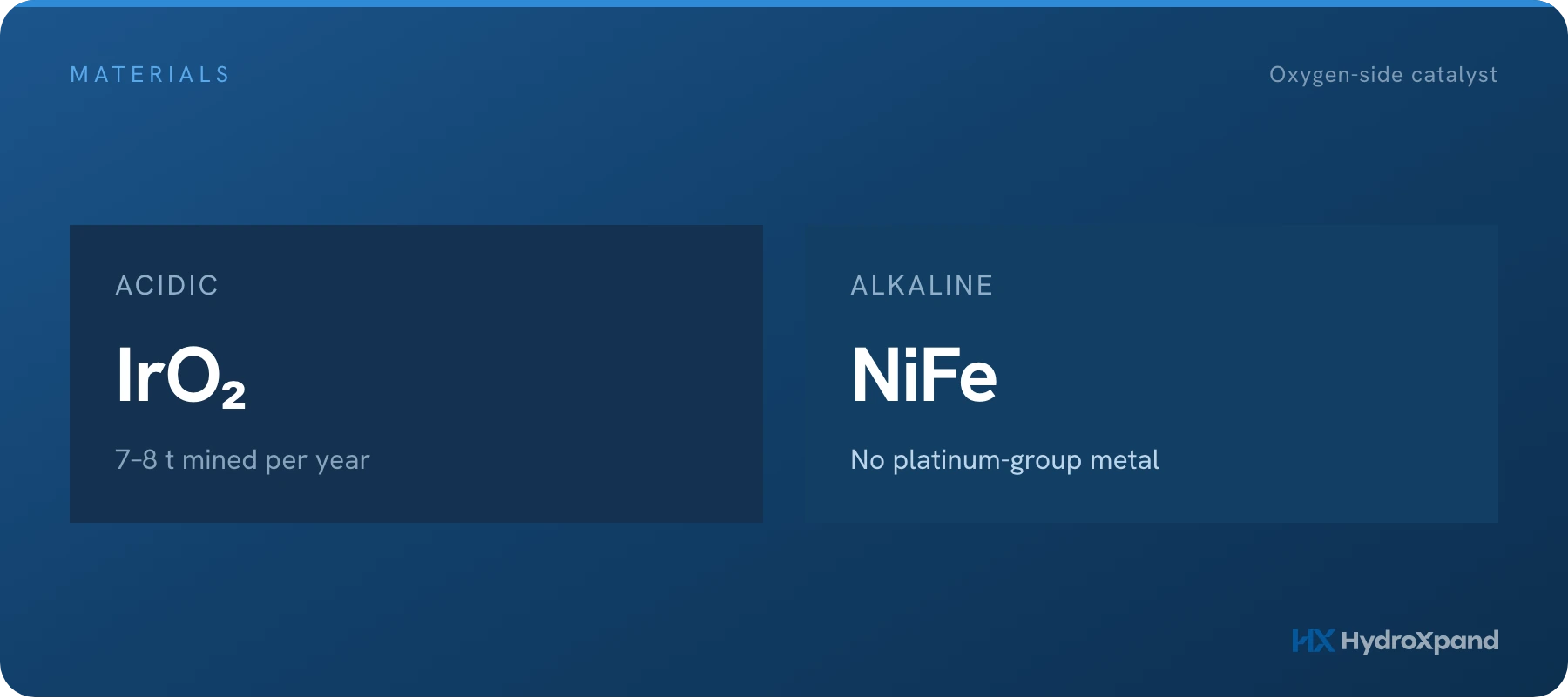
What a catalyst does, and why the electrolyte decides which one you can use
A catalyst does not split water. The current does. What it changes is the voltage the reaction needs, and whether your electrolyte is acidic or alkaline decides which materials are available to do it.
Read →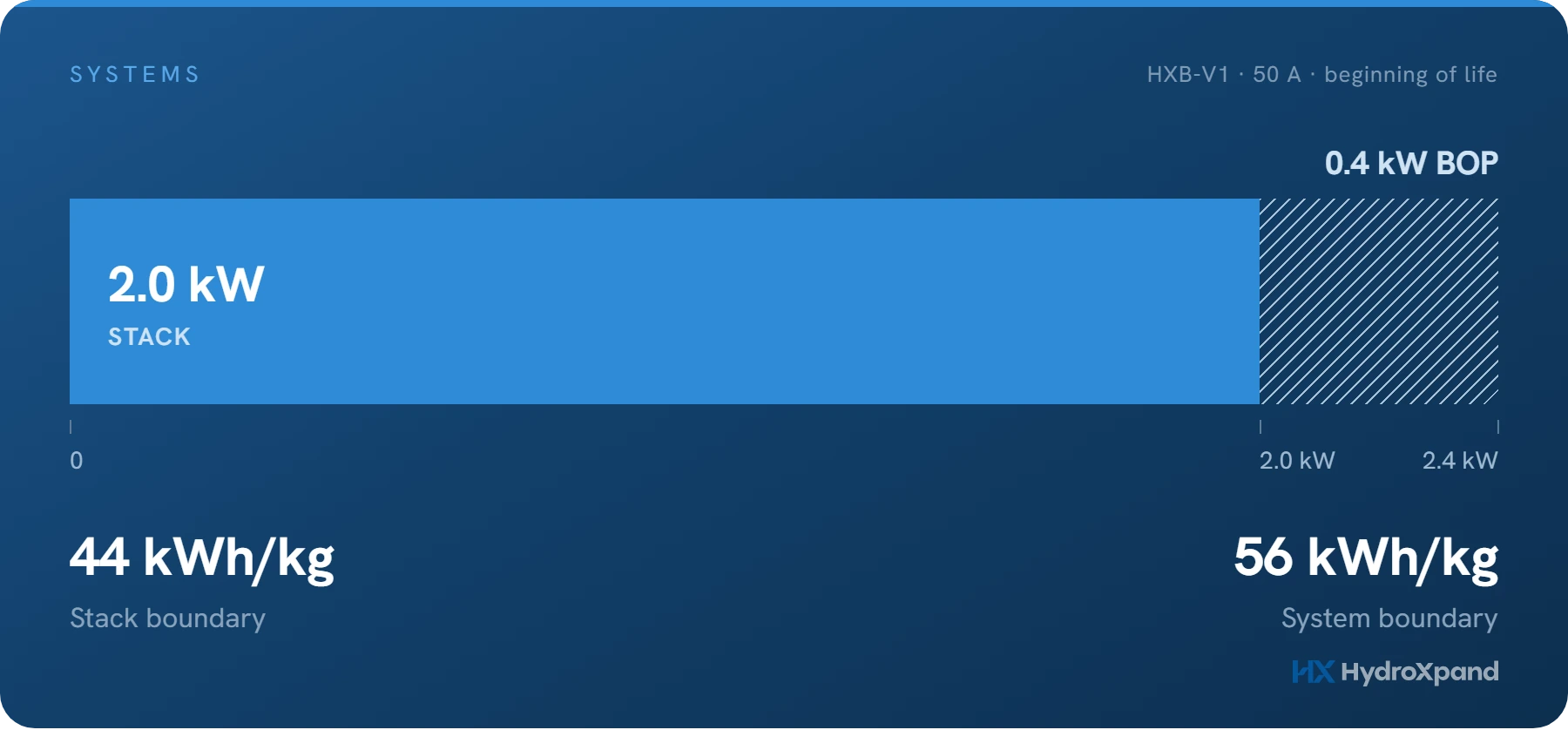
What an electrolysis system is, and why its efficiency is not the stack's
A stack splits water. It does not make hydrogen you can use. Between the two sits the balance of plant, and that is where the numbers you actually buy are decided: energy per kilogram, purity and pressure.
Read →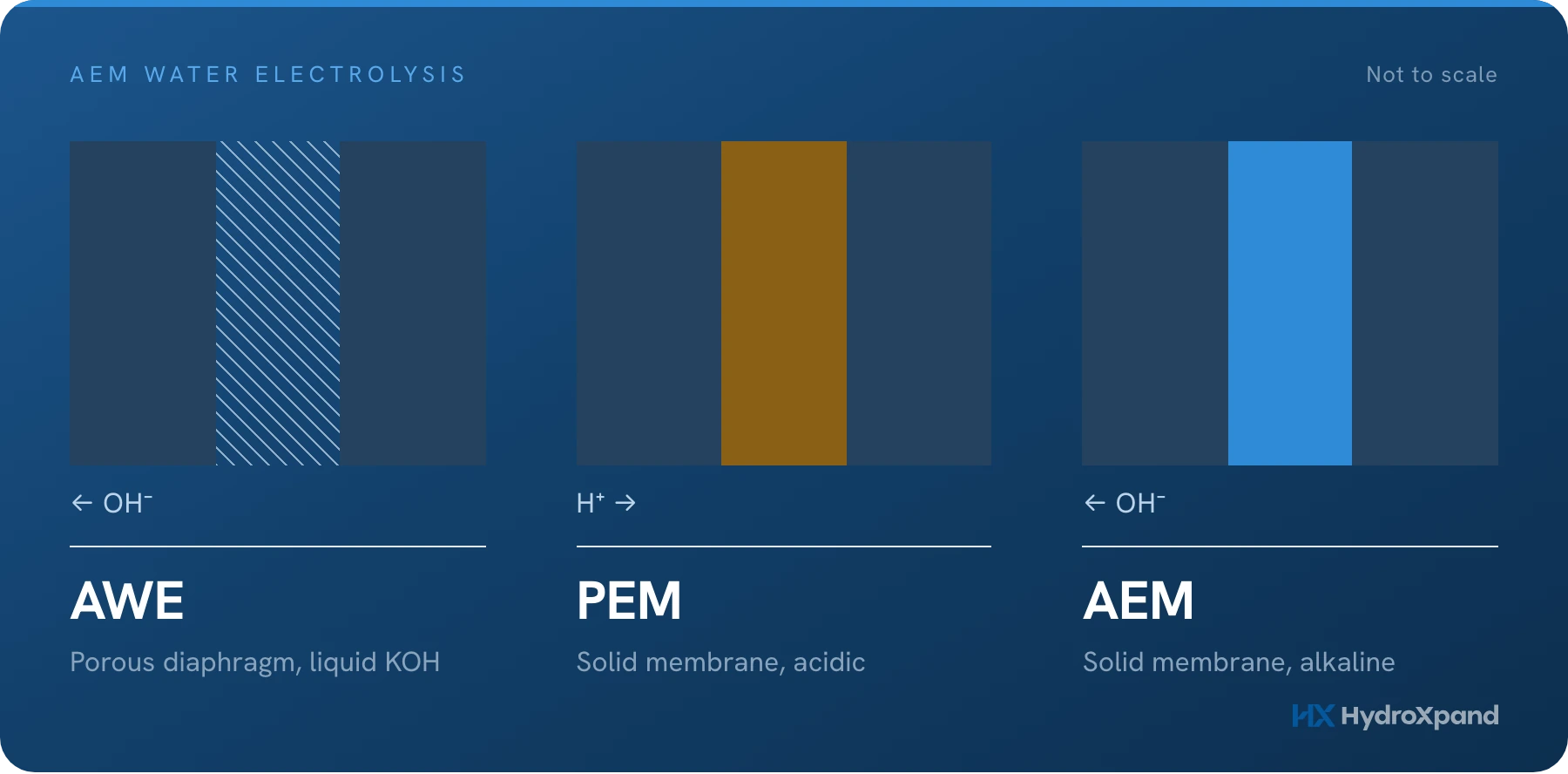
AEM water electrolysis explained: what changes when the membrane is anionic
Alkaline electrolysis is inexpensive but slow. PEM is fast but tied to iridium and PFAS. AEM keeps the solid membrane and moves it into an alkaline environment, and this is what that changes, what it has not solved, and where the technology stands measured.
Read →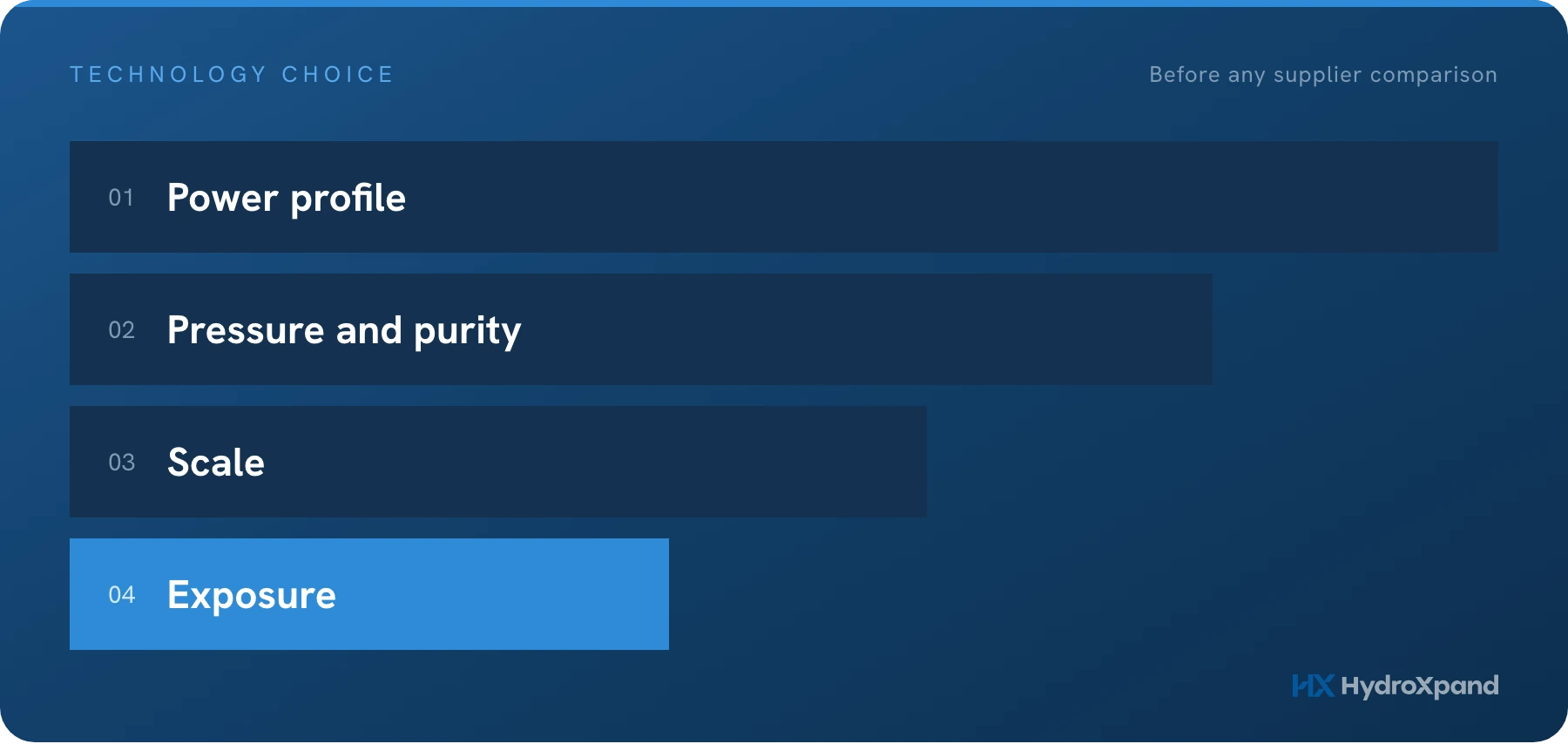
Alkaline, PEM or AEM: how to choose an electrolysis technology
There is no best electrolysis technology, only the one whose limits your project can live with. This is the set of questions that decides the answer, and what each of the three technologies is actually chosen for.
Read →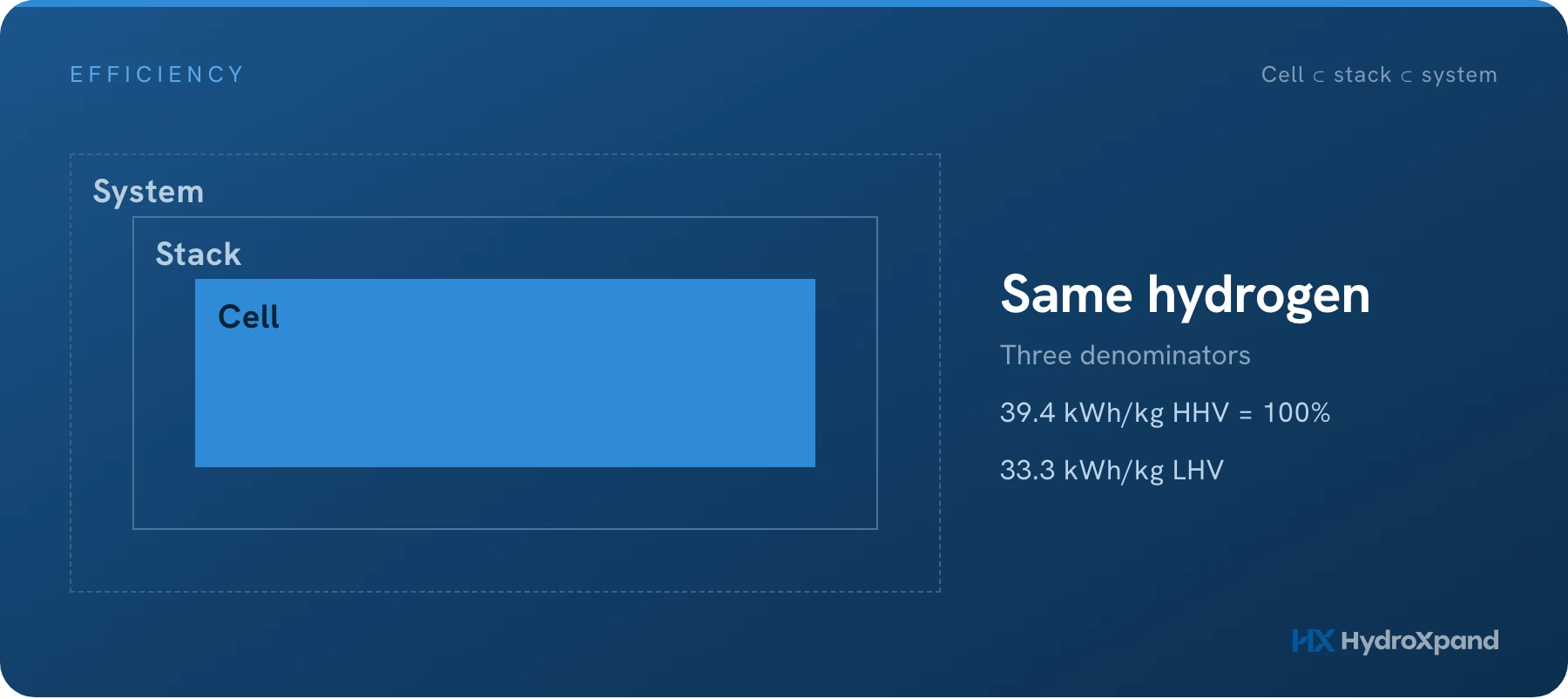
Electrolyzer efficiency: what the number means and how to compare it
Two electrolyzers quoted at 75% and 64% can be the same machine. Efficiency figures move with the heating value basis, the measurement boundary, the current density and the age of the stack, and this is how to read one properly.
Read →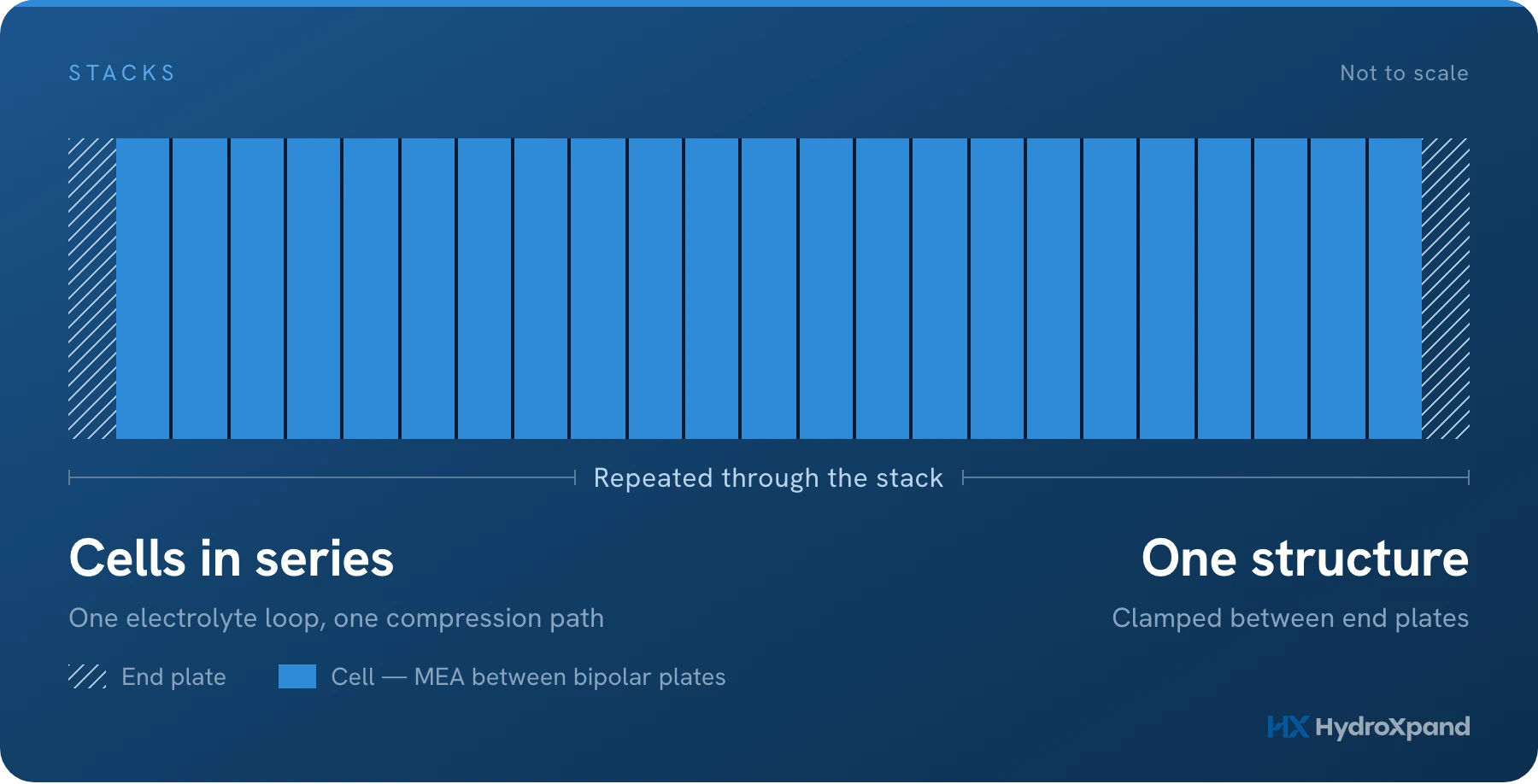
What is an electrolyzer stack, and what decides how well it works
A good cell is where a stack starts, not where it ends. Once cells are assembled, compression, flow, electrical contact and thermal conditions decide how much of that cell performance survives.
Read →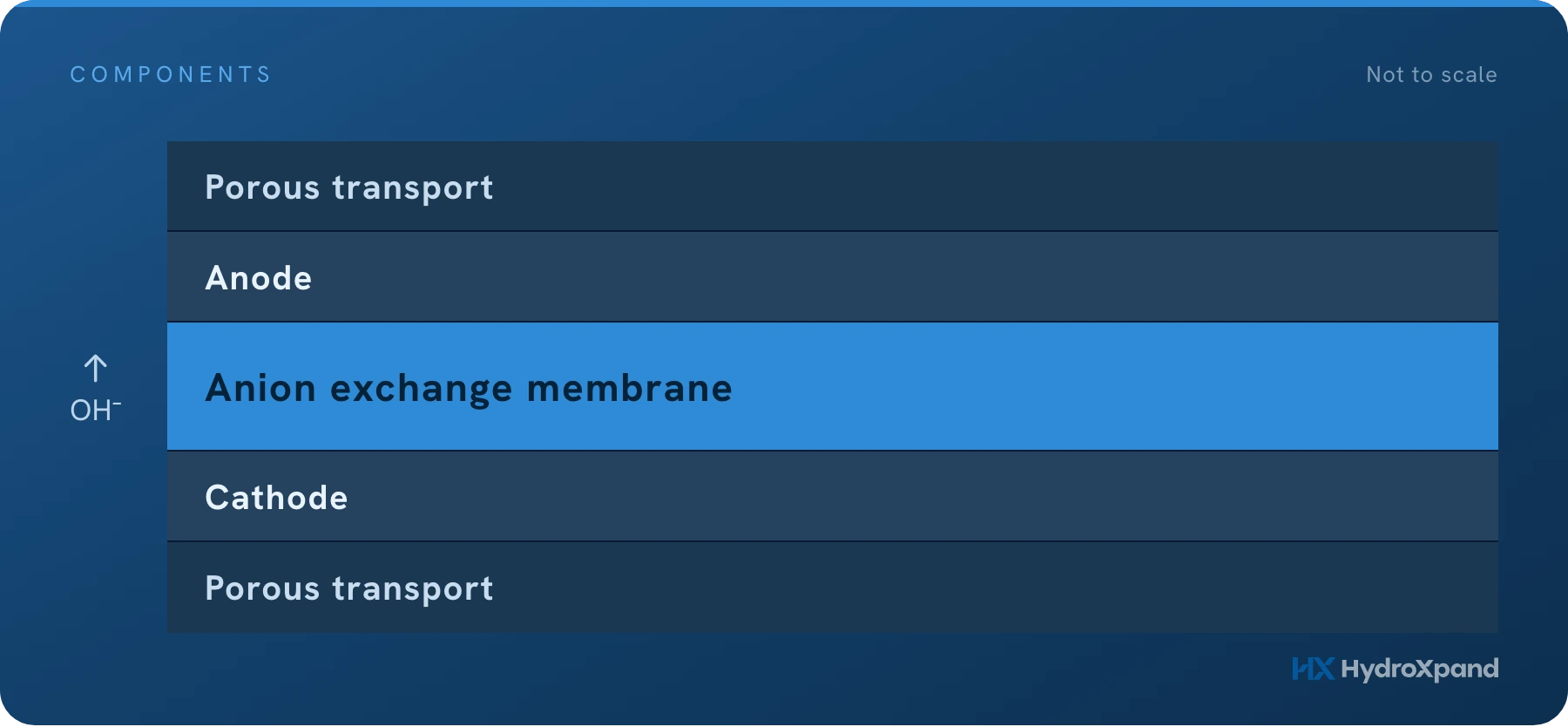
What is an MEA, and why it decides an electrolyzer's performance
The membrane electrode assembly is the layer stack where water is actually split. It sets the efficiency ceiling of everything built around it, and most of its performance is decided at the interfaces rather than by the ingredients.
Read →Measured data
Technical notes cover our own measurements and the conditions they were taken under.
Technical notes and news