A catalyst does not split water. The current does. What it changes is the voltage the reaction needs, and whether your electrolyte is acidic or alkaline decides which materials are available to do it.
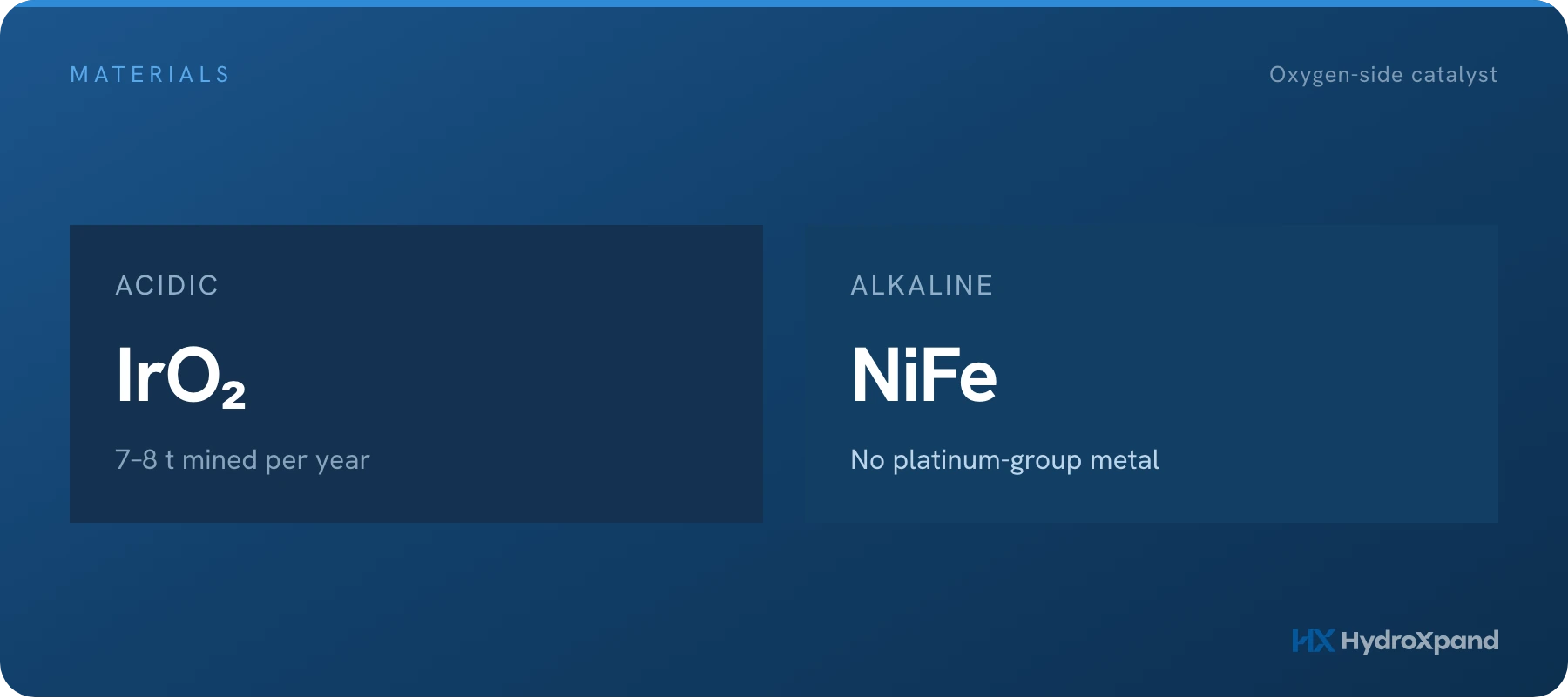
Every electrolyzer datasheet names its catalyst materials. Some say iridium, some say nickel and iron, and almost none say why. The answer is rarely a preference. It is set by the electrolyte the cell runs in, and once the technology is chosen the catalyst options are largely chosen with it.
It is also worth being precise about what a catalyst does, because the common shorthand is wrong. A catalyst does not split water and it does not make hydrogen. The current does that. What the catalyst changes is the voltage you have to apply before the reaction proceeds at a useful rate, and voltage is electricity you pay for.
A better catalyst does not produce more hydrogen. It produces the same hydrogen at a lower voltage, which is the same thing as less electricity.
Where the voltage actually goes
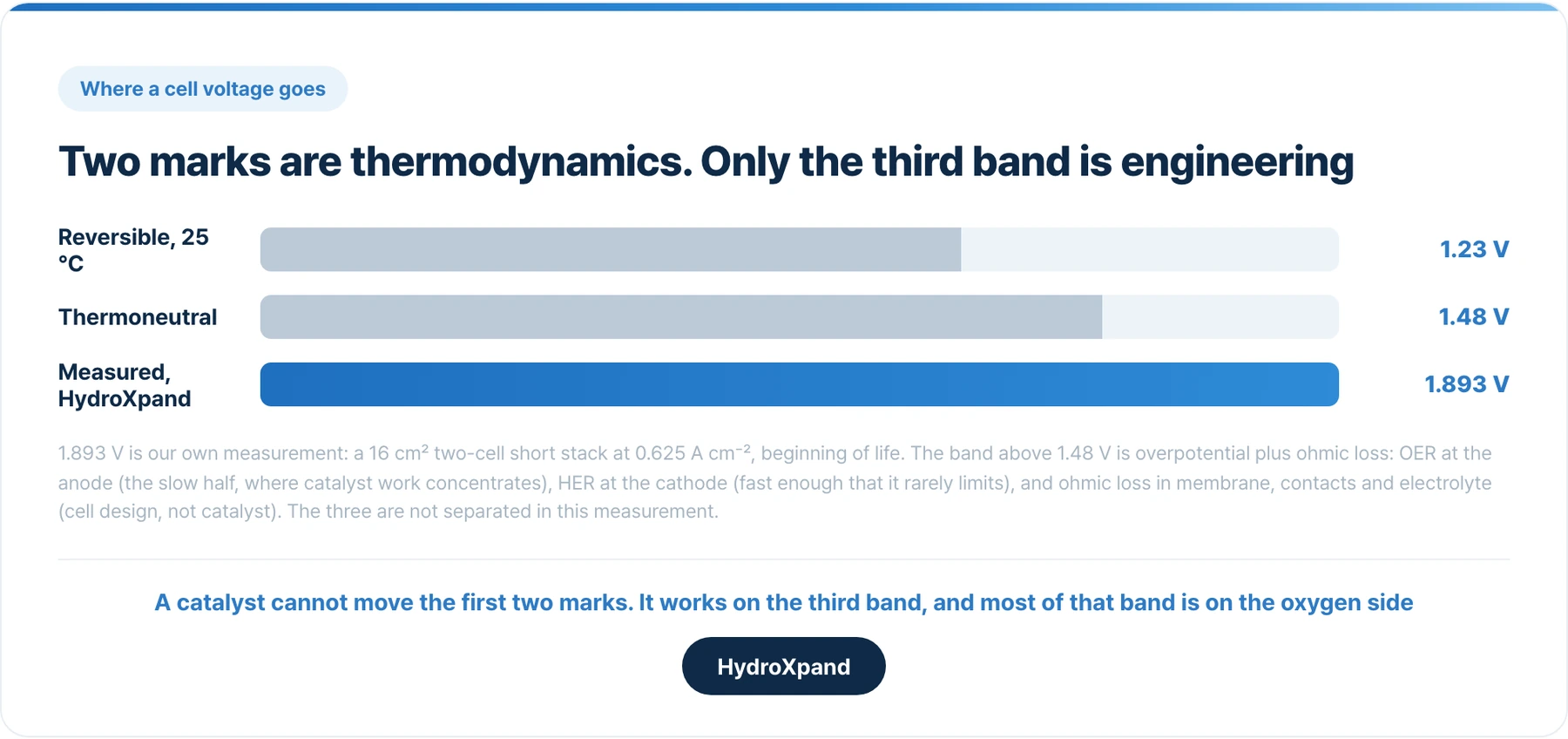
Splitting water has a thermodynamic floor. At room temperature the reversible cell voltage is 1.23 V, and no catalyst moves that number, because it is a property of the reaction rather than of the electrode. Run a cell adiabatically and the relevant figure is the thermoneutral voltage, 1.48 V, at which the reaction supplies its own heat.
Real cells run above both. The gap is what the catalyst, the membrane and the cell design compete over.
The OER is the limiting step of the complete electrolysis process due to its lower kinetics and higher overpotential than the HER
That third band is where the engineering lives, and it splits into three parts: the overpotential of the oxygen evolution reaction on the anode, the overpotential of the hydrogen evolution reaction on the cathode, and the ohmic losses of the membrane, the contacts and the electrolyte.
Those three parts are not equal. Oxygen evolution is the slow half of water splitting, and it carries most of the kinetic loss in the cell. That is why most catalyst research in the field is on the oxygen side, and why an anode is the component a materials team spends its time on. Hydrogen evolution is fast enough that it is usually not what limits a cell.
SourcesGinsberg et al., Solar RRL 2022: 1.23 V reversible and 1.48 V thermoneutral voltage · Molecules 26(21):6326 (2021): oxygen evolution as the rate-limiting half reaction
The electrolyte decides the catalyst
This is the part that is worth understanding before comparing quotes, because it explains why two suppliers name completely different materials without either of them being wrong.
| Acidic (PEM) | Alkaline (AWE, AEM) | |
|---|---|---|
| Why materials are limited | Most metals corrode in acidthe survivors are noble | Nickel and iron are stablethe field is much wider |
| Oxygen side (OER) | Iridium oxideno non-noble option in production | Nickel-iron and cobalt-iron oxidesno platinum-group metal required |
| Hydrogen side (HER) | Platinum on carbon | Platinum or platinum-rutheniumand non-noble routes under development |
| What follows | Cost and supply are tied to one scarce metal | Catalyst cost is not the binding constraint |
PEM does not use iridium because iridium is the best catalyst in the abstract. It uses iridium because acidic oxygen evolution at industrial current densities destroys almost everything else. The material is a consequence of the environment.
AEM keeps the solid polymer membrane that makes PEM attractive and moves the chemistry back into alkaline conditions, which is exactly what reopens the catalyst question. That is the single largest cost difference between the two, and it is a difference in what is available rather than in what is preferred.
SourcesMolecules 26(21):6326 (2021): acid stability requirement for PEM catalysts · U.S. DOE Technical Targets for PEM Electrolysis: iridium anode, platinum cathode
Two directions, and what they have in common
The reason catalysts are an active field rather than a settled one is supply. On the acidic side the constraint is a single scarce metal, and it is not a constraint engineering can design around.
Catalyst work today moves along two tracks in response, and it is worth knowing which one a supplier is on.
- Use less of the scarce metal. Thrifting iridium down by an order of magnitude or dispersing it to near-atomic loadings is an active field with real published results. The recurring difficulty is that lowering loading and keeping durability tend to pull against each other.
- Use none of it. Non-noble oxygen catalysts work in alkaline conditions, and this is established rather than speculative. The open problem is long-term stability, because transition metal catalysts can restructure, dissolve or lose active surface over thousands of hours.
South Africa is the world's largest supplier of one of the key metals for the hydrogen economy, with over 80% of annual iridium mine supply.
What both tracks share is where they get tested. Serious attempts to leave the noble metal market are run in alkaline cells, because that is the only environment in which non-noble oxygen catalysts survive at all. The direction of travel in catalyst research and the case for AEM are the same argument seen from two sides.
SourcesInternational Platinum Group Metals Association, White Paper on Iridium (2022) · Johnson Matthey PGM Market Report (May 2026): iridium primary supply by year
- HXP-an · anode→Ir-free. Catalyst grown on the substrate, no binder.
- HXP-ca · cathode→Low-PGM cathode.
- Datasheets→Six products. No form.
How to read a catalyst number
Three figures are usually quoted, and they trade against each other, which is why any one of them alone is close to meaningless.
- Overpotential. How much voltage above the thermodynamic floor the reaction needs. Lower is less electricity, and the condition it was measured at travels with it.
- Current density. How much current the electrode carries per unit area at a given voltage. Higher means more hydrogen from the same size of machine, and it is also the condition under which durability gets harder.
- Durability. How much of the performance survives. This is the figure most often quoted without the conditions that make it comparable.
Ask for the electrolyte, the temperature, the current density, the membrane, the hours and the voltage the run ended at. A number without them cannot be compared with anyone else's.
There is also a difference between a catalyst result and a cell result. A half-cell measurement tells you about the material. It does not tell you what happens once that material is bonded into an electrode, compressed against a porous transport layer and run against a membrane. Numbers rarely survive that transition unchanged.
Our own long runs are a useful illustration of why the cell matters more than the component. A HydroXpand grown nickel-iron anode ran 6,358 hours in a 16 cm² two-cell short stack at 0.625 A cm⁻², degrading at 14.7 µV/h per cell on a full-run linear fit. In the same campaign, changing only the membrane gave 1,234 hours. Five times the life, same anode.
What the published durability data suggests
One pattern in the literature is worth stating, with its limitation attached. Across published AEM durability reports, every run with an iridium-oxide anode is 2,000 hours or shorter, and iridium-free anodes have run longer, such as a coated nickel-iron anode at about 2,500 hours. The longest runs, about 5,000 and 8,900 hours, used proprietary industrial alkaline electrodes whose composition is not disclosed.
The limitation: every one of those points is a different laboratory, membrane, electrolyte and temperature, so this is a distribution and not a controlled comparison. And hours alone mislead: the 8,900-hour run was at 0.2 A cm⁻², a low current density, rising by about 18 µV per hour from 1.92 V. Hours mean little without the current density and voltage beside them.
Read carefully, the conclusion is narrow: in alkaline conditions, iridium is not required for a cell to run for thousands of hours. Nobody should conclude from this that non-noble catalysts have no durability problem. They have a different one.
What we use, and what we still buy
Our anode is nickel-iron layered double hydroxide grown directly on nickel foam. There is no binder and no platinum-group metal in it, the substrate porosity is 95 to 98 percent, and the measured surface area is about 25 times that of the bare foam. It was chosen for durability and cost rather than for the first measurement, and the trade is real: on a freshly assembled cell, a well-made iridium-oxide anode will give a higher current density at the same voltage.
Our cathode is not noble-metal-free, and we would rather say so plainly than let a page about iridium imply otherwise. It is Pt/C or PtRu/C on carbon paper at 0.2 mg of platinum-group metal per cm². Hydrogen evolution is the fast half of the reaction, the loading required is small, and platinum is neither as scarce nor as geographically concentrated as iridium. Removing it entirely is a research direction rather than a claim we make about a product we ship.
Both electrodes are sold as standard 200 by 300 mm sheets, with datasheets on this site.
- AEM electrolysis: technology and measured data→How AEM electrolysis works, AEM vs PEM vs alkaline, and the measured data behind our stacks.
- What is an MEA→Where these catalyst layers sit, and why interfaces decide more than ingredients.
- AEM water electrolysis explained→Why moving a solid membrane into alkaline conditions reopens the catalyst question.
- The anode that looks best on day one is not the one that lasts→Coated versus grown anodes, the 6,358-hour run and the full durability distribution.
- HXP-an and HXP-ca electrodes→Both electrodes with datasheets, no form.
- What an ionomer is→How the catalyst particle gets connected to the membrane, and what happens when there is too much of it.
- PEM water electrolysis→The acidic cell component by component, and why the materials list is not a choice.
Frequently asked questions
What does a catalyst do in water electrolysis?
It does not split the water; the current does. A catalyst lowers the voltage the reaction needs, which means the same hydrogen for less electricity.
Why does the electrolyte decide which catalyst you can use?
In an acidic PEM cell the oxygen-side catalyst has to survive acid, which in practice means iridium. In an alkaline cell nickel and iron based materials are available instead.
How should I read a catalyst performance number?
Ask for the electrolyte, temperature, current density, membrane, hours and the voltage the run ended at. A number without those conditions cannot be compared with anyone else's.
Sources
- Integrating Solar Energy, Desalination, and Electrolysis (DOI 10.1002/solr.202100732) — Solar RRL, 2022
- Recent Advances in Alkaline Exchange Membrane Water Electrolysis and Electrode Manufacturing (DOI 10.3390/molecules26216326) — Molecules, 2021
- Technical Targets for Proton Exchange Membrane Electrolysis — U.S. Department of Energy
- White Paper on Iridium — International Platinum Group Metals Association, 2022
- PGM Market Report, May 2026 — Johnson Matthey
Looking at AEM for a specific application?