
Applications / Power-to-X

Power-to-X

Hardware for Power-to-X projects that convert CO₂ electrochemically or combine renewable hydrogen with CO₂ or nitrogen. Direct conversion requires a custom review that may cover reaction-specific materials and cell or stack design, while hydrogen supply can start with the 2 kW system.

Typical users
CO₂ conversion, e-methanol and green ammonia
Public customer cases
1 case
Recommended starting points
HXB-V1HXS-230 kW
Good fit

This setup is a good fit when

  • You need custom cell or stack hardware for direct CO₂ conversion trials
  • You need an electrolytic hydrogen source for e-methanol or synthetic-fuel research and demonstration
  • You need a small-scale hydrogen generator for green ammonia research and demonstration
  • You want to begin with 2 kW-scale trials and evaluate the conditions for later expansion
Named cases

Named customer cases

Every customer below has agreed to be named. We describe only the use they stated in writing.

Case 01

RIST

Republic of Korea · Industrial research institute · 2026

2 kW stack hardware · Power-to-Chemicals

Direct CO₂ conversion (CO₂RR) in a 2 kW stack

Customer need

RIST used HydroXpand's 2 kW stack for direct electrochemical CO₂ conversion (CO₂RR). It falls under Power-to-Chemicals within the broader Power-to-X category and differs from e-methanol pathways that combine electrolytic hydrogen with CO₂ downstream.

Supply summary

  • 2 kW stack hardware for a Power-to-Chemicals (CO₂RR) application
  • Hardware specification and supply scope matched to the intended use
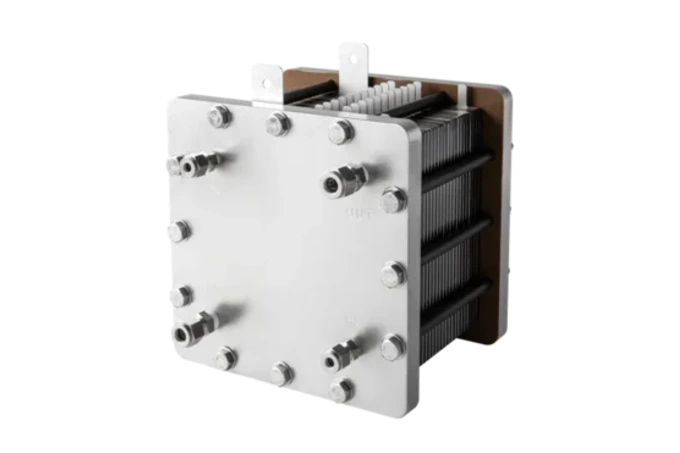
HXS-2 2 kW stack hardware
See the timeline and full supply scope

From enquiry to delivery

  1. The review of 2 kW stack hardware for CO₂RR began in March 2026.
  2. In April, the hardware specification and supply scope were refined for the intended application.
  3. RIST used the stack as an electrochemical platform for direct CO₂ conversion under Power-to-Chemicals.

Full supply scope

  • 2 kW stack hardware for a Power-to-Chemicals (CO₂RR) application
  • Hardware specification and supply scope matched to the intended use

Customer-side output, efficiency, lifetime and publication results are not included because we do not yet have consent to publish them.

Before you ask

Worth checking first

Our scopeOur standard product scope is hydrogen generation. Direct CO₂ conversion is reviewed as custom stack hardware, as in the RIST case, rather than a simple repurposing of a standard water-electrolysis stack. Depending on the reaction system, the scope may include changes to wetted or gas-contact materials and to the cell or stack design. CO₂ hydrogenation or ammonia synthesis reactors, nitrogen supply, gas mixing and storage remain part of project integration.
What to send usFor hydrogen-supply projects, send us the target hydrogen flow, pressure and purity, downstream synthesis process, daily operating hours and power variability. For direct CO₂ conversion, also provide the feed composition and flow, target product, electrolyte, operating temperature, pressure and current density, as well as your available electrodes, membrane and BoP conditions so we can define the custom review scope.
Direct CO₂ electrolysisThe RIST project used custom 2 kW stack hardware; it does not make the stack a standard CO₂-electrolysis product. Water electrolysis and CO₂RR differ in reactants, products, electrolytes, corrosion and mass-transfer conditions. Catalysts, electrodes, membranes, ionomers, bipolar plates, coatings, gaskets and seals may therefore need to be reselected, while flow fields, manifolds, cell architecture, compression and gas or liquid management may require redesign. Published performance is based on AEM water-electrolysis conditions, so material compatibility, safety, durability and performance must be validated separately under the customer's conditions.

Talk to us about this use case

Tell us the use case and target output, and we will review the right product configuration and quotation scope.