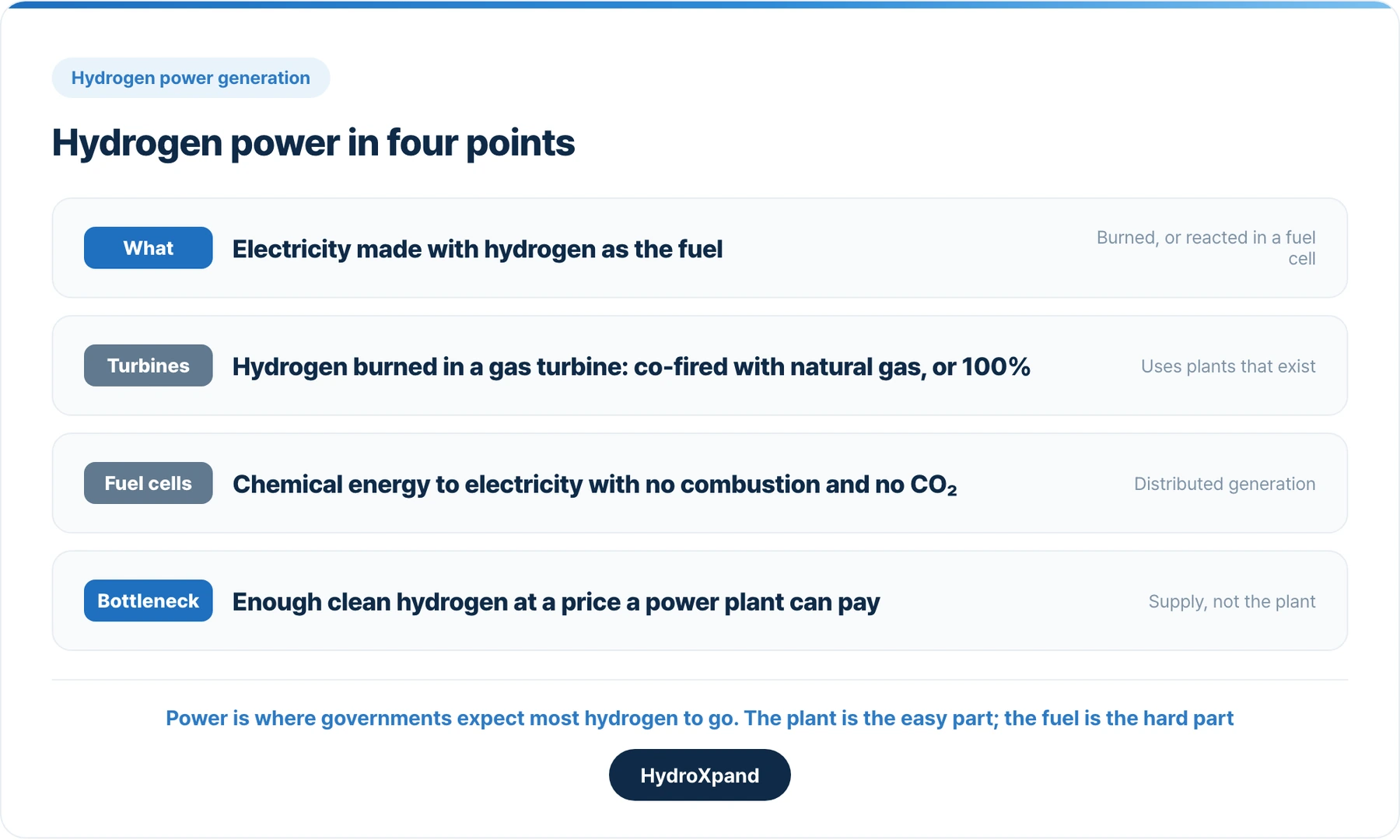
Hydrogen power generation means making electricity with hydrogen as the fuel, either by burning it in a gas turbine or by reacting it in a fuel cell. Governments expect power to be the largest use of hydrogen. This article sets out the three methods, what each is for, what stands in the way, how Korea's auctions buy hydrogen power, and why the whole thing comes back to the price of clean hydrogen.
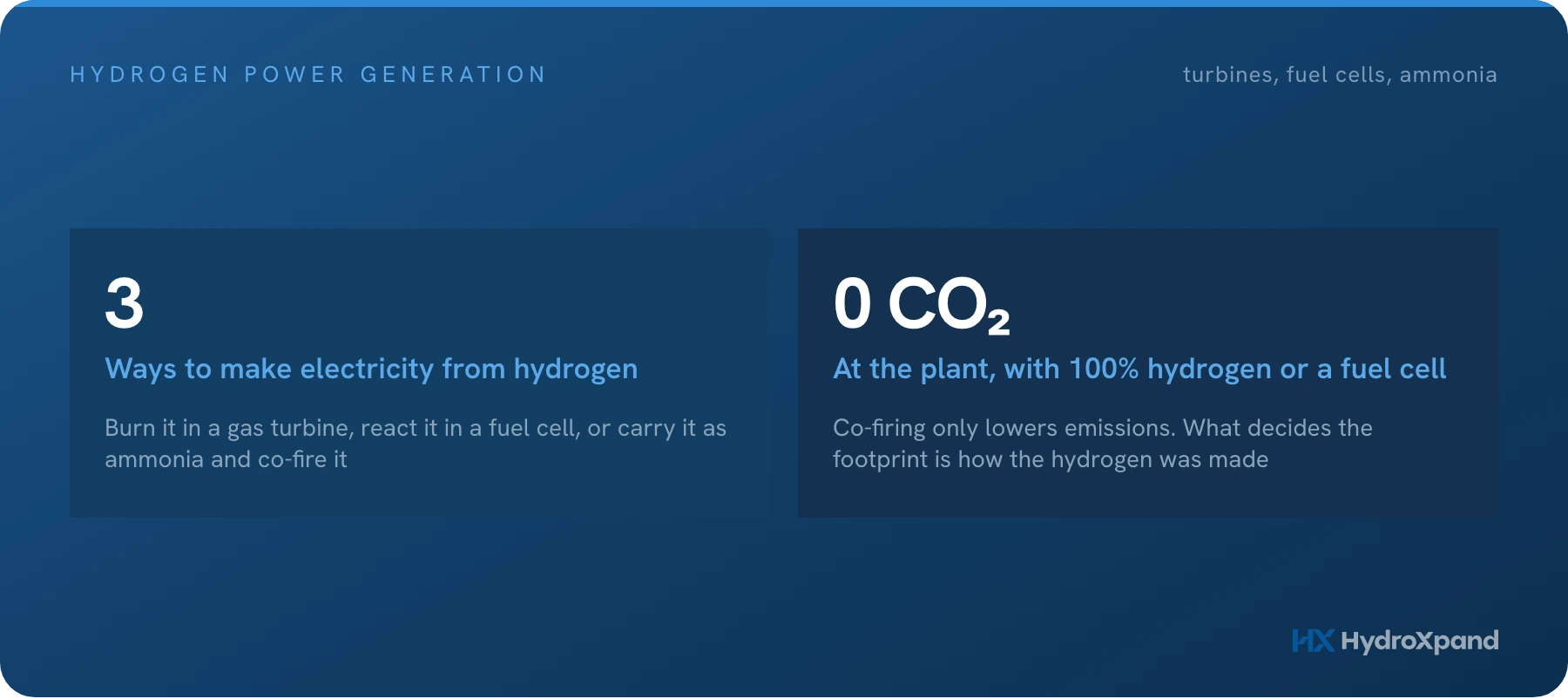
Hydrogen can be burned to make electricity, and it can be turned into electricity directly in a fuel cell. Making electricity with hydrogen as the fuel, by either route, is hydrogen power generation. Governments, Korea's among them, expect the power sector to be the largest consumer of hydrogen in the decades ahead.
For an electrolyzer company that is worth understanding closely, because a power plant is the customer at the far end of the chain. This article covers what hydrogen power is, the three methods used in practice, their advantages and limits, how Korea's clean hydrogen power auctions work, and why every method ends up depending on the same thing: clean hydrogen at a price a power plant can pay.
What hydrogen power generation is
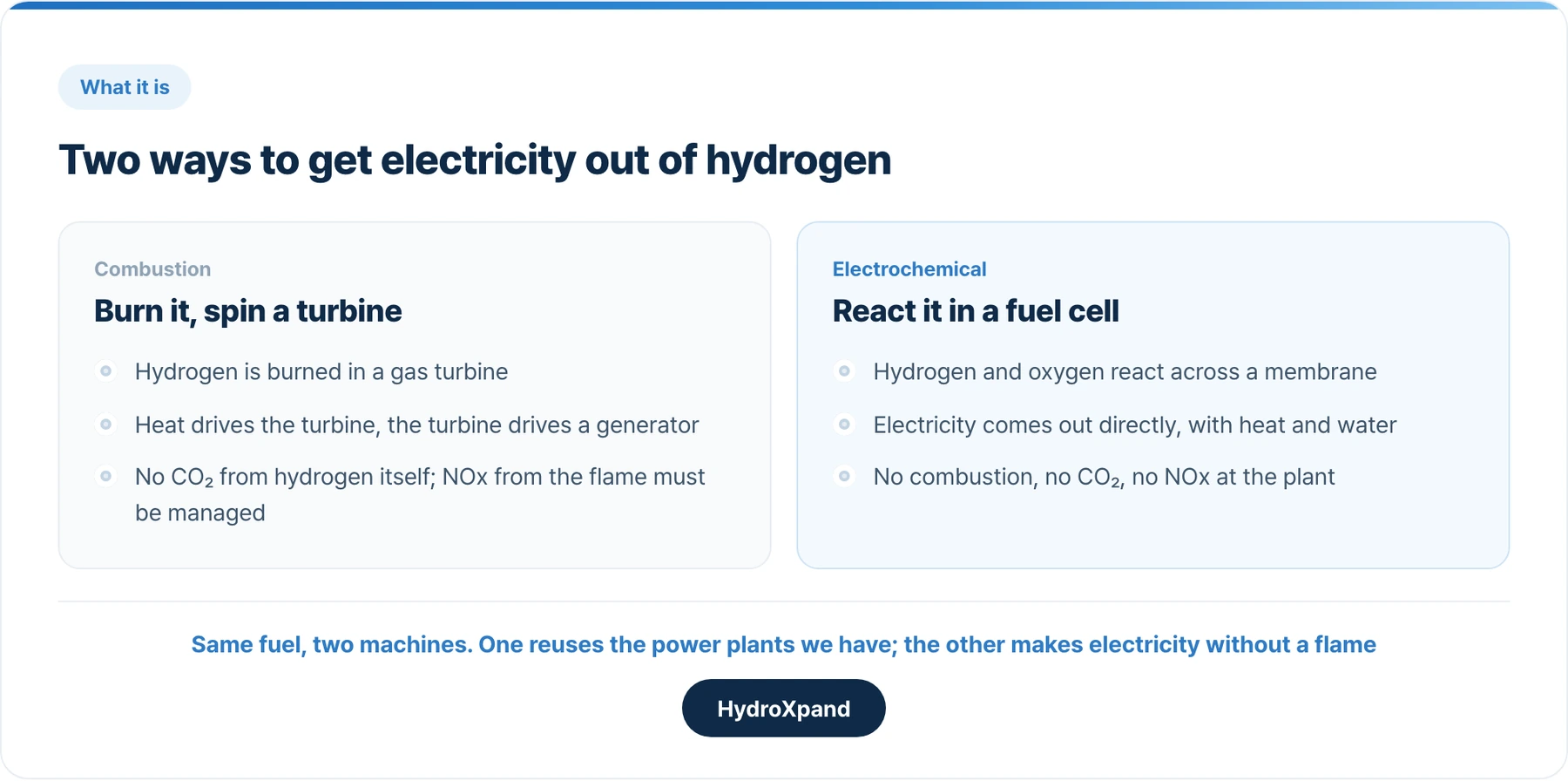
Hydrogen power generation is electricity produced with hydrogen as the fuel. There are two ways to get the electricity out. The first is combustion: hydrogen is burned in a gas turbine, the heat drives the turbine and the turbine drives a generator, exactly as natural gas does today. The second is electrochemical: hydrogen and oxygen react in a fuel cell and electricity comes out directly, with heat and water, and nothing is burned.
The two differ in what they emit and in what they reuse. Burning hydrogen produces no carbon dioxide, because there is no carbon in the fuel, though the flame still produces nitrogen oxides that have to be controlled. A fuel cell produces no combustion products at all. The turbine route reuses the power plants and grid connections that already exist; the fuel cell route builds new, usually smaller, plants close to where the electricity is used.
Hydrogen fuel cells emit only water with no air pollutants that create smog and cause health problems at the point of operation.
SourcesU.S. DOE: Fuel Cells (water as the only product at the point of use) · IEA Global Hydrogen Review 2025: power, mobility and synthetic fuels remain a tiny share of demand
The three methods
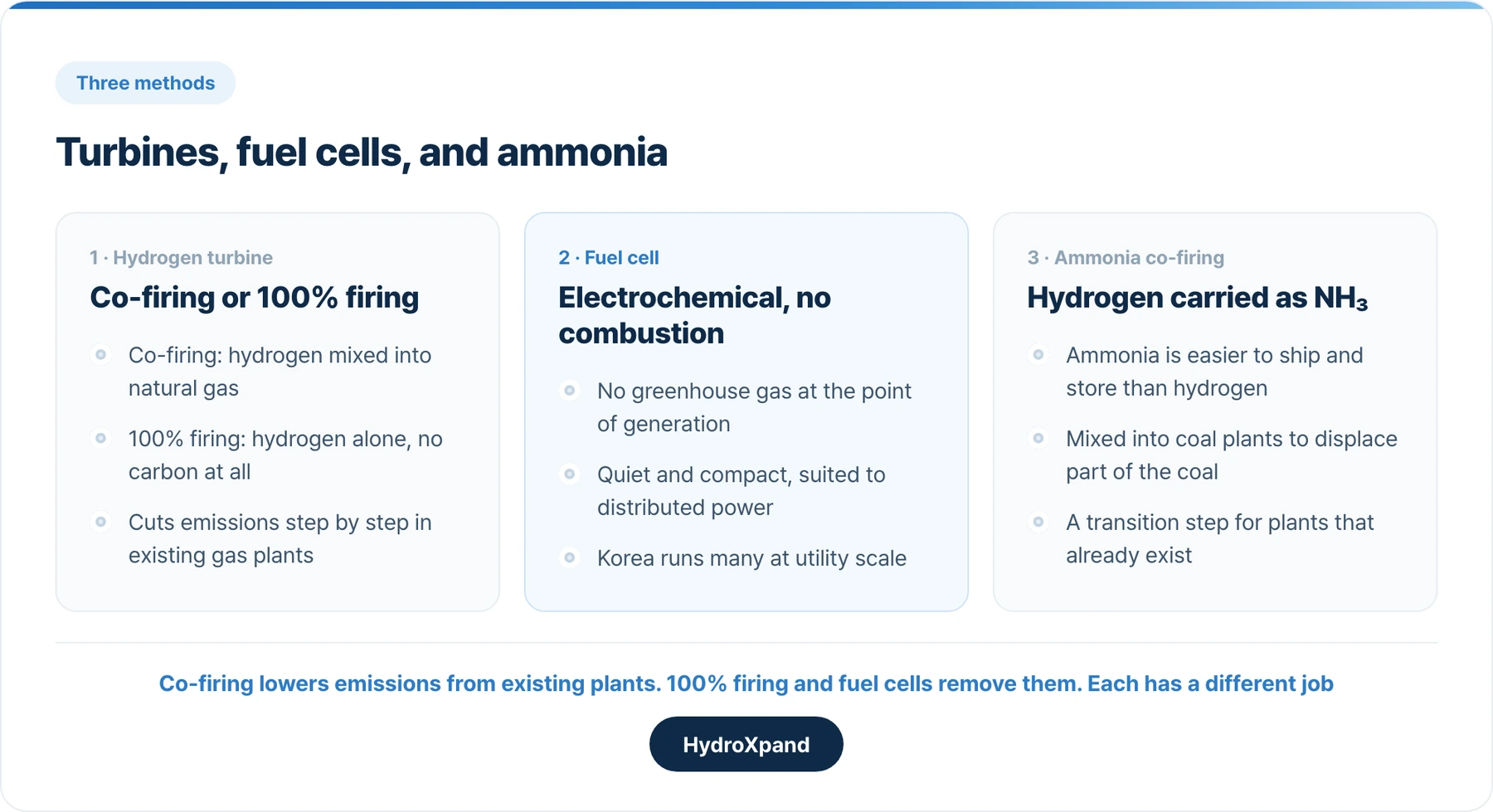
In practice hydrogen power is done three ways, and they are aimed at different problems.
Hydrogen turbine generation burns hydrogen in a gas turbine. It comes in two forms. Co-firing mixes hydrogen into the natural gas an existing plant already burns, cutting its emissions in proportion to the share of hydrogen. Full firing burns hydrogen alone, so the plant emits no carbon at all. Co-firing is a way of lowering the emissions of plants that exist; full firing is a way of building plants that are carbon-free from the start.
Fuel cell generation converts the chemical energy of hydrogen to electricity without combustion, so it releases no greenhouse gas at the point of generation. Fuel cell plants are quiet and compact and are mostly used for distributed generation, inside cities and at industrial sites. Korea runs a large fleet of them at utility scale.
Ammonia co-firing takes a different route to the same plant. Hydrogen is difficult to ship and store, and ammonia, which carries hydrogen in a form that is far easier to handle, can be burned in a coal plant to displace part of the coal. It is a transition method for plants that already exist rather than a design for new ones.
Advantages and limits
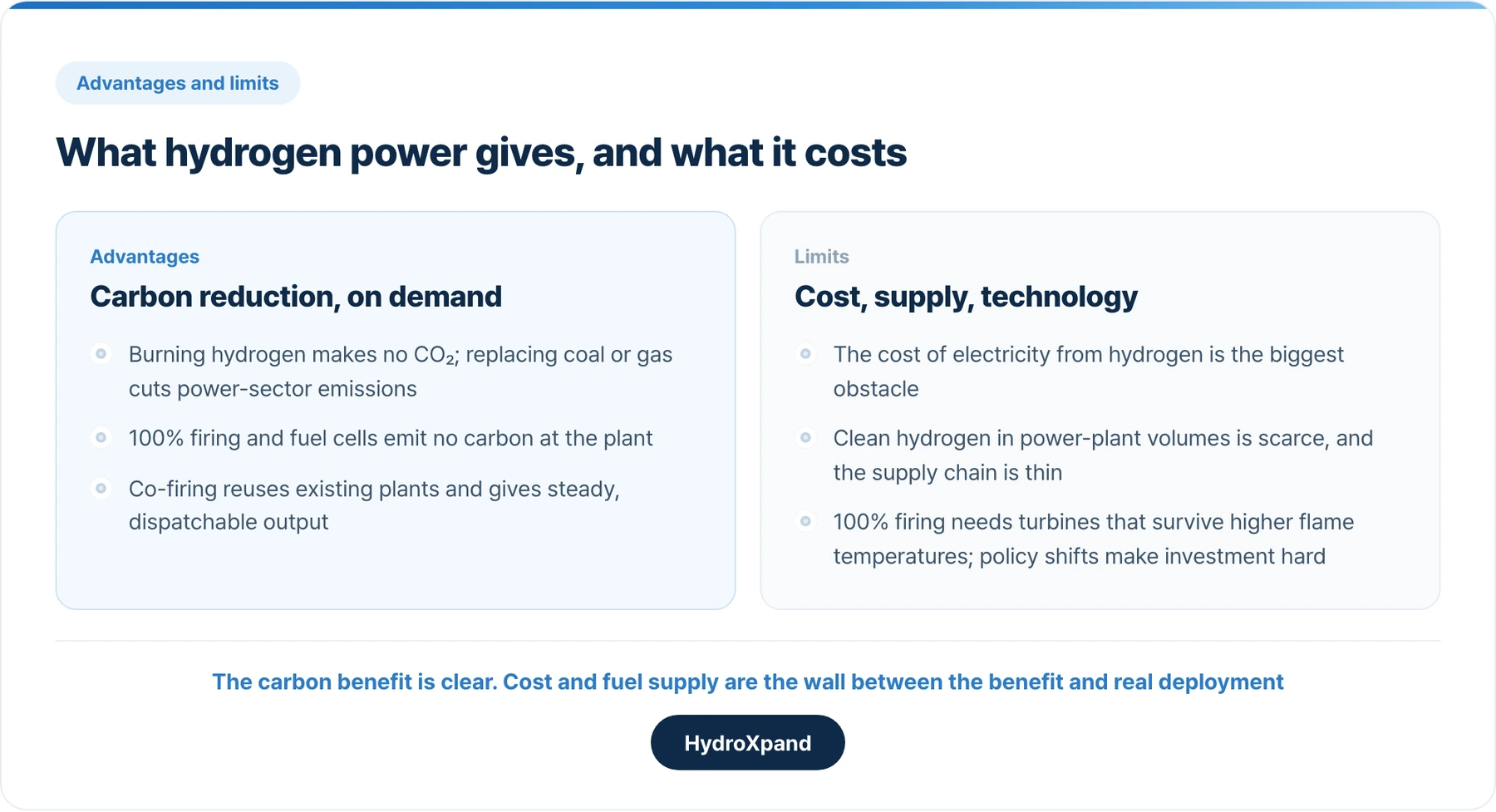
The advantage of hydrogen power is carbon reduction. Hydrogen makes no carbon dioxide when it burns, so replacing coal or natural gas with hydrogen cuts the power sector's emissions. Full firing and fuel cells emit no carbon at the plant at all. Co-firing can be introduced quickly because it reuses existing plants, and because a thermal plant runs whenever it is asked to, hydrogen power gives the grid steady, dispatchable output that wind and solar cannot.
The limits are cost and technology. The largest obstacle is the cost of the electricity a hydrogen plant produces, which is set almost entirely by the cost of the hydrogen it burns. Clean hydrogen in power-plant volumes is hard to secure, and the infrastructure to make, move and store it is still thin. Full firing needs turbines that can survive the higher flame temperature of hydrogen, which is demanding engineering. And policy in this area changes often, which makes a long-lived plant hard to finance.
The carbon benefit is real. Between the benefit and actual deployment stand the cost of the fuel and the supply chain that delivers it.
A hydrogen power plant is only as clean as its hydrogen and only as cheap as its hydrogen. Everything else is engineering that already exists.
How Korea buys hydrogen power
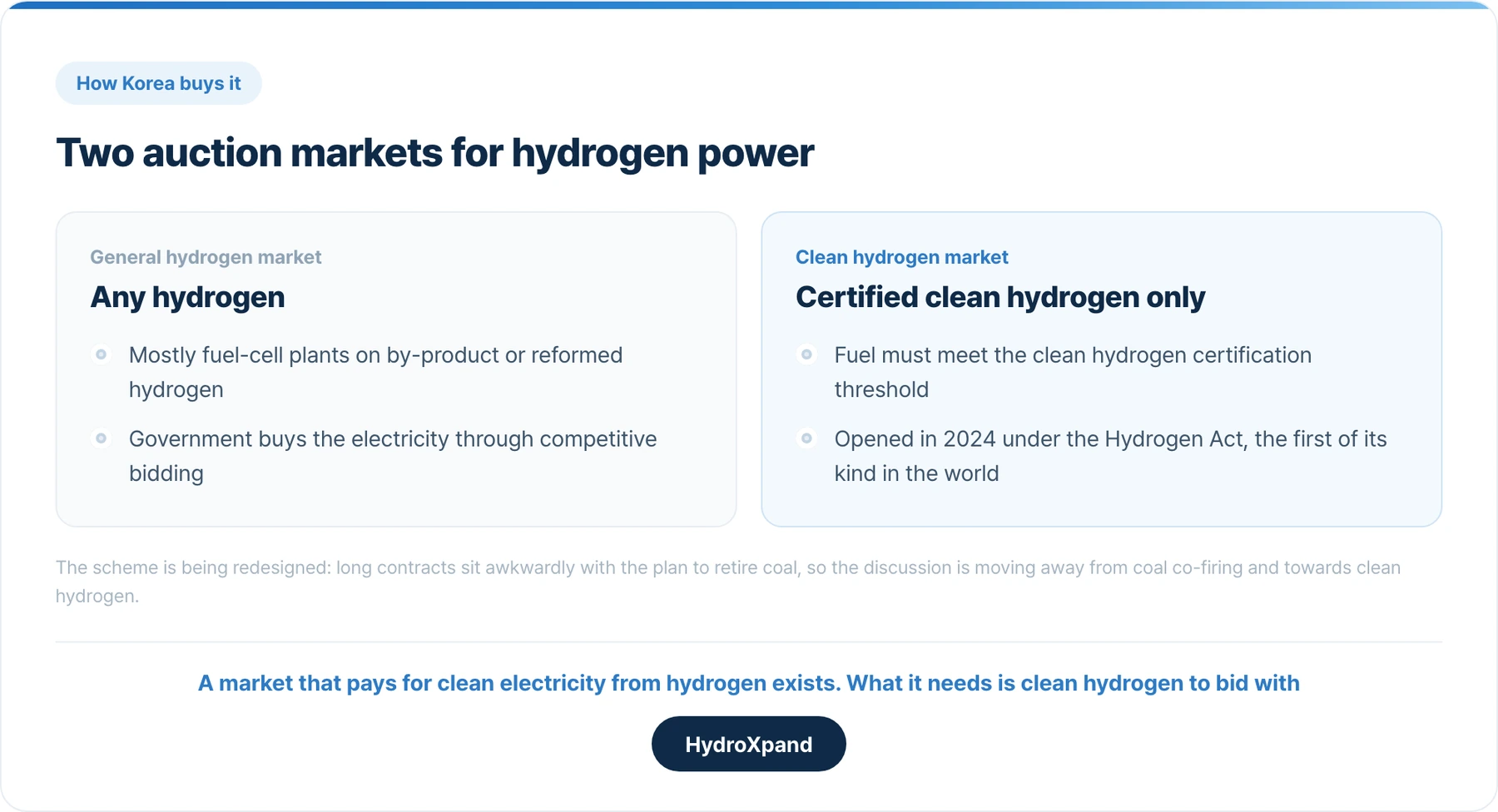
Korea has a clean hydrogen power bidding scheme built to expand hydrogen generation. The government buys electricity made from hydrogen through competitive auctions, and the auctions are split into two markets by the fuel used. The general hydrogen market is mostly fuel cell plants running on by-product or reformed hydrogen. The clean hydrogen market accepts only plants whose fuel meets the national clean hydrogen certification threshold; it opened in 2024 under the Hydrogen Act and was the first market of its kind in the world.
The scheme is being redesigned. Contracts in it run for many years, which sits awkwardly with the plan to retire coal plants, and the discussion has turned towards shrinking coal-based co-firing and rebuilding the market around clean hydrogen. For anyone outside Korea the useful point is that a buyer that pays for clean electricity from hydrogen already exists. What it is short of is certified clean hydrogen to bid with.
Sources수소발전 입찰시장 연도별 구매량 산정 등에 관한 고시, Article 3 and Annex 1: general and clean hydrogen markets (MOTIE Notice 2024-125) · Hydrogen Act, Article 2(7-2): clean hydrogen means hydrogen certified under Article 25-2 (English translation)
Hydrogen power and electrolysis
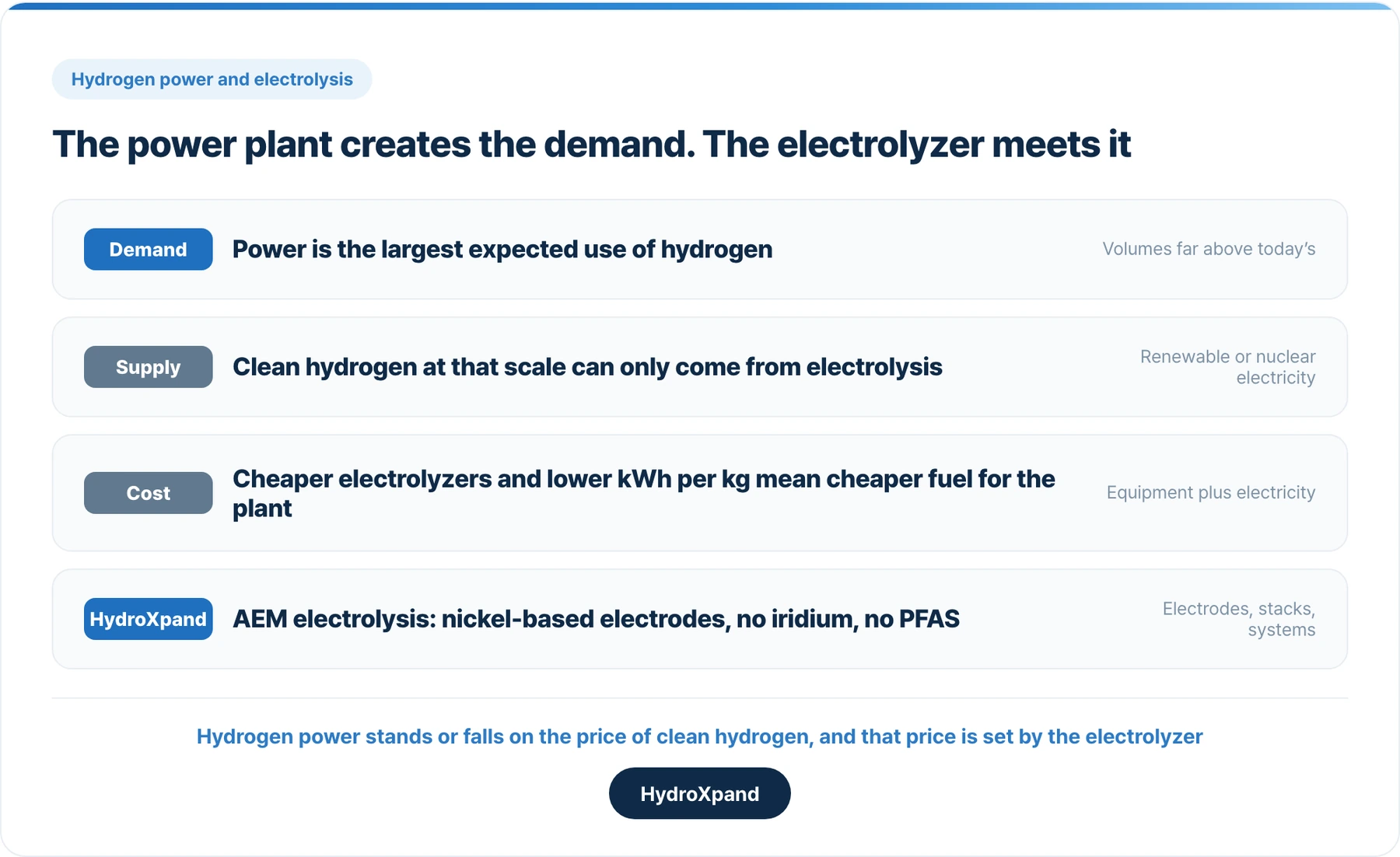
As hydrogen power grows, where the clean hydrogen comes from becomes the deciding question. Power is the largest expected use, so the volumes are far above anything made today, and reforming natural gas cannot supply them cleanly. Clean hydrogen at that scale can only come from electrolysis, running on renewable or nuclear electricity.
That links the power plant to the electrolyzer directly. As electrolysis equipment gets cheaper and uses fewer kilowatt-hours per kilogram, the fuel for a hydrogen plant gets cheaper with it. Hydrogen power stands or falls on the price of clean hydrogen, and that price is set by the electrolyzer and the electricity it runs on. HydroXpand's part is the electrolyzer: AEM electrolysis electrodes, stacks and systems with nickel-based catalysts and no iridium or PFAS membranes, built to bring the cost of clean hydrogen down to where a power plant can buy it.
What to take from this
- Ask which method a hydrogen plant uses. Co-firing lowers emissions; full firing and fuel cells remove them at the plant.
- Ask how the hydrogen was made. Burning green hydrogen and burning grey hydrogen give the same flame and very different footprints.
- Treat the cost of hydrogen as the cost of the plant. The turbine and the fuel cell are known technology; the fuel is what decides the economics.
- Where a clean hydrogen power market exists, as in Korea, the scarce input is certified clean hydrogen, and that is an electrolysis question.
HydroXpand's AEM electrolysis electrodes, stacks and systems are sold today, from 2 kW research and pilot units to a 30 kW stack, to buyers who want to make clean hydrogen from water rather than buy it from a reformer.
- Hydrogen fuel cell pros and cons→The fuel cell route in detail: four strengths in the cell, four limits around it.
- How hydrogen energy works→The three ways hydrogen is made, and why only electrolysis is clean at scale.
- Hydrogen colours: what the names leave out→The number certification actually measures, which is what a clean hydrogen market bids on.
- Power-to-gas: what a hydrogen round trip costs→Electricity to hydrogen and back to electricity, and where the losses fall.
- AEM water electrolysis: how it works→How HydroXpand makes clean hydrogen without iridium.
Frequently asked questions
Is hydrogen power generation clean?
Full hydrogen firing and fuel cells emit no carbon dioxide at the plant. Co-firing hydrogen into natural gas only cuts part of the emissions. In every case the real footprint depends on how the hydrogen was made; only hydrogen from renewable electricity makes the whole chain clean.
What is the biggest disadvantage of hydrogen power?
The cost of the electricity it produces, which is set by the cost of hydrogen. Clean hydrogen in power-plant volumes is hard to secure, and the infrastructure to make, move and store it is still thin, so hydrogen power costs more than other generation today.
What is the difference between co-firing and full firing?
Co-firing mixes hydrogen or ammonia into the natural gas or coal a plant already burns, lowering its emissions in proportion. Full firing burns 100% hydrogen, so the plant emits no carbon at all. Co-firing reuses existing plants; full firing needs turbines built for hydrogen's higher flame temperature.
How does Korea's clean hydrogen power auction work?
The government buys electricity made from hydrogen through competitive bidding in two markets: a general market, mostly fuel cell plants on by-product or reformed hydrogen, and a clean hydrogen market for plants whose fuel meets the certification threshold. The clean market opened in 2024 under the Hydrogen Act, the first of its kind, and the scheme is currently being redesigned.
Sources
- 수소발전 입찰시장 연도별 구매량 산정 등에 관한 고시, MOTIE Notice 2024-125 — law.go.kr
- Hydrogen Economy Promotion and Hydrogen Safety Management Act, English translation — Korea Legislation Research Institute
- Global Hydrogen Review 2025 — International Energy Agency, 2025
- Fuel Cells — U.S. Department of Energy
Looking at AEM for a specific application?