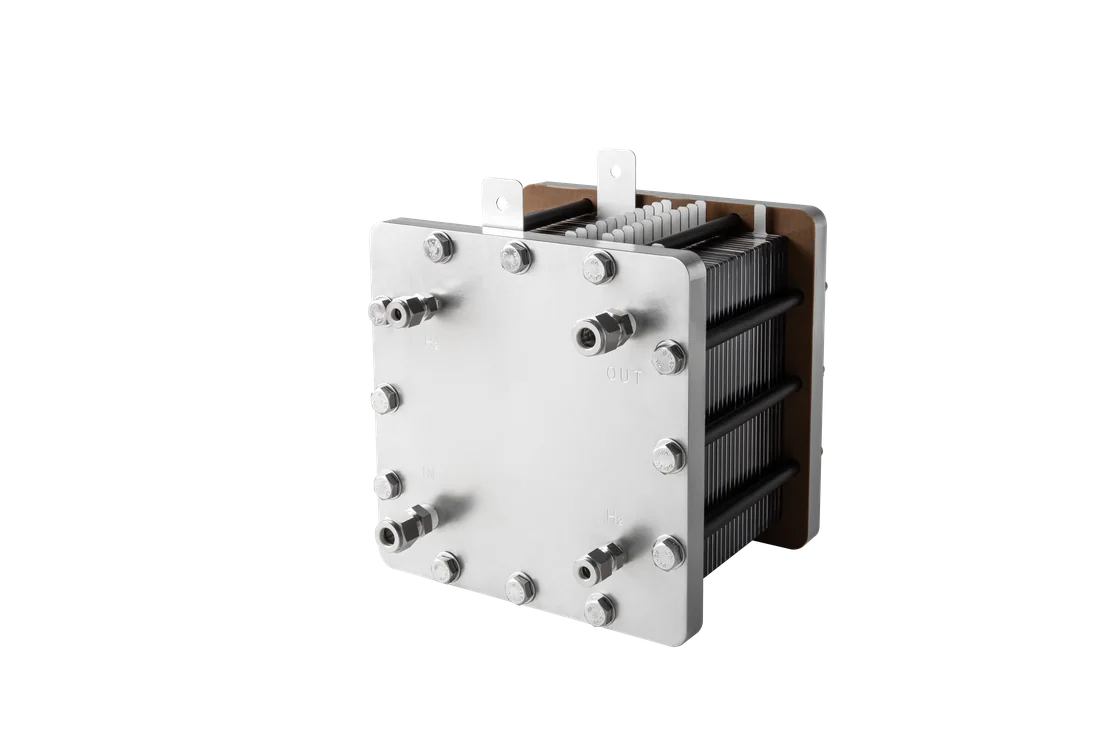
HXS-2 · 23-cell full stack
0.3 M KOH · 60 °C
From electrode to systemWe engineer from electrode
We engineer from electrode
through the operating system
To carry electrode performance into cells, stacks and real operation, we develop the membrane-electrode interface, flow paths, stack structure, electrolyte temperature and flow together. Results from each stage inform the next design.
- 01ELECTRODE
HXP-an · HXP-ca
Catalyst composition · electrode manufacturing
NiFe-LDH · Pt/C · PtRu/C - 02MEA · CELL
Membrane-electrode interface
Flow paths · compression · mass transfer
Cell-level performance checks - 03STACK
HXS-2 · HXS-30
Cell uniformity · sealing · thermal management
Short-stack · full-stack validation - 04SYSTEM
HXB-V1
Voltage · current · electrolyte temperature · flow
Control under operating conditions
MEASURE→REVIEW→REDESIGNTest results from each stage inform the next design.
Measured on HXS-2Performance and durability measured
Performance and durability measured
on the HXS-2 available today
The default view shows the representative results needed for an initial decision. Expand the section below for public charts and detailed test conditions.
HXS-2 · 23-cell full stack
0.3 M KOH · 40 °C · 50 A
View all charts and test conditions3 public datasets
SAME AREA, MORE OUTPUT
Track degradation as output increases
Separate short-stack runs at 50 A and 80 A were each tracked for approximately 1,000 hours at the same electrode area.
- 50 A
- 0.633 A/cm²88.9 µV/h
- 80 A
- 1.013 A/cm²93.9 µV/h
PUBLISHED i-V DATASET · 2026.04
1.675V/cellPolarization curve (i-V)
HXS-2 23-cell full stack · 0.3 M KOH · 60 °C
Measured in April 2026. Rated at 50 A and 38.5 V across the stack; current density is referenced to the 79 cm² cathode area. This public curve predates the latest representative rated point above.
DURABILITY
2,281h published windowGalvanostatic durability
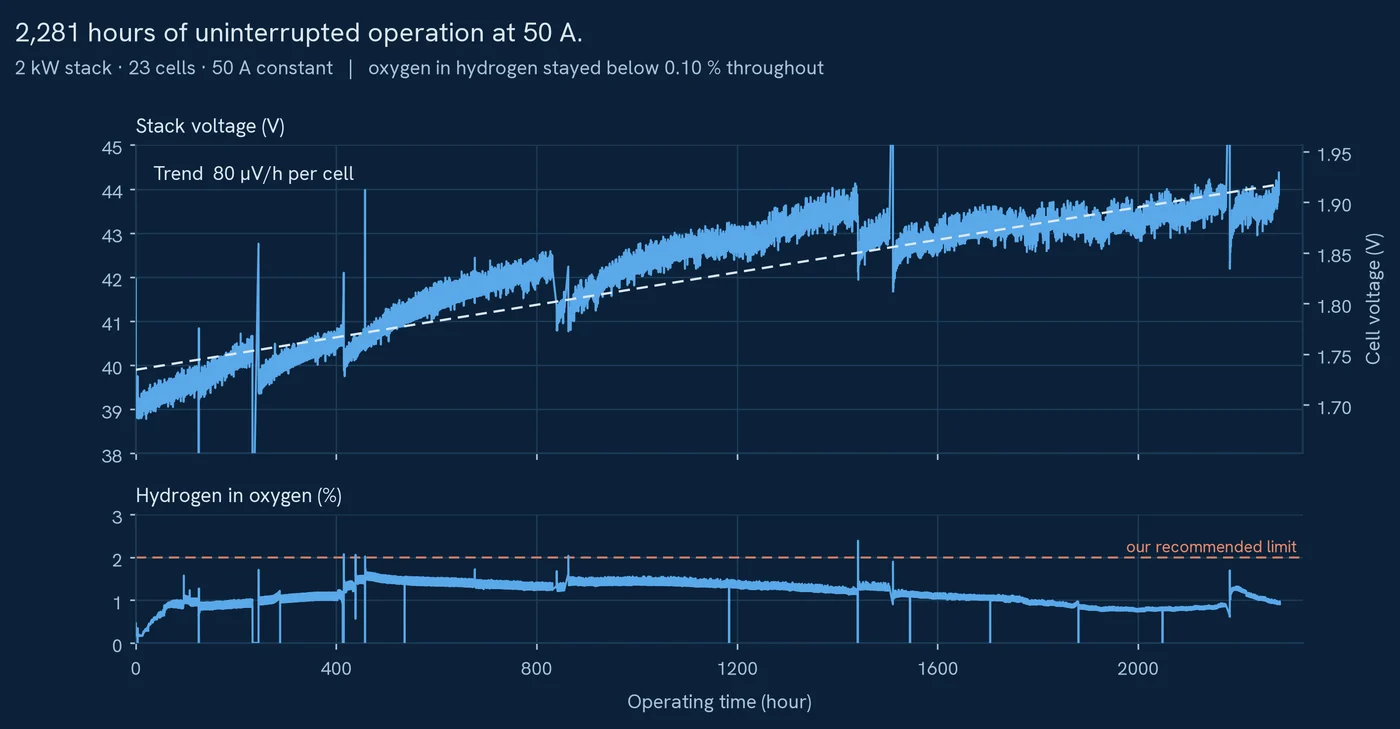
The latest continuous-operation record exceeds 2,400 hours. This chart shows the published 2,281-hour window.
Results apply to the stated test conditions and are not a product-lifetime guarantee. Detailed raw data are available on request.
Measured scale-upWe do not simply scale up
We do not simply scale up
a small-cell result
As active area and cell count grow, we retune flow, temperature, compression and sealing, then measure performance again.
- 01CELL · SHORT STACK
HXS-0
1–25 cm²Cell and short-stack evaluation
- 02COMMERCIAL STACK
HXS-2
23-cell full stackAvailable measured · 98/79 cm²
- 0330 kW SCALE
HXS-30
600 cm² anode · 46 cellsScaling up 500 h+ continuous on five cells · approx. 521 cm² reference active area
Technical review
Tell us your target output and operating conditions
Electrode and MEA evaluation, BoP integration, and stack or system deployment each require different inputs. Share your target production, current, pressure, purity and available equipment, and we will recommend the relevant product and confirm what test data can be provided.