They share a three layer cell, a catalyst vocabulary and even the technology names. One consumes hydrogen to make electricity, the other consumes electricity to make hydrogen. Why that single reversal changes almost every design decision.
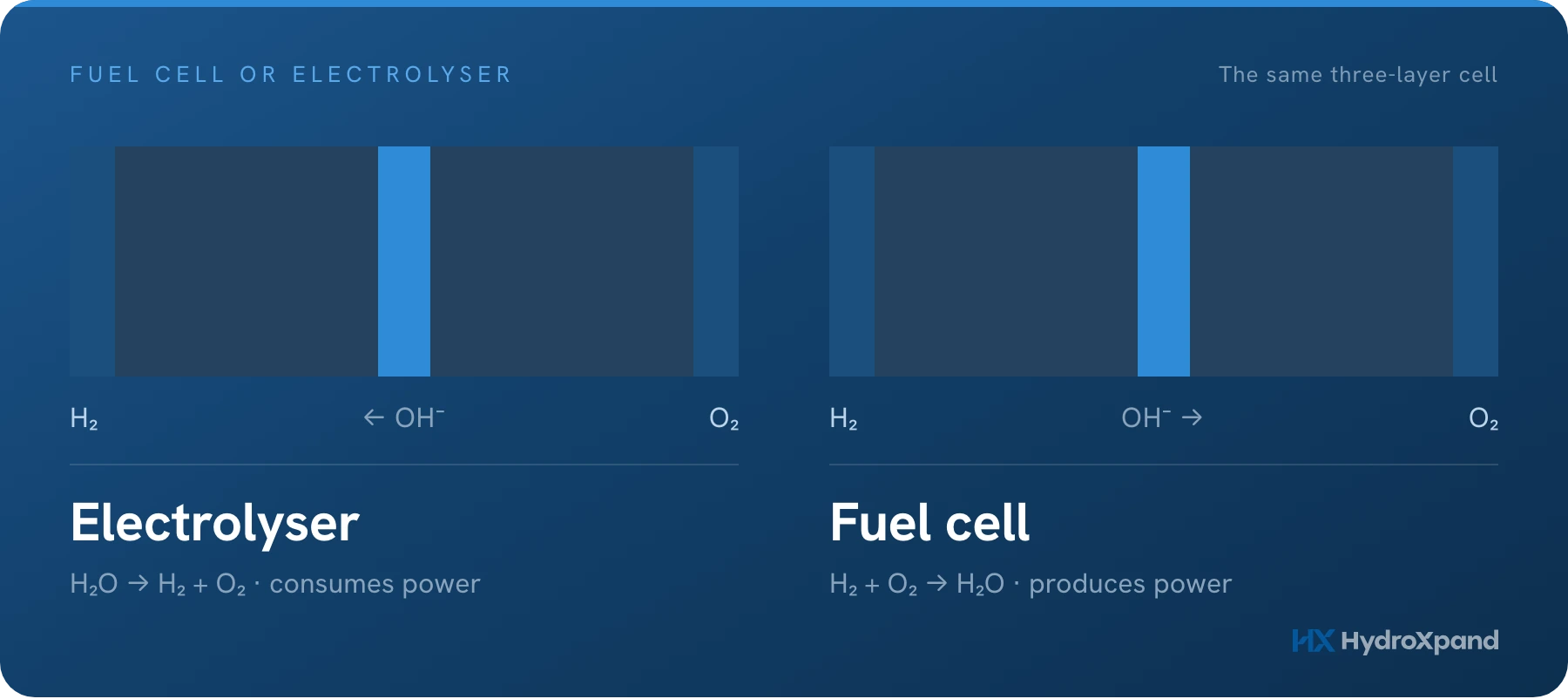
A fuel cell uses hydrogen and oxygen to produce electricity and water. An electrolyzer uses electricity to split water into hydrogen and oxygen. Their overall reactions run in opposite directions, but a conventional fuel cell is not an electrolyzer with its power supply reversed.
The comparison below shows what each device does, why the catalysts and fluid handling differ, and how the two can work together in an energy-storage system. Reversible devices require a design intended for both operating modes.
The reversal, stated plainly
| Electrolyzer | Fuel cell | |
|---|---|---|
| Direction | Electricity + water→ hydrogen + oxygen | Hydrogen + oxygen→ electricity + water |
| What it is for | Producing hydrogen using electricity | Producing electricity from hydrogen |
| Anode reaction | Oxygen evolution (OER) | Hydrogen oxidation (HOR) |
| Cathode reaction | Hydrogen evolution (HER) | Oxygen reduction (ORR) |
| Shares | Three layer MEA · same technology names (PEM, alkaline, solid oxide) |
The shared vocabulary is real. Both are built around a membrane electrode assembly: a catalyst layer, a membrane or electrolyte, and a second catalyst layer. Both are classified by that electrolyte, which is why PEM, alkaline and solid oxide appear on both sides.
Why one device cannot do both well
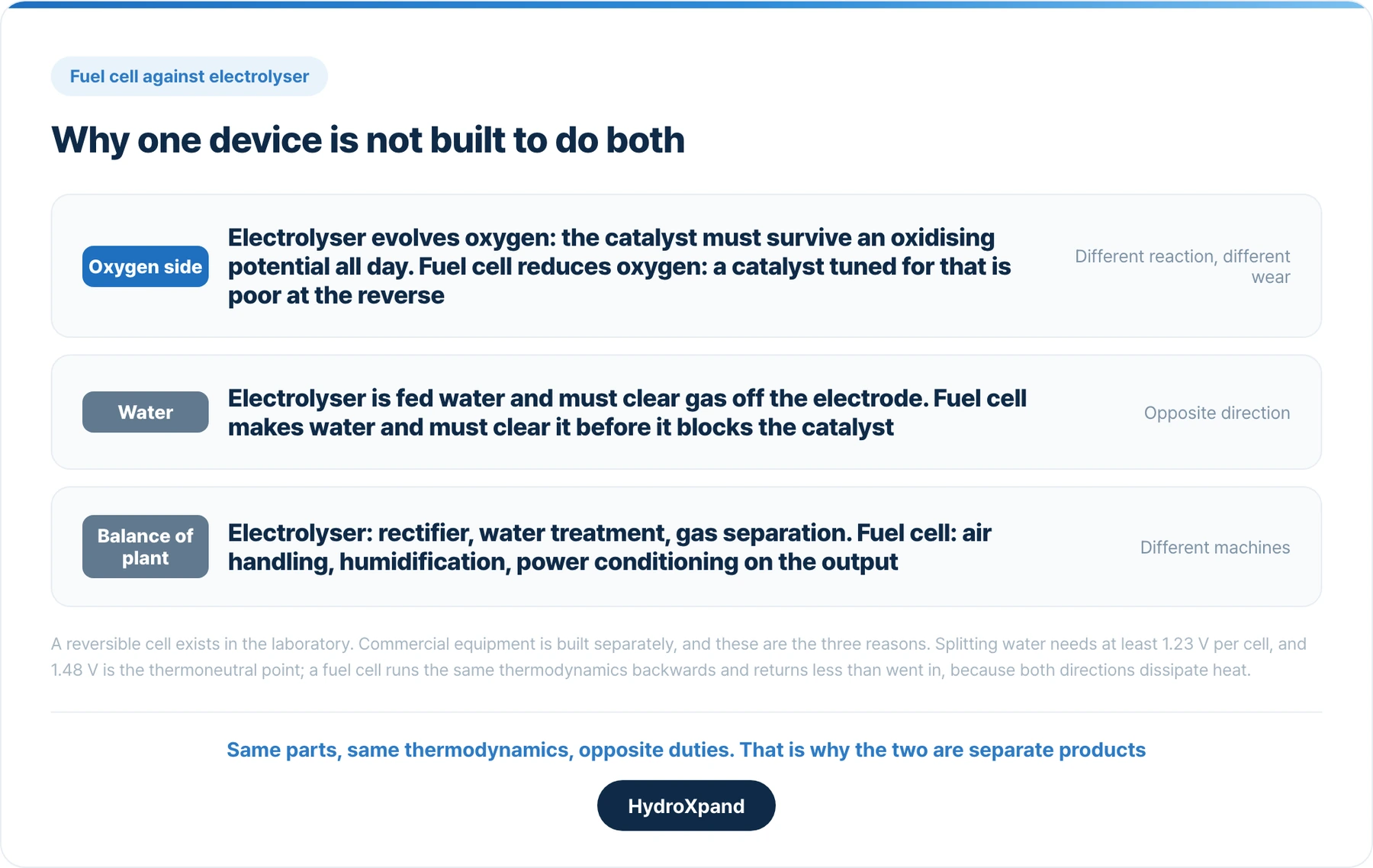
A reversible cell exists in the laboratory, and solid oxide is the technology where it comes closest to practical. In commercial equipment the two are built separately, for reasons that are mostly not about the membrane.
The oxygen side is the first divide. Evolving oxygen and reducing oxygen are different reactions with different catalysts and different degradation paths. A catalyst optimised to survive the oxidising potential of oxygen evolution is not the catalyst you would choose to reduce oxygen efficiently, and the electrode structure that suits one floods or dries in the other.
Water is the second. An electrolyzer is fed water and must remove gas from the electrode surface. A fuel cell produces water and must remove it before it blocks the gas from reaching the catalyst. Those are opposite plumbing problems solved with opposite flow field and porous layer designs.
The third is the balance of plant. An electrolyzer needs a rectifier, water treatment and gas separation. A fuel cell needs air handling, humidification and power conditioning on the output. Even where the stack could be shared, almost nothing around it can be.
Where the energy actually goes
Efficiency numbers for both devices are quoted with enough different boundaries that they are hard to compare. The physics underneath is fixed and worth holding onto.
Splitting water requires a minimum of 1.23 V per cell at standard conditions, and 1.48 V is the thermoneutral voltage at which the cell neither absorbs nor releases net heat. Every millivolt above that becomes heat. On the energy side, one kilogram of hydrogen carries 39.4 kWh on a higher heating value basis and 33.3 kWh on a lower heating value basis — which basis is being used explains a large share of the disagreement between published efficiency figures.
A fuel cell runs the same thermodynamics in reverse and gives back less than was put in, because both directions dissipate heat. The honest way to state a round trip is with its boundary attached: whether the heat from the fuel cell is recovered and used changes the answer more than the choice of either device does.
Lower heating value for H2 is 33.3 kWh/kg H2; 1 kg H2 ≈ 1 gal gasoline equivalent (gge) on energy basis.
SourcesU.S. DOE: Technical Targets for Onboard Hydrogen Storage (lower heating value) · U.S. DOE: Fuel Cells for Stationary Power Applications (electrical efficiency up to 60%)
Which one your project needs
Stated as a question about the site rather than the technology, the answer is usually immediate.
- You have electricity, often surplus or variable, and you need hydrogen — for a process, a laboratory, a fuelling point, or to store energy in a form that keeps for months. That is an electrolyzer.
- You have hydrogen, and you need electricity or heat where a combustion engine or a grid connection will not serve. That is a fuel cell.
- You have both problems at different times of day. That is two devices and a storage volume, not one reversible device, at least with equipment you can buy today.
The pairing matters more than the comparison. Long duration storage is the case where they are genuinely complementary — electrolyzer, storage, fuel cell — and it is also the case where round trip losses are least forgiving, which is why the heat recovery boundary decides whether the scheme works.
What we build
We build the electrolysis side: anion exchange membrane electrodes, stacks, and a 2 kW system that produces about 1 kg of hydrogen per day at up to 10 barg. The HXS-2 stack has more than 3,000 hours of cumulative operation.
We do not build fuel cells, and if that is what your project needs we would rather say so early than sell you the wrong direction.
- Fuel cell types: PEMFC, SOFC, MCFC, PAFC and AFC→The five fuel cell types and the electrolyzer each one pairs with.
- Power to gas, and back again→What the round trip through both devices actually returns.
- What water electrolysis is→The electrolysis side of the pair, with the constants.
- What an MEA is→The component both devices are built around, run in opposite directions.
- Storing hydrogen→The volume between the two devices, and what it charges.
- HXS-2 · 2 kW stack→The stack behind the cumulative operating hours and the 10 barg figure.
- Datasheets→Six products. No form.
Frequently asked questions
What is the difference between a fuel cell and an electrolyzer?
A fuel cell consumes hydrogen and oxygen to make electricity. An electrolyzer consumes electricity to split water into hydrogen and oxygen. They share a three-layer cell but run the reaction in opposite directions.
Can one device work as both a fuel cell and an electrolyzer?
Reversible cells exist, but one device cannot do both well, because the catalyst, water management and gas handling are optimised in opposite directions.
How efficient is each direction?
HydroXpand measures 90.0% HHV at the electrolysis stack, about 44 kWh per kg. A fuel cell returns roughly 50 to 60% of the lower heating value as electricity, so a full round trip returns about a third of the input.
Sources
- DOE Technical Targets for Onboard Hydrogen Storage for Light-Duty Vehicles — U.S. Department of Energy
- Fuel Cells for Stationary Power Applications — U.S. Department of Energy, Fuel Cell Technologies Office
Looking at AEM for a specific application?