Almost 100 million tonnes a year goes into refining, ammonia, methanol and iron ore. What each process does with the hydrogen, how much it takes per tonne of product, and why the uses everyone talks about add up to less than one percent.
Hydrogen is usually introduced as a fuel of the future. It has been an industrial commodity for a century.
The world used almost 100 million tonnes of it in 2024, and the International Energy Agency expects 2025 to pass that mark.
Almost all of it went into four processes: refining crude oil, making ammonia, making methanol, and reducing iron ore.
None of them is a vehicle. Mobility, power generation and synthetic fuels together accounted for less than 1% of demand.
Two jobs, not a long list
Hydrogen turns up in refineries, fertiliser plants, float glass lines, chip fabs and steel mills. The list looks unrelated.
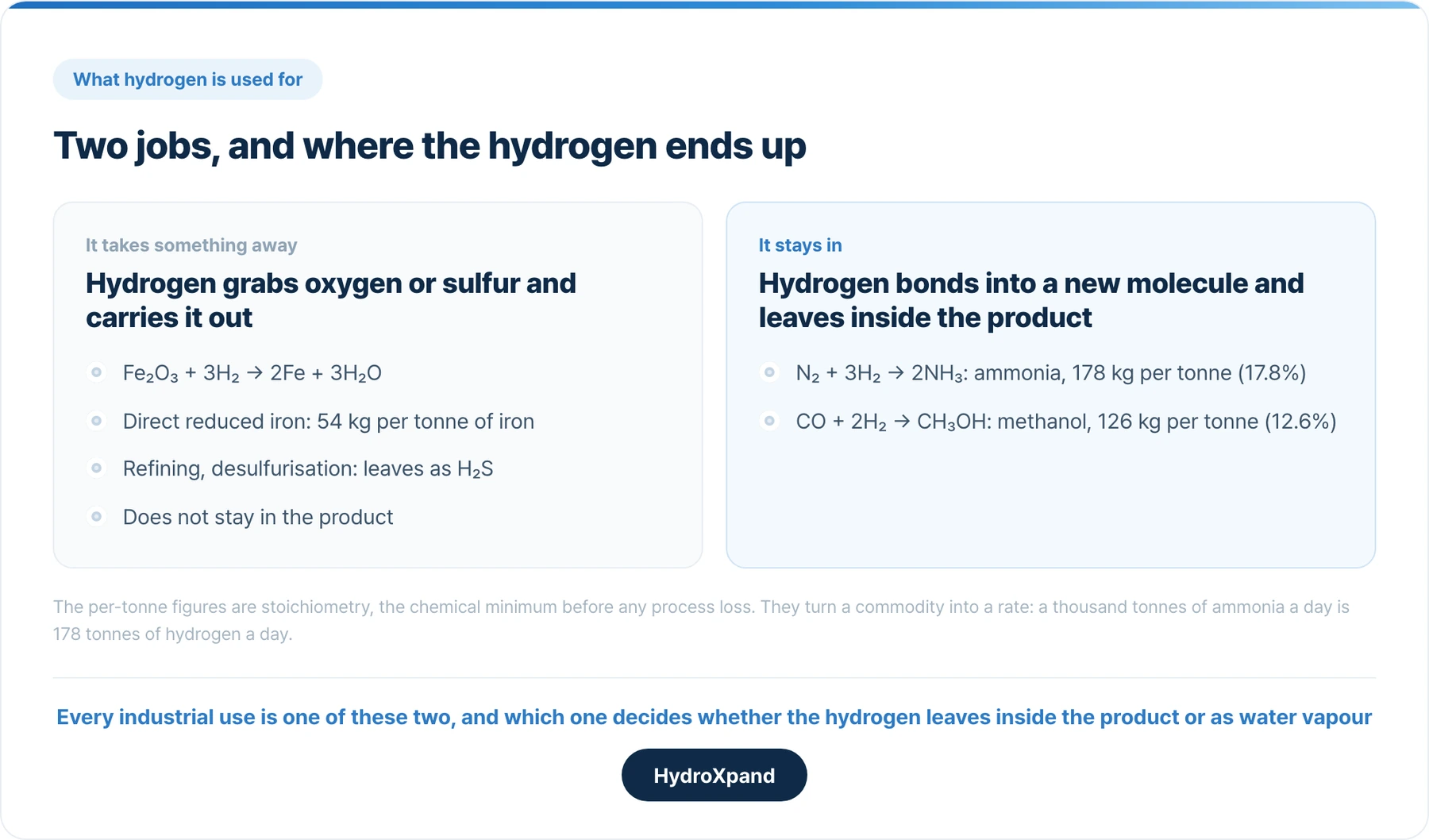
Underneath it there are only two jobs, and both follow from hydrogen's appetite for oxygen.
The first job is taking something away. Hydrogen pulls the oxygen out of an iron ore, leaves as water vapour, and the metal stays behind.
Refineries put the same habit to work on sulfur. Hydrogen binds it and carries it out of the fuel as hydrogen sulfide.
The second job is staying in. Hydrogen bonds to nitrogen and becomes ammonia. It bonds to carbon monoxide and becomes methanol.
In that second job hydrogen is not a fuel at all. It is an ingredient, and it leaves the plant inside the product.
The four uses that are almost the whole market
Refining is the oldest of the four. Hydrogen strips sulfur out of diesel and petrol, and breaks heavy fractions into lighter ones.
Ammonia is the largest chemical use. Nitrogen from the air plus hydrogen gives ammonia, and most of it becomes fertiliser.
Methanol is the other big feedstock. It becomes plastics, resins, paints and adhesives, which is why hydrogen sits inside objects nobody thinks of as hydrogen products.
Direct reduced iron is the newest of the four, and the only one where hydrogen is taking a job away from coal rather than being made from it.
| What the hydrogen does | Hydrogen per tonne | Where it ends up | |
|---|---|---|---|
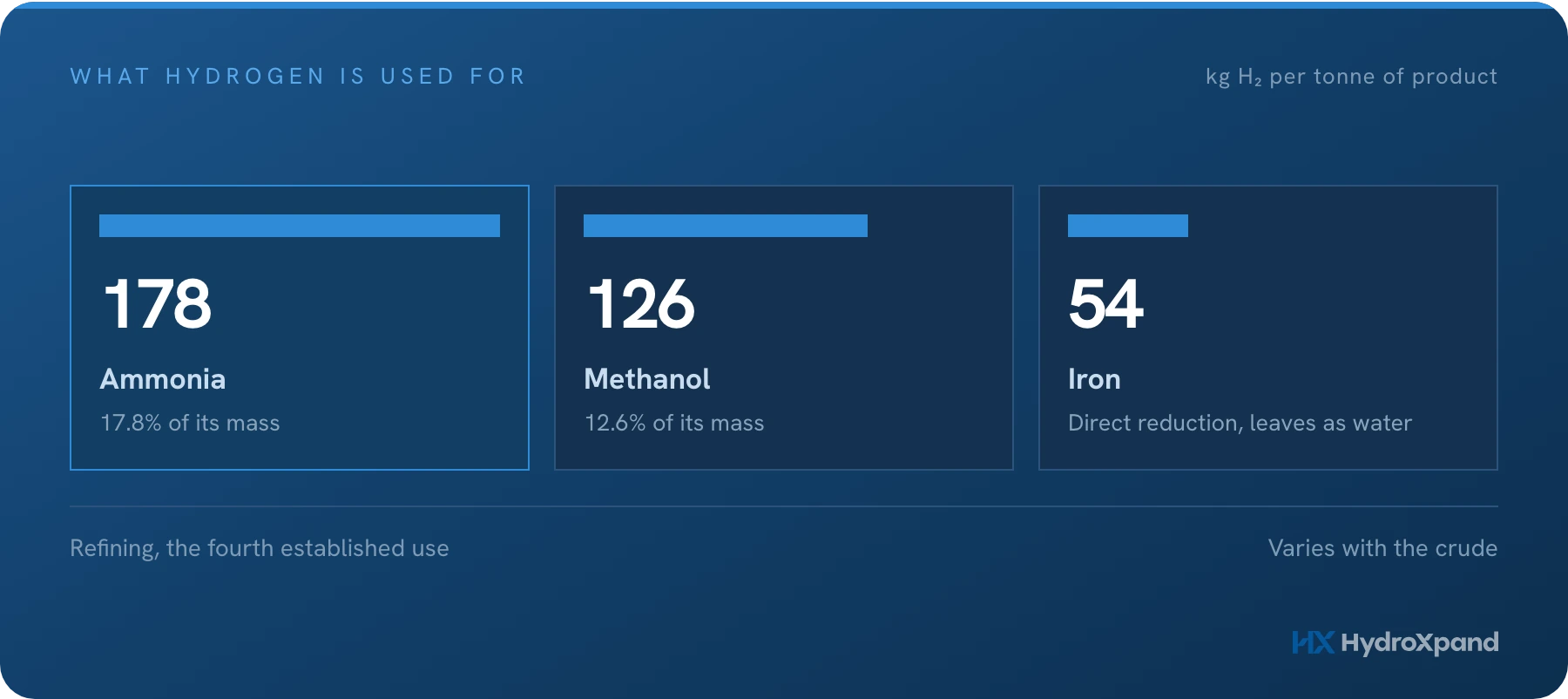
| Refining | Strips sulfur, breaks heavy fractions | Varies with the crudeand the product | Partly in the fuel,partly as H₂S |
| Ammonia | Bonds with nitrogenN₂ + 3H₂ → 2NH₃ | 178 kg | In the product17.8% of its mass |
| Methanol | Bonds with carbon monoxideCO + 2H₂ → CH₃OH | 126 kg | In the product12.6% of its mass |
| Direct reduced iron | Takes the oxygen out of the oreFe₂O₃ + 3H₂ → 2Fe + 3H₂O | 54 kgper tonne of iron | Leaves as water vapour |
Demand is still almost exclusively from established sectors (refining, ammonia, methanol and fossil-based direct reduced iron [DRI])
Those per-tonne figures are stoichiometry: the chemical minimum, before any process loss.
They are worth carrying because they turn a commodity into a rate. A plant making a thousand tonnes of ammonia a day is consuming 178 tonnes of hydrogen a day.
They also explain why hydrogen supply is an industrial gas question rather than an energy question. These plants buy a flow, not a fuel.
And in three of the four, hydrogen never leaves as hydrogen. It leaves as fertiliser, as plastic, or as water vapour.
SourceIEA Global Hydrogen Review 2025, chapter 2: demand of almost 100 Mt in 2024 by sector
The famous uses barely exist yet
Everything that makes hydrogen a headline sits in the same sliver. Fuel cell vehicles, hydrogen turbines, synthetic aviation fuel.
The IEA groups those new applications together at under 1% of demand, growing fast from a very low base.
That is not an argument against them. It is an argument about order.
A hundred million tonne market already exists, and it is supplied almost entirely from natural gas and coal.
Cleaning up that hydrogen needs no new vehicle, no new pipeline and no new customer. The customer has been buying for fifty years.
The quickest emission cut available in hydrogen is not a new use. It is the same hundred million tonnes, made differently.
SourceIEA Global Hydrogen Review 2025: new applications under 1% of demand
The tier that never makes the chart
Below the four big uses sits a wide, quiet tier of sites that buy hydrogen by the cubic metre rather than the tonne.
Chip fabs use it to keep surfaces from oxidising during annealing. Float glass lines mix it into nitrogen for the same reason.
Heat treatment lines use it to reduce surface oxides. Food processing hardens oils with it. Laboratories burn it in detectors and feed it to test cells.
Each site uses little, but it uses it whenever the process runs. Most of them buy cylinders, and the cylinder is the part that hurts.
What arrives with it is a delivery schedule, a storage rack, a regulator, and a quantity somebody else chose.
Our HXB-V1 system makes 480 NL/h, about a kilogram a day, from water and electricity in the room where it is used. Purity is 98 to 99% as it leaves the system, and 99.999% or better with the optional dryer.
A scale check, before anyone oversells this
One tonne of iron takes 54 kg of hydrogen. A machine making a kilogram a day would need about two months to supply it.
On-site generation belongs to the quiet tier, to laboratories and to pilot lines. It does not belong to a steel mill or an ammonia plant.
So the first question at a site is not which technology. It is which tier the site is in, and that is settled by five things.
- Feedstock or reducing agent. Feedstock demand tracks production tonnage; reduction demand tracks throughput and yield.
- The rate per hour, not the total per year. Supply equipment is sized on the rate.
- The purity the process actually needs, and whether it needs the gas dry as well as pure.
- The pressure it has to arrive at, and what would have to be added to reach it.
- Whether the process runs continuously or in bursts. Bursts need storage; steady running rewards making it on site.
The part that has to change is upstream
The use list is not the bottleneck. Hydrogen has customers, and has had them for decades.
What it does not have is a clean supply. Less than 1% of the hydrogen used in 2024 was made without emitting CO₂.
The reason is cost rather than chemistry. Splitting water with electricity has been understood for two centuries and is in service today.
That is the problem we work on. Anion exchange membrane electrolysis aims at the cost of the equipment itself, by building the stack out of nickel and steel instead of iridium, platinum and titanium.
The use list stays the same either way. What changes is what comes out of the plant that fills it.
Hydrogen production reached almost 100 Mt in 2024, but less than 1% was based on low-emissions hydrogen technologies.
SourceIEA Global Hydrogen Review 2025, chapter 3: production by technology
- What water electrolysis is→How the hydrogen is made, and what it costs in kWh per kilogram.
- Power to gas, and back again→The one use on this page that has to justify itself twice.
- Hydrogen generators→Sizing supply for the quiet tier, and what the specification has to say.
- The colours, and what they measure→Why the production route, not the use, decides the carbon number.
- Storing hydrogen→What it takes to move it from where it is made to where it is used.
- HXB-V1 · 2 kW system→The system the 480 NL/h and 99.999% figures belong to.
- Datasheets→Six products. No form.
Frequently asked questions
What is hydrogen used for today?
Almost all of the roughly 100 million tonnes used each year goes into four industrial processes: oil refining, ammonia, methanol and iron ore reduction. Mobility, power and synthetic fuels together take less than one percent.
How much hydrogen is produced without CO2 emissions?
Less than one percent of 2024 production was low-emissions hydrogen, according to the IEA Global Hydrogen Review 2025.
Where is the quickest emission cut in hydrogen?
Not in a new use. It is making the same hundred million tonnes differently, because almost all of today's hydrogen comes from unabated fossil fuels.
Sources
- Global Hydrogen Review 2025 — International Energy Agency, 2025
Looking at AEM for a specific application?