Active area is only the first specification. The sample also has to fit the gasket, make reliable electrical contact and work with the equipment in your laboratory. Here is how to turn those requirements into a test-cell order.
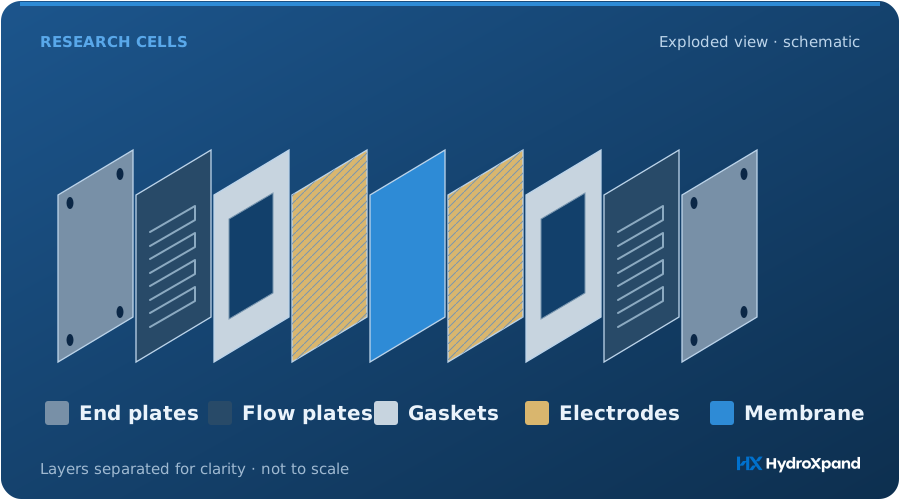
A test cell is often selected by its active area: 5 cm², 25 cm², or whichever size the next experiment needs. But that number describes the reaction window. It does not specify the outer size of the membrane, the thickness of the electrodes or the space needed for a seal.
For a laboratory testing its own materials, those details decide whether the hardware is useful. A cell that fits one membrane and electrode combination may need a different gasket or assembly arrangement for another. Resolving that before manufacture is easier than adapting samples after the cell arrives.
The selection comes down to three questions: will the samples fit, can the laboratory operate the cell, and can the setup repeat the comparison you want to make?
Active area does not tell you the sample size
The membrane normally extends beyond the reaction area so that the assembly can seal around it. The gasket defines an opening, while the electrode has its own outer dimensions, thickness and coated area. These measurements are related, but they are not interchangeable.
Start with a drawing of the materials you will supply. Include the active region and the outer dimensions, and say whether a thickness was measured dry or after conditioning. That gives the supplier enough information to review the layer arrangement and choose the corresponding gasket.
A nominal area is not even a complete description of the opening: two shapes can have the same area and different dimensions. Agree the geometry, not just the number in square centimetres.
| Sample detail | What it determines |
|---|---|
| Active window and outer dimensions | Reaction area and the space available for sealing |
| Membrane thickness and conditioning | The dimensions of the membrane being assembled |
| Electrode thickness, backing and coated area | Contact and the required gasket arrangement |
| Materials supplied by the laboratory | What the supplier must include in the order |
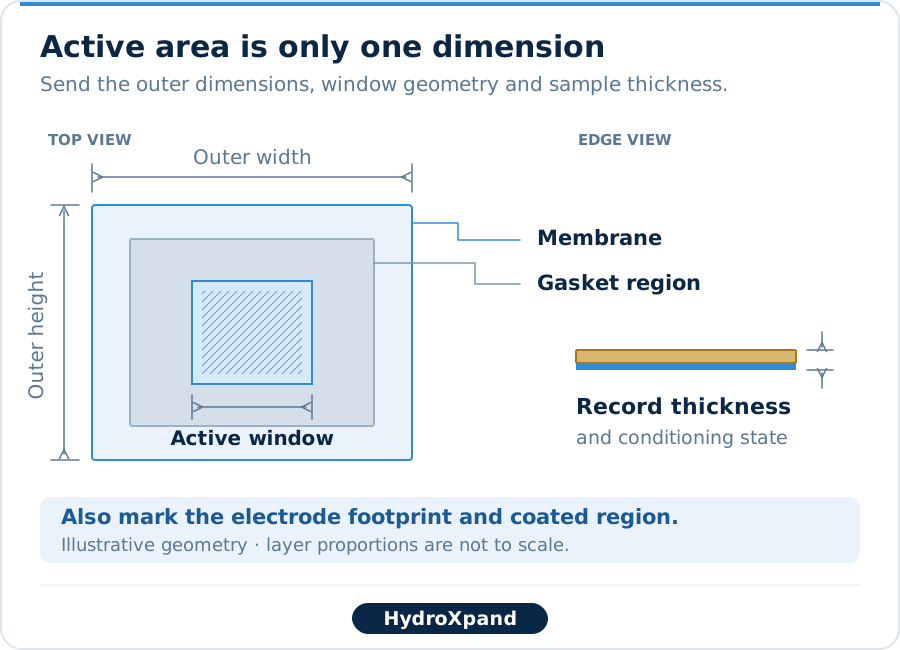
Specify the sample around the active area, not just the active area itself.
Sealing also depends on how the layers are compressed. The tightening sequence and torque belong to the selected fixture and materials; a value copied from another cell is not a reliable assembly specification.
Check the equipment around the cell
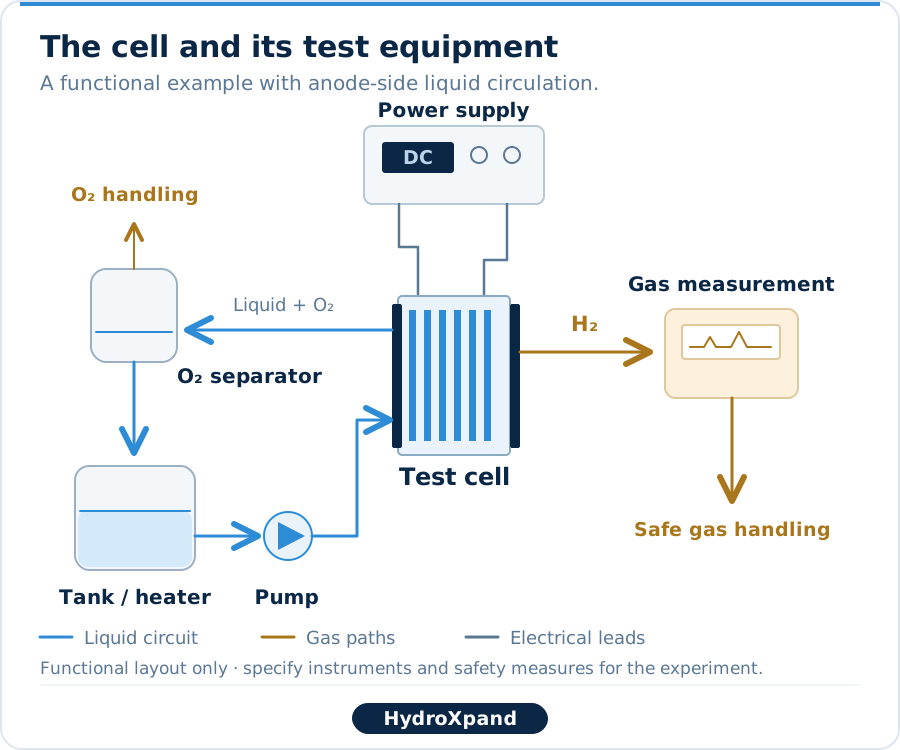
The cell holds the electrochemical assembly. It does not, by itself, supply current, circulate electrolyte, control temperature or measure the gases. Those functions come from the surrounding test equipment, so a cell order and a complete test-system order cover different things.
Check the current and voltage range of the available power supply, the fluid fittings, the circulation arrangement and temperature control. Increasing active area also increases the current needed to reach the same current density. A larger cell may therefore require changes outside the cell.
Include the measurement equipment in this review. If the experiment compares voltage, decide where voltage will be measured. If it compares gas production, identify the measurement point and how the gas will be handled. The laboratory must provide suitable ventilation and safety arrangements for the planned experiment.
Make the reference test repeatable
Suppose a new membrane gives a lower cell voltage. To attribute the change to the membrane, the comparison needs the same electrodes, active area and operating conditions. Changing the gasket, electrolyte concentration or temperature at the same time makes the result harder to explain.
Keep a reference configuration and record the sample batch, conditioning, gasket and assembly procedure for each run. Compare at the same current density, using the stated active area. Also distinguish measured voltage from voltage corrected for resistance: they answer different questions.
A repeat run or reassembly of the reference gives a practical check on variation introduced by the setup. If that variation is similar to the apparent improvement, one curve is not enough to establish a material advantage. Ease of replacing and reassembling samples is therefore part of choosing the hardware, not just a convenience.
The current procedure is a general characterisation method and should be used in both research and development of low-temperature WE single cells and stacks.
SourceJRC: EU harmonised polarisation curve test method for low-temperature water electrolysis (2018)
- What is an MEA?→The electrochemical assembly inside the hardware.
- Reading stack durability data→Why operating conditions must accompany the headline duration.
What to specify for HXS-0
HydroXpand’s HXS-0 is a research cell platform with a gasket-defined active area of 1–25 cm². It can be configured as a single cell or a short stack of up to 20 cells. The active area, cell count and flow-field configuration are agreed before manufacture.
The standard supply does not include the MEA. Laboratories can use their own materials after the dimensions and compatibility have been reviewed, or request a configuration with HXP-an, HXP-ca and a membrane. Confirm which parts will arrive with the hardware and which will be supplied by the laboratory.
The published hardware specification is atmospheric-pressure operation at temperatures up to 80 °C. The membrane and electrodes being tested may require a narrower operating range. Select the test conditions using both the fixture specification and the requirements of the materials.
- HXS-0 · AEM test cell & short stack→Current dimensions, operating limits and supply scope.
- HXS-0 datasheet→Product-specific specifications; confirm the configuration with the supplier.
When a short stack becomes useful
A single cell is a useful starting point for comparing materials. A short stack introduces another question: how consistently do those materials operate across several cells, with shared fluid distribution and a different assembly?
Choose the short stack when that is the question you are ready to investigate. Keep the single-cell result as a reference and record the changes in area, flow, compression and measurement. Total stack voltage can conceal differences between individual cells, so decide how cell-to-cell behaviour will be assessed before increasing the cell count.
- HXS-2 · 2 kW stack→For a separate review of stack-scale work and BoP integration.
What to send with an enquiry
A sample drawing and a short description of the planned test are enough to start the hardware review. Include:
- The membrane and electrode dimensions, thicknesses and conditioning state.
- The intended active area, cell count and the material you want to compare.
- The planned electrolyte, temperature, flow and pressure conditions.
- The power supply, circulation and measurement equipment already available.
- Which materials you will provide and whether you need an MEA with the hardware.
With these details, the supplier can check the sample fit, connections and supply scope before quoting. For HXS-0, they also form the basis for agreeing the configuration before manufacture.
- Review your test-cell requirements→Share the sample dimensions, active area and intended comparison.
- Building a stack in the lab→Where a home-built stack stops, and how to tell which part.
- AEM electrolysis: technology and measured data→How AEM electrolysis works, AEM vs PEM vs alkaline, and the measured data behind our stacks.
- What is an ionomer→The polymer that binds the catalyst layer and carries ions to it, and how AEM and PEM ionomers differ.
- AEM electrolyzer testing: comparing results→What to check when your measurement does not match the datasheet.
- Buying AEM components→Electrodes, cells and the supply boundary.
- What is an electrolyzer stack→What changes when the single cell becomes a short stack.
Frequently asked questions
What should I check before ordering an AEM test cell?
Active area, how the sample fits the gasket, electrical contact and whether the cell works with the equipment already in your laboratory.
What active area does the HXS-0 test cell offer?
1 to 25 cm², set by the gasket window, in configurations from a single cell to a 20-cell short stack. The MEA is excluded as standard and available on request.
Does active area tell me the sample size?
No. The sample has to be specified around the active area, including the gasket overlap, not just the active area itself.
Sources
- EU harmonised polarisation curve test method for low-temperature water electrolysis — European Commission Joint Research Centre, 2018
Looking at AEM for a specific application?