A stack splits water. It does not make hydrogen you can use. Between the two sits the balance of plant, and that is where the numbers you actually buy are decided: energy per kilogram, purity and pressure.
A stack is the part of an electrolyzer where water is split, which is why it gets most of the attention. It is also not a machine. Feed it direct current and electrolyte and it will produce hydrogen saturated with water vapour at whatever pressure the plumbing happens to be at, alongside oxygen and electrolyte that have to go somewhere.
Everything that converts that into hydrogen you can put in a cylinder or a process is the balance of plant, usually shortened to BOP. Stack plus BOP is a system, and the numbers a buyer compares are almost all system numbers rather than stack numbers.
The stack decides how efficient the reaction is. The system decides what you can actually do with it.
What surrounds the stack
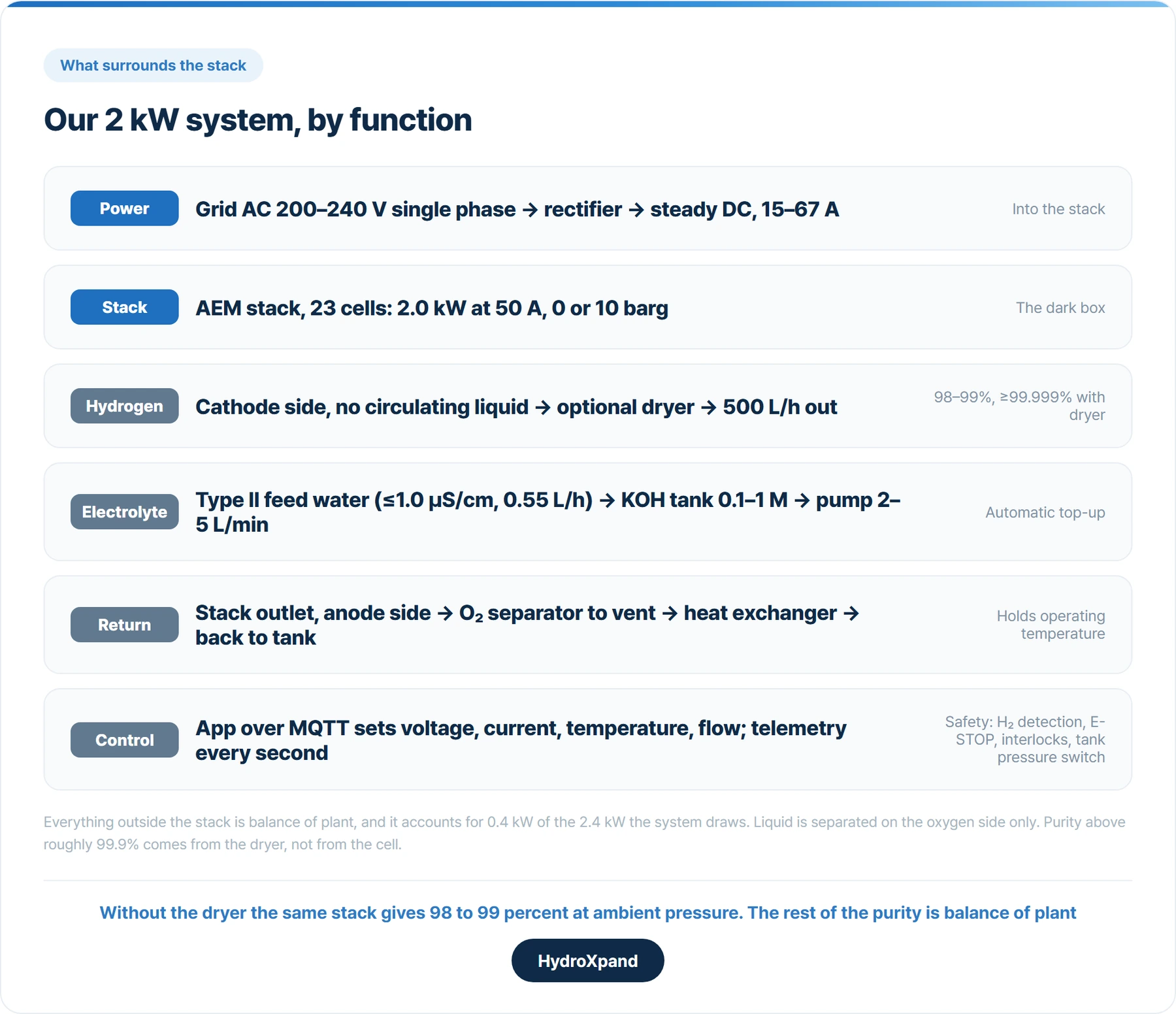
Power conditioning comes first, because a stack runs on direct current and a building does not supply it. A rectifier or power supply converts single or three-phase AC into stable DC, and the quality of that DC matters: ripple and drift show up as an unsteady operating point rather than as a separate problem.
The water and electrolyte loop feeds the reaction. In alkaline and AEM cells the working fluid is dilute KOH rather than pure water, so the loop includes a tank, a circulation pump and the water quality the electrolyte is made up with. Impurities in feed water do not pass through a cell harmlessly, which is why a conductivity specification appears on a datasheet at all.
Gas conditioning turns the product into a product. Hydrogen leaves the stack saturated with water vapour and carrying a trace of oxygen. In our stack only the anode side circulates electrolyte, so liquid is separated on the oxygen side and returned to the tank; the hydrogen line needs drying, plus oxygen removal where the application sets a limit. Purity above roughly 99.9 percent is a function of that train rather than of the cell.
Heat and safety are the part that is easy to underestimate. Only some of the electrical input becomes chemical energy in the hydrogen and the rest becomes heat, which has to be removed to hold the operating temperature steady. Hydrogen detection, interlocks, an emergency stop and pressure protection sit around all of it.
System efficiency is not stack efficiency
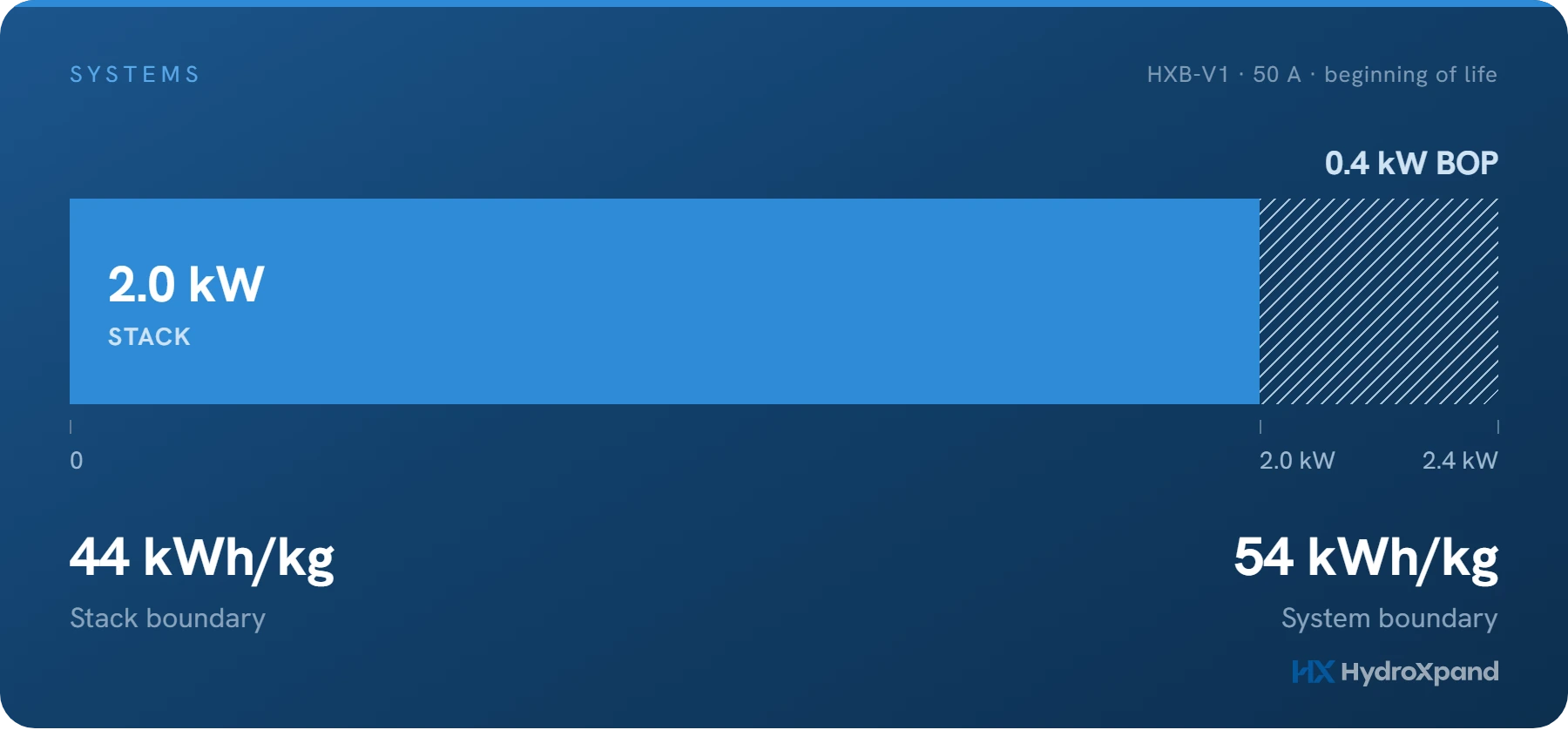
This is the single most common misreading of an electrolyzer specification, and it is easy to see with our own numbers. Our 2 kW system draws 2.4 kW at beginning of life at 50 A. The stack takes 2.0 kW of that. The remaining 0.4 kW runs the pump, the power supply losses, the control electronics and the rest of the BOP.
Ask which boundary the number was measured at, and ask for the other one too.
Both figures describe the same stack at 50 A, once on its own and once inside the system. Neither is dishonest, and the difference between them is not a rounding error: it is seventeen percentage points of efficiency, and on a small system the BOP share is proportionally larger than it would be on a megawatt plant, because much of the auxiliary load does not scale down with the stack.
So when a supplier quotes an efficiency, the first question is not how high it is. It is where the boundary was drawn. A stack figure compared against a competitor's system figure is not a comparison at all.
SourceU.S. DOE Technical Targets for Liquid Alkaline Electrolysis (separate stack and system energy rows)
- HXB-V1 · 2 kW system→The system: water loop, separation, control, safety.
- HXS-2 · 2 kW stack→The stack inside it.
- Datasheets→Six products. No form.
Purity and pressure are system decisions
Two specifications that people assume come from the cell are actually bought in the BOP, and both are worth separating on a quotation.
| Specification | Where it comes from |
|---|---|
| Purity, no dryer | 98 to 99% at 0 barg, 99% at 10 barg. This is what the cell gives, before any dryer |
| Purity, with dryer | 99.999% or better. This is the dryer, not the cell |
| Pressure | 0 or 10 barg on our system, chosen when ordering |
| Water quality | ASTM D1193 Type II, at or below 1.0 µS/cm, supplied to the system |
| Water consumption | 0.55 L/h at 50 A and 60 °C |
The water figure is a good example of why system numbers differ from textbook ones. Splitting one kilogram of hydrogen out of water consumes about 8.9 kilograms of water by stoichiometry. Measured feed consumption is above that, because water also leaves the system as vapour in the saturated product gas and through the vent. The reaction sets a floor, the system sets the number you actually plumb for.
Pressure deserves the same care. Producing at 10 barg rather than ambient saves a compressor downstream, and it costs cell voltage and raises gas crossover. On our stacks we have published that cost in a separate note rather than leaving it out of the pressure specification.
What to check on a system datasheet
- Utilities. Voltage, phase, water quality and consumption, ambient temperature range, footprint and clearances. A system that needs three-phase power or a chilled water supply is a facilities project, not a delivery. Ours runs on 200 to 240 V single phase and weighs 51.3 kg in a 6U format.
- Which boundary the energy figure uses, and what current it was measured at. Energy per kilogram rises over the life of a stack, so beginning-of-life numbers need to be labelled as such.
- How purity is reached, and at which pressure. Whether the dryer is included, and whether the quoted purity holds at the pressure you intend to run.
- Control and data. What you can set, what you can read, at what interval, and over which protocol. Ours exposes voltage, current, electrolyte temperature and flow with one-second telemetry over MQTT and Ethernet. A PLC or SCADA system can connect over Modbus TCP (not RTU), which matters if you are integrating into an existing plant.
- Service and the stack itself. Whether the stack can be removed, opened and replaced in the field, or whether a stack fault means the system goes back to the manufacturer.
Utilities and serviceability decide whether a system runs on your site. Efficiency decides what it costs once it does.
Our system
The HXB-V1 is a 2 kW system built around our own 23-cell stack, and it exists because two different customers want the same box. One wants hydrogen, on site, without cylinder deliveries. The other wants to test stacks, membranes or electrodes under conditions they set themselves.
| Item | Figure |
|---|---|
| Production | 500 L/h, approximately 1 kg per day |
| Power | 2.4 kW at beginning of life, 2.0 stack and 0.4 BOP |
| Energy | 44 kWh/kg stack, 54 kWh/kg system, 4.8 kWh/Nm³ |
| Current | 15 to 67 A, 50 A recommended |
| Purity | 98 to 99% without dryer, 99.999% or better with dryer |
| Electrolyte | KOH 0.1 to 1 M, circulated at 2 to 5 L/min |
| Stack | Removable, disassemblable and replaceable |
| Safety | H₂ detection, emergency stop (control app), interlocks, automatic stop from an electrolyte tank pressure switch |
| Compliance | CE Declaration of Conformity, LVD, EMC and RoHS |
That second use case is why the stack comes apart. A test system whose stack cannot be opened only tests the supplier's stack, and a customer evaluating their own membrane needs to run it in the same cell architecture we use rather than in a fixture that behaves differently.
Above this sits a 30 kW-class stack, the HXS-30. The 46-cell full stack, designed for 6,900 NL/h (15 kg/day), is available to order now; it completed first operation in September 2026 and is currently under long-term evaluation. It is a stack rather than a system, and we would rather say that clearly than let a capacity number imply a 30 kW turnkey system we do not yet ship.
- AEM electrolysis: technology and measured data→How AEM electrolysis works, AEM vs PEM vs alkaline, and the measured data behind our stacks.
- What is an electrolyzer stack→One level down: cells, plates, compression and what a stack datasheet should tell you.
- Electrolyzer efficiency explained→Heating value basis, measurement boundary and current density, and how to compare two quoted numbers.
- What changes when you run the stack at 10 bar→The measured voltage cost of pressurised operation, and what crossover really bounds.
- HXB-V1 2 kW system→Full specification, control app screens and datasheet.
- HXS-30 · 30 kW AEM electrolyzer stack→The 46-cell full stack, available to order, with measured data kept separate from design values.
- How to size a hydrogen generator→Turning daily consumption into a rate, and the five numbers a specification has to state.
- Balance of plant→The loops a bare stack needs around it, drawn at its ports.
Frequently asked questions
What is the difference between an electrolyzer stack and a system?
The stack splits water. The system adds the balance of plant that makes the hydrogen usable: power conversion, electrolyte circulation, gas separation, purification and control.
Why is system efficiency lower than stack efficiency?
Because the balance of plant draws power too. On the same HydroXpand machine the stack uses about 44 kWh per kg and the system about 54 kWh per kg; the difference of about 10 kWh per kilogram is the BOP share.
Are purity and pressure stack figures or system figures?
System figures. The outlet pressure is set by the system design and purity by the drying and purification stage, not by the stack alone.
Sources
- Technical Targets for Liquid Alkaline Electrolysis — U.S. Department of Energy
- MQTT: The Standard for IoT Messaging — OASIS
Looking at AEM for a specific application?