Five colour names, one identical molecule. The colour tells you what a kilogram of hydrogen was made from and what powered it, and nothing else. Certification schemes have already moved past the colours to the number underneath them.
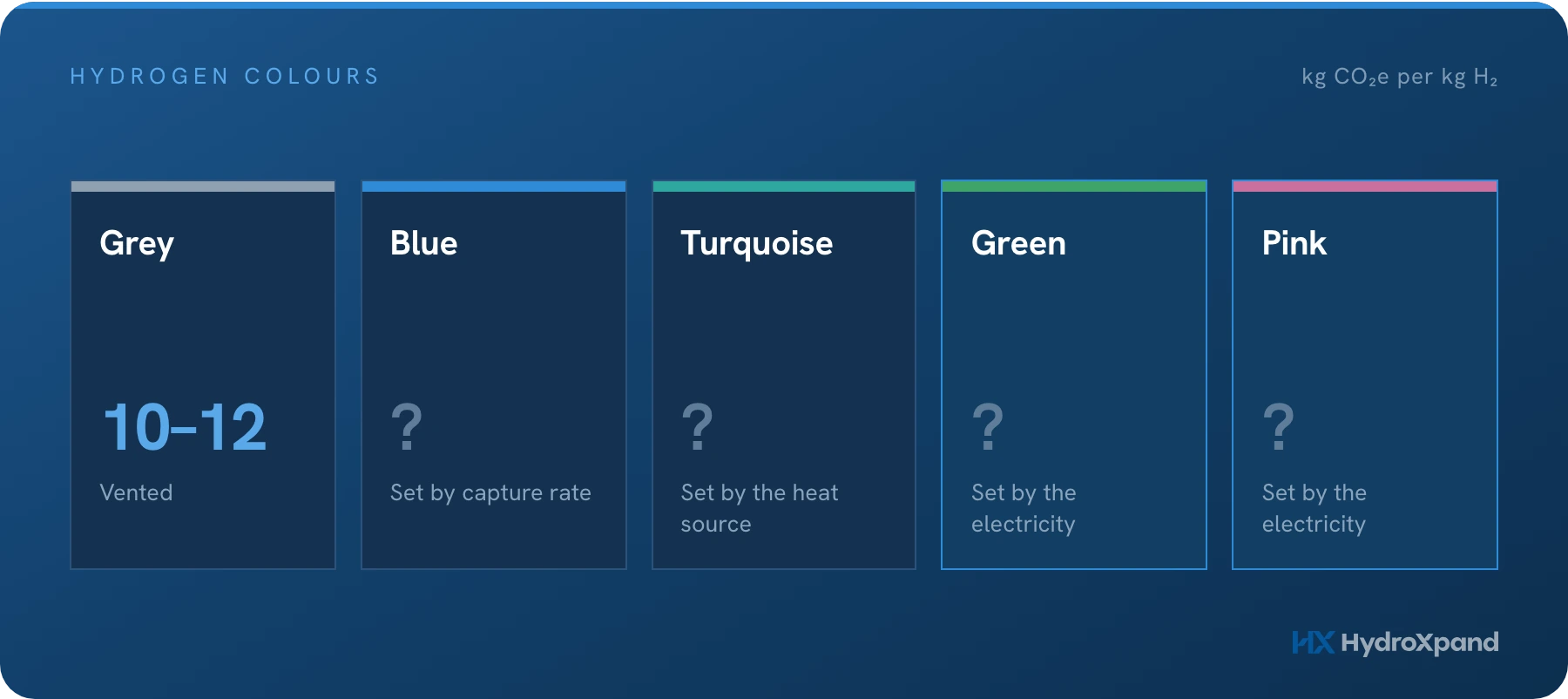
Hydrogen is a colourless gas. Every kilogram of it is the same molecule, however it was made.
The colours describe the production route, and they were a useful shorthand while the industry was still arguing about direction.
They stop being useful where money changes hands. A certificate, a subsidy or a supply contract does not ask for a colour. It asks for a number: kilograms of CO₂ equivalent per kilogram of hydrogen, measured over a stated boundary.
The five names, in one table
| Made from | Where the carbon ends up | CO₂ per kg H₂ | |
|---|---|---|---|
| Grey | Natural gas, steam reformed | Vented | 10–12 kgIEA, unabated natural gas |
| Brown or black | Coal, gasified | Vented | 22–26 kgIEA, unabated coal |
| Blue | Natural gas, steam reformed | Captured and stored, in part | Set by capture rateand upstream methane |
| Turquoise | Natural gas, pyrolysed | Solid carbon, sold | Set by the heat sourceand the carbon's fate |
| Green | Water, renewable electricity | No carbon in the feedstock | Set by the electricity |
| Pink | Water, nuclear electricity | No carbon in the feedstock | Set by the electricity |
The classification is a convention, not a standard. No standards body defines it, and the list grows whenever someone adds a feedstock.
Note the right-hand column. Four of the six rows cannot be given a carbon figure at all without knowing something the colour name does not carry.
Where grey hydrogen's CO₂ comes from
Steam methane reforming pulls hydrogen out of methane. The carbon that was in the methane has to go somewhere.
Including the shift step, the reaction is CH₄ + 2H₂O → CO₂ + 4H₂. Four molecules of hydrogen for one of carbon dioxide, which is 5.5 kg of CO₂ per kilogram of hydrogen. Nothing has been burned at that point.
That figure is not a design flaw waiting to be engineered away. It is what it costs to take hydrogen out of a molecule that has carbon in it.
Real plants report about twice as much. The reaction needs heat, and the heat comes from burning more gas.
The IEA puts unabated natural gas at 10 to 12 kg CO₂ equivalent per kilogram of hydrogen, and unabated coal at 22 to 26 kg. Those two routes are still most of the world's supply. Low-emissions hydrogen of every kind is under 1% of production.
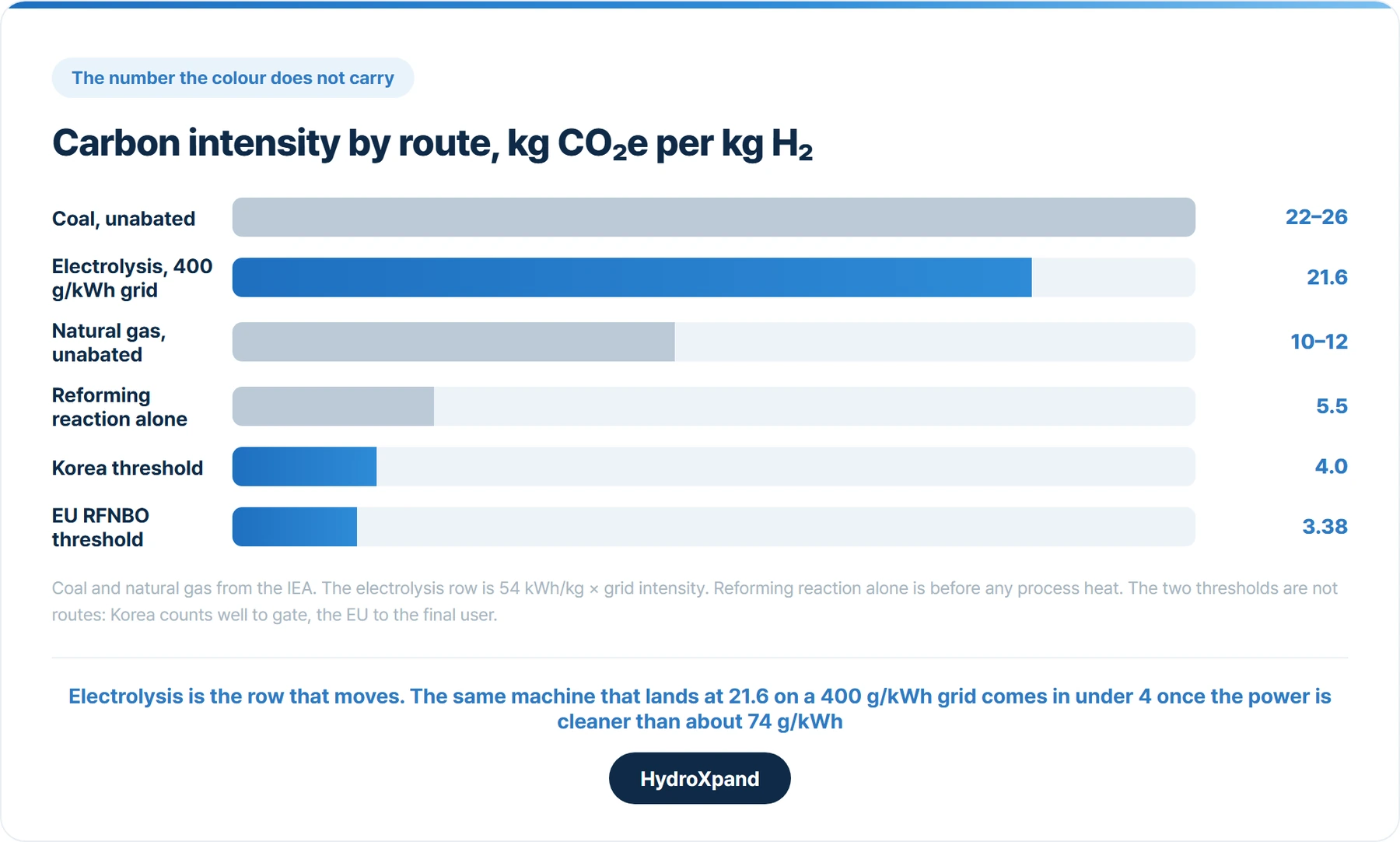
Nearly two-thirds of production was from unabated natural gas, which emits 10-12 kg CO2-equivalent (CO2-eq)/kg H2; about 20% was from unabated coal, which emits 22-26 kg CO2-eq/kg H2.
SourcesIEA Global Hydrogen Review 2024, chapter 7: emissions intensity by production route · IEA Global Hydrogen Review 2025: low-emissions hydrogen still under 1% of production
Blue is a capture rate, not a colour
Blue hydrogen is the same plant with carbon capture bolted on. The word covers a wide range of outcomes.
Part of the CO₂ is easy to catch. The shift step gives it up as a concentrated stream, and concentrated streams are cheap to separate.
The rest is not. The furnace that heats the reformer sends its CO₂ up the flue, diluted with air. Separating that is expensive, and it is a large share of the total.
That is why capture rates in the middle of the range are more common in operating plants than the 90%-plus figures that appear in project announcements.
The second gap sits outside the fence. Methane leaks while gas is drilled, piped and shipped, and no capture unit ever sees it. Methane also traps far more heat than CO₂ over a twenty-year horizon.
Life-cycle studies of well-run, high-capture plants still report a few kilograms of CO₂ equivalent per kilogram of hydrogen. That is small against 10 to 12. It is not small against a threshold of 4.
Blue hydrogen is only as clean as its capture rate and its methane record, and both are site-specific.
Turquoise: the carbon comes out solid
Methane pyrolysis heats natural gas with no oxygen present. The molecule splits into hydrogen gas and solid carbon instead of hydrogen and CO₂.
Nothing has to be captured and nothing has to be injected underground. That removes the storage-site problem blue hydrogen projects spend years on.
Two conditions come attached. The heat has to come from somewhere, and an electric or plasma reactor moves the emissions question onto the electricity supply rather than removing it.
The solid carbon also has to be sold. It is carbon black, the filler used in tyres, inks, plastics and battery materials, and the economics depend on that revenue. Published cost comparisons move a long way once the by-product credit is taken out.
There is an open accounting question as well. Carbon sold as a product gets used, and some of it gets burned. Whether that counts as keeping the carbon out of the air is something the certification schemes are still deciding.
Green and pink are the same machine
This is the part the colour chart hides. Green and pink hydrogen come out of identical equipment running an identical reaction.
An electrolyzer cannot tell where its electrons came from. The colour is a property of the power contract, not of the plant.
That has a consequence you can work out for yourself. Our HXB-V1 2 kW system measures 54 kWh per kilogram of hydrogen at the wall. Of that, 44 kWh is the HXS-2 stack; the rest runs the pumps, controls and drying around it.
Multiply that by the carbon intensity of the electricity you feed it. Take a grid at 400 g CO₂ per kWh, as an illustration rather than any particular country. The answer is 21.6 kg of CO₂ per kilogram of hydrogen, or roughly double unabated natural gas.
Now run it backwards. At 54 kWh per kilogram, the electricity has to be cleaner than about 74 g CO₂ per kWh to land under a 4 kg threshold. Very few grids are.
Electrolysis is not automatically clean. It is exactly as clean as its electricity, and that is a contract question rather than a technology one.
The number that replaced the colours
The two schemes our customers most often have to satisfy are colour-blind by design.
In the EU, hydrogen made with renewable electricity is called a renewable fuel of non-biological origin, or RFNBO. To qualify it has to come in 70% below a fossil comparator of 94 g CO₂e per MJ. That works out at about 3.38 kg CO₂e per kilogram, counted all the way to the final user.
Korea's clean hydrogen certification sets 4 kg CO₂e per kilogram, counted from the well to the factory gate. Qualifying hydrogen is then split into four grades, and the cleanest sits below 0.1 kg.
Neither scheme gives anything for a name. Gas-derived hydrogen with high capture and controlled methane can pass. Electrolytic hydrogen on an average grid can fail.
The colour is a conversation starter. The number is the specification.
- Ask for the figure in kg CO₂e per kg H₂, not the colour.
- Ask where the measurement stops. To the factory gate and to the final user are different questions, and they can differ by more than a kilogram.
- For anything made from gas, ask the capture rate, which CO₂ streams it covers, and what leak rate was assumed upstream.
- For anything made by electrolysis, ask about the electricity contract, and whether supply is matched hour by hour and region by region or only over a year.
- Ask which scheme issued the certificate. A grade under one is not a grade under another.
SourcesIEA Global Hydrogen Review 2024: EU low-carbon definition, 70% reduction against a 94 g CO2-eq/MJ benchmark · IEA Global Hydrogen Review 2025: Korea's clean hydrogen power tender requires below 4 kg CO2-eq/kg H2 · 청정수소 인증제도 운영에 관한 고시, Annex 1: the four Korean grades
- What water electrolysis is→The four numbers that describe any electrolyzer, including where 54 kWh/kg comes from.
- How to read an efficiency figure→Heating value basis and the cell, stack and system boundaries, in full.
- Alkaline, PEM or AEM→Once the electricity question is settled, the four questions that decide the technology.
- Who actually makes water electrolyzers→A working map of manufacturers by technology.
- HXB-V1 · 2 kW system→The system the 54 kWh/kg figure belongs to.
- Datasheets→Six products. No form.
Frequently asked questions
What do the hydrogen colours mean?
The colour describes what the hydrogen was made from and what powered the process, not the gas itself. Green is electrolysis on renewable electricity, grey is natural gas, blue is grey with carbon capture, turquoise is methane pyrolysis and pink is electrolysis on nuclear electricity.
How much CO2 does grey hydrogen emit?
About 5.5 kg of CO2 per kg of hydrogen from the reforming reaction alone, and 10 to 12 kg of CO2 equivalent per kg including process heat and upstream emissions, according to the IEA.
How clean must electricity be for electrolysis hydrogen to count as low-carbon?
At the HXB-V1's measured 54 kWh per kg, the electricity has to be under about 74 g of CO2 per kWh to bring the hydrogen under 4 kg of CO2 per kg. Certification schemes add rules on where and when the power was generated.
Sources
- Global Hydrogen Review 2024 — International Energy Agency, 2024
- Global Hydrogen Review 2025 — International Energy Agency, 2025
- 청정수소 인증제도 운영에 관한 고시 (clean hydrogen certification notice), MOTIE Notice 2024-39 — law.go.kr
Looking at AEM for a specific application?