A quotation usually gives the warranty as one line. Which product the warranty period applies to, what it promises, and what happens when performance drops through operation are not in that line. What to check before you order, using our own warranty and service policy as the example.
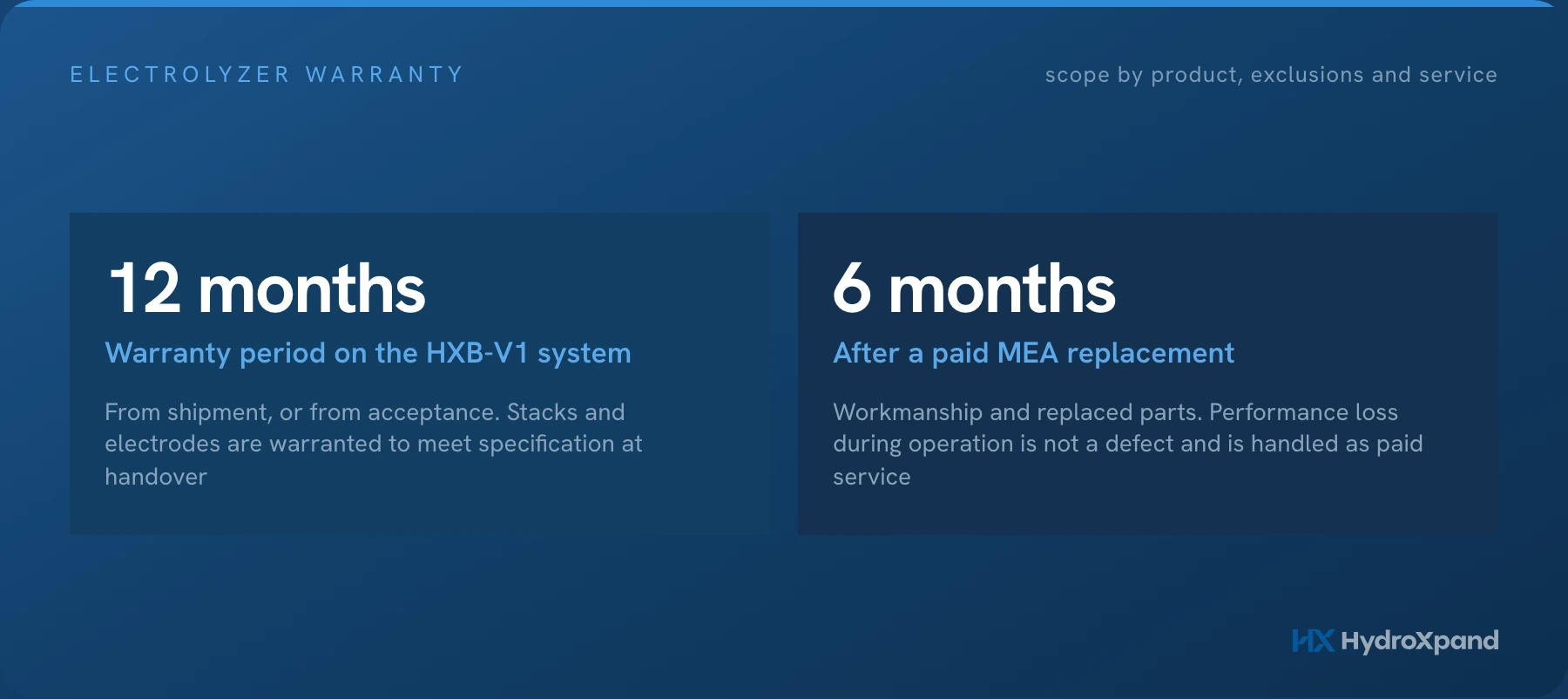
Quotations usually give the warranty as a single line: one year. Which product that year applies to, what it promises, and what happens if performance drops during operation cannot be read from that line. Finding out after a problem appears is too late; checking before the order lets you plan the cost and schedule after installation.
Using our own warranty and service policy as the example, this is what to check, in order.
- Check which product the warranty period applies to. A complete system and components such as stacks and electrodes are warranted on different terms.
- Separate defects from performance loss. Faults in materials or workmanship at delivery are handled under warranty; performance loss during operation is usually handled as paid service.
- Look closely at the exclusion for operation outside the specification: water quality, electrolyte concentration, temperature, pressure and power.
- Know what to send if something goes wrong. Diagnosis starts from the operating record.
Warranty coverage varies by product
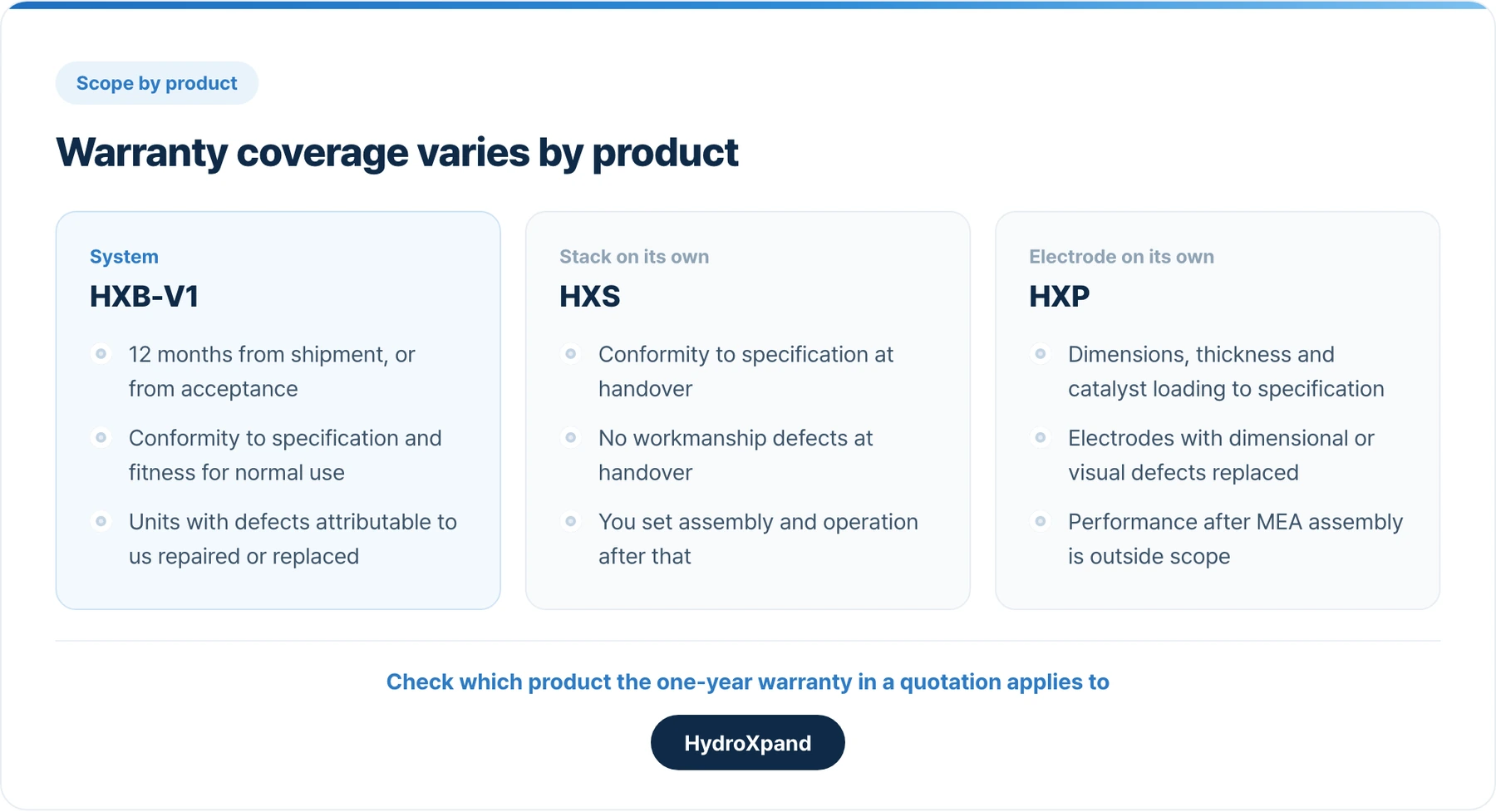
Our 12-month warranty applies to the HXB-V1, our 2 kW system. The stack, circulation pump, power supply and controls are in one unit, and it runs to our design under conditions we specify.
Stacks (HXS) and electrodes (HXP) bought on their own are different. What we warrant is that the product conforms to its published specification and is free of workmanship defects at handover; for an electrode, that means dimensions, thickness and catalyst loading. After handover, you decide how the cells are assembled, how the power supply and circulation are configured, and how the product is operated. We therefore cannot warrant its performance and service life after that point for a fixed period.
| Product | What is warranted | Term |
|---|---|---|
| HXB-V1 system | Conformity to the product specification and fitness for normal use. A defect attributable to us is repaired free of charge, or the unit is replaced with an equivalent or better one if repair is not practical. | 12 months from shipment, or from acceptance if the contract includes an acceptance procedure |
| HXS stack on its own | Conformity to specification and freedom from workmanship defects at handover | At handover |
| HXP electrode on its own | Conformity to specification at handover (dimensions, thickness, catalyst loading). Electrodes with dimensional or visual defects are replaced free of charge. | At handover |
The term runs from shipment because storage, transport and the installation date after shipment are outside our control. If the contract includes an acceptance procedure, it runs from the date of acceptance. Confirm the start date when you receive the quotation.
What the warranty covers
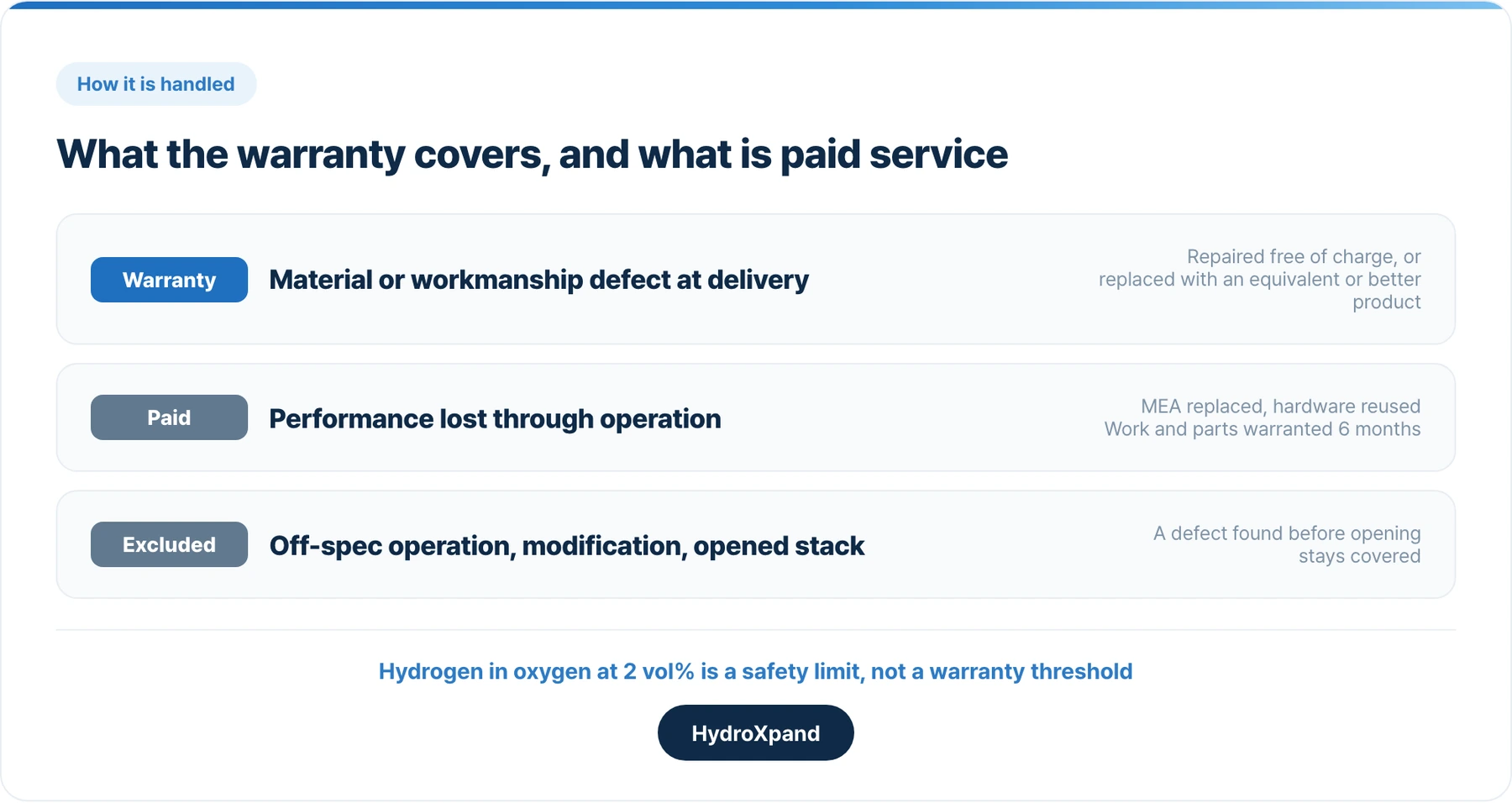
The warranty covers faults in materials or workmanship that were present at delivery. Where we are responsible, we repair free of charge, or replace with an equivalent or better product if repair is not practical.
Repairs are done at our facility: you send the unit, we diagnose and repair it and send it back. You pay the shipping to us and we pay the shipping back. Repair time depends on the fault, so we tell you the diagnosis and the expected schedule after the unit arrives, before we proceed.
What the warranty does not cover
- Defects caused by mishandling
- Modifications made without our prior agreement
- Defects from use outside the product specification, including water quality, electrolyte concentration, temperature, pressure and power conditions
- Normal wear of consumable parts, including the MEA and the electrolyte
- Force majeure
The third item depends directly on the operating record. Whether the feed water stayed outside the recommended range, or the electrolyte concentration or temperature went outside the specification, can only be checked from a record. Without one, telling a defect from the effect of operating conditions becomes difficult.
If you open the stack yourself
Our stacks are compression-assembled, so they can be taken apart and rebuilt, and we provide an assembly guide. Performance and leak-tightness after a customer has opened the stack are not warranted, because the quality of the reassembly determines the outcome. A defect identified before opening stays covered. If you want us to check a stack after you reassemble it, arrange that with us before opening; it is a service, not a warranty claim.
Opening the HXB-V1 system counts as a modification. If work inside the system is needed, contact us first.
When performance drops through operation
As a stack runs, its cell voltage rises slowly and efficiency at the same current falls. That is a normal consequence of operation, not a defect, so it is not covered by the warranty. How to read the rate of that rise is covered in our article on durability data.
When performance has fallen far enough that replacement is needed, it is handled as paid stack service. You send the stack; we replace only the consumable MEA and reuse the end plates, bipolar plates, cell frames and fasteners. For six months after a paid replacement we warrant the workmanship and the replaced parts, though not the normal degradation over those months. The cost depends on the stack type and is set out in a quotation.
- Reading electrolyzer durability data→Operating hours, degradation rate and the conditions behind them.
- Stack life and MEA replacement→How a replaceable-MEA stack changes a multi-year budget.
Hydrogen in oxygen at 2 vol% is a safety limit
If the hydrogen concentration in the oxygen-side gas exceeds 2 vol%, stop the unit and contact us. This is a safety limit, separate from any warranty or free-replacement threshold. Exceeding it does not automatically make an issue a warranty case, and staying below it does not exclude an issue from the warranty.
What happens when something goes wrong
| Step | What happens |
|---|---|
| 1. Contact | Send a description of the symptoms and the operating record to [email protected]. We reply in detail within 24 to 48 hours. |
| 2. Remote diagnosis | The HXB-V1 is operated from a PC, so we look at the same data with you to find the cause. Many issues are resolved at this stage. |
| 3. Return | If it cannot be resolved remotely, we explain how to return the unit and how to pack it. |
| 4. Repair and return | After the unit arrives we tell you the diagnosis and the expected schedule, then proceed. |
Sending the operating record with your first message speeds up the diagnosis, because records from before and after the symptoms appeared can be compared. What to record, and how, is the subject of our next article.
We commit to a response time but not to a repair time in advance. The work needed varies widely with the fault, and a time promised before diagnosis would be a promise we might not keep.
If the policy and the contract differ, the contract applies
Our warranty and service policy restates the quality warranty clause of the contract in plainer language. Where an individual contract differs from the policy, the contract applies. If a tender or procurement rule needs different warranty terms, raise it at the quotation stage; changing terms after the order is difficult.
- Reading an electrolyzer quotation→Supply tier, lead time, Incoterms and the item the warranty applies to.
Six things to check before you order
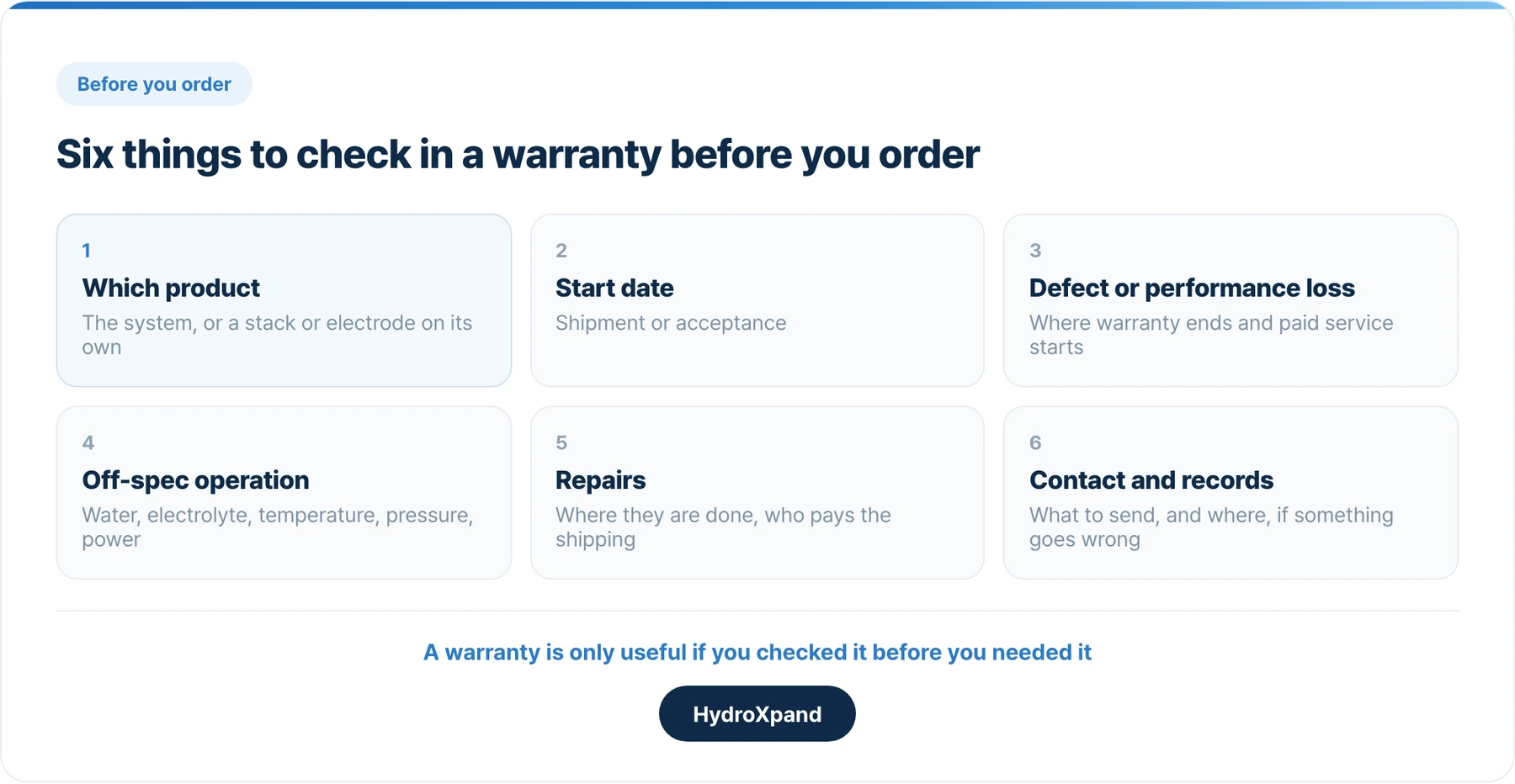
- Which product the warranty period applies to: the system, or a stack or electrode on its own
- Whether the term starts at shipment or at acceptance
- How defects are separated from performance loss through operation
- Which conditions count as operation outside the specification: water quality, electrolyte concentration, temperature, pressure, power
- How repairs are done, and who pays the shipping
- Which records to send, and where, if something goes wrong
- From order to installation→What happens, in order, after you place an electrolyzer order.
Frequently asked questions
Does a stack bought on its own carry the 12-month warranty?
The 12-month warranty applies to the HXB-V1 system. A stack bought on its own is warranted for conformity to specification and freedom from workmanship defects at handover, because assembly and operating conditions after that are set by the customer.
When does the warranty term start?
Twelve months from shipment. If the contract includes an acceptance procedure, it runs from the date of acceptance.
If efficiency drops during operation, is the stack replaced under warranty?
Performance lost through operation is not a defect, so it is not covered. It is handled as paid stack service: only the MEA is replaced, the rest of the hardware is reused, and the work and replaced parts are warranted for six months.
Can I open the stack to inspect it?
You can, but performance and leak-tightness after a customer has opened the stack are not warranted. A defect identified before opening stays covered; if you want a check after reassembly, arrange it with us before opening.
Looking at AEM for a specific application?