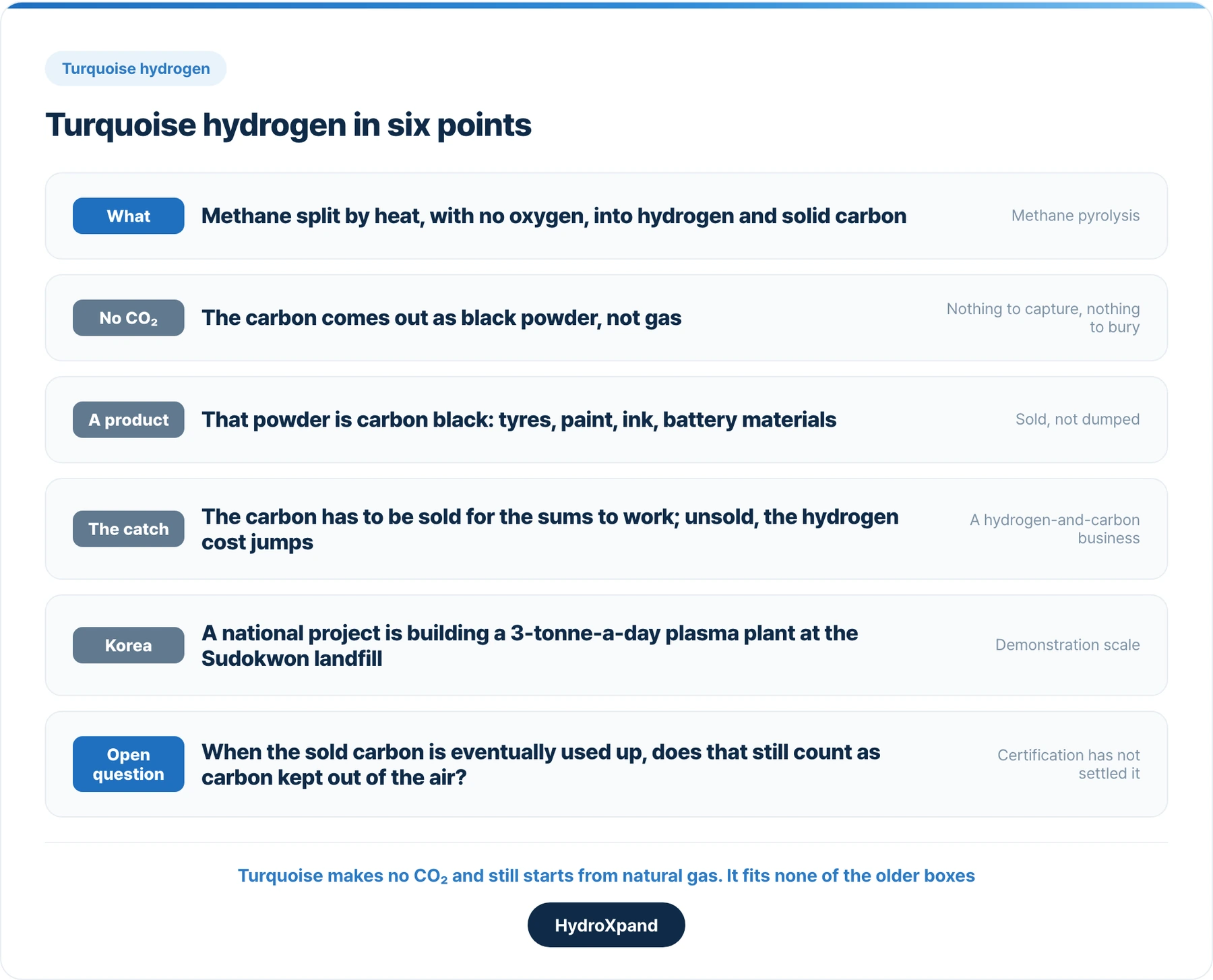
Turquoise hydrogen is made by heating methane with no oxygen present, so the molecule splits into hydrogen and solid carbon instead of hydrogen and CO₂. That removes the capture-and-storage step that blue hydrogen depends on, and it adds a condition of its own: the carbon has to be sold. This article sets out how the process works, where it sits among the colours, what it offers, what it requires, and what is still unresolved.
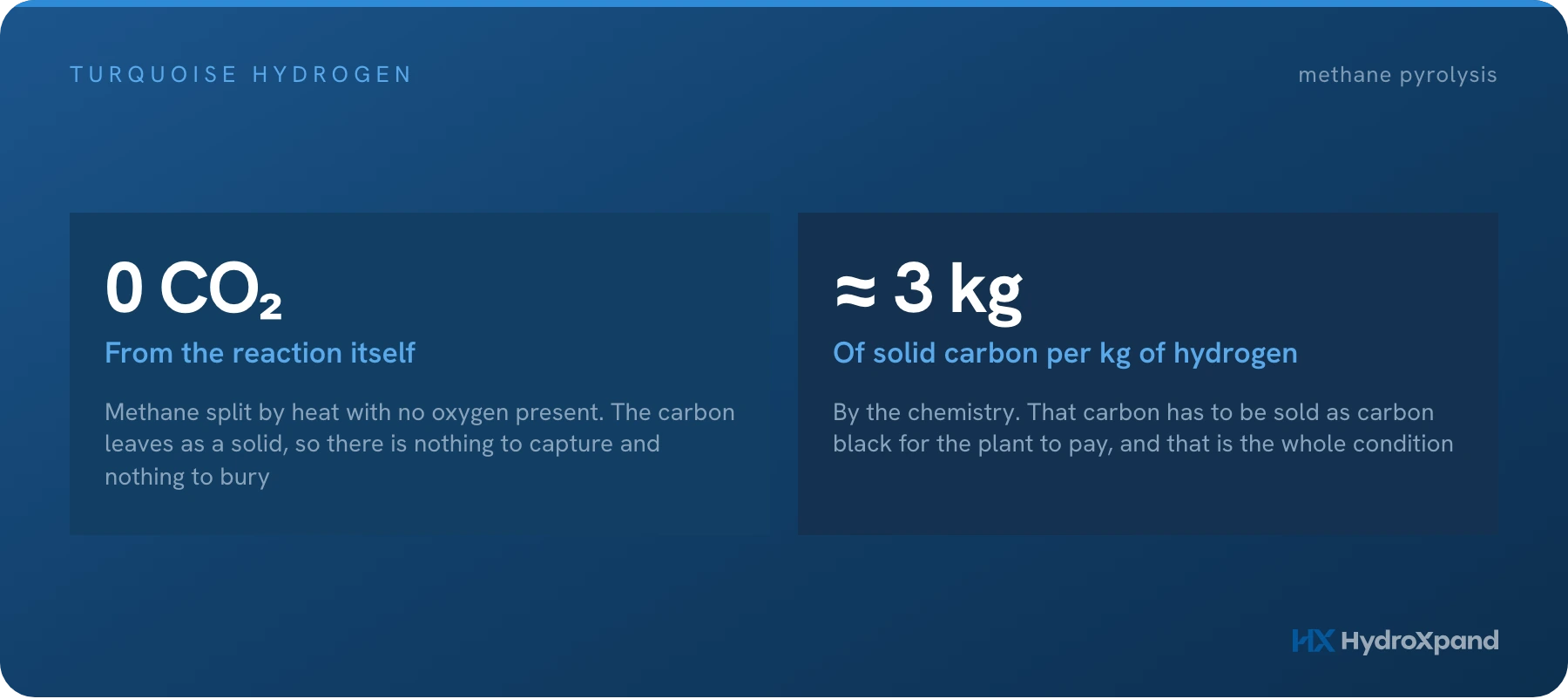
Most of the world's hydrogen is pulled out of natural gas or coal, and CO₂ is released in the process. The competing ways of making hydrogen without that CO₂ each carry a colour name, and turquoise is the unusual one among them. Where the others deal with CO₂ after it has been made, or avoid carbon by starting from water, turquoise hydrogen starts from natural gas and never makes CO₂ at all. The carbon comes out as a black powder.
HydroXpand works on the same problem by a different route, electrolysis of water on renewable electricity, and this article looks at turquoise hydrogen from that vantage point: what it is, how it is made, where it is being demonstrated, and what still stands between it and the market.
What turquoise hydrogen is
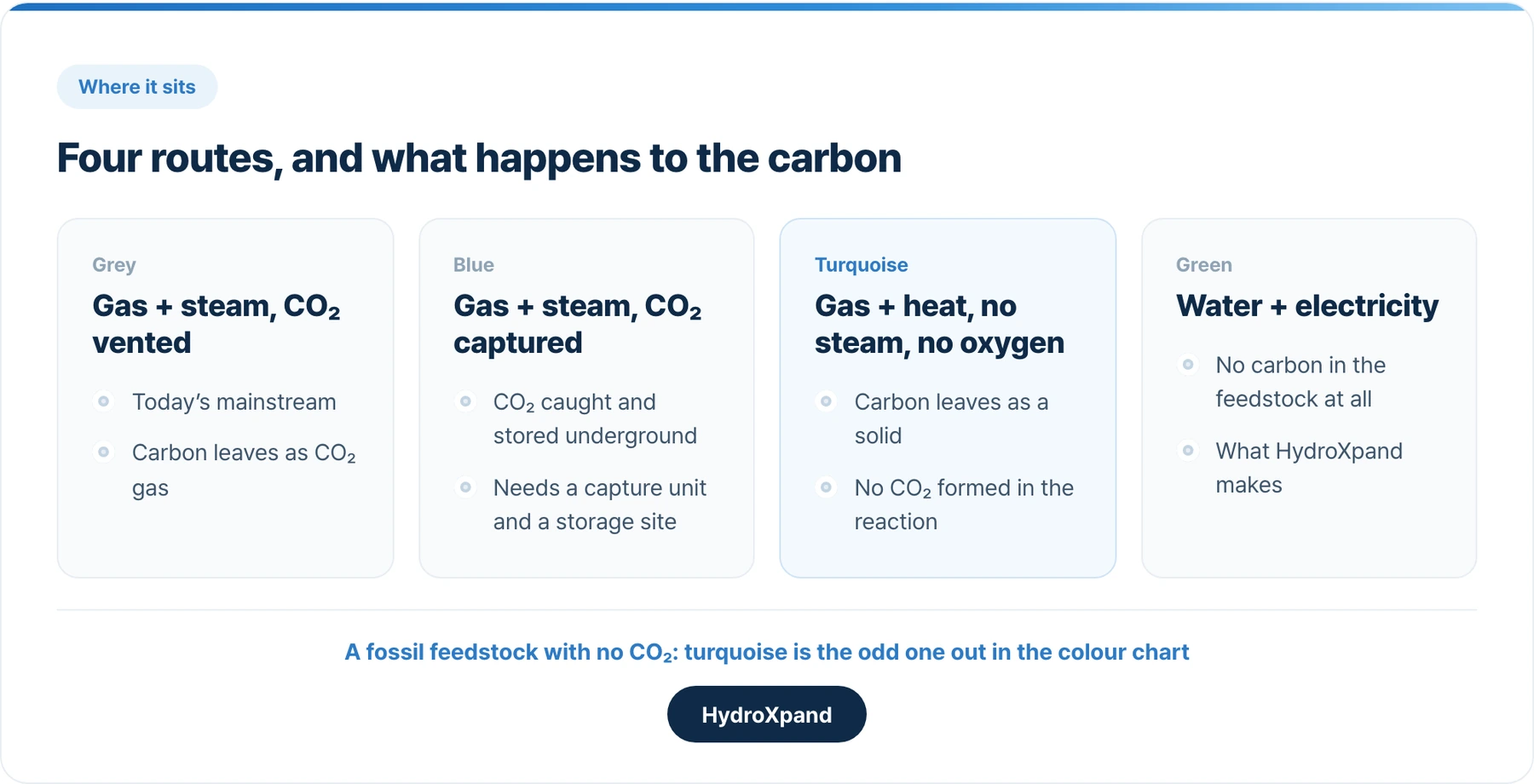
Hydrogen has no colour. The colour names exist to tell apart the ways of making it. The mainstream method reacts natural gas with hot steam, and if the CO₂ that comes with the hydrogen is vented, the result is grey hydrogen. Capture that CO₂ and store it underground and the same hydrogen is blue. Split water with electricity and it is green.
Turquoise starts from a different point. It uses natural gas, like grey and blue, but adds no steam and admits no air. The gas is simply heated, very hot, in the absence of oxygen, and methane splits into hydrogen and carbon, with the carbon coming out as a solid rather than as CO₂. A fossil feedstock that produces no CO₂ fits none of the existing categories, which is why it has a colour of its own.
| Feedstock | Carbon leaves as | What has to be done with it | |
|---|---|---|---|
| Grey | Natural gas and steam | CO₂ gas | Vented |
| Blue | Natural gas and steam | CO₂ gas | Captured and stored underground |
| Turquoise | Natural gas, heat, no oxygen | Solid carbon | Sold as carbon black |
| Green | Water and electricity | None | Nothing |
How it is made
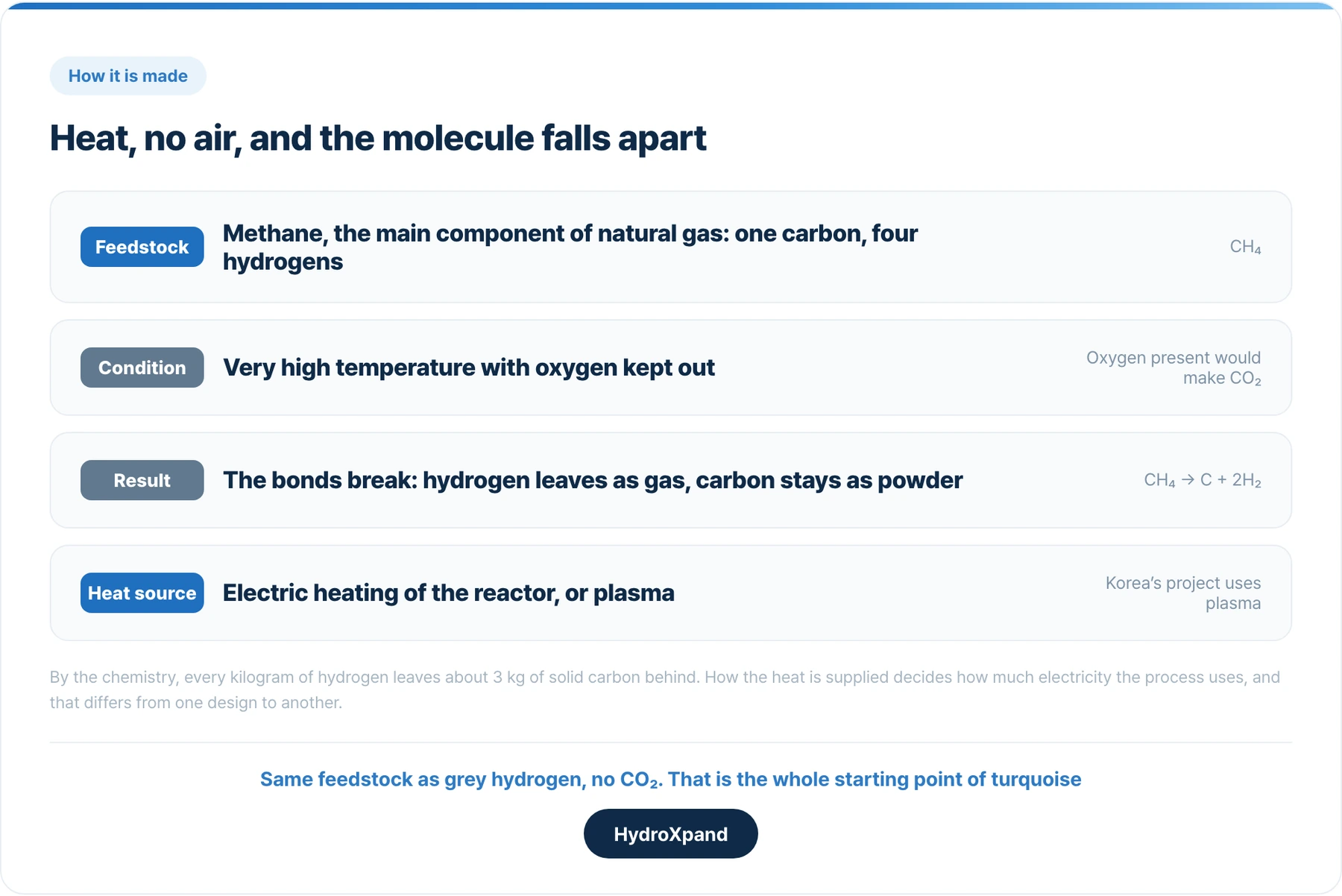
The principle is simple. Methane, the main component of the gas piped into homes, is a molecule of one carbon atom and four hydrogen atoms. Heat it enough and the bonds break: the hydrogen escapes as gas and the carbon remains as powder. The net reaction is CH₄ → C + 2H₂, which by the chemistry leaves about 3 kg of solid carbon for every kilogram of hydrogen.
The essential condition is the absence of air. With oxygen present the carbon would combine with it and leave as CO₂. With oxygen excluded and only heat applied, no CO₂ can form and the carbon stays solid. How the heat is supplied divides the designs: some heat the reactor electrically, some use plasma. Korea's national project uses plasma. The heat source also decides how much electricity the process consumes, which differs from one design to another.
SourceChemical Engineering: Hydrogen production via methane pyrolysis, an overview of turquoise hydrogen (carbon yield and markets) (trade-journal overview citing peer-reviewed studies)
The advantage: nothing to bury
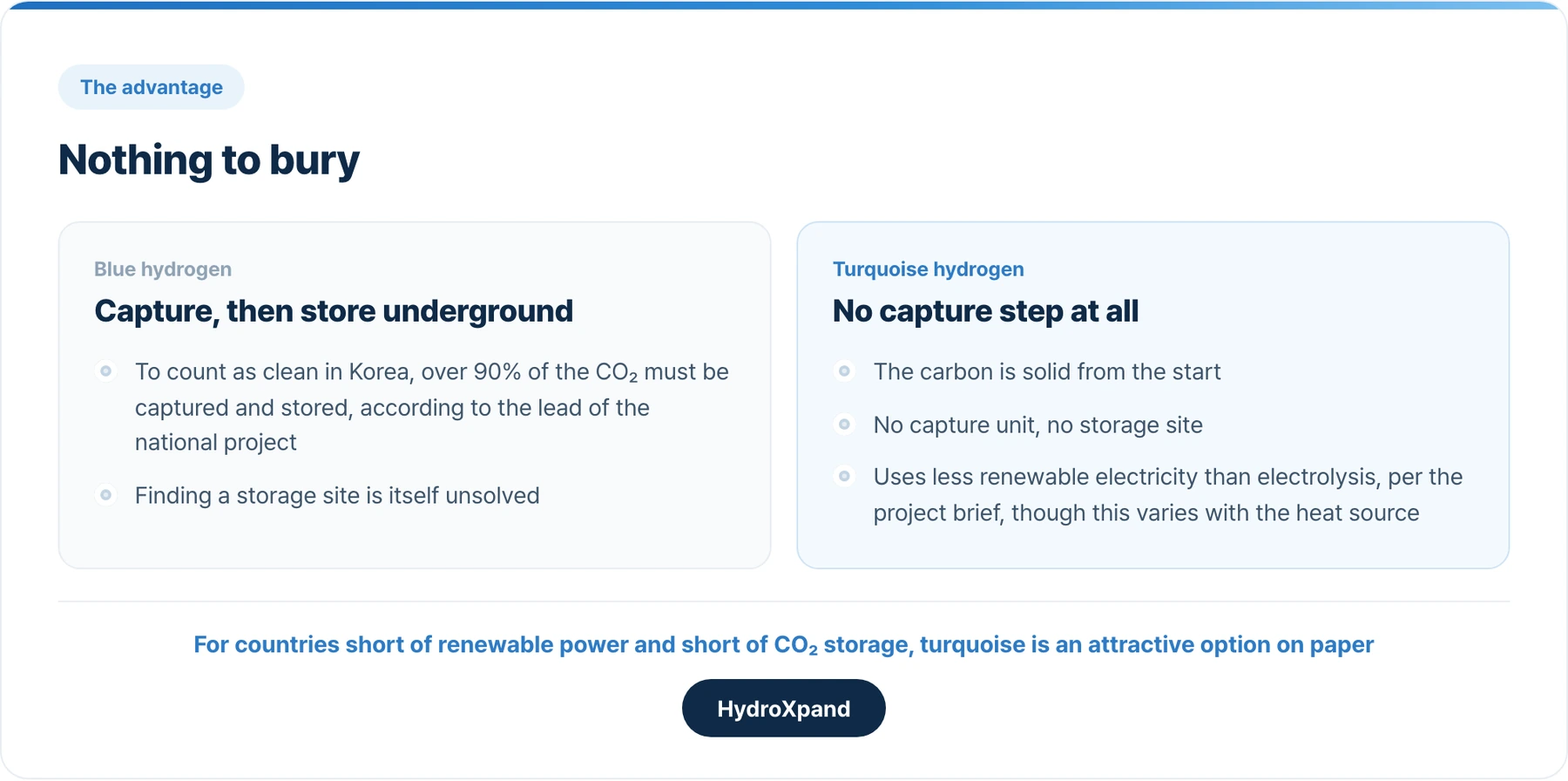
Blue hydrogen has to capture its CO₂ and store it deep underground. According to the lead researcher of Korea's turquoise hydrogen project, for blue hydrogen to be recognised as clean in Korea more than 90% of the CO₂ has to be captured and stored, and securing somewhere to store it is itself an unsolved problem.
Turquoise hydrogen has no such step. Because the carbon is solid from the start, there is no capture unit to build and no storage site to find. The project's own brief lists a second advantage: turquoise hydrogen consumes less renewable electricity than the electrolysis needed for green hydrogen, though the electricity demand depends on how the heat is supplied. For countries that are short of renewable power, or short of geology suitable for CO₂ storage, turquoise is therefore often raised as an especially attractive option.
The condition: the carbon has to be sold
This is where turquoise hydrogen's practical condition appears. The black powder that comes out with the hydrogen is not waste but a product. It is carbon black, the material that makes tyres black and hard, and it is also used in paint, ink, plastics and battery materials.
The difficulty is that the sums only work if that product is sold. A study by researchers at Korea Institute of Energy Technology and the Korea Institute of Machinery and Materials, comparing the production cost of several turquoise hydrogen processes, found that when by-product revenue is left out, the cost per kilogram of hydrogen rises markedly, and the more of its carbon a process can sell, the wider the gap. Turquoise hydrogen is therefore not a hydrogen business but a hydrogen-and-carbon business. If the carbon market does not hold up, the plant does not pay, however well the technology runs.
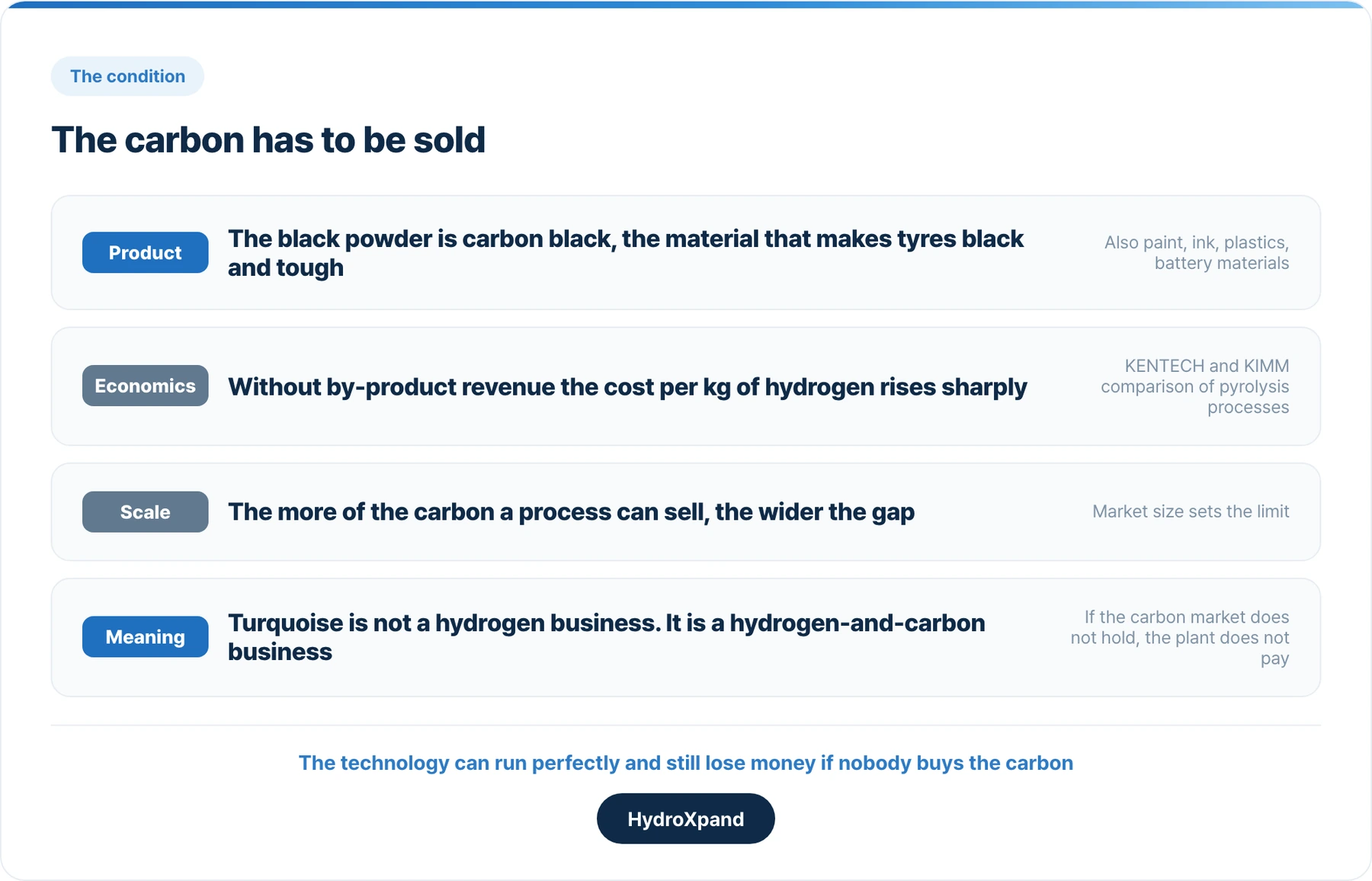
Turquoise hydrogen is not a hydrogen business. It is a hydrogen-and-carbon business.
What is still open
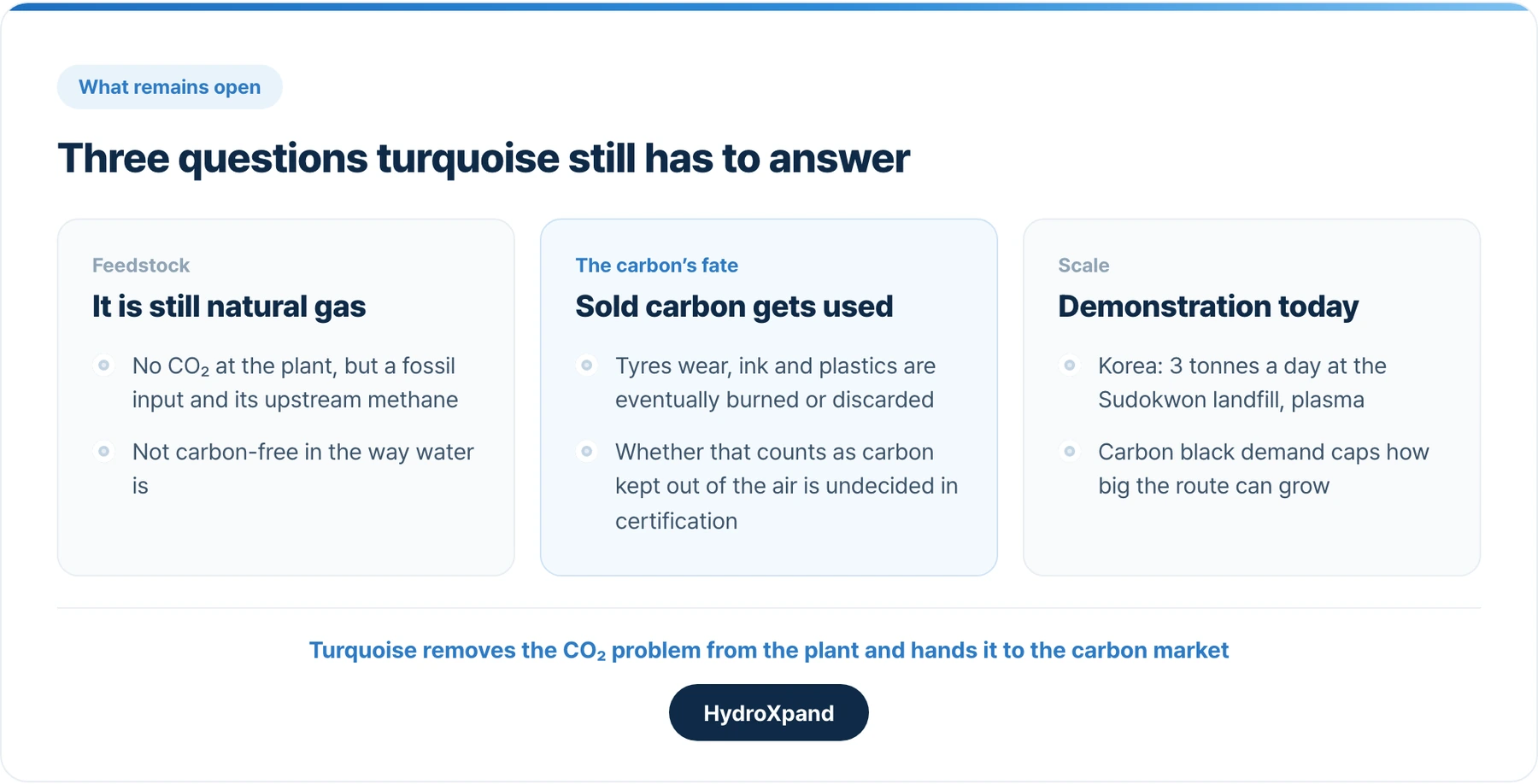
Three questions remain. The first is the feedstock: turquoise hydrogen makes no CO₂ at the plant, but it still starts from natural gas, with the fossil supply chain and the upstream methane that come with it. It is not carbon-free in the way water is. The second is the fate of the carbon. Tyres wear away, ink and plastics are eventually burned or thrown out, and whether carbon that has been sold and then consumed can still be counted as carbon kept out of the atmosphere is a question certification schemes have not settled. The third is scale: Korea's plant is a demonstration of 3 tonnes a day, and the size of the carbon black market caps how far the route can grow.
Turquoise hydrogen, in other words, removes the CO₂ problem from the plant and hands it to the carbon market.
What to take from this
- Turquoise is the one fossil route with no CO₂ in the reaction; judge it on the feedstock and the carbon's fate, not on the plant's stack.
- Treat the carbon black price as part of the hydrogen price. Without it the route does not pay.
- Ask any certification scheme how it treats solid carbon that is sold and later consumed; the answer decides whether turquoise counts as clean.
- Expect demonstration scale for now; the carbon market, not the reactor, sets the ceiling.
There is more than one way to make hydrogen. HydroXpand chose the one that uses only water and renewable electricity, and works on bringing its cost down through AEM electrolysis electrodes, stacks and systems, sold today from 2 kW research and pilot units to a 30 kW stack.
- Hydrogen colours: what the names leave out→All the colours in one table, including the turquoise row.
- What is blue hydrogen→The route turquoise is compared with: capture rate, residual CO₂ and the storage site.
- What is grey hydrogen→The same feedstock with the carbon vented as CO₂.
- Korea's clean hydrogen certification→The scheme that has to decide how sold carbon is counted.
- AEM water electrolysis: how it works→The route with no carbon at all, and how HydroXpand builds it.
Frequently asked questions
Is turquoise hydrogen clean hydrogen?
No CO₂ is formed in the reaction, which is clear. But the feedstock is still natural gas, and the verdict depends on what happens to the solid carbon that comes out with the hydrogen, which certification schemes have not yet settled.
What is the difference between turquoise and blue hydrogen?
Both start from natural gas, but the carbon leaves in different forms. Blue hydrogen produces CO₂ gas that has to be captured and stored underground. Turquoise hydrogen produces solid carbon from the start, so there is nothing to capture or bury.
What is the black powder from turquoise hydrogen?
Carbon black, a solid carbon used in tyres, paint, ink, plastics and battery materials. Selling it is what makes a turquoise hydrogen plant pay; without that revenue the cost per kilogram of hydrogen rises sharply.
Is Korea making turquoise hydrogen?
A national project is building a demonstration plant of 3 tonnes a day at the Sudokwon landfill using plasma pyrolysis. It is demonstration scale, not commercial production.
Sources
- Hydrogen Production via Methane Pyrolysis: An Overview of Turquoise H2 — Chemical Engineering (trade journal)
Looking at AEM for a specific application?