Grey hydrogen is hydrogen pulled out of natural gas with steam, with the carbon dioxide released to the air. It is almost all of the hydrogen the world makes today, and the reason is price. This is how the process works, what it emits per kilogram, and what the two routes away from it look like.
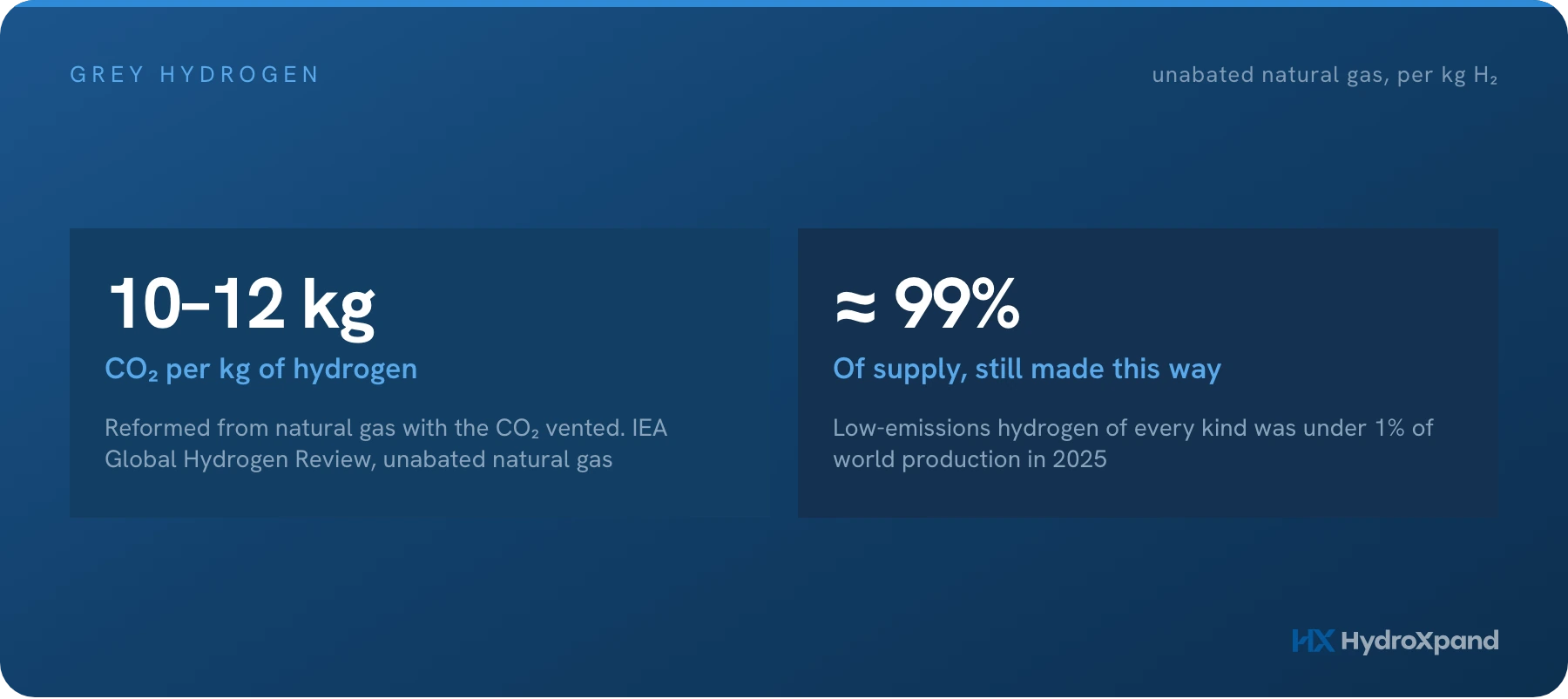
Hydrogen is discussed as a clean fuel, and most of it is made from fossil fuel. Grey hydrogen is the name for the largest share of that: hydrogen taken out of natural gas by reacting it with steam, with the carbon dioxide the reaction produces vented to the atmosphere. Nothing is captured, and nothing is offset.
That makes grey hydrogen the starting point for everything else in the field. Blue hydrogen is grey with a capture unit. Green hydrogen is what is meant to replace it. Certification schemes are written against its emissions. To understand where the world's hydrogen comes from today, this is the process to understand first.
This article covers what grey hydrogen is, how the reforming process works, how much CO₂ it releases per kilogram, why it still dominates supply, and what the two routes away from it are.
What grey hydrogen is
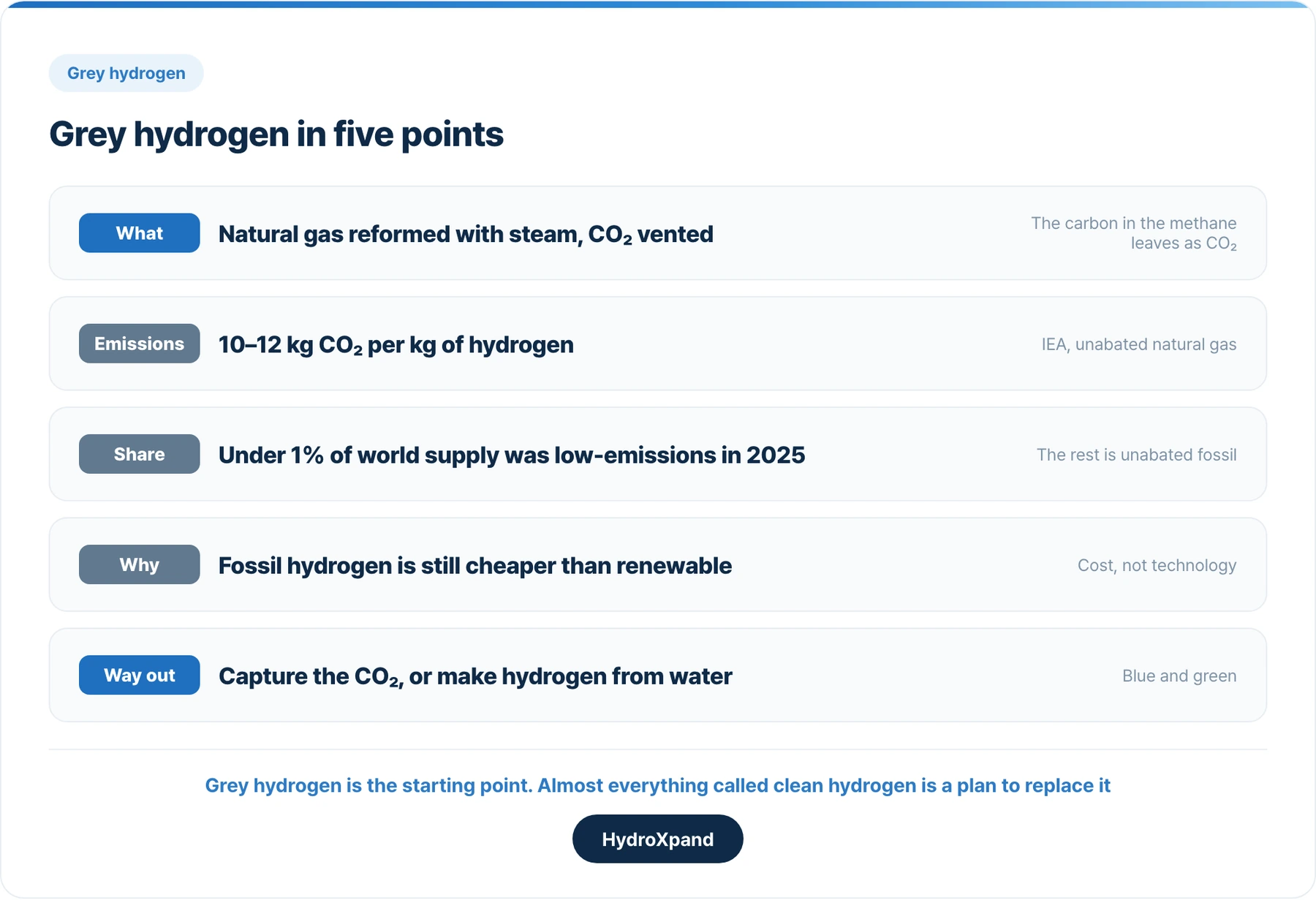
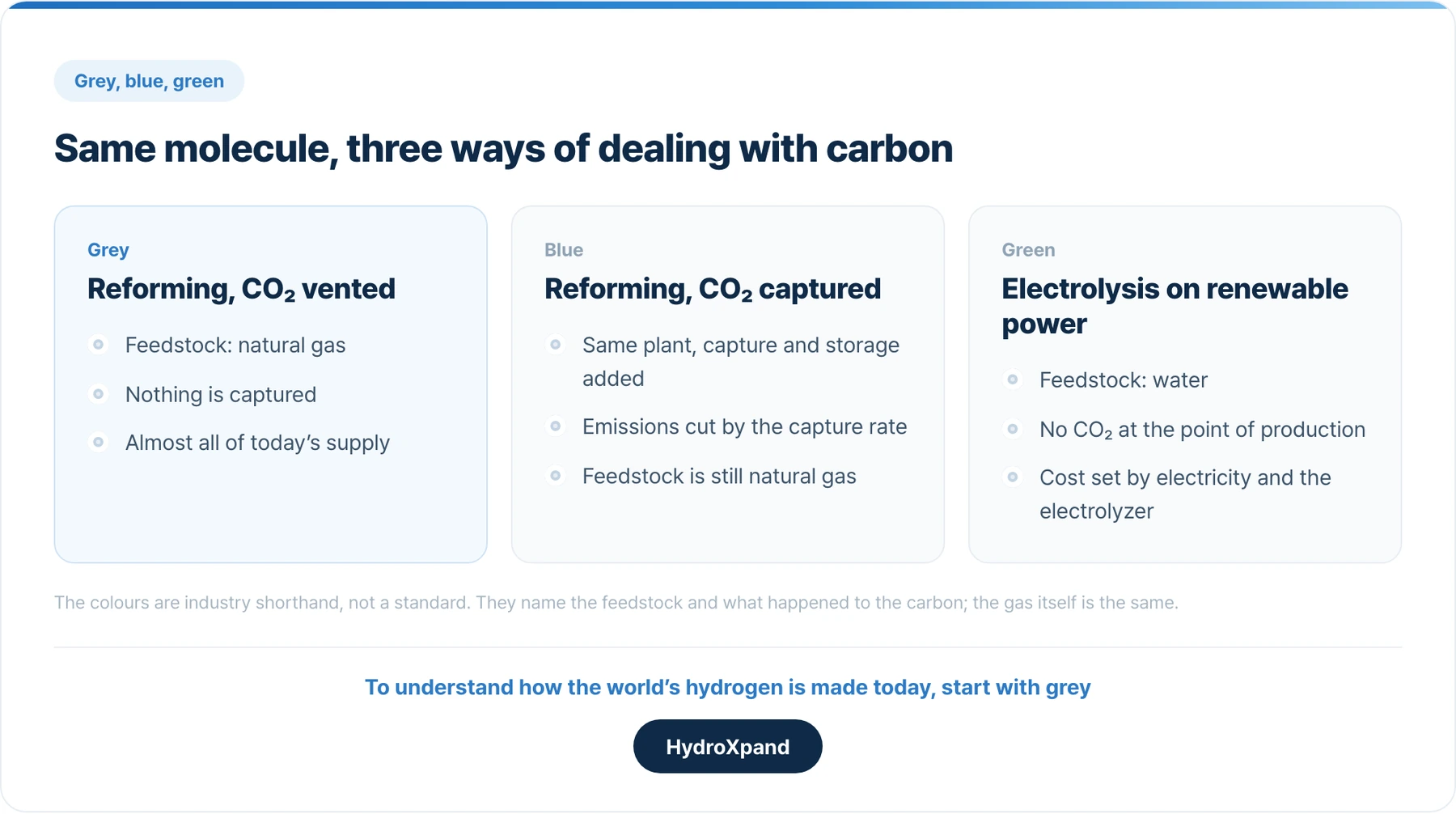
Grey hydrogen is hydrogen made by reforming natural gas, with the CO₂ from the process released to the air. The gas itself has no colour. The industry attaches colour names to hydrogen as shorthand for the feedstock it came from and what happened to the carbon along the way. The names are a convention, not an international standard, and they are useful only as long as everyone remembers what they stand for.
The three colours that matter most sit in a line. Grey is reforming with the CO₂ vented. Blue is the same reforming plant with carbon capture and storage added. Green is water split by electrolysis on renewable electricity, so there is no carbon at the plant at all.
| Grey | Blue | Green | |
|---|---|---|---|
| Feedstock | Natural gas | Natural gas | Water |
| Process | Steam reforming, CO₂ vented | Steam reforming, CO₂ captured and stored | Electrolysis on renewable electricity |
| CO₂ at the plant | 10–12 kg CO₂e per kgIEA, unabated | Reduced by the capture rateSet plant by plant | NoneFootprint is in the electricity |
| Share of supply | Almost all of it | Part of the under-1% low-emissions share | Part of the under-1% low-emissions share |
How it is made: steam methane reforming
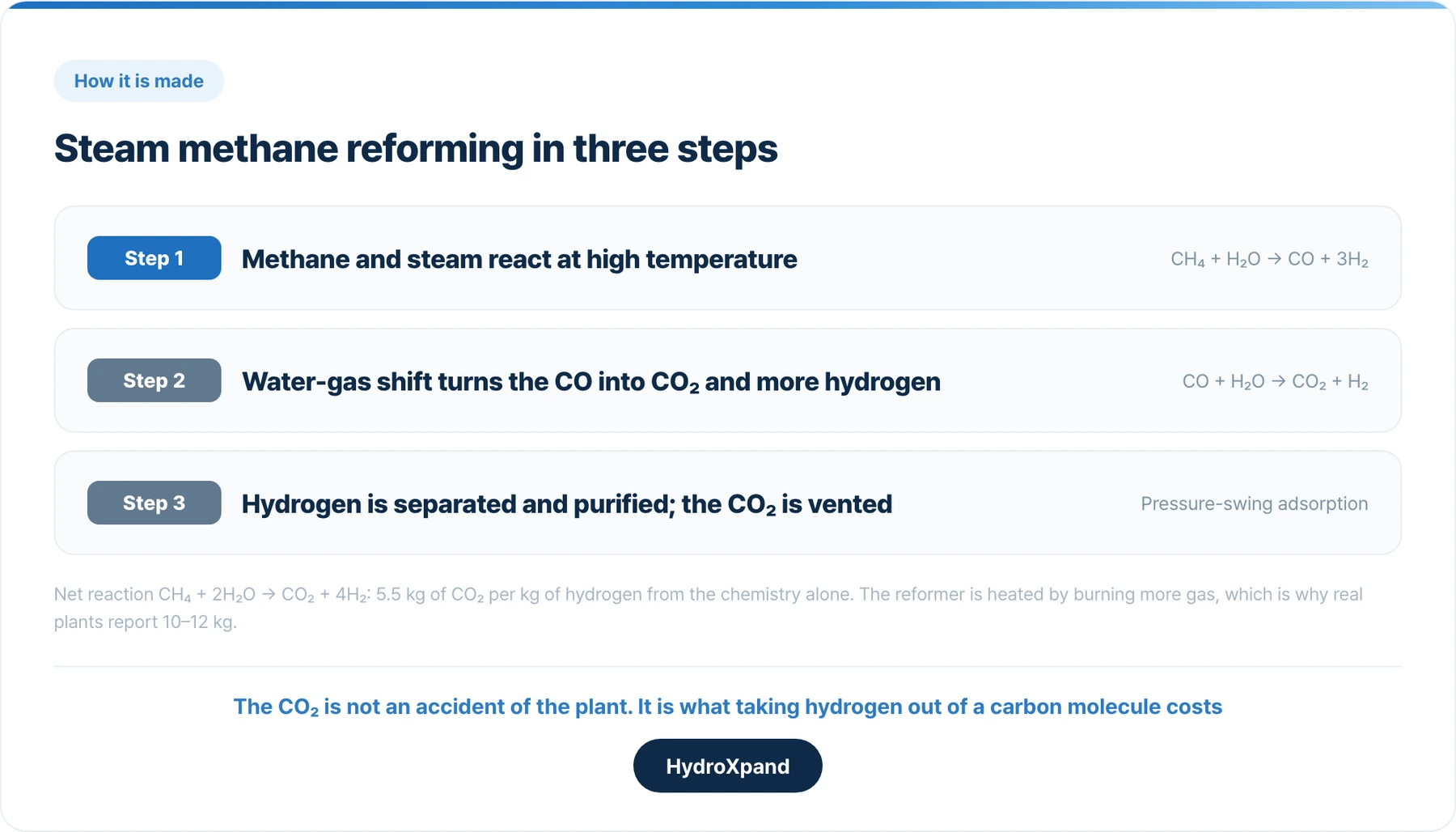
Almost all grey hydrogen comes from steam methane reforming. Methane, the main component of natural gas, is reacted with high-temperature steam over a catalyst. The hydrogen atoms in both the methane and the water end up as hydrogen gas. The carbon atom in the methane ends up as carbon dioxide.
The plant does this in three steps. In the reformer, methane and steam react to give hydrogen and carbon monoxide. In the shift reactor, the carbon monoxide is reacted with more steam, which gives more hydrogen and turns the carbon monoxide into carbon dioxide. Finally the hydrogen is separated from the gas mixture and purified, usually by pressure-swing adsorption, and the CO₂-rich remainder is vented.
Adding the two reactions together gives CH₄ + 2H₂O → CO₂ + 4H₂: four molecules of hydrogen for every molecule of carbon dioxide, or 5.5 kg of CO₂ for each kilogram of hydrogen from the chemistry alone. The reformer also has to be heated, and the heat comes from burning more natural gas in a furnace. That is why real plants report roughly twice the stoichiometric figure.
The CO₂, in other words, is not a defect of the plant that better engineering will remove. It is what taking hydrogen out of a molecule that contains carbon costs. Unless a capture unit is added, it goes to the atmosphere, and that is the whole difference between grey and green.
How much CO₂ grey hydrogen emits
The emissions depend on the feedstock and the plant, and the IEA's figures give the range. Unabated hydrogen from natural gas releases about 10 to 12 kg of CO₂ equivalent per kilogram of hydrogen. Unabated hydrogen from coal, which is common in some regions, releases about 22 to 26 kg. Both are fossil routes, and one is roughly twice as carbon-intensive as the other, so the feedstock matters as much as the colour.
At the scale of world supply those figures add up. Hydrogen production emitted about 920 million tonnes of CO₂ in 2023, according to the IEA. Of that, 75 to 95% is released directly at the production plant, which is the share a capture unit could in principle reach. The remainder is upstream: methane that leaks while the gas is drilled, processed and shipped, and never passes through the plant at all.
This is the point that gets lost when hydrogen is called a clean fuel. Hydrogen is clean where it is used, because burning it or running it through a fuel cell gives water. Grey hydrogen is not clean where it is made. If hydrogen is to serve as a route to net zero, the emissions of the production step are the problem that has to be solved.
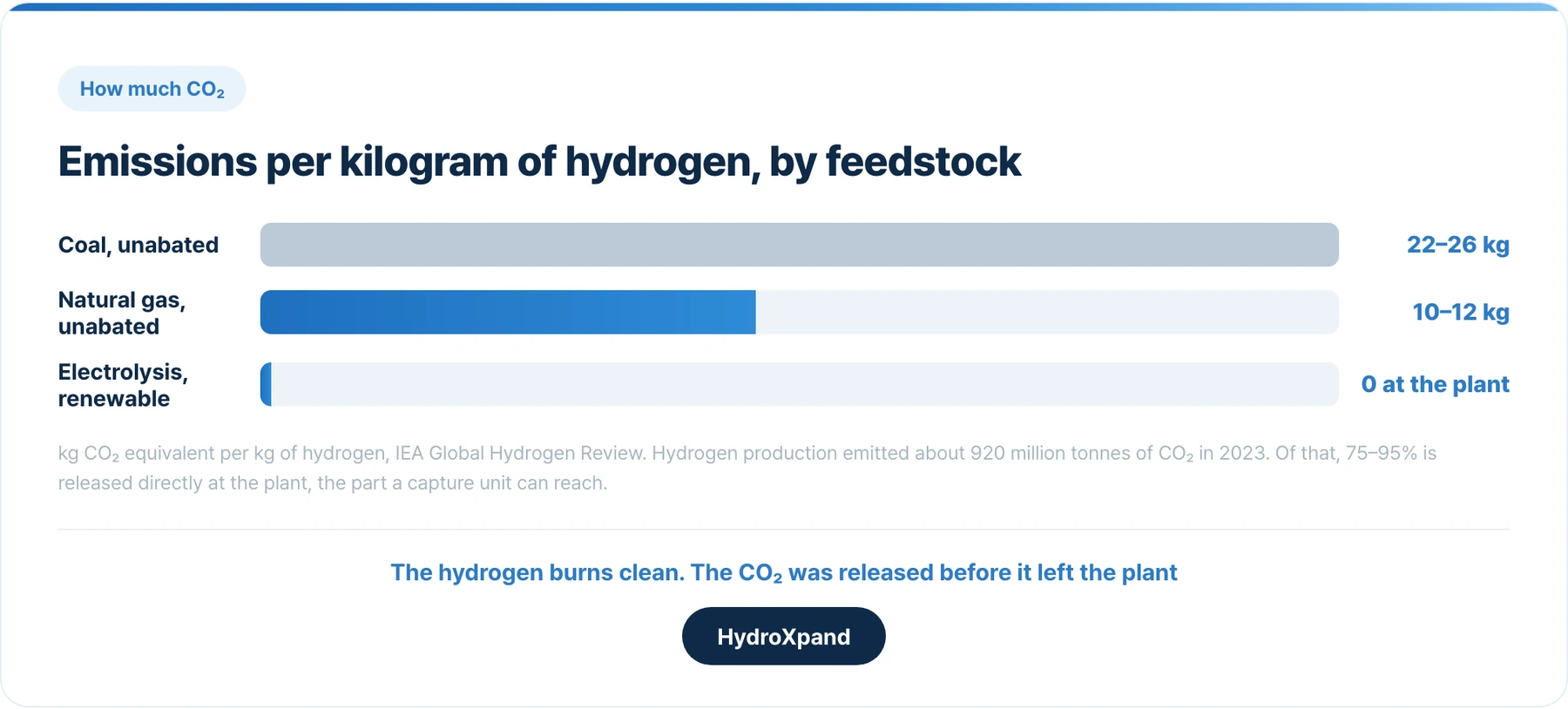
The hydrogen burns clean. The CO₂ was released before it left the plant.
Why grey hydrogen is still almost all of supply
If the emissions are this clear, the obvious question is why grey hydrogen still dominates. The answer is price. Low-emissions hydrogen of every kind, blue and green together, reached about one million tonnes in 2025, and the IEA expects it to pass 1% of world production in 2026. Everything else is unabated fossil hydrogen, most of it grey.
The IEA's assessment is that fossil-based hydrogen will remain cheaper than renewable hydrogen in most regions for the near term. The technology to make clean hydrogen exists and is sold. It is not yet cheaper, and industrial buyers of hydrogen, who use it for ammonia, refining and methanol, buy on price.
That reframes the transition. Grey hydrogen is not in the lead because green hydrogen cannot be made. It is in the lead because the fossil route is cheaper, so the question that decides the pace of the transition is how far the cost of renewable hydrogen can fall. That cost has two parts, the electricity and the electrolyzer, and the second is the problem HydroXpand works on.
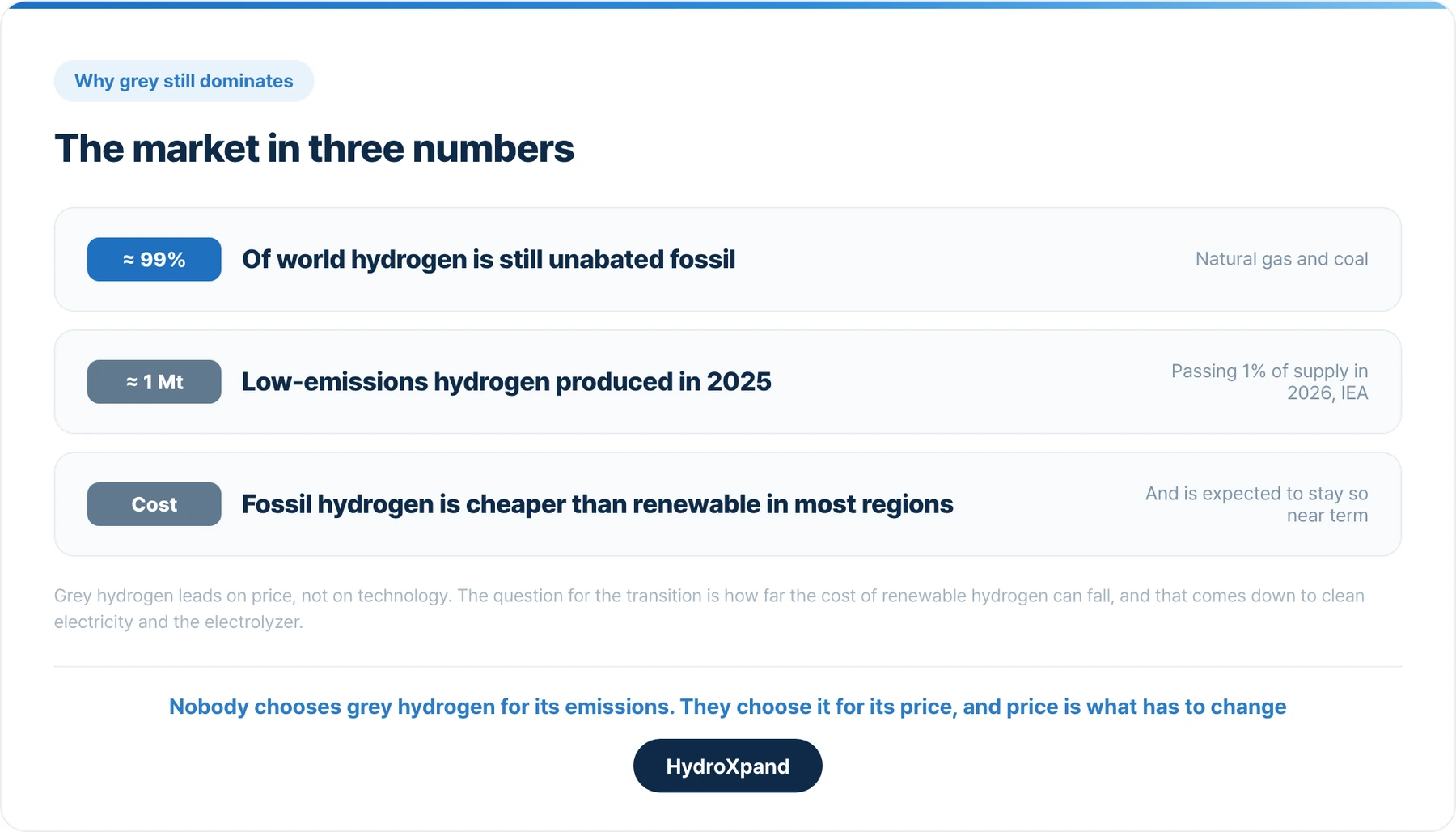
Low-emissions hydrogen production grew by 10% in 2024 and is on track to reach 1 Mt in 2025, but it still accounts for less than 1% of global production.
SourceIEA Global Hydrogen Review 2025, executive summary: low-emissions production and the cost gap
From grey to clean: the two routes
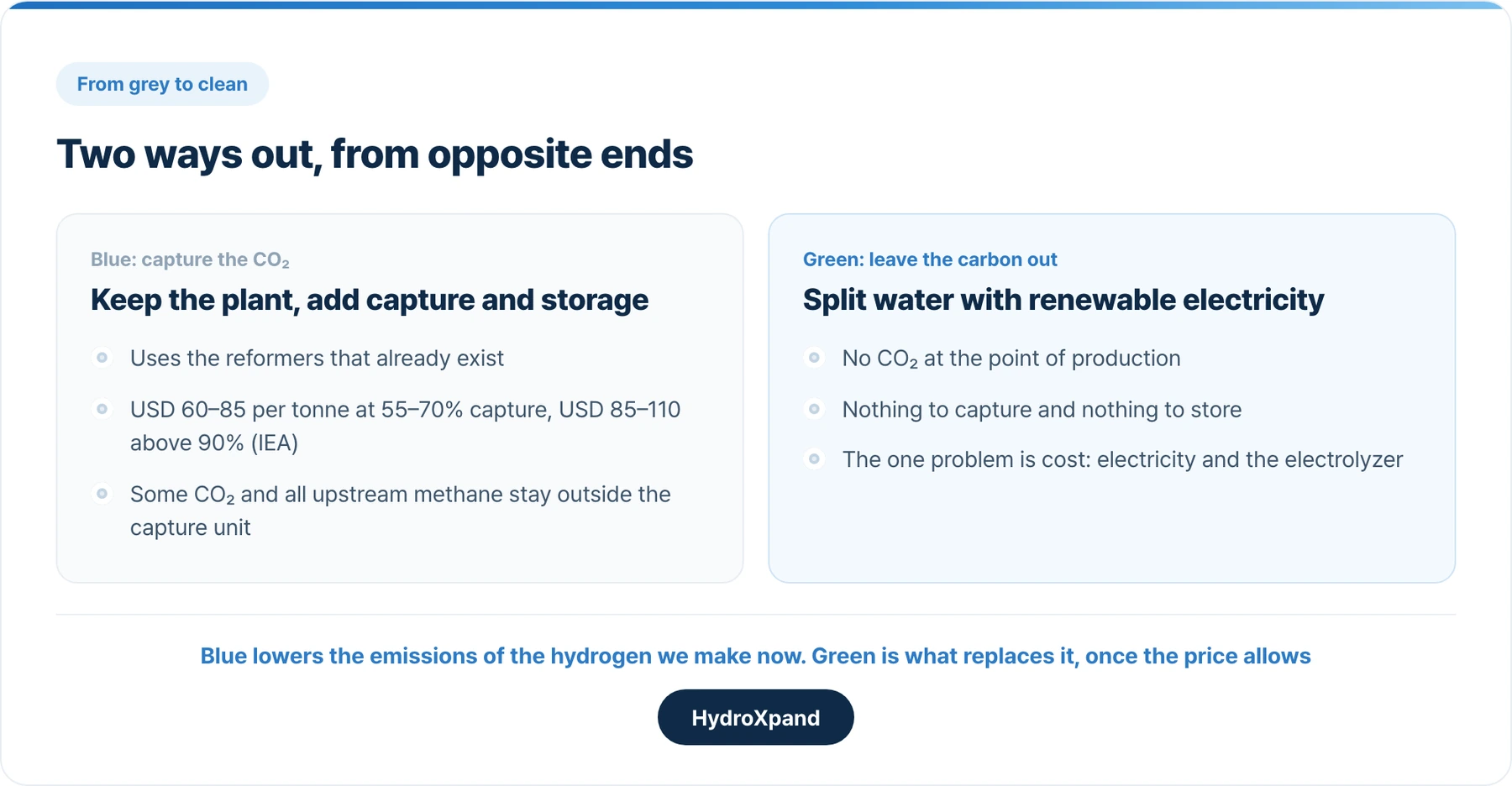
There are two ways to cut the emissions of grey hydrogen, and they start from opposite ends. One keeps the reforming plant and deals with the carbon after it has been made: capture the CO₂ and store it underground. That is blue hydrogen. The other removes the carbon from the process entirely by making hydrogen from water and electricity instead of from natural gas. That is green hydrogen.
Blue hydrogen is the realistic near-term route for the reformers that already exist. The IEA puts the cost of capture at roughly USD 60 to 85 per tonne of CO₂ for a plant capturing 55 to 70% of its process emissions, and USD 85 to 110 per tonne for capture rates above 90%. Its limits are the CO₂ that is never captured and the upstream methane that no capture unit sees. It lowers the emissions of grey hydrogen; it does not remove them.
Green hydrogen removes them at the plant. There is no carbon in water, so there is nothing to capture and nothing to store. Its one problem is cost, and cost is a number that moves. HydroXpand develops the electrodes, membranes and ionomers of AEM electrolysis in house, then builds them into stacks and systems, with the aim of bringing the cost of renewable hydrogen down to where it can replace grey.
What to take from this
Grey hydrogen is the honest baseline. It is how the world makes hydrogen today, it emits 10 to 12 kg of CO₂ for every kilogram it produces, and it dominates because it is cheap. Any claim about clean hydrogen is a claim measured against it.
- When a hydrogen supply is described, ask for the feedstock and what happened to the carbon. That is what the colour is shorthand for.
- Compare emissions in kg of CO₂ equivalent per kg of hydrogen. Grey is 10 to 12 from natural gas and 22 to 26 from coal; certification schemes measure this number, not the colour.
- Judge blue hydrogen by its capture rate and its methane record, not by its name.
- Judge green hydrogen by its cost per kilogram, because that is the only thing standing between it and the market grey hydrogen holds.
The last point is where HydroXpand works. Our AEM electrolysis electrodes, stacks and systems avoid iridium and PFAS membranes and are sold today, from 2 kW research and pilot units to a 30 kW stack, to buyers who want to make hydrogen from water rather than buy it from a reformer.
- Hydrogen colours: what the names leave out→All five colours in one table, and the one number that certification actually measures.
- What is blue hydrogen→The grey process with a capture unit added: capture rate, residual CO₂ and cost.
- Hydrogen energy pros and cons→The eight points, four fixed by physics and four set by cost.
- What is water electrolysis→The route with no carbon at the plant, and the four numbers fixed per kilogram.
- AEM water electrolysis: how it works→How HydroXpand makes the green route without iridium.
Frequently asked questions
What is the difference between grey hydrogen and green hydrogen?
The feedstock and the emissions. Grey hydrogen is pulled out of natural gas with steam and releases about 10 to 12 kg of CO₂ per kilogram of hydrogen. Green hydrogen is made by splitting water with renewable electricity and releases no CO₂ at the point of production.
Why is grey hydrogen still the most common kind?
Price. Fossil-based hydrogen is cheaper than renewable hydrogen in most regions, so low-emissions hydrogen of every kind was under 1% of world production in 2025 and is expected to pass 1% only in 2026, according to the IEA.
How much CO₂ does grey hydrogen emit?
About 10 to 12 kg of CO₂ equivalent per kilogram of hydrogen for unabated natural gas, according to the IEA. Hydrogen from unabated coal is higher, at about 22 to 26 kg. The reaction chemistry alone fixes 5.5 kg; the rest comes from heating the reformer.
Is blue hydrogen the same as green hydrogen?
No. Blue hydrogen is grey hydrogen with the CO₂ captured, which lowers emissions by the capture rate but leaves uncaptured CO₂ and upstream methane. Green hydrogen has no CO₂ at the plant to capture. Blue reduces the emissions of grey; green replaces the process.
Sources
- Global Hydrogen Review 2024 — International Energy Agency, 2024
- Global Hydrogen Review 2025 — International Energy Agency, 2025
Looking at AEM for a specific application?