Two quotations for electrolysis equipment can carry similar totals and still describe different purchases. The difference is rarely the unit price. It is in the lines beside it: which tier is supplied, when the lead time starts, which Incoterm the total is written on, and which item the warranty covers.
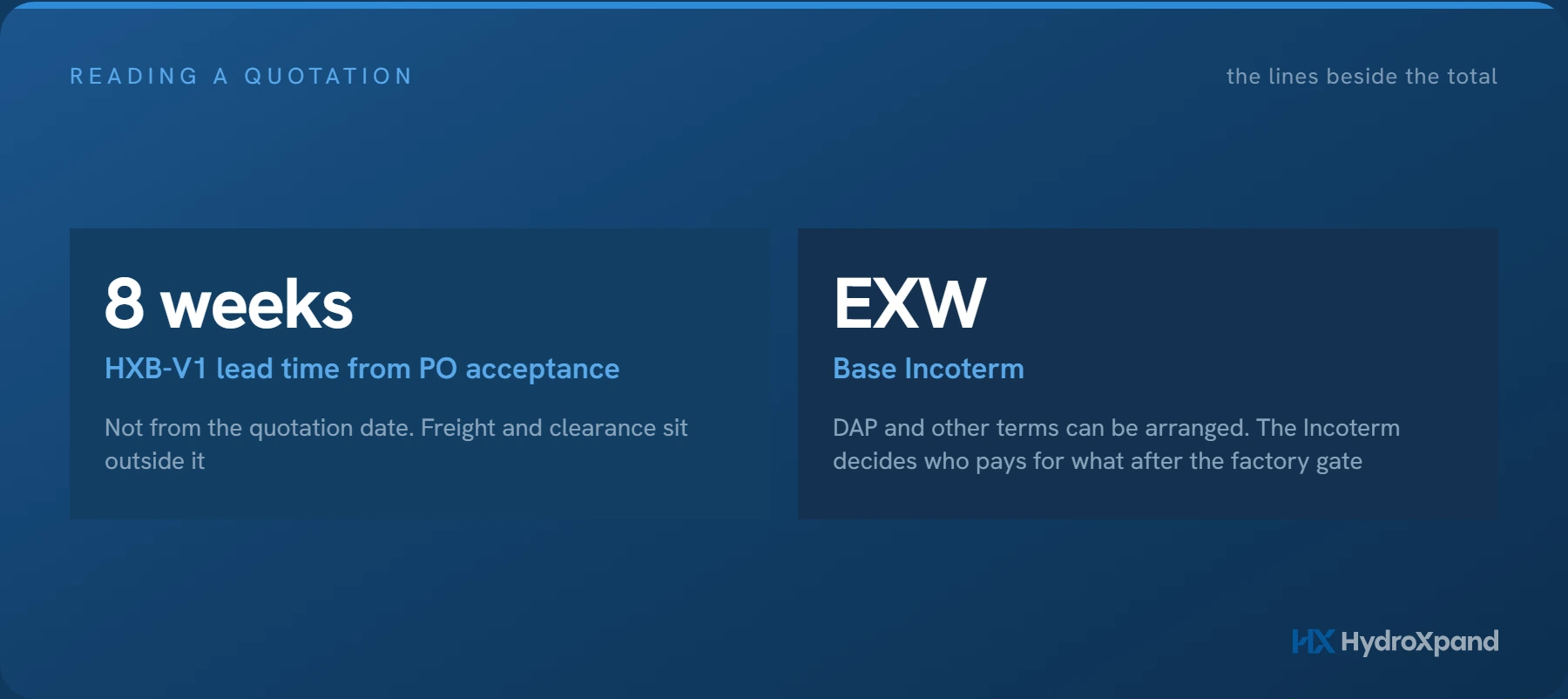
Two quotations for electrolysis equipment can arrive with similar totals and still describe quite different purchases. The difference is rarely the unit price. It sits in the lines next to it: what is supplied, when the lead time starts, which Incoterm the total is written on, and which item the warranty attaches to.
The same questions come back to us after almost every quotation we send. This is how we would read one, line by line, with our own terms as the worked example. The items to check are the same for any supplier.
Which tier is being quoted
The biggest difference between two quotations usually appears as a single product line. Electrolysis equipment is sold at three tiers. Electrodes are material, and the cell and stack are yours to build. A stack is the assembled electrochemical core, and power, circulation, gas separation and safety are designed around it by the buyer. A system has that balance of plant built in and needs power and water.
A stack quotation will be cheaper than a system quotation, as it should be. The real question is whether your team can design and build the balance of plant for the difference. A buyer who takes delivery of a stack and gets no hydrogen has usually misread the tier, not found a performance problem.
| Electrodes | Stack | System | |
|---|---|---|---|
| Products | HXP-an · HXP-ca | HXS-2 · HXS-30 | HXB-V1 |
| Left to you | Cells, stack andbalance of plant | Power, circulation,gas separation, safety | Site connections,a dryer if needed |
| Lead time fromPO acceptance | 2 weekscustom up to 2 months | HXS-2: 4 weeksHXS-30: on request | 8 weeks |
| Warranty basis | Specificationat handover | Specification andworkmanship at handover | 12-month term |
Numbers that need a condition next to them
Pressure and purity often share a line on a datasheet, but different equipment makes them. HXB-V1 delivers at 0 or 10 barg, selected in software, with no separate compressor. Hydrogen leaving it is 98 to 99% pure at 0 barg and 99% at 10 barg; 99.999% or better needs a dryer, which is not in the standard supply. If a quotation gives one purity figure, ask whether it is at the outlet or after drying.
Energy use is written three ways for the same machine. For HXB-V1 at beginning of life it is 5.0 kWh per normal cubic metre, or 56 kWh per kilogram for the whole system. The HXS-2 stack inside is 44 kWh per kilogram, 90.0% HHV at 0.1 M KOH and 50 °C. Compare the system figure between suppliers, because it is what the meter reads. The gap of about 12 kWh per kilogram is the balance of plant.
Durability figures need their conditions even more. The HXS-2 stack has more than 3,000 hours of cumulative operation, and its long-run data is published with the test conditions in our durability note. Hours with no conditions beside them cannot be compared.
A purity figure should say whether it is at the outlet or after drying, and an energy figure whether it belongs to the stack or the system.
When the lead time starts counting
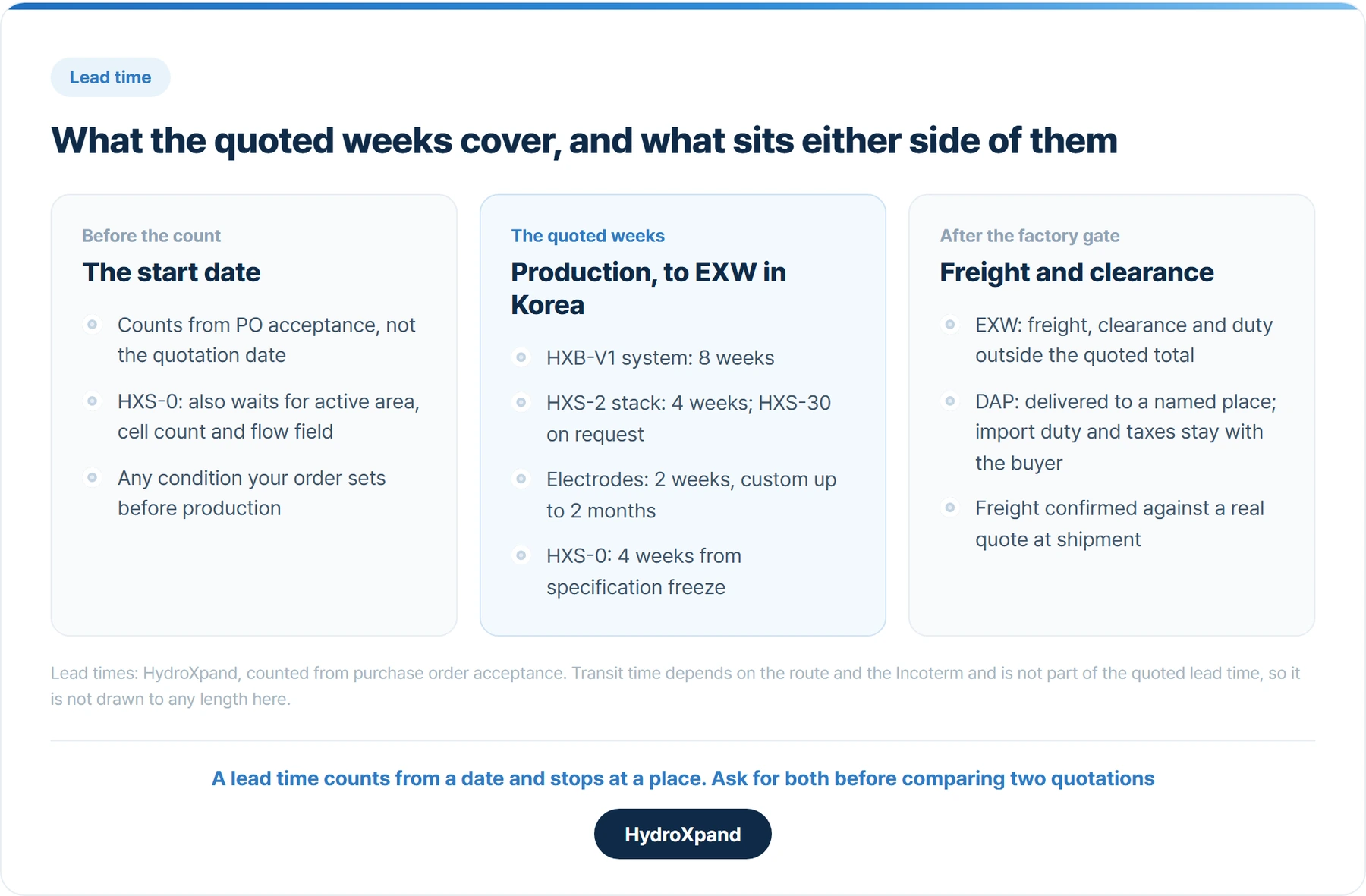
A lead time means little until you know the day it counts from. Ours counts from the day we accept the purchase order, not the date on the quotation.
Made-to-order products put a second condition in front. The HXS-0 test cell is built once the active area, cell count and flow field are fixed, and its 4 weeks run from then. It is worth asking any supplier what sits in front of their date: a specification freeze, a drawing approval, or a payment that has to clear.
The quoted weeks also end at the factory gate. Under EXW the goods are ready for collection in Korea, and transit and clearance come after.
Research institutions often have a fixed window for spending a budget. Check the lead time against it before asking for the quotation.
Incoterms, duties and origin
Two quotations with the same total can land at very different costs. Our base term is EXW, so freight, export and import handling and duties sit outside the quoted total. DAP and other Incoterms can be arranged; under DAP delivery to a named place is included, while import clearance, duty and taxes normally stay with the buyer. Freight is confirmed against an actual quote at shipment.
The goods are of Korean origin. Where a country has a free trade agreement with Korea, preferential duty may apply, but only with the origin document that agreement accepts. Agree with your customs broker which one is needed before the goods ship.
Then write down who pays freight and, separately, who pays import duty and VAT. Disputes over clearance costs usually begin when both were agreed in conversation only.
Under EXW the quoted total stops at our door. Freight, clearance, duty and import VAT still get paid, on other invoices.
Which item the warranty sits on
A line that says one-year warranty tells you little until you know which item it attaches to. Our 12-month term warranty sits on the HXB-V1 system. It runs from shipment, or from acceptance where the contract includes an acceptance procedure, and consumables are excluded.
Stacks and electrodes are supplied on a different basis: conformity to the published specification and workmanship at handover. How an electrode performs once it is built into an MEA or operated is outside that scope. On the system, the warranty has two parts.
- Defect warranty: faults in materials and workmanship present at delivery. A defect attributable to us is repaired free of charge, or replaced with an equivalent or better part. Repair is return to base; you pay to send the unit, we pay to return it.
- Stack service: performance lost through operation is not a defect, so service is paid. Only the MEA is replaced, the rest of the stack hardware is reused, and the work is warranted for six months.
A hydrogen-in-oxygen reading of 2 vol% is a safety limit, not a warranty threshold. If it is exceeded, stop the unit and contact us.
What to send with a request
The more of this that comes with the first enquiry, the fewer rounds of questions follow. These are the five things we ask back when they are missing.
- The product you are interested in, or what the hydrogen is for.
- Target hydrogen quantity and daily operating hours.
- Required pressure and purity, and whether that purity is needed after drying.
- Country of installation, the site power supply, and the Incoterm you would prefer.
- When you want the equipment on site.
We confirm receipt within one business day, then reply after a product and technical review with material or a quotation.
- HXB-V1 · 2 kW system→Purity, pressure, energy use and the warranty line, with the full specification table.
- What turnkey includes in a 2 kW electrolyzer→The lines a system quotation leaves out: dryer, piping, storage and the site safety case.
- Buying AEM electrodes and cells as components→What is specified and what arrives when the quotation is for the lower tiers.
- Before the electrolyzer arrives→The site checks to run while the lead time is counting.
- HXB-V1 warranty and service→The full terms: scope, exclusions, opening a stack and the paid stack service.
- HXS-2 durability data→The long-run data behind the hours quoted here, with its conditions and the trend.
- Hydrogen cost calculator→Cylinder supply against on-site generation, on your own usage and power price.
- After the purchase order→What happens, stage by stage, once the quotation becomes an order.
Frequently asked questions
When does an electrolyzer lead time start?
HydroXpand counts it from purchase order acceptance: 2 weeks for electrodes, 4 weeks for the HXS-2 stack and 8 weeks for HXB-V1 systems. The made-to-order HXS-0 test cell counts from the day its specification is fixed.
Does an EXW quotation include freight and import duty?
No. Under EXW the quoted total stops at the works, and freight, clearance, import duty and VAT are paid separately; DAP and other Incoterms can be arranged.
Which products carry the 12-month warranty?
The HXB-V1 system, from shipment or from acceptance where an acceptance procedure applies. Stacks and electrodes are supplied against their specification and workmanship at handover rather than a term warranty.
Sources
- Incoterms 2020 — International Chamber of Commerce
- Technical Targets for Liquid Alkaline Electrolysis — U.S. Department of Energy
Looking at AEM for a specific application?