Alkaline electrolysis is the only water electrolysis technology with a hundred years of industrial operation behind it, and it reached that position without a single noble metal. What separates it from the membrane technologies is not the chemistry but the separator, and almost every limit people attribute to alkaline electrolysis comes back to that one component.
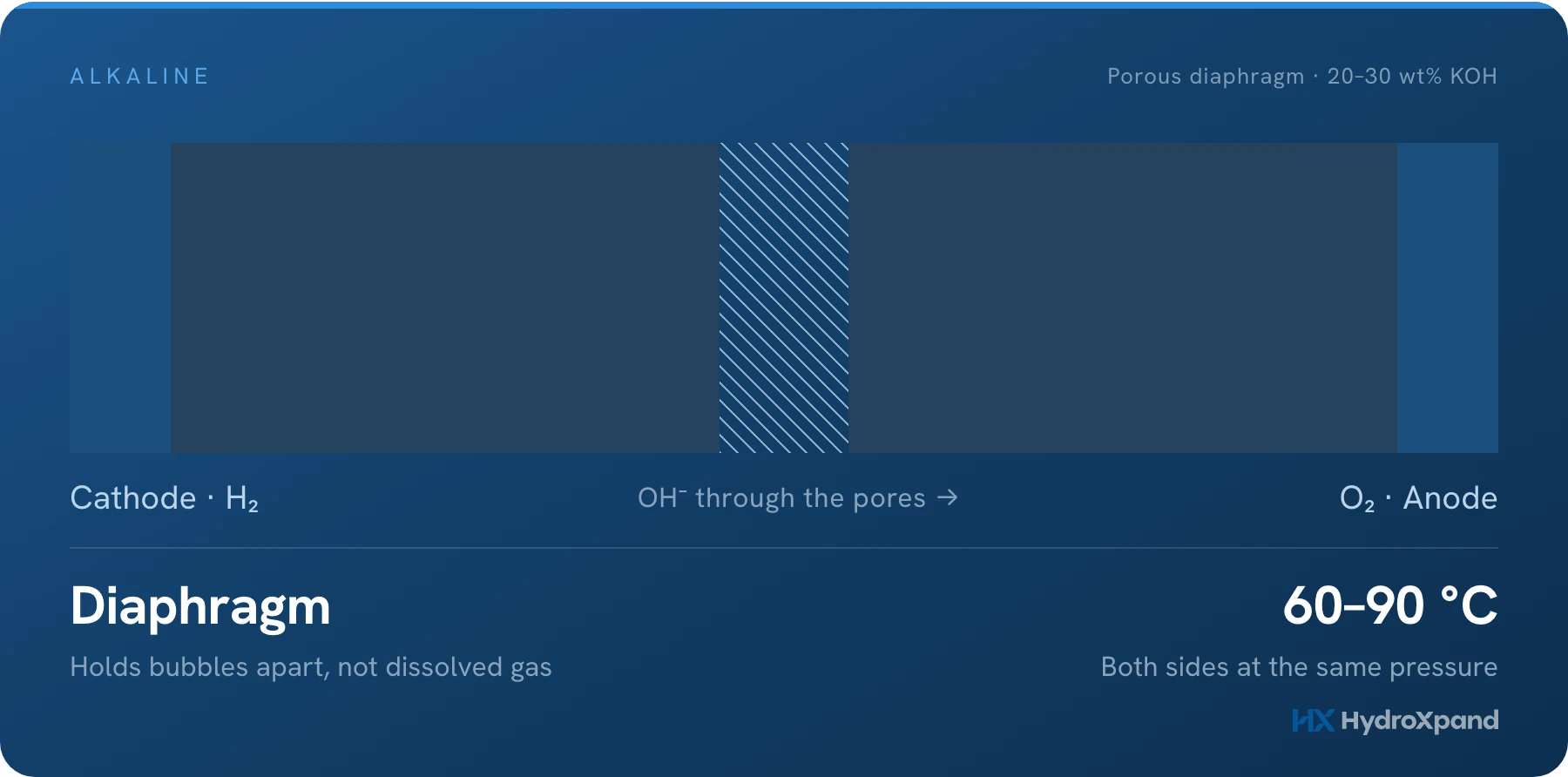
Alkaline water electrolysis is the oldest of the four technologies and still the one with the largest installed capacity. Cells run in a concentrated liquid alkali, typically potassium hydroxide at somewhere between 20 and 30 percent by weight, at temperatures around 60 to 90 °C. Hydroxide ions carry the charge from the cathode to the anode through the liquid.
It got to industrial scale a century ago and it did so with nickel and steel. There is no iridium in an alkaline cell, no platinum, and no fluorinated membrane. That is not a recent achievement in cost engineering. It is the reason the technology existed at all before those materials were available.
Alkaline electrolysis is the proof that water splitting does not require noble metals. Everything the newer technologies do is an attempt to keep that property while fixing the separator.
The separator is a diaphragm, not a membrane
This is the distinction that explains most of the technology's behaviour, and it is routinely blurred in comparison tables that call every separator a membrane.
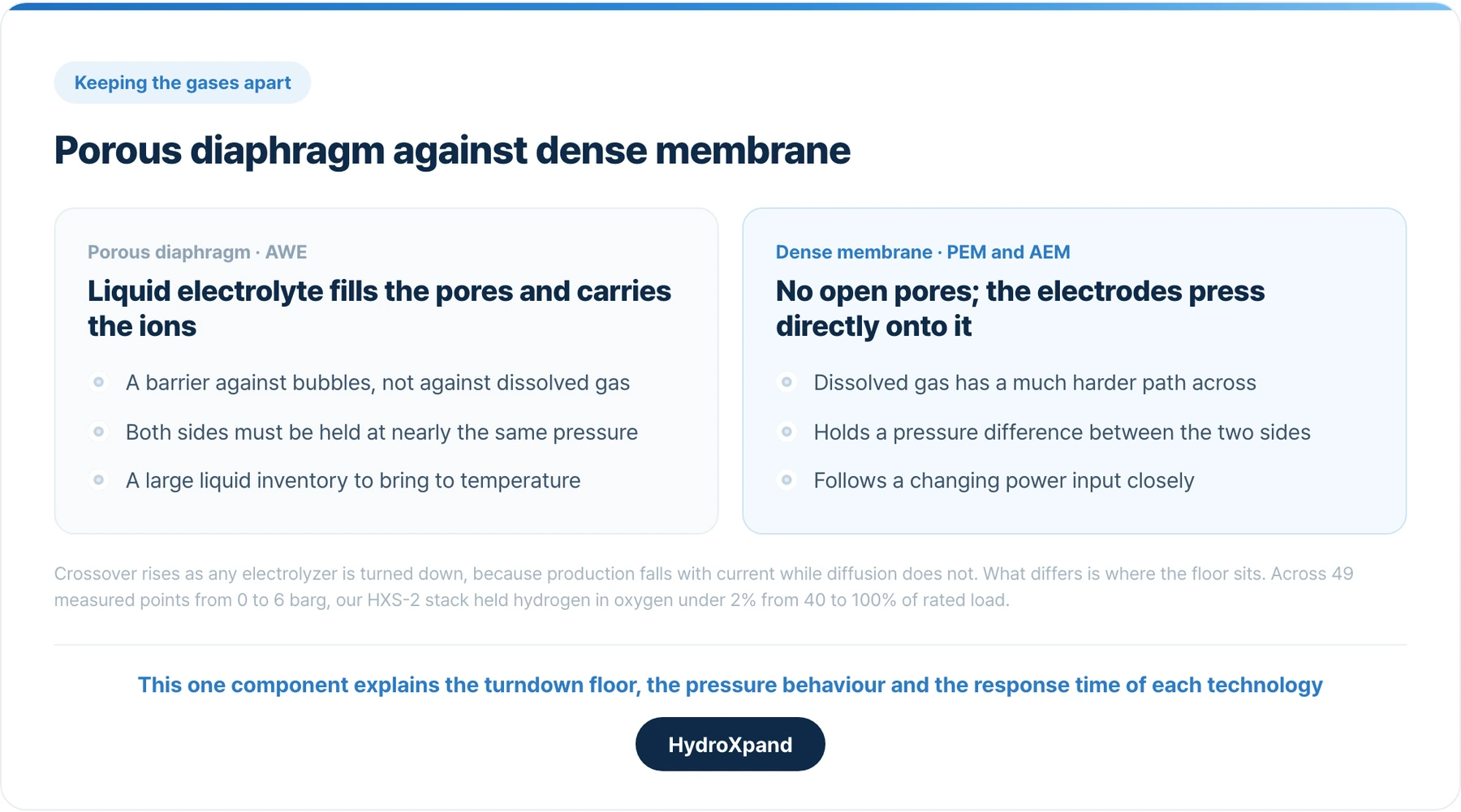
An alkaline cell separates the two gases with a porous diaphragm. The liquid electrolyte fills those pores and carries the hydroxide ions through them. The diaphragm is a physical barrier against bubbles, not a selective barrier against dissolved gas.
Unfortunately, the diaphragms do not completely prevent the cross-over of the gases nor that some oxygen arrives to the cathode where it can combine with hydrogen to form water.
A dense polymer membrane does the same job differently. There are no open pores, the ions move through the material, and dissolved gas has a much harder path across. That is what PEM and AEM cells use, and it is why they hold a pressure difference between the two sides while an alkaline cell generally cannot.
Once you know that, the two well-known limits of alkaline electrolysis stop being separate facts and become one fact seen twice.
SourcesMolecules 26(21):6326 (2021), DOI 10.3390/molecules26216326: diaphragm crossover in alkaline electrolysis · Polymers 15(9):2144 (2023): KOH concentration and operating temperature of alkaline electrolyzers
Limit one: the turndown floor
Gas crosses any separator at a rate set mostly by the concentration difference across it. That rate does not care how hard the cell is working. Production, on the other hand, is proportional to current.
Reduce the load and the numerator falls while the leak stays roughly where it was. The impurity fraction therefore rises as the machine is turned down, and at some load it reaches the point where the mixture is no longer acceptable and the plant has to stop rather than reduce further.
This allows the intermixing of the produced gases (hydrogen and oxygen – H2 and O2) that are dissolved in the electrolyte, limiting lower power-operating range
This is why the turndown floor belongs in a technical discussion about renewable-powered projects rather than in a footnote. A grid connection at steady base load never approaches it. A solar or wind profile spends a large share of its hours near it.
The behaviour is not unique to alkaline cells. It is a property of electrolysis, and we measure it in our own AEM stacks too. Our HXS-2 stack held hydrogen in oxygen under 2 percent across 49 measured points from 0 to 6 barg, everywhere from 40 to 100 percent of rated load. What differs between technologies is where the floor sits, not whether one exists.
Limit two: pressure and dynamics
A liquid electrolyte on both sides and a porous separator between them means the two sides must be held at nearly the same pressure. Let one side lead and the electrolyte moves through the diaphragm. Pressurised alkaline systems exist and work, but they pressurise both sides together, which is a different engineering problem from the differential pressure a dense membrane allows.
The liquid inventory also sets the response time. A large volume of hot circulating electrolyte is thermally slow, and the cell chemistry needs that inventory to be at temperature and in composition before the plant can take load.
- Delivery pressure usually needs downstream compression, which is capital cost and parasitic load.
- Ramping is slower than a membrane cell, which matters when the power source is the thing setting the profile.
- The electrolyte itself is a maintenance item, and a concentrated alkali is a handling and materials question through the whole plant.
None of these limits is a reason to dismiss the technology. They are the reasons the two membrane technologies were developed, and they are also the reasons alkaline electrolysis remains the right choice for the projects those limits do not touch.
- HXS-2 · 2 kW stack→An alkaline chemistry with a dense membrane, and the crossover data above.
- HXP-an · anode→Nickel-iron grown on nickel foam. The alkaline materials set, in a membrane cell.
- Datasheets→Six products. No form.
What alkaline electrolysis is still the right answer for
We build AEM, so this section is written by an interested party and should be read as one. It is still the honest summary.
| Project shape | Why alkaline fits |
|---|---|
| Large, steady industrial loadmulti-MW, flat profile | The turndown floor is never approachedand capital cost per kW is the lowest of the four |
| Long project horizonfinancing that wants an operating record | A century of industrial operationand a supply chain with no scarce metal in it |
| Hydrogen consumed at low pressureon the same site | Downstream compression is a small itemwhen the delivery pressure is already close |
| Variable renewable inputsmall or mid scale | This is where it does not fitand where the membrane technologies exist |
Alkaline remains the leading technology, with 60% of the additions and the global installed capacity.
The last row is the one that produced everything else in this series. AEM keeps the alkaline chemistry, and with it the freedom from iridium, while replacing the diaphragm with a dense anion exchange membrane. That single substitution is what changes the pressure and turndown behaviour, and it is also where AEM's own unsolved problem lives, because the membrane has to survive the alkaline environment it was put into.
SourcesIEA Global Hydrogen Review 2025, chapter 3: alkaline share of installed electrolysis capacity · U.S. DOE Technical Targets for Liquid Alkaline Electrolysis: status of commercial alkaline technology
- AEM electrolysis: technology and measured data→How AEM electrolysis works, AEM vs PEM vs alkaline, and the measured data behind our stacks.
- AEM water electrolysis explained→What changes when the diaphragm becomes an anion exchange membrane.
- PEM water electrolysis→The other membrane answer, and what the acidic environment costs.
- Alkaline, PEM or AEM→The four questions that decide which limit your project can live with.
- What pressurised operation costs→The 49 crossover points behind the turndown discussion, measured from 0 to 6 barg.
Frequently asked questions
What is alkaline water electrolysis?
Alkaline water electrolysis splits water in a liquid alkaline electrolyte with a porous diaphragm separating the two electrodes. It is the only electrolysis technology with a hundred years of industrial operation and uses no noble metals.
Why does alkaline electrolysis have a turndown floor?
Hydrogen in oxygen rises at low load because production falls with current while gas diffusion through the diaphragm does not. The floor is a safety limit set by flammability, not an efficiency limit.
What is alkaline electrolysis still the right answer for?
Large plants that run at steady load near their rated point, where its cost and proven history matter more than dynamic response or high pressure.
Sources
- Recent Advances in Alkaline Exchange Membrane Water Electrolysis and Electrode Manufacturing (DOI 10.3390/molecules26216326) — Molecules, 2021
- Recent Advancements of Polymeric Membranes in Anion Exchange Membrane Water Electrolyzer: A Critical Review (DOI 10.3390/polym15092144) — Polymers, 2023
- Green Hydrogen Cost Reduction — International Renewable Energy Agency, 2020
- Global Hydrogen Review 2025 — International Energy Agency, 2025
- Technical Targets for Liquid Alkaline Electrolysis — U.S. Department of Energy
Looking at AEM for a specific application?