Alkaline electrolysis is inexpensive but slow. PEM is fast but tied to iridium and PFAS. AEM keeps the solid membrane and moves it into an alkaline environment, and this is what that changes, what it has not solved, and where the technology stands measured.
Green hydrogen has one production route, and that route is water electrolysis. Which is why the limits of today's electrolysis technologies are not an academic question. They set the floor under the cost of clean hydrogen.
Two technologies carry the commercial market, and each is held back by the same structure that makes it work. AEM exists because of the gap between them.
- AEM electrolysis: the full technology overview→AEM vs PEM vs alkaline, what is inside a cell and stack, scale-up data and cost drivers in one place.
The trade-off in electrolysis today
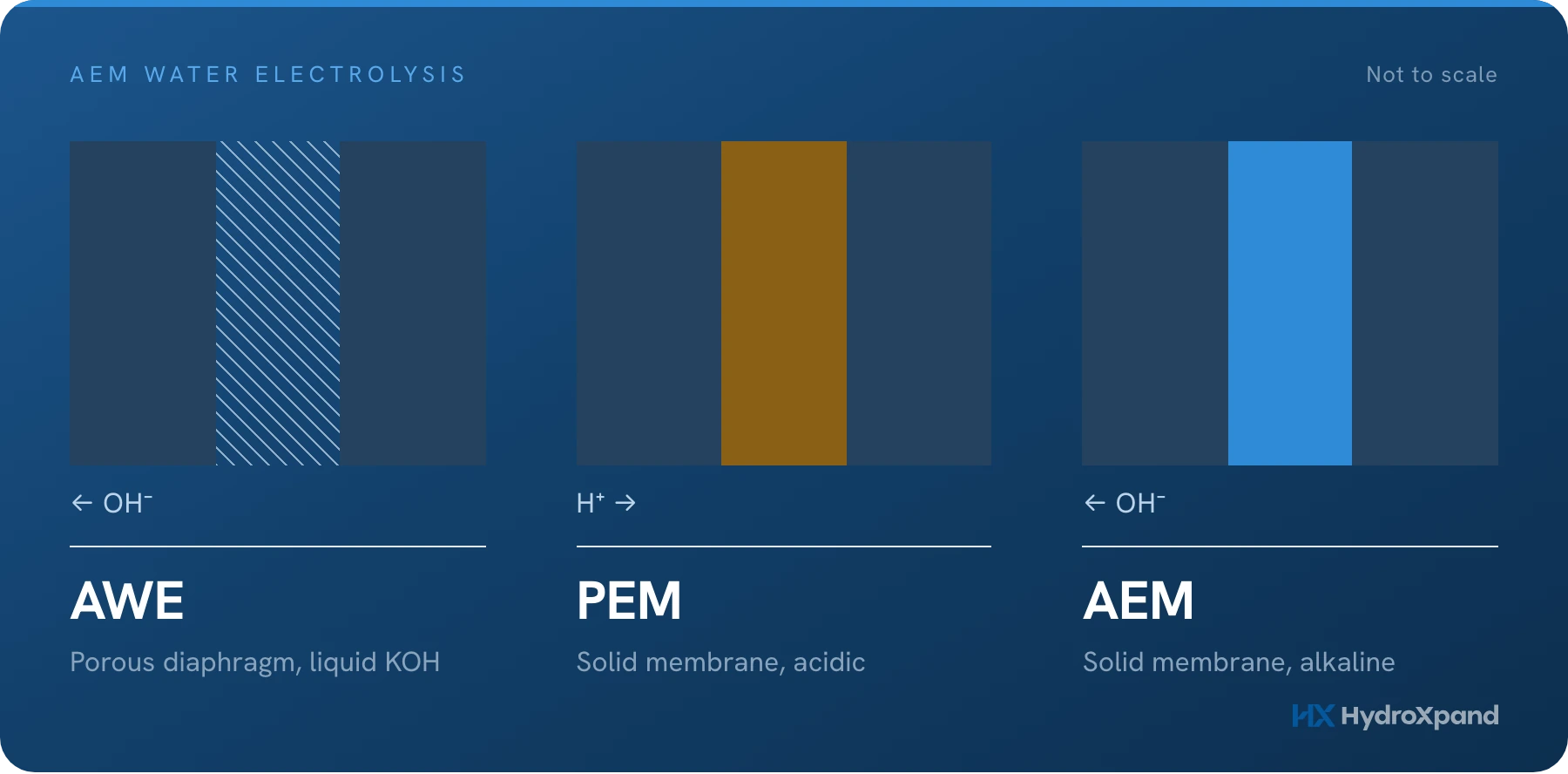
Alkaline electrolysis has been in industrial use since the 1800s. It runs liquid KOH between electrodes separated by a porous diaphragm and works with nickel-based catalysts rather than noble metals. That is why it is inexpensive to build, and why most installed electrolysis capacity in the world is alkaline.
The limits come from the same design. Response is slow. Gas crossover is structural, because a porous diaphragm separates the two half-cells but does not seal them, and the mixing gets worse at low load, exactly where a renewable-coupled system spends much of its time. That is a safety limit before it is an efficiency limit. Pressurised hydrogen is difficult for the same reason: suppressing crossover means a thicker diaphragm, and a thicker diaphragm means lower conductivity.
PEM replaced the porous diaphragm with a solid polymer membrane and moved the chemistry into an acidic environment. The result is fast and couples well to variable renewables. The acidity is also the bill, because acidic operation requires noble metal catalysts, principally iridium on the oxygen side.
Nobody knows the final scope of that restriction. But a technology whose core material sits inside an open regulatory question carries a risk unrelated to its performance.
SourcesIEA Global Hydrogen Review 2025, chapter 3: alkaline 60% of installed electrolysis capacity · International Platinum Group Metals Association, White Paper on Iridium (2022) · Hydrogen Europe, Position Paper on PFAS (2023) (industry association)
What the anionic membrane changes
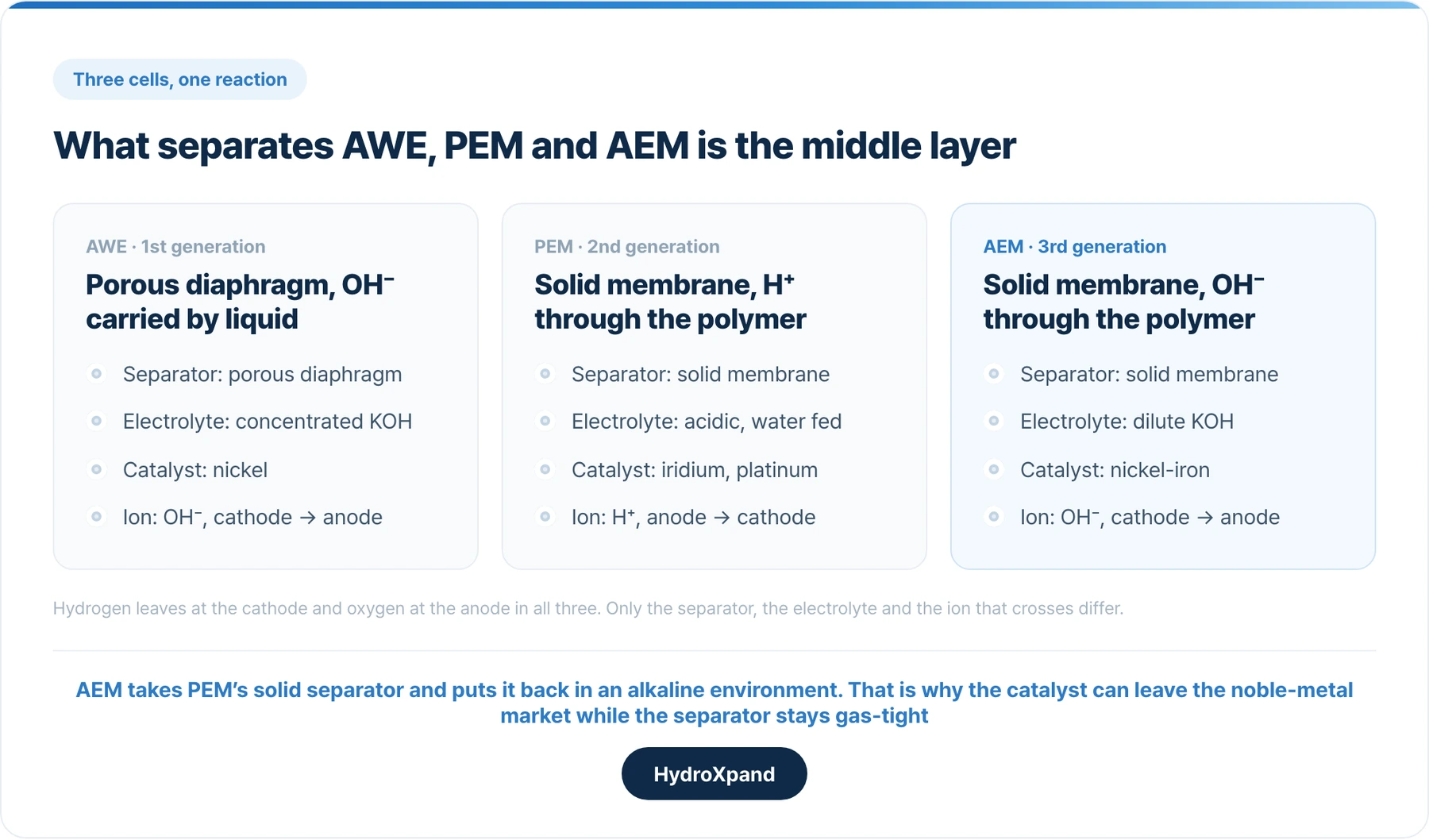
AEM keeps PEM's solid polymer membrane and moves it back into an alkaline environment. In one sentence: the membrane conducts hydroxide ions rather than protons. The technology is written both ways in the literature, anion exchange membrane water electrolysis and AEMWE, and they mean the same thing.
- The catalyst leaves the noble metal market. In alkaline conditions nickel-iron catalysts are stable and active enough for oxygen evolution, so iridium is not required.
- The separator is solid, so crossover is far lower. High-purity hydrogen without a downstream purifier, and pressurised operation without fighting the separator.
- The membrane can be hydrocarbon-based, which sits outside the PFAS scope entirely. Worth stating carefully: some commercial AEM membranes still use partially fluorinated backbones for durability. It is an option the chemistry allows, not a property every AEM product has.
- Response is fast, because the solid membrane gives AEM the dynamic behaviour that makes PEM attractive for renewable coupling.
The OER is the limiting step of the complete electrolysis process due to its lower kinetics and higher overpotential than the HER
That single change moves four things at once.
What AEM has not solved
AEM is not a finished technology, and it is worth being direct about where it is not.
Membrane durability over long operation is the open problem. Anion exchange membranes can lose conductivity over time through chemical degradation of the cationic groups that carry hydroxide. Improving this is where most of the field's material work sits, and it is done through membrane chemistry and operating conditions together rather than either alone.
The second problem is manufacturability. Reaching a performance number in a single lab cell and reproducing it across hundreds of stacks are different problems with different failure modes. MEA fabrication and stack assembly decide which of the two a customer actually receives.
Both are real. Neither is a reason to dismiss the technology, and the honest way to discuss them is with data rather than adjectives.
SourcesIRENA, Green Hydrogen Cost Reduction (2020): AEM status and degradation mechanisms as of 2020 · U.S. DOE Technical Targets for Liquid Alkaline Electrolysis and PEM Electrolysis: reference degradation rates in mV per 1,000 h
- AEM electrolysis stacks→The two stacks we build and sell, and the technology behind them.
- HXS-2 · 2 kW stack→AEM stack with anode, cathode and membrane developed in house.
- HXB-V1 · 2 kW system→480 NL/h, 0 or 10 barg selected in software.
- Datasheets→Six products. No form.
AWE, PEM and AEM compared
| Item | AWE | PEM | AEM |
|---|---|---|---|
| Separator | Diaphragmporous | Cation exchange membranesolid | Anion exchange membranesolid |
| Environment | Alkaline | Acidic | Alkaline |
| Catalyst | Non-PGMNi | PGMIr, Pt | Non-PGMNi-Fe |
| High-purity H₂ | Purification needed | Yes | Yes |
| Pressurised H₂ | Difficult | Yes | Yes |
| Renewable coupling | Limited | Well suited | Well suited |
| Open risk | Low efficiencysafety at low load | Iridium supplyPFAS regulation | Membrane durabilitymanufacturability |
Read the last row first. Every technology on this table has an open risk, and the useful question is what kind of risk it is.
The limits of AWE and PEM are structural. They follow from the porous separator and from the acidity, and no amount of engineering removes them. AEM's are maturity problems, which is a different category, and the last decade has moved them substantially.
Where the technology actually stands
General claims about AEM maturity are easy to make and hard to check, so here are ours with the conditions attached.
| Item | Disclosed condition |
|---|---|
| Stack | HXS-2, 23 cells |
| Electrolyte | Alkaline, dilute |
| Temperature | Moderate, well below boiling |
| Mode | 50 A galvanostatic, ambient pressure |
| Operation | More than 3,000 hours cumulative |
| Long-run data | Published with its test conditions in the durability note |
| Behaviour | No sign of accelerating degradation |
A second run answers the durability question from the materials side. A HydroXpand grown nickel-iron anode ran 6,358 hours in a 16 cm² two-cell short stack at 0.625 A cm⁻², degrading at 14.7 µV/h per cell on a full-run linear fit with a PiperION® 80 µm membrane. In the same campaign, changing only the membrane gave 1,234 hours, which is the honest way to read any single durability number: it belongs to the cell, not to one component.
Separately, the same stack reaches 90.0% efficiency on a higher heating value basis at beginning of life, measured at 50 A in 0.1 M KOH at 50 °C and ambient pressure. On the hydrogen side it runs up to 10 barg without a separate compressor. The anode is NiFe-LDH grown on nickel foam, with no iridium and no titanium.
Gas crossover is the safety number, and it is the one worth seeing plotted rather than quoted. Hydrogen in oxygen rises as the load drops, which is exactly the condition a renewable-coupled system spends time in, so a single figure at rated load does not describe it.
The safety number, plotted
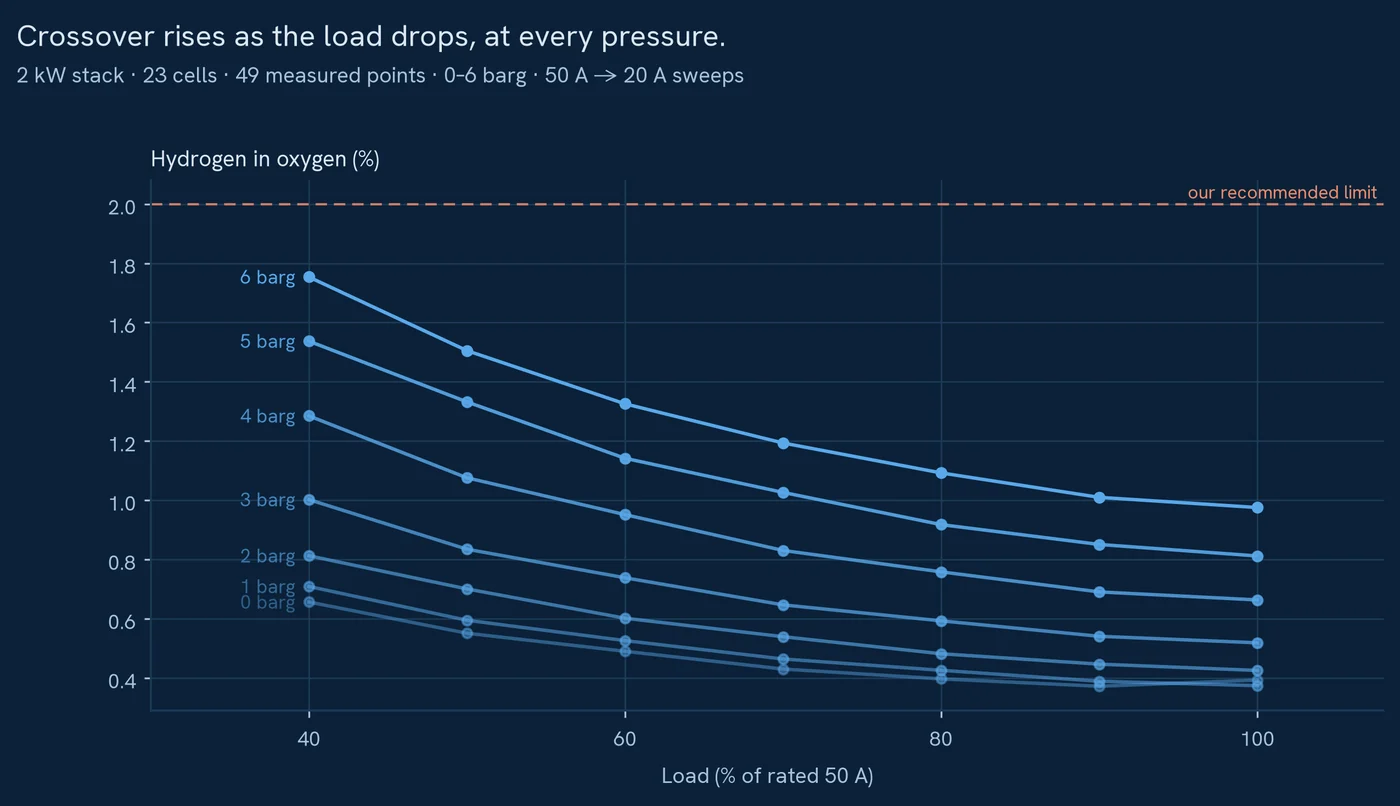
Across 0 to 6 barg and 40 to 100% of rated load, every one of those 49 points sits below our 2% control limit, and the curves rise as the load falls. Oxygen in the hydrogen stream is a trace, and a purity question for the dryer rather than a safety limit.
We publish test conditions with every number because a number without its conditions cannot be compared to anything. Two thousand hours at low current in a warm cell and two thousand hours at rated current are not the same result, and a specification sheet that gives you only the duration has told you very little.
One thing the durability figure does not tell you is product lifetime. We do not convert it into one.
- What is an electrolyzer stack→What a stack is made of, how cell count scales output, and what decides performance.
- What is an ionomer→The polymer that binds the catalyst layer and carries ions to it, and how AEM and PEM ionomers differ.
- What pressurised operation costs→28 mV per cell at 50 A, and the crossover measurements that set the real lower bound on load.
- HXS-2 durability data→The full technical note: cell-to-cell spread, crossover against load, and what to check before accepting a degradation rate.
- How to compare an efficiency figure→HHV against LHV, and why a cell number and a system number are not the same claim.
- Alkaline water electrolysis→The chemistry AEM keeps, and the diaphragm it replaces.
- PEM water electrolysis→The other membrane answer, and what an acidic cell costs in materials.
Why we build the whole chain
AEM performance is decided at the boundaries between material, electrode and stack, not inside any one of them. A membrane that performs well in a half-cell can behave differently once it is under compression against a specific electrode structure, and an electrode optimised in isolation can be the wrong choice for the flow field it ends up in.
Assembling purchased membranes and purchased electrodes into a stack makes it difficult to improve efficiency, durability and cost at the same time, because each change lands in somebody else's design and comes back as a constraint.
So we develop the catalysts and electrodes, design the cell, build the stack, and build the system and control software that run it. Three KAIST PhDs founded the company in December 2023. More than 70 customers in over 10 countries now use our electrodes, stacks and systems, from university laboratories evaluating their own materials to companies producing hydrogen on site.
The stack in those measurements is a product. The HXS-2 is a 23-cell 2 kW AEM water electrolyzer stack rated at 480 NL/h (1 kg/day), available to order and shipping four weeks from PO acceptance, and a five-cell configuration is available for evaluation.
Frequently asked questions
What is AEM water electrolysis?
AEM water electrolysis uses a solid anion exchange membrane in an alkaline environment. It keeps the solid membrane of PEM but removes the dependence on iridium and on PFAS-based membranes.
Why does AEM avoid iridium?
In an alkaline cell the oxygen-side catalyst can be nickel or iron based instead of iridium, whose global production is about 7 to 8 tonnes a year with over 80% from a single country.
What has AEM not solved yet?
Membrane durability and the operating history at stack and system level are shorter than for alkaline and PEM. Both are real and are best discussed with measured data rather than adjectives.
Sources
- Global Hydrogen Review 2025 — International Energy Agency, 2025
- White Paper on Iridium — International Platinum Group Metals Association, 2022
- Position Paper on PFAS — Hydrogen Europe, 2023
- Recent Advances in Alkaline Exchange Membrane Water Electrolysis and Electrode Manufacturing (DOI 10.3390/molecules26216326) — Molecules, 2021
- Green Hydrogen Cost Reduction — International Renewable Energy Agency, 2020
- Technical Targets for Liquid Alkaline Electrolysis — U.S. Department of Energy
Looking at AEM for a specific application?