A turnkey system is supposed to be the easy purchase: state an output and take delivery. What varies between suppliers is where the box stops. These are the questions worth settling before an order, using our own 2 kW system as the worked example.
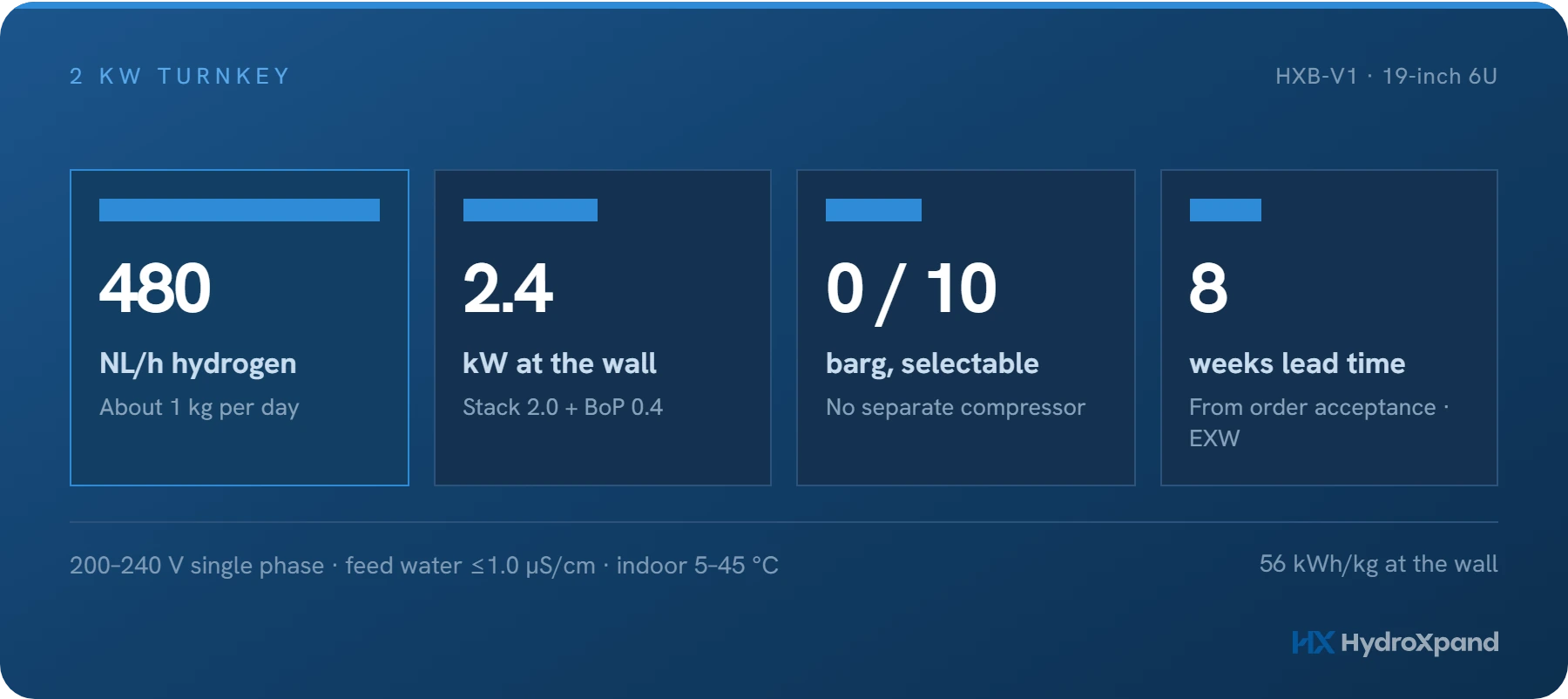
A turnkey electrolyzer is meant to be the simple purchase. State the output you need, take delivery, make hydrogen.
What differs between suppliers is where the box stops. Two systems quoted at the same output can leave very different work on your side of the wall.
So the useful questions are about the boundary rather than the specification sheet. What arrives assembled, what the room has to provide, and which number to compare.
Our HXB-V1 is the worked example here because we can state its conditions exactly. The questions apply to any supplier.
What the box contains, and what it does not
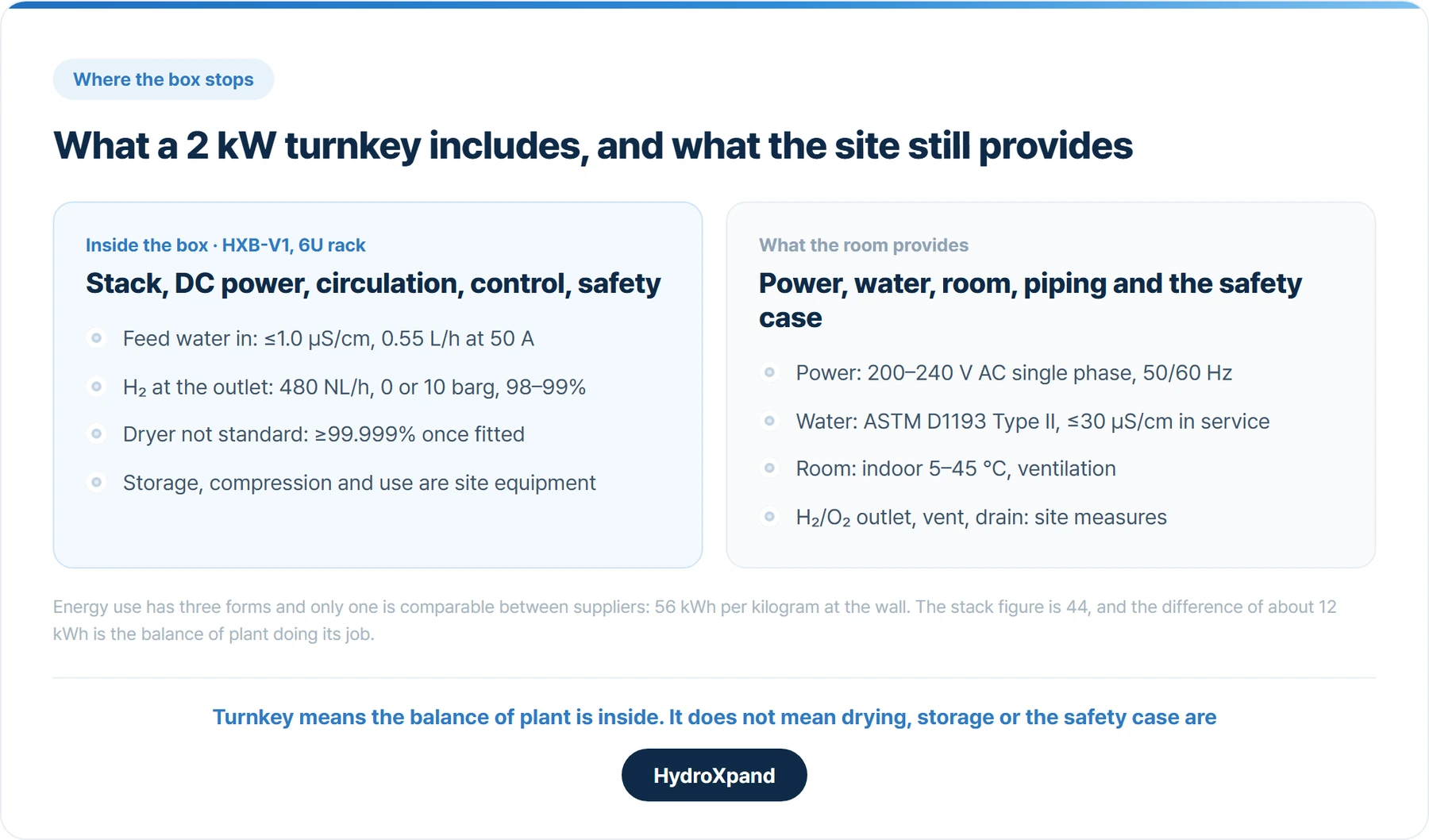
In one 19-inch 6U rack: the 2 kW stack, DC power, electrolyte circulation and temperature control, automatic water refill, and the control and safety logic.
Control is a desktop application, with an MQTT over Ethernet interface in JSON for integration. Telemetry runs at one-second intervals with eight external control variables. Modbus is not supported, which is worth knowing early if your lab standardises on it.
| In the rack | On your side | |
|---|---|---|
| Production | Stack, DC power, circulation,temperature control | — |
| Water | Automatic refill by internal pump | Feed-water tank at thespecified quality |
| Drying | Not standardmodular dryer in development | Dryer, if you need99.999% purity |
| Downstream | H₂ and O₂ outlets | Vent and drain piping, storage,compression, the application |
| Safety | H₂ detection, E-stop, interlocks | Room ventilation and thesite hydrogen safety case |
SourcesMQTT, the OASIS standard messaging protocol for IoT · Modbus Organization
Four things the site has to provide
None of these is unusual, and all four are cheaper to settle before the order than after delivery.
Power is 200 to 240 V AC single phase at 50 or 60 Hz. A 2 kW class system does not need three-phase, which is often what makes it possible to put one in a laboratory at all.
Water is the one that surprises people. Recommended feed is ASTM D1193 Type II, at or below 1.0 µS/cm, and in service we accept up to 30 µS/cm. Consumption is 0.55 L/h at 50 A and 60 °C, topped up automatically by a built-in pump.
The room is indoor, 5 to 45 °C, with ventilation and whatever hydrogen safety measures the site requires. That last part is a local decision and we do not make it for you.
Piping is yours: hydrogen and oxygen outlets, vent and drain. So is anything downstream, including storage and compression.
SourceASTM D1193-06(2018) Standard Specification for Reagent Water, Type II
Purity and pressure are two different purchases
Pressure is included. The system delivers at 0 or 10 barg, selected in software, with no separate compressor.
Purity is not, and this is where datasheets get read too quickly. As the hydrogen leaves the system it is 98 to 99% at 0 barg, and 99% at 10 barg.
Reaching 99.999% or better takes a dryer, and the dryer is not part of the standard supply. We have a modular one in development and can recommend a partner product when one is needed immediately.
So the honest way to compare quotes is to ask what purity is at the outlet, before drying, and what the drying step costs. A single 99.999% on a datasheet does not say which side of that line it sits on.
Pressure comes with the machine. Purity comes with a dryer. Any quotation that shows one number for both is hiding a line item.
The number to compare, and the one to ignore
Energy use has three forms on our page and they are not interchangeable. 5.0 kWh per normal cubic metre, 44 kWh per kilogram at the stack, and 56 kWh per kilogram at the wall.
The last one is the one to compare between suppliers, because it is the one your meter will read. The difference of about 12 kWh per kilogram between the two is the balance of plant doing its job.
Operating current runs 15 to 67 A with 50 A recommended, which is what sets the usable output range of a given unit.
What it will not do
This is a steady-operation machine. It is not built to follow a swinging input, and we do not present it as a renewable load-following product.
Low load has a second consequence that applies to any AEM system. Gas crossover rises as load falls, and rises again with pressure, which is why the minimum load matters more than the voltage penalty when you plan a duty cycle.
Storage and compression are separate equipment. A system that makes a kilogram a day is a production device, not a supply chain.
And it is a 2 kW class machine. If the answer to your requirement is tens of kilograms a day, this is the wrong tier and we will say so rather than stack units until the number works.
- Ask for purity at the outlet and separately with drying.
- Ask for energy use at the wall, not at the stack.
- Ask what the minimum load is at the pressure you plan to run.
- Ask what is not in the box: dryer, piping, storage, compression, the safety case.
If a stack is what you actually need, because your team will build the balance of plant, that is a different and usually cheaper purchase.
- What is an electrolyzer stack→What a stack is made of, how cell count scales output, and what decides performance.
- Before the electrolyzer arrives→What the site has to provide once the box is delivered.
- Between one and fifteen kilograms a day→What changes when the same unit is repeated.
- HXB-V1 · 2 kW turnkey AEM electrolyzer→Every figure on this page, with the full specification table.
- Buying AEM components→The tier below: electrodes, research cells and stacks bought separately.
- HXS-2 · 2 kW stack→The stack inside the system, sold on its own.
- Pressurised operation, measured→Why minimum load, not voltage, bounds pressurised operation.
- Hydrogen generators→Sizing on-site production before choosing a tier.
- Datasheets→Six products. No form.
- Do you need a compressor?→Whether pressurised output removes the compressor from your plant.
- Running an electrolyzer on solar→The minimum load question, measured, before you plan a duty cycle.
- Research or industrial electrolyzer→What decides the choice, and what each one includes.
Frequently asked questions
What does a turnkey 2 kW electrolyzer include?
The HXB-V1 contains the stack, power conversion, electrolyte circulation, gas separation, water refill and safety logic. Power, feed water, venting and a dryer for 99.999% purity are outside the box.
How much hydrogen does a 2 kW electrolyzer make?
About 480 NL/h, roughly 1 kg per day in continuous operation, drawing 2.4 kW at the wall at 50 A.
Are purity and pressure the same purchase?
No. Pressure comes with the machine, selectable up to 10 barg. Purity of 99.999% comes with a dryer, which is a separate item.
Sources
- ASTM D1193-06(2018) Standard Specification for Reagent Water — ASTM International
- MQTT: The Standard for IoT Messaging — OASIS
- Modbus Organization — Modbus Organization
Looking at AEM for a specific application?