Ni foam substrate
Porous 130 ppi substrate
Use an anode with a consistent architecture and specification for anion exchange membrane (AEM) water electrolysis while varying membranes, cells and operating conditions.
The HXP-an is a PGM-free NiFe-LDH anode electrode, available to order in two standard formats: 200 × 300 mm at 300 µm and 100 × 100 mm at 3 mm. Standard formats ship two weeks from PO acceptance; custom thickness or large areas take up to two months.
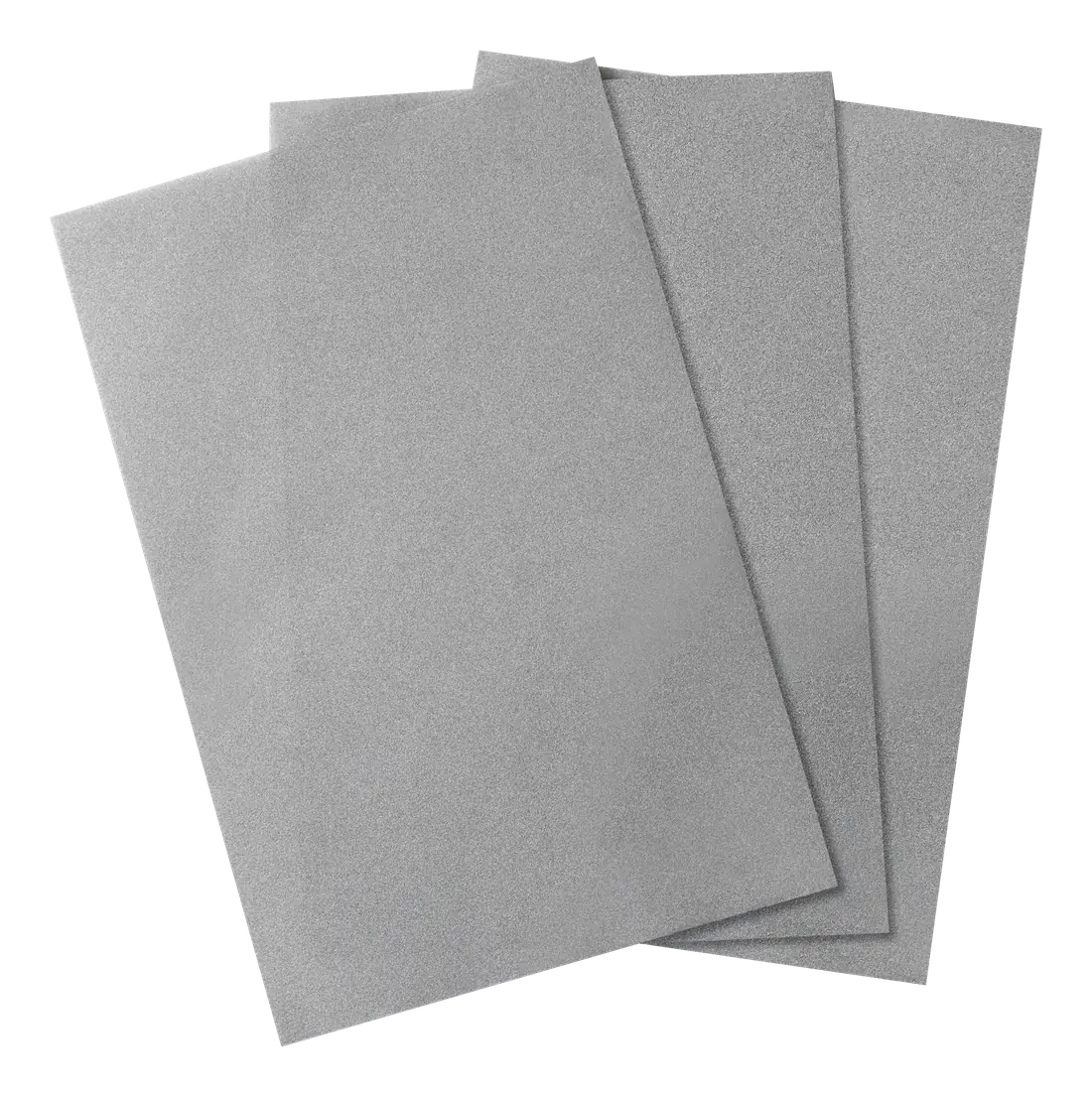
HXP-an is an OER anode with NiFe LDH grown directly on a Ni foam substrate. Review the material architecture, standard formats and test conditions before selecting the size for your study.
The OER anode is made by growing a NiFe LDH catalyst layer directly on a porous Ni foam substrate. It contains no platinum-group metal and no iridium. Because the catalyst is grown on the substrate itself, HXP-an is supplied as a catalyst-coated substrate (CCS) electrode rather than a catalyst-coated membrane (CCM).
Porous 130 ppi substrate
Grown directly on the substrate
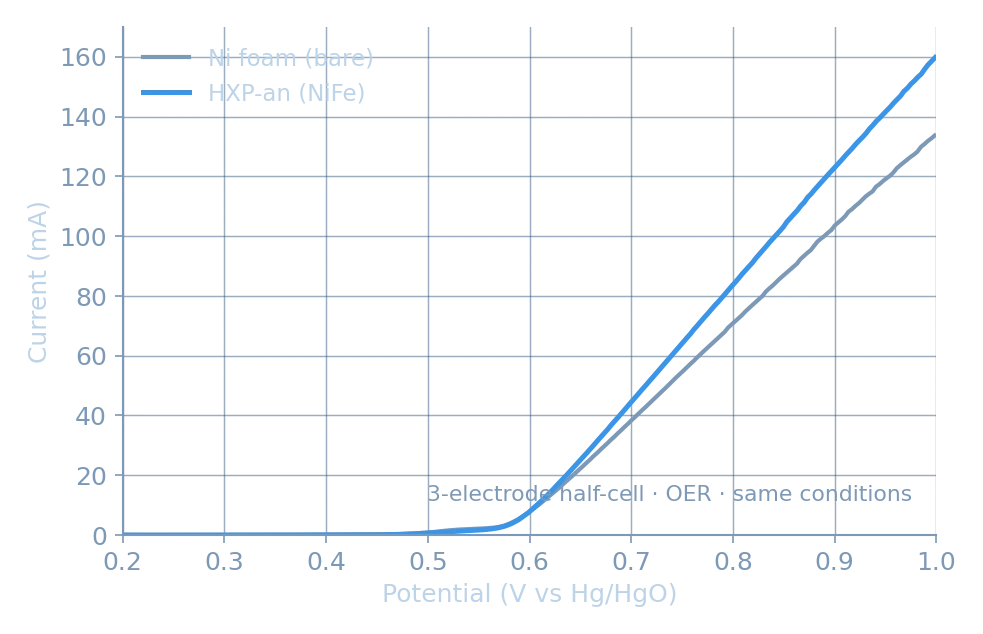
Compared with bare Ni foam under the same condition
The label on each chart says whether it is measured, test or design-target data. Test conditions are in each chart caption.
OER polarization · 3-electrode half-cell (NiFe vs bare Ni foam)
These records describe the selection purpose and application context, not customer-verified performance.
The specification table, support terms and review documents.
| Material | Ni-Fe @ Ni foam |
|---|---|
| Catalyst | NiFe LDH (OER) |
| Pore | 130 ppi |
| Porosity | 95–98% |
| Test condition | 0.3 M KOH · room temperature (3-electrode) |
| Standard format · laboratory grade | 200 × 300 mm · thickness 300 ± 20 µm |
| Standard format · stack grade | 100 × 100 mm · thickness 3.0 ± 0.2 mm |
| Custom | Custom size and thickness available (L ≤ 300 mm · W ≤ 200 mm) |
| Minimum order | One sheet · no minimum order value |
| Lead time | Standard 2 weeks · custom up to 2 months |
| Outgoing inspection | Dimension and thickness measurement, visual inspection of every sheet |
| Fabrication | Grown directly on a Ni foam substrate (binder-free) |
| Specific surface area (BET) | Approx. 25× that of Ni foam |
| Tafel slope | 98.7 mV/dec (three-electrode) |
| Accelerated stress (AST) | 10,000 cycles completed (1.0 ↔ 0.05 A/cm² · 5 s) |
Use the line below in the Methods section when reporting the material source.
NiFe LDH on Ni foam (HXP-an, HydroXpand Inc., Republic of Korea)Ask [email protected] if the lot number is required.
The anode uses our own synthesized NiFe-LDH, so replacements to the same specification come directly from us. We sign an NDA where detailed performance data or test results need to be exchanged.
Available · 2 weeks from PO acceptance for standard formats (custom up to 2 months)
EXW basis; DAP and other terms by agreement. Country of origin is the Republic of Korea, with certificate of origin provided.
Pricing depends on quantity and Incoterms, so it is issued as a quotation. Before asking for one, compare five years of buying cylinders against making the same hydrogen on site.
Cost vs cylinders calculatorMinimum order, lead time, formats and how pricing works. The full FAQ covers operating and integration questions.
HydroXpand sells it directly. Send the format (standard or custom size) and quantity through the enquiry form or to [email protected]; we return a quotation with price, lead time and Incoterms, and the lead time counts from the day we accept your purchase order.
No. Standard formats can be ordered from a single sheet with no minimum order value. Before a volume order we recommend evaluating the coating and its stability on a standard 200 × 300 mm (300 µm) anode first.
There are two standard formats: 200 × 300 mm at 300 µm (laboratory grade, for cutting electrodes and making MEAs) and 100 × 100 mm at 3 mm (stack grade, the format used in our own stacks). Standard formats ship two weeks from PO acceptance; custom thickness or large areas (L ≤ 300 mm, W ≤ 200 mm) take up to two months because the substrate is sourced first.
Price depends on format, quantity and Incoterms, so it is issued as a quotation. The catalyst is NiFe LDH with no iridium or other platinum-group metal, so the price does not track precious-metal markets.
The single-electrode figures (Tafel slope 98.7 mV/dec, OER polarisation) are three-electrode measurements in 0.3 M KOH at room temperature, and the accelerated stress test is 10,000 cycles of 1.0 ↔ 0.05 A/cm² at 5 s. These differ from our stack operating condition (0.1 M KOH, 50 °C), so match the condition when you compare.
EXW is the base term and other Incoterms such as DAP are available. The country of origin is the Republic of Korea; a certificate of origin is provided, so FTA preference may apply in countries that have an FTA with Korea.
Send the target cell, membrane, size and quantity, and we will confirm a suitable supply format.