Ordering an electrolyzer sets off seven stages, from the order check to the commissioning record. Most of the waiting happens during the build, which is exactly when the site should be getting ready. What each stage settles, and what you do while it runs.
Once a purchase order has gone out, the question first-time buyers ask us most is where things stand. When the middle of the process is invisible, people wait for the delivery date, and the time to prepare the site passes unnoticed.
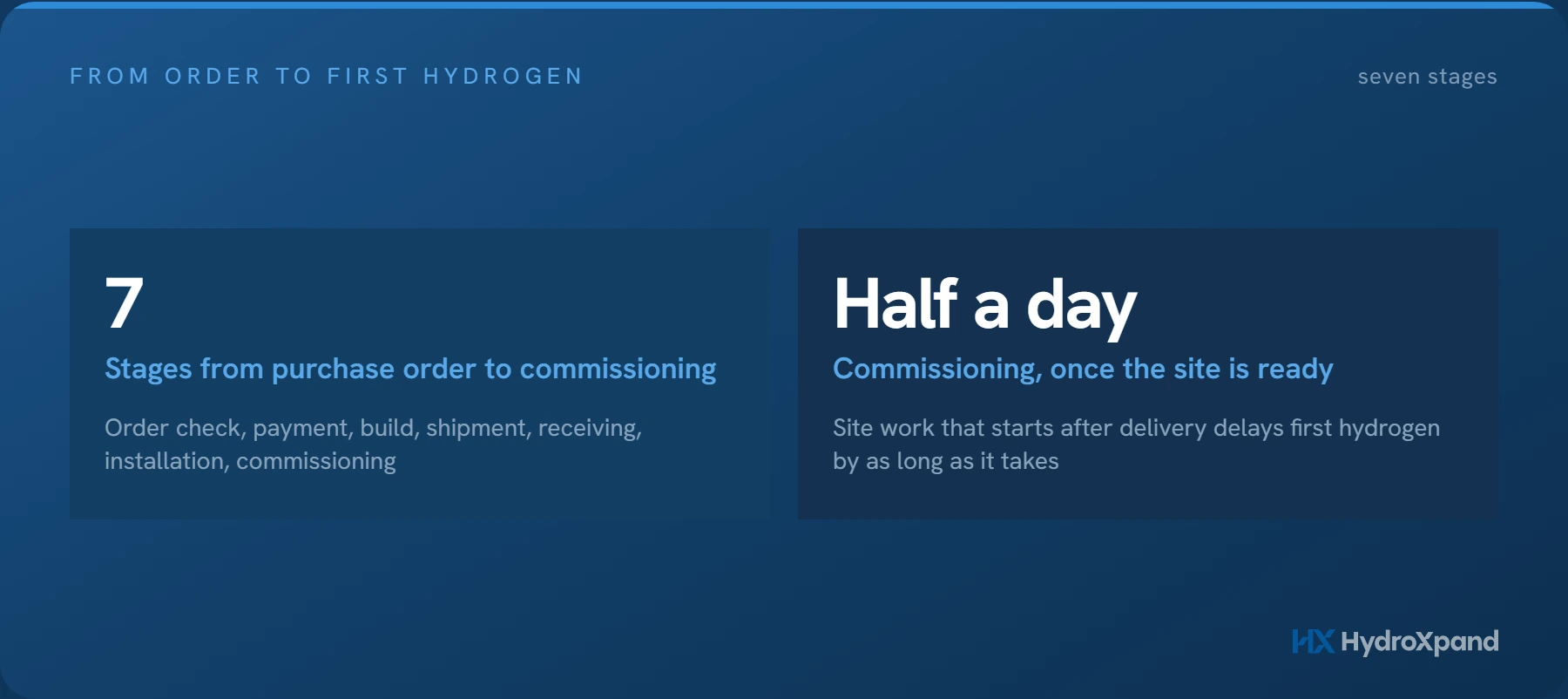
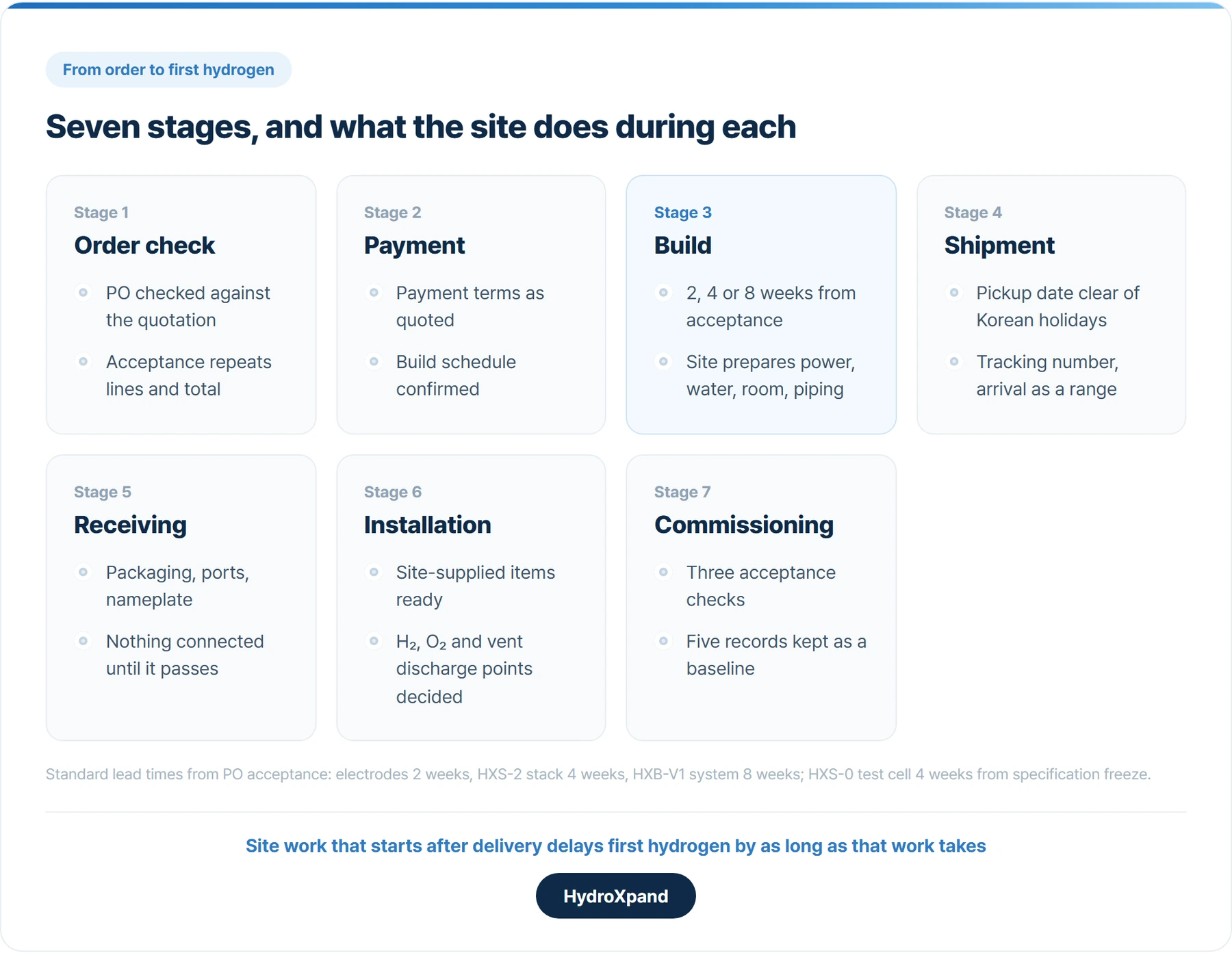
There are seven stages: order check, payment, build, shipment, receiving, installation and commissioning. Below is what each one confirms and what the site should be doing meanwhile. The figures are for our own products, mostly the HXB-V1 2 kW system.
The clock starts at acceptance, not at sending
We do not start building when a purchase order arrives. The order number, quotation number, lines, total and payment terms are checked against the quotation first, and our acceptance email repeats them. It looks like paperwork, but it is the cheapest point at which a wrong quantity or specification can be caught.
Lead times count from the day we accept the order, and two things can move that day. The payment terms are set in the quotation, and so is whether the build schedule waits for payment. A made-to-order HXS-0 test cell starts counting only when its active area, cell count and flow field are fixed.
On repeat orders under net terms a proforma invoice is normally unnecessary, though we ask, because some purchasing departments still need one. The quotation states which terms apply.
| Product | Standard lead time | Counted from |
|---|---|---|
| HXP-an, HXP-ca electrodes | 2 weekscustom formats up to 2 months | PO acceptance |
| HXS-2 stack | 4 weeks | PO acceptance |
| HXB-V1 system | 8 weeks | PO acceptance |
| HXS-0 test cell | 4 weeks | Specification freezeand PO acceptance |
The build period is the site's preparation period
If electrical work starts after delivery, first hydrogen slips by exactly that long. For a 2 kW system the list is short: 200 to 240 V AC single phase, with no three-phase supply; feed water at ASTM D1193 Type II, with ≤ 30 µS/cm as the in-service limit; an indoor, ventilated room at 5 to 45 °C with the site's own hydrogen safety measures; and piping for the hydrogen and oxygen outlets, the vent and the drain.
One of these, the vent route, can force a different room. The site checks have their own article, linked at the end.
SourceASTM D1193-06(2018) Standard Specification for Reagent Water, Type II
Shipment: a named date, then the carrier's range
When the build is finished we set a pickup day. If you need the equipment in a particular week, we check Korean public holidays first and then name a date inside that week, since a promised date that falls on a holiday simply fails.
Our base term is EXW, and DAP and other Incoterms can be arranged; the quotation says which applies and who books the freight. An HXB-V1 is 482 × 647 × 266 mm and 51.3 kg, and a stack is smaller. At that volume, the minimum charge for shared sea freight plus inland haulage and customs at both ends saves little over air, door to door, and transit takes considerably longer.
After pickup we send the tracking number and give arrival as a range of days, because the delivery day is set by the carrier.
The pickup date is something we can promise. The delivery day is not, which is why it comes as a range.
Receiving: inspect before anything is connected
The HXB-V1 weighs 51.3 kg. Move it on its pallet with a pallet jack, and once it is unpacked use a lifting aid or at least two people. Never lift it by the front panel, the connectors or anything attached to them.
- Outer packaging. Note any damage on the delivery documents and photograph it. A carrier claim needs both.
- Opening. Keep the blade shallow, because it can cut the port threads or the protective caps.
- Visual check. Look for dents or cracks in the enclosure, damage to the front fluid ports, connectors, power inlet and Ethernet port, and traces of leakage or loosened fittings. Check the model and serial number on the nameplate against the order.
- If anything is damaged or missing, do not connect power or piping. Tell us and the carrier first. A unit that was tipped or took a hard knock in transit should not be installed even if it looks intact.
Keep the packaging, a 500 × 710 × 330 mm box on a heat-treated pallet; the stack travels back in it if it ever returns for service. If installation has to wait, store the unit upright, indoors and at 5 °C or above. Liquid remains inside after shipment, and freezing damages the membrane and seals. A bare stack is no different.
This stage can also set the warranty date. The HXB-V1 carries 12 months from shipment, or from acceptance where the contract includes an acceptance procedure, consumables excluded. A bare stack or electrodes are supplied against conformity to specification and freedom from manufacturing defects at delivery, not a fixed term.
Installation: what is in the crate, and what is not
Three things come with the system: the unit, the user manual as an electronic file, and the factory acceptance test document, which the commissioning figures are later compared against.
Unless they were ordered, prepare the KOH electrolyte, DI water, an Ethernet cable, a C19 power cord and, for higher purity, a hydrogen dryer. The site also provides a control PC, containers for electrolyte, water make-up and drainage, KOH-resistant tubing and fittings, and whatever valves, sensors and safety devices its design calls for.
The surface or 6U rack position must carry at least 100 kg once hoses and cables are counted, with 300 mm clear in front and 400 mm behind. Before connecting anything, decide where the hydrogen outlet, oxygen outlet and hydrogen vent each discharge safely.
A bare stack is a different job: the DC supply, electrolyte tank, pump, heat exchanger, piping and safety devices are all on the buyer's side. That belongs in the decision before the order, not in this stage.
Commissioning: three checks, then a baseline
With the site ready, commissioning a system takes about half a day. One person can do it; two are recommended while handling electrolyte, with eye protection and alkali-resistant gloves. The first fill is about 5 L of 0.1 M KOH, and one electrolyte control switch starts make-up, circulation and temperature control together.
Accept the commissioning only if all three hold. If one does not, stop there.
- No visible electrolyte leakage at any fitting or port.
- Flow stable at the setpoint, with the electrolyte level inside its normal range.
- Stack voltage and current responding to the targets you set.
Months later, those five records are the only way to tell whether the stack voltage has actually moved.
Then record five things: the date and who ran it, the electrolyte specification and when it was made up, the settled stack voltage and current with electrolyte temperature and flow, how those compare with the factory test document, and any alarm raised.
Control is through the desktop app, with MQTT over Ethernet in JSON for integration. Modbus is not supported, which is worth checking before the order if your site standardises on it.
- Before the electrolyzer arrives→The site checks in the order that matters, starting with the vent route.
- What turnkey includes in a 2 kW electrolyzer→Where the supplied box stops and the site begins, settled before the order.
- Handbook: receiving and storage→The full unpacking sequence, inspection criteria and storage conditions.
- Handbook: quick start→Filling, warm-up, the acceptance check and what to record, step by step.
- Handbook: warranty and service→What the 12 months cover, what is excluded and how a return works.
- HXS-2 stack integration guide→The loop, ports and instrumentation a bare stack needs on your side.
- HXS-2 durability data→What a voltage trend looks like once there is a baseline to compare against.
- Reading an electrolyzer quotation→The lines to check before the order: tier, lead time, Incoterm and warranty.
Frequently asked questions
When does the lead time for an electrolyzer order start?
From the day we accept the purchase order: 8 weeks for the HXB-V1 system, 4 for the HXS-2 stack and 2 for electrodes. Any payment condition in the quotation comes first, and the HXS-0 test cell counts from specification freeze.
How is the HXB-V1 shipped to Europe?
At its size, usually by air, door to door, on a pickup date checked against Korean public holidays. Our base term is EXW, and DAP and other Incoterms can be arranged.
When does the HXB-V1 warranty start?
Twelve months from shipment, or from the acceptance date where the contract includes an acceptance procedure, with consumables excluded. Bare stacks and electrodes are supplied against conformity to specification and freedom from manufacturing defects at delivery instead.
Sources
- Incoterms 2020 — International Chamber of Commerce
- ASTM D1193-06(2018) Standard Specification for Reagent Water — ASTM International
Looking at AEM for a specific application?