Most electrolyzer suppliers sell a finished machine. A laboratory evaluating materials, or a group building its own cell hardware, needs the pieces instead. This is what buying AEM components involves: what is specified, what arrives in the box, and which part of the build stays yours.
Most electrolyzer suppliers sell a finished machine. You state an output, they deliver something that produces hydrogen.
That is the wrong shape for a laboratory comparing membranes, a group building its own cell hardware, or a company testing whether a catalyst survives its own duty cycle.
Those buyers want the pieces. Electrodes by the sheet, a test cell they can open, a stack they can instrument.
So this page is about the component purchase rather than the machine: what has to be specified, what arrives, and which part of the build stays with you.
What is sold separately
Four things, and they stack into each other. An electrode goes into a cell, cells become a stack, a stack goes into a system.
Buying at the lower tiers means more of the build is yours, and more of the result is yours to interpret.
| What it is | Standard format | Lead time | |
|---|---|---|---|
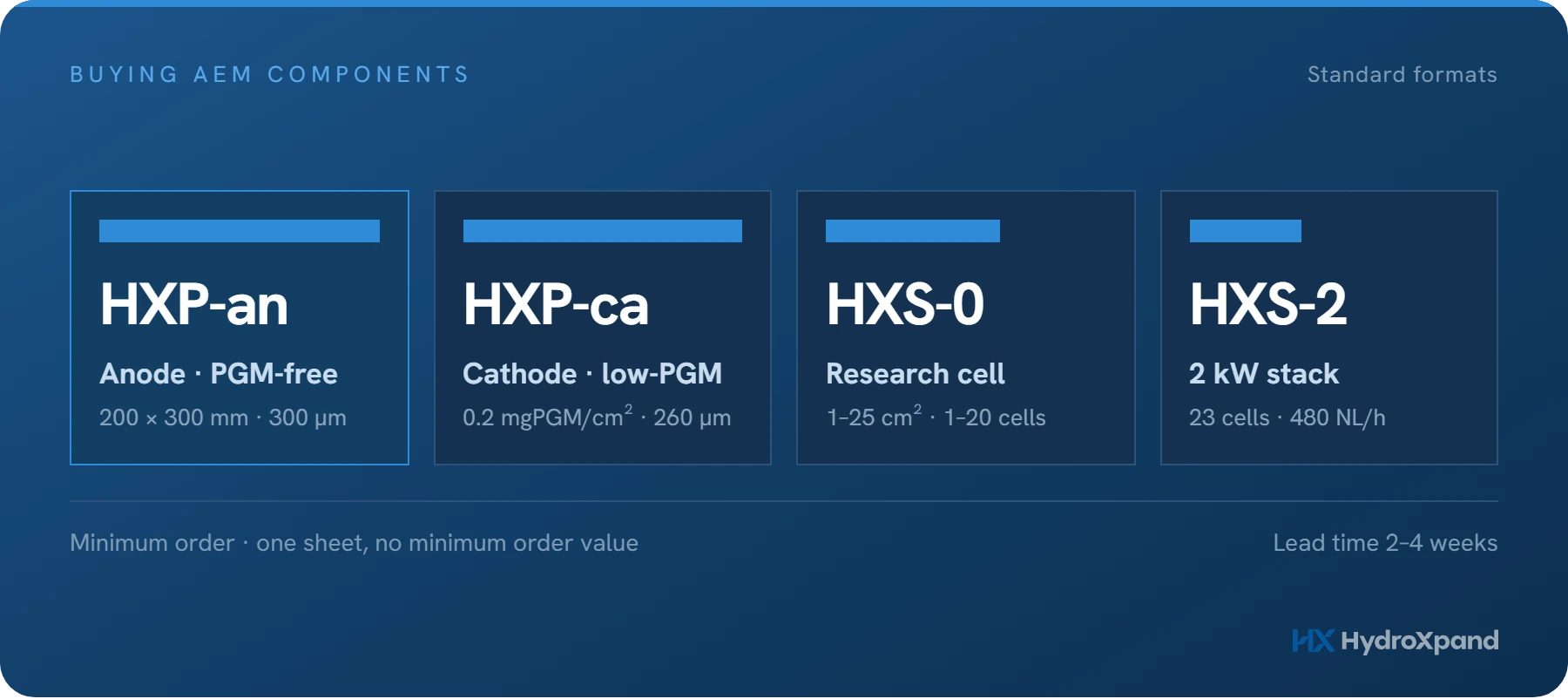
| HXP-ananode | NiFe layered double hydroxide grown directly on nickel foam, binder-free | lab grade 200 × 300 mm · 300 ± 20 µmstack grade 100 × 100 mm · 3.0 mm | 2 weekscustom up to 2 months |
| HXP-cacathode | Pt/C or PtRu/C on carbon paper, 0.2 mgPGM/cm² | 200 × 300 mm · 260 ± 20 µm | 2 weekscustom up to 2 months |
| HXS-0research cell | Single cell to a 20-cell short stack you assemble and open | Active area 1–25 cm²114 × 85.6 × 136 mm · 4 kg | Made to order |
| HXS-22 kW stack | 23 cells, 480 NL/h, 0 or 10 barg, ready to instrument | Fixed configuration | 4 weeks |
Electrodes ship as sheets with dimension, thickness and visual inspection recorded for every sheet. Custom sizes are cut to order within 300 mm by 200 mm.
Terms are EXW and lead times run from order acceptance, not from the enquiry.
What you have to specify
For electrodes, three things: format, thickness and quantity. The stack grade and the laboratory grade differ in thickness by a factor of ten, because one is pressed into a zero-gap stack and the other is handled on a bench.
For the research cell, three different things: active area, cell count and flow field. Active area is set by the gasket window rather than by the plate, so it is chosen rather than machined.
The standard flow field is single-serpentine. A different pattern can be cut if the test objective needs one.
One thing is deliberately not included. The standard research cell ships without an MEA, because most groups buying a cell at that tier are evaluating their own membrane. Ours can be supplied with it if you would rather not make that part.
An MEA from us is three parts: the HXP-an anode, the HXP-ca cathode and an AEM membrane. Each is ordered as its own item, and the ionomer for your own catalyst layers is a separate item as well. Each has its own page, linked further down.
Buying components is not a cheaper way to buy a machine. It is a different purchase, and the specification you send decides most of what arrives.
Reading the numbers on a component datasheet
Component figures are measured differently from system figures, and mixing the two produces nonsense.
Our electrode figures come from three-electrode half-cell testing, with the electrolyte and temperature stated alongside the data. The anode Tafel slope is 98.7 mV/dec. The cathode is 45.7 mV/dec for PtRu/C and 52.2 for Pt/C.
Those describe the electrode, not a cell. Put the same electrode in a zero-gap cell at 60 °C and the number that matters becomes cell voltage at your current density.
Both electrodes have completed 10,000 accelerated stress cycles, switching between 1.0 and 0.05 A/cm² every five seconds. Again: an electrode result, not a stack lifetime.
For stack-level numbers we point to the HXS-2 stack instead. It has more than 3,000 hours of cumulative operation, and its long-run data is published with the test conditions in our durability note.
One claim we keep narrow
The anode carries no platinum group metal. That is the part of AEM worth the attention it gets, and it is why the material is nickel and iron rather than iridium.
The cathode is not PGM-free. It uses Pt/C or PtRu/C at 0.2 mgPGM/cm², and we would rather say so than let the word cover the whole cell.
What we do not publish is the composition and the process. Catalyst formulation and coating are the part we are not going to describe, and a supplier who describes theirs freely is telling you something about how much of it is theirs.
Warranty sits on the system product. Components are supplied against the published specification and the outgoing inspection, which is a different promise, and we would rather it be clear before an order than after one.
Which tier fits the work
The choice is usually decided by what you want to be able to change.
- Comparing membranes or catalysts: electrodes by the sheet, into your own cell hardware.
- Evaluating a full MEA under controlled conditions: the research cell, active area chosen for the amount of material you have.
- Measuring what a stack does over time: the 2 kW stack, instrumented on your bench rather than rebuilt from cells.
- Producing hydrogen for something else to use: the 2 kW system, where the balance of plant is no longer your problem.
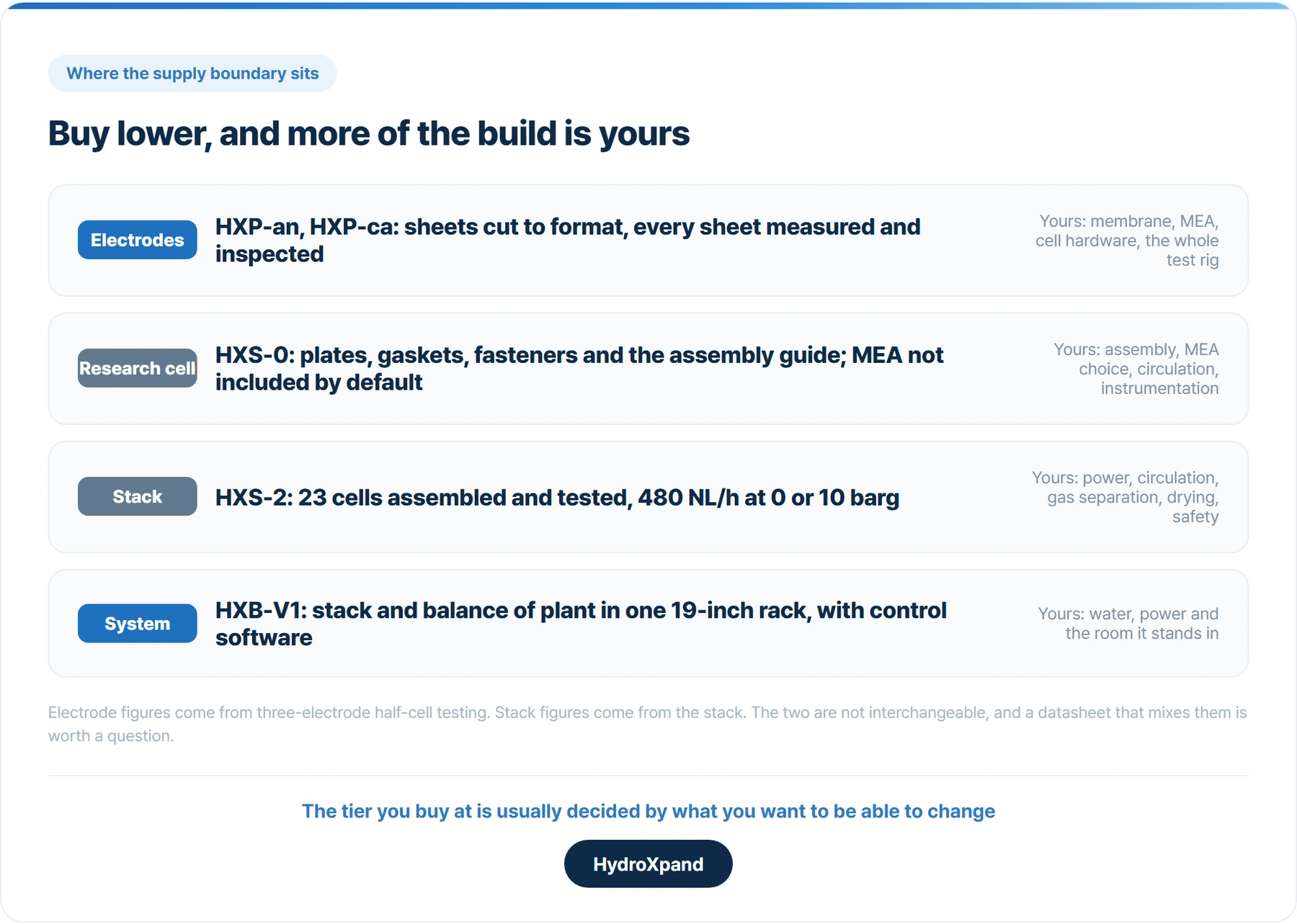
Groups often move up one tier at a time, and the data from the lower tier is what makes the next purchase specific.
If you tell us the operating conditions and what you are trying to measure, we will say which tier fits, including when it is the cheaper one.
- HXP-an · PGM-free anode→NiFe on nickel foam, formats, minimum order and lead time.
- HXP-ca · low-PGM cathode→Pt/C and PtRu/C options at 0.2 mgPGM/cm².
- HXS-0 · research cell→1–25 cm², single cell to 20 cells, assembled by you.
- HXS-2 · 2 kW stack→The stack behind the long-run durability data.
- AEM membrane · anion exchange membrane→The third part of an MEA, supplied in small quantities.
- AEM ionomer powder→For teams making their own catalyst layers. 0.8 g bottles.
- Is AEM proven?→What our durability figure covers, and what it does not.
- Datasheets→Six products. No form.
- Reading an electrolyzer quotation→The lines that matter more than the total.
- AEM electrolysis: technology and measured data→How AEM electrolysis works, AEM vs PEM vs alkaline, and the measured data behind our stacks.
- What is an electrolyzer stack→What a stack is made of, how cell count scales output, and what decides performance.
- What is an MEA→The assembly the electrodes go into.
- What is an ionomer→The powder sold by the bottle, and why anode and cathode grades differ.
- Choosing an AEM test cell→How to specify the cell hardware around the samples.
Frequently asked questions
Can I buy AEM electrodes and cells separately from a system?
Yes. HydroXpand sells anodes, cathodes, ionomer, membranes and a research cell as separate components, with a minimum order of one electrode sheet and no minimum order value.
What is the lead time for AEM electrodes?
Two weeks for standard sizes from order acceptance, and up to two months for custom sizes.
What active area does the research cell cover?
1 to 25 cm², set by the gasket window, from a single cell up to 20 cells.
Sources
- EU harmonised accelerated stress testing protocols for low-temperature water electrolyser, EUR 31748 EN — European Commission Joint Research Centre, 2024
Looking at AEM for a specific application?