A research institute in Europe took delivery of our system and could not switch it on for months. Nothing was wrong with the equipment. The room they had chosen shared an exhaust duct with other chemistry, and that is not something you can find out after delivery. Here is what to check while the site is still a choice.
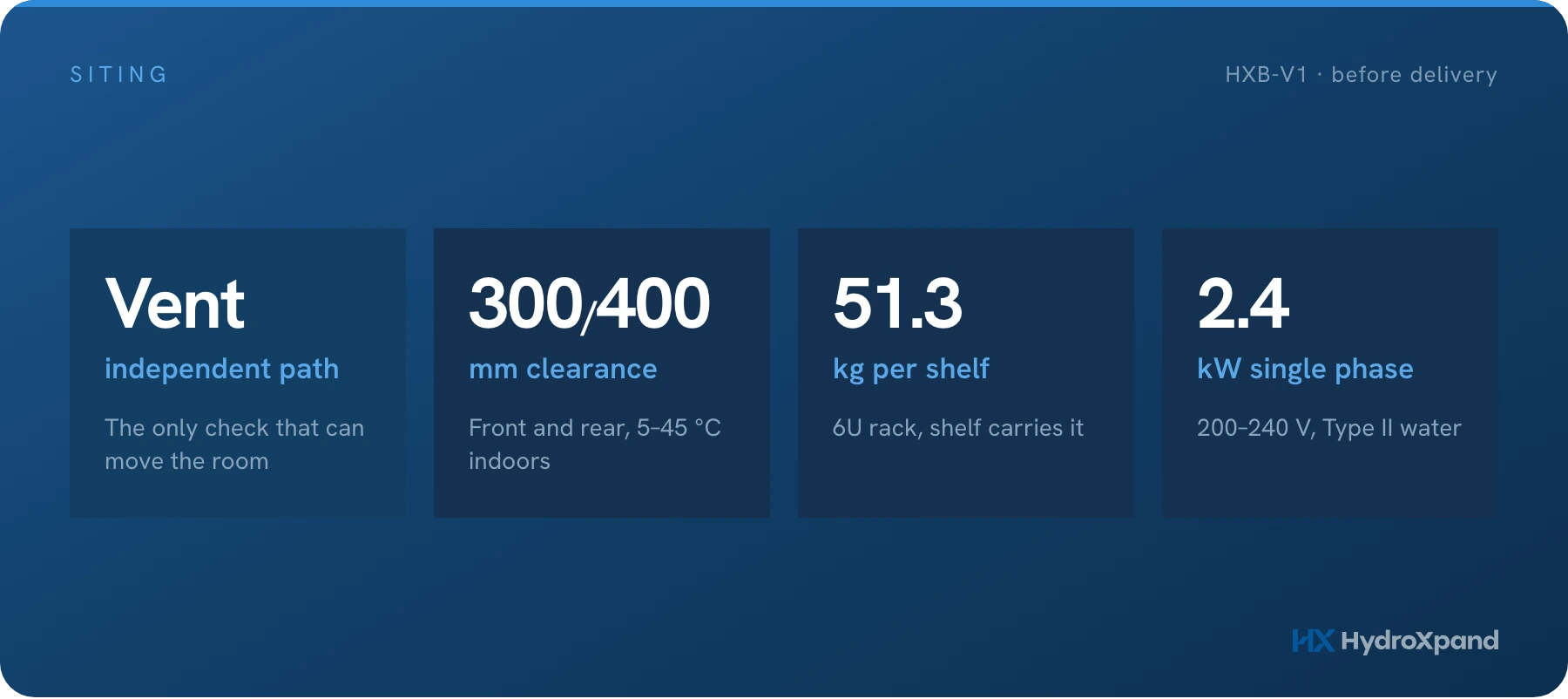
Buying an electrolyzer involves a long comparison of specifications, and then the equipment arrives and stands in a room nobody examined with the same care.
A research institute in Europe took delivery of one of our systems and could not switch it on for months. The equipment was fine. The room they had planned for it was tied into an exhaust duct shared with other chemical equipment, which is not a place to vent hydrogen, and they discovered it only once the crate was open. Re-siting took the rest of the schedule.
These checks are cheap while the site is still a choice and expensive afterwards, and they sort into a clear order. One of them can force a different room. The rest are specification checks you can settle from a datasheet.
Start with the vent, because it can move the room
An electrolyzer makes hydrogen and oxygen, and it also has to get rid of what it does not send to the outlet: vented gas, and water through a drain. Those lines have to go somewhere.
Tying them into an existing duct that other equipment already uses puts hydrogen and whatever else that duct carries into the same pipe. Hydrogen burns across a wide range of concentrations in air, so the principle is an independent path, and a building having a duct already is not the same as a building having a usable one.
This goes first for a practical reason rather than a safety-lecture one. Ventilation can usually be added. Power can usually be run. An exhaust route that cannot be made independent means a different room, and a different room means the whole plan is redrawn.
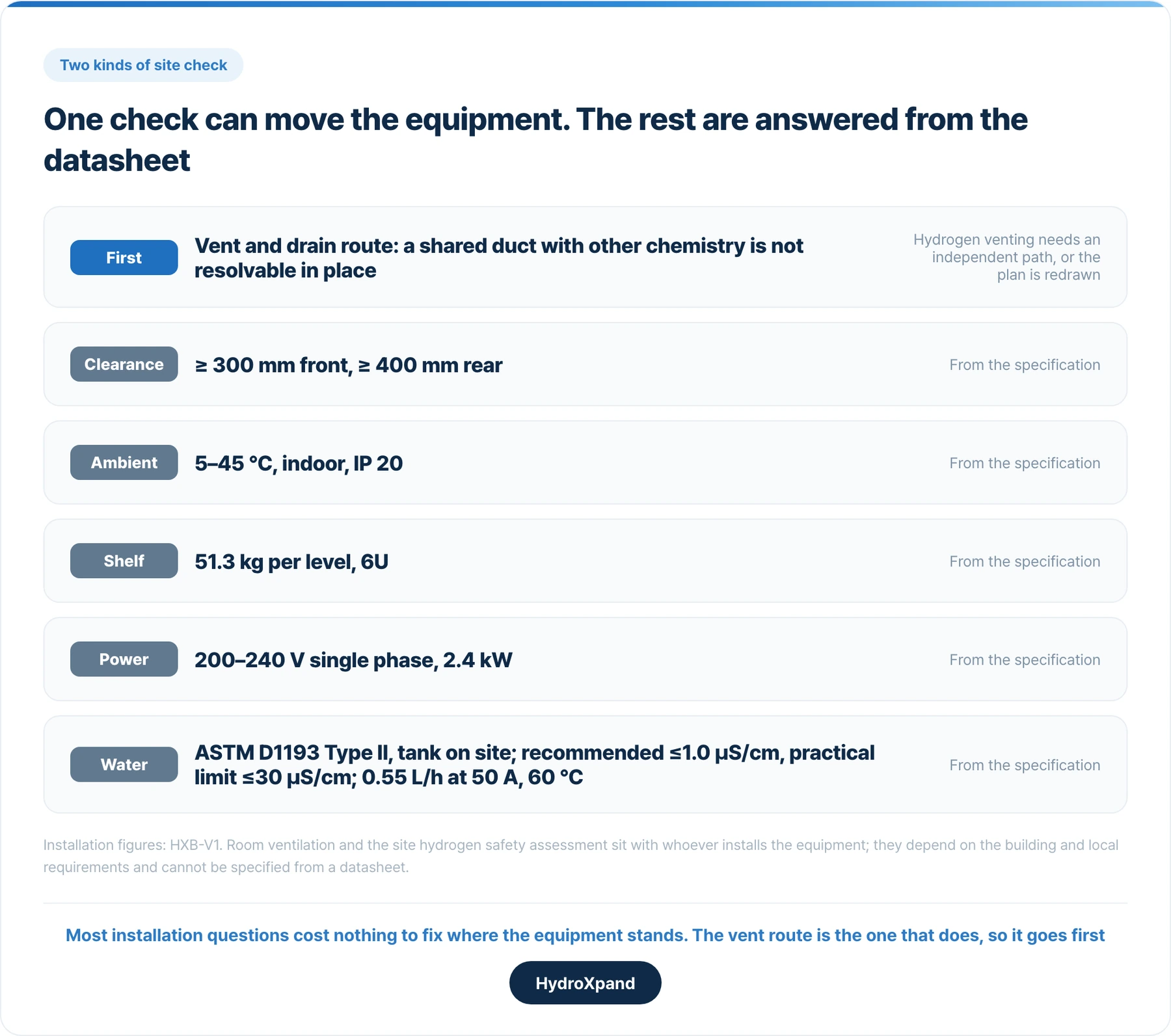
Ventilation and power are usually solvable where they stand. A shared exhaust duct is the one finding that can move the equipment to another room.
Air and temperature around the box
The system runs warm and moves that heat out of the back, so it cannot be pushed against a wall. HXB-V1 asks for at least 300 mm in front and 400 mm behind, and the specification is written for indoor installation at an ambient temperature between 5 and 45 °C, at IP 20.
That range is wider than it sounds until you apply it to a real building. An uninsulated warehouse in summer and an unheated space in winter both fall outside it for part of the year, and a shipping container swings further than either. In those cases the question to answer first is how the room will be conditioned, not which machine to buy.
Room ventilation and the site's own hydrogen safety measures sit with whoever is doing the installation. They depend on the building, the volume of the space and local requirements, and they are not something a supplier can specify from a datasheet.
the generally accepted value for the upward-propagating, lower flammability limit of hydrogen in air is 4% mole fraction
SourceSandia National Laboratories: lower flammability limit of hydrogen in air, 4% mole fraction (SAND2007-5365P, via OSTI)
Weight is usually not the problem
A customer planning to put three to five units in a standard server rack asked whether the two front screws would shear under the load. It is a reasonable question and the answer is that those screws are not carrying the weight. They stop the unit from sliding; the shelf carries the mass.
So the number to check is not the rack's total rating but what a single shelf level is rated for. HXB-V1 is 51.3 kg in a 6U, 19-inch rack format, and standard shelving is commonly rated somewhere between 50 and 100 kg per level. That is a matter of selecting to the specification rather than having anything fabricated.
For a stacked arrangement, apply the same check at every level rather than dividing a total by the number of units.
| What to check | Value | Where it matters |
|---|---|---|
| Unit mass | 51.3 kg | Per shelf level, not per rack |
| Format | 6U, 19-inch482 × 647 × 266 mm | Standard rack, no fabrication |
| Front clearance | ≥ 300 mm | Access and airflow |
| Rear clearance | ≥ 400 mm | Heat leaves through the back |
| Ambient | 5 to 45 °Cindoor, IP 20 | Decides whether the room needs conditioning |
Power and water are specification checks
Once the room is settled, what is left is matching connections. HXB-V1 takes 200 to 240 V AC single phase at 50 or 60 Hz through a C20 inlet, and draws about 2.4 kW in operation. There is no three-phase installation to arrange, which for many sites turns this into a check of the existing circuit rather than a piece of electrical work.
Water is a question of quality rather than quantity. Consumption is small, 0.55 L/h at 50 A and 60 °C, but the feed is specified at laboratory purified water: ASTM D1193 Type II, ≤ 1.0 µS/cm recommended, with ≤ 30 µS/cm as the practical operating limit. Tap water is not a feed. The storage tank is supplied by the site, so water treatment belongs in the installation plan rather than after it.
Fluid connections are fixed: water, hydrogen, oxygen, vent and drain are all 1/4-inch double-ferrule fittings. What happens downstream of the hydrogen outlet, including drying and storage, is specified by the application.
None of these four require a decision. They require somebody to read the number and look at the room.
SourceASTM D1193-06(2018) Standard Specification for Reagent Water, Type II
The checklist
- Can the vent and drain run on an independent path, not shared with other equipment? If not, choose another location before going further.
- Is there at least 300 mm in front and 400 mm behind, with the back of the unit clear?
- Does the ambient temperature stay between 5 and 45 °C year round, indoors, without conditioning you have not planned?
- Is a single shelf level rated for 51.3 kg, at every level you intend to use?
- Is there a 200 to 240 V single-phase circuit with headroom for 2.4 kW per unit?
- Is there a water treatment plan that reaches ASTM D1193 Type II, and a tank to hold it?
- Is there room ventilation and a site hydrogen safety assessment, prepared by whoever is installing?
Every item here is answerable before the equipment ships. The one that is not answerable afterwards is the exhaust route.
If a drawing is needed to answer any of these, ask the supplier for installation dimensions and an outline file. We provide both on request, and it is a better use of the pre-order conversation than another round of performance figures.
- HXB-V1 · 2 kW system→The full installation table: clearances, ambient, power, water quality and fittings.
- Sizing between one and fifteen kilograms a day→What changes in these checks when it is five units instead of one.
- What turnkey includes in a 2 kW electrolyzer→Where the supplied box stops and the site begins.
- Hydrogen generators: how to size one→The specification questions that come before siting.
- Do you need a compressor?→What the outlet pressure decides about everything downstream of the vent.
- Storing hydrogen→What sits after the outlet, and the pressure each route asks for.
- After the purchase order→Seven stages from ordering an electrolyzer to first hydrogen.
Frequently asked questions
What does a site need before an electrolyzer arrives?
A vent route that does not share an exhaust duct with other chemistry, clearance and ventilation around the unit, an ambient range of 5 to 45 °C indoors, single-phase power for 2.4 kW and feed water of the specified quality.
What is the one site issue that cannot be fixed after delivery?
The exhaust route. A shared exhaust duct can force the equipment into another room, which is why it is checked first.
How heavy is the HXB-V1 and what format is it?
51.3 kg in a 6U, 19-inch rack format, 482 by 647 by 266 mm, IP 20, with 300 mm front and 400 mm rear clearance.
Sources
- Flammability Limits of Hydrogen/air Mixtures, SAND2007-5365P — Sandia National Laboratories, via OSTI
- ASTM D1193-06(2018) Standard Specification for Reagent Water — ASTM International
Looking at AEM for a specific application?