AEM is no longer confined to single-cell laboratory demonstrations. What it does not yet have is the field history that alkaline and PEM have accumulated. The useful question for a project is what has been demonstrated at the scale, conditions and duty cycle it requires.
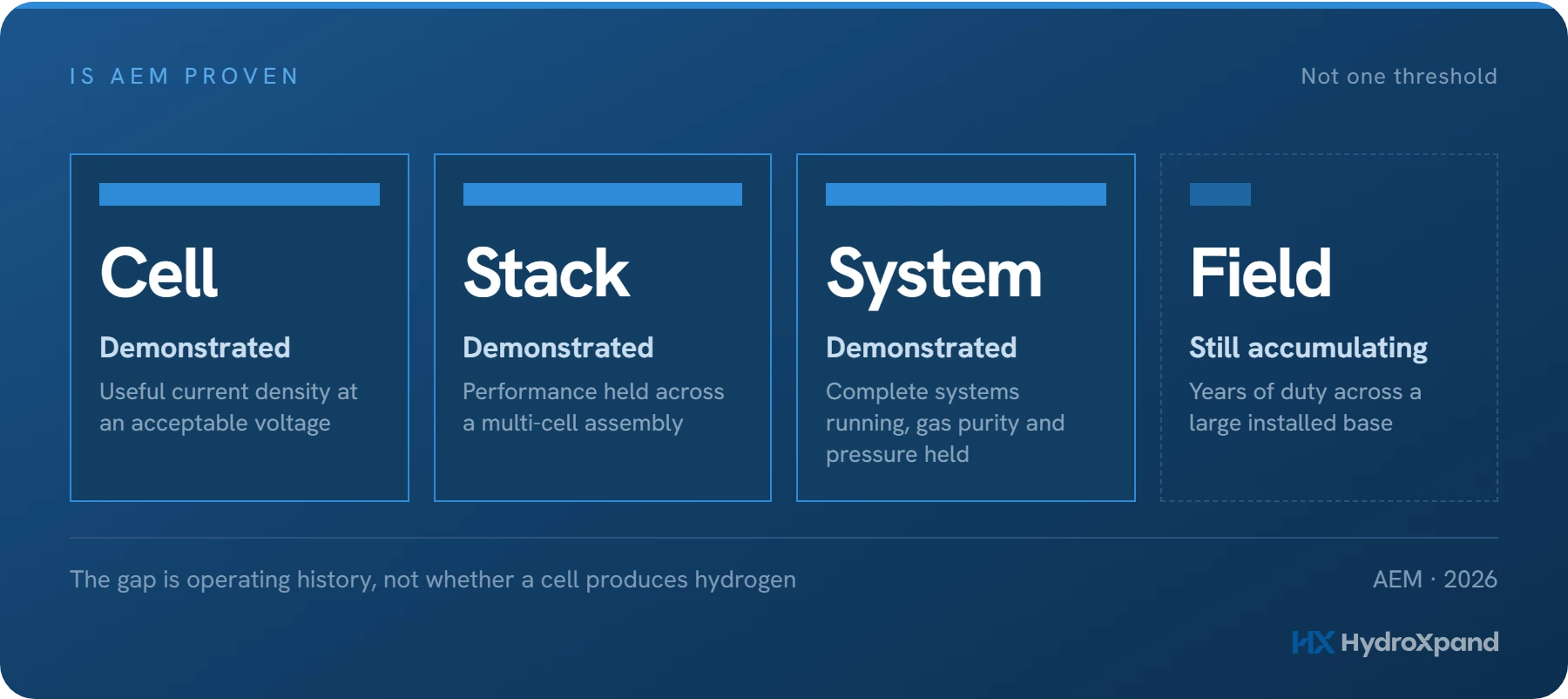
AEM water electrolysis is no longer confined to single-cell laboratory demonstrations.
Multi-cell stacks are being built, complete systems are operating, and commercial products are available. What AEM does not yet have is the operating history that alkaline and PEM electrolysis have accumulated over much longer periods.
That distinction matters.
The question is no longer simply whether an AEM cell can produce hydrogen. It is how much evidence exists at stack and system level, under the conditions a real project will require.
What has already been demonstrated
Single-cell performance answers only one part of the question.
A cell can reach a useful current density at an acceptable voltage and still leave most of the engineering problem unresolved. Once the same electrochemistry is repeated across a multi-cell stack, compression, electrolyte distribution, electrical contact and repeated interfaces all have to remain consistent.
The system around the stack introduces another set of variables. Gas purity, crossover, operating pressure, temperature and flow have to remain within their operating limits at the same time.
AEM has moved into this stage.
Commercial stacks and systems exist, and long-duration multi-cell tests have been reported. The evidence is no longer limited to whether an anion exchange membrane can operate in a small laboratory cell.
But that does not make AEM equivalent to technologies with decades of field operation behind them.
SourceEnapter: fleet figures published on the company site (stacks delivered, clients, countries)
What still takes time
The shorter part of the AEM record is field history.
Alkaline and PEM electrolyzers have been installed, operated and serviced across many sites over long periods. That creates a type of evidence that cannot be reproduced by one laboratory test, however long the test runs.
Field history includes what fails after several years, how performance changes across many units rather than one, which components are replaced most often, and how equipment behaves after repeated maintenance by people who did not design it.
Service procedures change after unexpected failures. Spare parts lists change after enough machines have been operated. Some failure modes only become visible when the installed population becomes large enough.
AEM has less of that evidence because its commercial installed base is younger and smaller.
This is different from saying that the technology does not work. It means that some long-term behaviour is still less well characterised.
Operating inside conditions that have already been demonstrated reduces some of that uncertainty. Moving outside them introduces questions that the existing record may not answer.
Alkaline electrolysers are the most robust, with proven lifetimes of over 30 years.
SourceIRENA, Green Hydrogen Cost Reduction (2020): proven lifetimes of alkaline and PEM electrolysers
How to read a durability result
This is where published durability data becomes useful.
Hours alone are not enough to compare two tests.
A 5,000-hour single-cell run and a 2,000-hour multi-cell stack run are not necessarily evidence of the same thing. Current, temperature, electrolyte concentration, pressure and stack size all affect what the test represents.
The calculation method matters as well.
A membrane electrode assembly can change during its initial operating period. A degradation rate fitted only after that period will differ from one fitted across the complete run. Both numbers can be valid, but they should not be compared without knowing how they were calculated.
The same applies to operating conditions. A degradation rate measured at one current, temperature or pressure should not be assumed to carry over unchanged to another.
And stack voltage alone does not show everything.
A stable average can hide individual cells that are beginning to move away from the rest. Gas purity and crossover can also change while the overall voltage trace remains relatively steady.
A durability figure is therefore most useful when the test conditions, stack configuration, fitting window and other measured variables are available with the dataset it came from.
End-of-life is based on 10% voltage loss from beginning-of-life operations (following any break-in/conditioning period), measured at the same current density.
SourceU.S. DOE Technical Targets for PEM Electrolysis: how end of life and degradation are defined
Where our own data sits
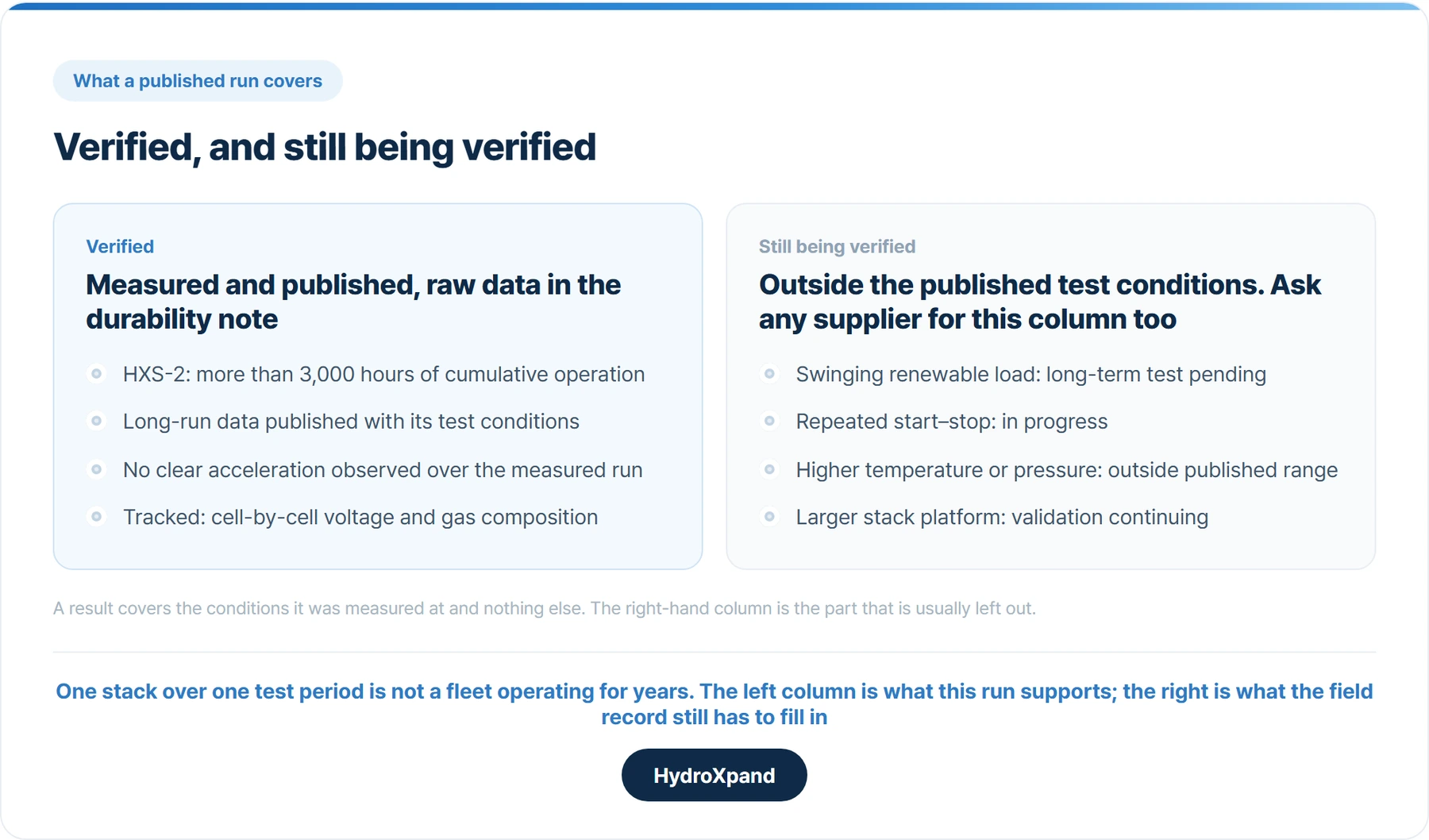
Our published long-duration test was performed on an HXS-2, a 23-cell AEM electrolyzer stack in the 2 kW class.
The HXS-2 stack has more than 3,000 hours of cumulative operation. The long-run data, the test conditions and how the degradation rate was fitted are published together in the durability note.
A separate HXS-2 stack has passed 1,000 hours at a 10 barg differential pressure.
We monitored individual cell voltages and gas composition during operation rather than using stack voltage alone.
What that long-run data shows is narrow and specific: a 23-cell stack operated under its stated test conditions, with no clear acceleration in voltage degradation observed over the measured period.
What it does not show is equally important.
The test was run at constant current. It does not establish long-term behaviour under a rapidly changing renewable power profile or repeated start-stop cycling.
It was conducted at ambient pressure and at a fixed temperature. It does not establish long-term durability at higher temperature or higher pressure.
And it is one stack over one test period, not a fleet of systems operating for years in the field.
Our larger stack platform is at an earlier stage of validation, with short-stack and full-stack testing continuing separately.
The purpose of publishing these boundaries is not to make the result weaker. It is to state exactly what the test supports.
So, is AEM proven?
There is no single point at which an electrolyzer technology becomes proven for every application.
AEM has moved beyond the question of whether useful electrochemical performance can be demonstrated in a laboratory cell. There is now evidence from multi-cell stacks and complete systems as well.
What remains shorter is the field record.
Compared with alkaline and PEM electrolysis, fewer AEM systems have accumulated years of operation across a large installed base. That leaves some long-term failure modes and operating conditions less well characterised.
For a project today, the useful question is therefore more specific than whether AEM is proven.
It is what has already been demonstrated at the scale, operating conditions and duty cycle the project requires, and where the available evidence stops.
- The durability dataset→The published graph, the fitted window and the conditions behind the figure on this page.
- What pressurised operation costs→The conditions behind the 10 barg run, and what pressure costs in cell voltage and crossover.
- The 15-cell short stack, 293 hours→Where the 30 kW programme stands.
- What is an electrolyzer stack→Why cell performance and stack performance are different measurements.
- Reading an efficiency number→The same problem on the efficiency side of the datasheet.
- HXS-2 · 2 kW stack→The stack the published run belongs to.
- Electrolyzer stack life→What changes when only the worn part, the MEA, is replaced.
- AEM electrolysis: technology and measured data→How AEM electrolysis works, AEM vs PEM vs alkaline, and the measured data behind our stacks.
- AEM water electrolysis→How the technology works, before asking how mature it is.
- Alkaline, PEM or AEM→The questions that decide the technology, including operating history.
- Running an electrolyzer on solar→The 49 measured crossover points referred to here.
Frequently asked questions
Is AEM electrolysis a proven technology?
It has passed the stage of proving that it works, at stack and system level. What is shorter than alkaline and PEM is the operating history behind it in the field.
What AEM operating data does HydroXpand publish?
The 23-cell HXS-2 stack has more than 3,000 hours of cumulative operation. Its long-run data, including the hydrogen-in-oxygen record, is published with the test conditions in the durability note.
How should I read an AEM durability result?
Ask for the hours, the electrolyte, the temperature, the current density and the voltage at the end of the run, and whether the number is a stack or single-cell measurement.
Sources
- Green Hydrogen Cost Reduction — International Renewable Energy Agency, 2020
- Technical Targets for Proton Exchange Membrane Electrolysis — U.S. Department of Energy
- Enapter company site — Enapter
Looking at AEM for a specific application?