Nickel foam, widely used as an anode substrate in alkaline and AEM electrolysis, is typically made by electroplating nickel onto a polyurethane sponge and burning the sponge out. This post explains that route and two others, where the numbers on a foam datasheet come from, and what we found when we measured the thickness and mass of foam we had ordered as 3 mm.
Nickel foam is a metal sheet that looks like a grey sponge. In alkaline and AEM electrolysis it is widely used as the anode substrate and as a porous transport layer, and our HXP-an anode is made by growing catalyst directly on it. Yet two foams sold as "3 mm nickel foam" can contain very different amounts of nickel, depending on how they were made and specified.
- The typical route electroplates nickel onto a polyurethane sponge and then burns the sponge out, which leaves the struts hollow.
- Nickel can also be deposited from nickel carbonyl gas, or metal powder can be coated and sintered onto an existing foam. The powder route can also make alloy foams.
- Pore density (PPI) comes largely from the starting sponge; the amount of nickel comes from how much is deposited. PPI alone does not tell you how much nickel is there.
- Foam we ordered as 3 mm, 130 PPI weighed about 1.7 times as much under one porosity specification as under another. Specify porosity or areal mass when ordering.
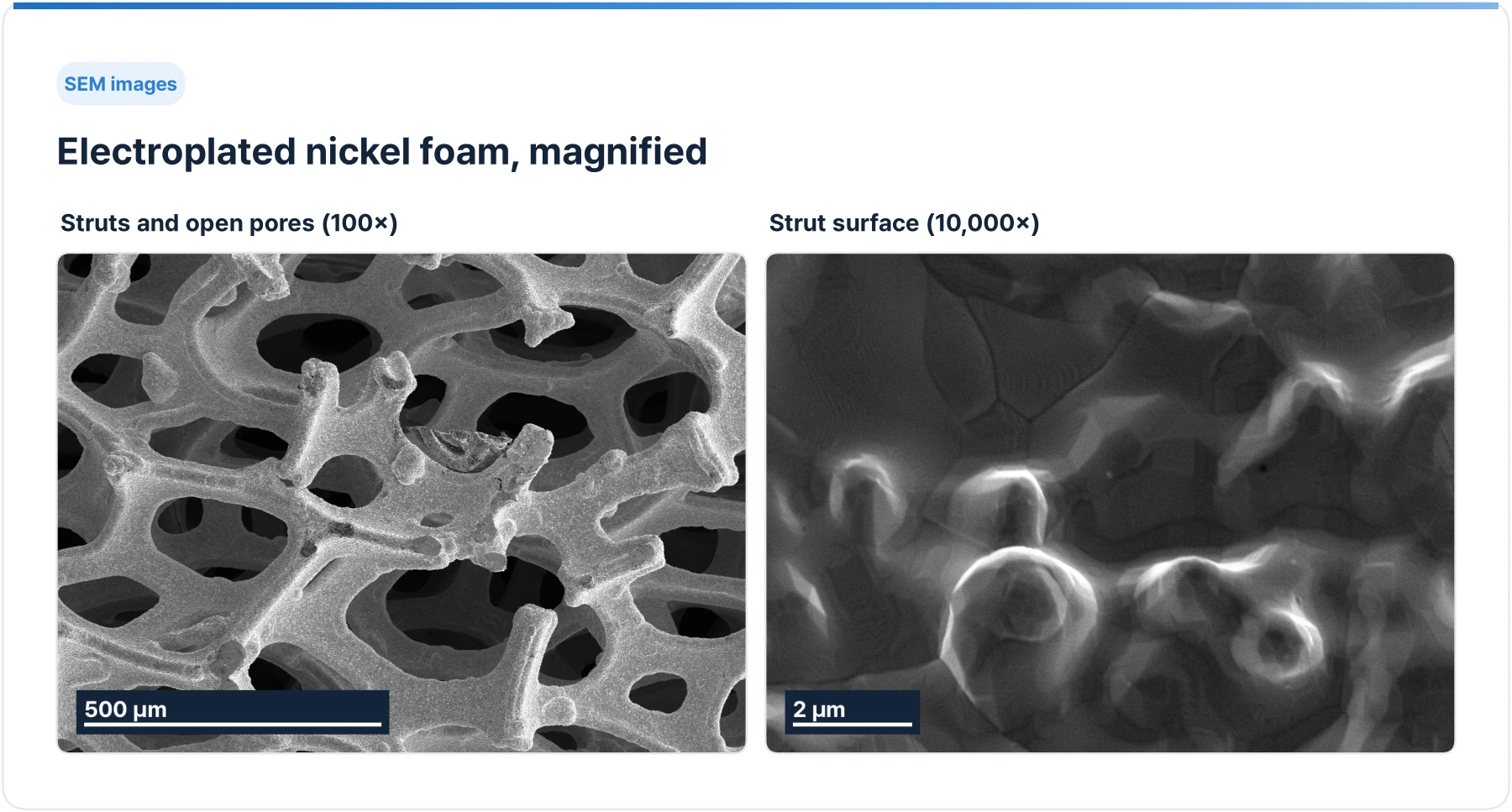
Plate a sponge with nickel, then burn the sponge away
Nickel foam takes its shape from a polyurethane sponge with open, connected pores. Nickel is deposited on the sponge's struts and the sponge is removed at the end. The usual sequence is:
- Make the sponge surface conductive, by applying a carbon coating such as graphite or a thin chemically deposited nickel layer.
- Electroplate nickel. The amount deposited here sets the strut thickness and the mass of the finished foam.
- Heat-treat to decompose and remove the sponge.
- Heat-treat again in a reducing atmosphere such as hydrogen. If the nickel surface oxidised while the sponge was burned out, this turns it back into nickel, and it makes the plated metal more ductile. How these two heat treatments are split or combined varies by manufacturer.
Because the sponge leaves a cavity behind, the struts of electroplated nickel foam are hollow tubes. In the 100x image above, the open space is the path for water and gas; at 10,000x the strut surface shows a fine texture and relief. That surface is where catalyst is grown or coated when an electrode is made.
Electroplating has one well-known difficulty. In a thick sponge, the interior receives less current and fewer nickel ions than the outside, so struts near the surface tend to end up thicker than those in the middle. A foam-plating patent notes that a 1:1 ratio between outer and inner deposits is difficult to achieve. For thick foam, it is hard to assume the same strut thickness throughout.
SourcesMaterials (2022): hollow struts in electroplated nickel foam · US8110076: apparatus and foam electroplating process (outer-to-inner deposit ratio)
Other ways to make the same shape
Electroplating is not the only way to make sponge-shaped metal.
| Route | How the metal is deposited | Notes |
|---|---|---|
| Electroplating | Nickel is plated onto a sponge made conductive | The typical route; hollow struts |
| Vapour deposition | Nickel carbonyl gas decomposes on a heated sponge | High purity (99.97% in a published case), made continuously in long coils |
| Powder coating and sintering | Metal powder and binder are applied to an existing foam, the binder removed and the foam sintered | Depending on powder composition and heat treatment, alloy foams can be made |
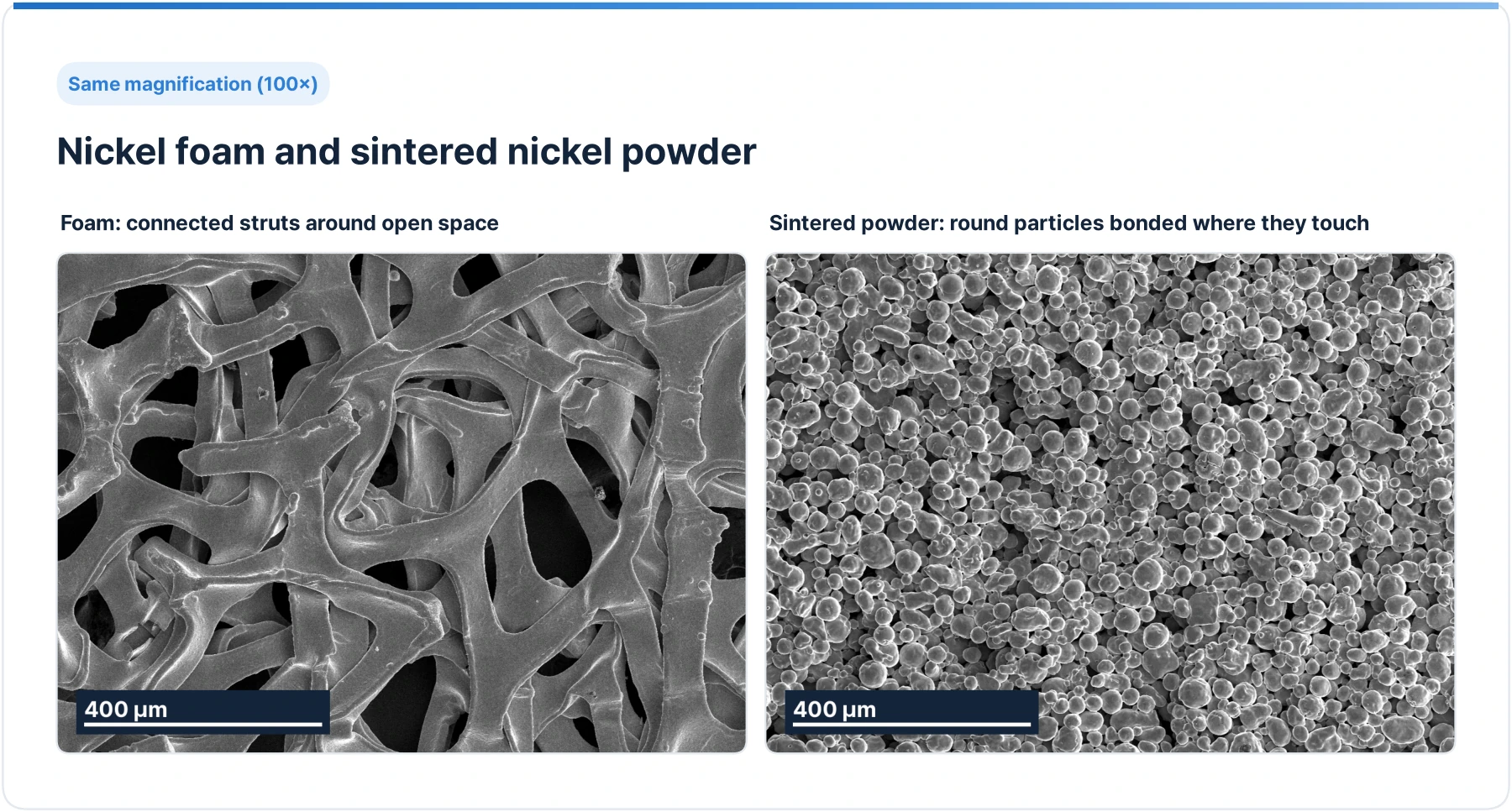
The powder coating and sintering in the table changes the composition of an existing metal foam while keeping its shape. A plate made by sintering metal powder without a sponge template is a sintered powder body, which has a different structure from foam.
SourcesCanadian Mining Journal: nickel carbonyl foam production and purity · EP0402738: nickel foam by nickel carbonyl deposition
- What is a PTL?→Foam, felt and sintered substrates, PPI and porosity.
Where the numbers on a datasheet come from
A nickel foam datasheet usually lists PPI, porosity, areal mass (g/m²), thickness and purity. Knowing how foam is made shows which step sets each number.
- PPI, the number of pores per inch, is set mostly by the starting sponge.
- Areal mass is the foam mass divided by sheet area; porosity is the fraction of the apparent volume that is open space. Both depend on how much nickel is deposited. For the same material and final thickness, higher areal mass means lower porosity.
- Thickness is the result of the sponge thickness and any rolling and heat treatment afterwards.
So two foams with the same PPI can contain very different amounts of nickel. Areal mass across products ranges from a few hundred to several thousand g/m².
What we measured when foam arrived
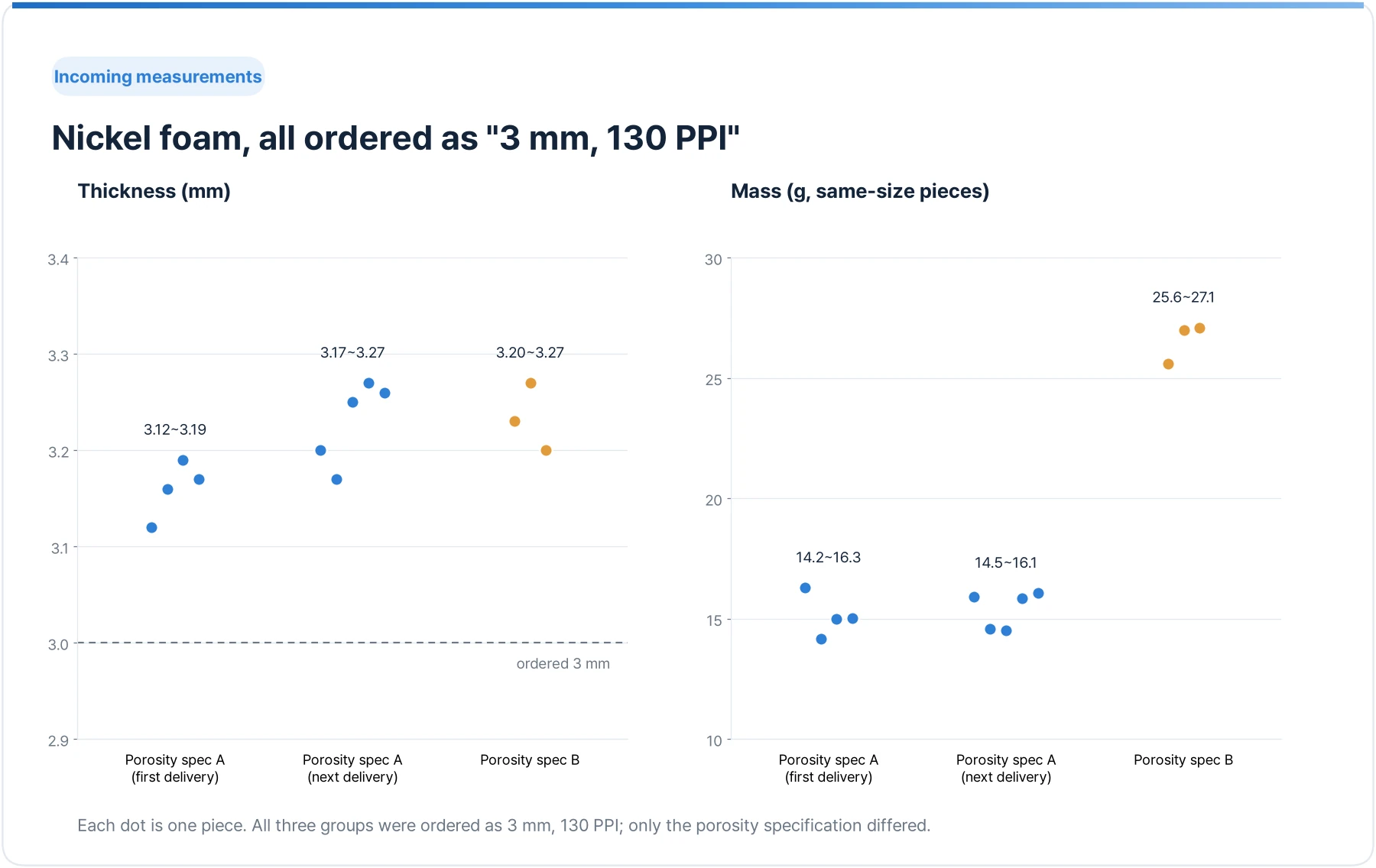
Over several deliveries of foam ordered as 3 mm, 130 PPI, we measured the thickness and mass of same-size comparison pieces one by one. Each dot in the chart is one piece.
Thickness. Everything was ordered as 3 mm, but measurements ran from 3.12 to 3.27 mm, so every piece measured above the nominal 3 mm. Thickness variation can affect how far the substrate is compressed during cell assembly. The thickness of foam as received is worth measuring rather than taking the ordered value on trust.
Mass. At the same 3 mm and 130 PPI, pieces under porosity specification A weighed 14.2 to 16.3 g and pieces under B weighed 25.6 to 27.1 g, and comparing the mean of the nine A pieces from both deliveries with the three B pieces, B was about 1.74 times as heavy. High-porosity foam is mostly empty space, so a few points of porosity make a large difference in nickel. As a hypothetical example, separate from these samples: for the same apparent volume, foam at 96% porosity has 4% nickel by volume and foam at 92% has 8%, twice as much. Two deliveries under specification A fell in almost the same mass range.
So nickel foam is better ordered with porosity or areal mass alongside thickness and PPI. A different amount of nickel changes the cross-section that carries current and how the foam holds up under compression, and strut shape and surface condition affect the surface available for catalyst.
What to write on a nickel foam order
- Thickness and tolerance. Measure thickness on arrival.
- Porosity or areal mass (g/m²) as well as PPI. PPI alone does not fix the amount of nickel.
- Purity or alloy composition. For alloy foam, ask for the composition range.
- Acceptable limits for visible defects. Agree with the supplier in advance how far surface defects such as scratches and cracks are acceptable.
The nickel foams we supply are 0.3 mm 130 PPI (the lab-evaluation substrate for HXP-an), 3 mm 130 PPI (the stack substrate for HXP-an) and 5 mm 120 PPI (the HXS-30 stack substrate), cut to size with orders from one sheet.
SourceNickel foam surface defect detection
- Nickel foam and nickel felt substrates→Specifications, cut to size, orders from one sheet.
- Selecting an electrolyzer anode→Coated and grown anodes, initial performance against durability.
Frequently asked questions
Is it a problem that nickel foam struts are hollow?
Electroplated nickel foam is hollow by construction, because the sponge it was plated on is removed. It is not a defect. Even at the same porosity, strut shape and connectivity can change strength and electrical resistance.
Is higher-PPI nickel foam better?
It depends on the use. Other things being equal, higher PPI means finer pores and more surface for catalyst, and narrower paths for bubbles to escape. PPI also describes only pore density; how much nickel the foam contains has to be read from porosity or areal mass.
Why do foams with the same thickness and PPI weigh different amounts?
PPI is largely determined by the starting sponge, while for the same size of foam, mass depends on how much nickel is deposited. Foam we received as 3 mm, 130 PPI weighed about 1.7 times as much under one porosity specification as under another.
Looking at AEM for a specific application?