The question we hear most is whether PEM or AEM suits a project. Comparisons of the technologies already exist, so this goes the other way: the projects our products do not suit, why we say so in the first reply, and the conditions that remain once those are removed.
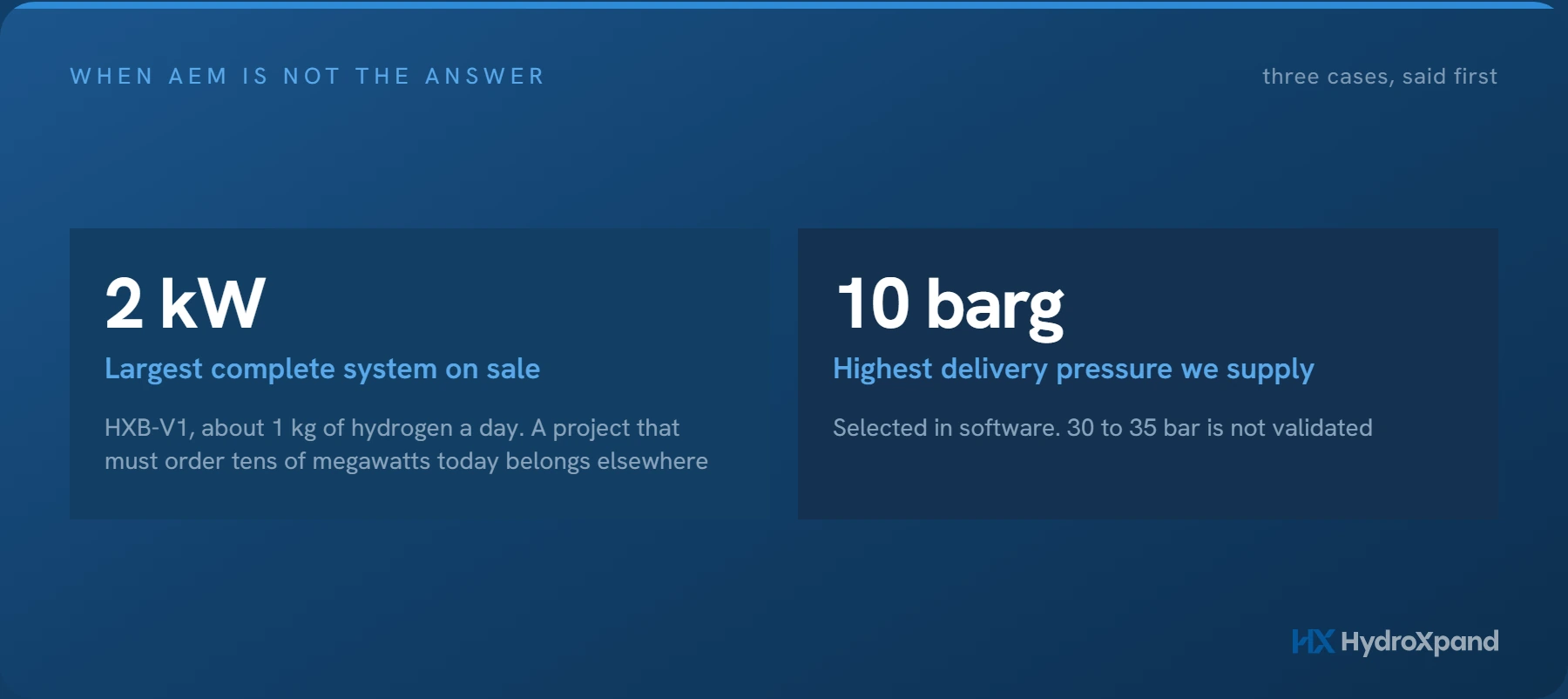
The question we are asked most often is whether a project should use PEM or AEM. We have written the technology comparison elsewhere. This article answers from the other side, starting with the enquiries where our own products are the wrong choice.
We already answer those enquiries that way. Saying no in the first reply costs us a quotation and saves the buyer several weeks of evaluation, and the conversation is easier to reopen later if the first one was straight.
There are three kinds of misfit, and they are worth keeping apart because each one fails at a different stage: scale, technology, and operating conditions.
When the scale does not fit
A project looking for tens of megawatts is not ours. We received an enquiry for a 20 MW project and replied that we were not the right supplier.
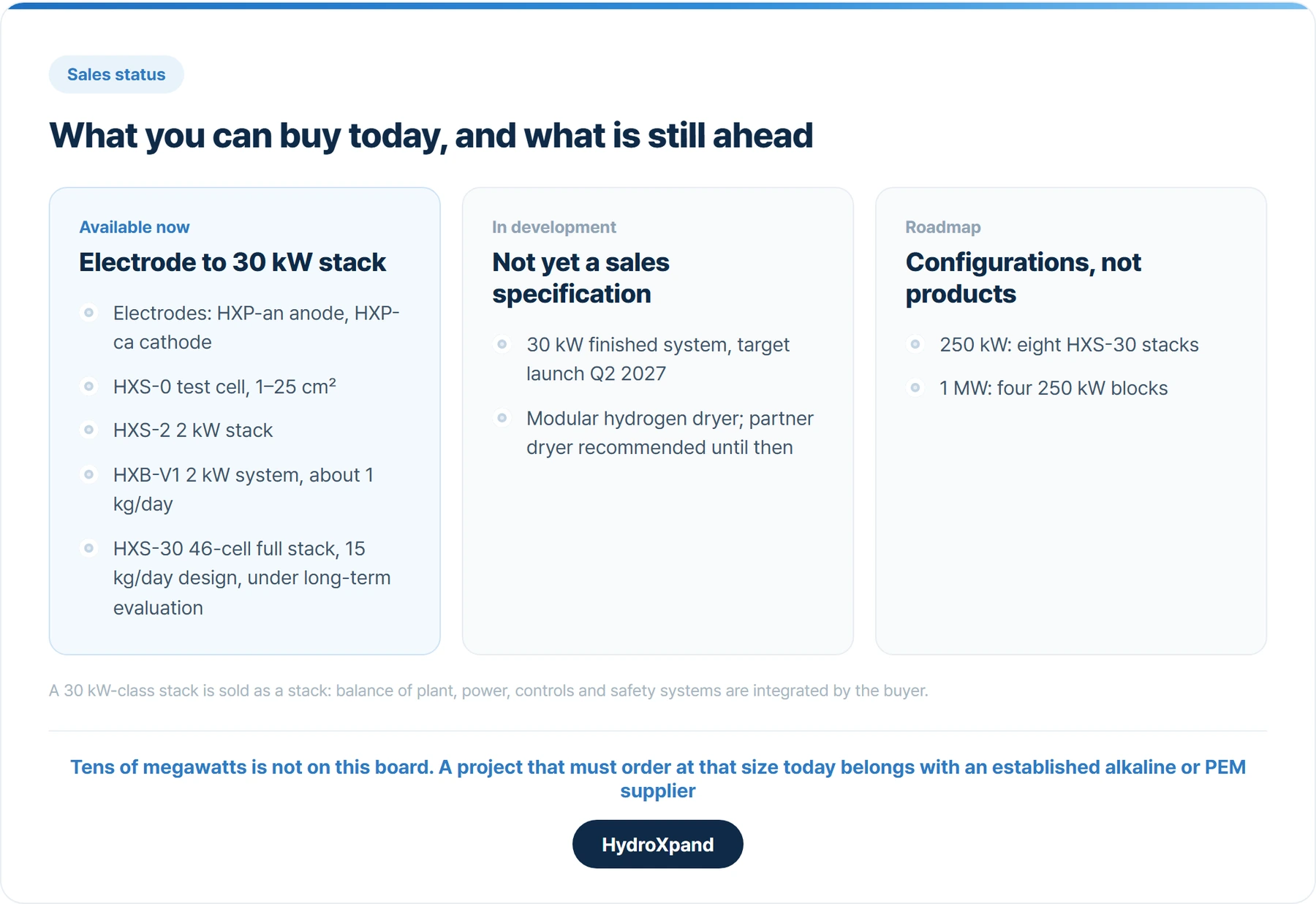
The reason is that what we sell is specific. Today that is electrodes, test cells, the 2 kW stack, the 2 kW HXB-V1 system, and the 46-cell, 30 kW-class HXS-30 full stack. HXS-30 has completed first operation and is under long-term evaluation, and we report its measured data separately from its design values. A 30 kW finished system is in development with a target launch in the second quarter of 2027. The 250 kW and 1 MW configurations come after that on the roadmap and are not sales specifications.
So a complete system today means one or more 2 kW units in parallel. A larger stack means buying HXS-30 and integrating the balance of plant, power, controls and safety systems yourself. A project that has to order tens of megawatts now belongs with an alkaline or PEM supplier that has commercial plants at that size behind it.
When the technology is already decided
We make AEM electrodes, stacks and systems, and nothing else. Two kinds of project are therefore outside our scope before any number is discussed.
The first is a specification that names PEM. The tender calls for an acidic membrane, or the plant is an extension that has to match existing PEM equipment. Our stacks use an anion exchange membrane and run on an alkaline electrolyte, so they cannot stand in for a PEM specification, and we tell the enquirer to go to a PEM supplier.
The second is a site already running its own alkaline plant, with liquid electrolyte and porous diaphragms, where the aim is to expand it. Extending with the same technology is the sensible answer. The electrolyte handling and operating procedures on that site are already built around it.
None of this is a ranking of technologies. Which one fits is decided by the project, and once a project has decided, we have nothing useful to propose.
When the operating conditions sit outside what we have validated
Scale and technology can both fit and the answer can still be no, because the requested condition lies outside what we have tested. These are the ones that come up most.
| Request | What we supply or have validated | What we suggest |
|---|---|---|
| Direct output at 30 bar or more | 0 or 10 barg10 barg continuous operation validated | A booster or compressor downstream |
| Electrolyte around pH 11 | 0.1 to 1 M KOH0.1 M is about pH 13 | Not offered; no tested lower limit |
| Outdoor installation | Indoor, 5 to 45 °CIP20 | Enclosure and HVAC discussed separately |
| Use as a fuel cell test bench | An electrolyzer drives current into the stack | Not possible in this form |
| Wide current and voltage sweeps | Built-in supply sized for the 2 kW stack | Add a programmable power supply |
| Modbus-only supervisory system | MQTT over EthernetModbus RTU and TCP not supported | Integrate over MQTT |
| Russian TR/TS certification | Manufacturer's EU declaration, CE marking | Other regions reviewed per country and use |
| Changed flow field in a production stack | Moulded plates in the 2 kW and 30 kW stacks | Custom flow fields in the HXS-0 test cell |
| Much higher electrolyte flow | Stack standard 4 L/min | Possible, but no data from us |
| Dryer included as standard | No dryer in the standard HXB-V1 | Partner dryer now; modular dryer in development |
Two of those rows need a sentence more. Higher flow is not forbidden, but we have not run and validated it, and it raises the pressure drop through the internal flow field, which widens the pressure difference between anode and cathode. And purity: with a dryer fitted we have confirmed hydrogen at 99.999% or better, but that is with a dryer, and the standard unit does not include one.
Why we answer only inside the validated range
The durability data, pressurised operation data and gas purity data by load that we publish were each measured under stated conditions. Outside them we cannot put a number on performance either.
If we say yes to an unvalidated condition and something goes wrong after installation, the cost falls on the buyer. So an enquiry that does not fit gets told so, and one that is close to the edge starts with whether we can test it. For custom builds we do not carry the published figures across; the quotation states which parts of the scope are validated and which are not.
The range of what we answer is the range of what we have published. Anything past that starts as a test, not a promise.
What is left once those are removed
- Sites that need between about 1 and 15 kg of hydrogen a day, where cylinder deliveries are the burden or small mobility fuelling needs on-site production. One HXB-V1 or several in parallel.
- Research that evaluates materials and stacks directly. Electrodes, a 1 to 25 cm² test cell and short stacks take the work from a single cell to a short stack on the same hardware, with our MEAs or other suppliers'.
- Developers integrating a stack into their own system. The 2 kW stack is supplied for balance-of-plant integration, with the connection specification and design inputs in a published integration guide.
- Demonstrations run without staff on site. The desktop app can be reached through remote access to its computer, and the built-in pump tops up feed water; whether unattended running is acceptable is a site risk assessment.
On renewable-coupled sites, the fit is narrower than it sounds. HXB-V1 is a steady-operation machine and not a load-following product; a varying supply is matched by switching units on and off and keeping the running ones at a load we have measured data for.
One more criterion for some buyers. The anode is a nickel-iron catalyst with no iridium or other precious metal. The cathode does use platinum-group metal, a low-loading platinum-based catalyst, so the claim is independence from iridium, not from precious metals altogether. If you are still deciding whether your project is in this list, send us the required quantity, pressure and site conditions, and we will tell you which side of it you are on.
- AEM electrolysis: technology and measured data→How AEM electrolysis works, AEM vs PEM vs alkaline, and the measured data behind our stacks.
- Alkaline, PEM or AEM: how to choose→The general comparison this article deliberately leaves out.
- Electrolysis technology in 2026→Where alkaline, PEM and AEM each stand by application.
- Is AEM electrolysis proven?→What AEM has demonstrated so far and what still takes time.
- Parallel units or a bigger stack→How the 1 to 15 kg a day range is filled in practice.
- Do you need a compressor?→What 10 barg output covers, and where a compressor is still needed.
- Running an electrolyzer on solar→Why a renewable site shuts units off rather than turning one down.
- The 46-cell HXS-30 in operation→The latest measured record for the largest stack on sale.
Frequently asked questions
Does HydroXpand make PEM stacks?
No. HydroXpand makes AEM electrodes, stacks and systems only, so a project whose specification names PEM should go to a PEM supplier.
Can HydroXpand supply a 20 MW electrolysis project?
Not today. The 2 kW system and stack and the 46-cell HXS-30 full stack are on sale, while the 250 kW and 1 MW configurations are on the development roadmap and are not sales specifications.
Can the HXB-V1 deliver hydrogen directly at 30 bar?
No. The HXB-V1 supplies 0 or 10 barg, and direct output at 30 to 35 bar is not a sales specification and has not been validated, so a booster or compressor downstream is the suggested arrangement.
Looking at AEM for a specific application?