Korea passed the world's first stand-alone hydrogen law in 2020, and an amendment that took effect on 18 September 2026 moves hydrogen energy out of the renewables law and into it. This article explains what the Act covers, what the amendment adds, whether an electrolyzer counts as hydrogen energy equipment, what equipment certification gives and demands, and the clean hydrogen obligation that arrives in May 2027.
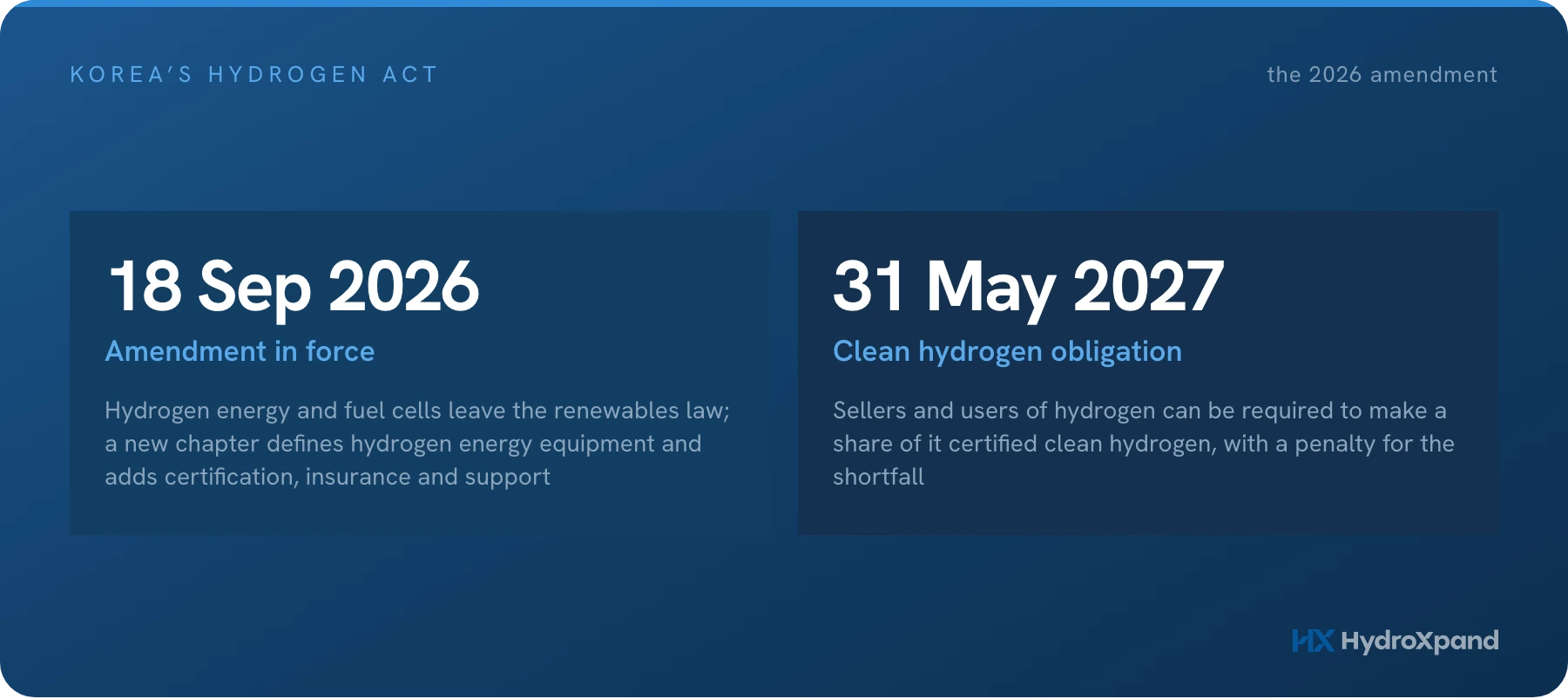
Korea's Hydrogen Act, in full the Hydrogen Economy Promotion and Hydrogen Safety Management Act, was enacted in February 2020, which made Korea the first country to give hydrogen a law of its own. An amendment promulgated on 17 March 2026 took effect on 18 September 2026, and it gathers into the Act the hydrogen energy provisions that had sat in the renewables law until then.
This article sets out what the Act covers, how it has changed since 2020, what the 2026 amendment adds, and which articles a company that makes, sells or installs electrolyzers has to check. It is based on the legal texts as published in July 2026 and describes them as they stand now that the amendment is in force. It is not legal advice; the original texts and the responsible ministry should be checked for any actual project.
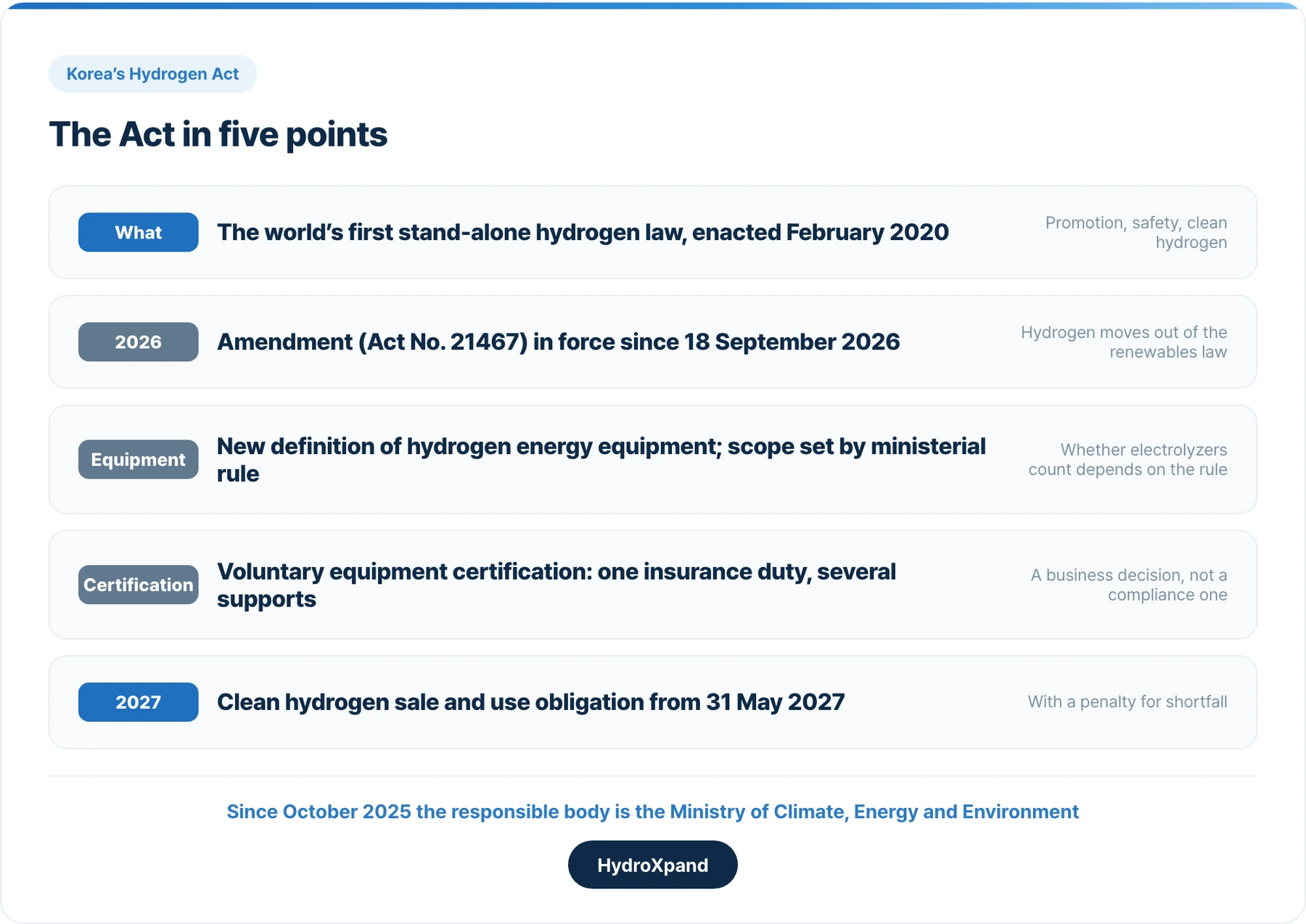
What the Hydrogen Act is: promotion, safety, and clean hydrogen
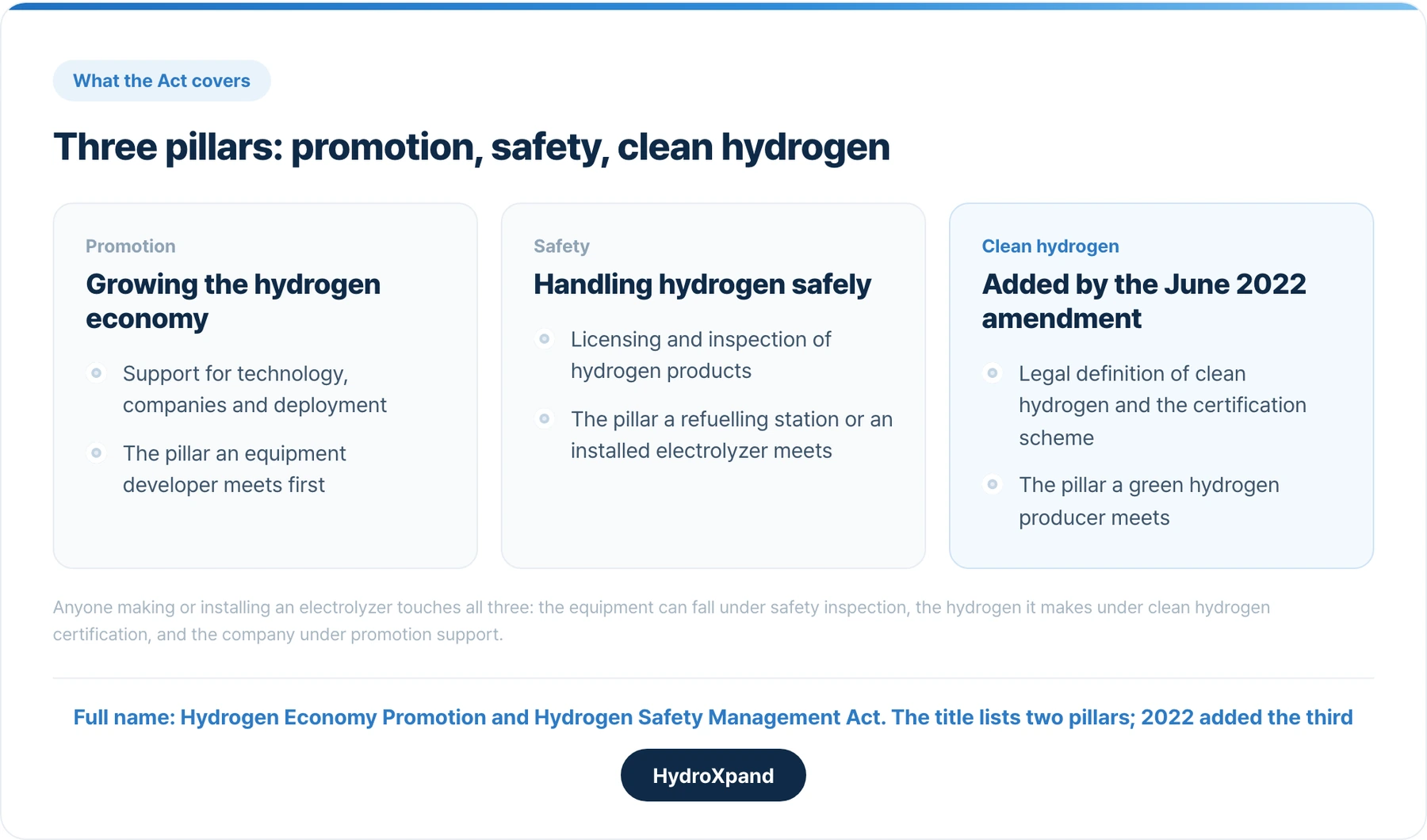
The full title names the Act's two original purposes. One is promotion: growing the hydrogen economy through support for technology, companies and deployment. The other is safety: licensing and inspecting the equipment that handles hydrogen. A third pillar was added by the June 2022 amendment, which wrote the definition of clean hydrogen and the legal basis of the certification scheme into the Act. Today the Act is best read as those three pillars together.
Any hydrogen business meets at least one of them first. A refuelling station meets the safety pillar; a green hydrogen producer meets the clean hydrogen pillar; a technology developer meets the promotion pillar. A company that makes or installs electrolyzers meets all three: the equipment can fall under safety inspection, the hydrogen it makes under certification, and the company itself under promotion support.
SourcesWorld's first hydrogen law takes effect on 5 February 2021 (Korean) (Korea.kr policy briefing, 2021) · Hydrogen Economy Promotion and Hydrogen Safety Management Act, English translation (Korea Legislation Research Institute)
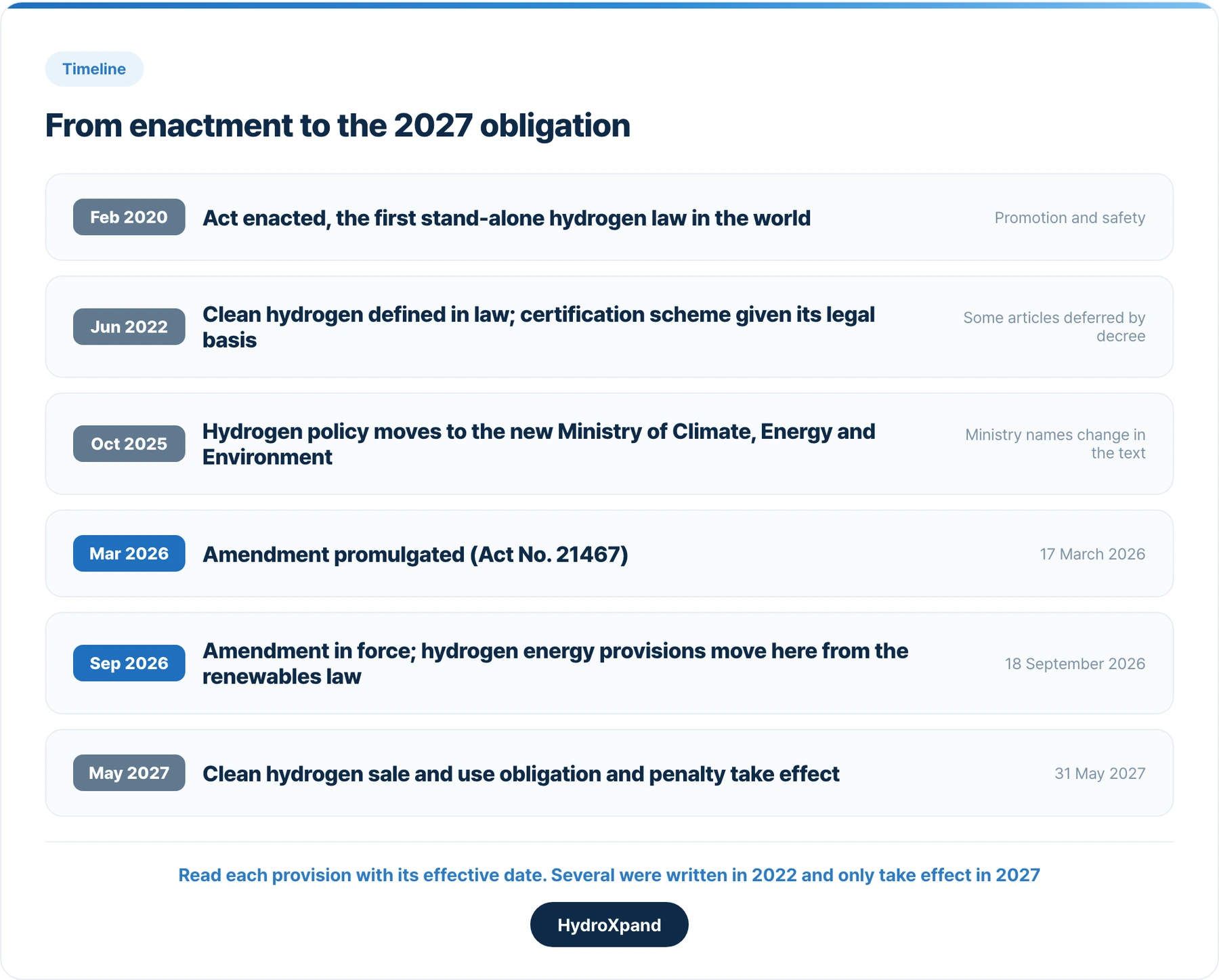
How the Act has changed, 2020 to 2026
The industrially important step before 2026 was the June 2022 amendment, which turned the colour words of the industry, green and blue, into legal categories defined by emissions and created the basis for certification. Not all of it took effect at once: the transitional provisions delegated the effective date of some clean hydrogen articles to presidential decree, and as a result the sale and use obligation and its penalty are still ahead, in 2027.
The version in force until September 2026 was Act No. 21065. Act No. 21467, the 2026 amendment, was promulgated in March and took effect on 18 September 2026. Reading any provision together with its effective date matters here, because several were written years before they apply.
Source수소경제 육성 및 수소 안전관리에 관한 법률, Act No. 21467, promulgated 17 March 2026 (law.go.kr, consolidated text)
What the 2026 amendment changes
The stated purpose of the amendment is to create definitions for hydrogen energy and to establish support measures for hydrogen energy equipment. Until now, hydrogen energy and fuel cells were classed as new energy under the Act on the Promotion of the Development, Use and Diffusion of New and Renewable Energy, in the same law as solar and wind. The amendment deletes those provisions and moves them into the Hydrogen Act, leaving the renewables law to renewables alone.
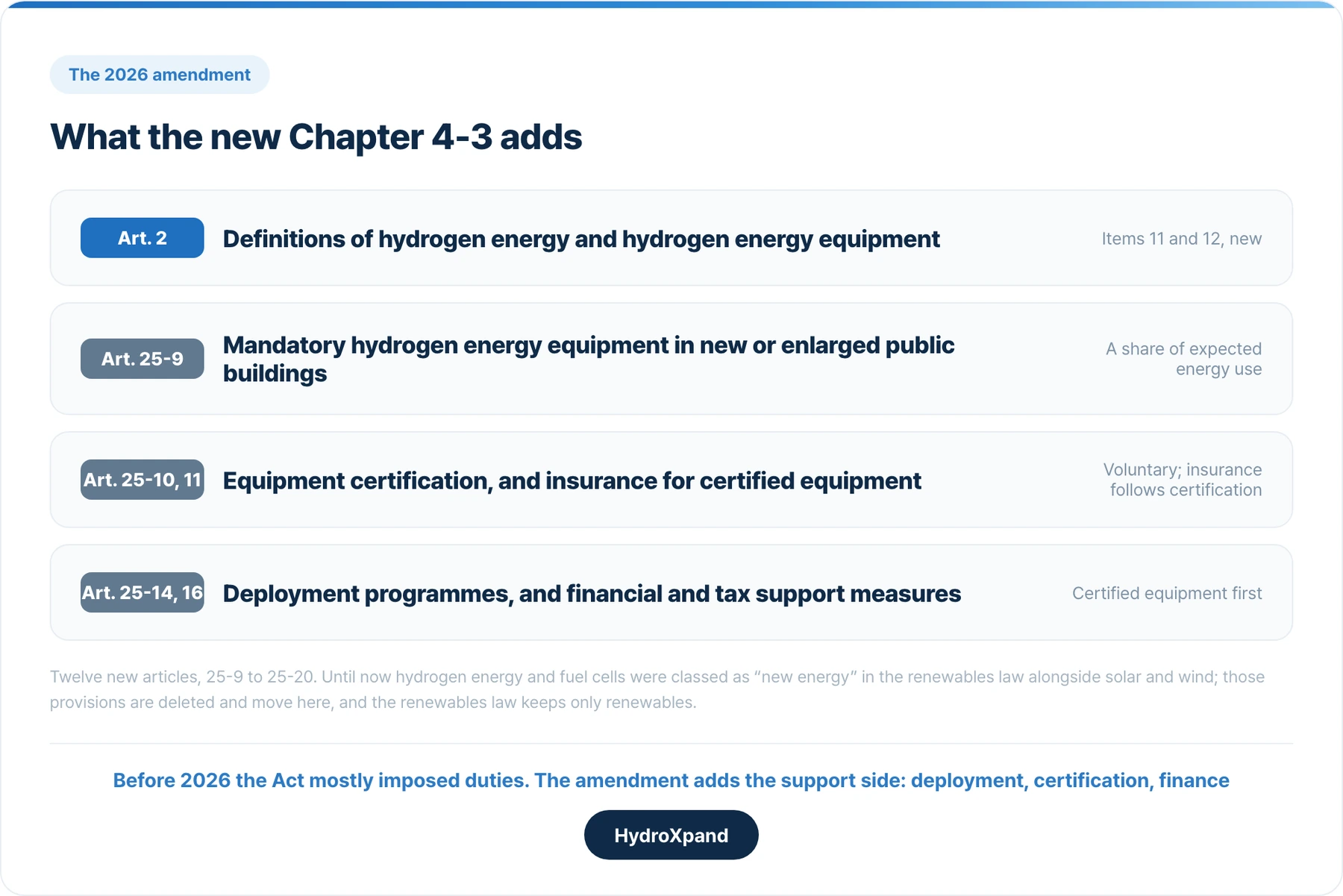
A whole new chapter, Chapter 4-3 on the development, use and diffusion of hydrogen energy, is inserted: twelve articles, 25-9 to 25-20. The ones that touch a maker or seller of equipment directly are the new definitions in Article 2, items 11 and 12; Article 25-9, which lets the minister require new, extended or rebuilt buildings of the state, local governments and public bodies to install hydrogen energy equipment supplying a set share of their expected energy use; Articles 25-10 and 25-11 on equipment certification and insurance; and Articles 25-14 and 25-16 on deployment programmes and financial and tax support.
Before this amendment the Act was mostly a set of obligations: certification of clean hydrogen, the coming sale and use obligation. The amendment adds the support side.
| Article | What it adds |
|---|---|
| Art. 2, items 11 and 12 | Definitions of hydrogen energy and hydrogen energy equipment |
| Art. 25-9 | Mandatory hydrogen energy equipment in new or enlarged public buildings |
| Art. 25-10 and 25-11 | Equipment certification, and insurance for certified equipment |
| Art. 25-14 and 25-16 | Deployment programmes, and financial and tax support measures |
Does an electrolyzer count as hydrogen energy equipment?
For an electrolyzer company the decisive text is the new Article 2, item 12. Hydrogen energy equipment is defined as equipment that converts water or other fuel to produce or use hydrogen, such as fuel cells and hydrogen gas turbines, as prescribed by rule of the Ministry of Climate, Energy and Environment.
The first half describes an electrolyzer exactly: equipment that converts water to produce hydrogen. The second half attaches a condition. The Act does not itself list the equipment that qualifies; it delegates the concrete scope to a ministerial rule. The examples named in the text are fuel cells and hydrogen gas turbines, and electrolyzers are not among them.
The rule has now answered the question. The amended Enforcement Rule, Ministry of Climate, Energy and Environment Ordinance No. 56, was promulgated on 31 August 2026 and took effect with the Act on 18 September 2026. Its new Article 2(6) lists the equipment covered by Article 2(12) of the Act as five kinds: fuel cells, hydrogen gas turbines, water electrolysis equipment, hydrogen extraction equipment, and other hydrogen production or use equipment designated by ministerial notice. Electrolyzers are therefore hydrogen energy equipment, and the support articles, the management articles and the mandatory-installation article of Chapter 4-3 all apply to them.
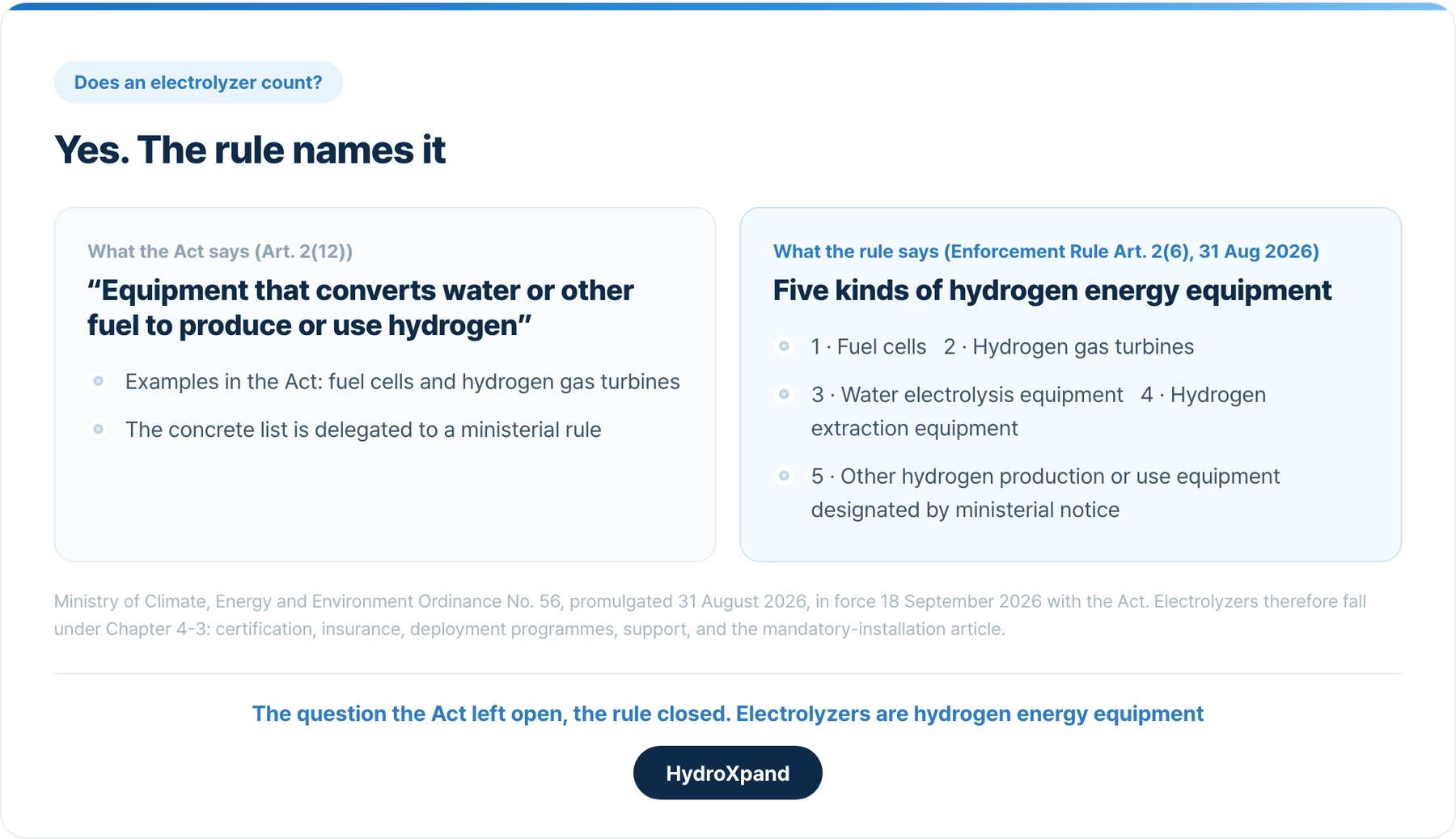
The question the Act left open, the rule closed. Electrolyzers are hydrogen energy equipment.
SourceEnforcement Rule of the Act, Article 2(6): fuel cells, hydrogen gas turbines, water electrolysis equipment, hydrogen extraction equipment (Ordinance No. 56, 31 August 2026)
Equipment certification: should you get it?
Article 25-10 provides that a person who manufactures, or imports and sells, hydrogen energy equipment may obtain product certification under Article 15 of the Industrial Standardization Act, the KS mark. The word is may. Certification is voluntary, and uncertified equipment may still be made and sold. The question is therefore whether it is worth having, and the amendment answers by attaching one duty and several supports to it.
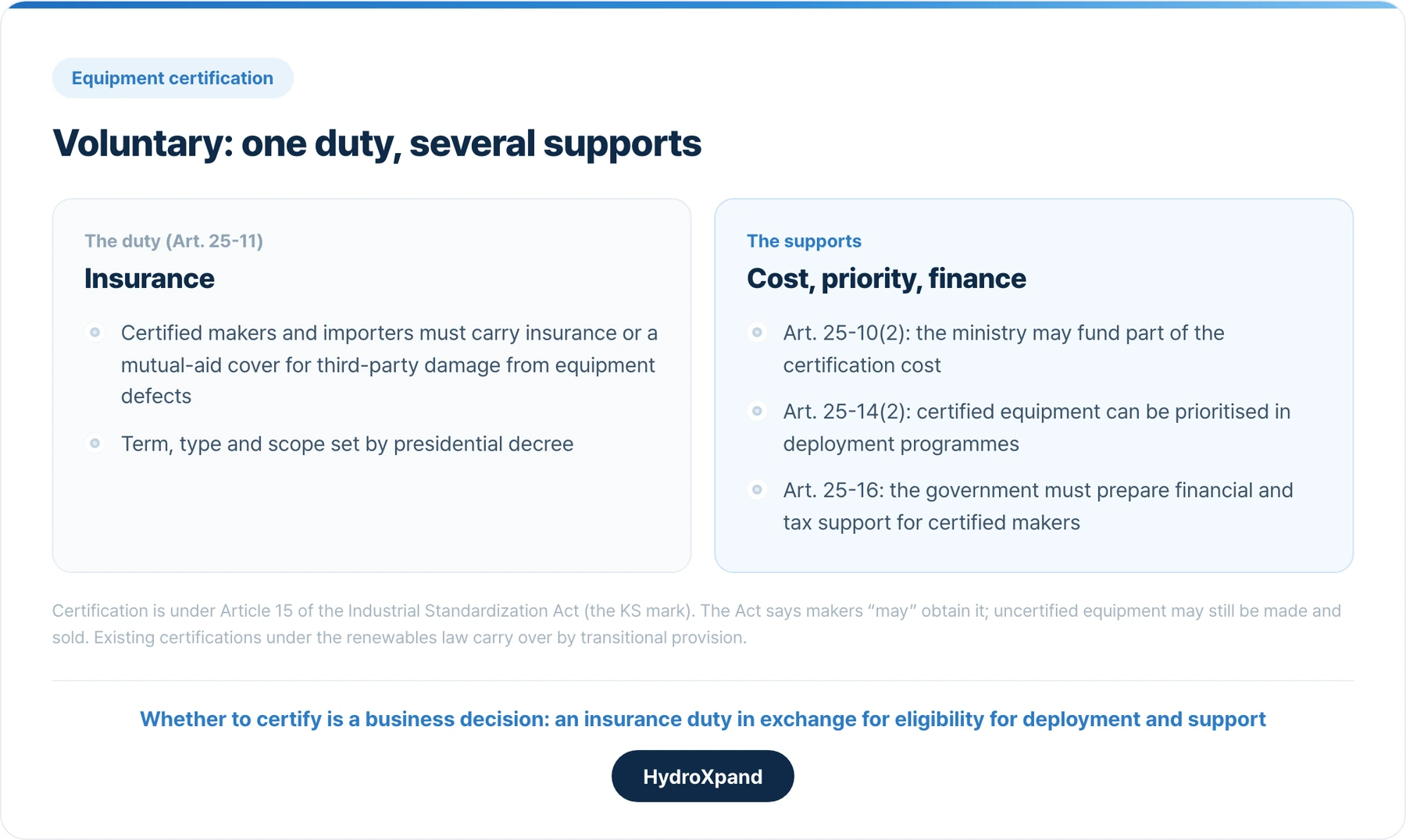
The duty is insurance. Under Article 25-11 a certified maker or importer must carry insurance or an equivalent mutual-aid cover for damage that third parties may suffer from defects in the equipment; the term, type, scope and method are delegated to presidential decree. The supports are three. Under Article 25-10(2) the ministry may fund part of the cost of certification. Under Article 25-14(2) certified equipment may be given priority in deployment programmes. Under Article 25-16 the government must prepare financial and tax support measures for certified makers, who are named in the text as the beneficiaries. A maker already certified under the renewables law is treated as certified under the amended Act by transitional provision.
Certification, then, is not a compliance matter but a business decision: an insurance obligation in exchange for eligibility for deployment programmes and support measures.
| Article | For a certified maker or importer |
|---|---|
| Art. 25-11 | Must carry insurance or mutual-aid cover for third-party damage from equipment defects |
| Art. 25-10(2) | The ministry may fund part of the certification cost |
| Art. 25-14(2) | Certified equipment may be prioritised in deployment programmes |
| Art. 25-16 | The government must prepare financial and tax support measures |
To promote the use of clean hydrogen, the Minister of Trade, Industry and Energy may certify hydrogen or hydrogen compounds meeting the certification standards prescribed by Presidential Decree
SourceArticle 25-10 of the Act: voluntary equipment certification under the Industrial Standardization Act
The clean hydrogen obligation of 2027
Some articles of the Act are written but not yet in force: the clean hydrogen obligations created in 2022 whose effective date was deferred. Under Article 25-5 the minister may require operators of hydrogen fuel supply facilities, and businesses that use hydrogen as feedstock or fuel in a way that reduces greenhouse gas emissions, to sell or use a set share of their hydrogen as certified clean hydrogen. Under Article 25-8 a shortfall can be penalised: the penalty is set within a range of up to 150% of the difference between the market price of top-grade clean hydrogen and the market price of ordinary hydrogen for that year, applied to the shortfall. Article 25-2(4) bans the clean hydrogen mark on uncertified hydrogen. All three take effect on 31 May 2027.
The concrete targets and shares are for presidential decree. For businesses that use hydrogen as feedstock or fuel, procuring clean hydrogen may stop being a choice from 2027.
| Article | Content | In force |
|---|---|---|
| Art. 25-5 | Clean hydrogen sale and use obligation | 31 May 2027 |
| Art. 25-8 | Penalty for shortfall against the obligation | 31 May 2027 |
| Art. 25-2(4) | Ban on the clean hydrogen mark for uncertified hydrogen | 31 May 2027 |
A new ministry
One more change frames every reading of the text. On 1 October 2025 the Ministry of Climate, Energy and Environment was launched, combining the former environment ministry with the energy functions of the Ministry of Trade, Industry and Energy, which became the Ministry of Trade and Industry. The Act now refers throughout to the Minister and rules of Climate, Energy and Environment where it used to refer to Trade, Industry and Energy.
In practice this means that notices, press releases and guidance issued in the industry ministry's name before October 2025 are now the new ministry's responsibility and should be checked for continued validity; that the contact points for hydrogen permits and support programmes have moved; and that searches for material should be split at October 2025, because the ministry's name changed.
Safety standards for new electrolysis technologies
The safety pillar of the Act includes licensing of hydrogen product manufacturing and product inspection. A difficulty arises when a newly developed electrolysis technology does not fit the equipment types the existing standards assume. If the type the law imagined and the type actually built do not match, there is no basis for installing the equipment even when the technology is ready, and no inspection standard to pass.
In such cases the regulatory sandbox, a demonstration exemption that conditionally permits technology for which no standard yet exists, has been used, typically with conditions such as a safety management plan. There are Korean cases of electrolysis technologies that could not be permitted under the standing rules proceeding under that exemption. One boundary is worth knowing for research buyers: under Article 2(4) of the Enforcement Rule, electrolyzers are hydrogen products subject to that regime, but equipment made and used to evaluate the performance of cells or stacks, and educational electrolyzers with an input voltage of 20 V or less, are excluded from the definition. Anyone planning to install an electrolyzer should establish early whether an applicable inspection standard exists for the technology in question or whether a separate procedure is needed. Finding out late delays the project.
What an electrolyzer business has to check
The hydrogen specialist company scheme is worth checking alongside. It was introduced in June 2021 and had 103 designated companies as of October 2024. The amendment widens eligibility to lease state and public property from designated specialist companies to anyone engaged in hydrogen energy technology development, use or deployment.
- Electrolyzers are hydrogen energy equipment under the Enforcement Rule, so read Chapter 4-3 as applying to you.
- Treat certification as a trade, insurance for eligibility, and decide it on the business case.
- Confirm an inspection standard exists for the technology before committing to a site and schedule.
- If the business sells or uses hydrogen, plan clean hydrogen procurement for 31 May 2027.
- Check every provision against the National Law Information Center; this article describes the texts as of July 2026 and is not legal advice.
| Item | What to check | When |
|---|---|---|
| The equipment rule | Settled: Enforcement Rule Art. 2(6) lists water electrolysis equipment. Chapter 4-3 applies | In force since 18 September 2026 |
| Certification | Voluntary. Weigh the insurance duty against eligibility for deployment and support | After entry into force |
| Inspection standard | Whether one exists for the technology being made or installed | At project start |
| Clean hydrogen procurement | Whether the business falls under the sale and use obligation; check the decree | Before 31 May 2027 |
| Support articles | Commercialisation loans, financial and tax support, lease of state property | After entry into force |
HydroXpand develops and supplies AEM electrolysis electrodes, stacks and systems in Korea and eleven other countries. If you are evaluating an electrolyzer under the amended Act, the questions above are the ones we work through with customers.
- Korea's clean hydrogen certification→The scheme the 2022 amendment created: four grades, a 4 kg ceiling and a 2029 deadline.
- Korea's hydrogen economy in 2026→Where Korea leads and lags, and the 2025 policy turn behind this amendment.
- Hydrogen power generation→The hydrogen power auctions that certified clean hydrogen bids into.
- Siting an electrolyzer: the checklist before installation→Space, venting, power and water, the practical side of the safety pillar.
- AEM water electrolysis: how it works→The technology HydroXpand builds.
Frequently asked questions
What is Korea's Hydrogen Act?
The Hydrogen Economy Promotion and Hydrogen Safety Management Act, enacted in February 2020 as the world's first stand-alone hydrogen law. It has three pillars: promoting the hydrogen economy, managing hydrogen safety, and, since 2022, defining and certifying clean hydrogen.
What does the 2026 amendment change?
It moves hydrogen energy and fuel cells out of the renewables law into the Hydrogen Act and adds Chapter 4-3 with twelve articles: definitions of hydrogen energy equipment, mandatory installation in public buildings, voluntary equipment certification with an insurance duty, and deployment, financial and tax support. It took effect on 18 September 2026.
Are electrolyzers covered as hydrogen energy equipment?
Yes. The Act delegates the list to a ministerial rule, and the amended Enforcement Rule of 31 August 2026, in force from 18 September 2026, names five kinds: fuel cells, hydrogen gas turbines, water electrolysis equipment, hydrogen extraction equipment, and other equipment designated by notice. Chapter 4-3 therefore applies to electrolyzers.
Is equipment certification mandatory?
No. The Act says makers may obtain certification under the Industrial Standardization Act. A certified maker must carry insurance for third-party damage from defects, and in return becomes eligible for certification cost support, priority in deployment programmes and financial and tax support.
What happens on 31 May 2027?
The clean hydrogen sale and use obligation takes effect. Hydrogen fuel suppliers and businesses using hydrogen as feedstock or fuel can be required to make a set share of it certified clean hydrogen, with a penalty of up to 150% of the price gap between top-grade clean hydrogen and ordinary hydrogen applied to any shortfall.
Sources
- 수소경제 육성 및 수소 안전관리에 관한 법률 (Hydrogen Economy Promotion and Hydrogen Safety Management Act), Act No. 21467 — Korea Ministry of Government Legislation, law.go.kr
- Enforcement Decree of the Act — law.go.kr
- Enforcement Rule of the Act, Ordinance No. 56 of 31 August 2026 — law.go.kr
- Hydrogen Economy Promotion and Hydrogen Safety Management Act, English translation (as amended by Act No. 18889) — Korea Legislation Research Institute Earlier consolidation; the 2026 amendment is not yet translated.
- 세계 첫 수소법 5일부터 시행 (policy briefing on the Act entering into force) — Korea.kr, 2021
Looking at AEM for a specific application?