Blue hydrogen is the grey hydrogen process with a carbon capture unit added. The word covers a wide range of outcomes, because the capture rate, the methane that leaks upstream and the cost of the capture unit are all set plant by plant. This is what each of those three decides.
Blue hydrogen is hydrogen made from natural gas, exactly as grey hydrogen is, with one difference: the carbon dioxide that the process produces is captured and stored instead of vented. The plant is the same. The feedstock is the same. What changes is what happens to the carbon.
That makes blue hydrogen the most practical way to cut the emissions of the hydrogen the world already makes, and it also makes it the easiest colour to overstate. A plant that captures 60% of its process CO₂ and a plant that captures 90% are both called blue. Neither reaches zero, because some of the CO₂ is never captured and the methane that leaks while the gas is drilled and shipped never passes through a capture unit at all.
So the useful questions are not whether blue hydrogen is clean but how much it captures, what remains, and what the capture costs. Those three numbers are what this article sets out.
What blue hydrogen is
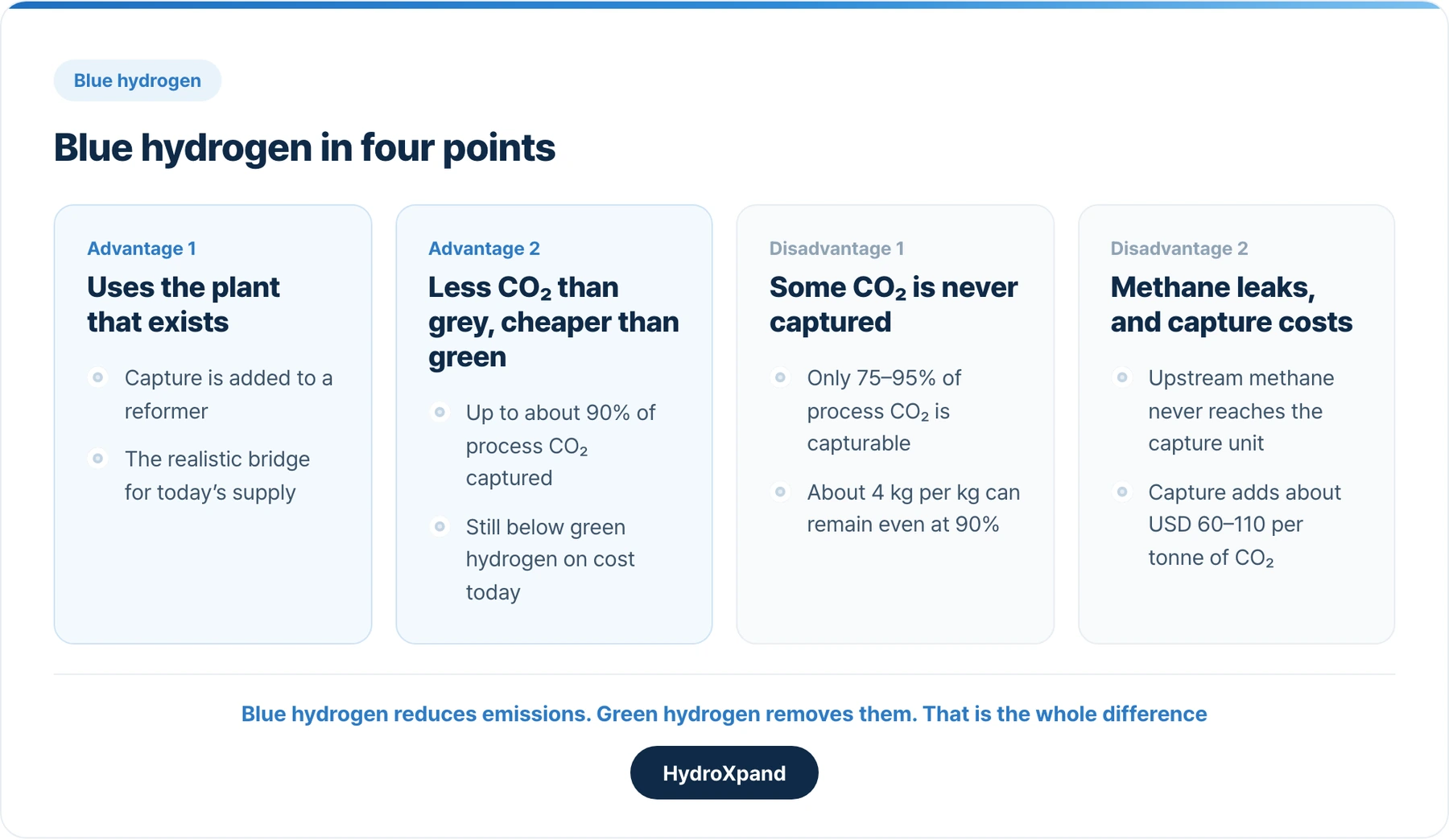
The hydrogen colours name the feedstock and what happens to the carbon, not the gas. Grey hydrogen is made by reforming natural gas and venting the CO₂. Blue hydrogen is the same reforming plant with carbon capture, utilisation and storage added. Green hydrogen is made by splitting water with renewable electricity, so there is no CO₂ at the plant to capture.
Blue therefore sits between grey and green. It is realistic because it uses plants that already exist and a supply chain that already runs. It is limited because the feedstock is still natural gas, and everything that comes with natural gas comes with it.
| Grey | Blue | Green | |
|---|---|---|---|
| Feedstock | Natural gas | Natural gas | Water |
| Process | Steam reforming, CO₂ vented | Steam reforming, CO₂ captured and stored | Electrolysis on renewable electricity |
| CO₂ at the plant | 10–12 kg CO₂e per kgIEA, unabated | Reduced by the capture rate60 to 90% of process CO₂ | NoneFootprint is in the electricity |
| What to check | Nothing to check; it is the baseline | Capture rate, residual CO₂, upstream methane | Where the electricity came from |
How it is made: reforming first, capture second
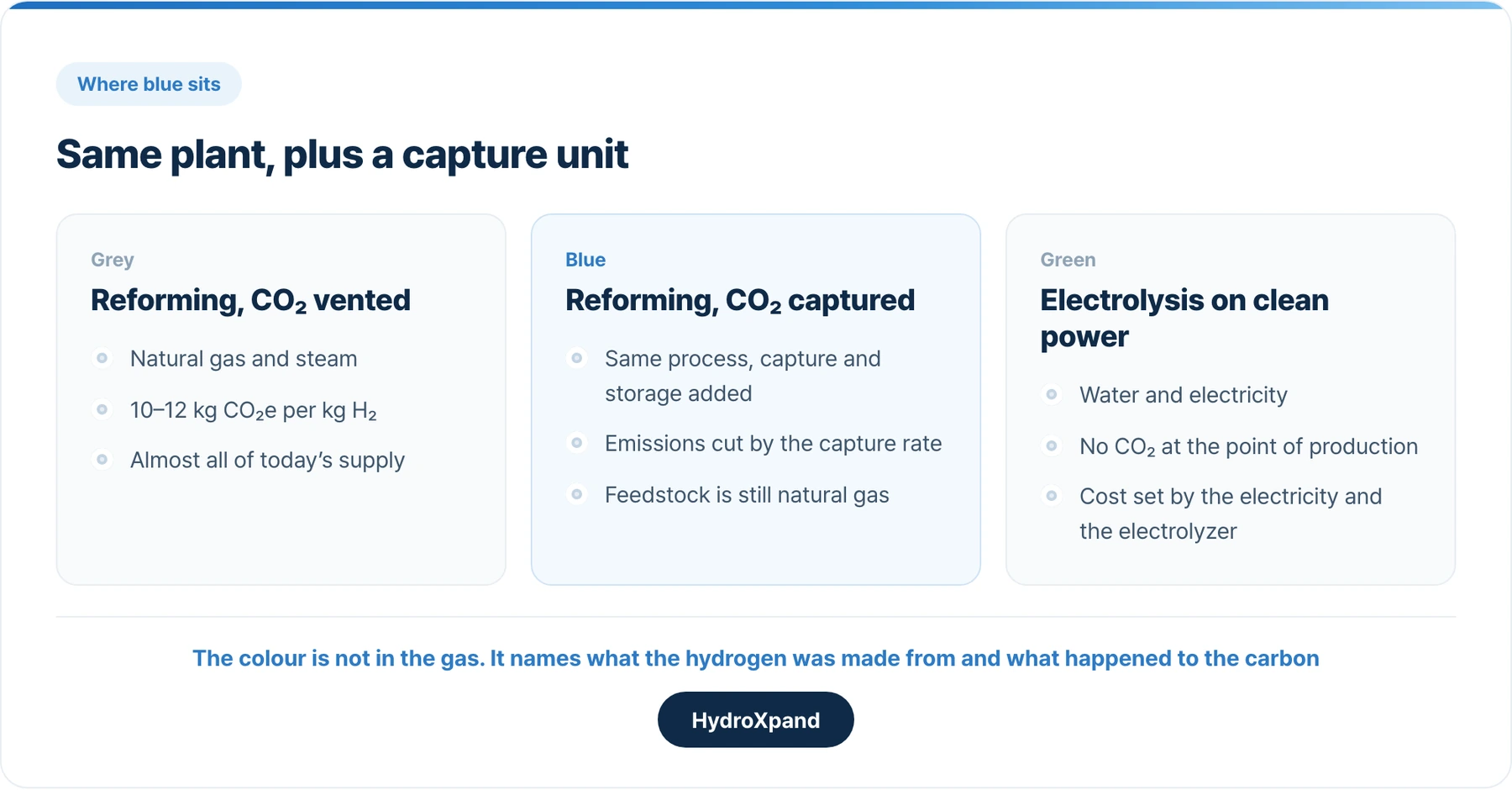
The front end of a blue hydrogen plant is a grey hydrogen plant. Methane and steam react at high temperature, and the products are hydrogen and carbon dioxide. Blue hydrogen adds a step: the CO₂ is separated from the gas stream, then piped to a storage site underground or sold as an industrial feedstock.
Not all of that CO₂ is equally easy to catch. The shift reactor gives up its CO₂ as a concentrated stream, and concentrated streams are cheap to separate. The furnace that heats the reformer sends its CO₂ up the flue, diluted with air, and separating that is expensive. The IEA's figures follow that split: capturing the concentrated process stream alone cuts emissions by about 60%, and adding flue-gas capture raises the rate to about 90%.
That is why the capture rates of operating plants are more often in the middle of the range than at the 90%-plus figures that appear in project announcements. Blue hydrogen is one process with one extra step, and the whole result depends on how far that step is taken.
How clean it is: the capture rate, and what remains
Blue hydrogen is cleaner than grey. It is not clean in the sense that green hydrogen is, and the gap has two parts.
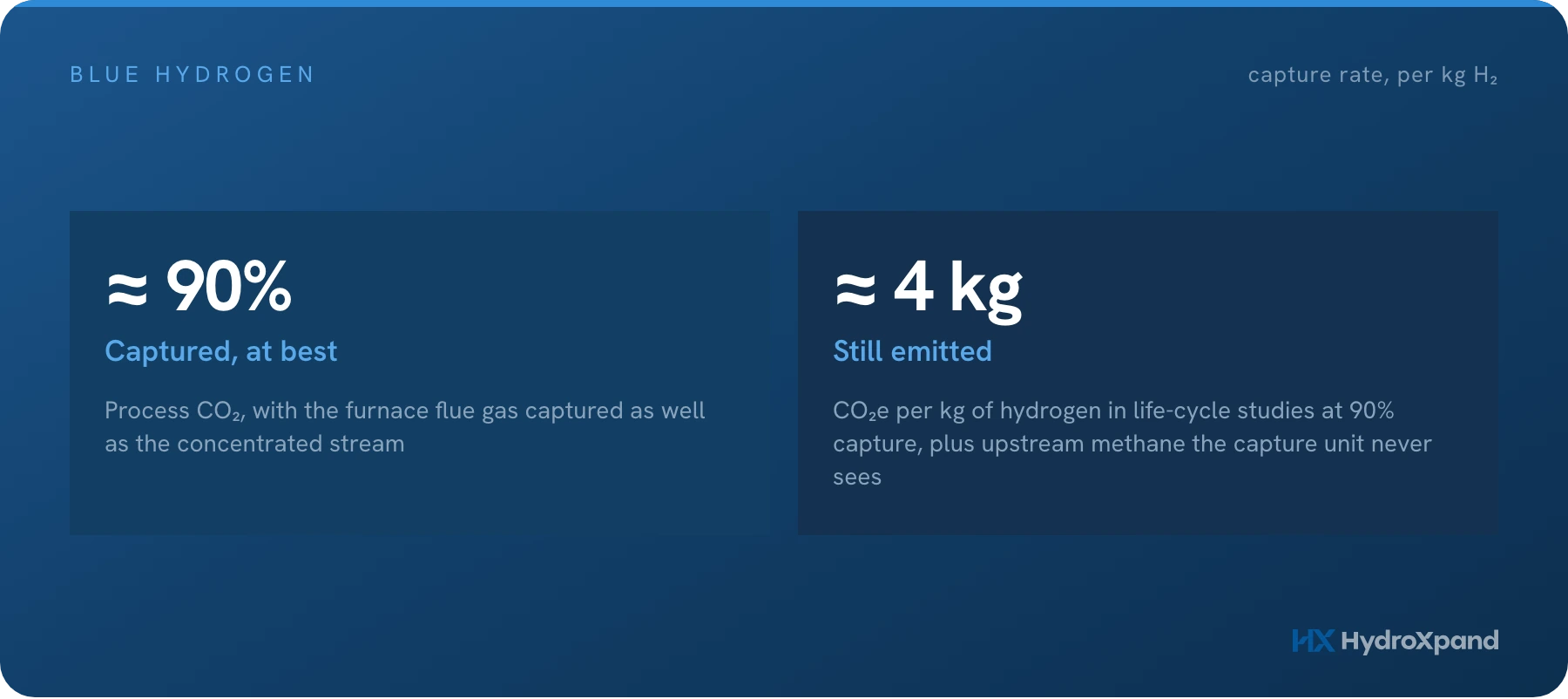
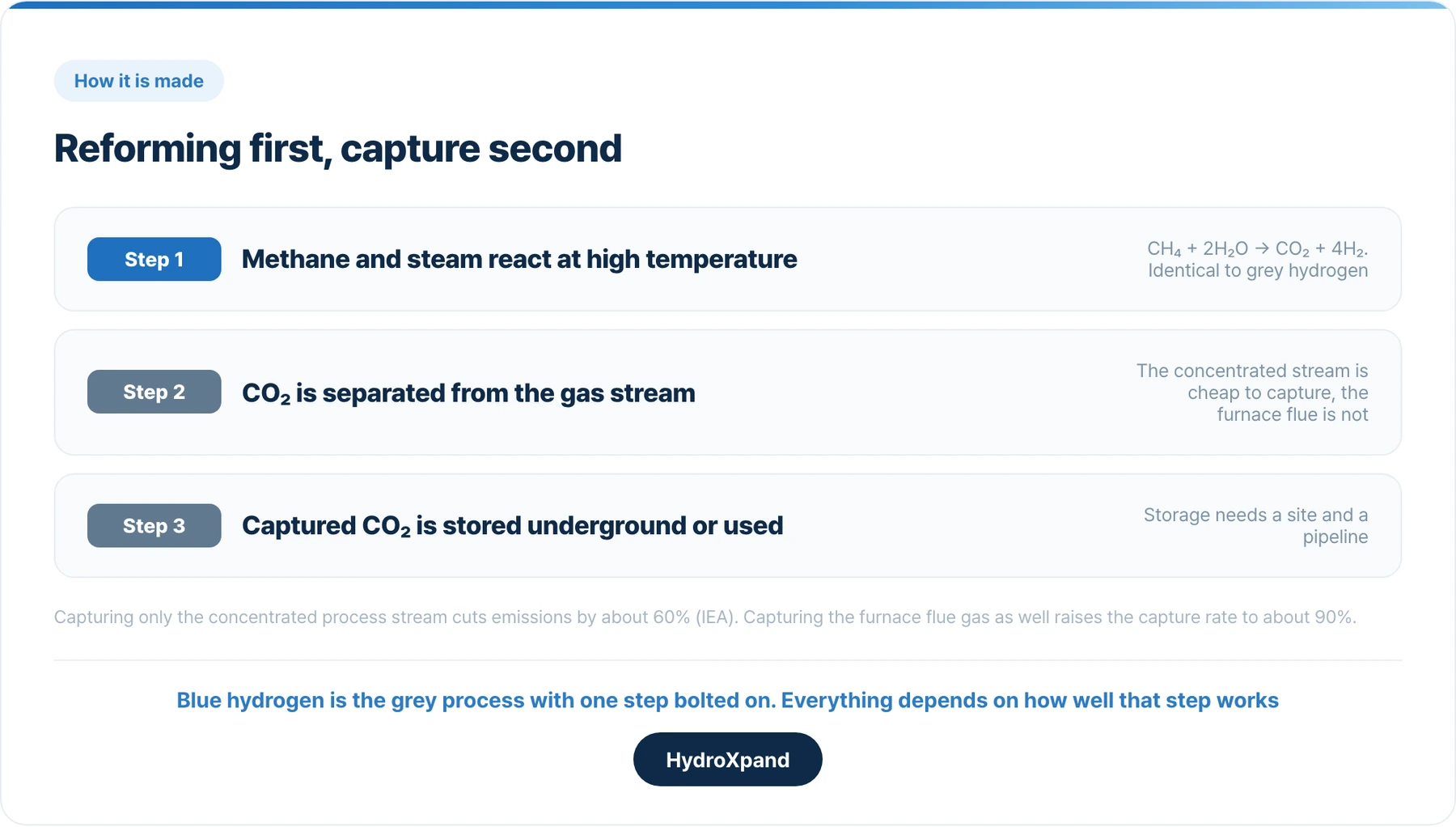
The first is inside the plant. Only 75 to 95% of the process CO₂ is capturable at all, according to the IEA, and a plant captures only the fraction its equipment is built for. Whatever is not captured is emitted exactly as it would be at a grey plant.
The second is outside the fence. Methane leaks while natural gas is drilled, processed and shipped, and no capture unit ever sees it. Methane traps far more heat than CO₂ over a twenty-year horizon, so a small leak rate has a large effect on the total. The IEA's position is that capture alone is not enough and that upstream methane has to be cut alongside it.
Life-cycle studies of well-run, high-capture plants put the two parts together and still report about 4 kg of CO₂ equivalent per kilogram of hydrogen at a 90% capture rate. That figure comes from academic analyses rather than from the IEA, and it varies with the plant and the gas supply. It is small against the 10 to 12 kg of grey hydrogen. It is not small against the thresholds that certification schemes now use.
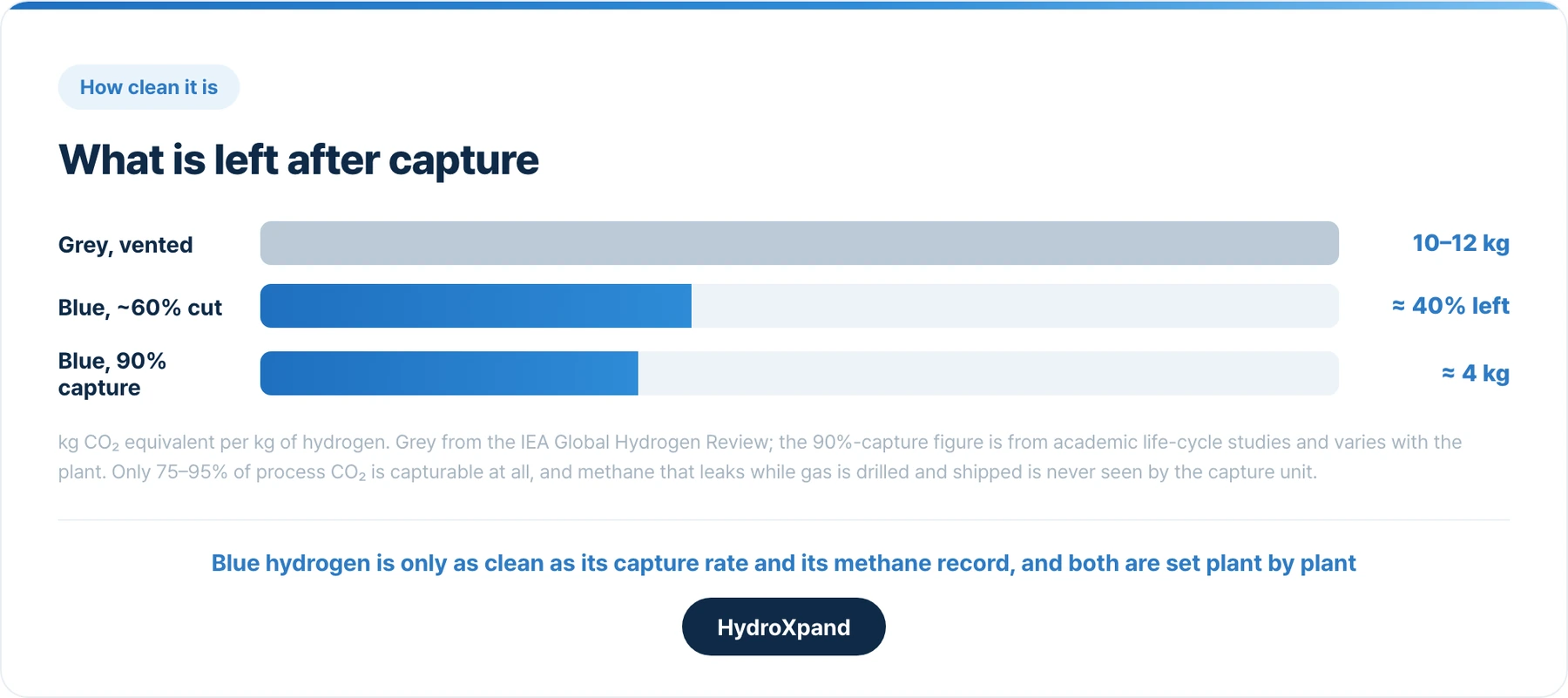
Blue hydrogen is only as clean as its capture rate and its methane record, and both are set plant by plant.
SourceIEA Global Hydrogen Review 2024, chapter 7: share of emissions at the point of production
What capture costs
Capture is a surcharge on grey hydrogen, not a new way of making it. The IEA puts the cost of capturing CO₂ at a reforming plant at roughly USD 60 to 110 per tonne. Grey hydrogen carries about 10 kg of process CO₂ per kilogram, so the arithmetic alone adds something like USD 0.6 to 1.1 per kilogram of hydrogen, before the pipeline and the storage site are paid for. On top of that sits the capital cost of the capture unit, which raises the investment in the plant substantially.
The result is the ordering the market shows today: blue costs more than grey and, in most regions, less than green hydrogen. The IEA's 2025 review notes that the gap between low-emissions and unabated production widened after 2023, as natural gas prices fell and electrolyzer costs rose, and that it is expected to narrow substantially by 2030. Blue hydrogen's price advantage over green is real now and is not guaranteed to last.
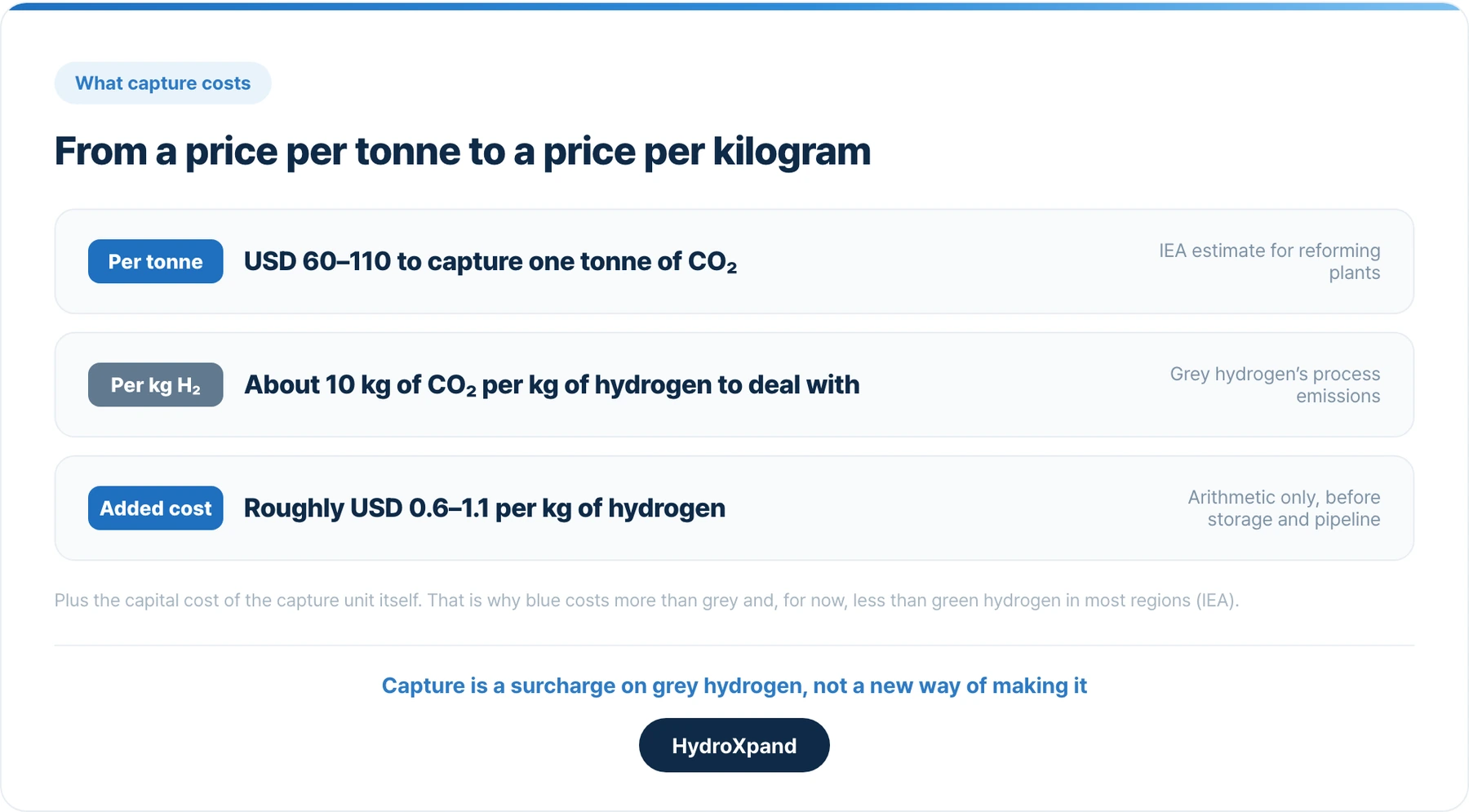
For hydrogen from steam methane reforming (natural gas), abatement costs are estimated at around USD 60-85/t CO2 for capture rates of 55-70%, and USD 85-110/t CO2 for rates above 90%.
SourcesIEA Global Hydrogen Review 2024: abatement cost per tonne of CO2 · IEA Global Hydrogen Review 2025: the cost gap between low-emissions and unabated hydrogen
Blue against green
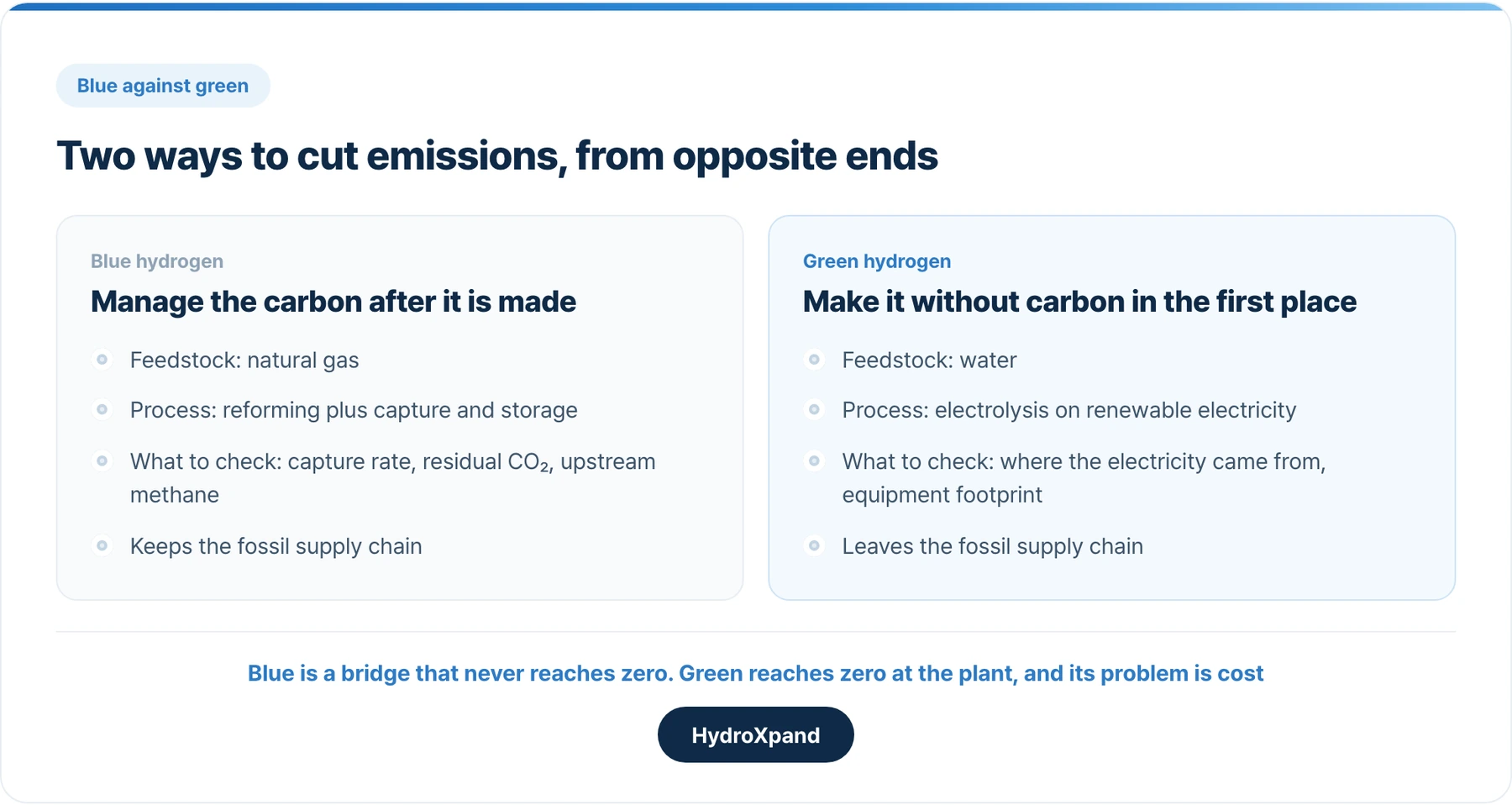
Both colours are attempts to cut emissions, and they start from opposite ends. Blue hydrogen manages the carbon after it has been made: keep the fossil feedstock, capture what can be captured. Green hydrogen avoids the carbon in the first place: replace the feedstock with water and the heat with electricity.
That difference decides what each one is limited by. Blue is limited by physics and by the gas supply chain, because some CO₂ and all of the upstream methane sit beyond what a capture unit can reach. Green is limited by cost, because the electricity and the electrolyzer have to be paid for, and by nothing else at the plant. One limit is permanent. The other is a price, and prices move.
Where blue hydrogen makes sense
Blue hydrogen is the right answer where a reforming plant already exists, a storage site is within reach, and the alternative is continuing to vent. Cutting the emissions of the hundred million tonnes of hydrogen the world already makes is the largest emission reduction available in hydrogen, and for much of that volume blue is the only near-term route.
It is the wrong answer when it is presented as the destination. A bridge that captures 60% of process CO₂ and leaks methane upstream is a partial fix, and the certification schemes that now define low-carbon hydrogen by a number rather than a colour will treat it as one.
- Ask for the capture rate of the specific plant, not the technology's maximum.
- Ask for the upstream methane intensity of the gas supply, because it is not in the capture rate.
- Ask for the life-cycle figure in kg CO₂ equivalent per kg, which is what certification will measure.
- Check the cost against green hydrogen for the year the plant will run, not for today.
The variable that decides how long blue's price advantage lasts is the cost of making green hydrogen, and that comes down to clean electricity and the electrolyzer. The second is what HydroXpand builds: AEM electrolysis electrodes, stacks and systems that avoid iridium and PFAS membranes, sold today from 2 kW research and pilot units to a 30 kW stack.
- Hydrogen colours: what the names leave out→All five colours in one table, and the one number that certification actually measures.
- Hydrogen energy pros and cons→The eight points, four fixed by physics and four set by cost.
- What is water electrolysis→The route that has no carbon at the plant, and the four numbers fixed per kilogram.
- What hydrogen is actually used for→The hundred million tonnes a year that blue hydrogen would clean up.
- AEM water electrolysis: how it works→How HydroXpand makes the green route without iridium.
Frequently asked questions
Is blue hydrogen clean hydrogen?
It is cleaner than grey, not clean like green. Some process CO₂ is never captured, and the methane that leaks while natural gas is drilled and shipped is outside the capture unit entirely. Life-cycle studies still report about 4 kg CO₂ equivalent per kg of hydrogen at a 90% capture rate.
How much CO₂ does blue hydrogen capture?
It depends on the plant. Capturing only the concentrated process stream cuts emissions by about 60%; adding flue-gas capture raises the rate to about 90%. Only 75 to 95% of process CO₂ is capturable at all, according to the IEA.
Is blue hydrogen cheaper than green hydrogen?
In most regions today, yes. Capture adds roughly USD 60 to 110 per tonne of CO₂, about USD 0.6 to 1.1 per kg of hydrogen, so blue costs more than grey but less than green. The IEA expects the gap to green to narrow substantially by 2030.
Is blue hydrogen made by electrolysis?
No. Blue hydrogen comes from reforming natural gas with the CO₂ captured. Electrolysis on renewable electricity is green hydrogen, a different process with no CO₂ at the plant.
Sources
- Global Hydrogen Review 2024 — International Energy Agency, 2024
- Global Hydrogen Review 2025 — International Energy Agency, 2025
Looking at AEM for a specific application?