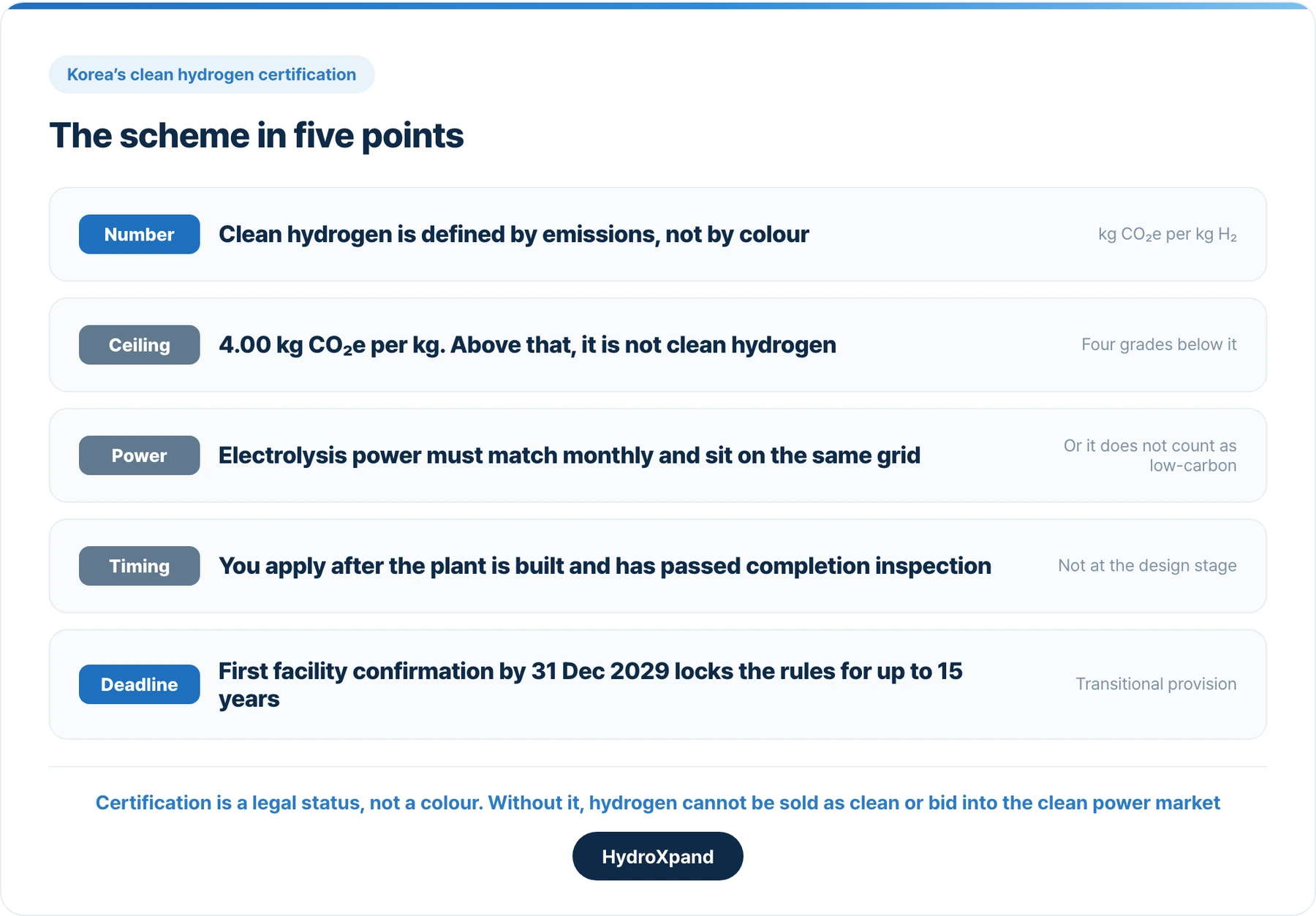
Korea defines clean hydrogen by a number, not a colour: at most 4.00 kg of CO₂ equivalent per kilogram of hydrogen, split into four grades. This article sets out what the law defines, how the grades and the accounting boundary work, the two conditions electrolysis power has to meet, when and how a plant applies, and why 31 December 2029 matters to anyone building an electrolyzer in Korea.
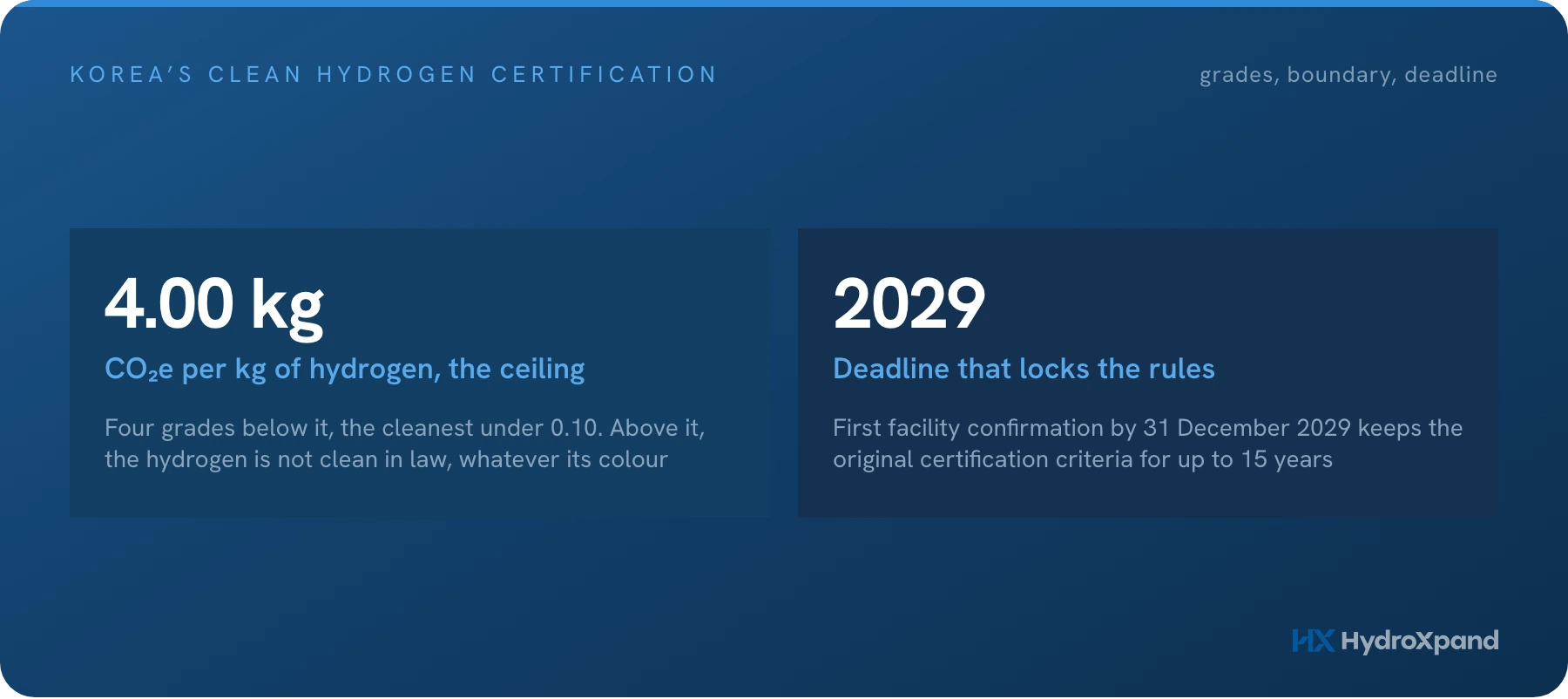
Calling hydrogen green or blue is an industry habit. What a regulator recognises is not a colour but a quantity of greenhouse gas. Korea wrote a definition of clean hydrogen into its Hydrogen Act in 2022, and a ministerial notice of March 2024 set the grades and the certification procedure. This article explains that scheme as it stood in July 2026: what counts as clean hydrogen, how it is graded, how the emissions are counted, what electrolysis projects have to prove about their electricity, when a plant can apply, and the deadline that locks the rules for fifteen years.
It is written for anyone planning to make or buy hydrogen in Korea, and for readers elsewhere who want to see what a working certification scheme looks like in detail. It summarises public law and notices; it is not legal advice, and the original texts and the responsible ministry should be checked for any actual project.
What the law defines: three kinds of clean hydrogen
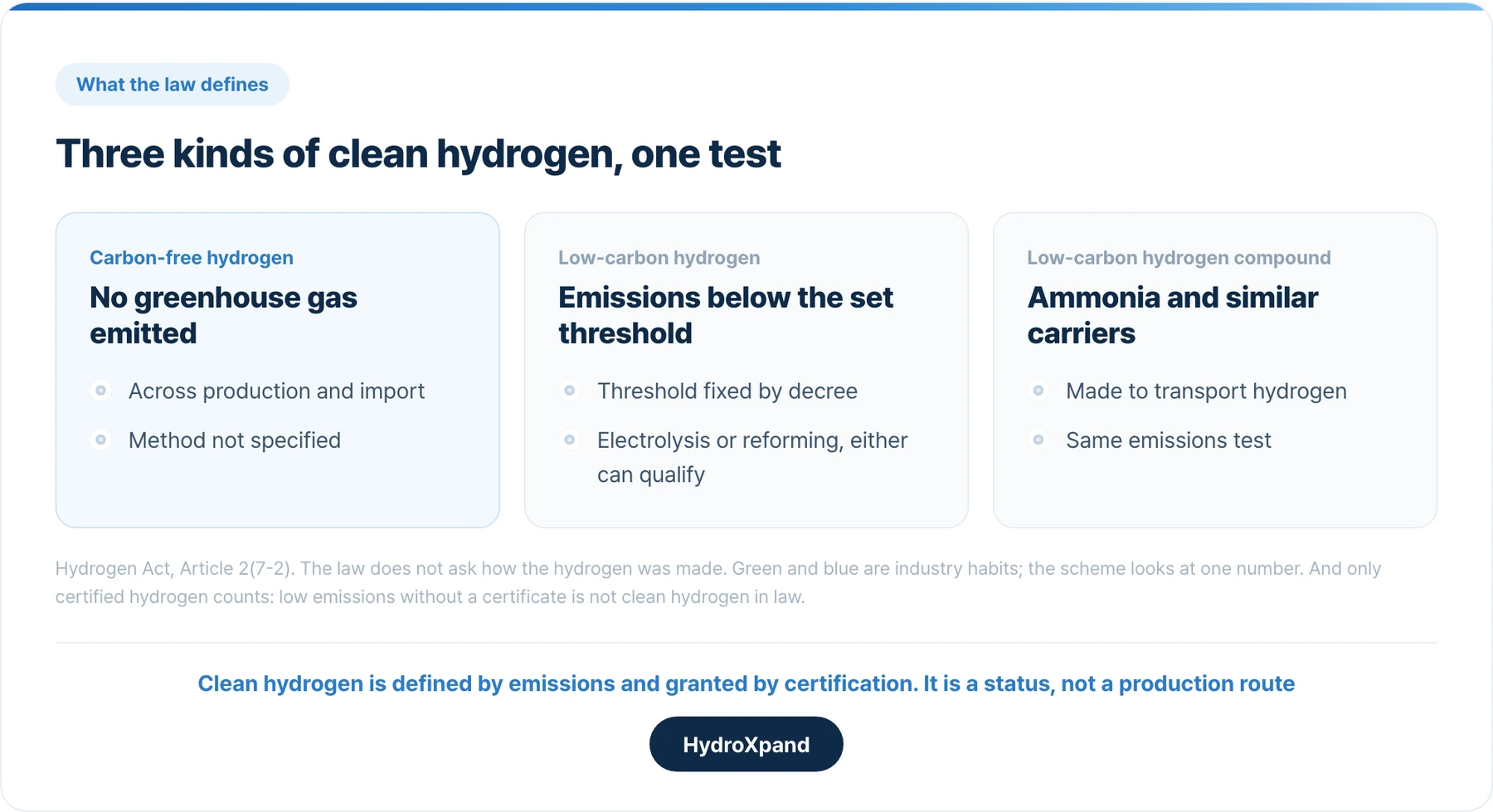
Article 2(7-2) of the Hydrogen Act defines clean hydrogen in three categories. Carbon-free hydrogen emits no greenhouse gas across its production or import. Low-carbon hydrogen emits less than a threshold set by presidential decree. Low-carbon hydrogen compounds are carriers such as ammonia, made to transport hydrogen, that meet the same kind of threshold.
Two things follow from the wording. First, the law does not ask how the hydrogen was made. Electrolysis or reforming, either qualifies if its emissions are under the line; green and blue are distinctions the industry makes, and the scheme makes none. Second, the status exists only through certification. Article 25-2 defines clean hydrogen as hydrogen that has been certified, so a low number without a certificate is not clean hydrogen in law. Without certification the hydrogen cannot carry the clean hydrogen mark, and it cannot be used to bid into the clean hydrogen power market.
| Definition | Note | |
|---|---|---|
| Carbon-free hydrogen | No greenhouse gas emitted in production or import | Method not specified |
| Low-carbon hydrogen | Emissions below a threshold set by decree | Electrolysis or reforming can both qualify |
| Low-carbon hydrogen compound | A carrier such as ammonia, made to transport hydrogen, below the threshold | Same emissions test |
To promote the use of clean hydrogen, the Minister of Trade, Industry and Energy may certify hydrogen or hydrogen compounds meeting the certification standards prescribed by Presidential Decree
SourceAct, Article 2(7-2) and Article 25-2: clean hydrogen and its certification
The grades and the ceiling
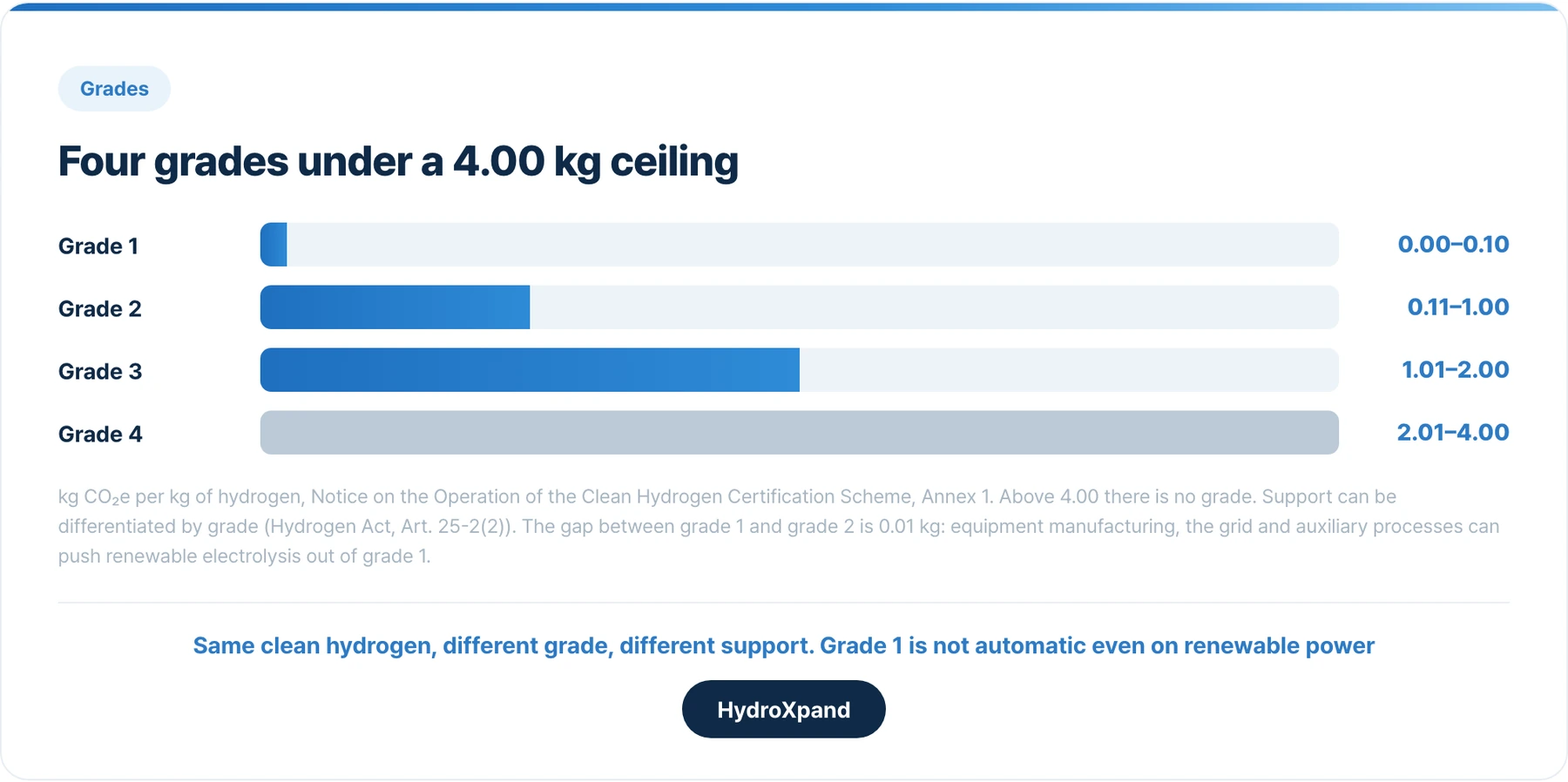
Article 8 of the notice delegates the grades to its Annex 1, which sets four bands of greenhouse gas emissions per kilogram of hydrogen, in kilograms of CO₂ equivalent. Grade 1 is 0.00 to 0.10. Grade 2 is 0.11 to 1.00. Grade 3 is 1.01 to 2.00. Grade 4 is 2.01 to 4.00. Above 4.00 there is no grade and the hydrogen is not clean hydrogen.
The annex also fixes the arithmetic: per-facility emissions are calculated to four decimal places, rounded to three when summed, and rounded to two when the certificate is issued and the grade assigned. The grades matter because Article 25-2(2) allows administrative and financial support to be differentiated by grade. Two lots of certified clean hydrogen can receive different support depending on where they land.
The band that deserves attention is the top one. Grade 1 and grade 2 are separated by a hundredth of a kilogram. Electrolysis on renewable electricity does not land in grade 1 automatically, because manufacturing the equipment, the grid connection and the auxiliary processes all contribute emissions that the calculation counts.
Source청정수소 인증제도 운영에 관한 고시, Annex 1: grade table and rounding rule (MOTIE Notice 2024-39)
How far the emissions are counted
Article 11 of the notice sets the accounting boundary, and the boundary decides the grade. The rule is that emissions are counted from raw material extraction through to production or import: direct emissions, indirect emissions from purchased electricity, and part of the other indirect emissions, including transport inside and outside Korea.
That rule is not yet applied in full. The transitional provisions of the notice defer part of it. Under Article 2 of those provisions the boundary currently runs from extraction to production only, and maritime transport emissions are excluded, until a date still to be set. When the deferral ends, the transport leg enters the calculation. Hydrogen shipped in by sea will see its number rise; hydrogen made in Korea, with a short transport leg, will barely move.
Emissions are calculated with default data supplied by the certification body where a dataset matching the applicant's process exists, and otherwise from accredited data and design data.
| The rule (Art. 11) | Applied today (transitional Art. 2) | |
|---|---|---|
| Boundary | Extraction to production or import, transport included | Extraction to production, transport excluded |
| Maritime transport | Included | Excluded |
| Until | A date to be set separately |
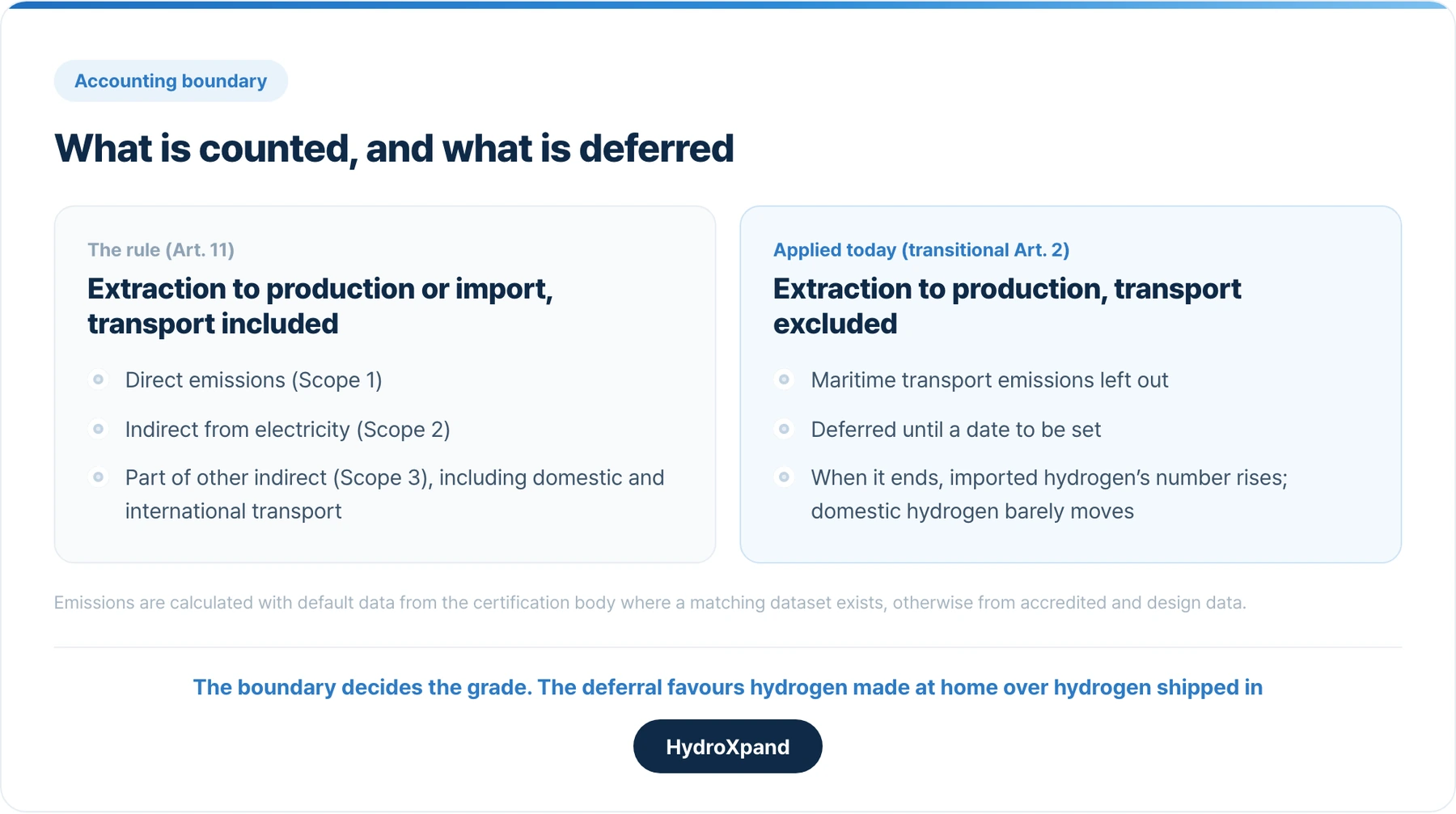
Source청정수소 인증제도 운영에 관한 고시, Addenda Article 2: system boundary during the transition
Electrolysis: two conditions on the electricity
Hydrogen made by electrolysis faces an extra test, in Article 12 of the notice, on the electricity it uses. The electricity counts as coming from a low-carbon source, meaning a generator with low greenhouse gas emissions such as renewables or nuclear, only if two conditions hold. The amount generated by the low-carbon source must match the amount consumed by the electrolyzer month by month, and the source must be connected to the same grid as the electrolyzer.
Matching annual totals is not enough, and a source on another grid does not qualify. If either condition fails, the electricity is not treated as low-carbon, the calculated emissions rise, and the grade falls. In practice this means an electrolysis project's grade is decided as much by its power procurement contract as by its electrolyzer, and the two have to be designed together.
The arithmetic from our hydrogen colours article shows why the electricity dominates. At 56 kWh per kilogram, the measured draw of our HXB-V1 system at the wall, the electricity has to be cleaner than about 71 g CO₂ per kWh for the hydrogen to land under 4 kg. Very few grids are, which is exactly why the notice asks for a dedicated low-carbon source rather than grid average power.
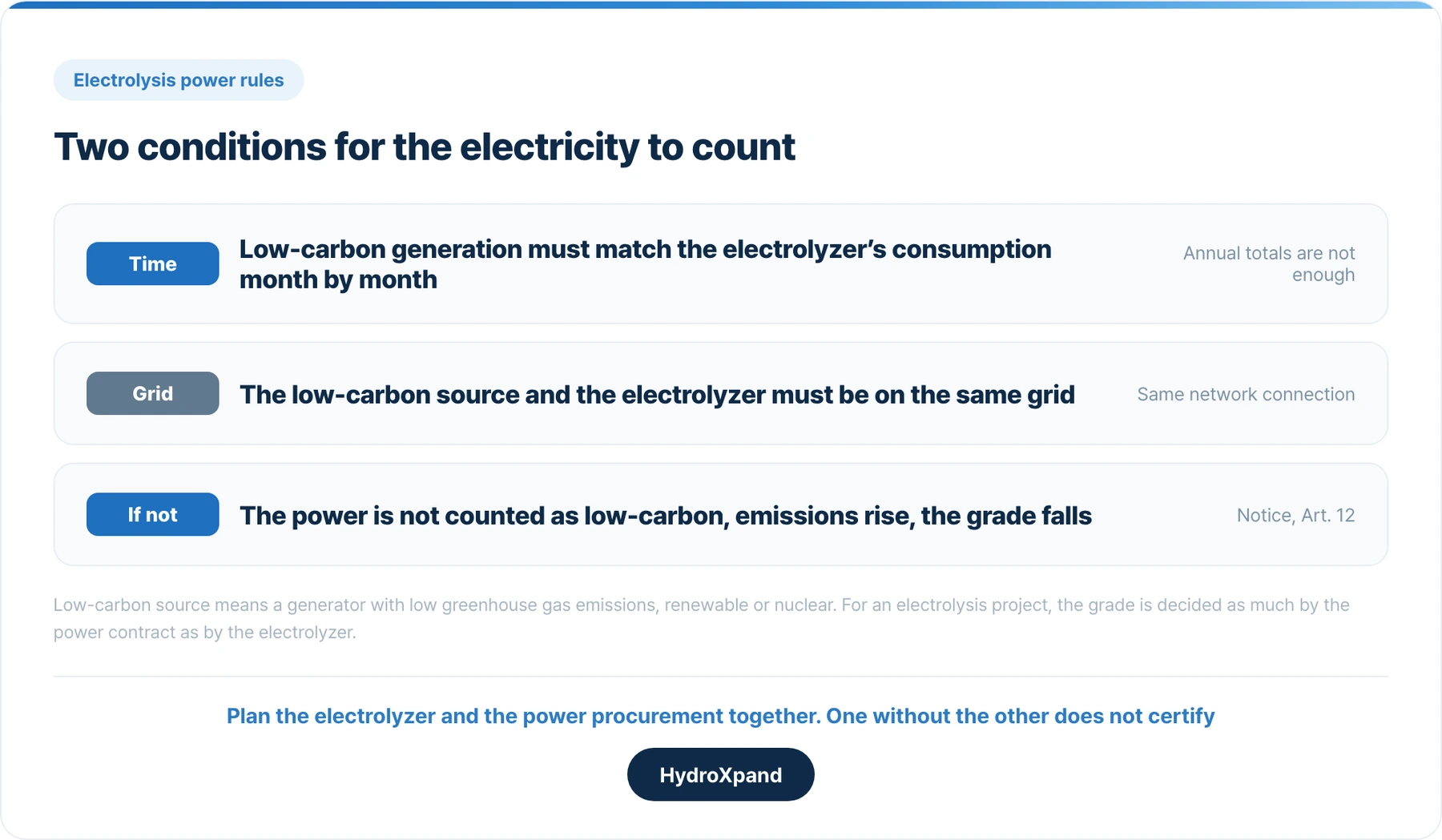
For an electrolysis project, the grade is decided as much by the power contract as by the electrolyzer.
Source청정수소 인증제도 운영에 관한 고시, Article 12(1): monthly matching and the same grid
When and how a plant applies
The first question is timing. Article 9(2) of the notice requires an applicant for facility confirmation to submit after the plant has been completed and has passed the completion inspection under Article 16(3) of the High-Pressure Gas Safety Control Act and any other required permits. There is no application at the design stage. The certification clock starts only when the plant is built and inspected, and that fact anchors the whole schedule.
From there the procedure runs in steps. The applicant files for facility confirmation, with up to 30 days to supply any missing documents. An on-site facility audit checks that the plant is operated as designed, to establish whether the design data can be trusted. An on-site data audit checks that the design data matches what is measured in the field. A facility confirmation certificate is then issued, stating that the plant is eligible. Hydrogen produced by that plant within the certificate's validity is certified as clean hydrogen. Compliance is checked at least once a year afterwards.
Facility confirmation and certification are two different things. Confirmation is about the plant: is it a plant that can receive certificates. Certification is about the hydrogen the plant actually makes.
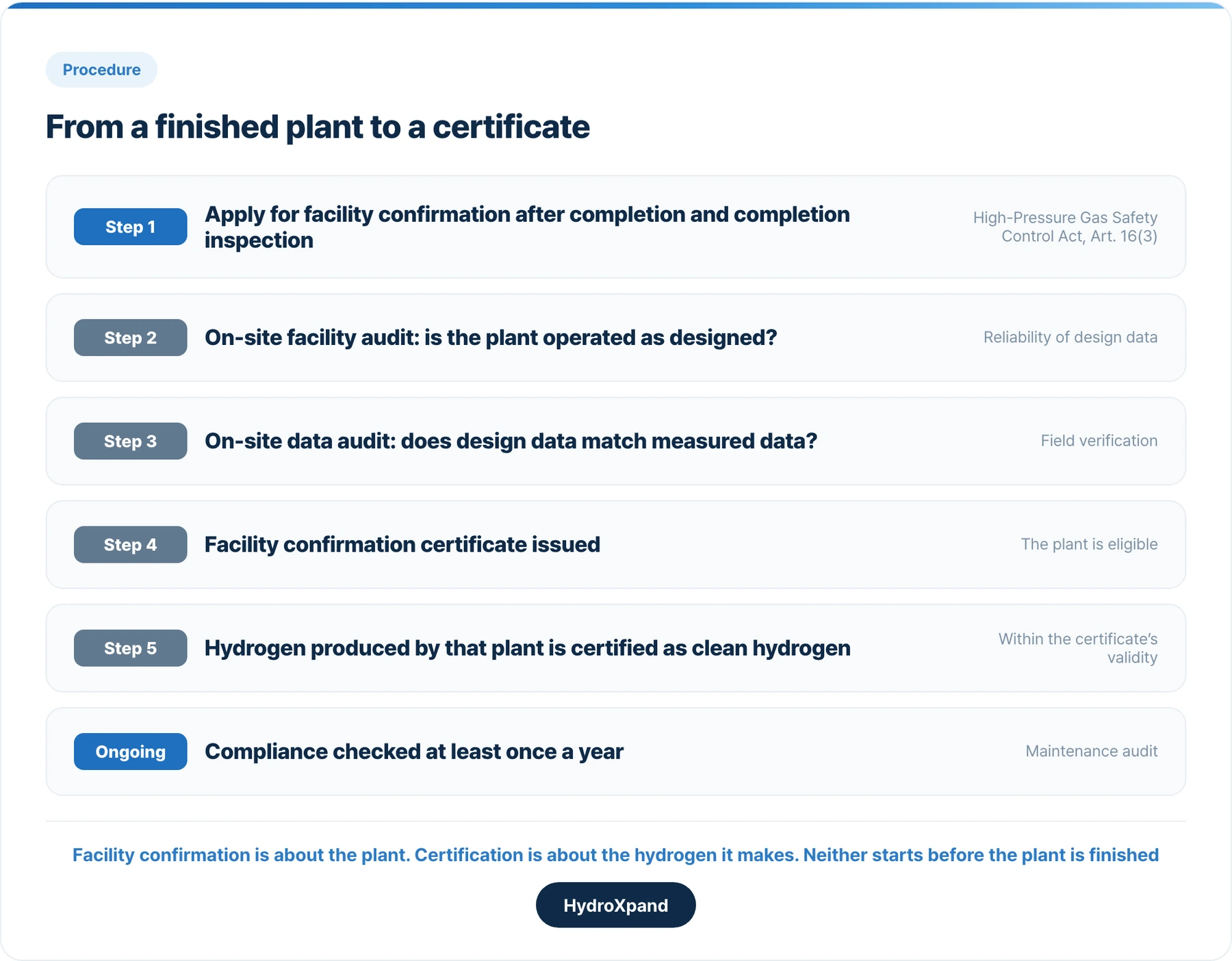
Source청정수소 인증제도 운영에 관한 고시, Article 9(2): facility confirmation after the completion inspection
The 2029 deadline
One transitional provision bears directly on investment decisions. Article 2(3) of the transitional provisions says that a production facility which receives its first facility confirmation on or before 31 December 2029 may continue to have its emissions calculated under the certification criteria that applied at that first confirmation, regardless of later changes to the criteria or the calculation method, for up to 15 years from the confirmation date.
Read together with the deferral above, the meaning is clear. Transport emissions are currently outside the boundary, and the boundary will change when the deferral ends. A plant confirmed before the end of 2029 keeps the rules it was confirmed under. Since confirmation requires a completed and inspected plant, the plant has to be designed, built and permitted before then, and working backwards from an electrolysis project's construction and permitting time, the margin is not large.
| Condition | First facility confirmation on or before 31 December 2029 |
|---|---|
| Effect | The certification criteria in force at first confirmation continue to apply, whatever changes later |
| Duration | Up to 15 years from the date of first confirmation |
Why certify: the hydrogen power auctions
Certified clean hydrogen is used, above all, in the hydrogen power bidding market that Article 25-6 of the Hydrogen Act allows the ministry to open. The notice on annual purchase volumes splits it in two: a clean hydrogen power market, for electricity generated from clean hydrogen as defined in Article 2(7-2), and a general hydrogen power market, for electricity from any hydrogen or hydrogen compound. To bid into the clean market the fuel has to be clean hydrogen, and to be clean hydrogen it has to be certified. The certificate is the ticket.
The size of each market is set by opening volumes in Annex 1 of that notice: 1,300 GWh of general hydrogen power opened in each of 2023, 2024 and 2025, for commercial operation two years later, and clean hydrogen power volumes of 3,500 GWh opened in 2024 for operation in 2027 and 3,000 GWh in 2025 for operation in 2028. The 1,300 GWh general volume corresponds to about 200 MW of capacity. Volumes for 2026 were not yet in the notice as of July 2026. The Act also contains an obligation to sell and use clean hydrogen, scheduled to take effect on 31 May 2027, so certification may in time become a procurement requirement for hydrogen users, not only an entry condition for power auctions.
| Year opened | General hydrogen market | Clean hydrogen market |
|---|---|---|
| 2023 | 1,300 GWhcommercial operation 2025 | |
| 2024 | 1,300 GWhcommercial operation 2026 | 3,500 GWhcommercial operation 2027 |
| 2025 | 1,300 GWhcommercial operation 2027 | 3,000 GWhcommercial operation 2028 |
Source수소발전 입찰시장 연도별 구매량 산정 등에 관한 고시, Annex 1: general and clean hydrogen market volumes (MOTIE Notice 2024-125)
What an electrolysis project has to settle, and when
Put from the project owner's side, the scheme comes down to six items. Three of them are fixed at the design stage and are hard to change once the plant is built.
- Decide the target grade, the power contract and the accounting approach before the plant is designed, not after.
- Treat the electricity as the main variable: at electrolysis consumption of tens of kWh per kilogram, the grid mix decides the number.
- Count backwards from 31 December 2029 through permitting, construction and completion inspection, and see whether the schedule holds.
- Check the notice and the Act at the National Law Information Center before relying on any figure here; this article describes the rules as of July 2026 and is not legal advice.
| Item | What to settle | When |
|---|---|---|
| Target grade | Which grade the project aims for. Grade 1 means under 0.10 kg CO₂e per kg | Design |
| Power procurement | A low-carbon source, matched monthly, on the same grid | Design |
| Emissions accounting | The boundary and the default datasets that apply | Design |
| Completion and inspection | The precondition for applying at all | Construction |
| First facility confirmation | Before 31 December 2029 to keep the original criteria for up to 15 years | Before end 2029 |
| Auction participation | Only certified clean hydrogen can bid into the clean power market | After certification |
HydroXpand develops and supplies AEM electrolysis electrodes, stacks and systems, from 2 kW research and pilot units to a 30 kW stack. If you are evaluating an electrolyzer with certification in mind, the grade will turn on the power contract and the equipment together, and we are glad to work through both.
- Hydrogen colours: what the names leave out→Why certification asks for a number rather than a colour, with Korea's and the EU's thresholds side by side.
- Hydrogen power generation→The auctions that certified clean hydrogen bids into, and the three ways hydrogen makes electricity.
- How hydrogen energy works→The three ways hydrogen is made, and why the electricity dominates electrolysis emissions.
- What is grey hydrogen→The 10 to 12 kg baseline that the 4 kg ceiling is measured against.
- AEM water electrolysis: how it works→How HydroXpand makes hydrogen from water without iridium.
Frequently asked questions
What counts as clean hydrogen in Korea?
Hydrogen certified under the Hydrogen Act with greenhouse gas emissions of at most 4.00 kg CO₂ equivalent per kilogram of hydrogen. The law defines carbon-free hydrogen, low-carbon hydrogen and low-carbon hydrogen compounds, and does not ask how the hydrogen was made. Only certified hydrogen has the status.
What are the clean hydrogen grades?
Four bands in kg CO₂e per kg of hydrogen: grade 1 is 0.00 to 0.10, grade 2 is 0.11 to 1.00, grade 3 is 1.01 to 2.00 and grade 4 is 2.01 to 4.00. Above 4.00 there is no grade. Government support can be differentiated by grade.
Does hydrogen from renewable electrolysis automatically get grade 1?
No. The electricity has to come from a low-carbon source matched to the electrolyzer's consumption month by month and connected to the same grid, and even then equipment manufacturing, the grid connection and auxiliary processes add emissions. Grade 1 and grade 2 are separated by a hundredth of a kilogram.
When can a plant apply for certification?
Only after it is completed and has passed the completion inspection under the High-Pressure Gas Safety Control Act and any other required permits. There is no application at the design stage. Facility confirmation comes first, then the hydrogen the plant produces is certified.
Why does 31 December 2029 matter?
A plant that receives its first facility confirmation by that date keeps the certification criteria in force at that time for up to 15 years, even if the criteria or the calculation method change later. Since confirmation requires a finished and inspected plant, the plant has to be built and permitted before then.
Sources
- 청정수소 인증제도 운영에 관한 고시 (Notice on the operation of the clean hydrogen certification system), MOTIE Notice 2024-39 — law.go.kr
- 수소발전 입찰시장 연도별 구매량 산정 등에 관한 고시 (Notice on annual purchase volumes of the hydrogen power bidding market), MOTIE Notice 2024-125 — law.go.kr
- 수소경제 육성 및 수소 안전관리에 관한 법률, Act No. 21467 — law.go.kr
- Hydrogen Economy Promotion and Hydrogen Safety Management Act, English translation — Korea Legislation Research Institute
Looking at AEM for a specific application?