Most electrode enquiries stall on the specification rather than the price. Area and thickness come from the cell the electrode goes into, the catalyst comes from the test, and only then does it make sense to choose between a standard sheet and a custom format. This is that order, with the figures for our anode and cathode.
When a laboratory asks us for electrodes on their own, the first reply is usually a question rather than a price. What size? Which thickness? Pt/C or PtRu/C? Each unanswered item is another round of email before a quotation can go out.
We have had to requote twice for that reason ourselves. In both cases the electrode had been specified before the cell.
This is for groups evaluating materials in a single cell or short stack, and for teams building their own MEAs. It follows the order in which the decisions depend on each other.
Start from the cell, not the electrode
An electrode is cut to fit a cell. The active area is set by the cell's gasket window, and the thickness that seals and makes contact is set by the cell hardware. So until the cell is chosen, the electrode has no size and no thickness, and a quotation cannot be firm.
The catalyst is the one decision that comes from somewhere else: the membrane and the test you intend to run. Put together, the sequence looks like this.
- The cell and the membrane. Yours, or our HXS-0 research cell.
- Area, from the gasket window.
- Thickness, from the cell hardware and what it has to reproduce.
- Catalyst and loading, from the membrane and operating conditions.
- Standard format or custom, from the schedule and the quantity.
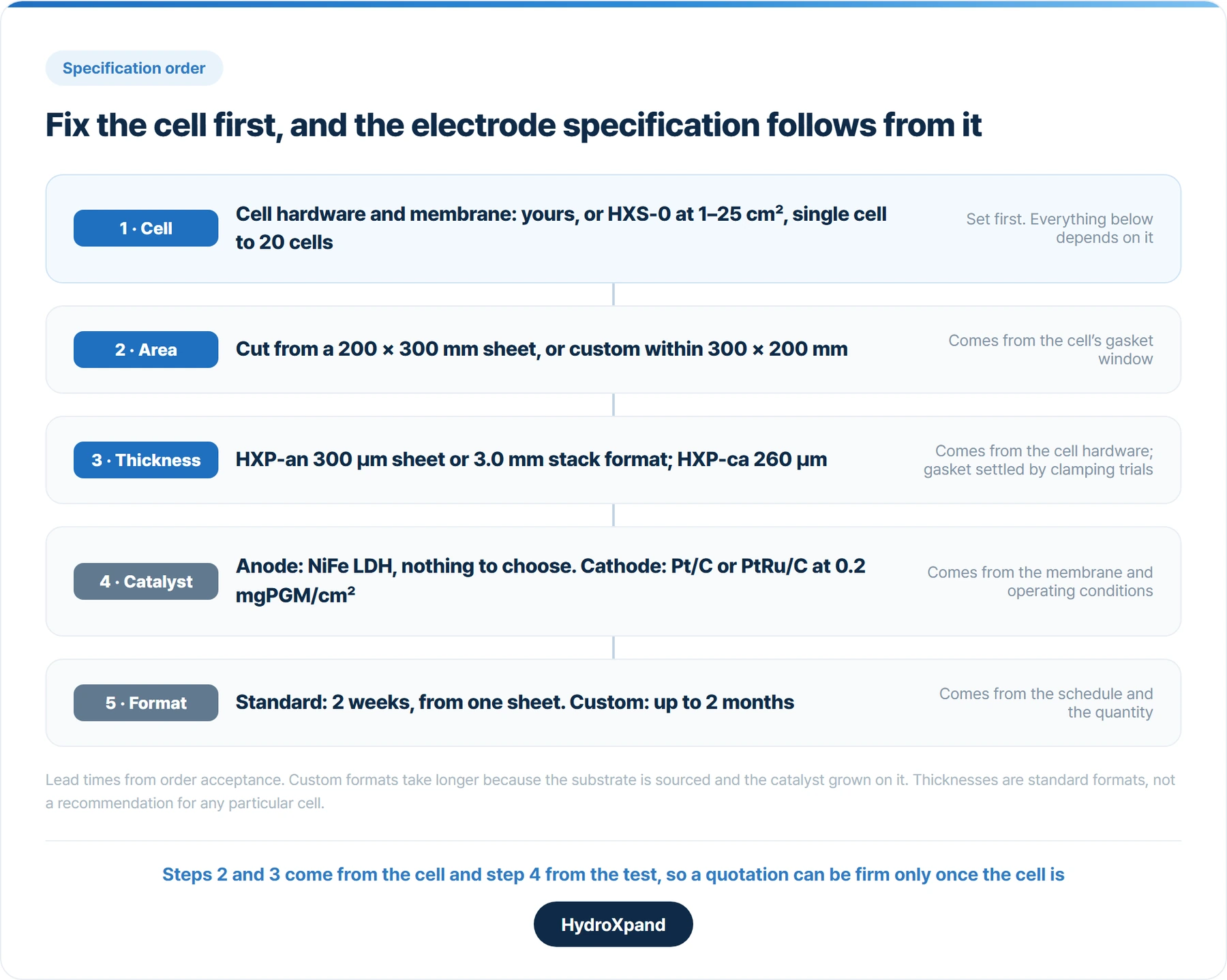
Most electrode quotations that go round twice were written before anyone measured the cell.
Area: buy a sheet and cut it to the window
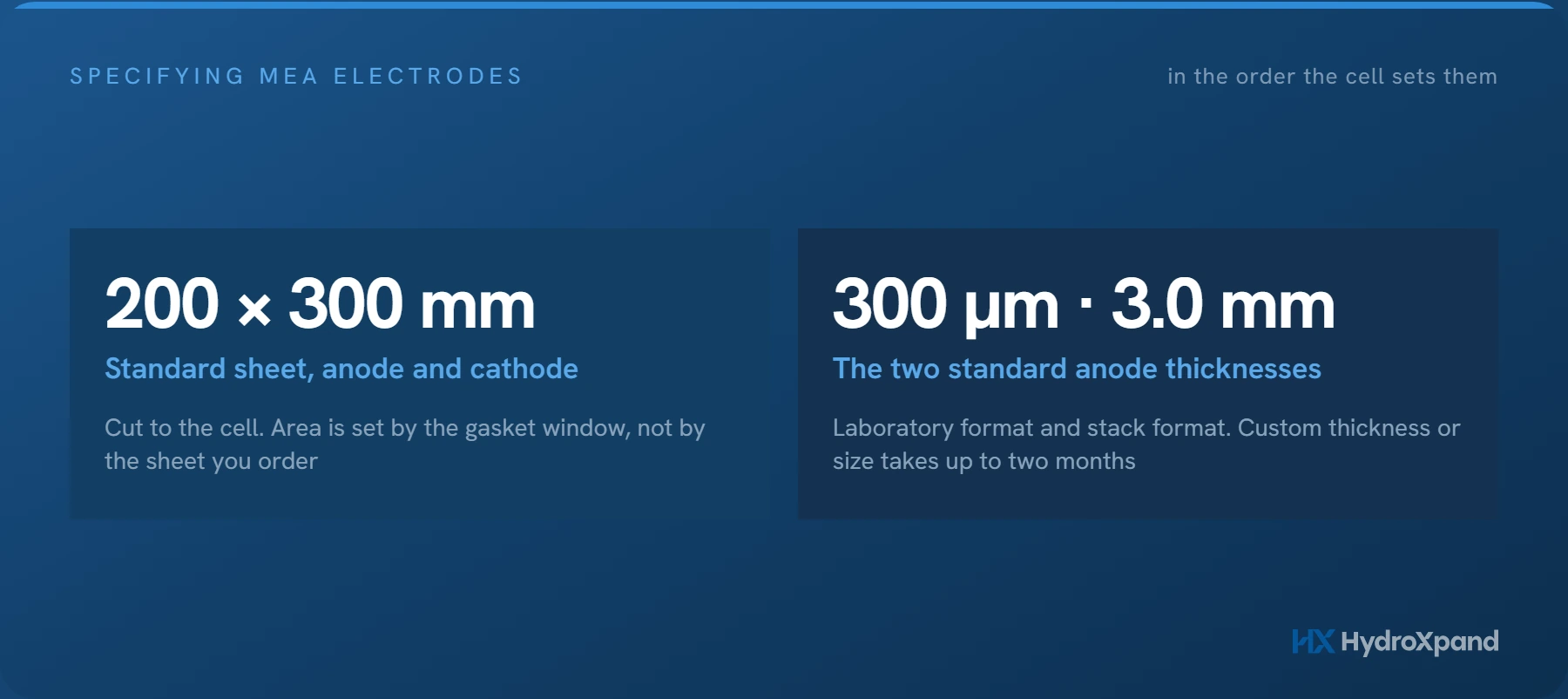
Electrodes are rarely used as the sheet they arrive in. The standard sheet for both our anode, HXP-an, and our cathode, HXP-ca, is 200 × 300 mm, and one sheet yields many pieces for comparing areas or conditions side by side.
HXS-0 takes active areas from 1 to 25 cm², chosen by the gasket window, from a single cell up to a 20-cell short stack. A 3 × 3 cm piece, 9 cm², sits inside that range. If you would rather receive pieces already cut, send the size and the quantity.
Custom sheets are made within 300 mm by 200 mm. Our inspection covers the sheet as shipped, so pieces you cut yourself are yours to measure. Cut in one pass with a sharp blade on a flat backing; a crushed edge changes local thickness and shows up later as a leak.
Depositing your own catalyst? Then you want the substrate, not the electrode. Nickel foam and felt, titanium felt and stainless fibre felt are supplied separately.
Thickness: where the electrode sits in the cell
The anode comes in two standard thicknesses of the same material, and the cathode in one. The difference is not quality. It is where the electrode goes.
| Standard format | Used for | |
|---|---|---|
| HXP-anlaboratory grade | 200 × 300 mm300 ± 20 µm | Cutting, MEA fabrication, preparing a range of active areas |
| HXP-anstack grade | 100 × 100 mm3.0 ± 0.2 mm | The format inside our own stacksalso single-cell evaluation and catalyst screening |
| HXP-cacathode | 200 × 300 mm260 ± 20 µm total | Carbon paper with a low-roughness catalyst layer, to limit membrane damage |
Choose by the gasket and the active area. Comparing membranes, the thin sheet cut to size is the usual answer; reproducing the conditions inside our stack, the 3 mm format.
Do not set the gasket thickness equal to the electrode thickness. Nickel foam compresses a great deal when the cell is clamped, by an amount that depends on the material, so the gasket is settled by clamping trials and a leak check. If the thickness you need falls between the two standards, either order a custom thickness or take up the difference in the gasket.
Catalyst and loading: two different decisions
On the anode there is nothing to choose. HXP-an is NiFe layered double hydroxide grown directly on 130 ppi nickel foam, binder-free, with no iridium or other platinum group metal. Because we synthesise it ourselves, the same specification can be supplied again for replacement.
On the cathode there is one choice. HXP-ca carries Pt/C or PtRu/C on carbon paper at 0.2 mgPGM/cm², measured by XRF, and for PtRu/C the loading counts the combined mass of Pt and Ru. The two cost the same. What differs is behaviour: Pt/C starts lower and lasts longer, and PtRu/C does the reverse.
Which suits a given membrane and operating condition we would rather decide with you than state in general. What the published electrode figures do and do not tell you is covered in the component buying guide linked below.
The electrode that looks best on the first day is not always the one still performing after cycling. Ask for both numbers.
Four combinations that come up most
- Comparing membranes. Hold the electrodes constant so the membrane is the only variable: anode and cathode as a set, cut from standard sheets. A membrane developer took ours up as its reference electrodes on exactly this basis.
- Screening catalysts. The 3 mm anode format in a single cell, compared condition by condition, in the same format that goes into our stacks.
- Building your own MEA. 200 × 300 mm sheets, cut to the active area you want. HXS-0 accepts our MEAs and those from other makers.
- Replacing parts in one of our stacks. Order the same specification for both electrodes; the anode is made in house.
Standard format or custom
Standard formats ship two weeks after order acceptance; custom specifications take up to 2 months. The gap is substrate sourcing and synthesis, not paperwork.
Standard formats can be ordered from a single sheet, with no minimum quantity or order value. Before a large custom order, it is usually quicker to evaluate a standard 200 × 300 mm anode first. It carries the same coating, so it tells you about coating stability and the oxygen evolution response, though not about the substrate. The custom quotation, which needs size, thickness and quantity, can run in parallel.
The HXS-0 standard supply has no MEA; on request we build one from HXP-an, HXP-ca and a membrane. There is no free sample programme. Electrodes are supplied against their specification at handover (dimensions, thickness, catalyst loading) and workmanship. How they perform once built into your MEA and cell is outside that.
We share the configuration of what we deliver. Synthesis recipes and ionomer composition stay confidential, and detailed performance data is exchanged under an NDA.
What to send with an electrode enquiry
- The cell and membrane you will use. If it is our HXS-0, say which configuration.
- Size, thickness and quantity, and whether you want sheets to cut or pieces cut to size.
- For the cathode, Pt/C or PtRu/C. If undecided, send the membrane and operating conditions and we will review them with you.
- The evaluation protocol: current density, electrolyte concentration, temperature and test duration. With these we can suggest operating conditions and point you to the published data that match.
If you publish, the product pages carry a citation line to use as written, for example "NiFe LDH on Ni foam (HXP-an, HydroXpand Inc., Republic of Korea)". Ask if you also need the lot number.
- HXP-an · anode→Both standard formats, the specification table and the citation line.
- HXP-ca · cathode→Pt/C or PtRu/C at 0.2 mgPGM/cm², 260 ± 20 µm.
- HXP electrode handbook · formats→Which row of the specification table to order, and how to cut a sheet.
- Electrode operation and measurement→Gasket thickness, clamping and the conditions behind our electrode data.
- The anode that looks best on day one→Why initial activity and durability part company, on a 6,358-hour run.
- Nickel foam and felt substrates→The bare substrate, for groups depositing their own catalyst.
- Ask about an electrode specification→Send the cell, membrane, size, thickness and quantity.
- AEM electrolysis: technology and measured data→How AEM electrolysis works, AEM vs PEM vs alkaline, and the measured data behind our stacks.
- What is an ionomer→The polymer that binds the catalyst layer and carries ions to it, and how AEM and PEM ionomers differ.
- Buying AEM electrodes and cells as components→What is sold separately, reading electrode datasheet figures, and which tier fits.
- Choosing an AEM test cell→Specifying the cell the electrodes are cut for.
- What is an MEA→The assembly these electrodes become part of.
Frequently asked questions
Can I buy a single electrode sheet?
Yes. HydroXpand standard electrode formats can be ordered from one sheet, with no minimum quantity and no minimum order value.
Which HXP-an anode thickness should I choose?
The 200 × 300 mm sheet at 300 µm is for cutting and MEA fabrication, and the 100 × 100 mm format at 3.0 mm is the one inside HydroXpand stacks, also used for single-cell evaluation and catalyst screening. Choose by the gasket and active area of your cell.
Can electrodes be supplied cut to a small size such as 3 × 3 cm?
Yes. The HXS-0 research cell takes 1 to 25 cm², so 9 cm² is inside its range, and electrodes can be cut to that size on request.
Looking at AEM for a specific application?