The price of a kilogram of hydrogen varies more than twentyfold depending on how it is supplied. Korean prices for refuelling stations, high-purity cylinders and on-site generation side by side, and the three factors behind the gap.
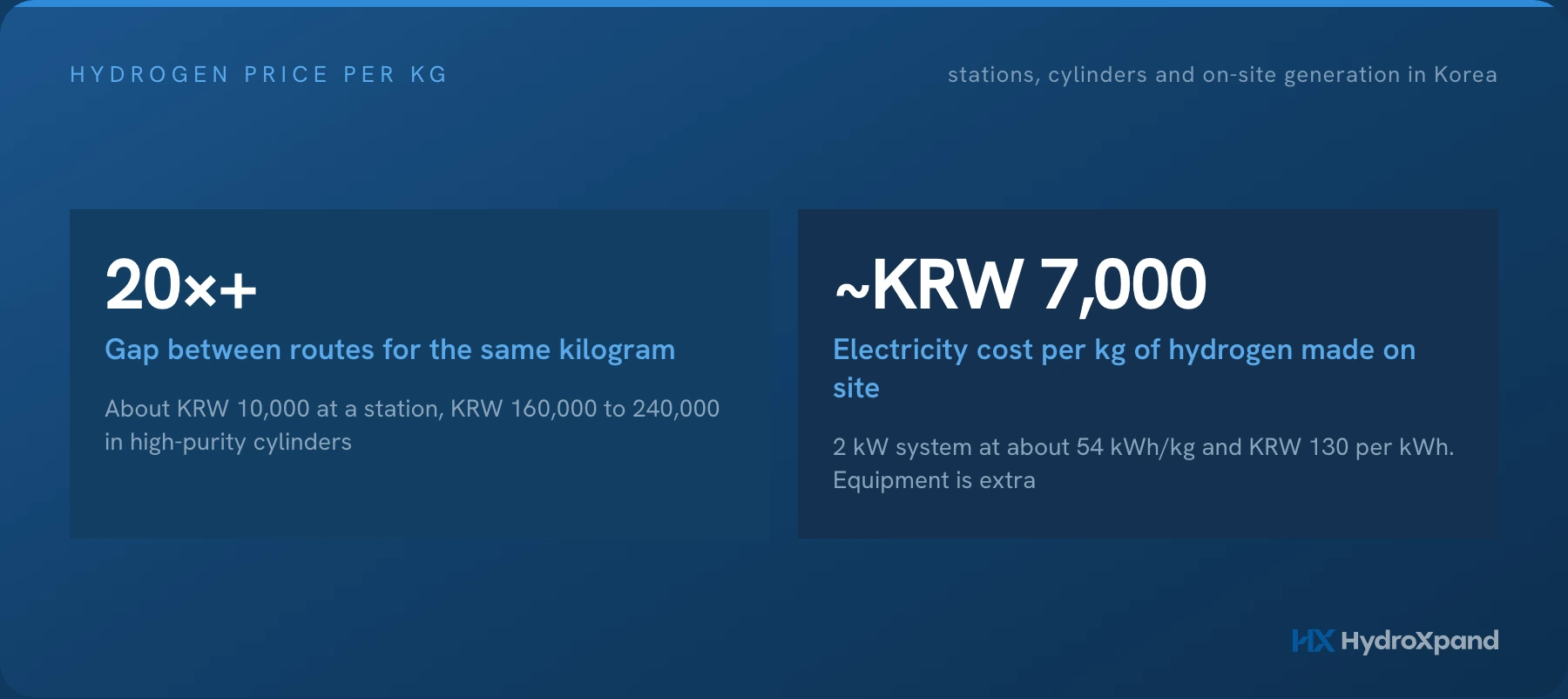
Search for the price of hydrogen and you get refuelling-station prices, cylinder prices and production costs mixed together. The price per kilogram differs by more than twentyfold between them because the supply method and form differ.
Here we put the per-kilogram price of three supply routes in Korea side by side: hydrogen bought at a refuelling station, hydrogen delivered in cylinders, and hydrogen made on site. We use public statistics and prices we have confirmed ourselves; the industrial-grade cylinder price is an assumption and is labelled as such. Prices are rounded to the nearest thousand won, with dollar figures at KRW 1,361 to the dollar.
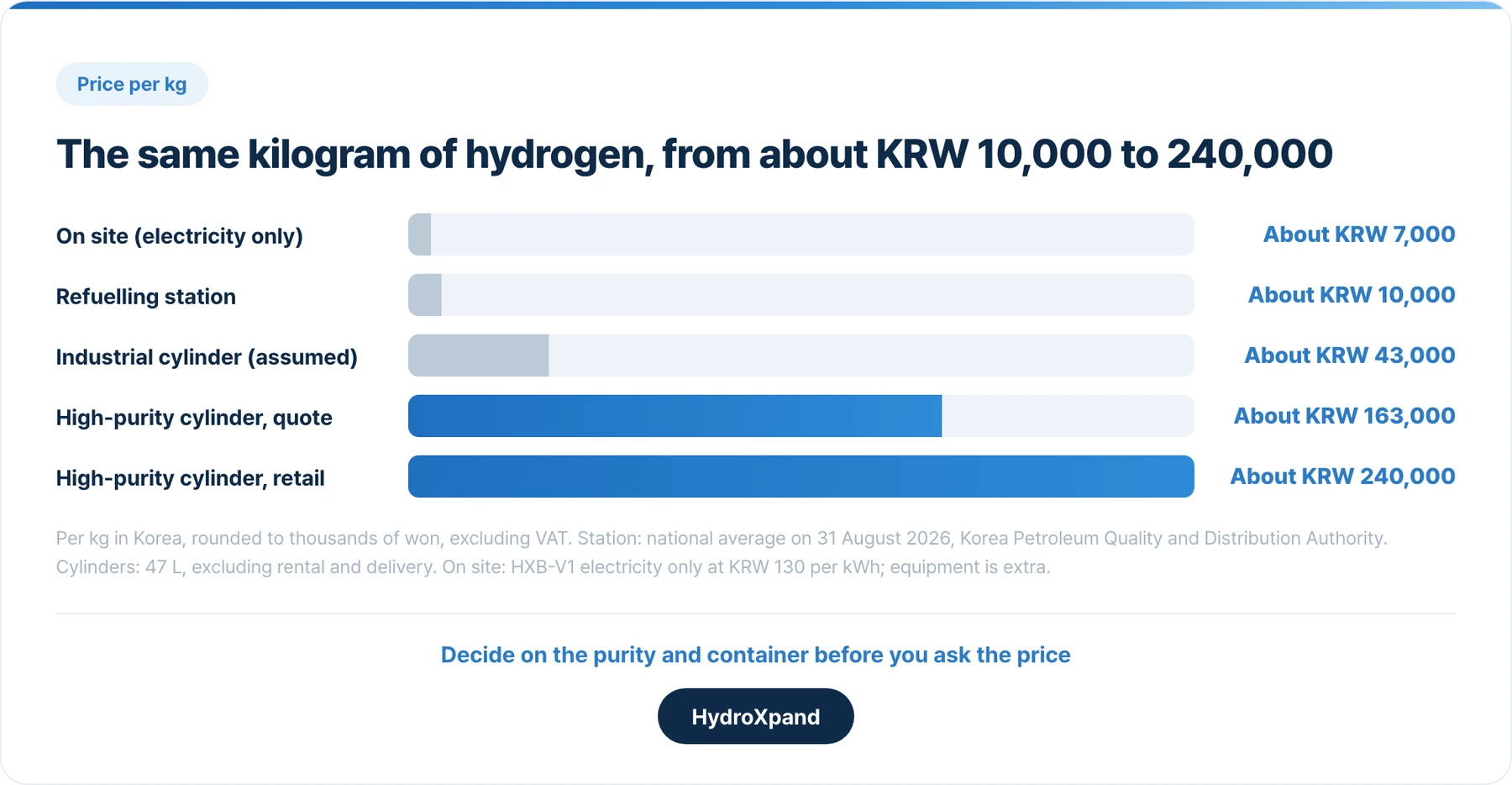
- At a refuelling station, about KRW 10,000 (around USD 7) per kg: the national average on 31 August 2026.
- In high-purity cylinders for laboratories and plants, KRW 160,000 to 240,000 (around USD 120 to 180) per kg: KRW 75,000 to 110,000 for a 47 L cylinder holding 0.46 kg.
- For industrial-grade cylinders we assume around KRW 43,000 per kg. This is an assumed figure; we do not yet have a primary source.
- When hydrogen is made on site, the electricity cost comes to about KRW 7,000 (around USD 5) per kg, for a 2 kW electrolyzer system at KRW 130 (about USD 0.10) per kWh. Equipment is extra.
- The price differences come from purity, the container and logistics.
Refuelling stations, about KRW 10,000 per kg
Hydrogen for fuel-cell vehicles is sold by the kilogram at refuelling stations. According to the hydrogen distribution information system run by the Korea Petroleum Quality and Distribution Authority, the national average price on 31 August 2026 was about KRW 10,000 per kg. Regional prices range from about KRW 9,000 to KRW 14,000, the highest being Jeju after a price cut in September.
A full tank of 5 to 6 kg therefore costs KRW 50,000 to 60,000. Station hydrogen is produced in bulk, transported by tube trailer and compressed at the station, so hundreds of kilograms move at a time and logistics costs per kilogram are low.
Station hydrogen is dispensed into vehicles only and cannot be used in a laboratory or plant.
Cylinders, KRW 160,000 to 240,000 per kg
Laboratories and plants are usually supplied in high-pressure cylinders, typically 47 L. The prices below were confirmed by quotation and by phone, except the industrial-grade figure, which is an assumption.
| Type | KRW per kg (rounded to thousands) | Source and date |
|---|---|---|
| Korea, high purity (99.999%) 47 L, quotation | 163,000 | Korean specialty-gas supplier quotation (April 2025), KRW 75,000 per cylinder |
| Korea, high purity (99.999%) 47 L, retail | 240,000 | Korean specialty-gas retailer, by phone (August 2024), KRW 110,000 per cylinder |
| Korea, industrial grade | 43,000 | Assumed figure; no primary source yet |
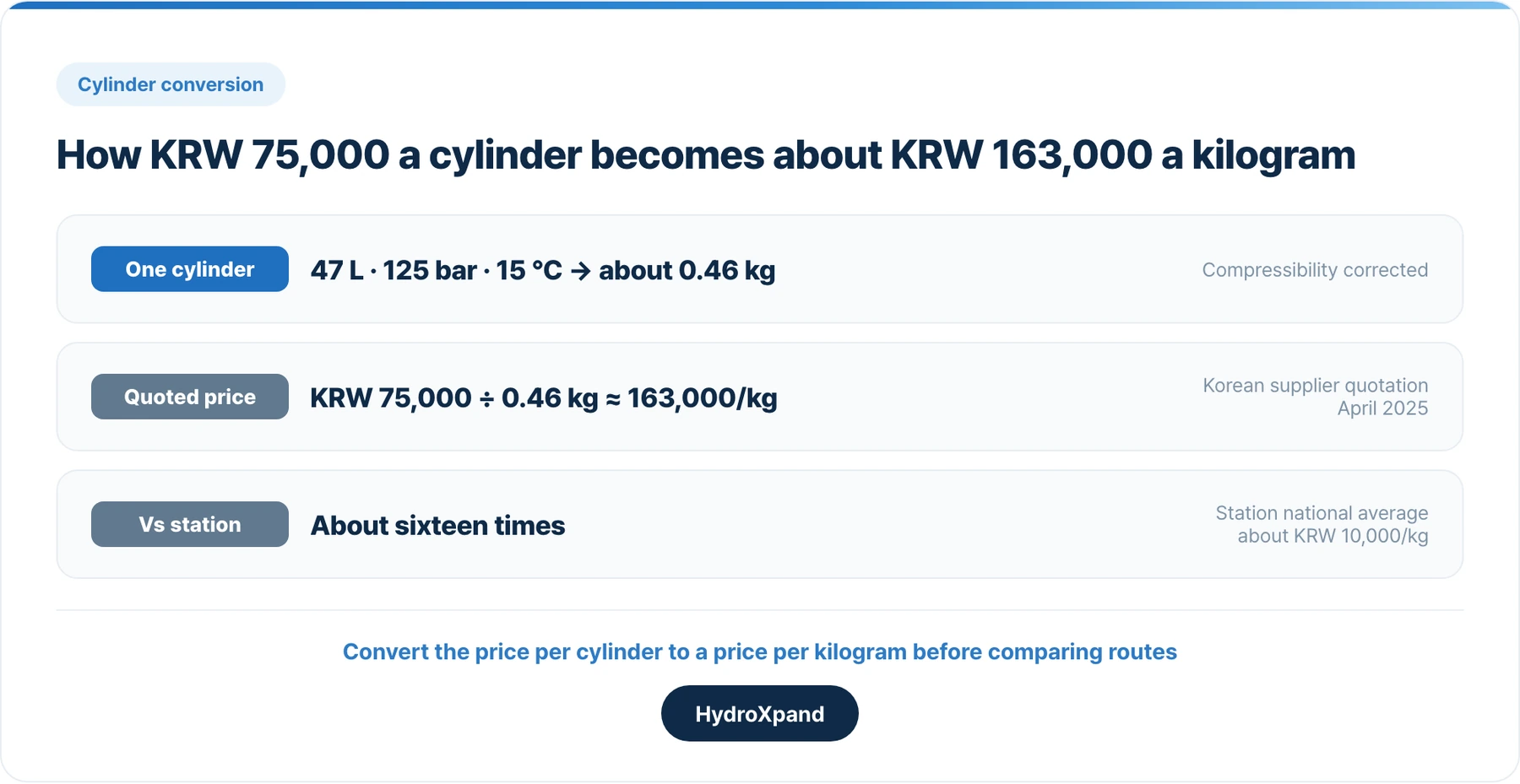
Prices exclude VAT, cylinder rental and delivery. A 47 L cylinder holds 0.46 kg of hydrogen (125 bar, 15 °C, corrected for compressibility), so KRW 75,000 per cylinder becomes about KRW 163,000 per kg.
That is about sixteen times the station price. Purity is higher at 99.999%, each cylinder adds filling, inspection and collection costs, and delivery is by the cylinder. For small quantities of high-purity gas, handling and logistics make up a larger share of the price than the gas itself.
- Hydrogen cylinder cost vs on-site generation→Five cylinder prices with sources, and a five-year comparison calculator.
Made on site, about KRW 7,000 per kg in electricity
The third route is to install an electrolyzer on site and produce hydrogen from water and electricity. Operating cost is then mostly electricity.
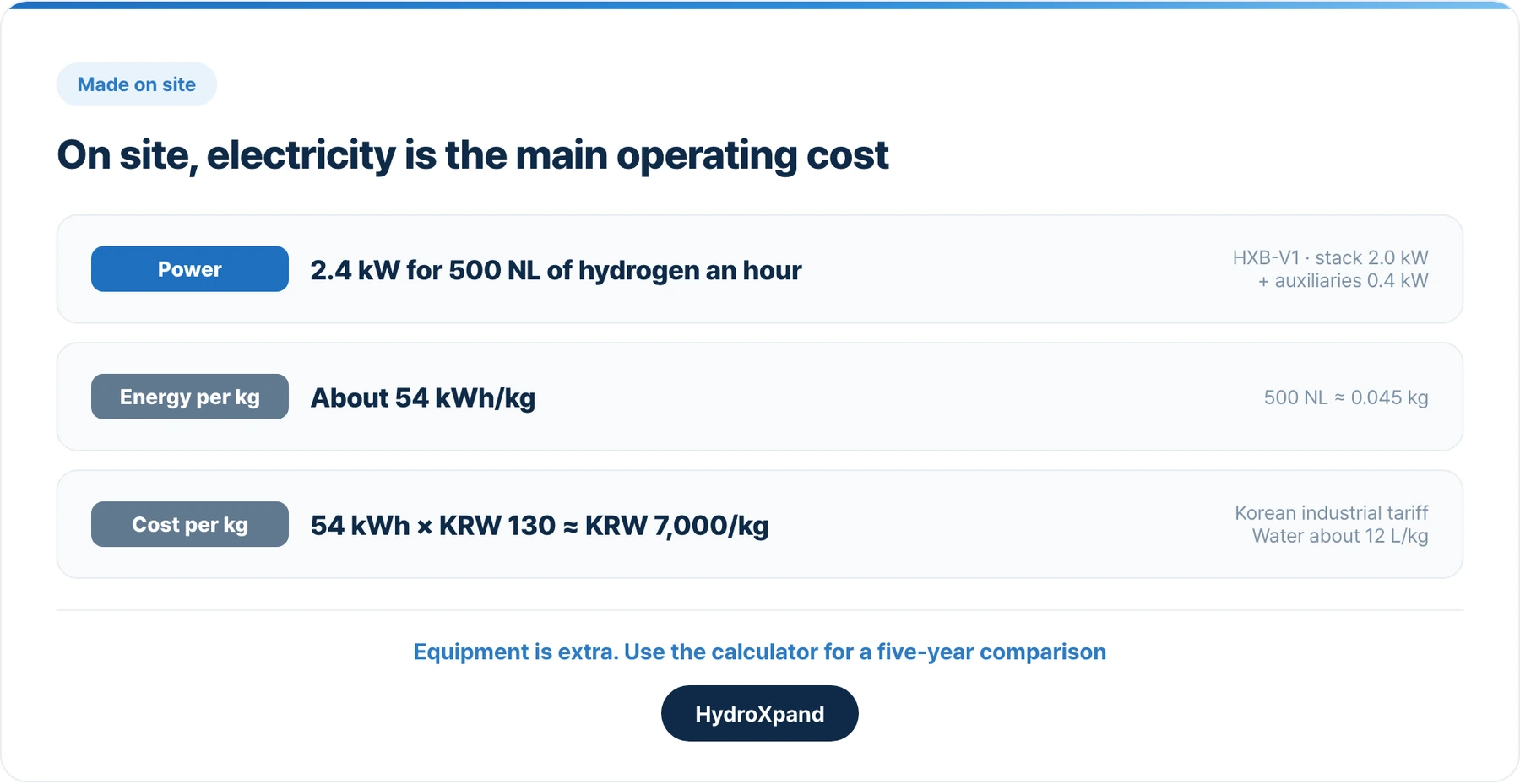
Our 2 kW system, the HXB-V1, draws 2.4 kW and produces 500 NL of hydrogen an hour. That corresponds to about 54 kWh of electricity per kg of hydrogen; at a Korean industrial tariff of KRW 130 per kWh it comes to about KRW 7,000 per kg. It uses about 12 L of water per kg.
The equipment is a separate cost. Over a five-year horizon, what you would have spent on cylinders minus the electricity cost is the most you could spend on equipment and still break even, before consumables and maintenance, which lower that figure. Enter your consumption and your current cylinder price in the calculator to see that figure. We quote our equipment prices individually, so they are not in this article.
On-site generation also has requirements. Hydrogen from the unit is 98 to 99% pure, so a dryer is needed for 99.999%. Power, water, ventilation and vent piping are required, as is someone responsible for operating the unit.
Why the gap is so wide
| Route | Per kg | Purity | Who uses it |
|---|---|---|---|
| Refuelling station | About KRW 10,000 | Vehicle grade (ISO 14687) | Fuel-cell vehicles |
| Cylinder, high purity | KRW 160,000 to 240,000 | 99.999% | Laboratories, analysis, small-scale processes |
| Cylinder, industrial | Around KRW 43,000 | Industrial grade | Heat treatment, welding |
| On-site generation (electricity only) | About KRW 7,000 (equipment and consumables extra) | 98 to 99% (99.999% with a dryer) | Sites using several cylinders a month |
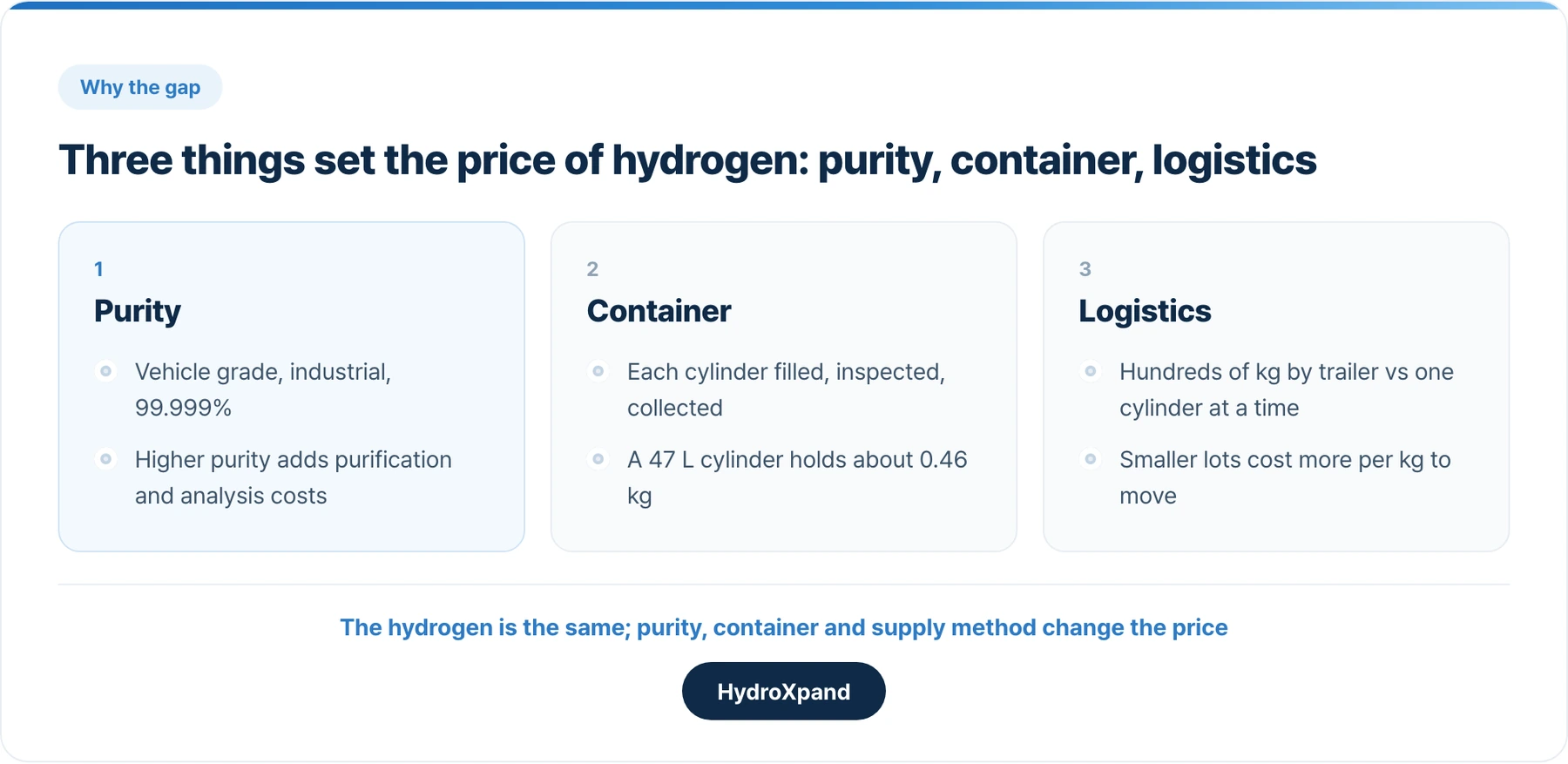
The hydrogen is the same, but the required purity, container and supply method change the price. When comparing prices, first define the purity, supply form and consumption you need.
Which route fits your site
- For vehicles, a refuelling station.
- If you use one or two cylinders a month or fewer, cylinders are the better fit; the consumption does not justify equipment.
- If you take several cylinders every month and plan your work around deliveries, it is worth calculating the cost of on-site generation. Enter your consumption and current price in the calculator to see the five-year cost and how much you could spend on equipment.
- Hydrogen cylinder cost vs on-site generation→The five-year comparison calculator.
- Reading hydrogen purity→What purity figures mean, and when you need a dryer.
Frequently asked questions
How much does 1 kg of hydrogen cost?
It depends on how it is delivered. In Korea, about KRW 10,000 at a refuelling station (national average, 31 August 2026), KRW 160,000 to 240,000 in high-purity cylinders, and about KRW 7,000 in electricity when made on site, plus the equipment.
Why are cylinders about sixteen times the station price?
Purity is 99.999%, and each cylinder is filled, inspected, collected and delivered individually. For small quantities of high-purity gas, handling and logistics make up a larger share of the price than the gas itself.
Is KRW 7,000 per kg the whole cost of making hydrogen on site?
No. About KRW 7,000 per kg covers electricity only. Equipment and MEA replacement are extra, and so is a dryer if 99.999% is needed. The calculator compares the total with cylinder spending over five years.
What does green hydrogen cost?
This article covers the price of hydrogen you buy and use. The production cost of green hydrogen varies widely with electricity prices and utilisation, so we do not give a single figure. What we have confirmed is about KRW 7,000 per kg in electricity when it is made with our equipment.
Looking at AEM for a specific application?