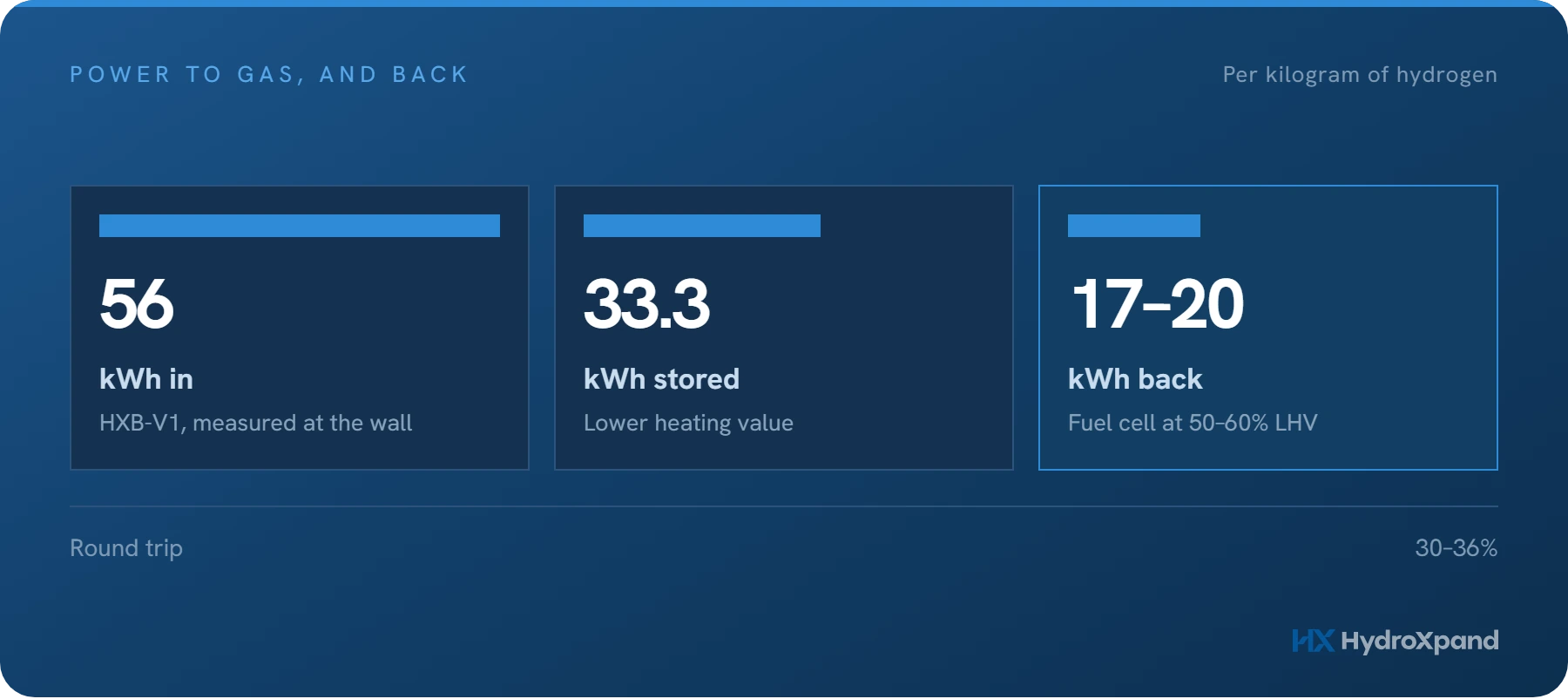
The outward leg costs about 56 kWh per kilogram on our own measured system. The return leg gives back roughly a third of what went in, which is why the uses worth building for are the ones that never turn the hydrogen back into electricity.
Solar and wind produce when they produce. When output runs past demand, the surplus is curtailed or it is stored.
Power-to-gas is one answer. Run an electrolyzer on the surplus, keep the hydrogen, and use it later.
It gets described as a battery with a bigger tank. It is not, and the reason is what comes back out.
Send electricity in and take electricity out, and roughly a third of it returns. That number decides everything else on this page.
What power-to-gas is
The name covers four steps, and only the first is compulsory.
Electricity splits water into hydrogen and oxygen. That is the step that turns power into gas, and everything after it is a choice.
The hydrogen can be reacted with carbon dioxide to make methane, which existing gas networks accept without modification.
It is then stored, as compressed gas, in a tank, in a salt cavern, or in the gas grid itself.
Finally it is used: burned, converted in a fuel cell, injected into the network, or delivered to a plant that needs hydrogen as a raw material.
The last of those options is the one that changes the arithmetic, and it is the one discussed least.
The outward leg, measured
The first conversion is the one we can put our own numbers on.
Our HXS-2 stack reaches 90.0% efficiency on a higher heating value basis at beginning of life, measured at 50 A in 0.1 M KOH at 50 °C and ambient pressure. That is about 44 kWh per kilogram at the stack.
The HXB-V1 system built around that stack draws about 56 kWh per kilogram at the wall. The difference runs the rectifier, the pump, the separators and the dryer.
A kilogram holds 33.3 kWh of usable energy. So 56 kWh goes in and 33.3 kWh is stored: about 59% of the electricity survives the outward leg.
Larger systems use less per kilogram than a 2 kW one. The shape of the arithmetic does not change with size.
SourceU.S. DOE: Technical Targets for Onboard Hydrogen Storage (lower heating value 33.3 kWh/kg)
The return leg is where it goes
A fuel cell turns hydrogen back into electricity, and published designs return somewhere around half to sixty percent of the lower heating value.
Take the lower end and the upper end of that range and run our own numbers through it. Of the 56 kWh that went in, 17 to 20 kWh comes back.
That is a round trip of 30 to 36 percent. Use the stack figure instead, which is the same as pretending the balance of plant is free, and the ceiling moves to 37 to 44 percent.
A turbine burning hydrogen lands in a similar band, for a different reason: it is a heat engine, and heat engines have their own ceiling.
A lithium battery gives back most of what it is handed. Over hours, that comparison is not close, and no amount of engineering will make it close.
Every kilowatt-hour that comes back as electricity has paid for two conversions. Two thirds of it does not come back at all.
SourcesIEA Global Hydrogen Review 2024: electrolysis consumes 50 to 55 kWh per kg H2 · U.S. DOE: Fuel Cells for Stationary Power Applications (electrical efficiency up to 60%)
Making methane costs another sixth
Methanation is the optional second step. Carbon dioxide plus four hydrogen molecules gives one methane molecule and two of water.
The reaction gives off heat, which is the clue: energy that was in the hydrogen leaves as warmth rather than staying in the gas.
Count it in usable energy. Four hydrogen molecules carry 967 kJ; the methane they become carries 802 kJ. About 83% survives.
What that sixth buys is compatibility. Methane travels in the pipes, storage and burners that already exist, and hydrogen does not, above a low blending limit.
It also needs a carbon dioxide supply, which has to come from somewhere that is not a fossil flue gas if the exercise is to have a point.
A blend by volume is not a blend by energy
In power generation the usual first step is co-firing: mix hydrogen into the natural gas a turbine already burns.
Blends are quoted by volume, and volume flatters hydrogen. A cubic metre of hydrogen carries 10.8 MJ; a cubic metre of methane carries 35.8 MJ.
Hydrogen holds about 30% of the energy of methane for the same volume. So the energy share, and the carbon saving with it, is far below the headline percentage.
| Hydrogen by volume | Share of the energy | CO₂ reduction |
|---|---|---|
| 10% | 3.2% | ≈ 3% |
| 20% | 7.0% | ≈ 7% |
| 30% | 11.4% | ≈ 11% |
| 50% | 23.1% | ≈ 23% |
| 100% | 100% | No CO₂NOx still forms |
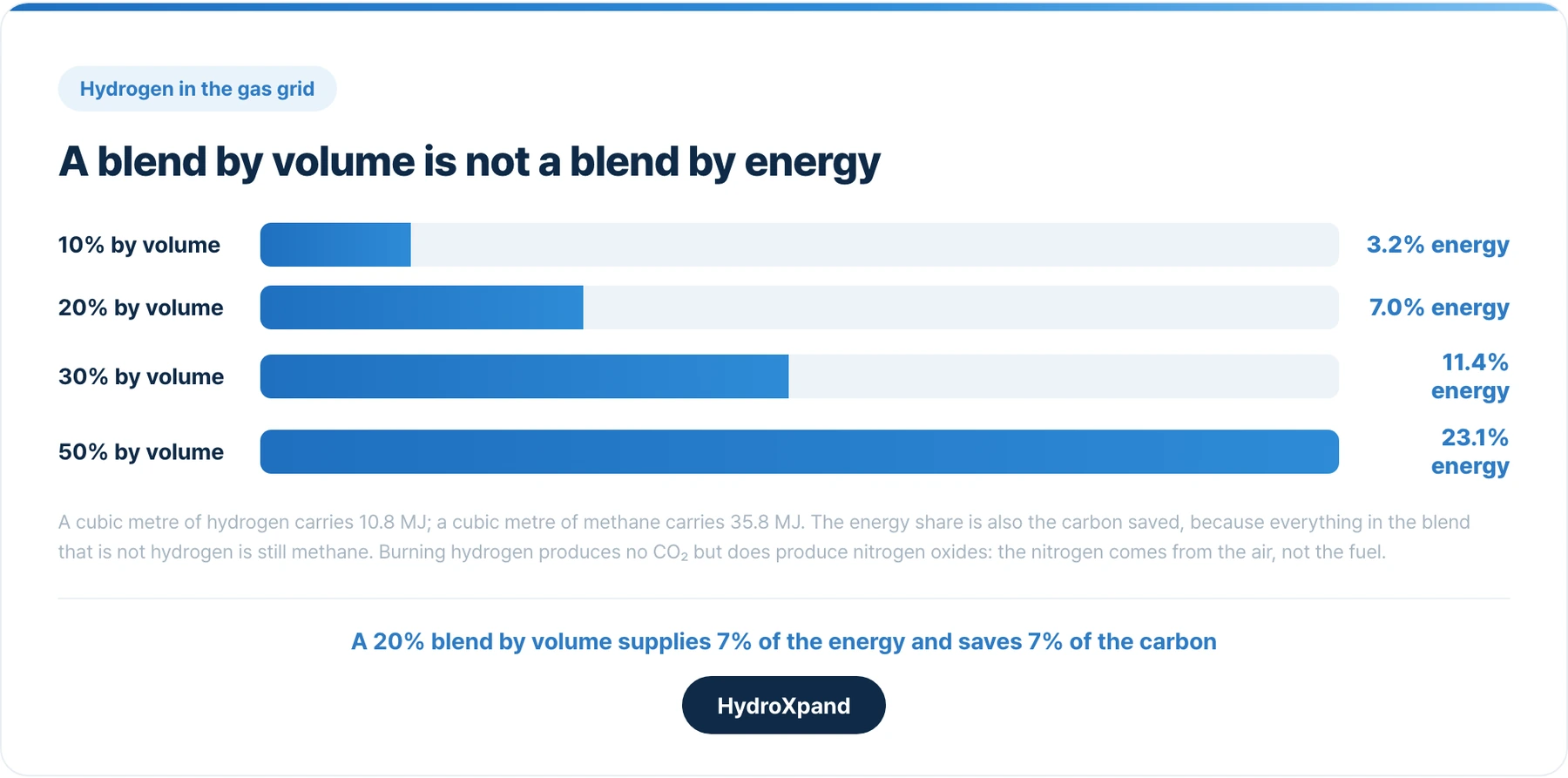
Burning hydrogen produces no carbon dioxide, but it still produces nitrogen oxides, because the nitrogen comes from the air and the flame is hot.
Fuel cells avoid that by not burning anything, which is why they are the usual choice for distributed generation rather than for grid-scale plant.
Ammonia co-firing is the same manoeuvre one carrier further out. Cracking ammonia back into hydrogen costs 4.2 kWh per kilogram recovered, so some plans burn the ammonia itself instead.
Where the arithmetic starts working
Round-trip efficiency is the wrong single number, because it assumes the hydrogen has to come back as electricity.
Two things make hydrogen storage worth the loss. The first is duration.
A battery holds its energy in the same hardware that delivers it, so more hours means more cells. Hydrogen separates the two: the stack sets the rate, the tank or the cavern sets the quantity.
Enlarging the tank does not enlarge the stack. That is why the comparison changes character somewhere between a day and a season.
The second is that most hydrogen never becomes electricity again. Fertiliser, methanol, refining and steel take it as a raw material, and nothing else can do that job.
There is also an operating condition that decides whether this works at all. An electrolyzer tied to a solar profile spends many of its hours at low load.
We measured what that does. Across 49 points from 0 to 6 barg, our HXS-2 stack shows gas crossover rising as load falls, which makes the minimum load, not the voltage, the design variable.
- Decide first whether the hydrogen has to return as electricity. If it does not, the round-trip figure is not your number.
- Match the storage duration to the technology. Hours belong to batteries; weeks and seasons are where the tank stops being the expensive part.
- If methane is the goal, count the extra sixth, and find the carbon dioxide before anything else.
- Read blend percentages as energy, not volume. A fifth by volume is about a fourteenth of the fuel.
- Check the electrolyzer's minimum load against the generation profile it will follow, at the pressure you actually need.
- What hydrogen is actually used for→The uses that never turn it back into electricity, and how large they are.
- Fuel cell or electrolyzer→The same stack run in both directions, and why one machine rarely does both well.
- Storing hydrogen→Compressed, liquid, LOHC and ammonia, and what each charges to store a kilogram.
- Pressurised operation, measured→The 49-point crossover dataset, and why minimum load bounds the operating range.
- HXS-2 · 2 kW stack→The stack the 90.0% HHV and 44 kWh/kg figures belong to.
- Datasheets→Six products. No form.
- Running an electrolyzer on solar→What a solar profile does to the stack, and where the floor sits.
Frequently asked questions
What is power-to-gas?
Power-to-gas turns surplus electricity into hydrogen by electrolysis, and optionally into methane, so that energy can be stored or moved as a gas.
How much electricity comes back if hydrogen is converted back to power?
Roughly a third. The HXB-V1 system draws about 56 kWh per kg, the hydrogen holds 33.3 kWh on a lower heating value basis, and a fuel cell returns about 50 to 60% of that.
When is power-to-gas worth building?
When the hydrogen is used as hydrogen, in industry or as a feedstock, rather than turned back into electricity. Uses that never reverse the conversion keep the losses to one leg.
Sources
- DOE Technical Targets for Onboard Hydrogen Storage for Light-Duty Vehicles — U.S. Department of Energy
- Global Hydrogen Review 2024 — International Energy Agency, 2024
- Fuel Cells for Stationary Power Applications — U.S. Department of Energy, Fuel Cell Technologies Office
Looking at AEM for a specific application?