The question buyers ask first is which electrolysis technology will win. The market is answering a different question: which technology fits which application. Alkaline holds large steady-power industry, PEM holds the high-performance niche and is capped by iridium and PFAS rules, and AEM is the third route with three things still to prove. This article maps the territories as they stand in 2026 and gives the four questions that narrow the choice.
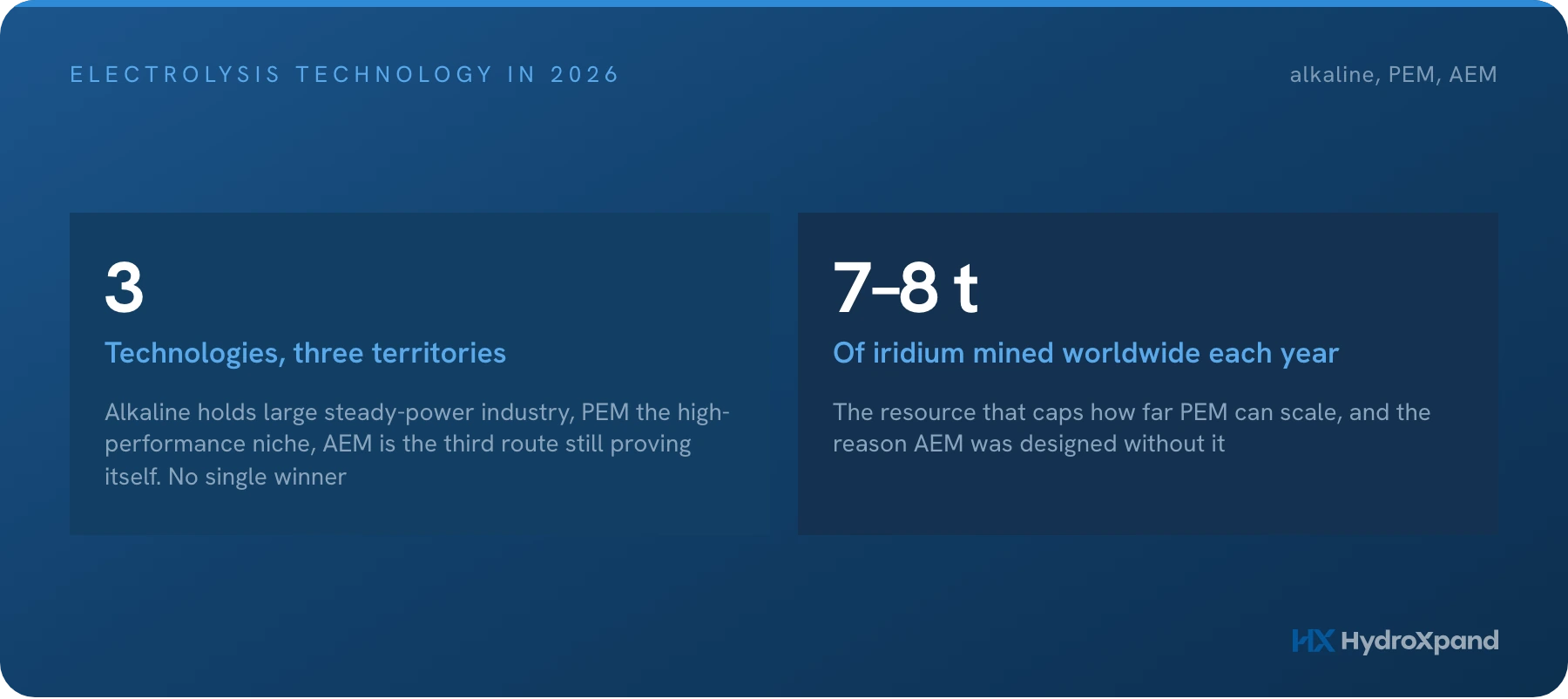
Anyone evaluating an electrolyzer runs into the same first question: of alkaline, PEM and AEM, which one will finally take the market? It sounds like the obvious thing to ask. Seen from a company that builds and delivers electrolyzers, the question the market is actually answering is different. It is not choosing a single winner. Each technology is securing a different set of applications and conditions, and where those boundaries lie in 2026 is the information that matters.
This article sets out where the three technologies now stand, which ground each holds and why, what limits each one, and the four questions that narrow the choice for a specific project. It draws on HydroXpand's experience supplying electrodes, stacks and systems to research institutes and industrial customers in twelve countries since the company was founded in December 2023.
The map in 2026
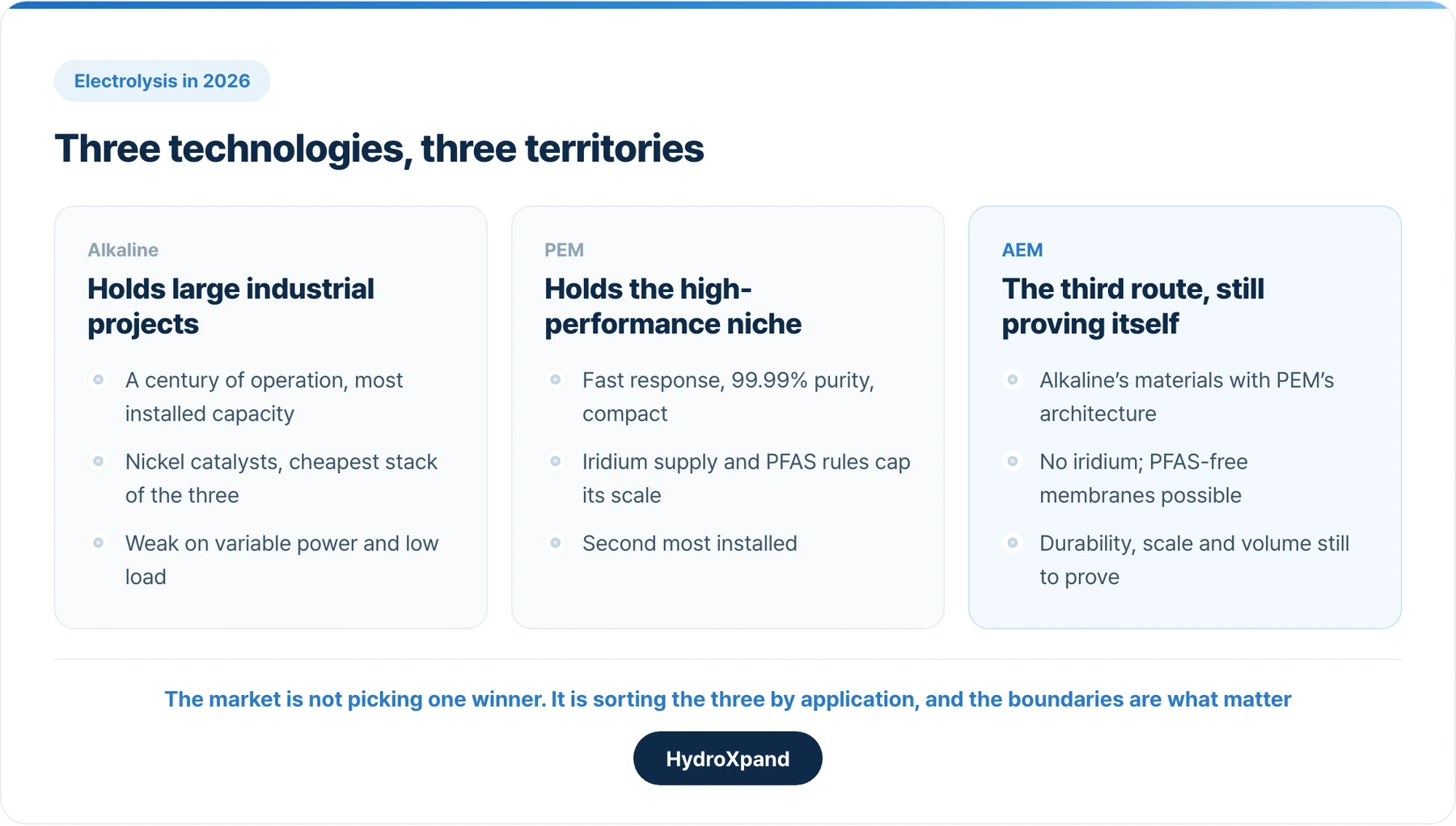
The global electrolysis market is settling into a structure in which the three technologies coexist, each holding its own ground. Alkaline keeps the lead in large industrial projects. PEM keeps the high-performance segment despite its materials risk. AEM is passing through the stage of proving itself as the third alternative.
In a line each: alkaline is the workhorse for large industrial and steady-power projects, on the strength of a low-cost supply chain led by China and durability accumulated over a century of operation. PEM is first choice where high purity and fast response are required, with the iridium bottleneck and PFAS regulation as structural limits on large-scale expansion. AEM is the third-generation technology that pursues alkaline's economics and PEM's performance at once, with membrane durability and volume manufacturing as the tasks of the late 2020s. They do not replace one another; they are options optimised for different conditions, and for a buyer the useful question is which one fits the application, not which one wins.
Alkaline: why the oldest technology still leads
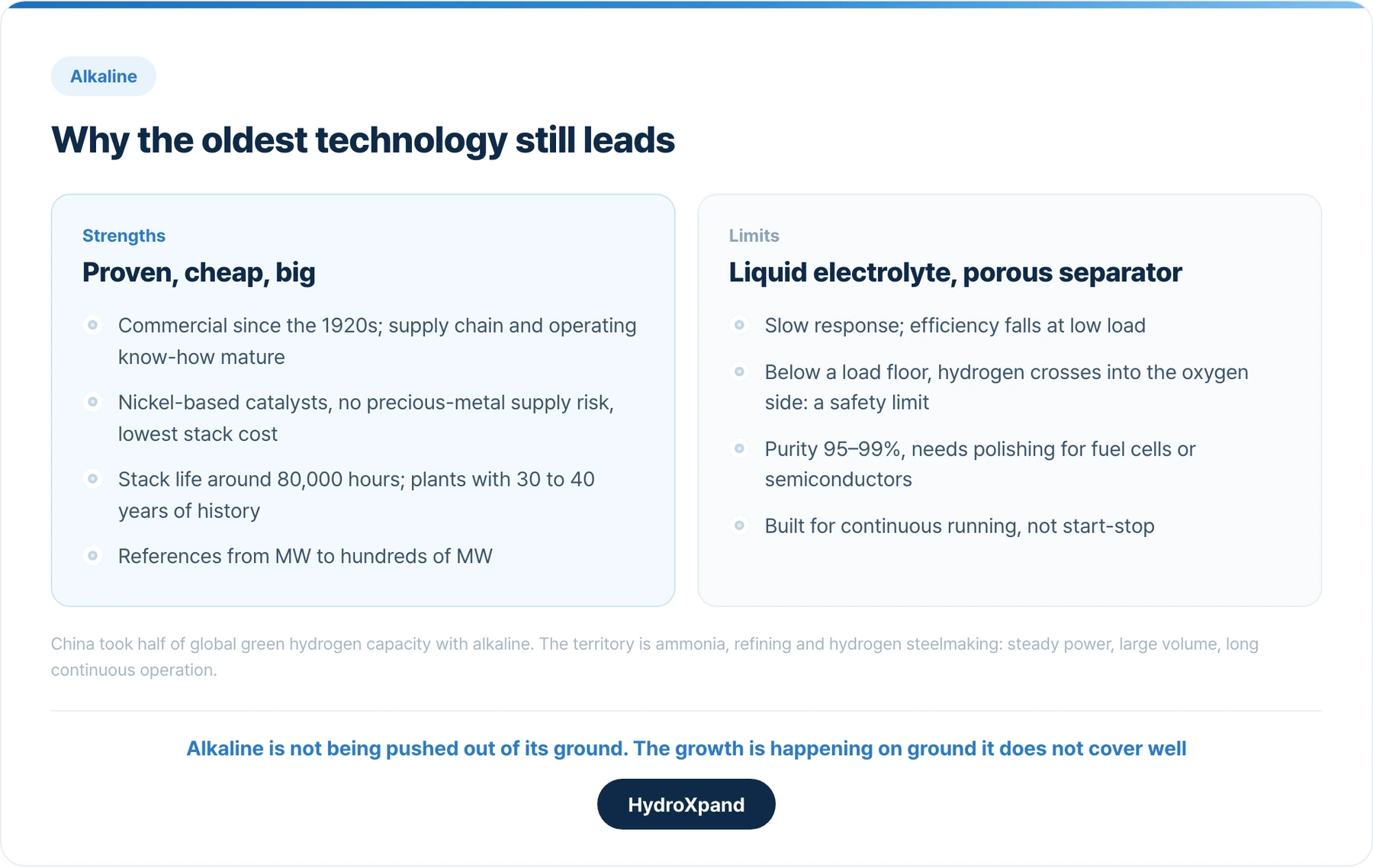
Alkaline water electrolysis has been in commercial use since the 1920s. It still accounts for most of the electrolysis capacity installed in the world, and it was the technology China chose while building up half of global green hydrogen production capacity.
It has survived a century not because it is old but because surviving that long means everything that can be verified has been. The supply chain and the operating know-how are mature. Nickel-based catalysts free it from precious-metal supply risk and make its stack the cheapest of the three. Stack life is around 80,000 hours, more than ten years, and there are plants with 30 to 40 years of operating history. References run from MW to hundreds of MW, which is the level of assurance a large project owner demands. For sites that run 24 hours a day on predictable power, ammonia synthesis, refining, hydrogen-based steelmaking, alkaline remains the first choice.
Its limits come from the liquid electrolyte and the porous separator. Reaction rates are slow, efficiency falls steeply at low load, and below a certain load hydrogen crosses into the oxygen side, which sets a safety floor on operation. That makes it structurally unsuited to direct coupling with solar and wind. Its hydrogen is 95 to 99% pure, so fuel cell or semiconductor use needs a separate purification step, and it is built for continuous running rather than fast start and stop. As renewable-linked projects have multiplied through the 2020s, the ground alkaline does not cover well has grown. It is not being pushed off its own ground; the growth is happening where other technologies have the advantage.
China now accounts for 65% of global installed capacity and capacity that has reached a final investment decision.
SourcesIEA Global Hydrogen Review 2025, chapter 3: alkaline 60% of installed capacity, China 65% of installed and FID capacity · IRENA, Green Hydrogen Cost Reduction (2020): alkaline electrolysers in industrial use since before 1900, proven lifetimes over 30 years · U.S. DOE Technical Targets for Liquid Alkaline Electrolysis: stack lifetime 60,000 h (2022 status), 80,000 h (2026 target)
PEM: ahead on performance, boxed in by materials
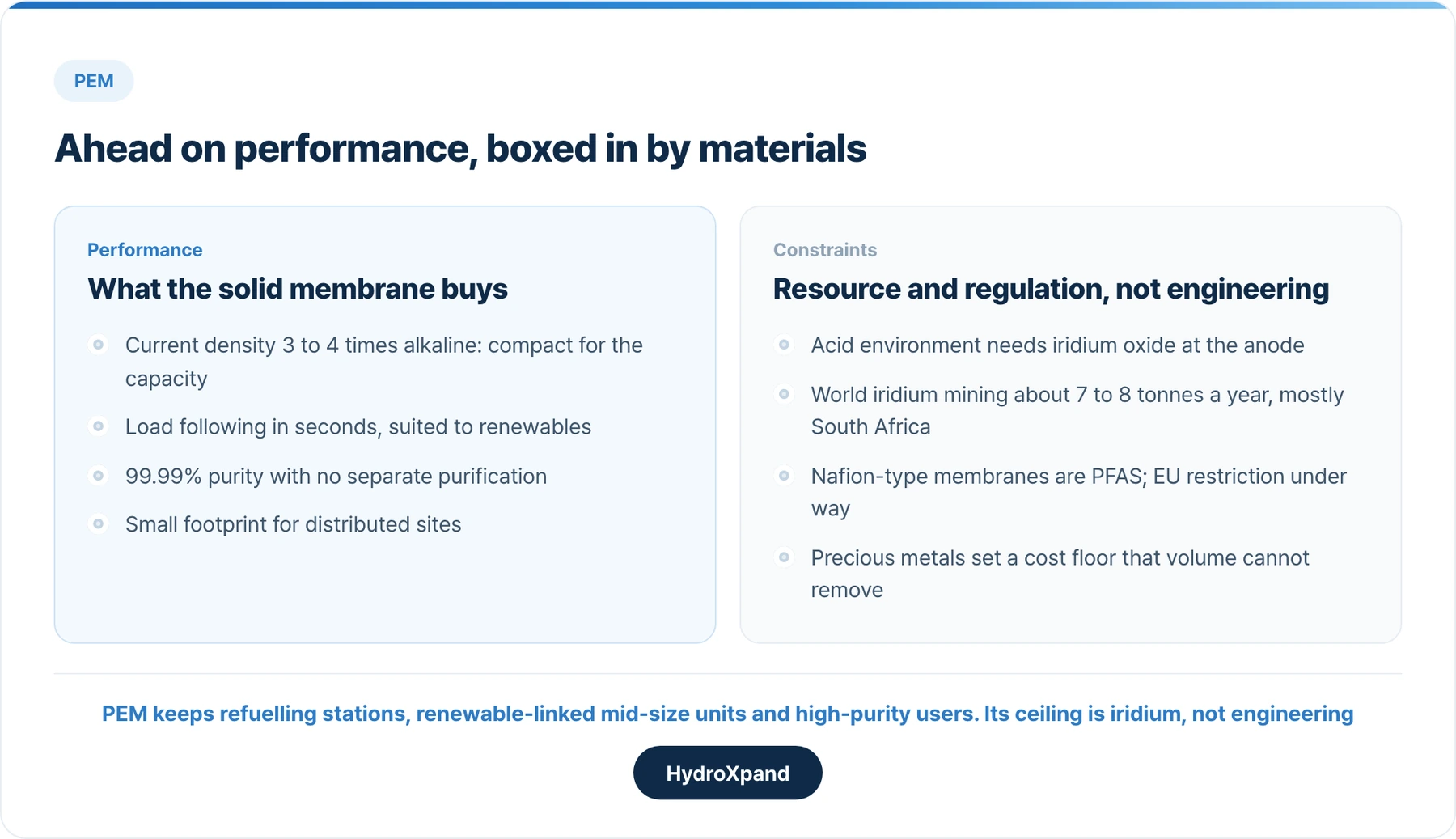
PEM electrolysis grew out of fuel cell technology and has been commercial since the late 1990s; by 2026 it is the second most installed technology. Its case for renewable-linked hydrogen has always been performance. A solid polymer membrane removes several of the structural limits of a liquid electrolyte: current density three to four times that of alkaline, so the equipment is far more compact for the same capacity; load following in seconds, matched to variable renewable power; hydrogen at 99.99% purity or better with no separate purification; and a footprint small enough for distributed sites. That is why PEM spread quickly into refuelling stations, renewable-linked small and mid-size systems and high-purity industrial supply.
The constraint PEM has run into since the mid-2020s is not engineering but materials. Because it operates in an acidic environment it needs acid-resistant precious-metal catalysts, and in particular iridium oxide at the anode. Iridium is among the rarest metals on Earth: world mining is about 7 to 8 tonnes a year, most of it from South Africa. The larger PEM grows, the faster iridium demand rises, and whether supply can follow has been doubted for years. Reducing catalyst loading is being researched, but the acidic environment itself rules out non-precious catalysts, and the precious metals set a cost floor that volume manufacturing cannot remove.
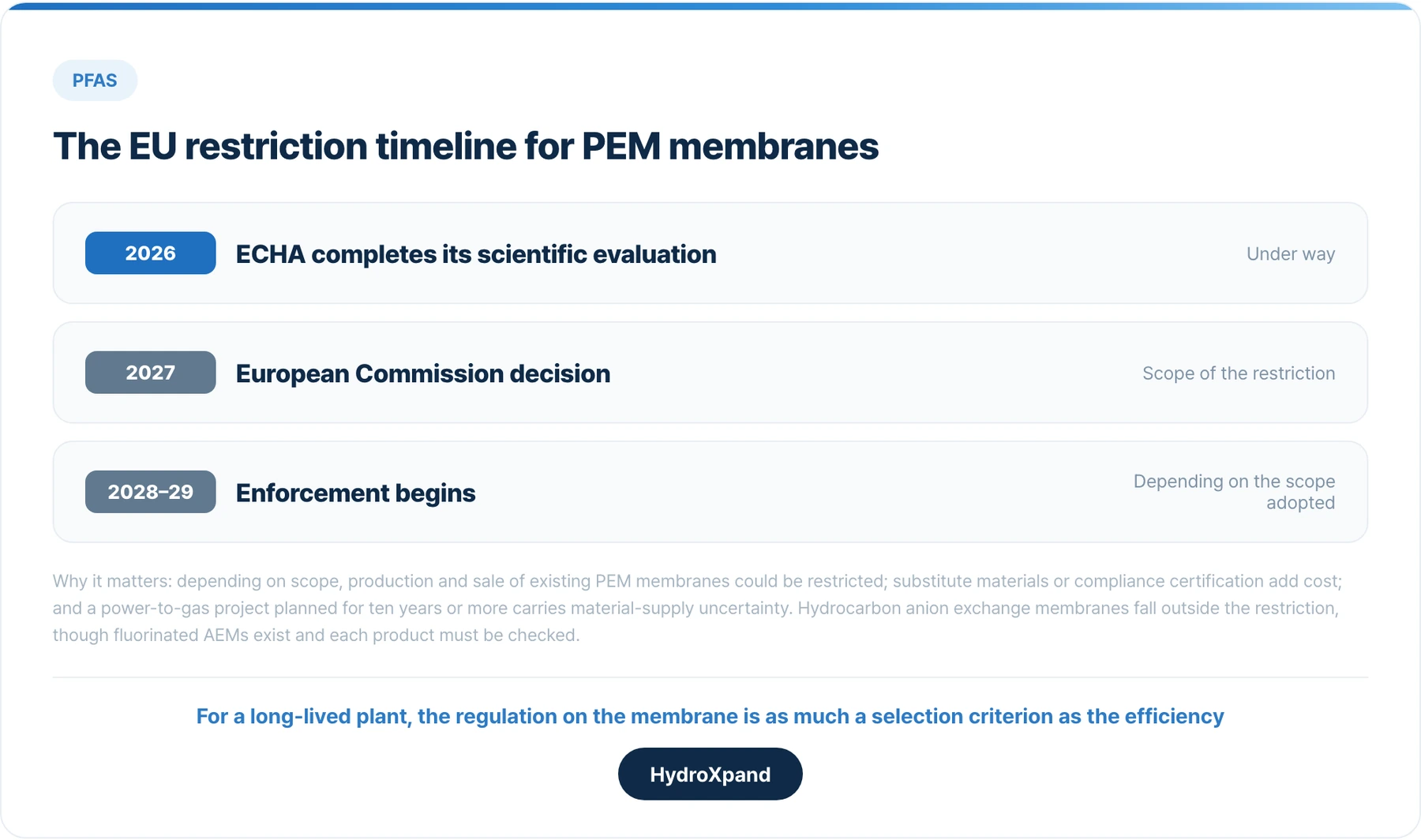
The second constraint is the membrane. Nafion, the reference material, is a per- and polyfluoroalkyl substance, and the EU is advancing a strengthened PFAS restriction: ECHA's scientific evaluation is due in 2026, a Commission decision in 2027, and enforcement in 2028 to 2029. Depending on the scope adopted, production and sale of existing PEM membranes could be limited, substitute materials or compliance certification will add cost, and a power-to-gas project planned for ten years or more carries material-supply uncertainty it cannot price.
None of this pushes PEM out of the market. Fast response, high purity and compactness remain unmatched, and the materials and manufacturing base it shares with fuel cells sustains its ecosystem. The IEA expects PEM cost to converge with alkaline by 2030, though given the iridium structure many doubt that forecast. PEM keeps on-site production at refuelling stations, renewable-linked small and mid-size units, and high-purity supply for semiconductors and chemicals.
Operates at higher current densities compared to alkaline, of about 2.0-2.3 A/cm2, though more efficient at 1.6 A/cm2 (with 1 MW as reference).
SourcesIRENA, Green Hydrogen Cost Reduction (2020): PEM current density · Polymers 15(9):2144 (2023), Table 1: gas purity by technology · International Platinum Group Metals Association, White Paper on Iridium (2022)
For any plant with a long operating horizon, the regulatory status of the membrane material has become as much a selection criterion as efficiency.
AEM: the third route, and what it has to prove
AEM electrolysis is the third-generation technology that appeared between alkaline and PEM. Structurally it uses a solid polymer membrane like PEM, so it is compact and fast-responding; chemically it runs in alkaline conditions, so it needs no iridium and uses nickel-iron catalysts at the anode. The design is not an incremental improvement but an attempt to route around the structural limits of both predecessors at once: alkaline's low-cost materials with PEM's performance. In renewable-linked mid-size projects it avoids PEM's iridium risk and alkaline's response limit together, which is why it has drawn attention over the last few years.
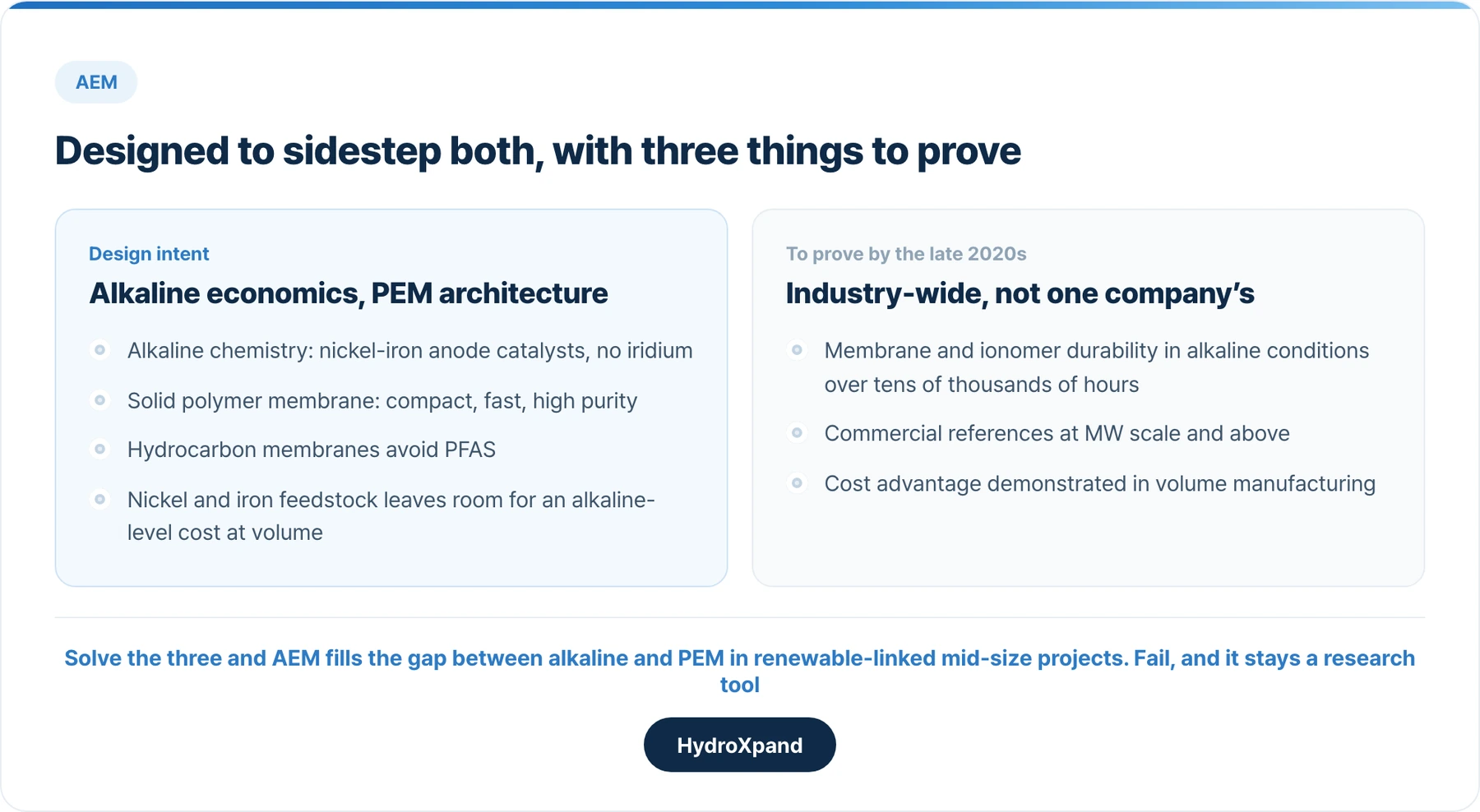
The design intent comes down to four points. An iridium-free catalyst structure, because the alkaline environment allows nickel-iron anodes. A solid-membrane architecture, with the compactness, fast response and high purity that implies. Freedom from PFAS risk where hydrocarbon anion exchange membranes are used, though fluorinated AEMs also exist and each product has to be checked. And room to improve the cost floor, because nickel and iron feedstock leaves a structural path to alkaline-level cost at volume.
In 2026 AEM is still at the commercialisation stage, and its theoretical appeal has to be proved in the market on three counts. These are the industry's shared tasks, not any one company's. Long-term durability of the membrane and ionomer in alkaline conditions is the central bottleneck, and data showing performance held over tens of thousands of hours is still thin. Commercial references at MW scale and above are very few, against the GW-scale record alkaline and PEM already hold. And the claim of reaching alkaline-level cost has limited proof from large-volume manufacturing. Solve the three and AEM becomes the option that fills the gap between alkaline and PEM in renewable-linked mid-size projects. Fail, and it may stay in research and small special-purpose use. The next few years decide which.
The market is not picking one winner. It is sorting the three technologies by application, and the boundaries are what matter.
The 2030 map by application
Seen as a comparison of technologies, the structure of three coexisting territories is likely to hold through 2030. The three are chosen for different applications for different reasons: alkaline on proof and price, PEM on performance and response, AEM on the combination of the two. The 2030 map of electrolysis will most likely be drawn not by one dominant technology but by application.
| Application | 2026 to 2030 | Why |
|---|---|---|
| Large industrial, steady power (ammonia, refining, steel) | Alkaline | Proven at scale, lowest stack cost, continuous operation |
| Refuelling stations, high-purity users | PEM | 99.99% purity without purification, compact, fast |
| Renewable-linked small and mid-size | PEM now, AEM if it proves out | Fast response needed; iridium and PFAS push towards AEM |
| Research and pilot | AEM and PEM | Small scale, component-level access, material development |
What HydroXpand has seen in the field
Since it was founded in December 2023, HydroXpand has supplied electrodes, stacks and systems to research institutes and industrial customers in twelve countries. The questions that come up most when a customer is actually deciding are whether the technology will run stably under their process conditions, and whether there is a verified reference at their capacity. This article's point of view comes from those conversations.
- The market moves application by application. The decision criterion is the combination of conditions that fits a specific use, not a technology's general superiority.
- Trust is built on references. Customers ask for verified operation at a particular capacity band, and that requirement is what forms the entry barrier for each technology.
- A technology choice is a three-to-five-year decision. With equipment expected to last ten years or more, supply-chain and regulatory stability matter more than short-term price.
Four questions that narrow the choice
If you have read this far you are probably evaluating a project. Four criteria make the conversation with suppliers efficient.
| Question | The split it makes |
|---|---|
| Power: steady 24-hour supply, or variable renewable power? | The first divide between alkaline and PEM or AEM |
| Scale: MW-class and above, or hundreds of kW and below? | Large leans alkaline; mid-size leans PEM or AEM |
| Purity: is 95% enough, or is 99.99% required? | High purity narrows the field to PEM and AEM |
| Horizon: a short demonstration, or ten years of operation? | The longer the project, the more supply chain and regulation decide |
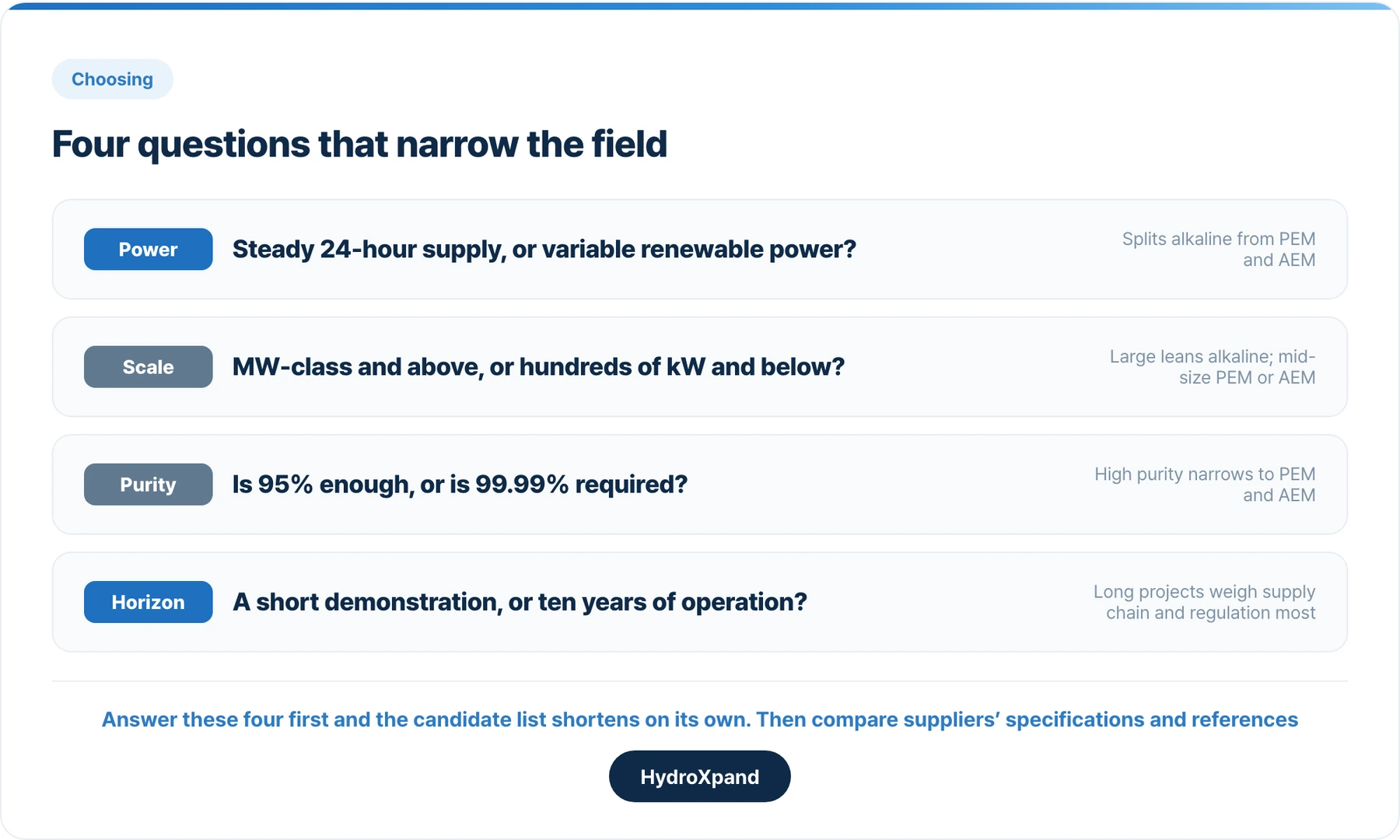
Settle these four and the candidate list shortens on its own; then the comparison of suppliers' specifications and references goes far faster. HydroXpand's AEM electrodes, stacks and systems, without iridium or PFAS membranes, are sold today from 2 kW research and pilot units to a 30 kW stack.
- AEM electrolysis: technology and measured data→How AEM electrolysis works, AEM vs PEM vs alkaline, and the measured data behind our stacks.
- What is an electrolyzer stack→What a stack is made of, how cell count scales output, and what decides performance.
- Alkaline, PEM or AEM: which to choose→The three technologies compared on principle and structure.
- Electrolyzer efficiency: how to read the numbers→Efficiency, durability and cost figures, and what basis each is quoted on.
- Is AEM proven?→What AEM has demonstrated, what it has not, and how HydroXpand measures it.
- Who makes electrolyzers in 2026→The suppliers, sorted by technology.
- AEM water electrolysis: how it works→The third route in detail.
Frequently asked questions
Which electrolysis technology will win?
None outright. In 2026 the market is sorting the three by application: alkaline for large steady-power industry, PEM for high-purity and fast-response niches, and AEM as the third route for renewable-linked mid-size projects if it proves its durability and cost. That structure is likely to hold through 2030.
Why is alkaline electrolysis still the most installed?
A century of verified operation, nickel catalysts with no precious-metal supply risk, the lowest stack cost of the three, stack life around 80,000 hours and references up to hundreds of MW. For plants running continuously on steady power, that is what buyers want.
What limits PEM electrolysis?
Materials rather than engineering. Its acidic environment needs iridium, of which only about 7 to 8 tonnes are mined a year, mostly in South Africa, and its Nafion-type membrane is a PFAS substance facing an EU restriction expected to take effect in 2028 to 2029.
What does AEM still have to prove?
Three things: membrane and ionomer durability in alkaline conditions over tens of thousands of hours, commercial references at MW scale and above, and a cost advantage demonstrated in volume manufacturing. These are tasks for the whole AEM industry in the late 2020s.
How do I choose between them for my project?
Answer four questions first: is the power steady or variable, is the scale MW-class or hundreds of kW, is 95% purity enough or is 99.99% required, and is the project a short demonstration or ten years of operation. The answers narrow the candidates before any supplier comparison.
Sources
- Global Hydrogen Review 2025 — International Energy Agency, 2025
- Green Hydrogen Cost Reduction — International Renewable Energy Agency, 2020
- Technical Targets for Liquid Alkaline Electrolysis — U.S. Department of Energy
- Recent Advancements of Polymeric Membranes in Anion Exchange Membrane Water Electrolyzer: A Critical Review (DOI 10.3390/polym15092144) — Polymers, 2023
- White Paper on Iridium — International Platinum Group Metals Association, 2022
Looking at AEM for a specific application?