Water electrolysis is one reaction with a fixed price. Thermodynamics sets the floor for the energy, Faraday's law sets the charge, and stoichiometry sets the water. Everything a supplier can influence is the gap between those floors and the machine you buy.
Water electrolysis passes direct current through water and splits it into hydrogen and oxygen. That is the whole reaction, and it has been understood since the beginning of the nineteenth century. What has changed since then is not the chemistry but the cell it happens in.
This is useful to a buyer for one reason. Because the reaction is fixed, several of the numbers on an electrolyzer datasheet are not the supplier's to choose. They are thermodynamic and they are the same for everyone. Knowing which numbers those are tells you where a comparison between two quotations can be real, and where it cannot.
No supplier competes on the energy, charge or water that the reaction itself requires. They compete on the distance between those floors and what the machine actually consumes.
The reaction, and where the two gases come from
Two half reactions run on opposite sides of the cell. On the cathode, water takes electrons and becomes hydrogen. On the anode, water gives up electrons and becomes oxygen. Between them sits a separator that lets the charge carrier through and keeps the two gases apart.
The oxygen half is the slow one. It carries most of the kinetic loss in every technology, which is why an anode is where a materials team spends its time and why the anode is usually the first component a supplier will talk about.
Which ion carries the charge across the middle is the single choice that produces the different technologies. A liquid alkaline cell and an anion exchange membrane cell move hydroxide ions from cathode to anode. A PEM cell moves protons the other way. A solid oxide cell moves oxide ions at high temperature. Everything else about the four technologies follows from that one decision.
The four fixed numbers
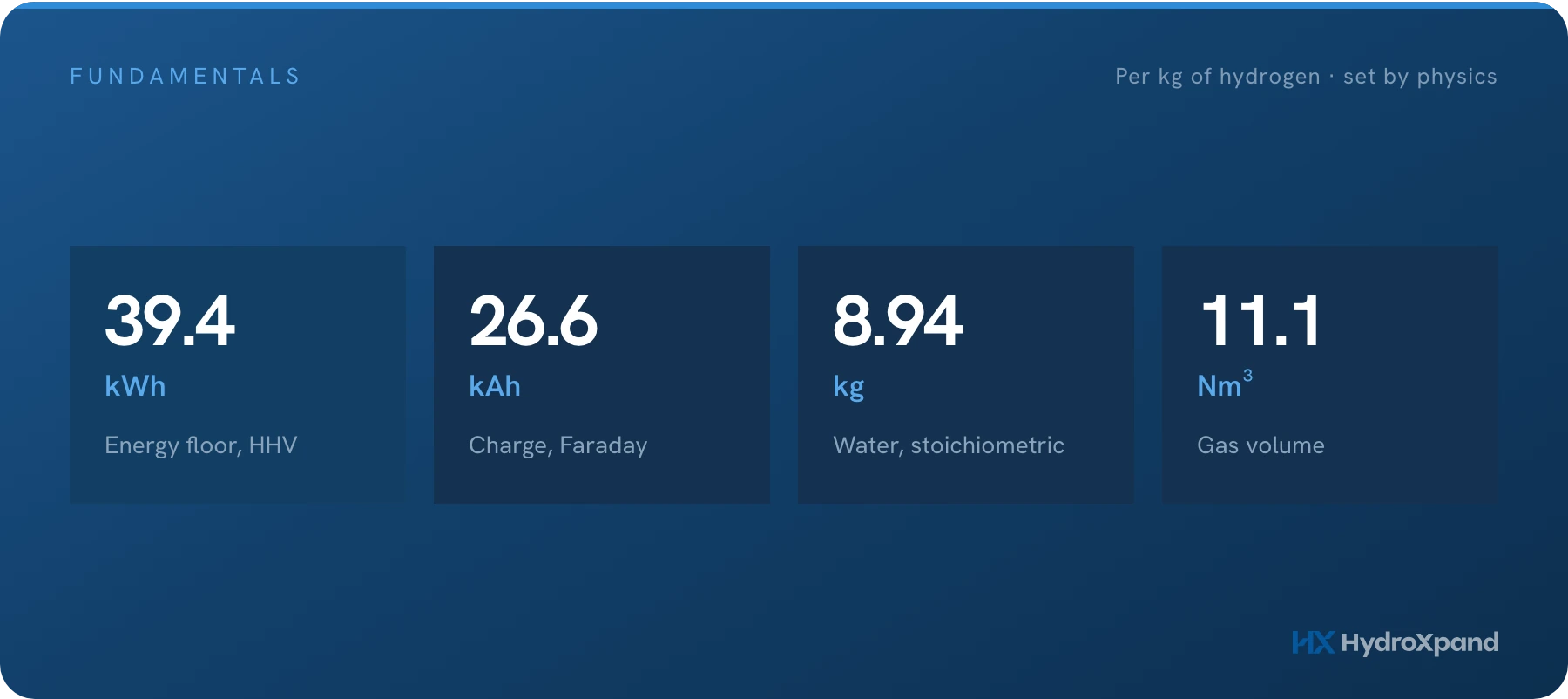
For one kilogram of hydrogen, four quantities are set by physics rather than by engineering. They are worth memorising, because they are the only benchmark against which a quoted specification can be judged.
The heat of formation of steam is 33 kWh/kg of hydrogen, and is the lower heating value (LHV) of hydrogen.
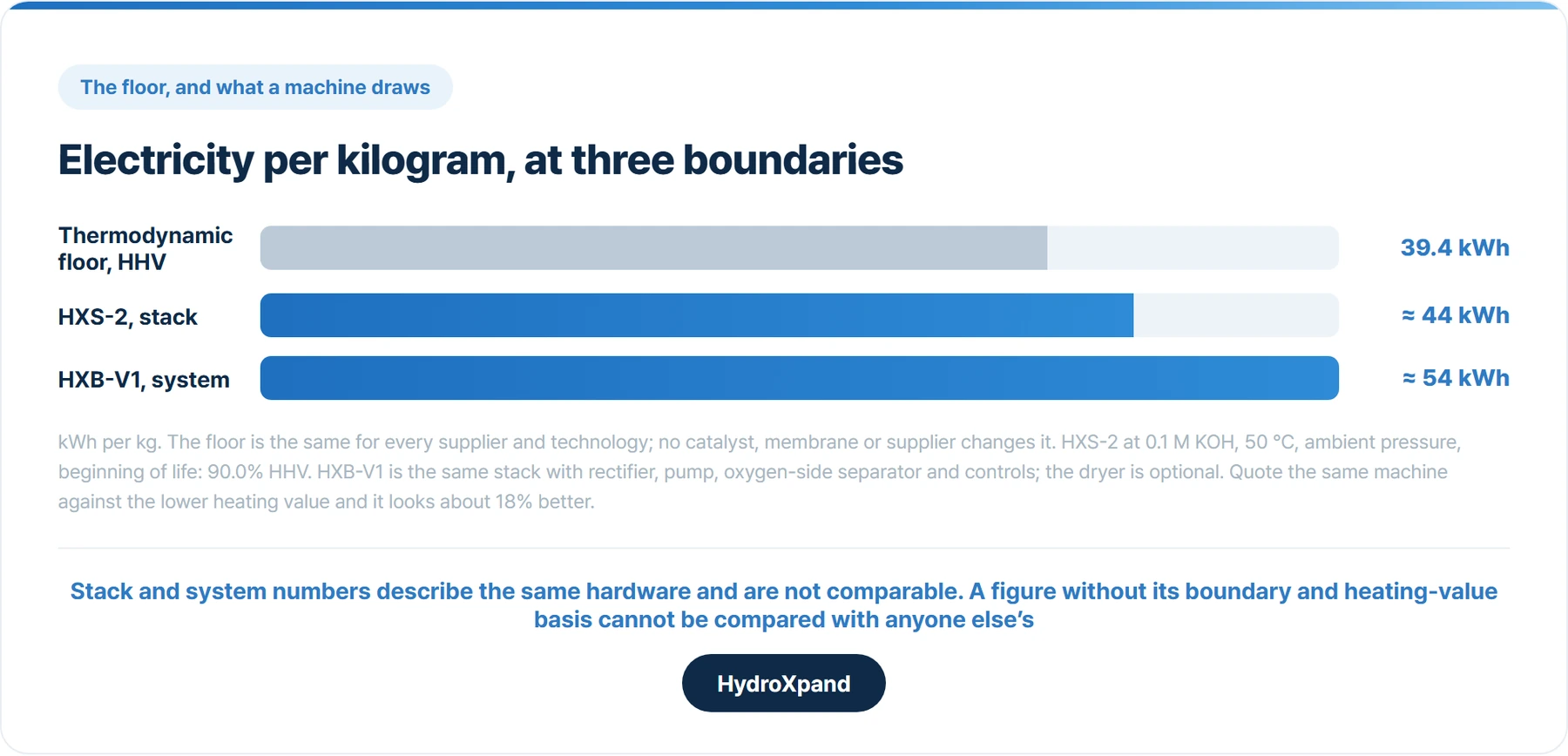
The energy figure is the one most often misread. An electrolyzer quoted at 39.4 kWh per kilogram would be a perfect machine, so any real number is higher, and the size of the gap is the efficiency. Quoting that gap against the lower heating value instead makes the same machine look about 18 percent better, which is why the basis has to travel with the number.
The charge figure explains why stacks are built as they are. Current, not voltage, sets the production rate, and a cell can only carry so much current per unit of area. More hydrogen therefore means more area, more cells in series, or a higher current density with the extra losses that come with it.
The water figure is worth keeping separate from the water a system actually consumes. Our HXB-V1 2 kW system draws about 0.55 litres an hour of feed water at rated output, and the electrolyte circulating through the stack is a much larger flow that is not consumed at all.
Voltage is where the technologies differ
A cell has two thermodynamic marks on it. The reversible voltage at room temperature is 1.23 V, below which the reaction does not proceed. The thermoneutral voltage is 1.48 V, at which the reaction supplies exactly its own heat. Neither can be moved by a catalyst, a membrane or a supplier.
Every real cell runs above 1.48 V, and the excess is what the industry competes on. It divides into the overpotentials of the two half reactions and the ohmic losses of the membrane, the contacts and the electrolyte.
Splitting liquid water into hydrogen at 25 °C requires a minimum voltage of 1.23 V be applied across the anode and cathode of the electrolyzer
Two of our own measurements make the point concrete. Our HXS-2 stack reaches 90.0 percent efficiency on a higher heating value basis at beginning of life, measured at 50 A in 0.1 M KOH at 50 °C and ambient pressure, which corresponds to about 44 kWh per kilogram at the stack boundary. The complete HXB-V1 system around that stack consumes about 54 kWh per kilogram, because the rectifier, the pump, the separators and the dryer all draw power that never reaches the cell.
Those two figures describe the same stack at two different boundaries. Neither is wrong. They answer different questions, and a comparison that mixes the two is not a comparison at all.
- HXS-2 · 2 kW stack→The stack the 44 kWh/kg figure belongs to.
- HXB-V1 · 2 kW system→The system the 54 kWh/kg figure belongs to.
- Datasheets→Six products. No form.
The four technologies in one paragraph each
| AWE | PEM | AEM | SOEC | |
|---|---|---|---|---|
| Charge carrier | OH⁻liquid KOH | H⁺acidic membrane | OH⁻alkaline membrane | O²⁻ceramic, steam |
| Separator | Porous diaphragm | Dense polymer | Dense polymer | Solid oxide ceramic |
| Noble metals | None | Iridium and platinum | Low, cathode only | None |
| Operating temperature | 60–90 °C | 50–80 °C | 40–60 °C | Around 700–850 °C |
| Chosen for | Large steady loads | Pressure, purity, dynamics | Dynamics without iridium | Sites with waste heat |
Those five rows explain most of what separates the four. The rest of the difference is maturity, and it runs in the opposite direction to novelty: alkaline has been industrial for over a century, PEM is widely deployed, AEM became commercial in the 2020s, and solid oxide is at the demonstration and early commercial stage.
SourcesIRENA, Green Hydrogen Cost Reduction (2020), Table 1: operating temperatures and current densities by technology · Polymers 15(9):2144 (2023), DOI 10.3390/polym15092144, Table 1: AWE, PEM and AEM compared
What to ask, before any of this matters
- The efficiency, with its basis and its boundary. Higher or lower heating value, and cell, stack or system.
- The current density and temperature it was measured at. Any cell looks better run softer.
- The outlet pressure and purity from the stack itself, before a compressor or a dryer is added.
- The turndown floor. Not the ramp rate, but the load below which the machine has to stop rather than reduce.
- The durability, with the load and the voltage the run ended at. Hours alone describe nothing.
For our own products those answers are published rather than available on request. The HXS-2 stack has more than 3,000 hours of cumulative operation, and its long-run data is published with the load, the voltage and the test conditions in our durability note.
- AEM electrolysis: technology and measured data→How AEM electrolysis works, AEM vs PEM vs alkaline, and the measured data behind our stacks.
- How to read an efficiency figure→The heating value basis and the cell, stack and system boundaries, in full.
- Alkaline, PEM or AEM→The four questions that decide which of the technologies your project can use.
- What is an electrolyzer stack→Where the charge figure turns into cells, area and plates.
- HXS-2 durability data→The long-run data and test conditions behind the durability answer above.
- What the hydrogen colours leave out→Why the consumption figure above, multiplied by the grid, decides whether it is green.
- What hydrogen is actually used for→Where the 100 million tonnes a year go, and what each process does with it.
- Reading a hydrogen flow figure→Nm³/h, NL/min, SCFH and kg/day, and the reference state behind each.
Frequently asked questions
What is water electrolysis?
Water electrolysis is the reaction that splits water into hydrogen and oxygen with electricity. Thermodynamics sets the energy floor, Faraday's law sets the charge and stoichiometry sets the water.
How much energy does it take to make 1 kg of hydrogen by electrolysis?
At least 39.4 kWh per kg on a higher heating value basis, or 33.3 kWh per kg on a lower heating value basis. A real machine uses more; the HXB-V1 system draws about 54 kWh per kg.
How much water does 1 kg of hydrogen need?
8.94 kg of water is consumed stoichiometrically per kg of hydrogen, which also yields about 8 kg of oxygen. Feed and circulation flows are much larger and are quoted separately.
Sources
- Summary of Electrolytic Hydrogen Production, NREL/MP-560-36734 — National Renewable Energy Laboratory, 2004
- Integrating Solar Energy, Desalination, and Electrolysis (DOI 10.1002/solr.202100732) — Solar RRL, 2022
- Green Hydrogen Cost Reduction: Scaling up Electrolysers to Meet the 1.5 °C Climate Goal — International Renewable Energy Agency, 2020
- Recent Advancements of Polymeric Membranes in Anion Exchange Membrane Water Electrolyzer: A Critical Review (DOI 10.3390/polym15092144) — Polymers, 2023
Looking at AEM for a specific application?