Solid oxide electrolysis does not beat the other technologies by being a better cell. It changes the accounting, paying for part of the reaction with heat instead of electricity. Whether that is an advantage depends entirely on where the heat comes from.
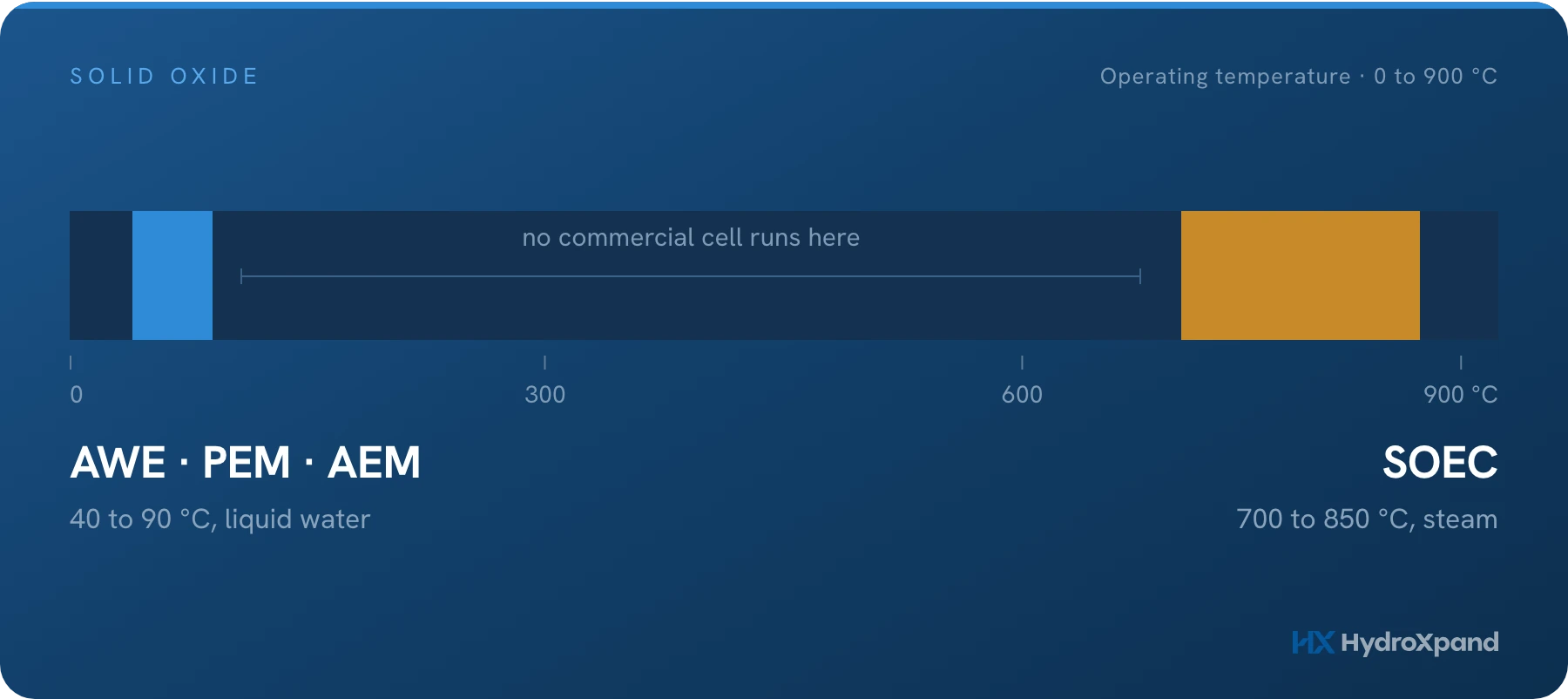
A solid oxide electrolysis cell splits steam rather than liquid water, at roughly 700 to 850 °C, using a ceramic electrolyte that conducts oxide ions instead of a polymer that conducts protons or hydroxide. There is no liquid electrolyte, no membrane in the polymer sense, and no noble metal.
It is usually introduced as the most efficient of the four technologies. That framing is close enough to be useful and loose enough to be misleading, and the difference between the two matters when a project is being costed.
What temperature does to the accounting
Splitting water requires a fixed total amount of energy, and thermodynamics divides that total into two parts. One part has to arrive as electricity. The rest may arrive as heat.
The split is not fixed. As temperature rises, the share that must be electricity falls, while the total stays close to where it was. That single fact is the whole of the solid oxide argument.
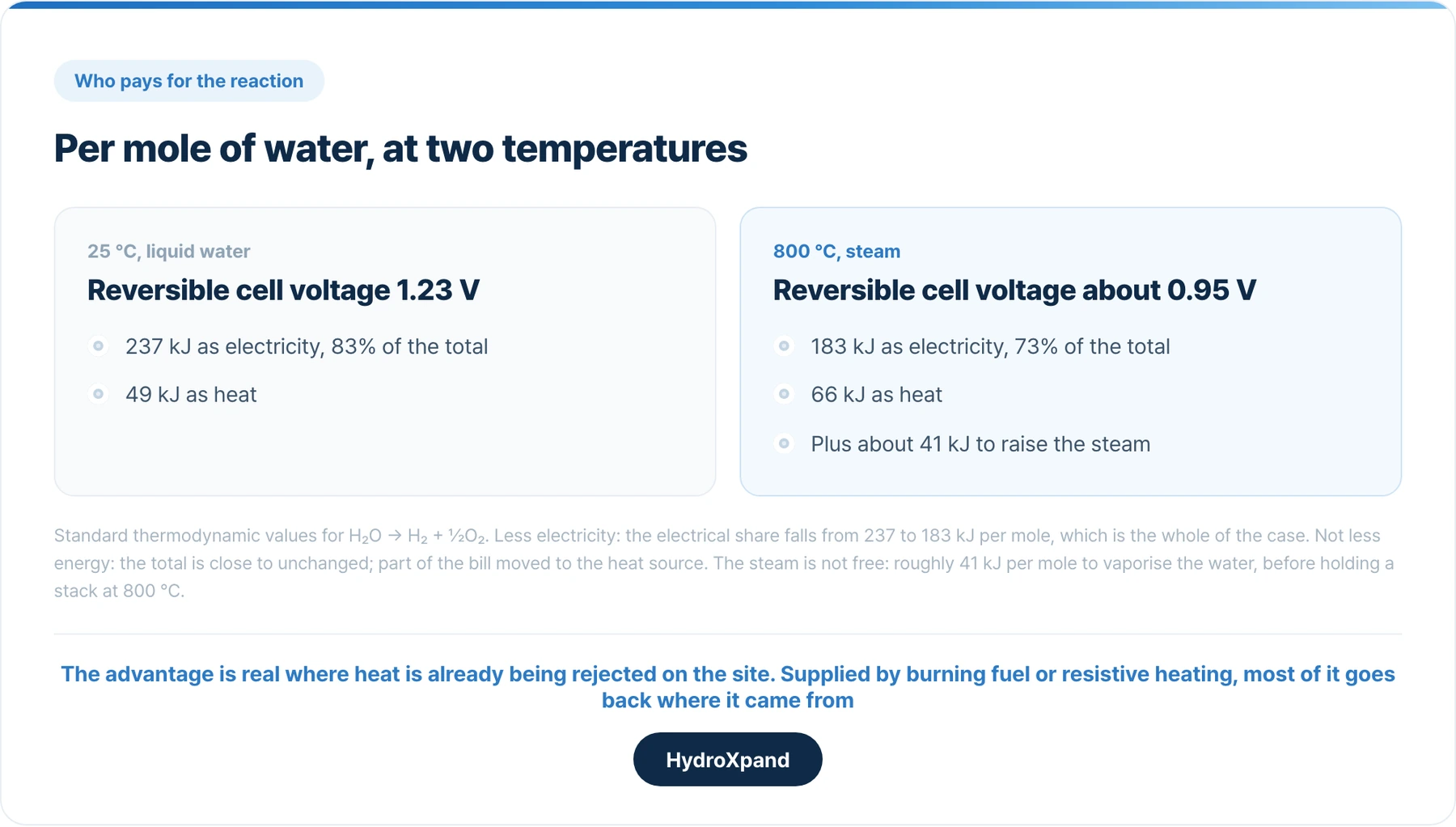
Solid oxide electrolysis does not make the reaction cheaper. It moves part of the bill from the electricity meter to the heat source, which is only an improvement if the heat is cheaper than the electricity.
At 25 °C with liquid water, the total is about 286 kJ per mole and about 237 kJ of it must be electricity, which is the 1.23 V reversible cell voltage every electrolyzer is measured against. At 800 °C with steam, the electrical share falls to roughly 183 kJ, near 0.95 V, and the remainder is supplied thermally.
A cell that needs less voltage for the same current consumes less electricity for the same hydrogen. If electricity is what you are paying for and the heat is something you already have, the case is straightforward.
SourcesLiu et al., Chem. Rev. 124(18) 2024, DOI 10.1021/acs.chemrev.3c00795: thermodynamics of steam electrolysis (author postprint) · Ginsberg et al., Solar RRL 2022: 285.8 kJ/mol and 1.48 V at 25 °C
The part that is usually left out
The 249 kJ per mole that a high-temperature cell works with is the figure for steam. It does not include the energy that turned liquid water into steam in the first place, which is roughly 41 kJ per mole on its own, nor the energy to hold a stack at 800 °C.
Supply that heat by burning fuel or by resistive heating and much of the advantage goes back where it came from. Supply it from process heat that a site is already rejecting, from a nuclear plant, or from an exothermic downstream synthesis, and the advantage is real and large.
- The technology is chosen by the site, not by the datasheet. The question is whether high-grade waste heat exists next to the electrolyzer.
- This is why solid oxide appears in industrial contexts, next to synthesis plants and steelworks, rather than as a general purpose on-site hydrogen generator.
- It is also why the same cell can run in reverse as a fuel cell, and why co-electrolysis of steam and carbon dioxide into syngas is an active application. Neither is available to the low-temperature technologies.
What 800 °C costs
The operating temperature that produces the advantage is also the source of every difficulty the technology has.
| What happens | What it means for a project | |
|---|---|---|
| Start-up | The stack has to be brought to temperatureslowly enough not to crack | Measured in hours, not secondsnot a machine you switch on for a shift |
| Dynamics | Thermal mass and ceramics limit how fast load can change | Poor fit for a directly coupledvariable renewable input |
| Thermal cycling | Ceramics and seals are stressed by every cool-down | Continuous operation is strongly preferredintermittent duty is the hard case |
| Materials | Sealing, interconnects and degradation at temperature | The active engineering problemand the reason for the maturity gap |
The solid oxide electrolyzers can effectively use heat available at these elevated temperatures (from various sources, including nuclear energy) to decrease the amount of electrical energy needed to produce hydrogen from water.
This is a different failure mode from the ones the low-temperature technologies have. An alkaline plant has a turndown floor, a PEM plant has a materials exposure, and a solid oxide plant has a thermal cycle it does not want to take.
It is also why the four technologies do not sit on a single ladder from worst to best. They fail differently, and a project picks the failure mode it can live with.
SourcesU.S. DOE: Hydrogen Production, Electrolysis (solid oxide electrolyzers at about 700 to 800 °C) · IRENA, Green Hydrogen Cost Reduction (2020): SOEC lifetimes of 20,000 hours under steady operation
- HXS-2 · 2 kW stack→The other end of the range: 40 to 60 °C, seconds to start.
- HXB-V1 · 2 kW system→On-site hydrogen without a heat source to plan around.
- Datasheets→Six products. No form.
Where this leaves the four technologies
Solid oxide is the clearest case in electrolysis of a technology being chosen by context rather than by specification, and it is a useful test of whether a comparison table is honest. If a table ranks the four on efficiency alone, it will put solid oxide first and will have told you nothing about whether you can use it.
| AWE | PEM | AEM | SOEC | |
|---|---|---|---|---|
| Temperature | 60–90 °C | 50–80 °C | 40–60 °C | 700–850 °C |
| Feed | Liquid alkali | Deionised water | Dilute alkali | Steam |
| Follows variable power | Slowly | Well | Well | Poorly |
| Decided by | Scale and capital cost | Pressure and purity | Dynamics without iridium | Whether the heat is free |
Our own work is at the opposite end of that table. An AEM stack runs at 40 to 60 °C, starts in seconds, and is built for sites that have variable power and no waste heat to plan around. The reason to explain solid oxide carefully on a page written by an AEM supplier is that the two are not competing for the same projects, and pretending otherwise would make every comparison on this site less useful.
- What water electrolysis is→The four fixed numbers every technology is measured against.
- How to read an efficiency figure→Why a single efficiency number cannot rank four technologies.
- Alkaline, PEM or AEM→The four questions that come before any supplier comparison.
Frequently asked questions
What is SOEC electrolysis?
Solid oxide electrolysis splits steam at around 800 °C through a ceramic electrolyte. Part of the reaction energy is supplied as heat instead of electricity.
Does SOEC make hydrogen cheaper?
Not by itself. The electrical demand per mole falls from 237 to about 183 kJ, but the total energy is almost unchanged. It is only an advantage if the heat is cheaper than the electricity.
What does running at 800 °C cost?
Thermal cycling and ceramic durability. Starting and stopping is expensive for the cell, so SOEC suits sites with a steady heat source and steady operation.
Sources
- High Temperature Solid Oxide Electrolysis for Green Hydrogen Production (DOI 10.1021/acs.chemrev.3c00795), author postprint — Chemical Reviews, 2024
- Integrating Solar Energy, Desalination, and Electrolysis (DOI 10.1002/solr.202100732) — Solar RRL, 2022
- Hydrogen Production: Electrolysis — U.S. Department of Energy
- Green Hydrogen Cost Reduction — International Renewable Energy Agency, 2020
Looking at AEM for a specific application?