The membrane electrode assembly is the layer stack where water is actually split. It sets the efficiency ceiling of everything built around it, and most of its performance is decided at the interfaces rather than by the ingredients.
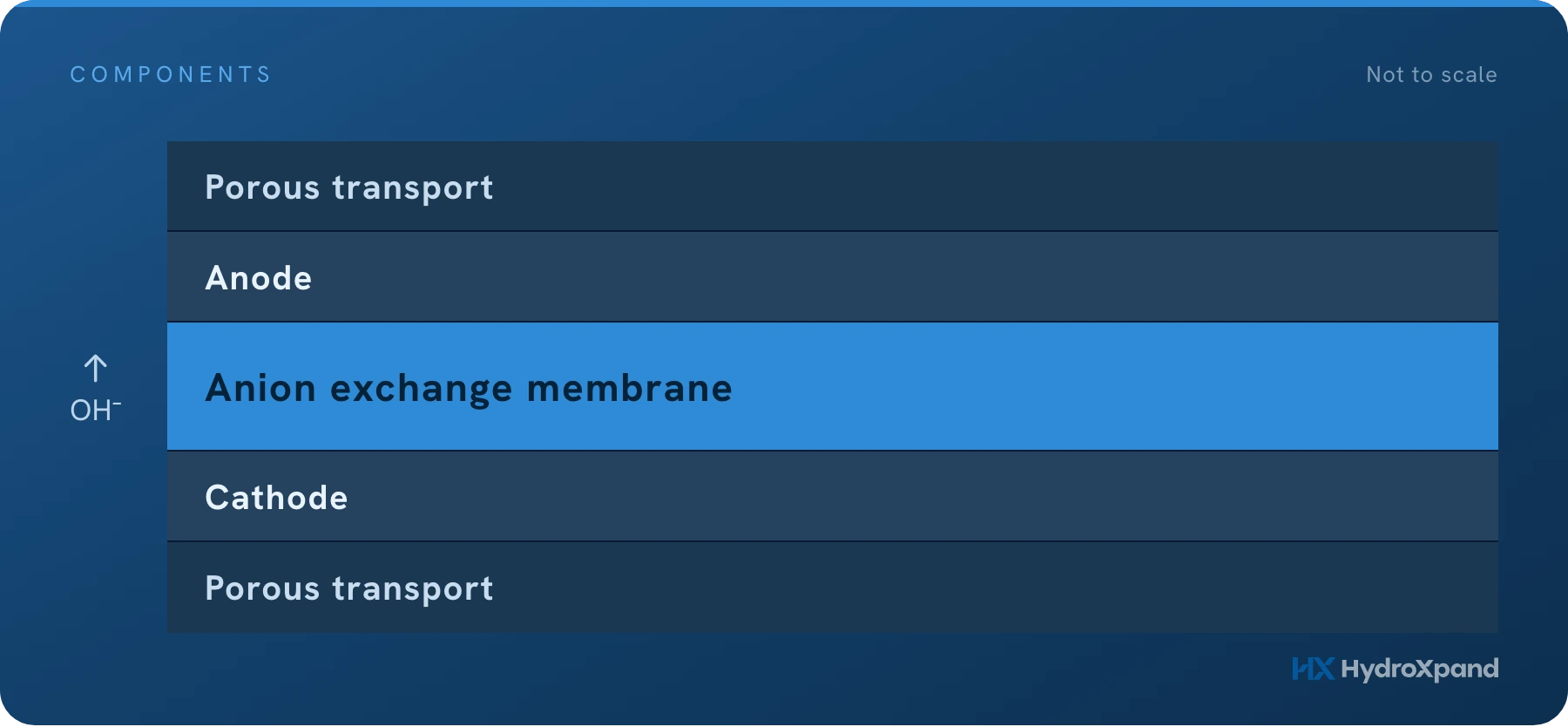
Every specification an electrolyzer carries, its efficiency, its current density, its degradation rate, is set first by a component a fraction of a millimetre thick. The membrane electrode assembly, or MEA, is the membrane with a catalyst layer bonded to each face. Everything else in the machine exists to give the MEA current, water and a way out for the gas.
An electrolyzer can be no better than the MEAs inside it, and a stack built around a mediocre MEA cannot be engineered back to a good number.
What each layer does
Iridium in the anode accounts for much of the platinum group metal (PGM) content in PEM electrolyzers, but platinum is also present in the cathode.
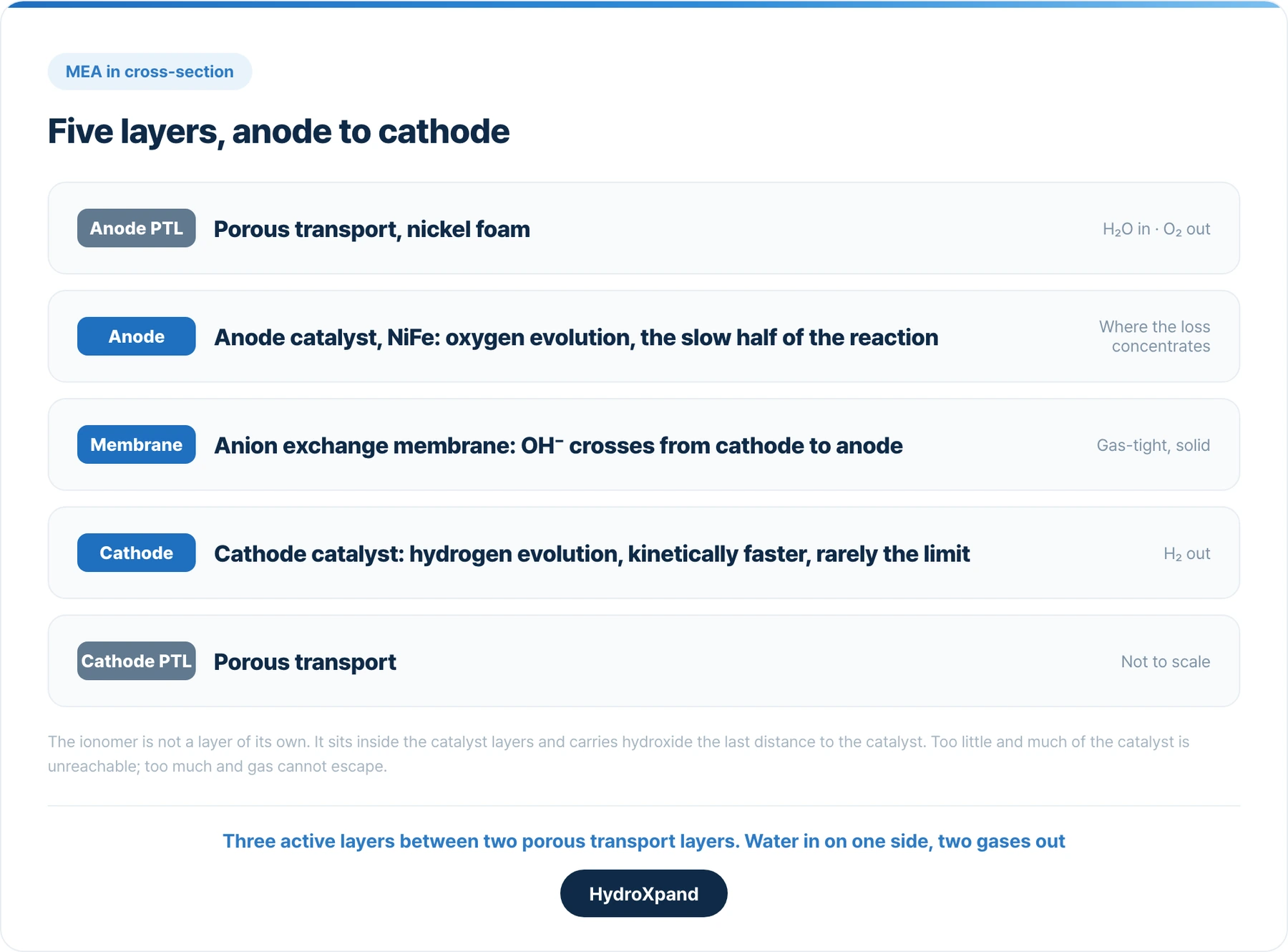
The membrane conducts ions and keeps the two gases apart. In an AEM cell it carries hydroxide from the cathode to the anode, and it has two competing requirements: thin enough that ionic resistance stays low, tough enough to seal against a pressure difference and survive years of alkaline conditions.
The anode catalyst layer runs the oxygen evolution reaction. This is the slow half of water splitting and the reason most catalyst research in the field is on the oxygen side. In alkaline conditions it can be done with nickel-iron catalysts rather than iridium, which is the single largest cost difference between AEM and PEM. The cathode side runs hydrogen evolution, which is kinetically faster, so it is usually not what limits the cell.
The ionomer is easy to overlook because it is not a layer of its own. It is the polymer inside the catalyst layers that carries hydroxide the last distance to the catalyst particles, and it is a genuine design variable: too little and much of the catalyst is electrochemically unreachable, too much and gas cannot escape the layer.
SourcesMolecules 26(21):6326 (2021): oxygen evolution as the rate-limiting half reaction · U.S. DOE Technical Targets for PEM Electrolysis: PGM content of PEM electrolyzers · IRENA, Green Hydrogen Cost Reduction (2020): rare metals as a share of PEM system cost
Two ways to put catalyst where it is needed
| Coated | Grown in place | |
|---|---|---|
| What happens | Catalyst powder is milled into an ink with ionomer and solvent, then coated onto the membrane or the porous transport layer | The catalyst is synthesised directly on the metal support, with no binder between catalyst and substrate |
| What decides the result | The inkdispersion, ionomer ratio, solvent, drying profile | Growth conditions and the substratefewer interfaces to go wrong |
| How it scales | With the coating line | With the size of the electrode |
| Where we sit | Not our route | NiFe-LDH grown on nickel foam |
Neither route is inherently better, and both are used in commercial products. The question to put to a supplier is not which one they use, but how tightly they can repeat it. Two laboratories with the same catalyst powder and different ink recipes will not report the same performance.
What separates a good MEA from a bad one
- Interfaces decide more than ingredients. A strong catalyst on a poor interface performs worse than a modest catalyst on a good one, because the loss is not in the catalyst's activity but in getting electrons, ions and gas to and from it.
- Ionomer loading is a design variable and not a detail. The same catalyst gives measurably different curves at different loadings, which is one reason published catalyst results are hard to compare across groups.
- Reproducibility tells you about the process. The spread across a batch is more informative than the best cell in it.
- Conditions travel with the number. An MEA measured at 80 °C in concentrated KOH will not repeat that figure at 40 °C in 0.3 M KOH.
Ask a supplier for the spread across a batch, not the best cell in it.
- HXS-0 · MEA evaluation cell→Single cell for MEA screening. 1-25 cm active area, 1-20 cells.
- HXP-an · anode→Catalyst grown on the substrate, no binder. 6,358 h on a 16 cm2 two-cell short stack.
- Datasheets→Six products. No form.
Why we make our own
MEA performance is decided at the boundary between the membrane, the catalyst layer and the porous transport layer, and those boundaries only exist once the parts are assembled and compressed together. A membrane that performs well in a half-cell can behave differently under compression against a particular electrode structure.
So we develop the catalysts and electrodes, and design the cell and stack they go into. That is not a claim that integration is the only way to build an electrolyzer. It is the reason we can change one of those layers without waiting for three suppliers to agree, and the reason we can publish the conditions behind our numbers rather than repeat someone else's.
Three KAIST PhDs founded the company in December 2023. More than 70 customers in over 10 countries now use our electrodes, stacks and systems, from university laboratories evaluating their own materials to companies producing hydrogen on site.
The two electrodes are sold on their own. HXP-an is a PGM-free NiFe-LDH anode and HXP-ca a catalyst-coated cathode with Pt/C or PtRu/C at 0.2 mgPGM/cm², both available to order at 200 × 300 mm and shipping two weeks from PO acceptance.
- AEM electrolysis: technology and measured data→How AEM electrolysis works, AEM vs PEM vs alkaline, and the measured data behind our stacks.
- What an ionomer is→The polymer inside the catalyst layer, and why its amount decides whether the catalyst works.
- What a catalyst does, and who decides which one you get→Why the electrolyte, not the purchase order, decides the catalyst in those layers.
- What is an electrolyzer stack→Where the MEA sits, and the three mechanical decisions that decide how much of it survives assembly.
- What changes when the membrane is anionic→Why an anion exchange membrane lets the catalyst leave the noble metal market.
- HXP-an and HXP-ca electrodes→The electrodes themselves, with datasheets.
- Specifying electrodes for an MEA→Area, thickness and catalyst loading, in the order the cell sets them.
Frequently asked questions
What is an MEA in an electrolyzer?
The membrane electrode assembly is the layer stack of anode, membrane and cathode where water is actually split. It sets the efficiency ceiling of everything built around it.
What separates a good MEA from a bad one?
Most of the performance is decided at the interfaces between layers rather than by the ingredients. Ask a supplier for the spread across a batch, not the best cell in it.
Can a stack compensate for a mediocre MEA?
No. An electrolyzer can be no better than the MEAs inside it, and a stack built around a mediocre MEA cannot be engineered back to a good number.
Sources
- Recent Advances in Alkaline Exchange Membrane Water Electrolysis and Electrode Manufacturing (DOI 10.3390/molecules26216326) — Molecules, 2021
- Technical Targets for Proton Exchange Membrane Electrolysis — U.S. Department of Energy
- Green Hydrogen Cost Reduction — International Renewable Energy Agency, 2020
Looking at AEM for a specific application?