We have run the HXS-30 46-cell stack for about 567 hours. After restarts the voltage started low, cell spread widened during operation and narrowed after a restart, and starting directly at high current caused voltage spikes in some cells for about a minute.
Since late September we have been running a 30 kW-class HXS-30 46-cell stack. It has now accumulated about 567 hours of operation, with one inspection during that period. Here are three observations from the run.
This post follows on from our last one on scaling a stack from 2 kW to 30 kW, which covered the first 96.7 hours.
- After a stop and restart, cell voltage started low. The rate at which it rose again varied each time.
- Cell spread widened during operation and narrowed after a restart.
- When we started directly at high current, some cell voltages spiked for the first minute or so.
- Scaling an electrolyzer stack from 2 kW to 30 kW→The first 96.7 hours of the 46-cell stack.
After a restart, the voltage started low
We compared four instances in which the HXS-30 was stopped while running at 360 A and then restarted at 360 A. Each time, the voltage per cell initially measured about 21 to 87 mV below its value just before the stop.
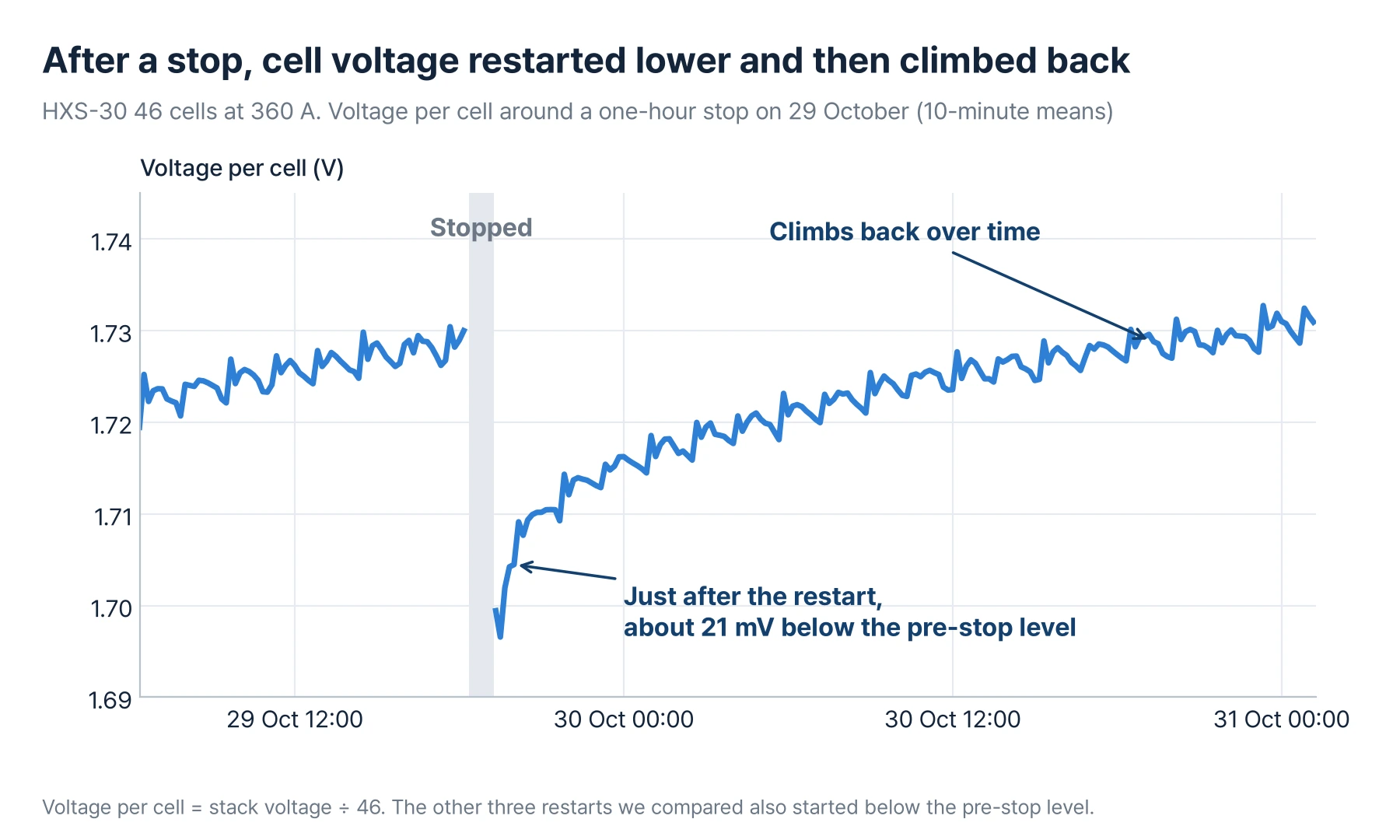
The voltage climbed back during operation, but at a different pace each time. In one case, it returned to its pre-stop level within a day; in another, it was still below that level after two days. We have not yet worked out what makes the difference.
We therefore flag readings taken just after a restart. Combining these directly with readings taken just before a stop can make the rise during operation look smaller than it really is.
Cell spread widened during operation and narrowed after a restart
The HXS-30 logs the voltage of all 46 cells. We take the difference between the highest and lowest cell voltages as the cell spread.
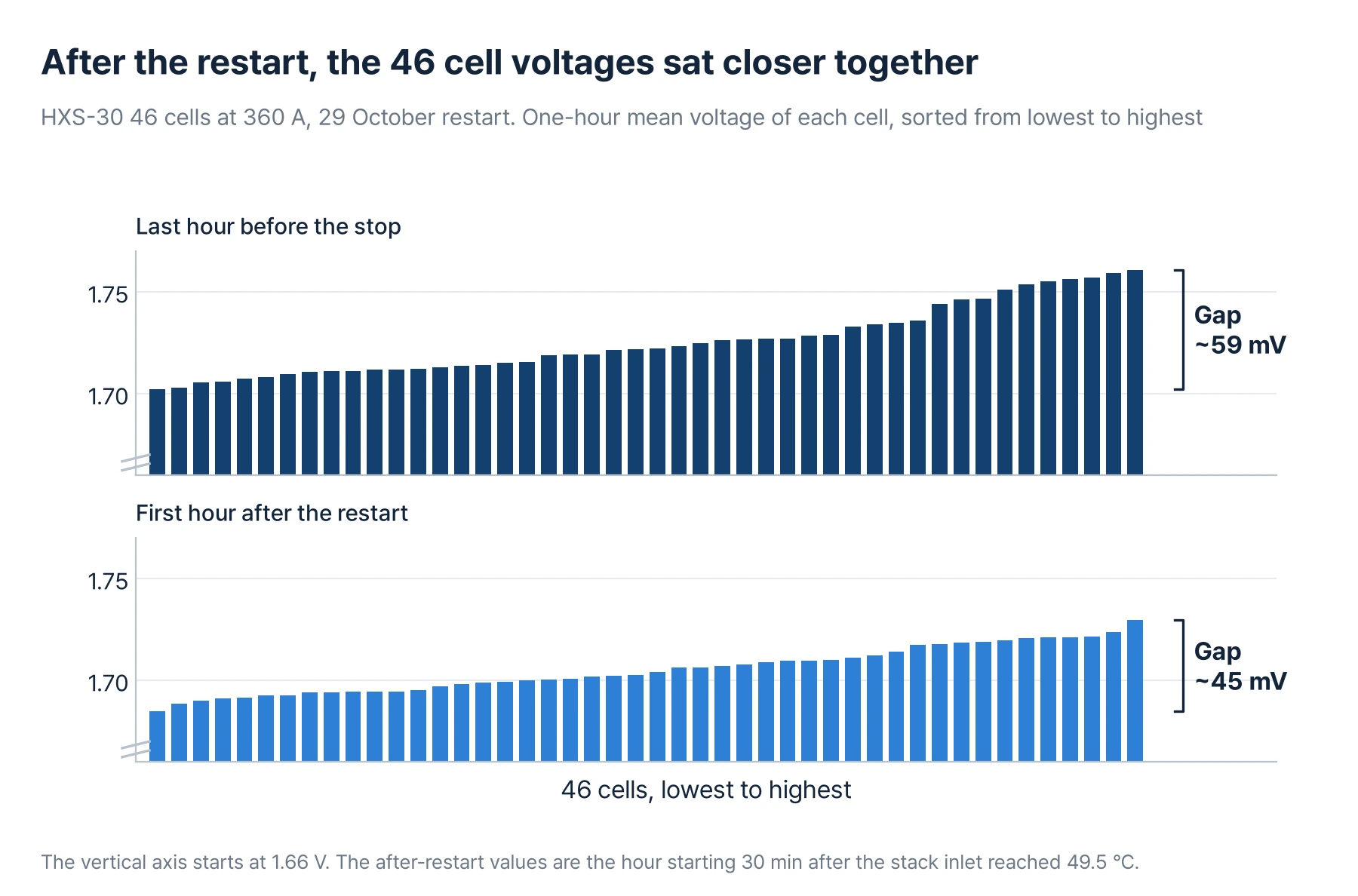
The spread widened while the stack ran, narrowed when it was stopped and restarted, then widened again, following the same pattern as the voltage. It was about 34 mV on the first day of the run, about 64 mV just before the first stop, and about 37 mV after the restart.
Operating conditions differed before and after the mid-run inspection, so we analyse the two periods separately.
- Cell voltage distribution→What a stack voltage hides, and what to ask for.
When started directly at high current, some cell voltages spiked for about a minute
When we started the HXS-30 directly at high current, the voltages of a few cells rose well above the rest before dropping back after a minute or so. At the largest spike, the highest cell voltage was about 500 mV above the 46-cell median.
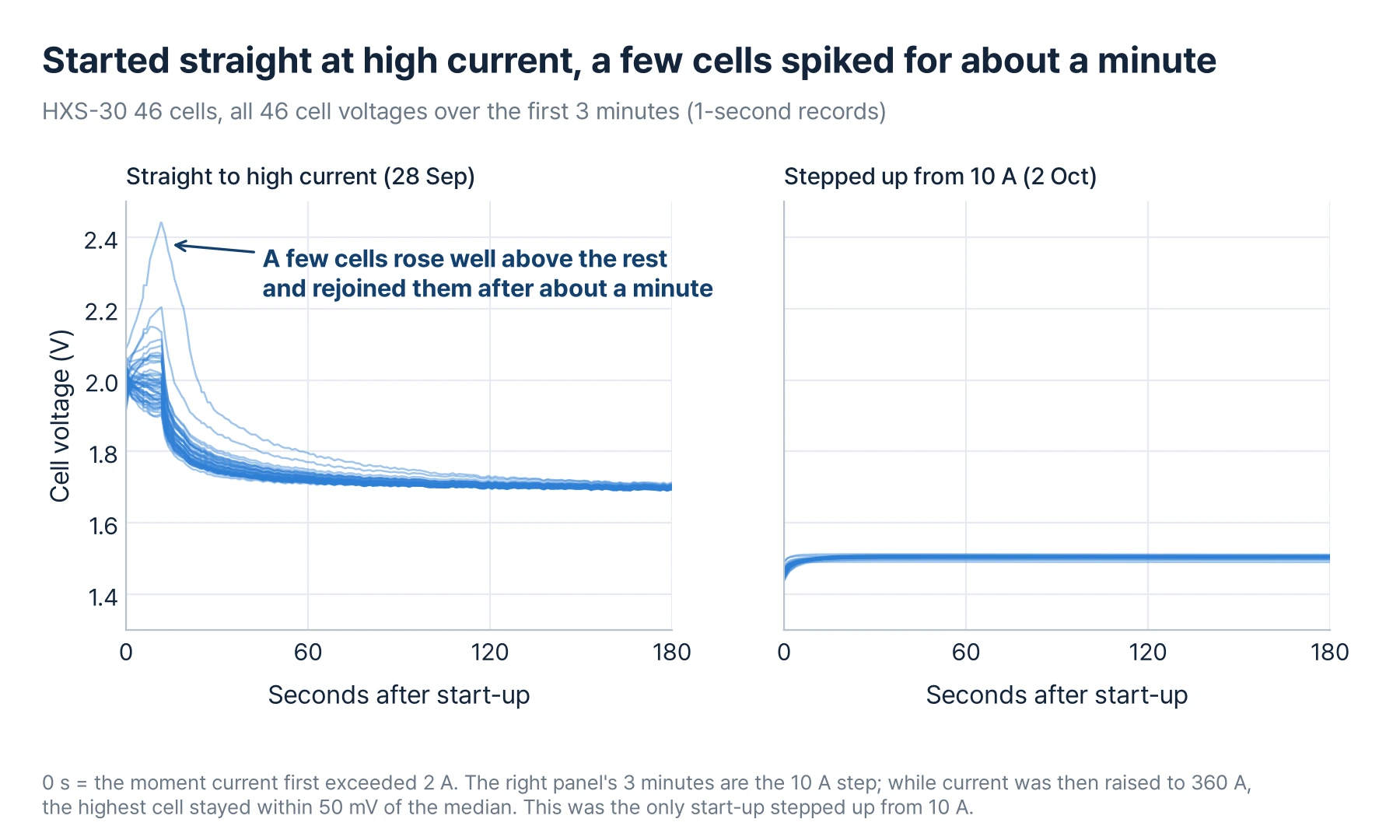
In the single start-up where we increased the current in steps from 10 A, there was hardly any voltage spike. With only one such start-up in the record, we cannot attribute the difference to the start-up method.
How we read long-run data
- We consider when each value was measured and under what conditions.
- We log how long it has been since the last restart, and compare values at the same point after a restart.
- We look at the spread between cells alongside the average voltage.
- We assess cell voltages at start-up separately from those during steady operation.
- We have brought the 46-cell, 30 kW-class full stack into operation→The first 96.7 hours of the full stack.
- Why electrolyzer cells and stacks perform differently→What changes when cell results are carried over to a stack.
- HXS-30→The 30 kW-class, 46-cell stack.
Frequently asked questions
What does the 567-hour total include?
The time current flowed through the HXS-30 46-cell stack, counted for the stack as a whole, between 22 September and 6 November 2026, a period that included a mid-run inspection. Part of that time was at other currents, so every comparison in this post is between periods run at 360 A.
What is the degradation rate of the 46-cell stack?
This post does not give a degradation rate.
Why does the voltage start low after a restart?
We have not yet worked out the cause. It started low in all four restarts we compared, and how far and how fast it climbed back differed each time.
Can we get the raw data?
We discuss the scope of data sharing on request.
Looking at AEM for a specific application?