Once you know how water electrolysis works, the next question is who builds it. This is a map of the manufacturers by technology, and a reading of what the list itself tells you about where the industry is.
There is no shortage of explanations of how water electrolysis works. There is much less written about who builds the machines, which is the question that comes next for anyone actually specifying one.
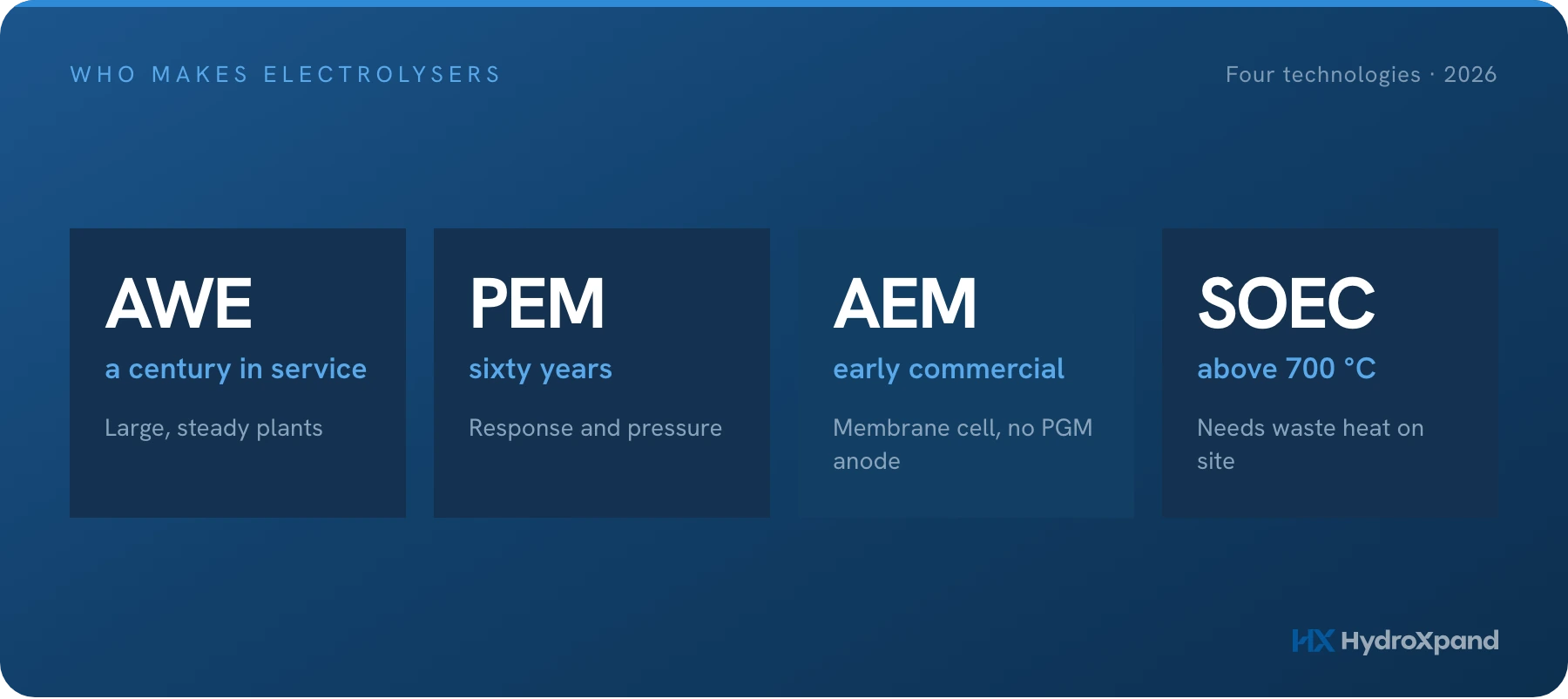
This is a working map rather than a ranking. Companies are grouped by the technology they build, because that is what determines whether a supplier belongs on your shortlist at all. Everything attributed to a company here is something that company or a public agency has stated.
First, the shape of the market
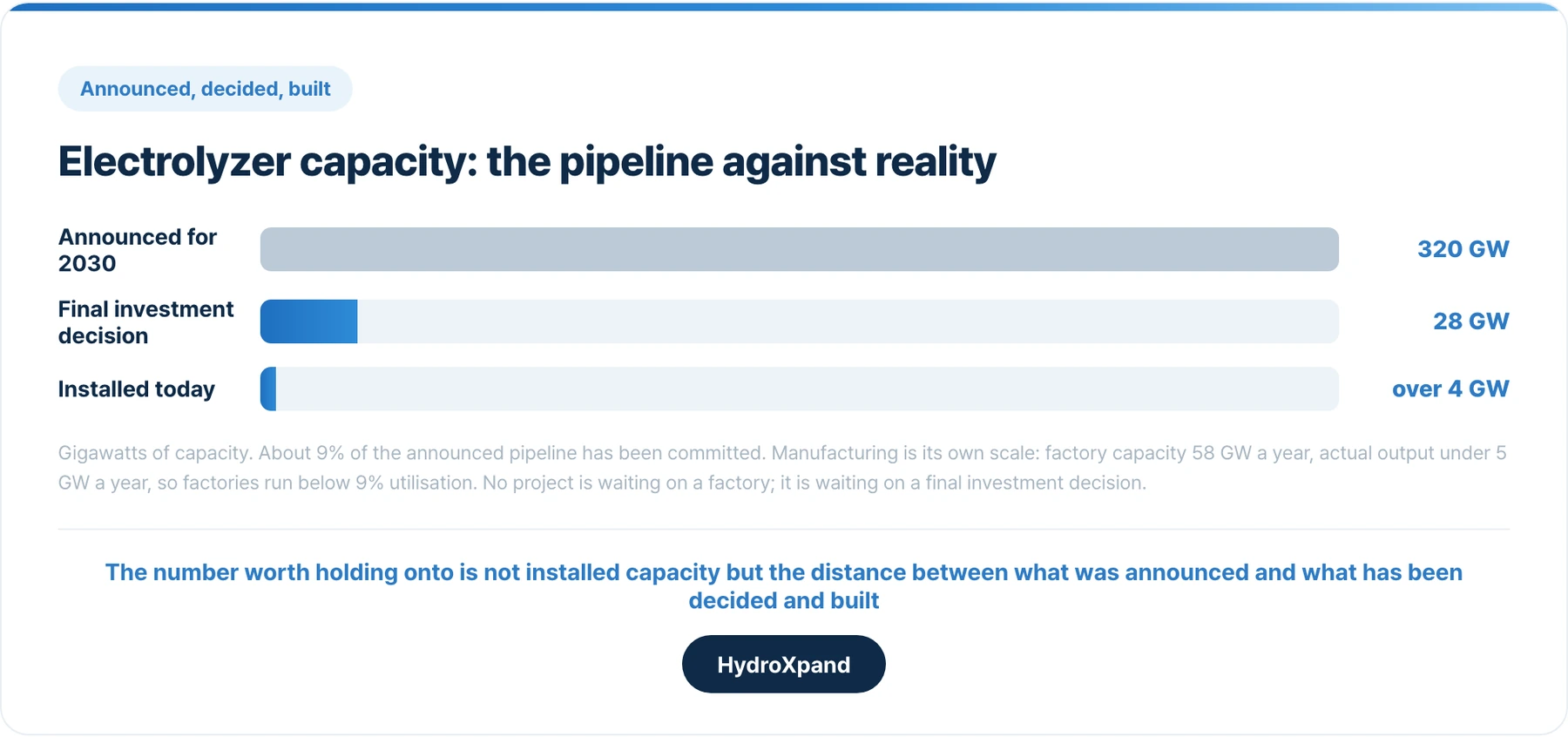
The number worth holding onto is not total installed capacity. It is the distance between what was announced and what was built.
Against roughly 320 GW of electrolyzer capacity announced for 2030, about 28 GW has reached a final investment decision, and installed capacity stood above 4 GW at the end of 2025 (IEA, Global Hydrogen Review 2026). Roughly 9% of the announced pipeline has been committed to, and around 1% of it exists.
The manufacturing side shows the same gap from the other direction. In 2025, manufacturing capacity was nearly 58 GW per year while estimated output, including electrolyzers for chlor-alkali, was below 5 GW: a ratio under 9%, though not the utilisation of any single manufacturer. Factories were built for the announced pipeline rather than for the orders that followed.
Read as a sequence, the last six years are legible: national hydrogen strategies in 2020, mega project announcements from 2021 to 2024, and from 2025 a refocus onto projects that can actually be executed. Figures here are from the IEA Global Hydrogen Review 2026, and the under-5 and above-4 notations are the IEA's own.
That gap is the context for everything below. A supplier list assembled in 2026 is a list of companies operating a fraction of the capacity they built, waiting on projects that were announced but not committed.
Alkaline (AWE): the default for large, steady plants
Alkaline electrolysis has been in industrial use since the nineteenth century, and that record is why it still wins most large projects. It runs on a liquid alkaline electrolyte and does not require platinum group metals, so the cell materials are inexpensive at scale.
thyssenkrupp nucera (Germany) is the reference supplier at gigawatt scale, built on decades of chlor-alkali cell manufacturing. In August 2026 it stopped its own SOEC mass-production programme; its alkaline business continues. McPhy (France) is no longer an independent supplier: a French court placed it in judicial liquidation on 8 July 2025, and John Cockerill Hydrogen took over most of its business, including the Belfort factory. The largest volumes, however, come from the Chinese manufacturers (LONGi, PERIC and Sungrow among them), which is also where most of the world’s electrolyzer manufacturing capacity sits.
What you accept with alkaline is a floor on turndown and a slower response to changing power. Those limits are the reason the other three technologies exist.
By the same judgment, the Court converted the judicial reorganization proceedings opened against McPhy into judicial liquidation.
SourcesIEA Global Hydrogen Review 2025, chapter 3: alkaline 60% of installed capacity · McPhy Energy press release, 8 July 2025: judicial liquidation and transfer to John Cockerill Hydrogen · thyssenkrupp nucera: financial outlook adjusted after halting SOEC stack mass-production plans
PEM: chosen for response and pressure
Proton exchange membrane electrolyzers use a solid polymer membrane and run at high current density with fast response to changing input, which is why they are specified for variable renewable power and for applications that need pressure and purity at the stack outlet.
Plug Power (United States, founded 1997) came to electrolysis from fuel cells and now spans production, liquefaction and refuelling; it installed 100 MW of PEM electrolyzers at Galp's Sines refinery in Portugal in January 2026, one of Europe's largest PEM projects, with operation targeted for the second half of 2026. Plug continues to take electrolyzer orders while restructuring its workforce and selling selected assets. ITM Power (United Kingdom) and Siemens Energy (Germany) are the other established European names; in August 2026 Siemens Energy began preparing to separate the business area that includes its electrolyzers into a standalone company. Nel (Norway) builds both PEM and alkaline lines, but paused production of its existing alkaline electrolyzers at Herøya in January 2025 because of weak orders.
The open questions on PEM are not about performance. They are iridium, whose annual primary supply is on the order of 7 to 8 tonnes with more than 80% coming from a single country, and the 2023 ECHA proposal to restrict PFAS, which is still under EU assessment, with its final scope and timetable not yet settled. Both sit outside any project's control.
On a fifteen year horizon, an unresolved regulatory question about a core material is a line item, not a footnote.
SourcesPlug Power case study: 100 MW PEM electrolysis at Galp's Sines refinery, operation expected in the second half of 2026 · Cummins Inc. results release, 5 February 2026: charges from the electrolyzer business review
AEM: alkaline chemistry in a membrane cell
Anion exchange membrane electrolysis puts an alkaline environment inside a membrane cell. The intent is to keep the compact, pressurised, fast-responding cell architecture of PEM while removing the requirement for platinum group metals on the oxygen side.
Enapter (Italy and Germany, founded 2017) is an AEM manufacturer that, by its own count, has supplied more than 5,000 AEM electrolyzers to over 360 customers across 55 countries, built around small modules combined into larger systems. In August 2026 it announced a shift to production through partners in China and the United States, keeping core electrode manufacturing in Pisa. Evoloh (United States, founded 2020) takes the opposite approach, building large single stacks, and announced the start of commercial-quantity production in 2025 against a stated manufacturing target of 3.75 GW per year.
We build AEM as well, from the electrode and the stack upward, and supply to research groups and industrial customers in over 10 countries. Our HXS-2 stack has more than 3,000 hours of cumulative operation, and our systems operate at up to 10 barg.
AEM is the youngest of the four in commercial terms. The honest open questions are membrane durability over long runs and the depth of the supply base, and any supplier who tells you otherwise is selling rather than answering.
SourceEnapter company site: fleet figures (stacks delivered, clients, countries)
SOEC: highest efficiency, if you have the heat
Solid oxide electrolysis runs above 700 °C and splits steam rather than liquid water. Because part of the energy of dissociation is supplied as heat rather than electricity, electrical efficiency is the highest of the four — provided a source of high grade waste heat is already on site.
Topsoe (Denmark), Sunfire (Germany) and Bloom Energy (United States) are the principal suppliers, although Topsoe announced in May 2026 that it would place its Herning SOEC factory into hibernation until demand improves and cancelled a planned second factory in the United States. The constraint is not the cell but the application: without co-located industrial heat, the case weakens quickly, and thermal cycling remains the durability question.
Topsoe will prove commercial-scale manufacturing capabilities from its factory in Herning, Denmark, after which the factory will be hibernated until demand is robust.
SourceTopsoe financial release (May 2026): SOEC commercialization pathway adjusted
What the list says
Read together, three things stand out.
- Technology choice is decided by the site, not by a ranking. Load profile, outlet pressure and scale narrow the field before a single specification sheet is compared.
- Capacity is not the general constraint. With global output below 9% of manufacturing capacity, most projects are waiting on a final investment decision rather than a factory, although delivery still has to be checked supplier by supplier.
- The list is shorter than it was. In February 2026 Cummins announced through its Accelera business that it would stop taking new electrolyzer orders, after recording about USD 458 million of electrolyzer-related charges for 2025 (USD 415 million non-cash, USD 43 million cash), citing slower than expected market growth and policy uncertainty. Existing contracts continue.
That last point is worth sitting with. A century old industrial manufacturer with an established PEM line and multi-megawatt deliveries concluded that the near term market did not support new orders. It is a data point about the pace of the market rather than about the technology.
If you are specifying an electrolyzer now, the question that survives all of this is not which supplier is largest. It is which supplier will still be answering the phone when the stack needs its first membrane replacement.
- AEM electrolysis: technology and measured data→How AEM electrolysis works, AEM vs PEM vs alkaline, and the measured data behind our stacks.
- What is an electrolyzer stack→What a stack is made of, how cell count scales output, and what decides performance.
- Choosing between alkaline, PEM and AEM→The four questions that narrow the field before any supplier is compared.
- What water electrolysis is→The constants every quotation on this page is measured against.
- Reading an efficiency number→Why two machines quoted at 75% and 64% can be the same machine.
- What hydrogen is actually used for→The demand these suppliers are building for, and how much of it exists already.
- HXS-2 durability data→Our own run, and what to check in anyone's durability claim.
- HXS-2 · 2 kW stack→The stack behind the figures in the AEM section.
- Datasheets→Six products. No form.
Frequently asked questions
Who manufactures water electrolyzers?
Manufacturers group by technology: alkaline for large steady plants, PEM for response and pressure, AEM for alkaline chemistry in a membrane cell, and SOEC where high-grade heat is available. HydroXpand builds AEM electrodes, stacks and systems.
How much electrolyzer capacity is actually installed?
About 320 GW was announced for 2030, about 28 GW reached final investment decision and more than 4 GW was installed at the end of 2025. Manufacturing capacity was nearly 58 GW per year against output below 5 GW (IEA, 2026).
Which technology dominates large projects?
Alkaline electrolysis is the default for large, steady plants. PEM is chosen where response and pressure matter, and AEM and SOEC serve narrower cases.
Sources
- Global Hydrogen Review 2025 — International Energy Agency, 2025
- McPhy Energy and John Cockerill Hydrogen: press release of 8 July 2025 — McPhy Energy, via GlobeNewswire
- thyssenkrupp nucera adjusts financial outlook following SOEC realignment — thyssenkrupp nucera, ad hoc release, 2026
- Cummins Reports Strong Fourth Quarter and Full-Year 2025 Results — Cummins Inc., 2026
- Delivering 100 MW of On Site Green Hydrogen at Galp's Sines Refinery — Plug Power, 2026
- Topsoe adjusts SOEC commercialization pathway to match market outlook — Topsoe, 2026
- Enapter company site — Enapter
Looking at AEM for a specific application?