One datasheet says 480 normal litres an hour, another says a kilogram a day, a third quotes SCFH. They can describe the same machine. Converting between them is simple arithmetic once you know three things about the number: whether it is volume or mass, over what time, and at which reference temperature and pressure.
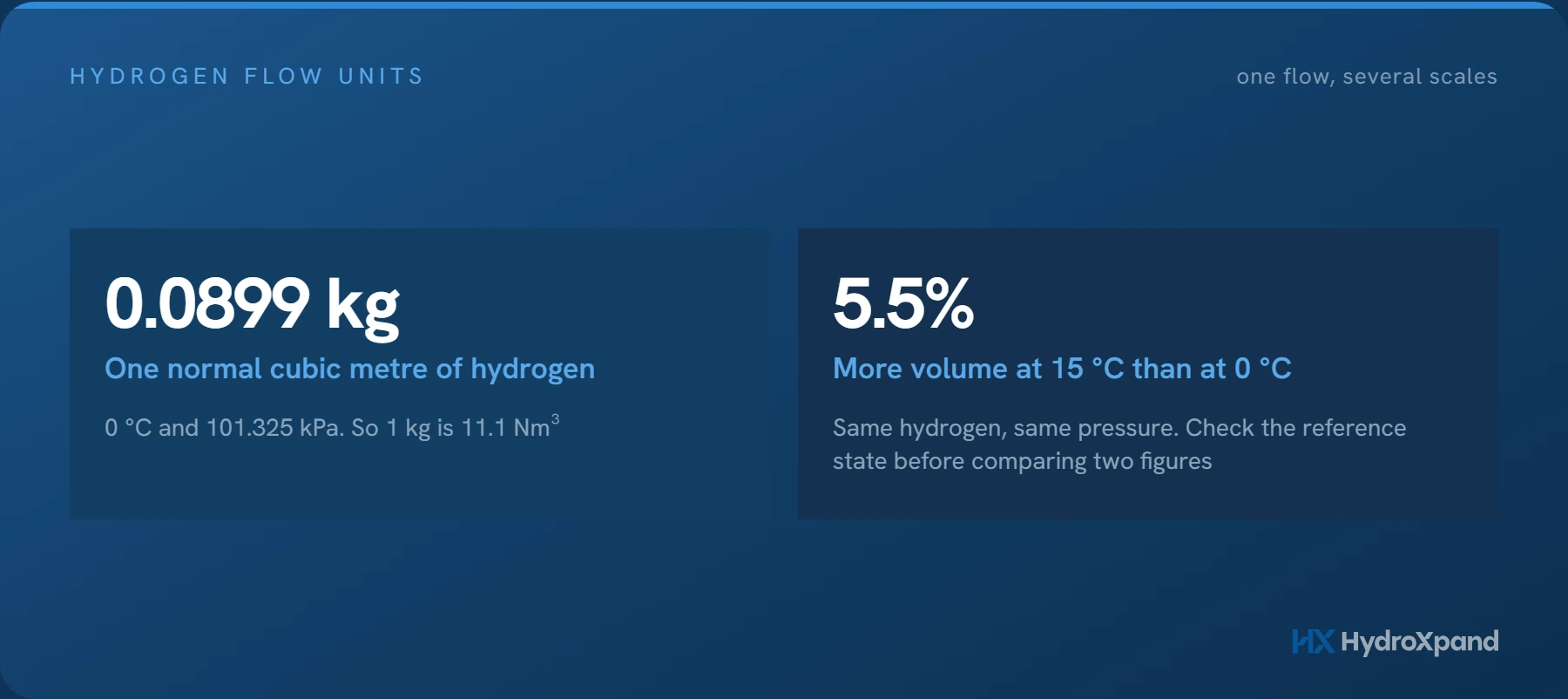
Hydrogen output is written in at least four units, and datasheets rarely use the same one twice. A European supplier quotes Nm³/h, a laboratory flow controller reads in NL/min or SLPM, an American catalogue gives SCFH, and a project plan counts kilograms a day.
The arithmetic between them is easy. What makes figures hard to compare is the part that is usually left off: the temperature and pressure the volume was corrected to. Get that right and the rest is multiplying by a few fixed numbers.
Three questions every flow figure has to answer
Before converting anything, read the unit as three separate statements.
- Volume or mass. Nm³, NL, SCF and SLPM are volumes; kg is mass. Going from one to the other needs a density, and density needs a temperature and a pressure.
- Over what time. h, min and day. 1 NL/min is 60 NL/h, which is 0.06 Nm³/h. A per-day figure also hides how many hours the machine ran.
- At what reference state. The N or S in front of the unit says the volume was corrected to a reference. It does not say which one.
Keep rate and quantity apart as well. A generator rated at 1 kg/day and a vessel holding 1 kg are different things: one is a production speed, the other is what sits in a tank.
Normal is not standard
A gas expands when it warms, so a volume only means an amount of hydrogen once the temperature and pressure are fixed. Different industries fixed them differently, and the words normal and standard do not line up across countries.
In European practice, normal conditions are 0 °C and 101.325 kPa (DIN 1343). The gas industry's standard conditions are 15 °C at the same pressure (ISO 13443). American SCF and SCFH are usually referenced to 60 °F and one atmosphere, although 14.73 psia also appears. IUPAC's STP is 0 °C and 100 kPa, not one atmosphere.
| Reference state | Temperature, pressure | kg per m³ | m³ per kg |
|---|---|---|---|
| Normal (Nm³, NL)DIN 1343 | 0 °C, 101.325 kPa | 0.0899 | 11.1 |
| IUPAC STP | 0 °C, 100 kPa | 0.0888 | 11.3 |
| Standard (Sm³)ISO 13443 | 15 °C, 101.325 kPa | 0.0853 | 11.7 |
| US standard (SCF) | 60 °F, 14.696 psia | 0.0851 | 11.8415 ft³ per kg |
| Room reference, some instruments | 20 °C, 101.325 kPa | 0.0838 | 11.9 |
The N tells you the volume was corrected. The datasheet has to tell you to what.
The spread across the table is about 7%. That is larger than most efficiency differences buyers argue about, and it comes purely from the label on the volume. A standard cubic metre at 15 °C holds about 5% less hydrogen than a normal one, so an energy figure per Sm³ looks about 5% better than the same machine's figure per Nm³.
SLPM is the one to be most careful with. Mass flow controllers define their standard temperature by manufacturer and sometimes by model, and 0, 20 and 25 °C all appear. The calibration certificate states it.
Densities here are ideal-gas values from the NIST molar mass of 2.01588 g/mol. NIST's real-gas data for hydrogen at 0 °C and one atmosphere give 0.08988 kg/m³, within 0.1%, so the ideal gas law is fine at reference conditions. It is not fine at storage pressures.
SourceISO 13443:1996 Natural gas, Standard reference conditions (ISO catalogue)
Dry, absolute, and measured where
Three more conditions sit behind a normal volume, and they are the ones a flowmeter reading most often gets wrong.
Dry. Hydrogen leaving a cell is saturated with water vapour. A wet litre contains less hydrogen than a dry one, so ask any supplier whether the figure is on a dry basis.
Absolute. Reference pressures are absolute. A process line at 10 barg is at about 11 bar absolute, and 480 NL/h passing through it at 20 °C occupies only about 47 actual litres an hour. A meter reading in actual units there shows a tenth of the rated figure, and nothing is wrong with the machine.
Measured where. Output at the system outlet and output after a dryer differ by the dryer's regeneration loss, and output at the point of use differs again by any purge. Our HXB-V1 handbook takes the system outlet as the reference point for production.
Working one number through
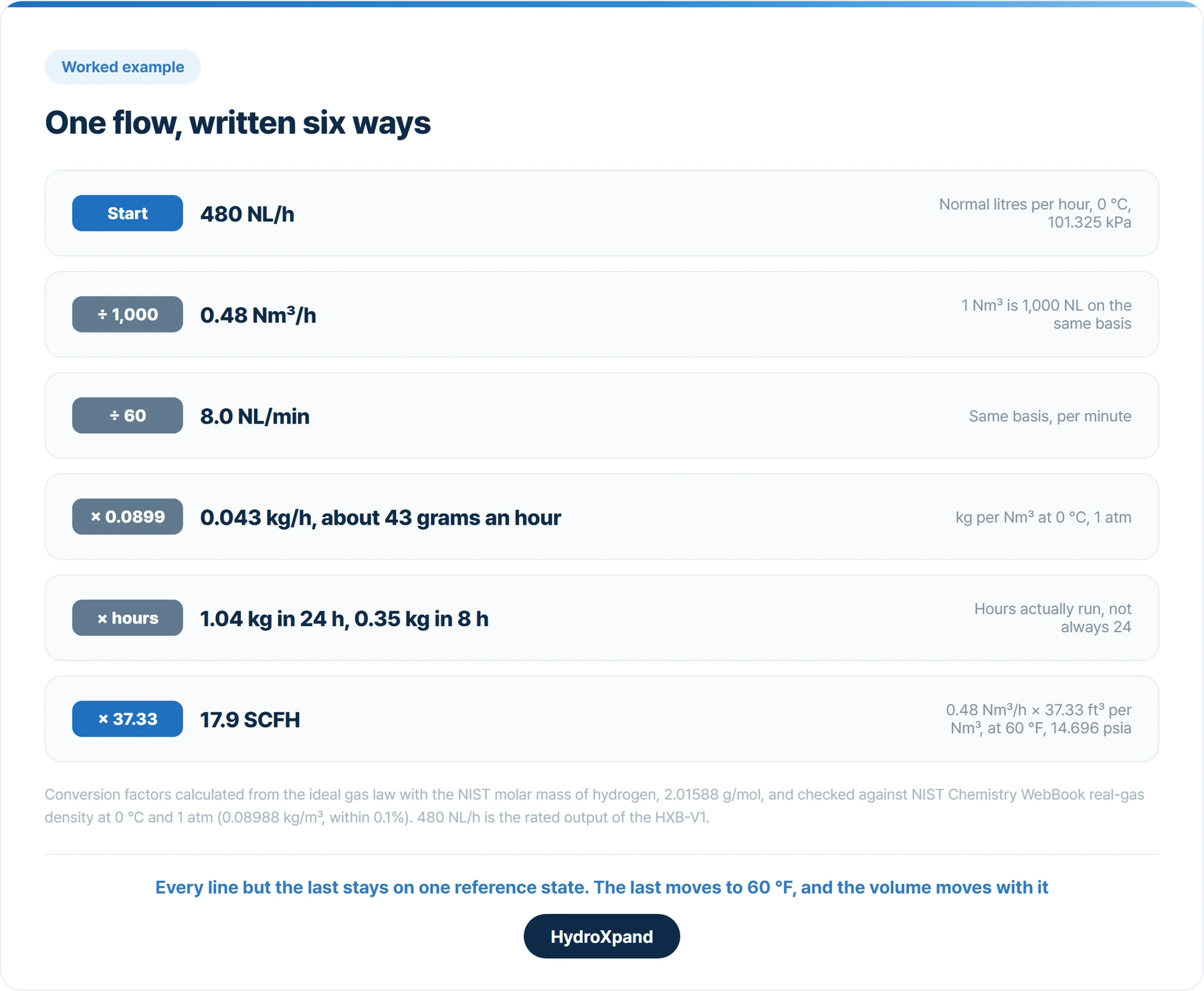
Take 480 NL/h, which is the rated output of our HXB-V1. Divide by 1,000 and it is 0.48 Nm³/h. Divide 480 by 60 and it is 8.0 NL/min. Multiply 0.48 by 0.0899 and it is about 43 grams an hour.
The HXB-V1 datasheet states that figure as 480 NL/h, at 0 °C and 1 atm, and its energy line follows from it: 2.4 kW divided by 0.48 Nm³/h is 5.0 kWh/Nm³, and multiplying by 11.12 gives 55.6 kWh/kg, which the datasheet rounds to 56 for the system. Referenced to 15 °C instead, the same HXB-V1 would read about 4.74 kWh per cubic metre without anything changing inside it.
From an hourly rate to a daily figure
A per-day figure is an hourly rate multiplied by the hours actually run. At 0.48 Nm³/h, eight hours gives 0.48 × 0.0899 × 8, about 0.35 kg. Twenty-four hours gives about 1.04 kg, which is where our about 1 kg/day comes from.
Starts, stops, maintenance and part-load running all bring the real daily figure down. If the rate changes during the day, add up each period separately. When a stated kg/day does not match your own calculation, the usual causes are the reference state, the assumed hours, or rounding.
Turning a daily requirement into a machine size, and deciding when several units beat one, is covered in the sizing articles linked below.
Before you compare two datasheets
- Put both on the same reference state. If one says Nm³ and the other SCF or Sm³, convert with the table above rather than treating the cubic metres as equal.
- Check the operating point. A rated flow belongs to a current and usually to beginning of life.
- Check where it was measured: stack outlet, system outlet, or after drying.
- For any per-day figure, find the hours behind it.
When you send us an enquiry, the most useful numbers are the hydrogen you need per day, the hours per day the plant can run, and the pressure and purity at the point of use. We will state our figures back on a named reference state.
- Hydrogen generators: how to size one→Turning daily consumption into a rated flow, and the five numbers a specification has to state.
- Between one and fifteen kilograms a day→When the daily figure lands between product grades.
- Electrolyzer efficiency explained→kWh/Nm³, kWh/kg and percent HHV, and which boundary each belongs to.
- Hydrogen storage→Where the ideal gas law stops working, and why 11 m³ per kilogram is the problem.
- HXB-V1 handbook: downstream→What leaves the outlet, and where to measure flow, dew point and pressure.
- Scaling a stack from 79 to 512 cm²→A measured result quoted in kWh per Nm³, with the hydrogen flow it was calculated from.
- HXB-V1 · 2 kW system→480 NL/h, 0.48 Nm³/h, about 1 kg a day.
Frequently asked questions
How many kilograms is one Nm³ of hydrogen?
About 0.0899 kg for dry hydrogen at 0 °C and 101.325 kPa absolute, so one kilogram is about 11.1 Nm³.
Is a standard cubic metre the same as a normal cubic metre?
No. A standard cubic metre at 15 °C holds about 5% less hydrogen than a normal cubic metre at 0 °C, and US SCF at 60 °F is close to the 15 °C basis.
How do I convert NL/min to Nm³/h?
Multiply by 60 and divide by 1,000, provided both are on the same reference state. 10 NL/min is 0.6 Nm³/h.
Sources
- ISO 13443:1996 Natural gas, Standard reference conditions — International Organization for Standardization
Looking at AEM for a specific application?