The porous transport layer, or PTL, is the porous sheet between the catalyst layer and the bipolar plate in a water electrolyzer. It carries current, brings water to the catalyst, takes gas away and provides mechanical support for the membrane. This post explains how it differs from a fuel cell GDL, why PEM anodes use titanium and alkaline and AEM cells use nickel, and what to check when you choose one.
A porous transport layer (PTL) is the porous sheet that sits between the catalyst layer and the bipolar plate in a water electrolysis cell. It collects and conducts current, gives water and gas a path in and out, and provides mechanical support for the thin membrane and catalyst layer.
- PTL stands for porous transport layer. It is often used interchangeably with gas diffusion layer (GDL), a term borrowed from fuel cells.
- It has four jobs: electron conduction, water supply, gas removal and mechanical support.
- The electrolyte and electrode potential determine the material: titanium on the PEM anode, nickel in alkaline and AEM cells, carbon paper on many cathodes.
- A PTL handles transport and current collection. When catalyst is applied to a porous substrate, the substrate becomes part of the electrode while still functioning as a PTL.
- Six properties matter when choosing one: porosity, pore size, thickness, surface roughness, contact resistance and corrosion resistance.
Where the PTL sits
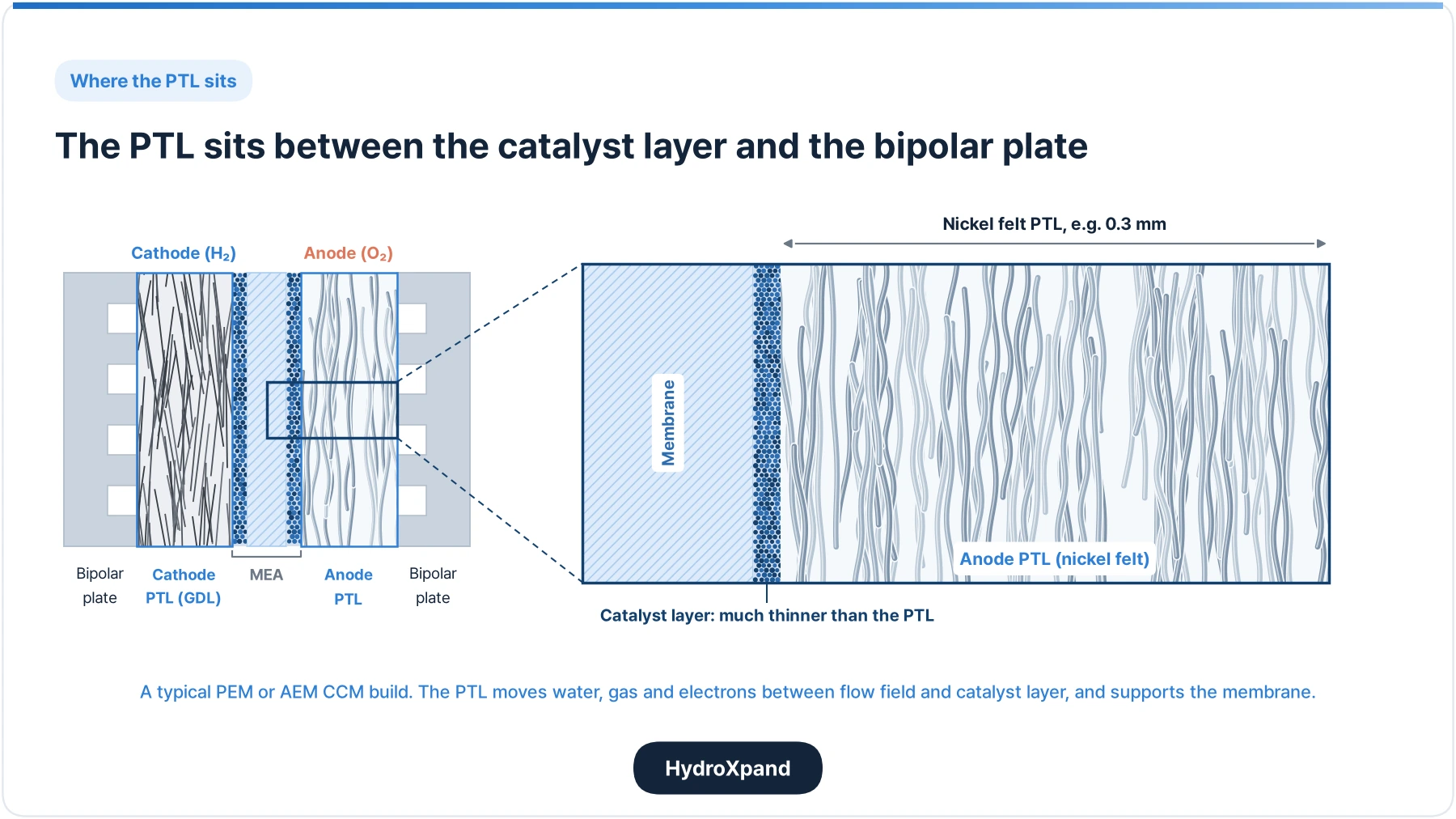
Consider a typical catalyst-coated membrane (CCM) configuration in PEM and AEM cells: a membrane in the middle, a catalyst layer coated on each face, then a PTL and a bipolar plate on each side. Conventional alkaline cells and configurations with catalyst on the substrate are arranged differently, as discussed below. The plate carries a flow field: channels for water and gas, separated by ribs. If the catalyst layer were pressed directly against the plate, the areas under the channels would get little current and the areas under the ribs would get little water.
The PTL fills that gap. It spreads water and current from the plate evenly across the whole catalyst layer and collects the gas coming the other way, returning it to the channels. Its name describes both its structure and its role: a porous layer that transports electrons, water and gas.
| Position (anode to cathode) | Part | What it does |
|---|---|---|
| 1 | Bipolar plate | Carries current between cells; its channels distribute water and gas |
| 2 | Anode PTL | Water in, oxygen out, electron conduction |
| 3 | Anode catalyst layer | Oxygen evolution reaction (OER) |
| 4 | Membrane | Conducts ions, keeps hydrogen and oxygen apart |
| 5 | Cathode catalyst layer | Hydrogen evolution reaction (HER) |
| 6 | Cathode PTL (GDL) | Hydrogen out, electron conduction |
| 7 | Bipolar plate | Carries current on to the next cell |
The membrane and its two catalyst layers make up the MEA, the membrane electrode assembly. Some sources count the PTLs as part of the MEA as well.
- What is an MEA→The membrane and catalyst layers the PTL presses against.
- What is an electrolyzer stack→How cells, plates and PTLs are assembled into a stack.
Four functions and their trade-offs
| Job | What moves | Path |
|---|---|---|
| Electron conduction | Electrons | Through the conductive skeleton, metal or carbon, between catalyst layer and plate |
| Water supply | Water (electrolyte in alkaline cells) | Through the pores, from the channels to the catalyst |
| Gas removal | Oxygen at the anode, hydrogen at the cathode | Through the pores, from the catalyst back to the channels |
| Mechanical support | Clamping load | Bridges the channels so the membrane does not sag into them |
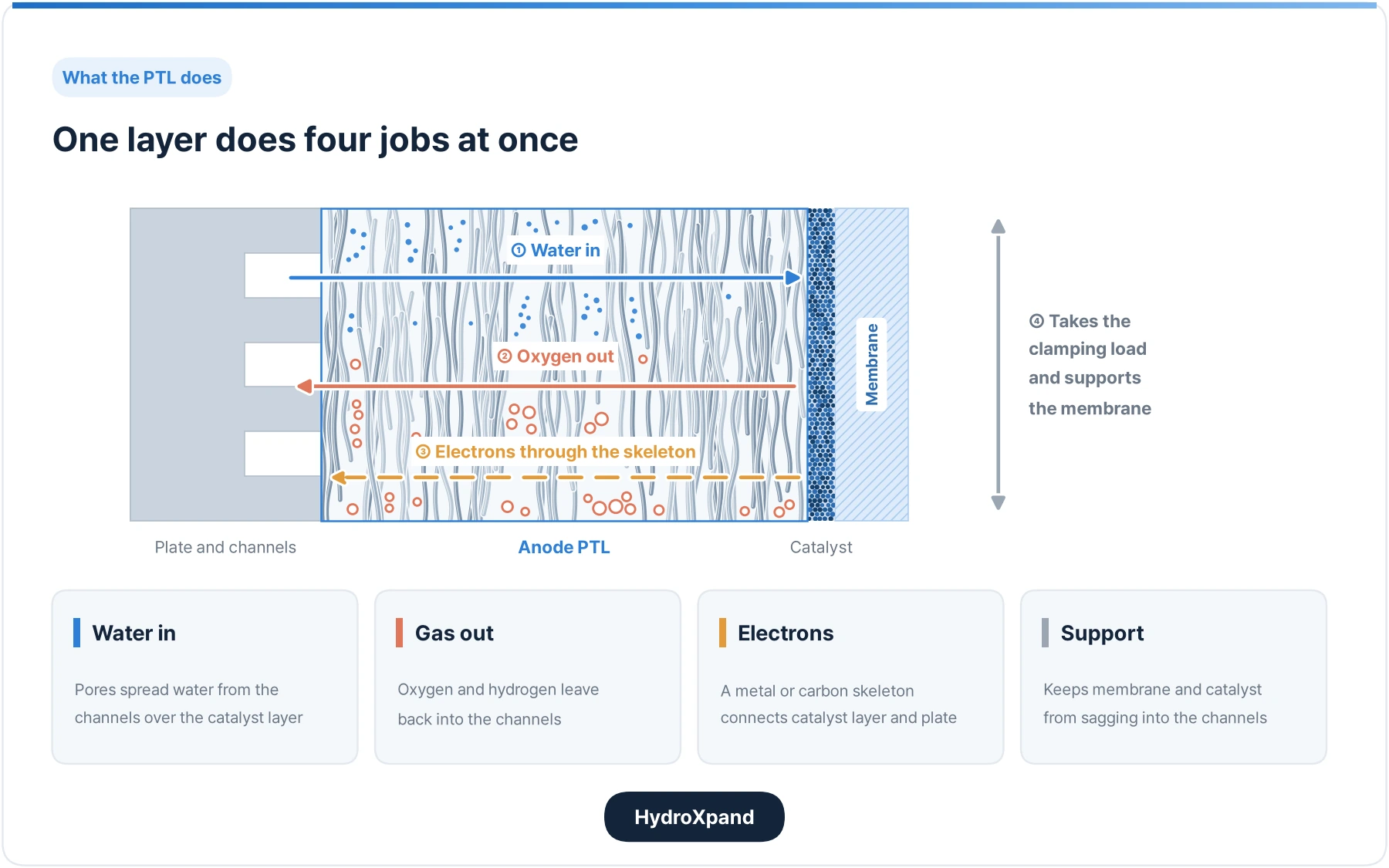
Each function has different structural requirements. Electrons need a conductive skeleton, metal or carbon fibre; water and gas need empty space. Other things being equal, more open volume helps water and gas but leaves fewer paths for current and less stiffness to support the membrane, while less open volume conducts better but makes it harder for bubbles to escape. Pore connectivity and how readily water wets the material also affect this balance.
These trade-offs become more pronounced at higher current density, as more gas is produced in the same amount of time. Bubbles that stay inside the PTL block water from reaching that part of the catalyst layer, and the cell voltage rises or becomes unsteady. Designing a PTL comes down to where you set that balance.
PTL vs GDL
Gas diffusion layer is the older term, from fuel cells. A fuel cell feeds in hydrogen and air, so the layer's main job there is to spread gas over the catalyst and carry product water away. An electrolyzer runs the other way: water goes in and gas comes out. That is why electrolysis literature tends to prefer the broader name, transport layer.
| Fuel cell GDL | Electrolyzer PTL | |
|---|---|---|
| Goes in | Hydrogen, air | Water (electrolyte in alkaline) |
| Comes out | Water | Oxygen, hydrogen |
| Typical material | Carbon paper or cloth | Anode: titanium or nickel. Cathode: carbon paper or nickel |
| Surface treatment | Water-repellent treatment, microporous layer | Depends on the material, for example a precious-metal coating |
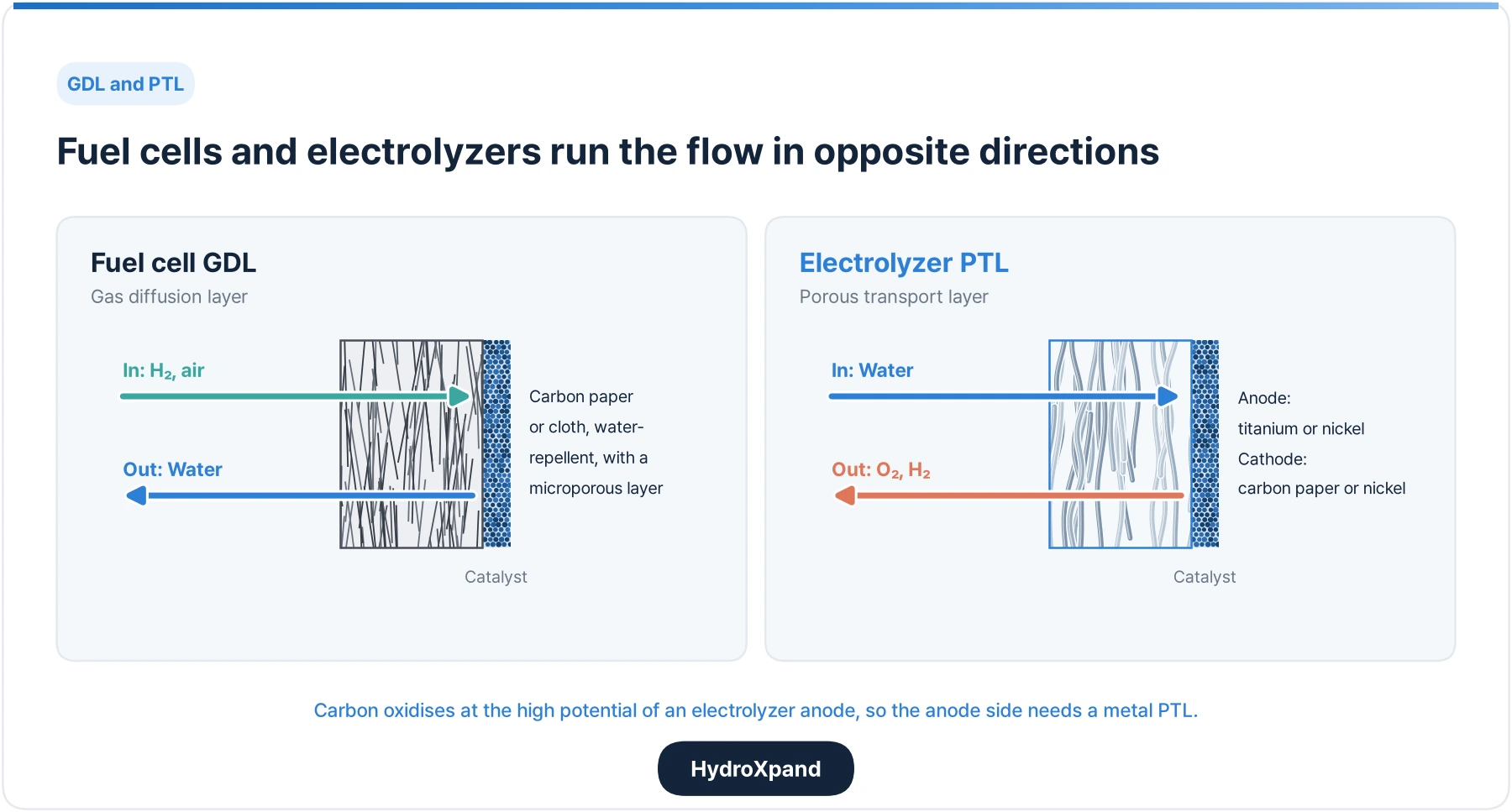
The two terms are not always used consistently. Carbon paper on an electrolyzer cathode belongs to the same product family as a fuel cell GDL and is usually still called a GDL. Many papers also use the two terms loosely.
The material difference is clear at the anode. At the high potential where oxygen evolves, carbon oxidises and wears away. A carbon GDL cannot simply be used on an electrolyzer anode, which is why the anode side needs a metal PTL.
Materials: titanium for PEM, nickel for alkaline and AEM
| Anode PTL | Cathode PTL | Why | |
|---|---|---|---|
| PEM | Titanium (sintered, felt or mesh), often precious-metal coated | Carbon paper | Titanium is widely used for its corrosion resistance on an acidic, high-potential anode |
| Alkaline | Nickel (mesh, foam and others) | Nickel | Nickel is relatively stable in alkaline conditions |
| AEM | Nickel (foam, felt or mesh) | Carbon paper or nickel | The alkaline environment allows the use of nickel |
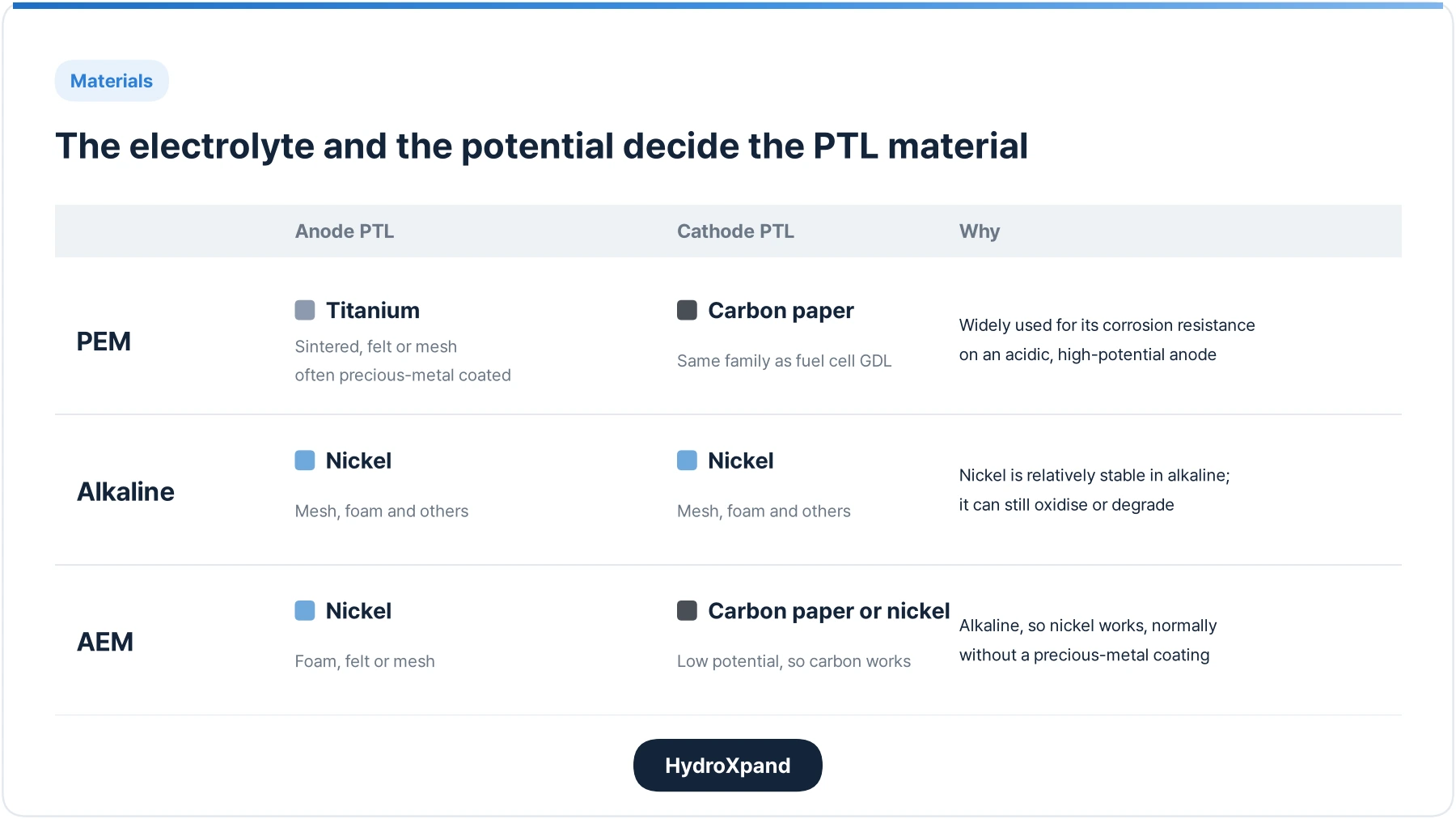
PEM anode: titanium. A PEM cell uses an acidic membrane and operates at a high anode potential. Nickel and stainless steel corrode there and carbon oxidises, so titanium is widely used for its corrosion resistance. Titanium resists corrosion because a thin oxide layer forms on its surface, but that oxide conducts poorly, so contact resistance can increase over extended operation. Titanium PTLs therefore often have a thin coating of platinum or iridium. They come as sintered titanium powder, sintered titanium fibre felt, or woven and expanded mesh.
Alkaline and AEM: nickel. Nickel is relatively stable in alkaline conditions, so nickel foam, nickel felt and nickel mesh are the usual choices. Nickel is easier to process than titanium and is normally used without a precious-metal coating, although its surface can still oxidise or degrade depending on potential and operating conditions. Nickel is also somewhat active for oxygen evolution in alkaline conditions, which is why it is common to apply catalyst directly to a nickel substrate so that the sheet serves as both electrode and PTL.
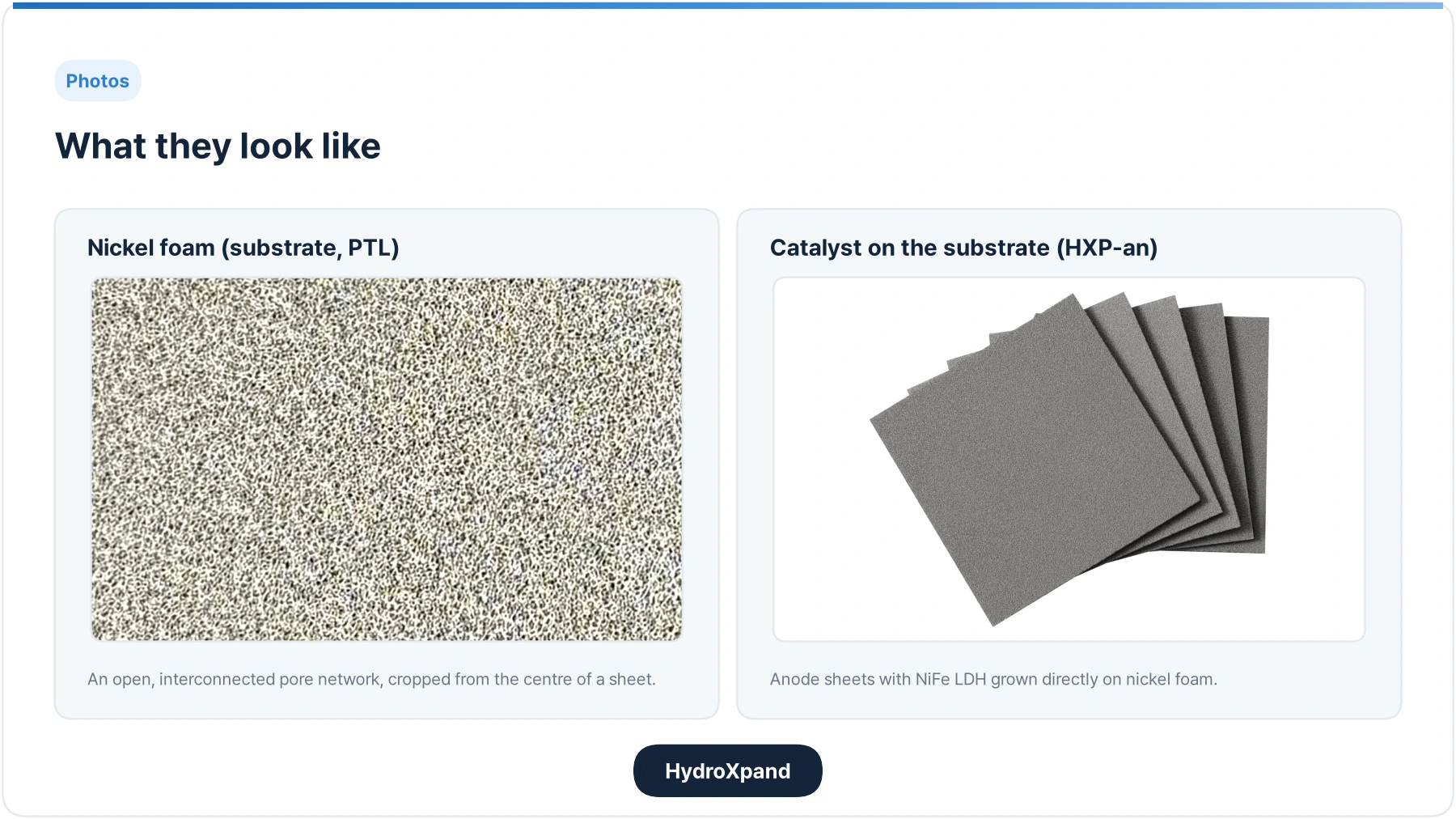
Foam and felt differ in structure. Foam is a sponge-like skeleton with interconnected pores; the foams we supply range from 0.3 mm to 5 mm thick. Felt consists of overlapping metal fibres bonded at their contact points; the felts we supply are around 0.3 mm thick.
Cathode: often carbon paper. The cathode operates at a low potential where carbon does not oxidise, so both PEM and AEM cells commonly use carbon paper there. Our HXP-ca cathode is built on carbon paper too.
- PEM water electrolysis: what the acidic membrane buys, and what it costs→Why PEM needs titanium and precious metals.
- Nickel foam and nickel felt substrates→How foam and sintered fibre differ, in more detail.
Electrode or PTL
A PTL is the layer that handles transport and current collection; the electrode is where the reaction takes place. In a catalyst-coated membrane (CCM) configuration, the reaction takes place mainly in the catalyst layer on the membrane, and the PTL moves water and gas and collects current. When the catalyst goes onto the porous substrate instead, the substrate becomes part of the electrode and continues to function as a PTL. Some substrates, nickel among them, are somewhat active on their own, so the presence of catalyst alone does not distinguish an electrode from a PTL.
| As a PTL (CCM configuration) | Catalyst on the substrate (electrode and PTL) | |
|---|---|---|
| Where the reaction mainly occurs | In the catalyst layer on the membrane | On the catalyst on the substrate surface |
| What the pores should favour | Easy passage for water and gas, and wide, even contact with the catalyst layer | Surface area for catalyst as well as gas release |
| Where it is common | CCM configurations in PEM and AEM | Nickel-substrate electrodes in alkaline and AEM |
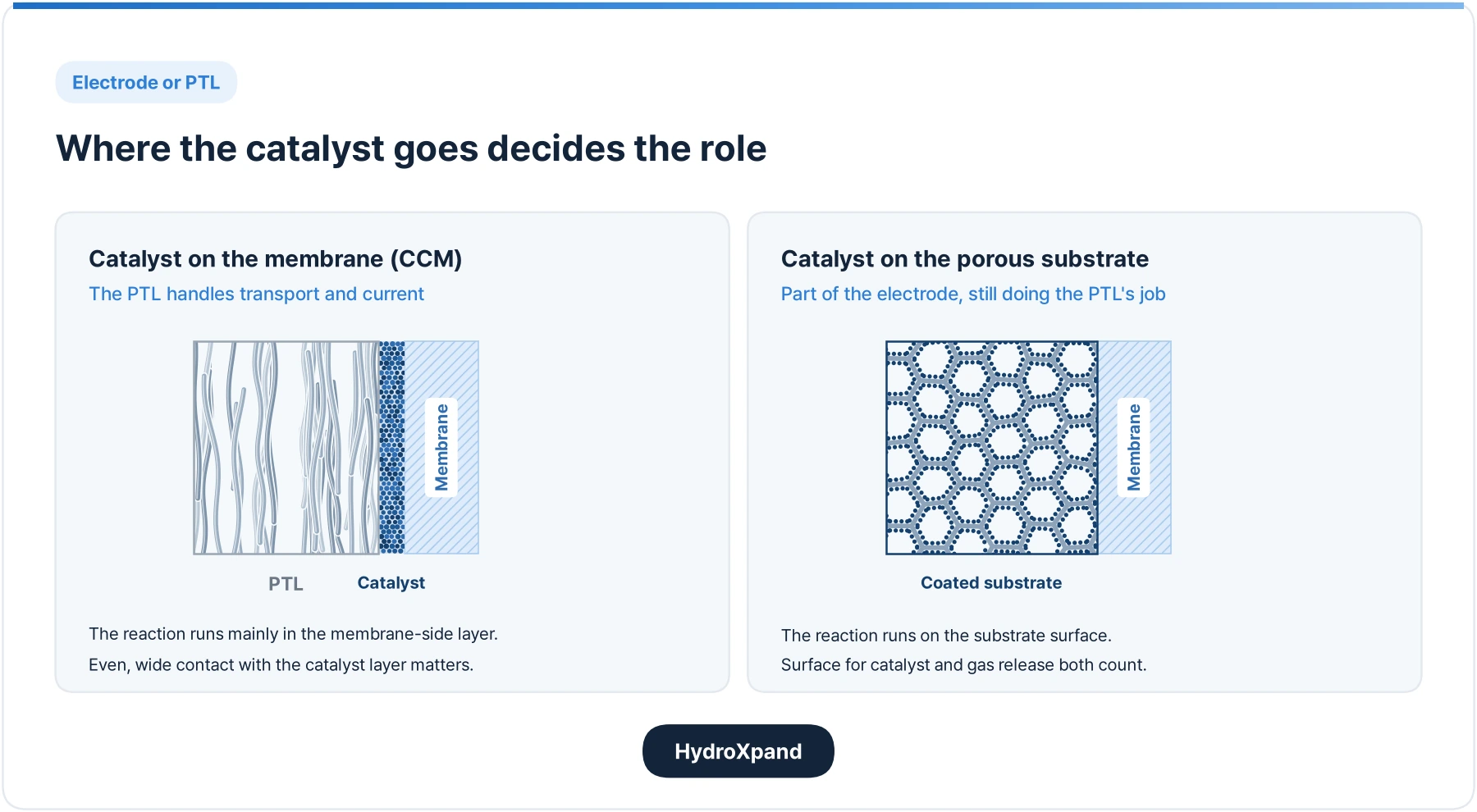
So the same nickel foam needs a different pore structure depending on its job. As an electrode it needs surface area for the catalyst, which favours finer pores. As a PTL, easy passage for water and gas comes first. Other things being equal, coarse pores release bubbles easily but leave less surface for catalyst; fine pores add surface but trap bubbles once current density goes up.
Our HXP-an anode is NiFe LDH grown directly on nickel foam, so the foam is part of the electrode and works as the PTL too.
- Selecting an electrolyzer anode→Particle-coated catalysts compared with catalysts grown directly on the substrate.
- What is OER→The reaction the anode PTL feeds with water.
- Choosing an AEM test cell→Electrode and CCM configurations compared in a test cell.
Six things to check when choosing a PTL
| Property | Meaning | What to watch |
|---|---|---|
| Porosity | Share of the volume that is empty | Higher porosity can improve water and gas transport but tends to reduce conductivity and mechanical support |
| Pore size | Size of each pore; for foam, PPI counts pores per inch as a measure of fineness | Larger pores tend to release bubbles easily but touch the catalyst layer at fewer points |
| Thickness | Thickness under compression | Greater thickness lengthens the path for water, gas and current; stiffness depends on structure and clamping |
| Surface roughness | Fine-scale height variation of the face against the membrane | Protruding fibre ends or a rough face can pierce or thin the membrane |
| Contact resistance | Resistance where the PTL meets the catalyst layer and the plate | Depends on clamping pressure, surface oxide and any coating |
| Corrosion resistance | Whether it dissolves or oxidises in operation | Set by electrolyte and potential; dissolved metal ions can poison membrane and catalyst |
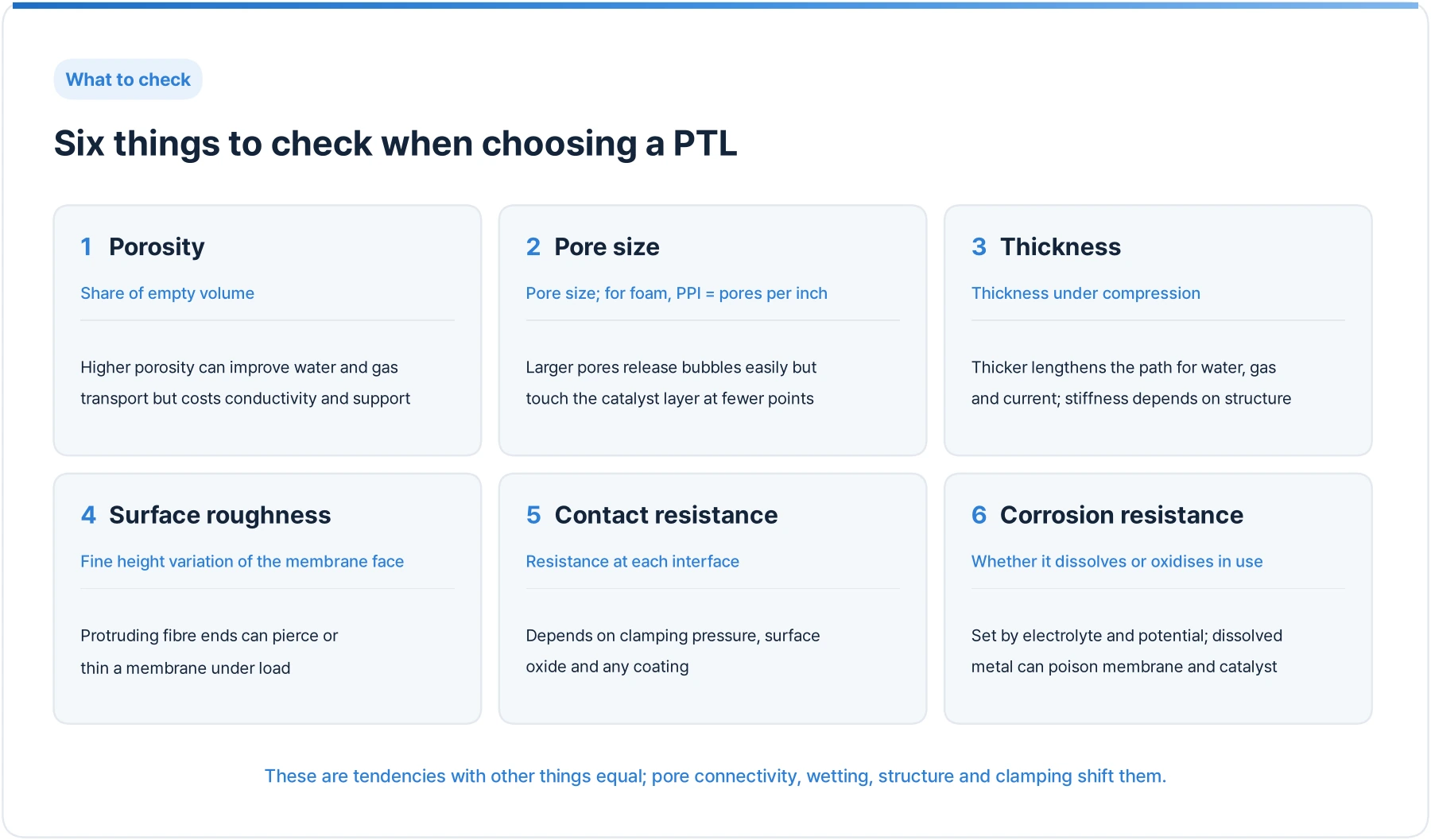
These trends assume other conditions are equal. In practice, they also depend on pore connectivity, wettability, fibre or skeleton structure, and clamping conditions.
PPI and porosity are different numbers. PPI counts pores per inch of length, a measure of how fine the structure is rather than a pore diameter; porosity is the empty fraction of the volume. In our supply table foam is specified in PPI and sintered fibre felt in porosity, so the two cannot be compared side by side.
Look at the compressed values. Clamping a stack squeezes the PTL, reducing its thickness and porosity as well as its contact resistance. How much it compresses depends on the structure and the clamping conditions. Catalogue thickness is the uncompressed figure.
The thinner the membrane, the more the surface matters. Pressure concentrates on any high spot on the PTL face, and a membrane thinned or torn there lets hydrogen and oxygen mix.
- Building an electrolyzer stack in the lab→Where clamping, sealing and alignment fail, and how to tell which.
The PTLs and substrates we supply
We supply porous metals for research on the anode side, cut to your dimensions with orders starting at a single sheet. Lead times are 2 weeks for stock sizes and up to 8 weeks for custom sizes. Use them as an electrode, as a substrate for your own catalyst, or as a PTL.
| Substrate | Structure | Thickness | Pore specification | Note |
|---|---|---|---|---|
| Nickel foam | Foam | 0.3 mm | 130 PPI | HXP-an substrate for laboratory evaluation |
| Nickel foam | Foam | 3 mm | 130 PPI | HXP-an substrate for stack use |
| Nickel foam | Foam | 5 mm | 120 PPI | HXS-30 stack substrate |
| Nickel felt | Sintered fibre | 0.3 mm | 70% porosity | |
| Sintered nickel fibre sheet | Sintered fibre | 0.25 mm | 60% porosity | Fibre diameter 22 µm (confirm against current manufacturer data before ordering) |
| Titanium felt | Sintered fibre | 0.30 mm | 70% porosity | Fibre diameter 20 µm (confirm against current manufacturer data before ordering); for conditions nickel does not suit |
| Sintered stainless fibre sheet | Sintered fibre | By grade | By grade | Grade specified when ordering |
The pore structure you need depends on whether you use the material as a PTL or coat it with catalyst. Tell us your application, electrolyte and operating temperature so we can help narrow down the options.
- Nickel foam and nickel felt substrates→Cut to size from a single sheet. 2 weeks from stock.
- HXP-an→PGM-free NiFe LDH anode grown on nickel foam.
Frequently asked questions
What does PTL stand for?
Porous transport layer: a porous sheet that transports electrons, water and gas between the catalyst layer and the bipolar plate of an electrolyzer cell.
Is a PTL the same as a GDL?
They sit in the same place, but the names come from different devices. GDL is the fuel cell term for a layer that spreads gas over the catalyst; PTL is the broader electrolysis term, where water goes in and gas comes out. Carbon paper on an electrolyzer cathode is usually still called a GDL.
Why are anode and cathode PTLs made of different materials?
The anode runs at the high potential of oxygen evolution, where carbon oxidises and, in acidic PEM cells, nickel corrodes. The cathode runs at a low potential where carbon can be used. So anodes use metal (titanium in PEM, nickel in alkaline and AEM) and cathodes often use carbon paper or nickel.
Can a PEM electrolyzer use a nickel PTL?
Not on the anode. PEM is acidic, nickel dissolves there, and the dissolved nickel ions lower the membrane's ionic conductivity. PEM anodes use titanium.
Can an AEM electrolyzer use a titanium PTL?
It can. Nickel is the usual choice because it is relatively stable in alkaline conditions and is normally used without a precious-metal coating. If you use titanium, check its corrosion resistance in your electrolyte and potential window, the contact resistance its surface oxide adds, and whether it needs a coating.
Is higher porosity always better?
No. Other things being equal, higher porosity allows water and gas to pass more easily, but leaves less solid to carry current and less stiffness to support the membrane. The right value depends on current density, membrane thickness and clamping pressure.
Can I put catalyst directly on a PTL?
Yes. It then becomes part of the electrode while still working as the PTL, and you need to look at surface area for the catalyst as well as gas release. Alkaline and AEM cells often use catalyst on nickel foam or nickel felt in exactly this way.
Looking at AEM for a specific application?