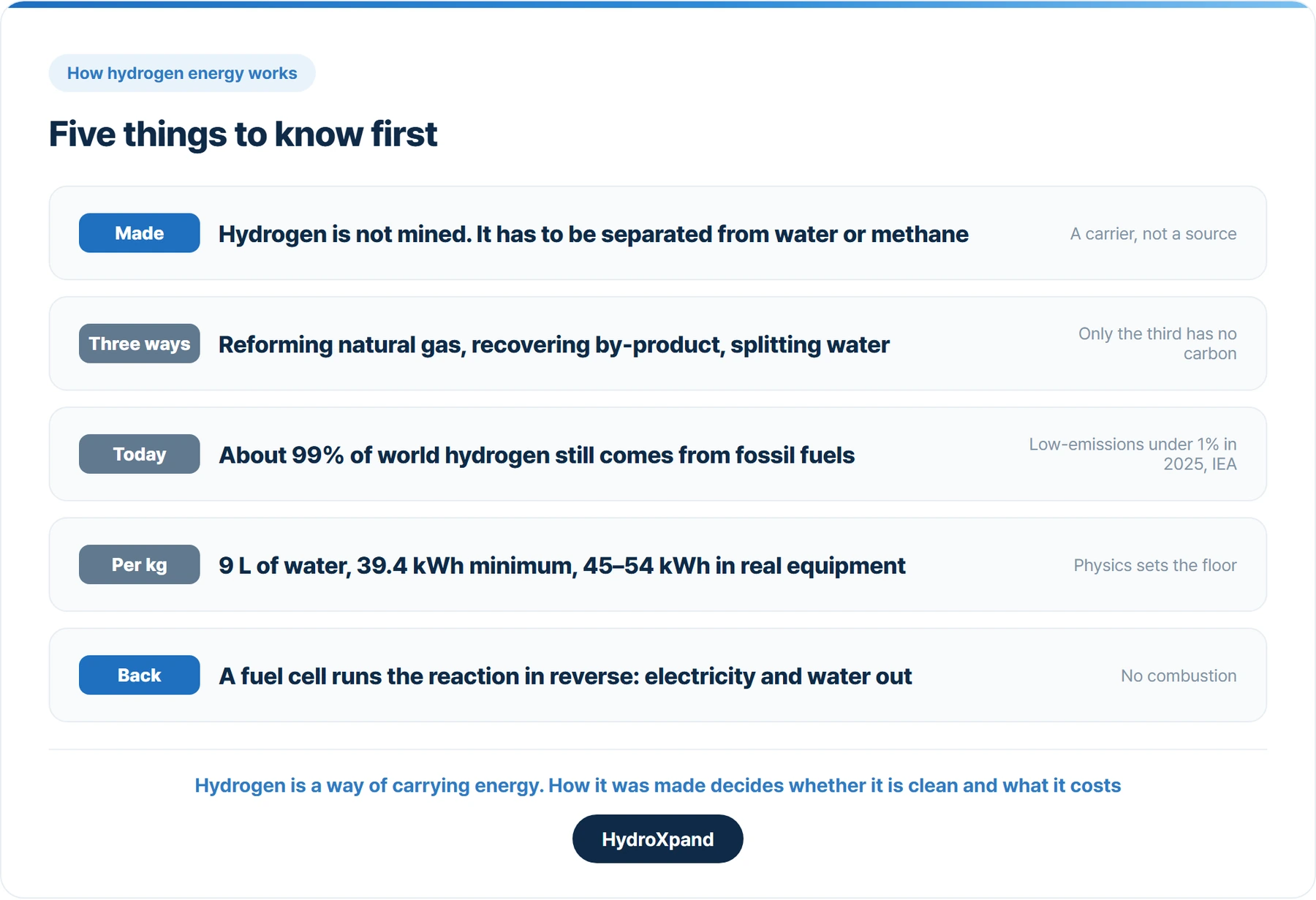
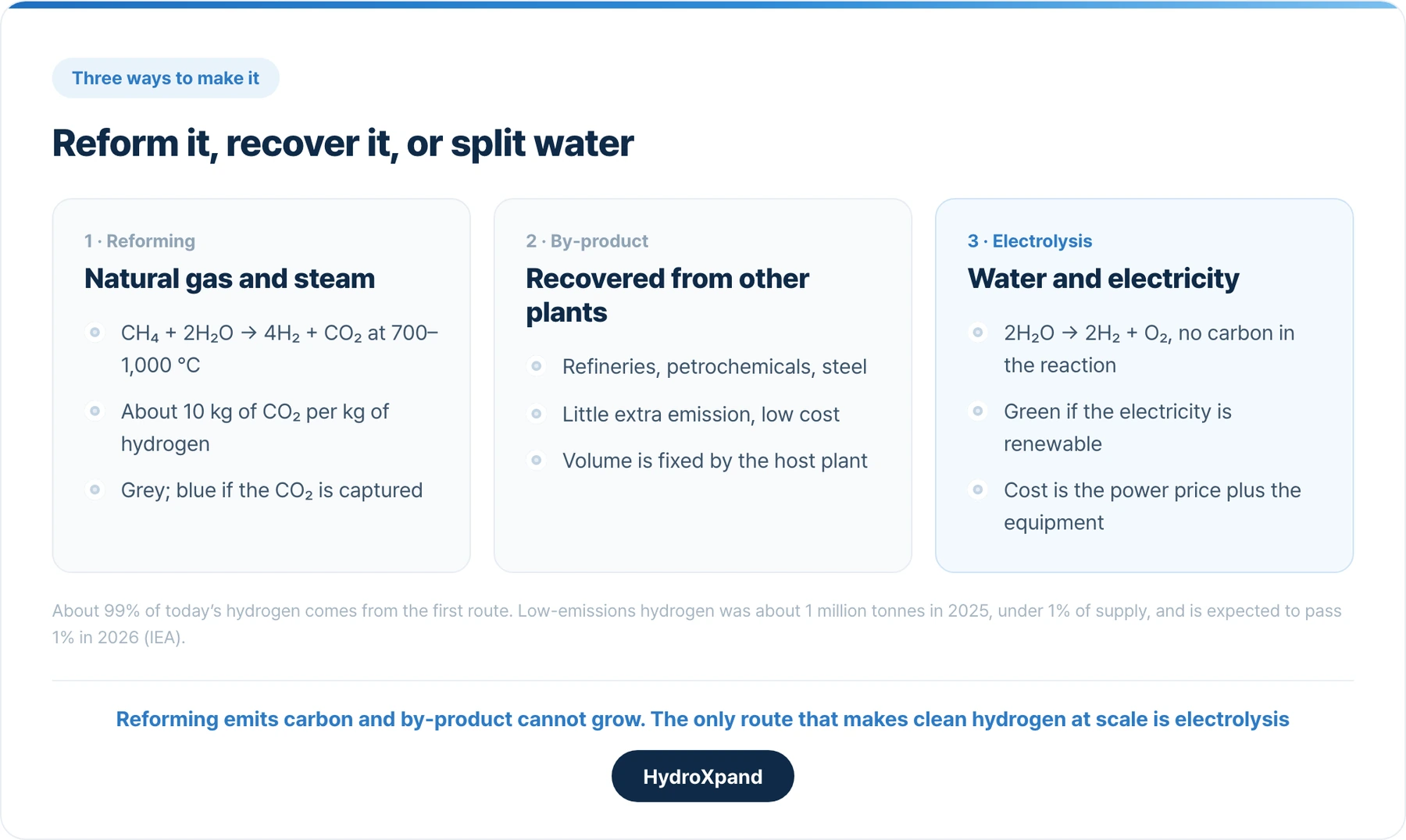
Hydrogen is not an energy source that is found. It is one that has to be made, by separating it from water or methane, and that single fact explains most of what follows: why there are three ways to make it, why only one of them is clean, why 39.4 kWh per kilogram is a floor no electrolyzer can go under, and why a fuel cell is the same reaction run backwards.
Hydrogen energy is talked about constantly, and the part that is usually skipped is where the hydrogen comes from. Without that, it is hard to see why green hydrogen and grey hydrogen have different prices, why electrolysis is expensive, or why a gas that burns to water can still have a carbon footprint.
This article follows the energy from one end to the other. It covers what hydrogen energy is and why hydrogen has to be made rather than found, the three ways of making it, how an electrolyzer splits water and how much electricity that takes, and how a fuel cell turns the hydrogen back into electricity. It is written for someone looking at the hydrogen industry for the first time, whether as a buyer, an engineer or a student, who wants the whole picture in one reading.
What hydrogen energy is
Hydrogen energy means using hydrogen gas as a fuel to get electricity and heat. When hydrogen reacts with oxygen, the products are electricity or heat and water, and nothing else. That is the property everything is built on.
The property that matters just as much is easy to miss. Hydrogen is a secondary energy, not a primary one. Coal and oil come out of the ground as fuel. Hydrogen, although it is about three quarters of the mass of the universe, hardly exists free on Earth. It is bound up in water and in methane, and to use it you first have to separate it, which takes energy.
That is why hydrogen is called an energy carrier. It does not supply energy the way a coal seam does. It holds energy that was put into it, the way electricity does, and carries it somewhere else. This one fact produces both sides of the hydrogen ledger: renewable electricity can be turned into hydrogen, stored for months and moved across oceans, which is the advantage, and making it costs an extra conversion, which is the disadvantage.
Three ways to make hydrogen
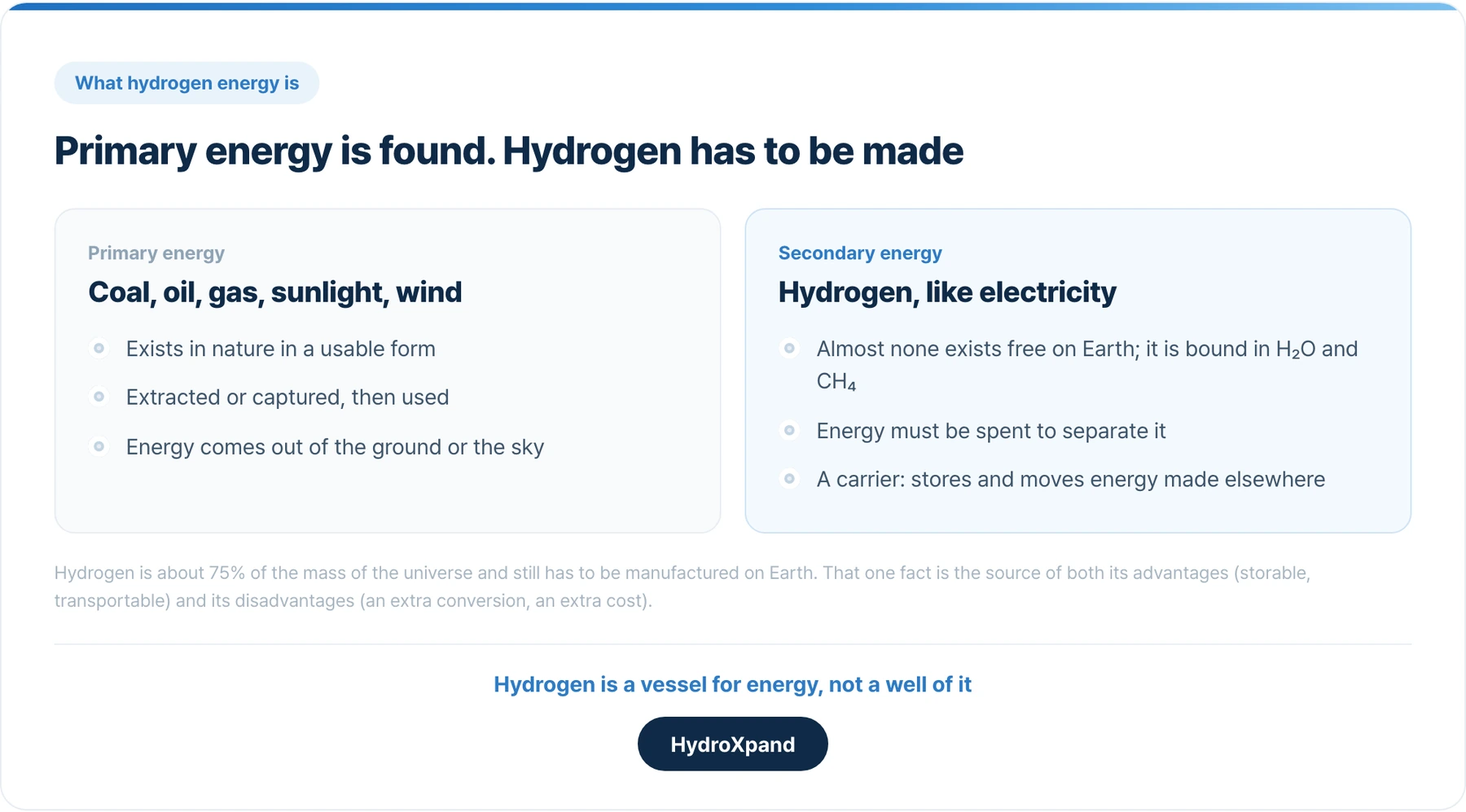
There are three ways to get hydrogen out of the compounds it is bound in, and they differ in what goes in, what comes out beside the hydrogen, and how far they can scale.
1. Reforming: pull it out of natural gas
Methane is reacted with steam at 700 to 1,000 °C, and hydrogen comes off. This is steam methane reforming, and it makes most of the world's hydrogen. The reaction is CH₄ + 2H₂O → 4H₂ + CO₂: four molecules of hydrogen and one of carbon dioxide, which in a real plant comes to about 10 kg of CO₂ per kilogram of hydrogen. Hydrogen made this way is called grey. Capture the CO₂ and store it, and the same hydrogen is called blue.
Most hydrogen produced today in the United States is made via steam-methane reforming, a mature production process in which high-temperature steam (700°C–1,000°C) is used to produce hydrogen from a methane source, such as natural gas.
2. By-product: recover it from another process
Refineries, petrochemical plants and steelworks give off hydrogen as a side product of what they are really making. Collecting and purifying that gas is by-product hydrogen. Because it is being made anyway, the extra emissions are small and the cost is low. The limit is volume: the amount is fixed by the host plant, and it cannot be increased because someone wants more hydrogen.
3. Electrolysis: split water with electricity
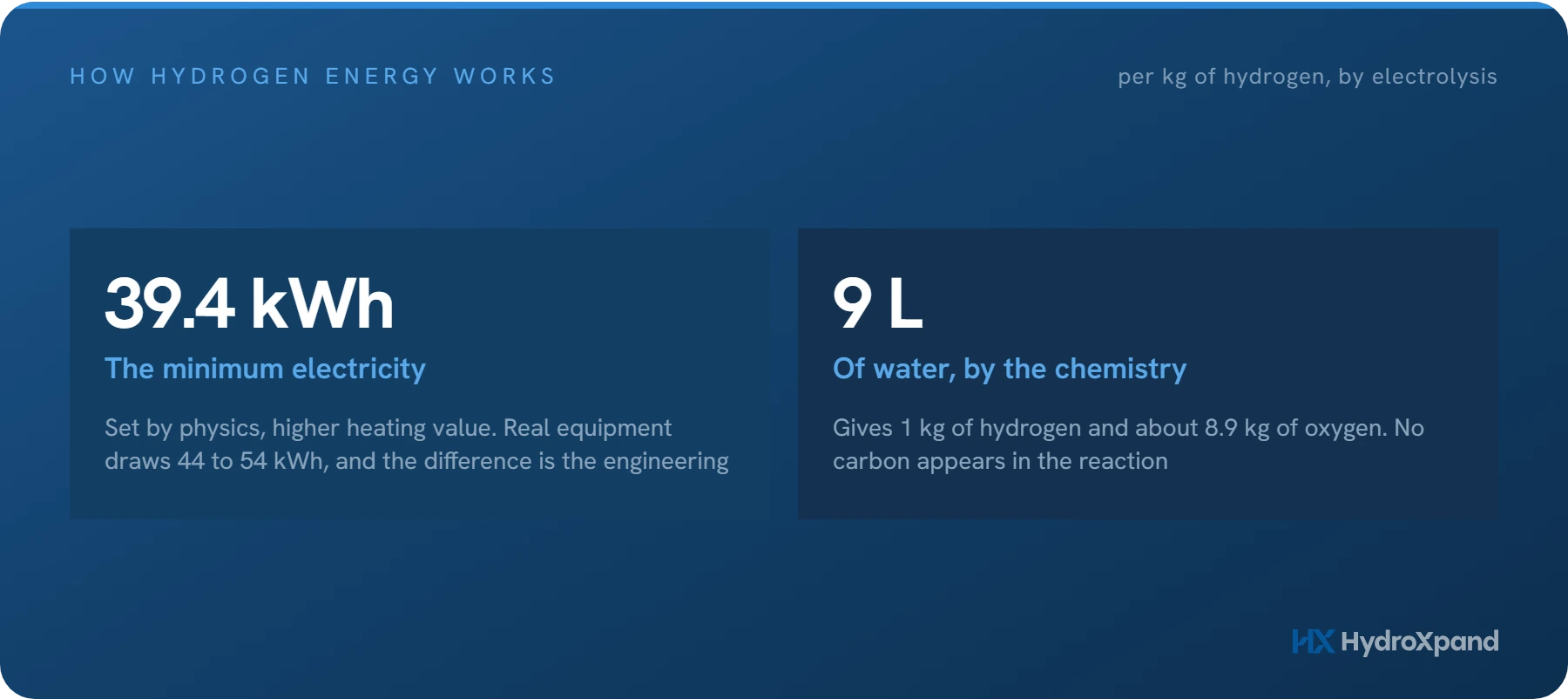
Pass a current through water and it separates into hydrogen and oxygen: 2H₂O → 2H₂ + O₂. No carbon appears anywhere in the reaction, so if the electricity is renewable, the hydrogen is made without CO₂. That is green hydrogen. The feedstock is water, 9 litres per kilogram of hydrogen by the chemistry, with about 8.9 kg of oxygen released alongside. What remains to be paid for is the electricity and the equipment, and those two prices decide almost the whole economics of electrolysis.
About 99% of today's hydrogen comes from the first route. Low-emissions hydrogen of every kind reached about one million tonnes in 2025, under 1% of world supply, and the IEA expects it to pass 1% in 2026. Hydrogen is not clean by nature; it is clean or not depending on which of the three routes made it.
How electrolysis splits water
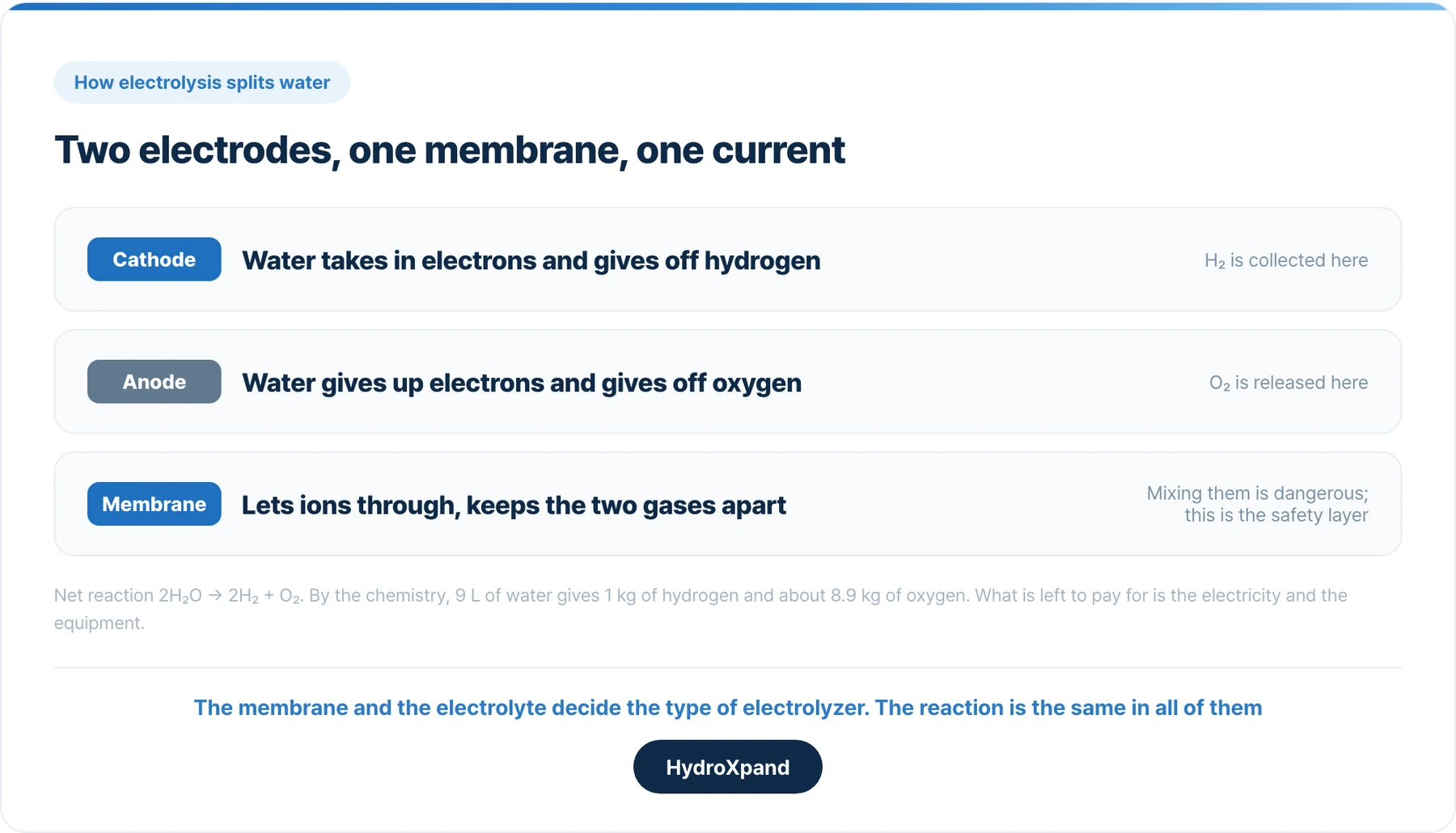
Inside an electrolyzer are two electrodes in water with a thin membrane between them. Apply a voltage and different reactions run at each electrode. At the cathode, water takes in electrons and gives off hydrogen. At the anode, water gives up electrons and gives off oxygen. The membrane in the middle lets ions pass and keeps the two gases from meeting, which matters because a mixture of hydrogen and oxygen is explosive. The membrane is the safety layer as well as the electrical one.
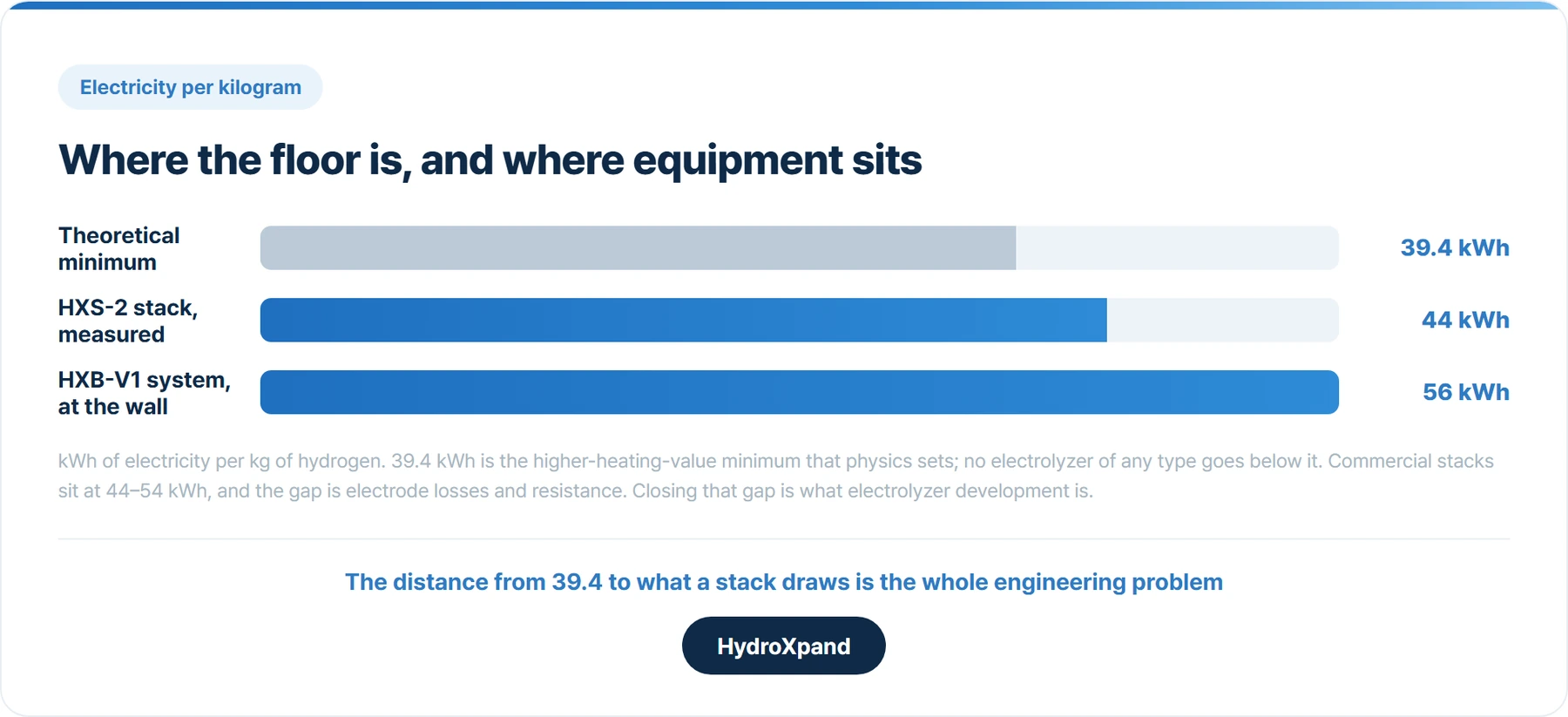
How much electricity this takes has a floor that physics sets. Splitting water needs a minimum of 39.4 kWh of electricity per kilogram of hydrogen on a higher-heating-value basis, and no electrolyzer of any design goes below it. Real equipment uses more, because of losses at the electrodes and resistance in the cell. Commercial stacks sit in a band of about 44 to 54 kWh per kilogram, and shrinking the distance between that band and 39.4 is what electrolyzer development consists of.
SourceIEA Global Hydrogen Review 2024: electrolysis consumes 50 to 55 kWh per kg H2 at system level
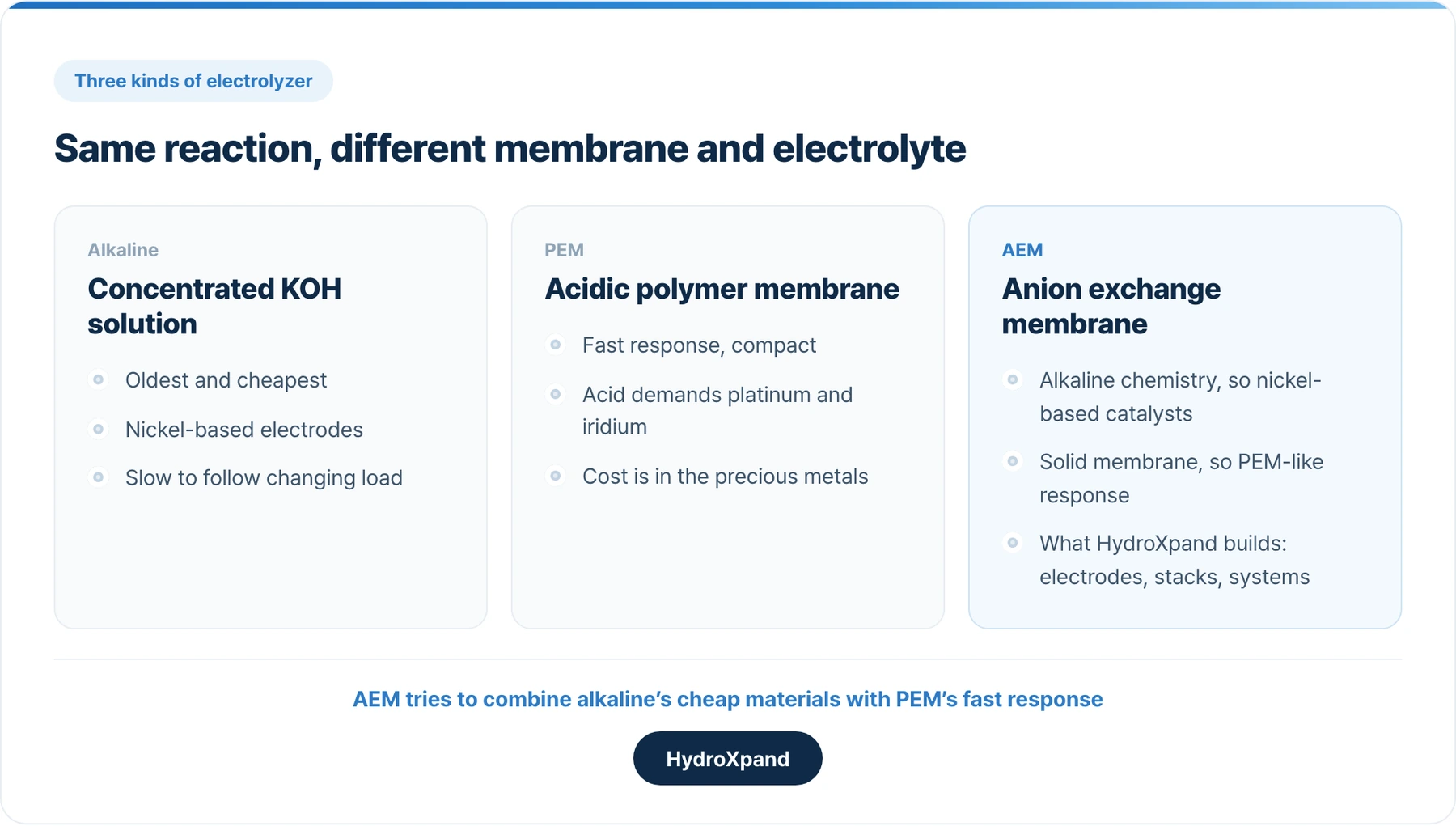
Which membrane and electrolyte are used decides the type of electrolyzer. Alkaline electrolysis runs in a concentrated potassium hydroxide solution; it is the oldest and cheapest design, but slow to follow a changing load. PEM electrolysis uses an acidic polymer membrane; it responds fast, but the acid demands platinum and iridium. AEM electrolysis uses an anion exchange membrane in alkaline conditions, so it can use nickel-based catalysts like alkaline while responding like PEM. It is an attempt to combine the strengths of the other two, and it is what HydroXpand makes.
| Alkaline | PEM | AEM | |
|---|---|---|---|
| Electrolyte | Concentrated KOH solution | Acidic polymer membrane | Anion exchange membrane, alkaline |
| Catalysts | Nickel-based | Platinum, iridium | Nickel-based |
| Response to changing load | Slow | Fast | FastSolid membrane |
| Where the cost sits | Large, slow plant | Precious metals | Membrane and electrode development |
How hydrogen becomes electricity again
Using the hydrogen runs the reaction the other way. A fuel cell is an electrolyzer in reverse: feed it hydrogen and oxygen, and it gives electricity and water. The two devices share their chemistry and much of their construction.
What matters is that this is an electrochemical reaction, not combustion. Nothing burns, so there is no flame, no nitrogen oxides and no Carnot limit on the efficiency, which is why a fuel cell can in principle beat a generator driven by an engine. The price is that energy is lost twice, once when the hydrogen is made and once when it is turned back. From electricity to hydrogen and back to electricity, about a third of the original energy returns, 30 to 36% on our own measured figures. Hydrogen is therefore used where electricity cannot simply be used directly: where energy has to be stored for months, where a battery would be too heavy for the distance, or where the process itself needs hydrogen, as steelmaking does.
Hydrogen is a vessel for energy, not a well of it. How it was filled decides whether it is clean and what it costs.
SourceU.S. DOE: Fuel Cells for Stationary Power Applications (electrical efficiency up to 60%)
The whole picture in one table
| In | Out | What to know | |
|---|---|---|---|
| Reforming | Natural gas and steam | Hydrogen and CO₂ | Cheap, emits carbon. Grey, or blue with capture |
| By-product | Another plant's off-gas | Hydrogen | Little extra emission; volume fixed by the host |
| Electrolysis | Water and electricity | Hydrogen and oxygen | No carbon in the reaction. Green if the power is renewable |
| Fuel cell | Hydrogen and oxygen | Electricity and water | Electrolysis in reverse; electrochemical, not combustion |
What an electrolyzer company sees in this
Follow the three routes to their ends and they meet at one point: for hydrogen to be clean, electrolysis has to become cheap. Reforming emits carbon and by-product cannot grow, so the only route to large volumes of clean hydrogen is splitting water.
The cost of electrolysis divides into the price of electricity and the price of the equipment. The first is not ours to change. The second is. HydroXpand builds AEM electrolyzers with electrodes that use no precious metals, and makes the materials, stacks and systems in house so that fewer margins stack up between the membrane and the customer. On our measured numbers, the HXB-V1 system uses 56 kWh of electricity per kilogram of hydrogen at the wall, of which 44 kWh is the HXS-2 stack. The distance from there to the 39.4 kWh floor is the gap we are working to close.
- Ask which of the three routes made the hydrogen. That answer, not the word hydrogen, sets its carbon footprint.
- For electrolysis, ask for kWh per kilogram and whether it is stack or system. The floor is 39.4; the difference above it is the equipment.
- For any use of hydrogen, ask whether electricity could have been used directly. If it could, hydrogen is the wrong tool; if it could not, the round-trip loss is the price of the job.
HydroXpand's AEM electrolysis electrodes, stacks and systems avoid iridium and PFAS membranes and are sold today, from 2 kW research and pilot units to a 30 kW stack, to buyers who want to make hydrogen from water on their own site.
- What is water electrolysis→The four numbers fixed per kilogram, and where the technologies differ on voltage.
- Hydrogen energy pros and cons→The eight points, four fixed by physics and four set by cost.
- Hydrogen fuel cell pros and cons→The way back to electricity, in detail.
- What is grey hydrogen→The reforming route, its three steps and its emissions.
- AEM water electrolysis: how it works→How HydroXpand makes the electrolysis route without iridium.
Frequently asked questions
How is hydrogen made?
Three ways: reforming natural gas with steam, recovering by-product hydrogen from refineries and steelworks, and splitting water with electricity. Reforming makes most of today's supply; electrolysis is the only one of the three with no carbon in the reaction.
How much water and electricity does 1 kg of hydrogen take?
About 9 litres of water by the chemistry. Electricity has a physical minimum of 39.4 kWh per kilogram on a higher-heating-value basis; commercial equipment uses about 44 to 54 kWh, and the difference is losses at the electrodes and resistance in the cell.
Why is hydrogen called clean energy?
Because using it gives only water. Making it is a different matter: about 99% of today's hydrogen comes from fossil fuels with CO₂ released at the plant, so whether hydrogen is clean depends on how it was made.
What is the difference between electrolysis and a fuel cell?
Direction. Electrolysis uses electricity to split water into hydrogen and oxygen; a fuel cell combines hydrogen and oxygen to make electricity and water. The reactions are each other's reverse.
If making hydrogen uses electricity, why not just use the electricity?
Where the electricity can be used directly, you should. Hydrogen is for the places it cannot be: storing energy for months, moving it over distances where a battery is too heavy, and processes like steelmaking that need hydrogen itself. About a third of the electricity comes back on the round trip, and that is the price of those jobs.
How is AEM electrolysis different?
It runs in alkaline conditions with a solid anion exchange membrane. The alkaline chemistry allows nickel-based catalysts instead of platinum and iridium, and the solid membrane gives a fast response to changing load, combining the low-cost materials of alkaline electrolysis with the responsiveness of PEM.
Sources
- Hydrogen Production: Natural Gas Reforming — U.S. Department of Energy
- Global Hydrogen Review 2024 — International Energy Agency, 2024
- Global Hydrogen Review 2025 — International Energy Agency, 2025
- Fuel Cells for Stationary Power Applications — U.S. Department of Energy, Fuel Cell Technologies Office
Looking at AEM for a specific application?