Hydrogen straight from an electrolyzer stack is saturated with water and carries trace oxygen. Whether that matters depends on the use. Here is how to read the purity figures a specification will ask for, why a dew point is not a purity, and where the dryer comes in.
Someone planning to feed electrolyzer hydrogen into a fuel cell or a process usually gets handed a purity requirement, and the notation is where the conversation stalls. Is 99.999% the same thing as 5N? Is a dew point of -70 °C good or bad, and good compared with what? And can the gas be used as it comes out of the stack?
The three questions are connected. The gas leaving an electrolyzer carries a known impurity, most of it water, and the notations are different ways of counting it.
Can it be used as it comes out?
It depends on the use. Hydrogen leaving the stack is saturated with water vapour and carries a trace of oxygen. Where the requirement is modest, gas-liquid separation alone can be enough. Where it is strict, as for fuel cells, drying and usually oxygen removal have to follow.
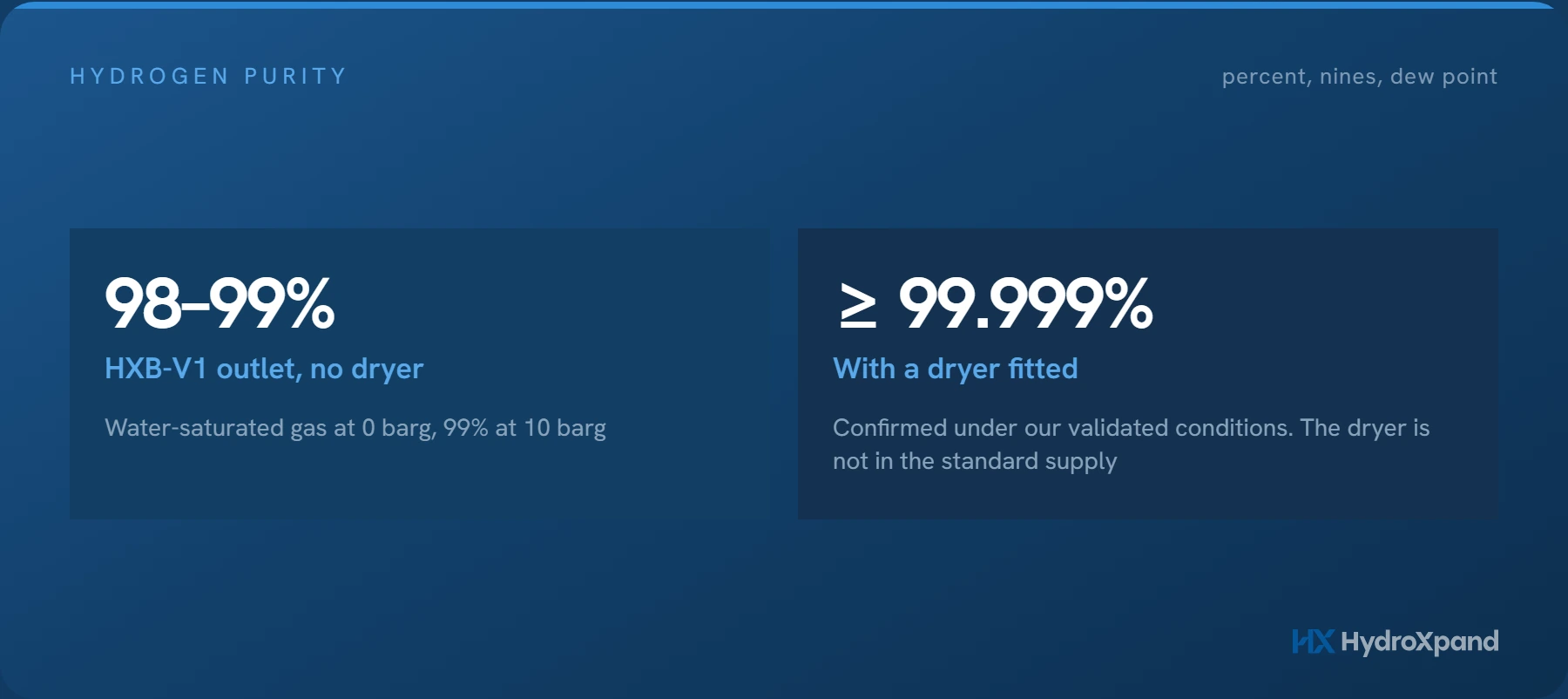
On our HXB-V1 the figures split on whether a dryer is fitted. The 99.999% belongs to the dryer, not the electrolyzer, and the dryer is not part of the standard configuration.
What is in the gas leaving the stack
Mostly water. An electrolyzer makes hydrogen from water, so the outlet gas is saturated, and the warmer the stack runs, the more vapour it carries. Most of the gap between 98 to 99% and five nines is that vapour.
Next is oxygen that has crossed the membrane. Crossover runs in two directions and they mean different things. Hydrogen in the oxygen stream is the safety figure: on HXS-2, all 49 points measured between 0 and 6 barg and 40 to 100% of rated load sat below our 2% control limit. Oxygen in the hydrogen stream is at trace level and is a purity question, settled by whether the application sets an oxygen limit.
Nitrogen is not made by the stack at all. It comes in from purge gas and air left in the pipework, so it appears at start-up and after maintenance.
Three notations, two different quantities
Purity as a percentage is the mole fraction of hydrogen, and counting the nines gives the shorthand: 99.999% is 5N. Both describe total impurity, water and oxygen and nitrogen together. In parts per million, 99.999% leaves 10 ppm for everything else, and 99.99% leaves 100.
A dew point is a different kind of figure. It is the temperature at which moisture in the gas starts to condense, so it describes water alone; the lower it is, the drier the gas. It cannot be converted into a purity, because it says nothing about oxygen or nitrogen.
| Notation | What it counts | Example |
|---|---|---|
| Percent | Total impuritywater, oxygen, nitrogen | 99.999% |
| N (nines) | Total impuritysame figure, shorter | 5N = 99.999% |
| ppm | Total impuritywhat is left over | 10 ppm = 99.999% |
| Dew point | Water only | -70 °C ≈ 2.6 ppmvatmospheric basis |
A purity counts everything that is not hydrogen. A dew point counts only the water.
The scale shows why the two have to be kept apart. At atmospheric pressure, -60 °C is about 10.7 ppmv of water, already past the whole 10 ppmv allowance for 99.999% before any oxygen is counted. At -70 °C it is about 2.6 ppmv, which leaves room for the rest. -40 °C, about 128 ppmv, stops condensation in a pipe and is well short of five nines.
SourceDOE: Hydrogen Fuel Quality Specifications for PEM fuel cells in road vehicles (ISO 14687-2 Grade D table) (2016)
A dew point needs a pressure and a place
-40 °C at atmospheric pressure and -40 °C at 10 barg are not the same condition, so a dew point is only a specification once it states its pressure basis.
Location matters too. The dew point at the dryer outlet is not the dew point at the point of use: moisture held on the pipe walls comes back out downstream, more so after a long pipe run or a long idle period.
Unless we say otherwise, the dew points we quote are atmospheric and at the dryer outlet, and we convert to line pressure or the point of use on request. Either way, meeting the figure is confirmed by measuring where the specification says.
How far to clean it, and in what order
The clean-up is built in layers, and the application decides where it stops. Gas-liquid separation comes first and takes liquid out of the gas; done poorly, it loads everything after it.
Drying removes the vapour that separation leaves behind and sets the dew point. Where the application also has an oxygen limit, as fuel cells and refuelling usually do, a catalytic step reacts the remaining oxygen with hydrogen. That turns the oxygen into water, so drying comes after it.
Many process and laboratory uses need only the moisture figure. Hydrogen duty stops at five nines; the ppb level beyond belongs to semiconductor work and is a separate train. Layers the application does not ask for only add equipment and running cost, so settle the required grade before anything is priced.
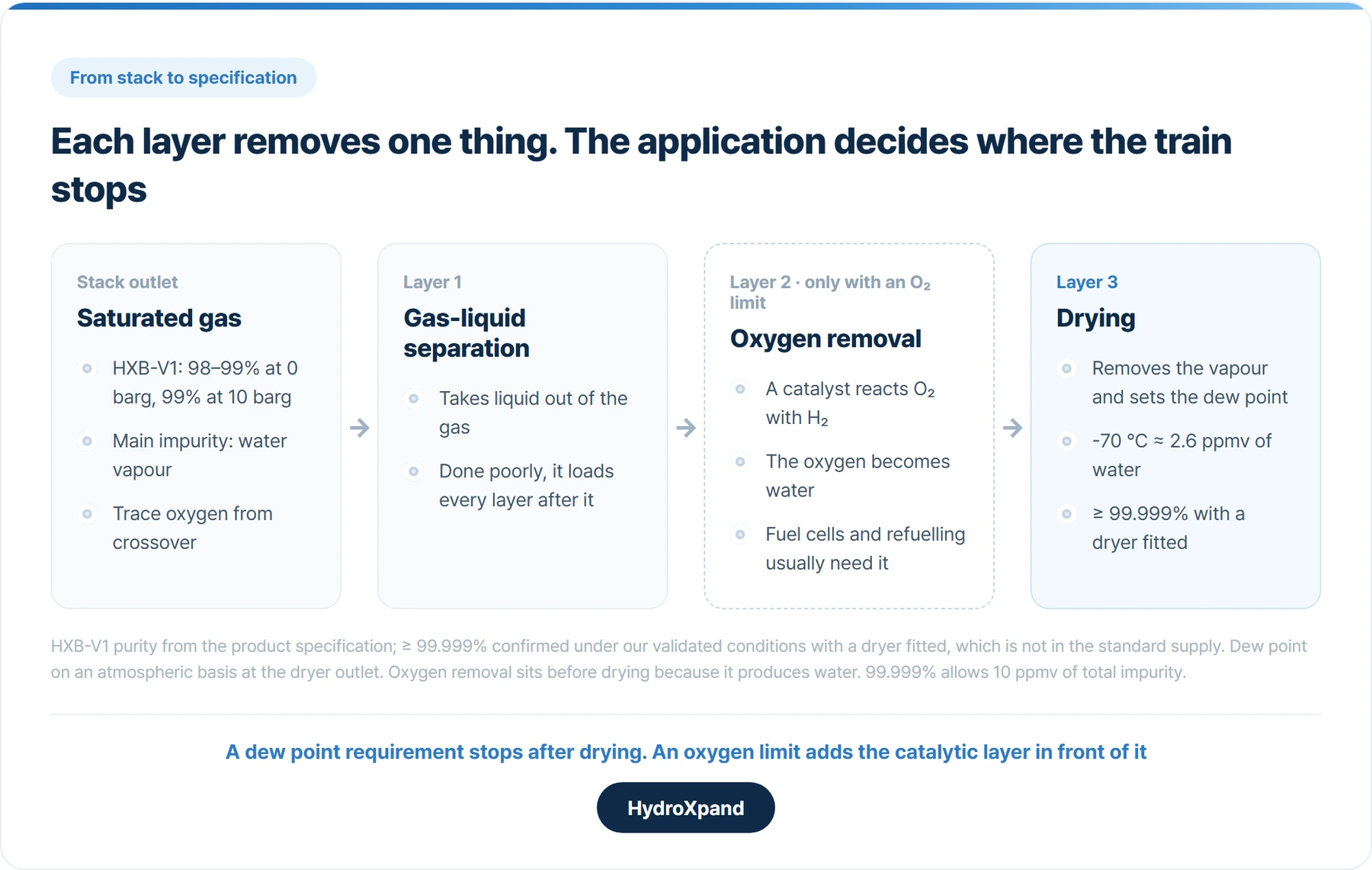
Pressure is a separate line. HXB-V1 delivers at 0 or 10 barg, selected in software, with the dryer and storage downstream. Compressed gas holds less water vapour, which is why the undried figure at 10 barg is 99%, but pressure does not do the dryer's job.
Where we are, and four things to settle first
HXD-V1, our modular drying and purification unit, is targeting Q4 2026 and its specification is not fixed yet. If a dryer is needed before then, we source one matched to your dew point, flow and pressure, and the manufacturer's warranty passes through to you.
When a purity figure appears on a quotation, check whether a dryer is in the scope of supply. If it is not, the figure describes gas after a dryer somebody still has to buy.
Before talking to any supplier about purity, pin down four things:
- Total impurity or water only. A percentage or an N figure is total impurity; a dew point is water alone.
- The pressure basis of any dew point: atmospheric or line pressure.
- The measuring point: dryer outlet or point of use.
- Whether there is an oxygen limit. That decides whether an oxygen removal step is needed at all.
All four are questions about the application. None of them is answered by the electrolyzer.
- Hydrogen drying and purification→The dew point conversions, every drying and purification method, and how we source a dryer today.
- What turnkey includes in a 2 kW electrolyzer→Why purity and pressure are separate purchases on a quotation.
- HXB-V1 · 2 kW system→Purity with and without a dryer, at 0 and 10 barg, in the full specification table.
- Pressurised operation, measured→The 49 crossover points behind the hydrogen-in-oxygen figure.
- Instrumentation and safety→Measuring gas quality, dew point and flow where the specification asks for it.
- Do you need a compressor?→What happens to pressure after the dryer.
- What hydrogen is actually used for→The applications behind each purity requirement.
Frequently asked questions
What does 5N hydrogen mean?
5N means 99.999% hydrogen, five nines. It counts total impurity, water, oxygen and nitrogen together, which is 10 ppm or less.
Can electrolyzer hydrogen go into a fuel cell without a dryer?
It is not recommended. Without a dryer the HXB-V1 outlet gas is water-saturated at 98 to 99%, and fuel cell use needs drying and usually oxygen removal.
What purity does a dew point of -70 °C correspond to?
It does not convert directly, because a dew point counts water only. At atmospheric pressure -70 °C is about 2.6 ppmv of water, and purity also counts oxygen and nitrogen.
Sources
- Hydrogen Fuel Quality Specifications for Polymer Electrolyte Fuel Cells in Road Vehicles — U.S. Department of Energy, Fuel Cell Technologies Office, 2016
Looking at AEM for a specific application?