A hydrogen fuel cell splits hydrogen into ions and electrons at one electrode, sends the electrons through an external circuit to produce electricity, and combines the ions and electrons with oxygen to form water at the other electrode. This article walks through the four steps, the layers inside a cell, why each cell produces less than one volt, where the voltage is lost, and what efficiency figures mean.
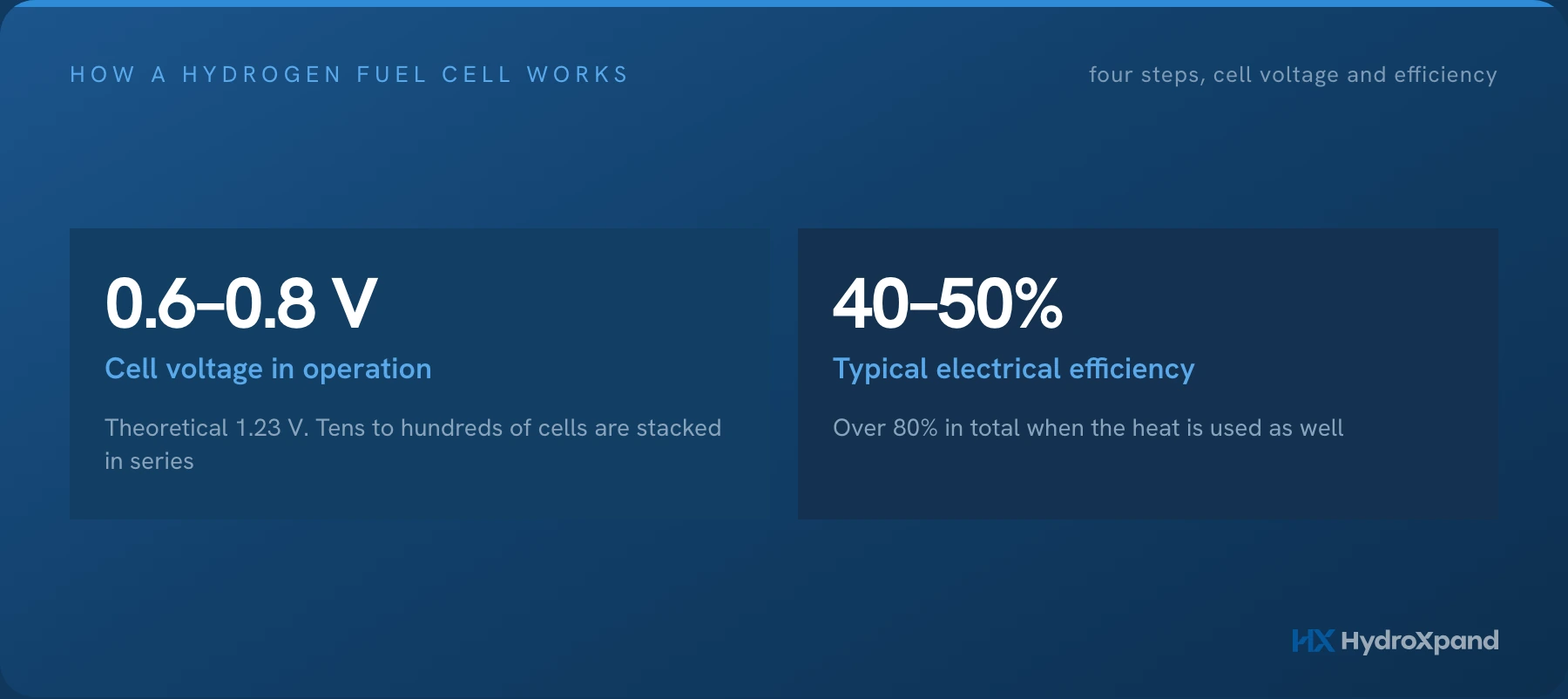
In short: a hydrogen fuel cell splits hydrogen into hydrogen ions and electrons at one electrode, sends the electrons through an external circuit, and produces electricity from that flow. At the other electrode, the ions, electrons and oxygen from the air combine to form water. Nothing is burned; the energy comes directly from an electrochemical reaction.
Most people have heard that a hydrogen car does not burn hydrogen. This article explains what it does instead: how a cell makes electricity without combustion, how much voltage one cell produces, why its efficiency can beat a heat engine, and what needs to be controlled inside the cell to keep it working. The pros and cons of fuel cells are covered in a separate article; this one is about the mechanism itself.
What a hydrogen fuel cell is
A hydrogen fuel cell is a device that makes electricity by reacting hydrogen with oxygen electrochemically. The word cell suggests a battery, but it does not store electricity. It generates electricity for as long as fuel is supplied, which makes it closer to a generator. Supply hydrogen and current flows; cut off the hydrogen and it stops.
The main difference from a combustion plant is the number of conversion steps. A thermal power plant burns fuel to make heat, uses the heat to raise steam, and uses the steam to spin a turbine. A fuel cell takes electrons directly from the chemical reaction. Fewer conversion steps mean less energy lost along the way, and with no combustion there is no exhaust smoke.
Four steps from hydrogen to electricity
A single cell has three main layers: the fuel electrode (anode), the electrolyte membrane and the air electrode (cathode). Both electrodes carry a catalyst that speeds up the reactions. In a proton exchange membrane fuel cell (PEMFC), the type used in hydrogen cars, hydrogen becomes electricity in four steps. Fuel cells with other electrolytes move a different ion across the membrane, but the principle is the same.
- Hydrogen arrives at the anode. On the catalyst surface, each hydrogen molecule splits into two hydrogen ions and two electrons: H₂ → 2H⁺ + 2e⁻.
- The electrons leave through the external circuit. The membrane lets ions through but blocks electrons, so the electrons travel along the wire to the cathode. That flow is the electricity we use; it can power a motor or a lamp.
- The hydrogen ions cross the membrane. The membrane lets ions pass while blocking gases and electrons.
- Water forms at the cathode. Oxygen from the air meets the hydrogen ions and the electrons returning through the circuit, and they form water, releasing heat: O₂ + 4H⁺ + 4e⁻ → 2H₂O.
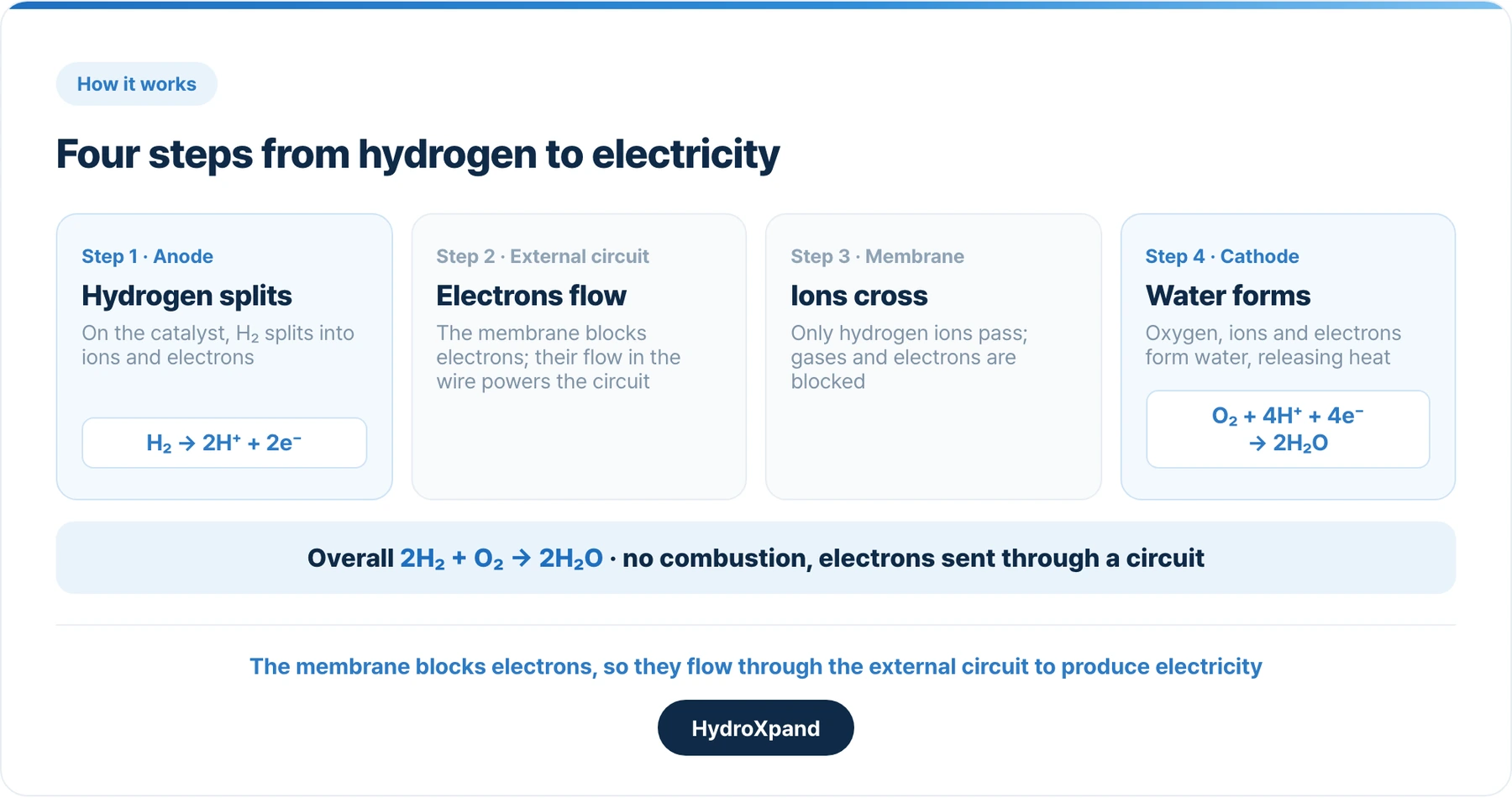
Combine the two half-reactions and the overall reaction is 2H₂ + O₂ → 2H₂O, the same equation as burning hydrogen. The difference is that a fuel cell splits the reaction across the membrane and forces the electrons through an external circuit, so the energy comes out as electricity rather than as a flame.
Inside a cell: membrane, catalyst layers, gas diffusion layers, bipolar plates
The three-layer description is a simplification. A real cell has more layers. From the centre outwards: the electrolyte membrane, a catalyst layer on each side, a gas diffusion layer on each side, and a bipolar plate on each side. The membrane, catalyst layers and gas diffusion layers together are called the MEA, the membrane electrode assembly, and they determine much of the cell's performance.
- Electrolyte membrane: a thin polymer film that passes only hydrogen ions. It is a few tens of micrometres thick, thinner than a human hair.
- Catalyst layers: coated on both faces of the membrane. A PEMFC mainly uses platinum-group catalysts. The reaction takes place where the catalyst, an ion pathway (the ionomer) and gas meet.
- Gas diffusion layers (GDL): porous carbon-fibre sheets that spread hydrogen and air evenly over the catalyst layer, carry product water away, and conduct electrons to the bipolar plate.
- Bipolar plates: the plates between neighbouring cells. Surface channels distribute hydrogen and air. The plates connect one cell electrically to the next and often contain coolant passages.
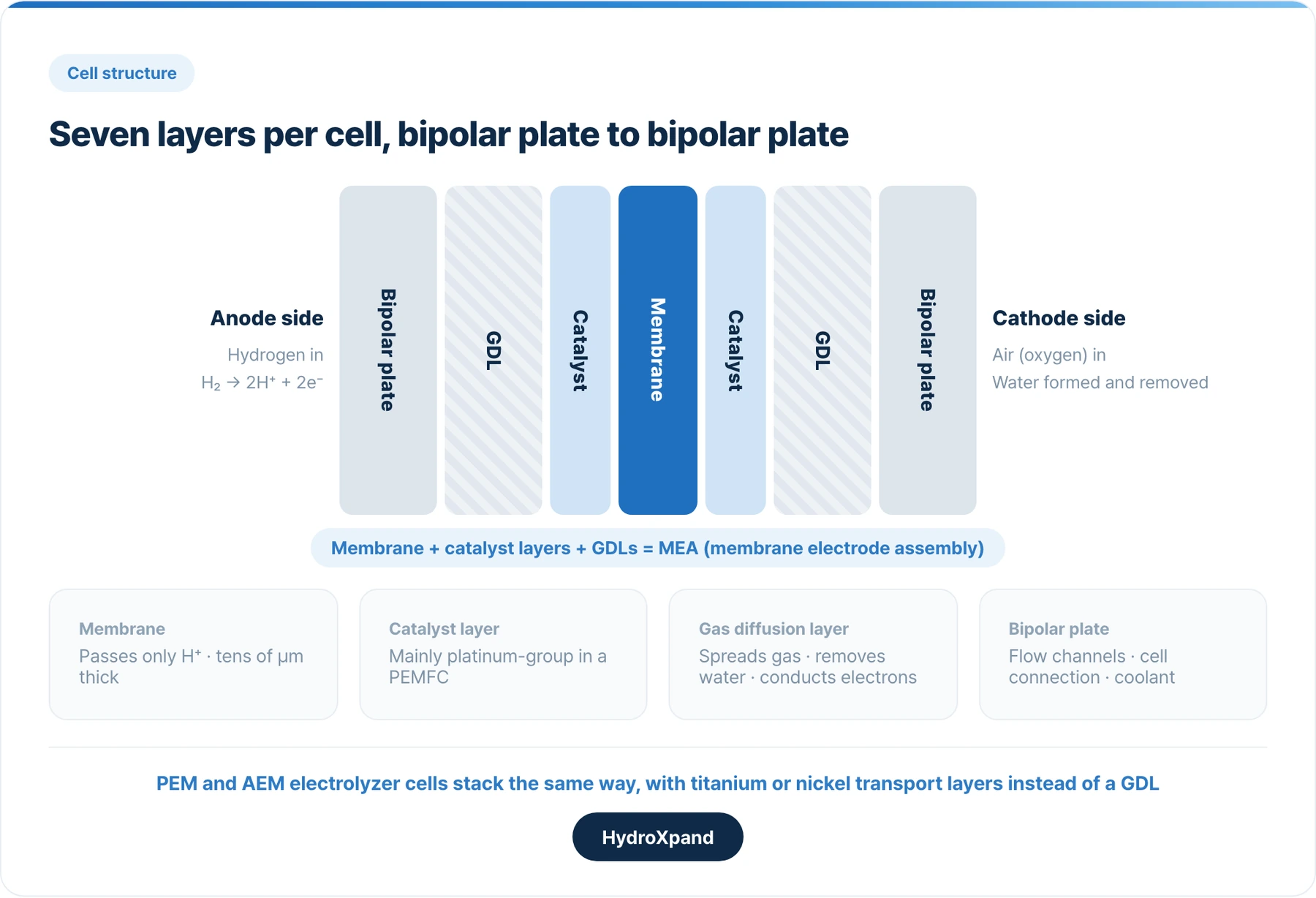
PEM and AEM electrolyzer cells are stacked in the same order. Because water goes in and oxygen comes out on the anode side, they use a porous transport layer of titanium (PEM) or nickel (AEM) in place of the carbon gas diffusion layer.
Cell voltage and the stack
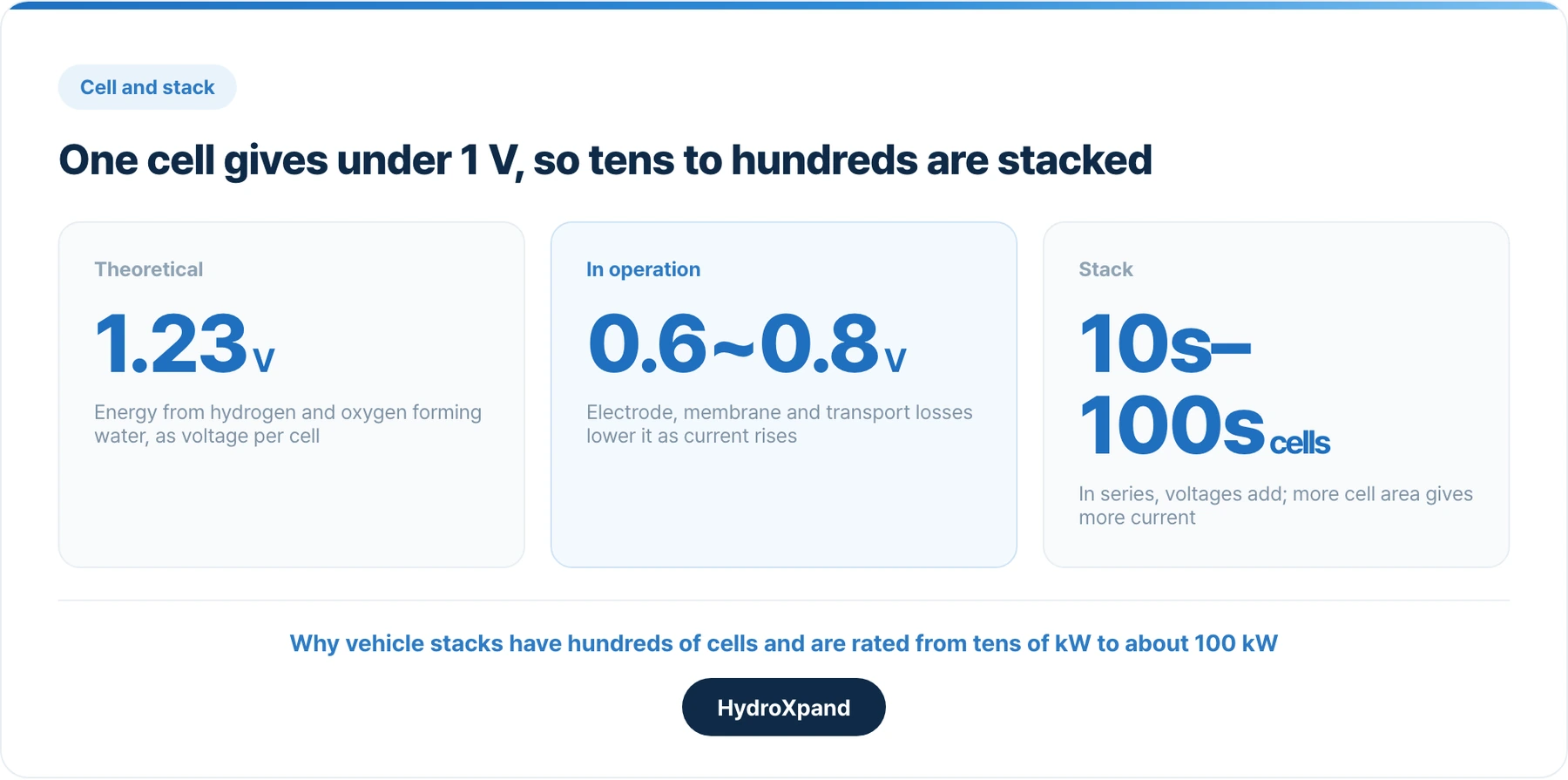
Expressed as a voltage, the energy released when hydrogen and oxygen form water gives a theoretical 1.23 V per cell. In practice, losses at the electrodes, the resistance of the membrane and the rate at which reactants reach the electrodes lower the voltage as more current is drawn, so a cell typically operates at 0.6 to 0.8 V.
Less than a volt is not useful on its own, so tens to hundreds of cells are stacked in series. That is a fuel cell stack. Stacking cells adds their voltages; enlarging the cell area raises the current. This is why vehicle stacks are built with hundreds of cells and rated from tens of kilowatts to around 100 kW.
Why voltage falls as current rises
The cell voltage does not drop from 1.23 V to 0.6–0.8 V in one step. It depends on how much current is drawn. Plotting voltage against current gives the polarisation curve, or i–V curve, with three main causes of voltage loss.
- Activation loss: the energy needed to drive the reactions. Voltage falls steeply at low current, and most of this loss comes from the slow oxygen reaction at the cathode.
- Ohmic loss: the resistance encountered by ions crossing the membrane and electrons moving through the electrodes and plates. It grows in proportion to current, so the middle of the curve is close to a straight line.
- Mass transport loss: at very high current, hydrogen and oxygen cannot reach the catalyst as fast as they are consumed, and product water can block the gas paths. The voltage drops sharply at the end of the curve.
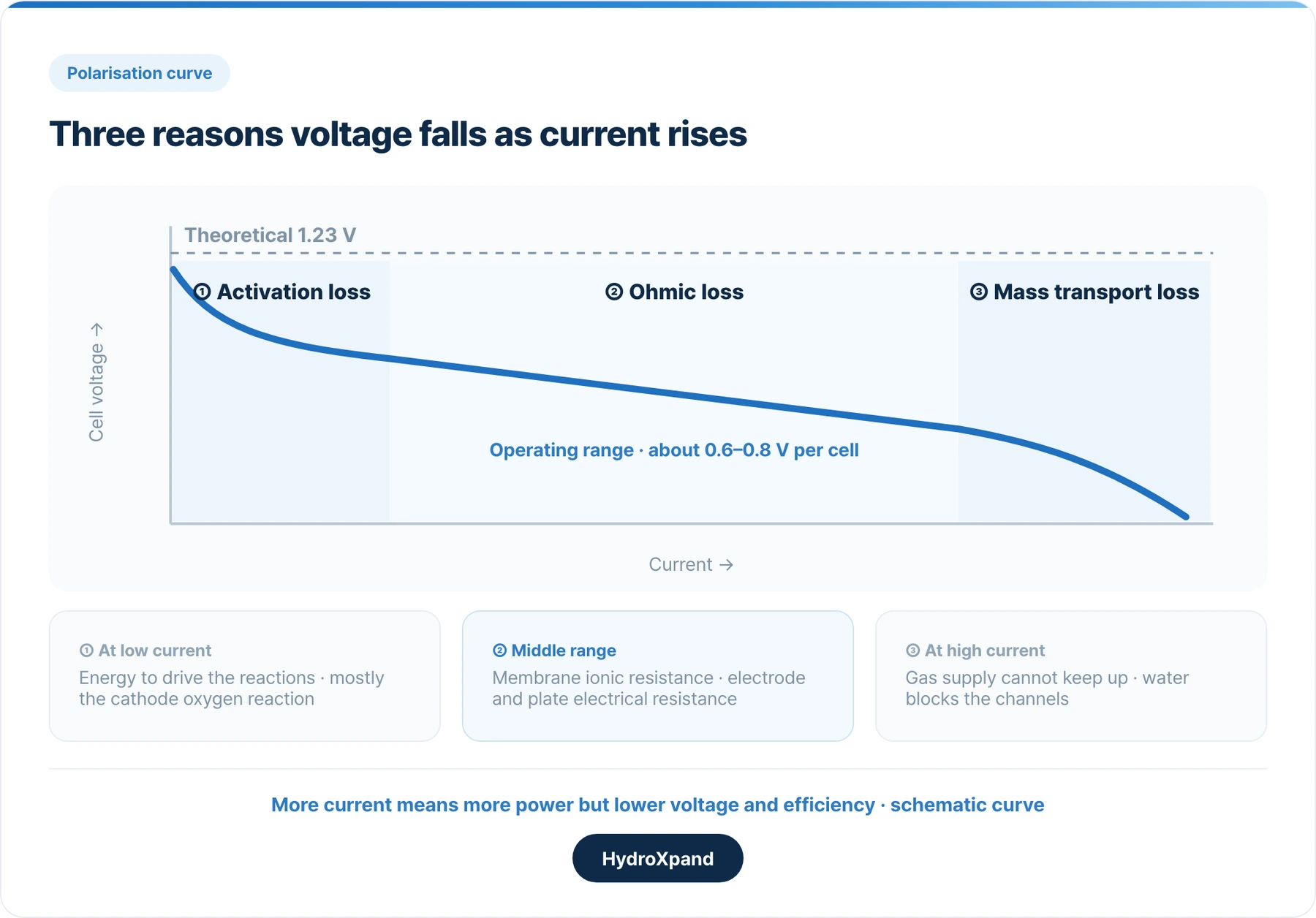
So drawing more current from the same cell raises the power output but lowers the cell voltage, and with it the efficiency. Choosing an operating point that balances efficiency and power is central to fuel cell design.
How efficient is a fuel cell
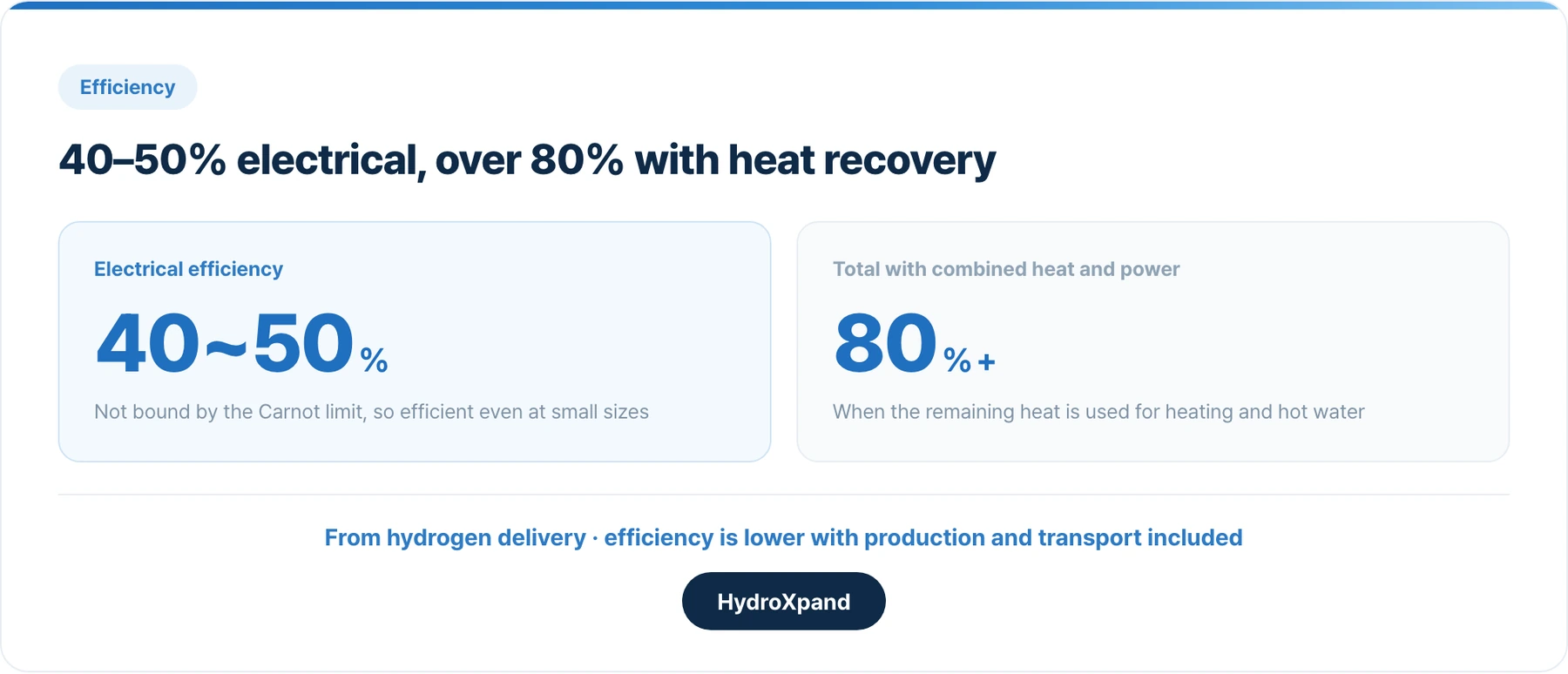
A hydrogen fuel cell system typically converts 40 to 50% of the hydrogen's energy into electricity. The rest comes out as heat, and if that heat is used for space heating or hot water in a combined heat and power arrangement, total efficiency exceeds 80%. Because a fuel cell is not a heat engine, it is not bound by the Carnot limit, so it keeps its efficiency even at small sizes.
That figure starts once the hydrogen has been delivered. Add the steps of making, compressing and transporting the hydrogen, and the round-trip efficiency from electricity to hydrogen and back to electricity is much lower. The round-trip arithmetic is in our article on power-to-gas.
Water, heat and hydrogen purity
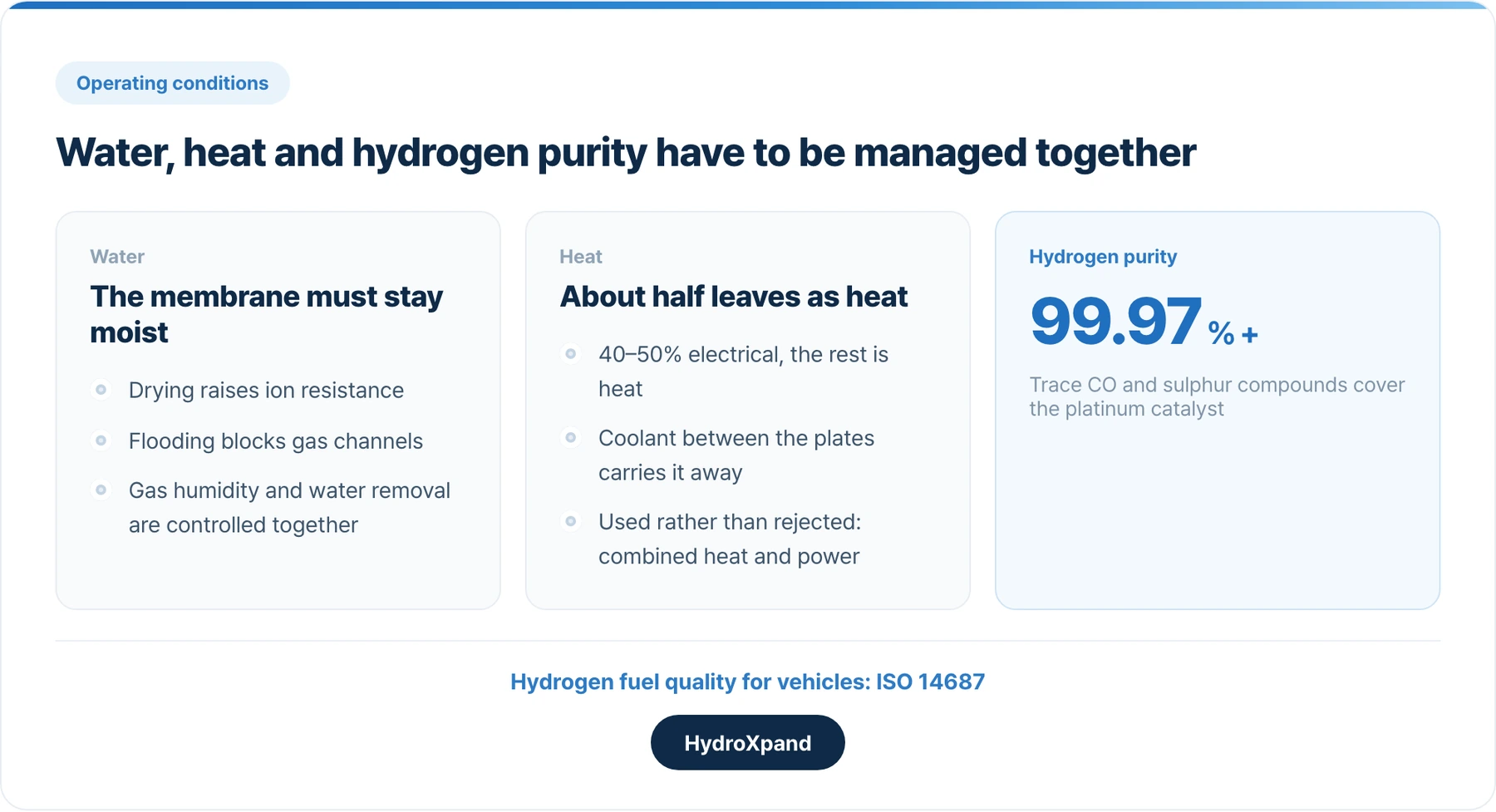
A PEMFC membrane has to stay moist for hydrogen ions to move through it. If it dries out, its resistance rises; if too much product water collects at the cathode, it floods the gas channels and the voltage falls. The humidity of the incoming gases and the removal of water are controlled together.
An electrical efficiency of 40 to 50% means roughly half the energy leaves as heat. Keeping the cell at a steady temperature requires cooling, and vehicle stacks run coolant between the bipolar plates to carry the heat away. Using that heat instead of rejecting it is what combined heat and power does.
Hydrogen purity matters too. Carbon monoxide and sulphur compounds cover the platinum catalyst even in trace amounts and cut its performance. That is why the fuel quality standard for hydrogen vehicles, ISO 14687, sets a purity of at least 99.97% along with limits for individual impurities.
Same parts, opposite direction: the fuel cell and the electrolyzer
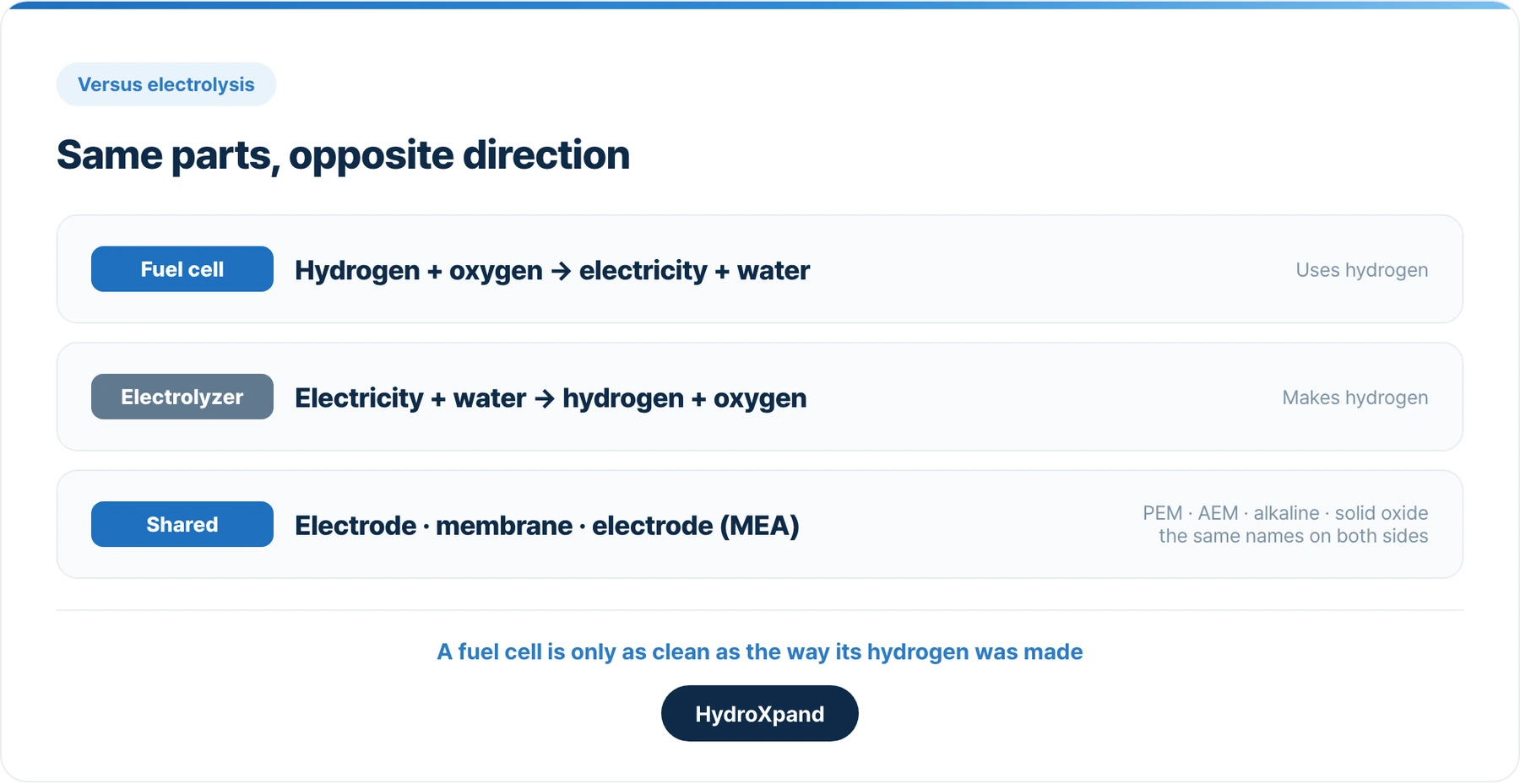
An electrolyzer runs the same reaction backwards, using electricity to split water into hydrogen and oxygen. A fuel cell consumes hydrogen and an electrolyzer produces it, but both are built around the same core of electrode, membrane and electrode at the heart of the MEA. That is why the same technology names, PEM, AEM, alkaline and solid oxide, appear on both sides. The detailed comparison is in our article on fuel cells and electrolyzers.
Five types of fuel cell
Fuel cells are classified by their electrolyte: the polymer membrane PEMFC (vehicles and homes), the ceramic SOFC (power plants), the molten carbonate MCFC (large-scale power), the phosphoric acid PAFC (distributed power for buildings) and the alkaline AFC (spacecraft). A different electrolyte changes the ion that crosses it, the operating temperature and the fuels the cell can use. The types are compared in our article on fuel cell types.
A fuel cell seen from the electrolyzer side
HydroXpand does not make fuel cells. We work on the opposite side: AEM electrolysis electrodes, stacks and systems that split water with electricity to make hydrogen. From a fuel cell's point of view, we are the fuel supply. However clean the fuel cell is, if its hydrogen came from natural gas, the system as a whole still emits carbon. A fuel cell's environmental credentials depend on how its hydrogen was made, and the answer is electrolysis of water with renewable electricity.
- Hydrogen fuel cell pros and cons→Four strengths of the cell and four limits of the wider system.
- Fuel cell types: PEMFC, SOFC, MCFC, PAFC and AFC→Electrolyte, ion, temperature, efficiency and uses of the five types.
- Fuel cell vs electrolyzer: the same parts, run backwards→Why one device cannot do both jobs well.
- What is an MEA→The membrane electrode assembly that determines much of a cell's performance.
- Power-to-gas and back→The round-trip efficiency of storing electricity as hydrogen.
Frequently asked questions
Does a hydrogen fuel cell burn hydrogen?
No. It splits hydrogen into ions and electrons at the anode and sends the electrons through an external circuit as electricity. It is an electrochemical reaction with no flame and no combustion.
Why is the voltage of one fuel cell less than 1 V?
The reaction energy of hydrogen and oxygen forming water corresponds to a theoretical 1.23 V per cell, and drawing current causes electrode and membrane losses that lower it to about 0.6 to 0.8 V. Cells are therefore stacked in series, tens to hundreds at a time.
What does the electrolyte membrane do?
It passes hydrogen ions and blocks electrons and gases. Because electrons cannot cross it, they flow through the external circuit to produce electricity.
Are a fuel cell and an electrolyzer the same device?
They share the same three-layer structure of electrode, membrane and electrode, run in opposite directions. A fuel cell makes electricity from hydrogen; an electrolyzer makes hydrogen from electricity.
What layers make up a fuel cell?
From the centre outwards: the electrolyte membrane, catalyst layers, gas diffusion layers and bipolar plates. The membrane, catalyst layers and gas diffusion layers together form the MEA.
Why does fuel cell hydrogen need to be so pure?
Impurities such as carbon monoxide and sulphur compounds cover the platinum catalyst and reduce performance. Hydrogen for fuel cell vehicles must be at least 99.97% pure under ISO 14687.
Sources
- Types of Fuel Cells — U.S. Department of Energy
Looking at AEM for a specific application?