Korea passed the world's first hydrogen act, sells the world's best-selling fuel cell car and runs the largest fuel cell power market, and still makes only hundreds of tonnes of green hydrogen a year. This article sets out why Korea is betting on hydrogen, where it leads and where it lags, why its green hydrogen costs about twice the global average, and how policy turned in 2025 from importing clean hydrogen towards making it.
Korea is often named among the leading hydrogen countries, and the picture behind that label is uneven. In using hydrogen, in vehicles and in fuel cell power plants, Korea is at or near the front. In making hydrogen, and green hydrogen in particular, it is a latecomer at pilot scale. Understanding both halves explains most of what is happening in Korean hydrogen policy in 2026.
This article, written from inside a Korean electrolyzer company, covers what the hydrogen economy means and why Korea is pursuing it, where the country stands in use and in production, why Korean green hydrogen costs what it does, and where policy has been moving since late 2025. It describes the situation as of September 2026; forward-looking items are marked as expectations.
What the hydrogen economy is, and why Korea wants one
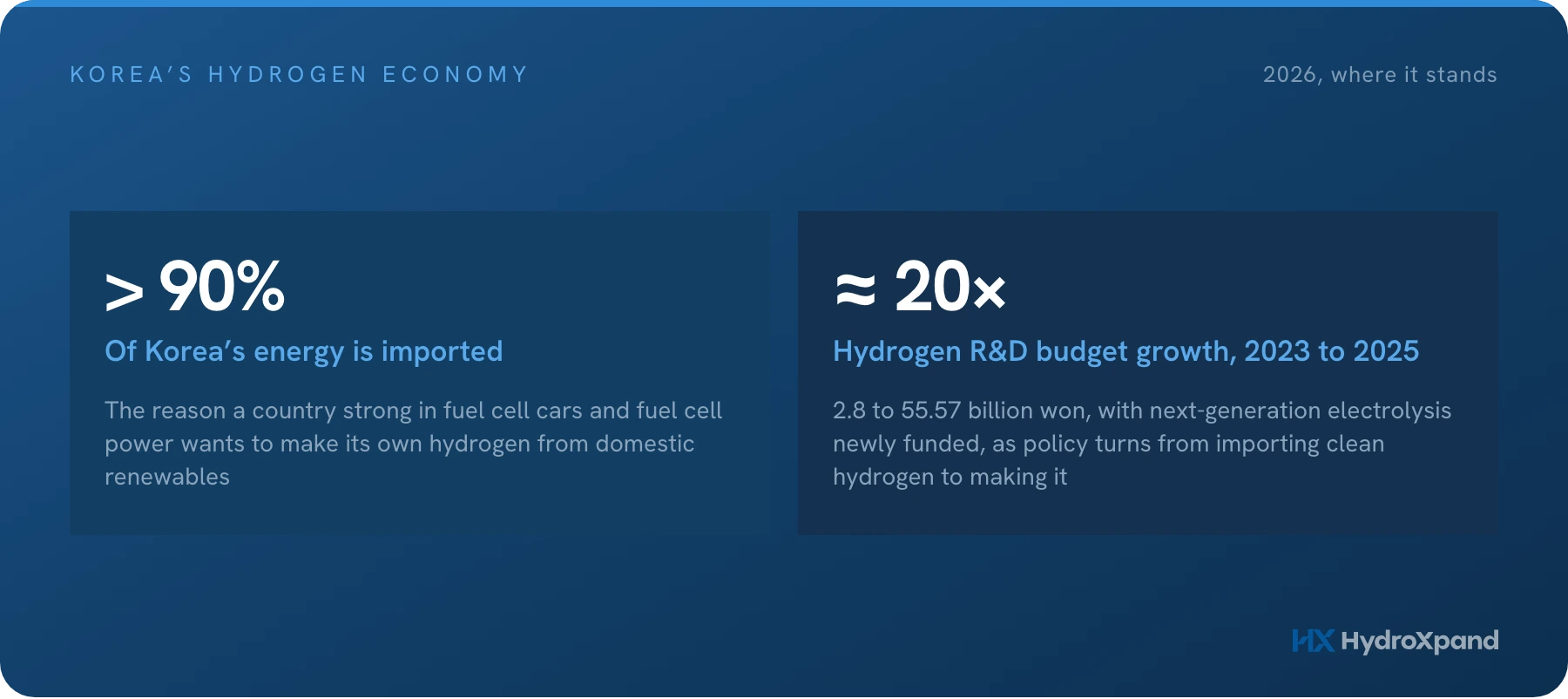
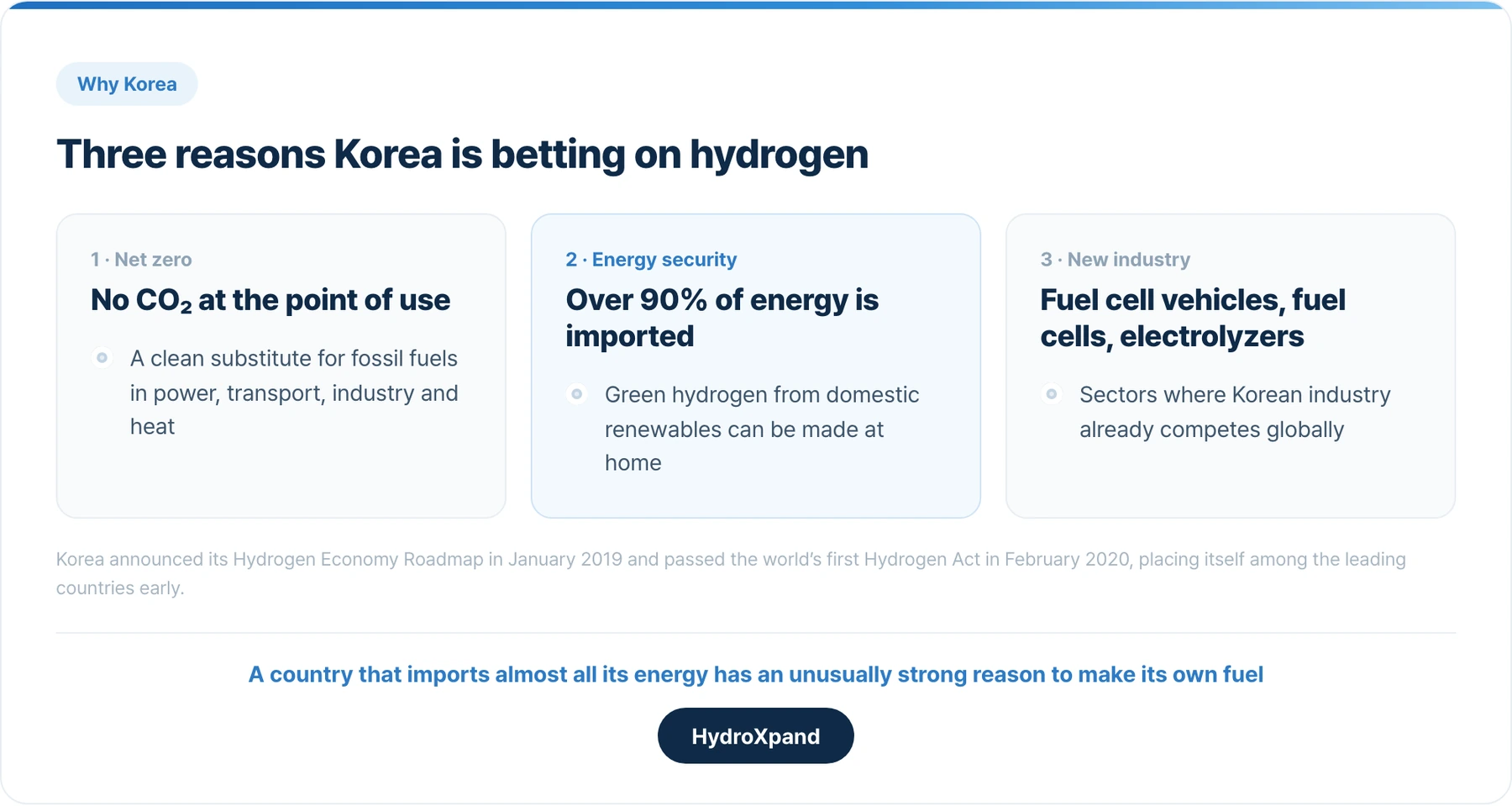
The hydrogen economy means shifting an energy system built on fossil fuels towards one in which hydrogen is a central carrier, used in power generation, transport, industrial processes and heating. Korea's interest in it rests on three things. The first is net zero: hydrogen releases no CO₂ where it is used, so it can replace fossil fuels in sectors that are hard to electrify. The second is energy security: Korea imports over 90% of its energy, and green hydrogen made from domestic renewables is a fuel it could produce at home. The third is industry: fuel cell vehicles, fuel cells and electrolyzers are sectors where Korean companies can compete globally.
Hydrogen is sorted by how it is made. From fossil fuels it is grey; from fossil fuels with carbon capture, blue; from water split with renewable electricity, green; and from water split with nuclear electricity, pink. Only the last two are clean at the point of production, and green is the one Korean policy now leans on. Korea moved early: it published its Hydrogen Economy Roadmap in January 2019 and passed the Hydrogen Economy Promotion and Hydrogen Safety Management Act, the first law of its kind in the world, in February 2020.
Where Korea stands in 2026
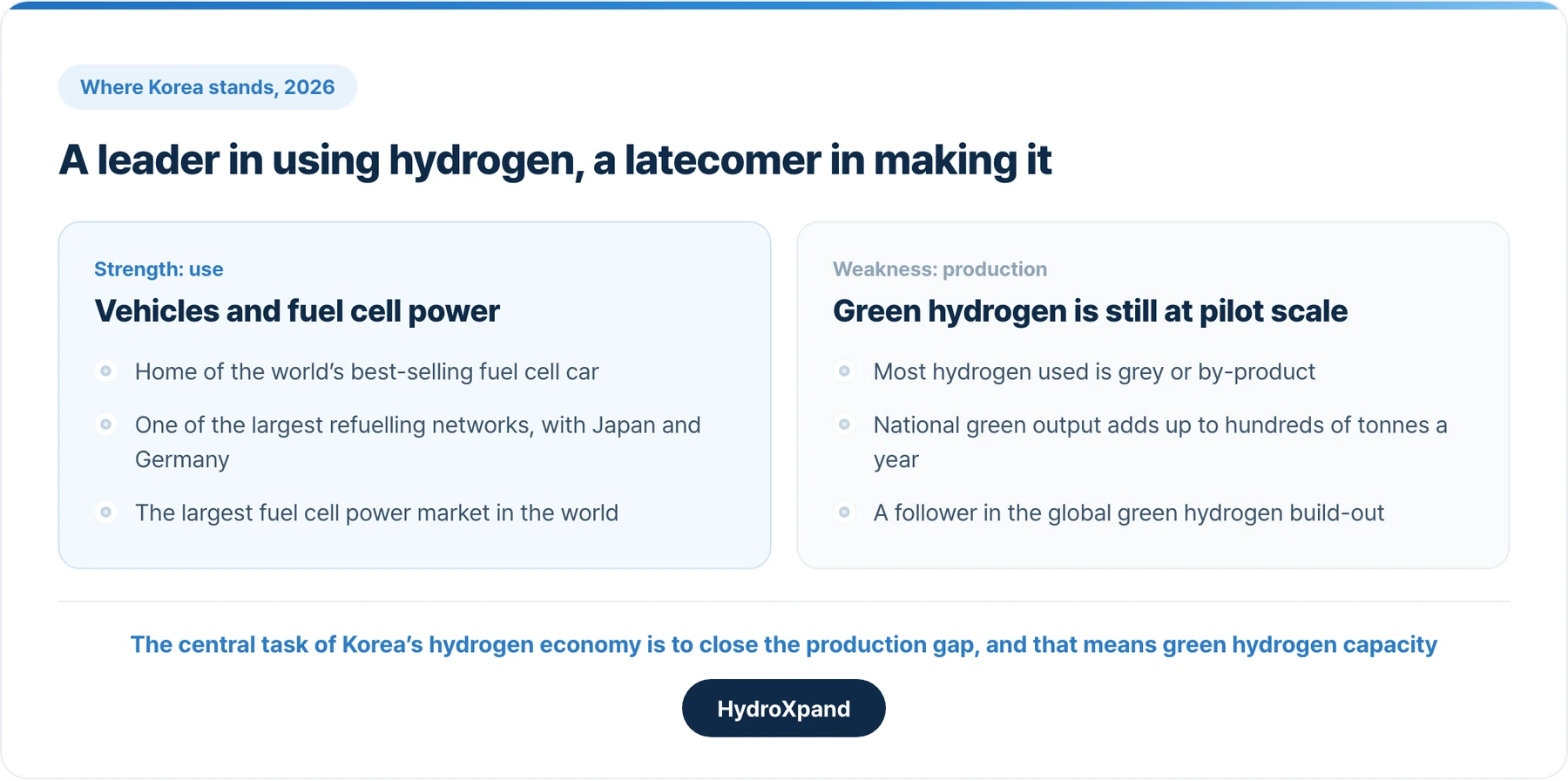
Korea's hydrogen economy has clear strengths and clear weaknesses. It leads in using hydrogen and follows in producing it.
Use: a global leader in vehicles and fuel cell power
In fuel cell vehicles Korea is in the top one or two worldwide. Hyundai's NEXO has been the best-selling fuel cell car globally, and Korea's refuelling network, 461 dispensers at 268 sites at the end of 2025, is among the largest in the world alongside Japan's and Germany's. In stationary fuel cell power the lead is clearer still: Korea has the largest fuel cell generation market in the world, and Doosan Fuel Cell and SK ecoplant are major players in it internationally.
Source461 dispensers at 268 hydrogen stations at the end of 2025, ministry figures (Korean) (eNews Today, 2026)
Production: green hydrogen is still at pilot scale
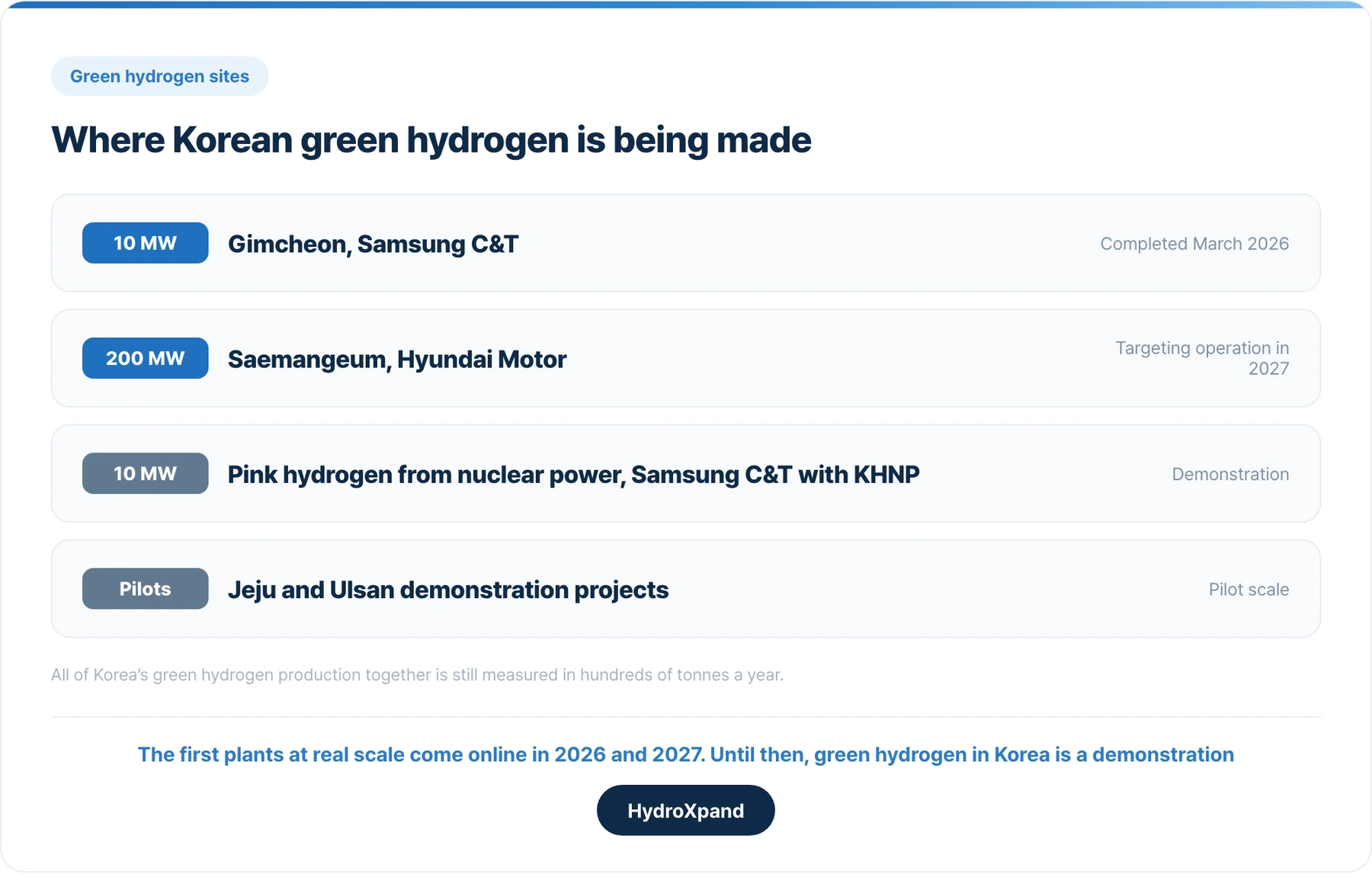
Production is the other half of the picture. Most of the hydrogen used in Korea today is grey hydrogen from natural gas reforming or by-product hydrogen from petrochemical plants. Green hydrogen is being demonstrated rather than produced: a 10 MW plant at Gimcheon by Samsung C&T, completed in March 2026; a 200 MW plant at Saemangeum by Hyundai Motor, targeting operation in 2027; a 10 MW pink hydrogen demonstration by Samsung C&T with KHNP; and pilot projects on Jeju and in Ulsan. Add up all the green hydrogen made in the country and it comes to hundreds of tonnes a year. In the global green hydrogen build-out Korea is a follower.
That is the structure of the problem. The central task of Korea's hydrogen economy is to build green hydrogen production capacity, and the policy tools of the last two years are aimed at exactly that.
Why Korean green hydrogen is expensive
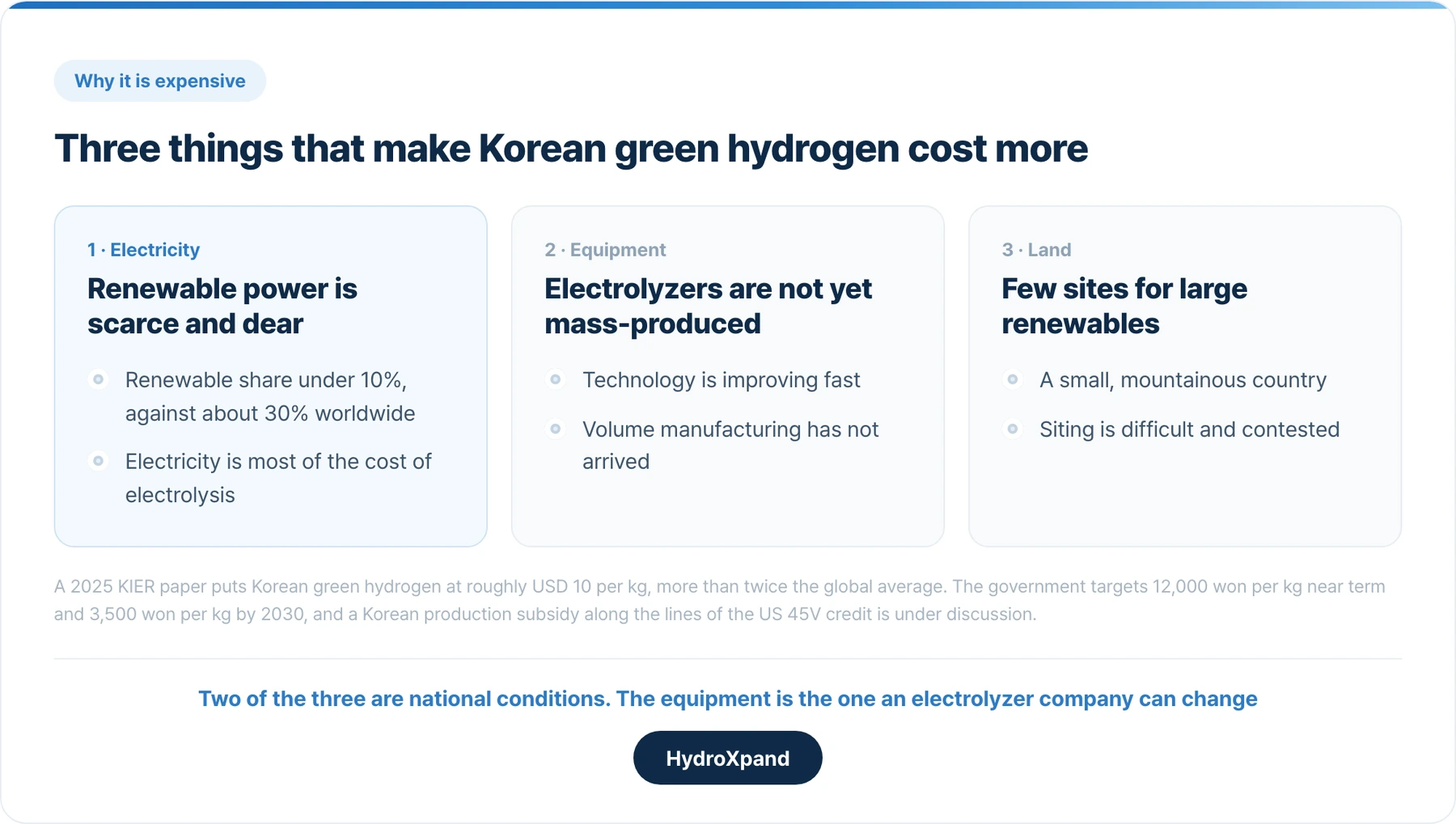
A 2025 paper from the Korea Institute of Energy Research puts the cost of Korean green hydrogen at roughly USD 10 per kilogram, more than twice the global average. This is the biggest obstacle in the whole system, and three causes act at once.
The first is electricity. Korea's renewable share is under 10%, against a world average of about 30%, and the renewable power that exists is expensive; since electricity is most of the cost of electrolysis, expensive power means expensive hydrogen. The second is equipment. Electrolysis technology is advancing quickly, but it has not reached mass production, and system costs remain high. The third is land. Korea is small and mountainous, and sites for large renewable plants are hard to secure.
The cost is falling nonetheless. The government's targets are 12,000 won per kilogram in the near term and 3,500 won per kilogram by 2030, and a Korean production subsidy on the model of the United States' 45V credit is under consideration.
SourceKIER: green hydrogen production cost about USD 10/kg today, 3,500 won/kg target for 2030 (Korean) (Financial News, 6 March 2025)
Two of the three causes are national conditions that an equipment maker cannot change. The third is the one it can, and it is where HydroXpand works.
Where the policy is going
In the second half of 2025 Korean hydrogen policy turned. Its centre of gravity had been clean hydrogen for power generation, largely blue hydrogen and ammonia to be imported and burned. From 2025 it has shifted towards building the country's own capacity to make green and pink hydrogen.
A new ministry
On 1 October 2025 the Ministry of Climate, Energy and Environment was launched, and much of the hydrogen policy function moved to it from the Ministry of Trade, Industry and Energy. The reorganisation of hydrogen policy around green hydrogen is part of that transfer.
The 12th Basic Plan for Electricity Supply
The Basic Plan for Electricity Supply and Demand is Korea's most important medium-term power document, rewritten every two years. The 12th plan, covering 2026 to 2040, is the first drawn up by the new ministry, which gives it symbolic weight beyond its content. It had been expected in the second half of 2026, but as of late September 2026 it is still being drafted: the ministry has said the demand forecast and the capacity plan will be substantially revised, and a three-month public deliberation on the role of nuclear power begins in October, so finalisation is now expected around the end of 2026 or later. The industry's expectation is that it will reduce the role of ammonia co-firing and raise the share of green and pink hydrogen. Where the plan lands will be the clearest signal of where Korea's hydrogen economy is going.
Source12th Basic Plan government draft pushed past December after the nuclear public deliberation (Korean) (Aju Business Daily, 22 September 2026)
Electrolysis at the centre
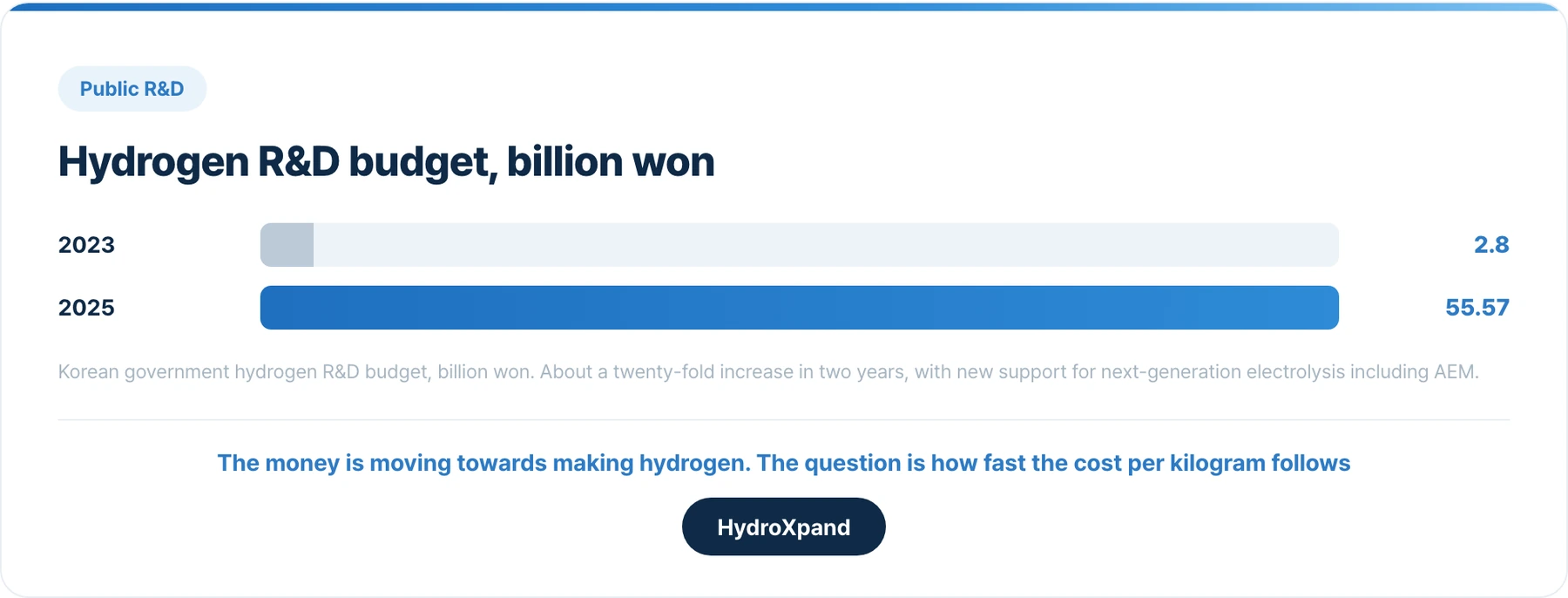
Within this turn the field drawing most attention is green hydrogen electrolysis: splitting water with electricity, which makes genuinely clean hydrogen when the electricity is renewable. Public money is following. The government's hydrogen R&D budget rose from 2.8 billion won in 2023 to 55.57 billion won in 2025, about twenty-fold, and next-generation electrolysis technologies including AEM are being funded for the first time. The demonstration plants at Saemangeum, Gimcheon and the nuclear-powered pink hydrogen site are coming into operation one after another.
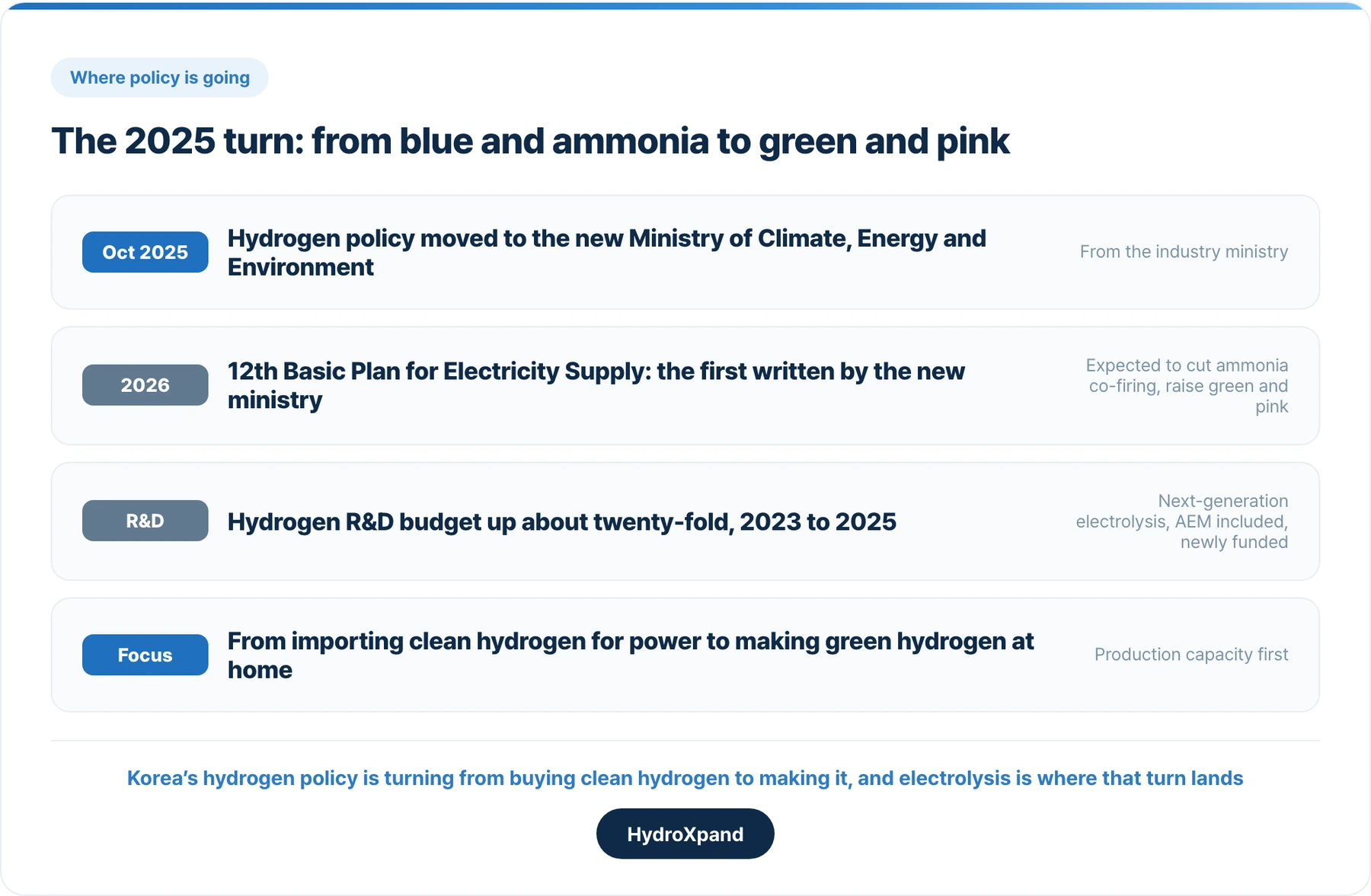
Korea's hydrogen policy is turning from importing clean hydrogen to making it, and the equipment that makes it is the electrolyzer.
SourcesHydrogen R&D budget 2.8 bn won in 2023 to 47.8 bn won in 2024, AEM electrolysis among the new projects (Korean) (Monthly Hydrogen Economy, 16 May 2024) · 2025 hydrogen R&D plan: 14 programmes, 55.57 bn won (Korean) (Monthly Hydrogen Economy, 15 January 2025)
Where HydroXpand sits
HydroXpand is a Korean company that develops AEM electrolysis, the anion exchange membrane technology that pairs iridium-free catalysts with a solid membrane. Because it avoids the precious metals of PEM electrolysis while keeping a solid-membrane design, AEM has the potential to lower the cost of the electrolyzer, which is the part of the green hydrogen cost that Korean conditions do not fix.
Since the largest problem in Korea's hydrogen economy is the cost of green hydrogen, AEM electrolysis is one of the technologies on which Korean competitiveness in green hydrogen will turn. HydroXpand supplies electrodes, stacks and systems to research institutes and industrial customers in twelve countries, and its aim at home is to contribute to a Korean green hydrogen supply made in Korea.
- Read Korea as two markets: a mature one for using hydrogen and an early one for making it. The second is where growth and policy are concentrated.
- The cost of green hydrogen is set by electricity, equipment and land; in Korea only the equipment is a variable, which is why electrolyzer cost matters more here than in countries with cheap renewables.
- Watch the 12th Basic Plan for Electricity Supply. Its treatment of ammonia co-firing versus green and pink hydrogen will set the direction for the next five years.
- Korea's clean hydrogen certification and its hydrogen power auctions already exist. What they lack is certified green hydrogen to fill them.
HydroXpand's AEM electrolysis electrodes, stacks and systems are sold today, from 2 kW research and pilot units to a 30 kW stack, in Korea and in eleven other countries.
- Korea's clean hydrogen certification→The four grades, the 4 kg ceiling and the 2029 deadline that shape Korean green hydrogen projects.
- Hydrogen power generation→Korea's fuel cell fleet and the clean hydrogen power auctions.
- Renewable energy pros and cons→Why Korea's weak solar resource and low renewable share make electrolysis cost more.
- Hydrogen colours: what the names leave out→Grey, blue, green and pink, and the one number certification measures.
- AEM water electrolysis: how it works→The technology HydroXpand builds, and why it avoids iridium.
Frequently asked questions
What is the hydrogen economy?
A shift of the energy system from fossil fuels towards hydrogen as a central carrier in power, transport, industry and heating. Korea set out to build one with its Hydrogen Economy Roadmap in 2019 and the world's first Hydrogen Act in 2020.
Why did Korea pass the world's first hydrogen act?
As a strategic move. Already a leader in fuel cell vehicles and fuel cell power, Korea wanted a legal foundation for the whole industry early and a hand in setting global standards. The Act established a hydrogen economy committee, support for refuelling stations and the basis for clean hydrogen policy, and the EU, Japan and the United States followed with laws of their own.
Why is Korean green hydrogen so expensive?
Three causes at once: renewable electricity is scarce and expensive, electrolysis equipment is not yet mass-produced, and sites for large renewable plants are hard to find. A 2025 KIER paper puts the cost at about USD 10 per kg. The government targets 3,500 won per kg by 2030.
Is the hydrogen economy realistic?
Yes, but it takes time. Green hydrogen is still expensive and infrastructure is thin, while costs are falling quickly and the EU, the United States, China and Korea are all investing at government scale. Hydrogen will not replace fossil fuels everywhere; its role is in long-distance transport, industrial processes and seasonal storage, where batteries fall short. The realistic picture is hydrogen and electricity dividing the work, not competing.
What should be watched in Korean hydrogen in 2026?
Three things: the 12th Basic Plan for Electricity Supply, still being drafted as of September 2026 with finalisation expected around the end of the year or later, and how it treats green and pink hydrogen; the first demonstration plants at real scale, Gimcheon at 10 MW, Saemangeum at 200 MW and the 10 MW pink hydrogen site, coming into operation in 2026 and 2027; and how fast the cost of green hydrogen falls.
Sources
- 2026년 수소 모빌리티 드라이브, 정부 7600억 투입 (hydrogen station count, ministry figures) — eNews Today, 2026
- 그린수소 생산단가를 4달러까지 낮출 수 있다 (KIER press release coverage) — Financial News, 2025
- 수소 R&D 예산 확대, 올 상반기 신규 지원과제 확정 — Monthly Hydrogen Economy, 2024
- 올해 추진될 수소분야 R&D 사업은? — Monthly Hydrogen Economy, 2025
- 12차 전기본 정부안 12월 이후로 늦어진다 — Aju Business Daily, 2026
Looking at AEM for a specific application?