A hydrogen generator makes hydrogen where it is used, from water and electricity, instead of having it delivered. Sizing one is not a matter of picking a model. It is a matter of turning what you consume into a rate, and then checking five numbers against your site.
A hydrogen generator is a machine that produces hydrogen at the point of use. Most of them are electrolyzers: water goes in, direct current goes in, hydrogen and oxygen come out. The alternative on the market is a reformer, which cracks hydrogen out of a hydrocarbon feed and carries a carbon footprint with it.
The reason to have one is rarely the hydrogen itself, because hydrogen is available in cylinders almost everywhere. It is that a cylinder is an inventory item. It has to be ordered, delivered, stored, changed and returned, and the amount stored on site at any moment is decided by the delivery schedule rather than by what the process needs.
An electrolyzer does not store hydrogen, it makes it. The safety case and the logistics case change together, and both of them change because of what is not on site rather than what is.
Start with a rate, not a model
The most common mistake we see in an enquiry is a request for a machine size before the consumption has been converted into a rate. The conversion is arithmetic and it is worth doing before any supplier is contacted.
- Take what the process consumes over a day, in kilograms or normal cubic metres. One kilogram of hydrogen is 11.1 Nm³, and one Nm³ is 0.0899 kg.
- Divide by the hours the machine will actually run. A generator running continuously needs a lower rated flow than one that only runs during a shift.
- Check the peaks. If the process draws hydrogen in bursts, the generator is sized by the average and a buffer covers the burst. If it draws continuously, the generator is sized by the draw itself.
- Add the losses you know about. Purge, leak-up on a long line, and whatever the analytical instrument vents while idle.
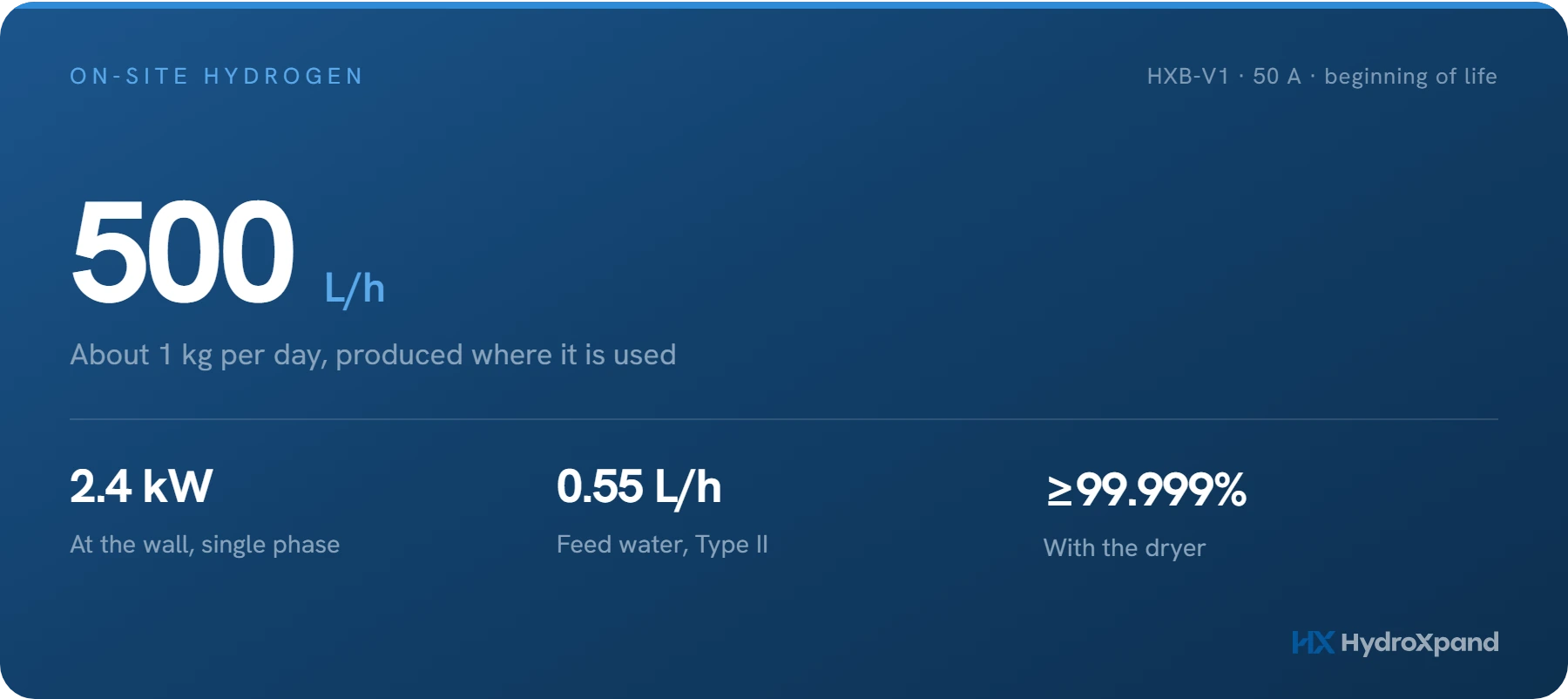
Only then does a nameplate figure mean anything. Our own 2 kW system produces 500 litres an hour, which is about 1 kilogram a day if it runs continuously, and that single sentence has two conditions inside it that a comparison table usually leaves out.
The five numbers a specification has to state
These are the figures we publish for our own system, and they are the ones we would ask any other supplier for. A number without its condition is not a specification.
| What to ask for | HXB-V1 | |
|---|---|---|
| Flow | Rate, and the current it was rated at | 500 L/h at 50 A15 to 67 A operating range |
| Purity | From the stack, and after the dryer | 98 to 99% without a dryer≥99.999% with one |
| Pressure | At the outlet, before any compressor | 0 or 10 bargchosen when ordering |
| Power | At the wall, not at the stack | 2.4 kWstack 44 kWh/kg, system 54 kWh/kg |
| Water | Consumption and required quality | 0.55 L/hType II, ≤1.0 µS/cm |
The purity row is the one that most often surprises a buyer. Hydrogen leaving a cell is saturated with water and carries a small amount of the other gas, so the figure quoted on a datasheet usually belongs to the dryer rather than to the stack. Ours is explicit about both, because the two are separate purchases in every system, including ours.
The power row matters for the opposite reason. A stack figure and a wall figure differ by everything the rest of the machine draws, and in our case that is about 10 kWh for every kilogram produced.
- HXB-V1 · 2 kW system→The generator every number on this page belongs to.
- HXS-2 · 2 kW stack→The stack inside it, if you are building your own balance of plant.
- Datasheets→Six products. No form.
What the site has to provide
A generator is a piece of process equipment, not an appliance, and the reason a project stalls is usually one of these rather than the machine itself.
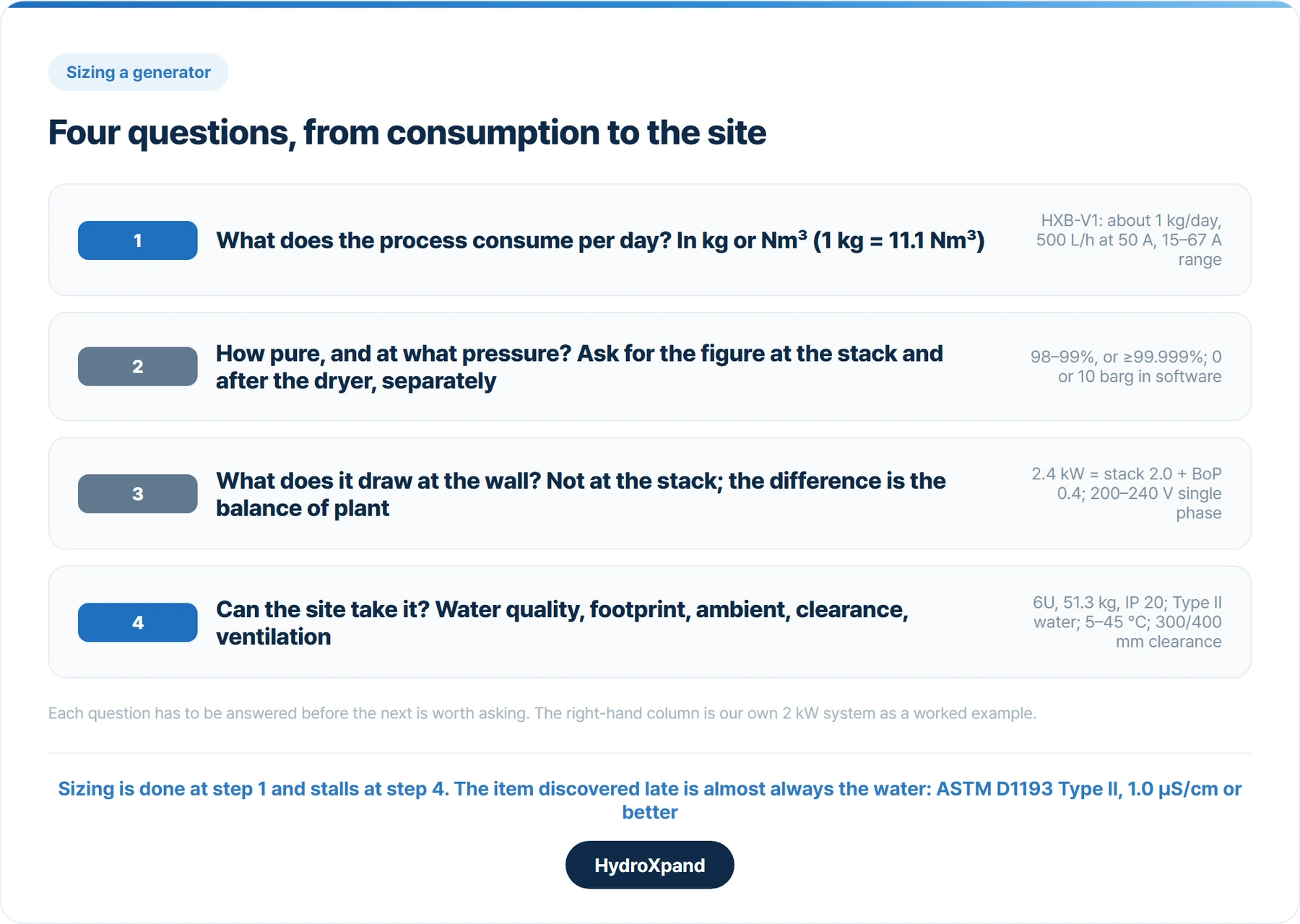
Electrical supply is first. Ours runs on 200 to 240 V single phase at 50 or 60 Hz, which is a normal laboratory or workshop connection rather than a three-phase industrial one. That is a deliberate choice at this size and it is worth confirming with any supplier, because a three-phase requirement can be a bigger obstacle than the price of the machine.
Water quality is second, and it is the item most often discovered late. Deionised water to ASTM D1193 Type II, 1.0 µS/cm or better, is required. Tap water will damage a cell, and a site with no deionised supply needs a small polisher upstream.
Then space and environment. Ours is a 6U unit, 482 by 647 by 266 mm and 51.3 kg, IP 20, for an ambient of 5 to 45 °C, with 300 mm clearance at the front and 400 mm at the back. Ventilation and the site's own hydrogen risk assessment govern where it may stand and whether it may run unattended.
What we would tell you not to buy from us
- A consumption far above 1 kilogram a day. Running two small units to cover one large demand is worse on every axis than one machine sized for it, and at that point the question is a different product.
- Hydrogen needed at high pressure directly, beyond the 10 barg the stack delivers. That is a compressor, and it belongs in the project rather than inside the generator.
- Bursts with no buffer. A generator produces at a rate. If the process wants a large volume in a short window and there is nowhere to hold it, the answer is storage, sized separately.
What is left after those three is the case an on-site generator is genuinely good at: a steady, modest, continuous demand, at a site that would otherwise be receiving cylinders. That is the case our system was built for, and it is the one we will quote for without qualification.
- Before the electrolyzer arrives→The site checks that come after the specification is settled.
- What an electrolysis system is, and why its efficiency is not the stack's→Everything between the stack and the outlet, and where the 0.4 kW goes.
- What water electrolysis is→The fixed numbers behind the arithmetic on this page.
- Alkaline, PEM or AEM→Which technology a generator of this size should be built on.
- What is an electrolyzer stack→The part inside the generator that sets the rate, and what its datasheet should say.
- What pressurised operation costs→What the 10 barg outlet costs in cell voltage, measured.
- Storing hydrogen: four routes→The delivery problem an on-site generator is an alternative to.
- What hydrogen is actually used for→The quiet tier an on-site generator serves, and the tiers it does not.
- Reading a hydrogen purity specification→Percent, nines, dew point, and the dryer behind them.
Frequently asked questions
What is a hydrogen generator?
A hydrogen generator makes hydrogen where it is used, from water and electricity, instead of having it delivered in cylinders. It produces hydrogen but does not store it.
How do I size a hydrogen generator?
Turn what you consume into a rate. The HXB-V1 produces 500 L/h, about 1 kg per day continuous, and draws 2.4 kW at the wall while consuming 0.55 L/h of feed water.
What five numbers must a hydrogen generator specification state?
Flow rate, purity, outlet pressure, power draw and water quality. The site has to provide the matching electricity, feed water, venting and clearance.
Sources
- ASTM D1193-06(2018) Standard Specification for Reagent Water — ASTM International
Looking at AEM for a specific application?