Pressurising the stack instead of compressing after it removes a rotating machine, a buffer and its safety equipment. The price is 28 mV per cell and, more importantly, crossover headroom at low load. Where that trade works, and where a compressor is still unavoidable.
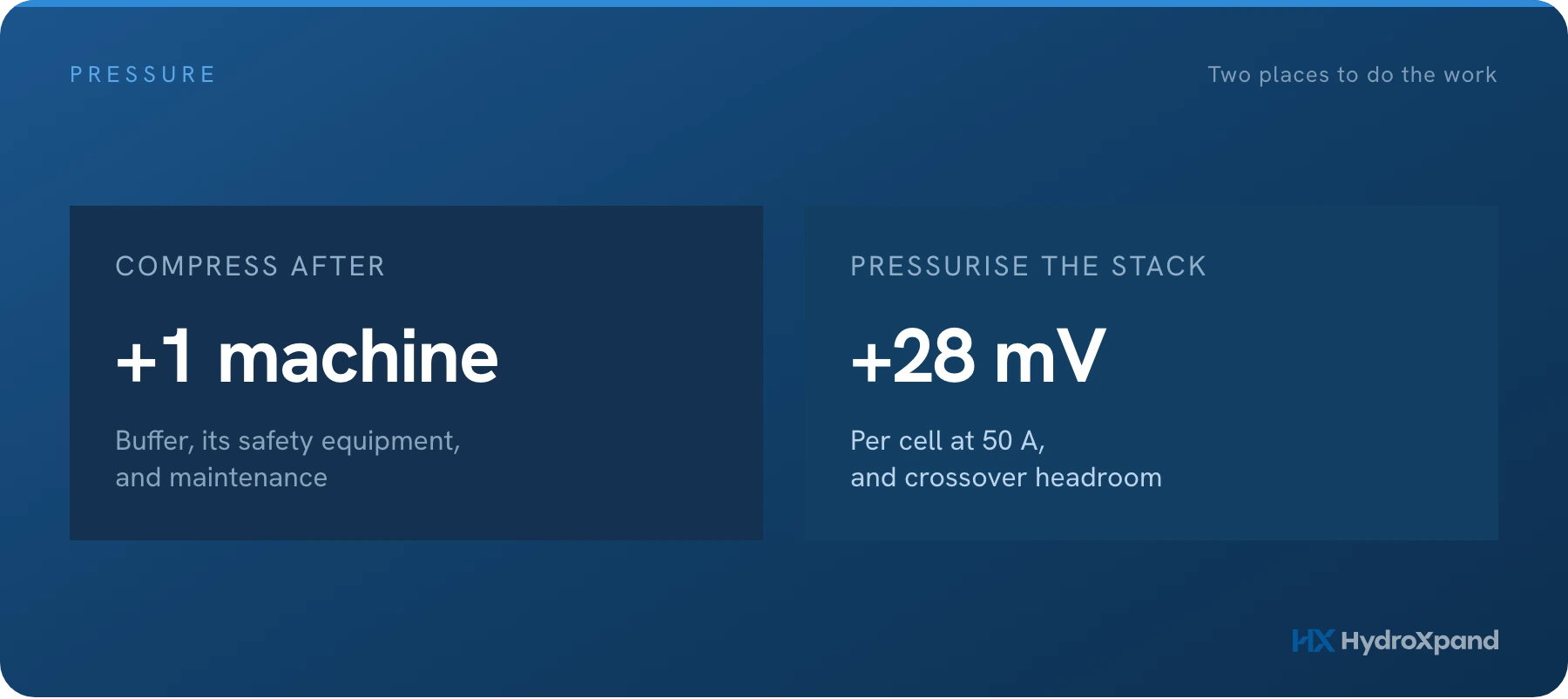
Hydrogen leaves a stack at whatever pressure the stack is held at. If the application needs more than that, something has to raise it, and there are only two places to put that work: after the stack in a compressor, or inside the stack by running it pressurised.
Choosing the second removes a compression stage and the power it draws, the low-pressure buffer between stack and compressor, the safety equipment around that buffer, and one more rotating machine to maintain.
It is a real simplification, and it is also frequently oversold. Two things are worth settling before a specification is written: what the pressurised output actually costs inside the stack, and what pressure the application genuinely needs.
The voltage cost is settled, and it is small
Running pressurised needs a higher voltage to pass the same current. The Nernst term rises with pressure, and this is not a loss anyone can engineer away. It is what thermodynamics asks for.
We measure it at 28 mV per cell at 50 A, which is 0.64 V across a 23-cell stack, about 1.7% of the cell voltage at the same condition.
That is the debit. The credit side holds the compressor's own power draw, the buffer and its safety equipment, and the maintenance of a rotating machine. Which side is larger depends on the pressure you need and how much of the year the plant runs, so it is a per-project calculation. What is settled is the size of the cost inside the stack.
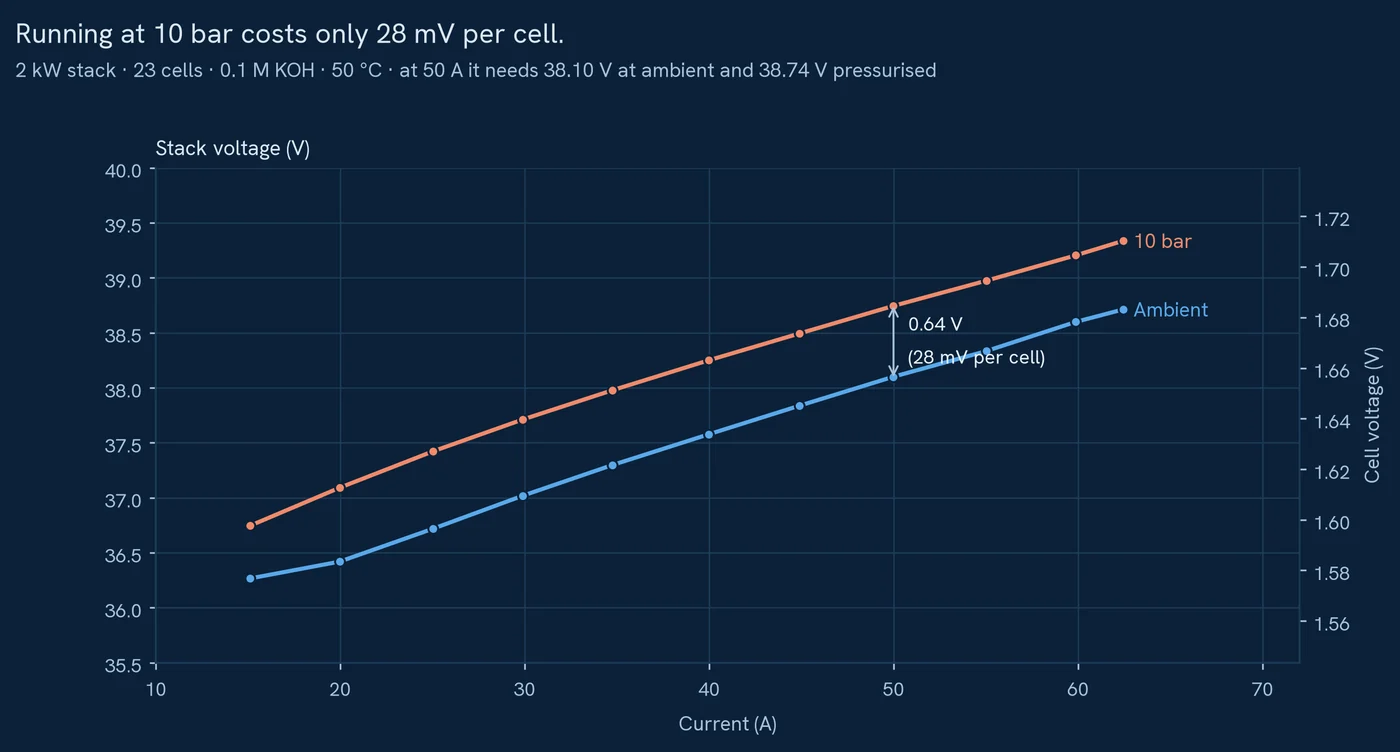
The voltage penalty is the part everyone asks about, and it is the smaller half of the trade.
The real cost is headroom, not voltage
Pressure drives hydrogen across the membrane. So pressurised operation raises the hydrogen appearing in the oxygen stream, and that figure is bounded by a safety limit rather than an efficiency target. Ours is 2%.
At rated load there is plenty of room. The measurement that matters is what happens when the load falls, because crossover rises there too, and the two effects multiply.
| Hydrogen in oxygen | Rated load (50 A) | 40% load (20 A) |
|---|---|---|
| Ambient (0 barg) | 0.39% | 0.66% |
| 6 barg | 0.98% | 1.75%0.25 points below the 2% limit |
So pressurised output and a wide turndown range are competing requirements, drawn from the same budget. A plant that runs steadily at rated load can spend that budget on pressure. A plant following a variable resource generally cannot spend all of it.
One boundary on these numbers: the sweeps cover 0 to 6 barg and 50 A down to 20 A. The 10 barg on our datasheet is a pressure rating, and we have not published crossover measurements across that last stretch.
What 10 barg reaches, and what it does not
This is where specifications and applications most often fail to meet. Pressurised output at ten bar is useful for a set of jobs, and irrelevant to another set, and the boundary is not subtle.
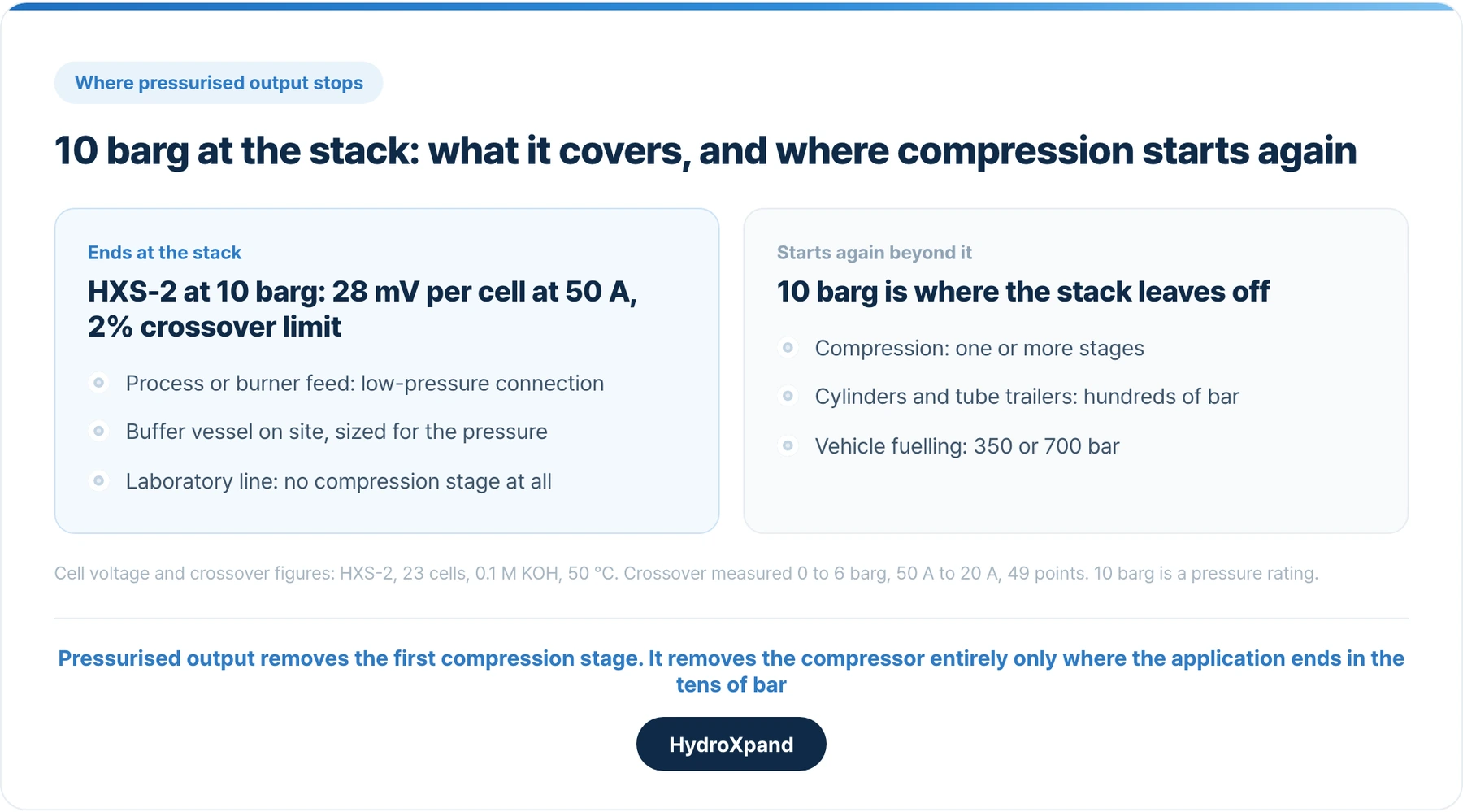
Feeding a process at low pressure, filling a buffer vessel, supplying a burner or a laboratory line: ten bar is comfortably enough, and the compressor disappears from the plant entirely.
Storage in standard cylinders, tube trailers, or anything to do with vehicle fuelling: ten bar is nowhere near it. Cylinders and trailers work in the hundreds of bar, and vehicle fuelling standards sit at 350 and 700 bar. A pressurised stack does not remove a compressor from those plants; at best it removes the first stage of one.
| Application | 10 barg is enough | Still needs compression |
|---|---|---|
| Process or burner feed at low pressure | Yes | — |
| Buffer vessel on site | Yessized for the pressure | — |
| Standard cylinders and tube trailers | — | Hundreds of bar |
| Vehicle fuelling | — | 350 or 700 bar |
| Pipeline injection | Depends on the linecheck the connection pressure | Often |
Commercial hydrogen fueling stations primarily dispense gaseous hydrogen in two pressure classes: H35 (350 bar/35 MPa/5,000 psi) or H70 (700 bar/70 MPa/10,000 psi)
SourceDOE Alternative Fuels Data Center, Fleet Hydrogen Basics: H35 and H70 dispensing classes (2026)
What we can say about running that way, and what we cannot
We have two stacks running galvanostatically at 10 barg. As of 12 September 2026 they stand at 922 and 954 hours of current-on time, and both are still running. Cell voltage went from 1.691 to 1.764 V on one and from 1.669 to 1.903 V on the other, and hydrogen in oxygen has stayed below our 2% limit on both.
What we will not do is convert those voltage rises into a degradation rate. Electrodes and membrane are still settling into the operating condition at this point in a run, and the slope is coming down rather than holding steady. The full curve and its conditions are in the durability note.
So when a supplier quotes a degradation rate for pressurised operation, the useful question is how many hours are behind it and where in the run the fit was taken. A slope over a short early window is not a degradation rate. We will publish ours in the same format as the ambient data once the tests reach a settled window.
What to check
- Write down the pressure the application actually requires at its connection point, before looking at any equipment.
- If that number is in the hundreds of bar, a pressurised stack is a convenience, not a compressor deletion. Specify the compressor first and let the stack pressure reduce its stages.
- If it is in the tens of bar, count everything that leaves with the compressor: power, buffer, buffer safety equipment, maintenance.
- Fix your minimum load, and ask for crossover at that load and at your pressure. The two requirements compete.
- Ask for total current-on hours behind any pressurised durability figure, and which window was fitted.
Pressurised output does not remove compression from a hydrogen plant. It moves the boundary, and the boundary is worth locating before anything is bought.
- Between one and fifteen kilograms a day→Why every unit on a shared header has to be set to the same pressure.
- Alkaline, PEM or AEM: how to choose→Where pressure sits among the questions that decide a technology.
- Pressurised operation, measured→The 28 mV, the 49 crossover points and the two 10 barg runs.
- Running an electrolyzer on solar→The same headroom, spent on turndown instead of pressure.
- HXB-V1 · 2 kW system→0 or 10 barg selected in software, with no separate compressor.
- What turnkey includes in a 2 kW electrolyzer→Where the box stops, including what pressure and purity each cost.
- Storing hydrogen→Four routes, and the pressure each one asks for.
Frequently asked questions
Does a pressurised electrolyzer remove the need for a compressor?
It removes one stage. Delivering at 10 barg takes out a rotating machine, a buffer and its safety equipment, but it does not reach storage pressures, so compression moves rather than disappears.
What does pressurised output cost in efficiency?
About 28 mV per cell at 10 bar and 50 A on the HXS-2, roughly 1.7% of the cell voltage. The larger cost is crossover headroom at low load.
What pressure does the HXB-V1 deliver?
Up to 10 barg on the hydrogen side, selected in software.
Sources
- Fleet Hydrogen Basics — U.S. Department of Energy, Alternative Fuels Data Center, 2026
Looking at AEM for a specific application?