Two polymers do different jobs in the same cell. The membrane separates the gases. The ionomer sits inside the catalyst layer and carries ions the last few micrometres to the catalyst surface. Too little and the layer has no ion path. Too much and the gas has no way out.
What is an ionomer?
An ionomer is a polymer in which a minority of the repeating units carry ionic or ionizable groups, such as sulfonic acid, carboxylic acid or quaternary ammonium groups. The rest of the chain is an ordinary, uncharged polymer backbone.
That small ionic fraction changes how the material behaves. The ionic groups tend to cluster together inside the non-polar matrix, and the clusters act like physical cross-links, which makes many ionomers tough while still melt-processable. When the ionic groups take up water, the clusters can also connect into channels that let ions move through the solid.
Those two properties lead to two quite different families of use.
- Packaging and consumer goods. Ethylene and methacrylic acid copolymers partly neutralised with sodium or zinc, best known under the trade name Surlyn, are used for heat-seal packaging films and golf ball covers. Here the ionic clusters are there for toughness and clarity, not for conduction.
- Electrochemistry. Perfluorosulfonic acid ionomers, best known as Nafion, conduct protons and are the standard membrane and catalyst-layer binder in PEM fuel cells and PEM electrolyzers. Anion exchange ionomers carry fixed positive groups instead and conduct hydroxide ions, which is what an AEM electrolyzer needs.
Surlyn ionomers are copolymers of olefin, typically ethylene, and an alpha-beta ethylenically unsaturated carboxylic acid, such as methacrylic acid.
The rest of this article is about the second family: the ionomer inside an electrolyzer electrode, what it does there, and how it differs from the membrane next to it.
SourcesHydrogen Europe, Position Paper on PFAS (2023): perfluorinated sulfonic-acid ionomer membranes (industry association) · EP0630665A2: Surlyn ionomer composition and neutralisation with sodium or zinc
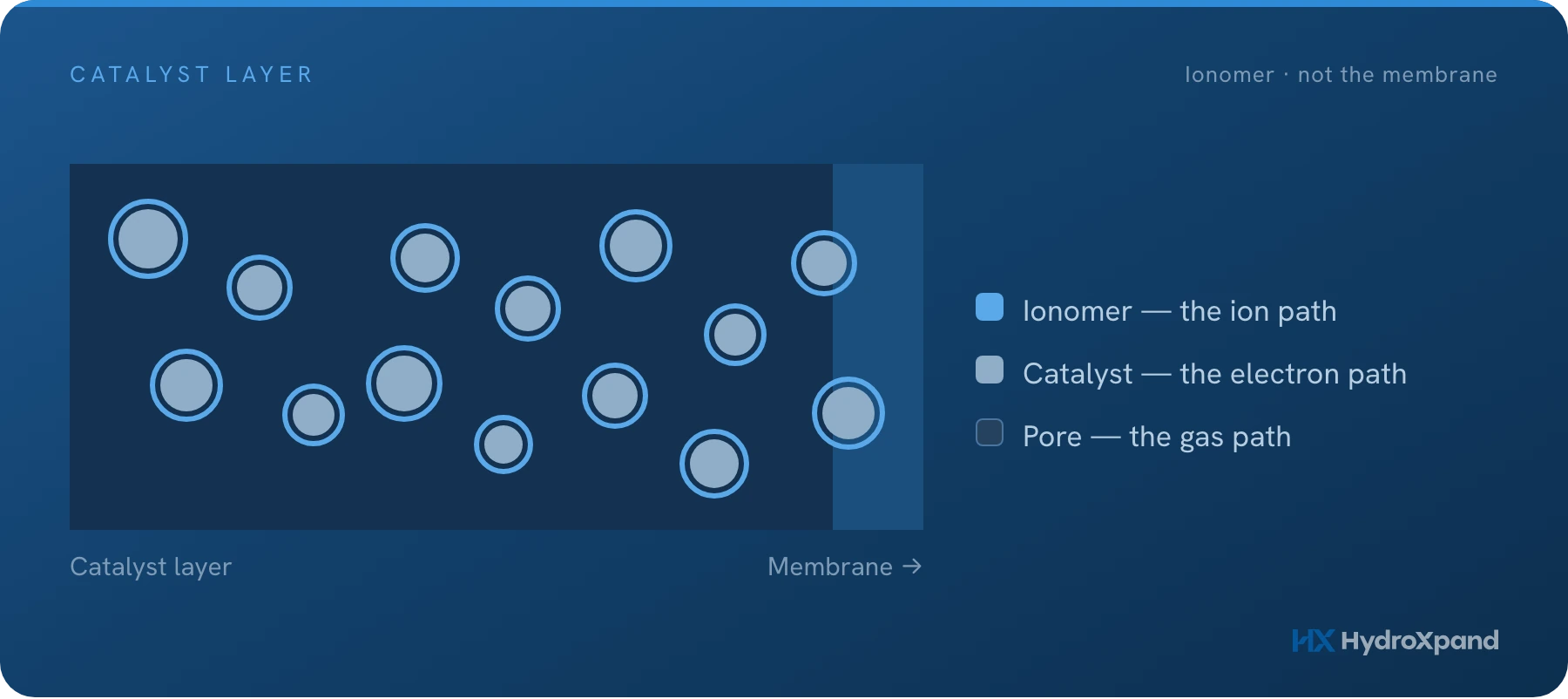
In electrolyzer catalyst layers, an ionomer provides ion-conducting paths and helps bind the layer together. That electrode role is different from the role of a membrane, even when the two are made from related chemistry.
An electrode is not a sheet of catalyst. It is a porous layer in which three things have to reach the same place at the same time: ions, electrons and gas. The catalyst particles carry the electrons and provide the surface. The pores carry the gas. The ionomer carries the ions.
It is the component most often confused with the membrane, and the confusion matters commercially as well as technically, because they are separate purchases. A membrane is bought as a sheet. An ionomer is bought as a powder or a dispersion, by the bottle.
The membrane decides what crosses the cell. The ionomer decides whether the catalyst you paid for is doing anything at all.
What it does, in the last few micrometres
A catalyst particle only contributes if it is connected three ways. It needs an electronic path back to the current collector, a gas path out to the flow field, and an ionic path to the membrane. A particle missing any one of those three is inert mass.
The ionomer supplies the third connection. It coats the catalyst and bridges the gap between the particle and the membrane, and in doing so it also acts as the binder that holds the layer together on its substrate.
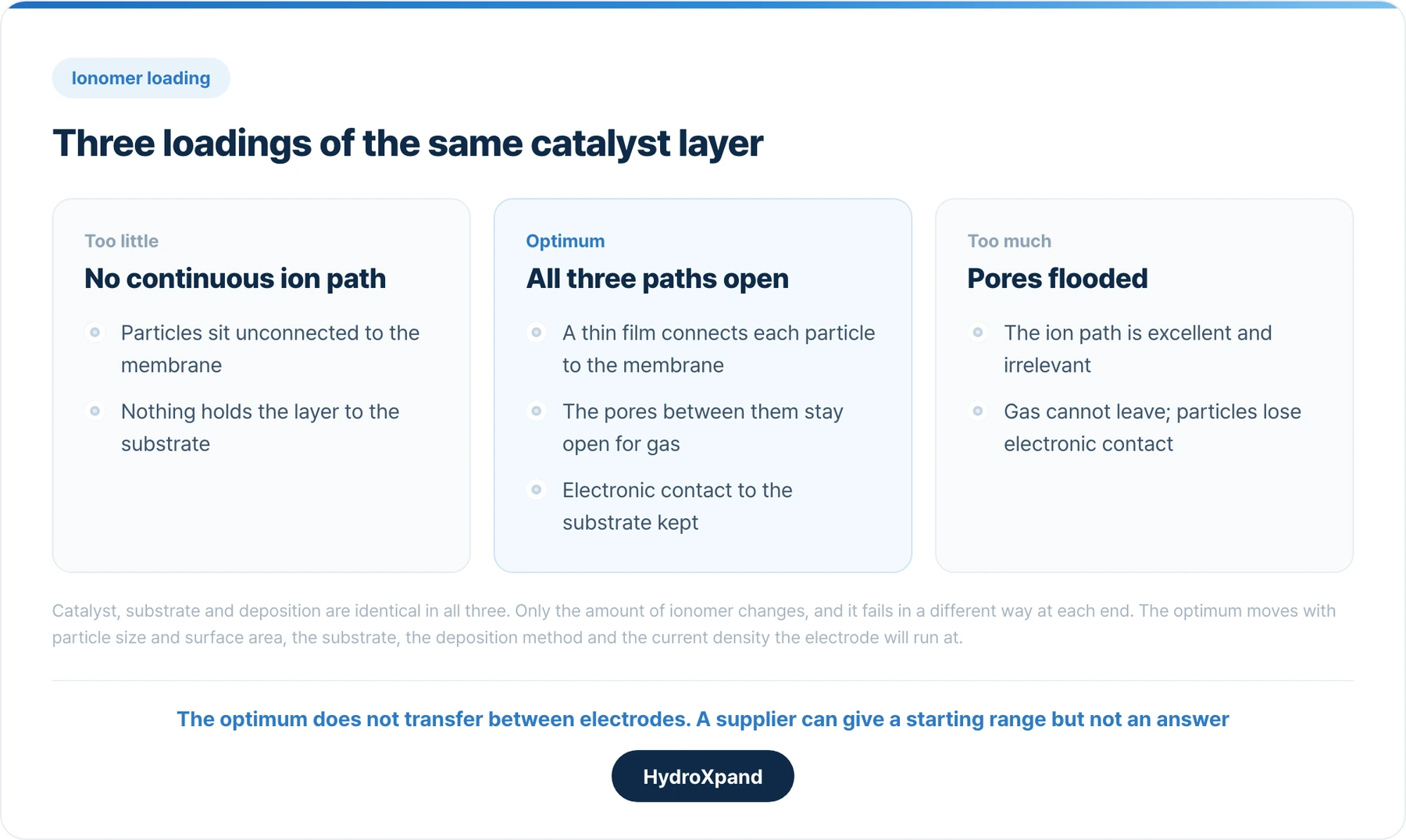
That dual role is the reason the ionomer is interesting rather than incidental. It is not an additive that improves an electrode. It is a structural component whose amount changes the geometry of everything else in the layer.
Why the loading is the whole problem
There is an optimum, it is narrower than people expect, and missing it in either direction fails for a different reason.
| Too little | Optimum | Too much | |
|---|---|---|---|
| Mechanical | The layer crumblesand sheds from the substrate | The layer holds | The layer holds |
| Ionic path | Brokenparticles are not connected to the membrane | Continuous | Continuous |
| Gas and electron path | Open | Open | Blockedpores flooded, particles insulated |
| What you see | Low performanceand a layer that does not last | The performance the catalyst can give | Low performanceworse at high current density |
The optimum is not a single number that transfers between electrodes. It depends on the catalyst's particle size and surface area, on the substrate, on how the layer is deposited and on the current density the electrode will run at. This is why an ionomer supplier can give you a starting range but not an answer, and why anyone fabricating their own electrodes ends up measuring it.
The practical consequence for buying is that the quantity you need follows from the ratio of ionomer to catalyst weight in your ink, not from the electrode area. Knowing that ratio is how you work out how many bottles an electrode programme needs.
It is also why a half-cell result and a cell result diverge. A catalyst evaluated on a rotating disk electrode has no ionomer problem to solve. The same material in a real electrode has to be connected three ways under compression, and that transition is where most of the promised performance is lost.
- HXP-ca · cathode→A catalyst layer already built, with the ionomer question already solved.
- HXP-an · anode→An electrode with the layer already built, if you would rather not solve this.
- Datasheets→Six products. No form.
Membrane and ionomer are not interchangeable
They are related chemistry doing unrelated jobs, and in an alkaline cell both have to survive the same environment. That shared vulnerability is the reason AEM durability is a polymer problem rather than a catalyst problem.
| Membrane | Ionomer | |
|---|---|---|
| Job | Separates the two gasesand conducts ions across the cell | Connects catalyst to membraneand binds the layer together |
| Where it sits | Between the two electrodes | Inside each catalyst layer |
| Form | Sheet | Powder or dispersionordered by the bottle |
| Chosen by | Conductivity, gas barrier, durability | Grade for the electrodeand the loading |
One more distinction is worth stating plainly, because we are asked it often enough that it is on our own parts page: not every electrode needs an ionomer. It goes where the catalyst is applied as particles. Our HXP-an anode grows its NiFe catalyst directly on nickel foam and uses none; our HXP-ca cathode is a particulate Pt/C or PtRu/C layer and does.
Our own long-run data is a useful illustration of how much the polymer components decide, even though it is a membrane measurement rather than an ionomer one. In one campaign on a 16 cm² two-cell short stack at 0.625 A cm⁻², changing only the membrane took the run from 1,234 hours to 6,358 hours, degrading at 14.7 µV/h per cell on the longer run. Same catalysts, same electrodes, five times the life.
AEM and PEM ionomers are different materials
The word ionomer covers both, but an ionomer made for one cell does not work in the other. The difference follows from the ion each cell moves.
| PEM ionomer | AEM ionomer | |
|---|---|---|
| Ion carried | Proton (H⁺) | Hydroxide (OH⁻) |
| Fixed ionic group | Negativesulfonic acid | Positivecationic groups such as quaternary ammonium |
| Environment | Acidic | Alkaline |
| Best-known example | Nafionperfluorosulfonic acid | Several familiesPiperION® is the one we supply |
| Anode catalyst it sits with | Iridium | Nickel and iron based |
The main degradation mechanism is hydroxide (OH-) attack on the polymer backbone, which leads to membrane collapse and catalyst layer dissolution within a few days.
The fixed group is also where AEM durability is decided. The cationic groups that carry hydroxide are what the alkaline environment attacks, in the ionomer as in the membrane, which is why both are chosen together with the operating conditions.
SourceIRENA, Green Hydrogen Cost Reduction (2020): hydroxide attack as the main AEM degradation mechanism
What to ask when you buy one
- Whether your electrode needs one. It does if the catalyst is applied as particles, and not if the catalyst is grown directly on the substrate.
- Which grade. The grades we supply differ by one number, the ion exchange capacity (IEC). A higher IEC improves ion transport but holds more water and can soften the layer; a lower one keeps the layer firmer.
- The recommended loading range for your catalyst type, stated as a starting point rather than a specification.
- The form and how it is dispersed. Powder or dispersion, the solvent system it is meant for, and the mixing procedure.
- Storage and shelf life, which are ordinary questions with unhelpful answers if you ask them after delivery.
- The conditions behind any conductivity figure, since ionic conductivity is quoted at a temperature and a humidity or an electrolyte, and rarely at yours.
Teams building their own electrodes can buy ionomer from us as powder in 0.8 g bottles. We supply three Versogen PiperION® grades at 2.35, 2.79 and 3.55 meq/g, the manufacturer's brochure values on an OH⁻ basis. If you have a target IEC we match it; if not, the catalyst and the loading ratio decide the grade.
What we do not publish is the composition of the ionomer we synthesise ourselves, because the detailed formulation is confidential, and we would rather say that than imply there is nothing to disclose.
SourcesVersogen PiperION-A ionomer brochure (2021): ion exchange capacity 2.35 meq/g, OH- form · Versogen PiperION-B ionomer brochure (2021): 2.79 meq/g · Versogen PiperION-C ionomer brochure (2021): 3.55 meq/g
- Buy ionomer powder: three IEC grades→0.8 g bottles, 2.35 to 3.55 meq/g. Ask for a quote.
- AEM membranes→The other polymer in the cell, supplied in small quantities.
- What is an MEA→The assembly this layer belongs to, and why interfaces decide more than ingredients.
- What a catalyst does→The particle the ionomer has to connect, and why the electrolyte decides which one it is.
- The anode that looks best on day one is not the one that lasts→The 6,358-hour run above, with every condition attached.
- AEM electrolysis: technology and measured data→How an AEM cell works, what is inside it, and where the ionomer sits.
- What is water electrolysis→The reaction the ionomer serves, and the four numbers fixed before any polymer is chosen.
- AEM water electrolysis→The alkaline membrane cell this ionomer is made for.
- PEM water electrolysis→The acidic counterpart, and why its ionomer is a different material.
Frequently asked questions
What is an ionomer?
An ionomer is a polymer in which a minority of the repeating units carry ionic or ionizable groups. Examples range from Surlyn in packaging films to Nafion in PEM fuel cells and electrolyzers; in an electrolyzer catalyst layer the ionomer provides the ion path to each catalyst particle and binds the layer together.
What is the difference between the membrane and the ionomer?
The membrane separates the two gases and conducts ions across the cell. The ionomer sits inside each catalyst layer and carries ions the last few micrometres to the catalyst surface.
Why does ionomer loading matter so much?
Too little and the layer has no ion path and falls apart. Too much and the pores flood, blocking gas and electron paths. The optimum depends on the catalyst, substrate and current density.
What is the difference between a PEM and an AEM ionomer?
A PEM ionomer such as Nafion carries fixed negative groups and conducts protons in an acidic cell. An AEM ionomer carries fixed positive groups and conducts hydroxide ions in an alkaline cell, so one cannot replace the other.
Does every electrode need an ionomer?
Only electrodes where the catalyst is applied as particles. Our HXP-an anode grows its catalyst directly on nickel foam and uses none; the particulate HXP-ca cathode does.
Sources
- Position Paper on PFAS — Hydrogen Europe, 2023
- EP0630665A2, Golf ball with cover formed from hard and soft ionomer resins — European Patent Office, 1994
- Green Hydrogen Cost Reduction — International Renewable Energy Agency, 2020
- PiperION-A, -B and -C ionomer brochures (2021) — Versogen, via K&R
Looking at AEM for a specific application?