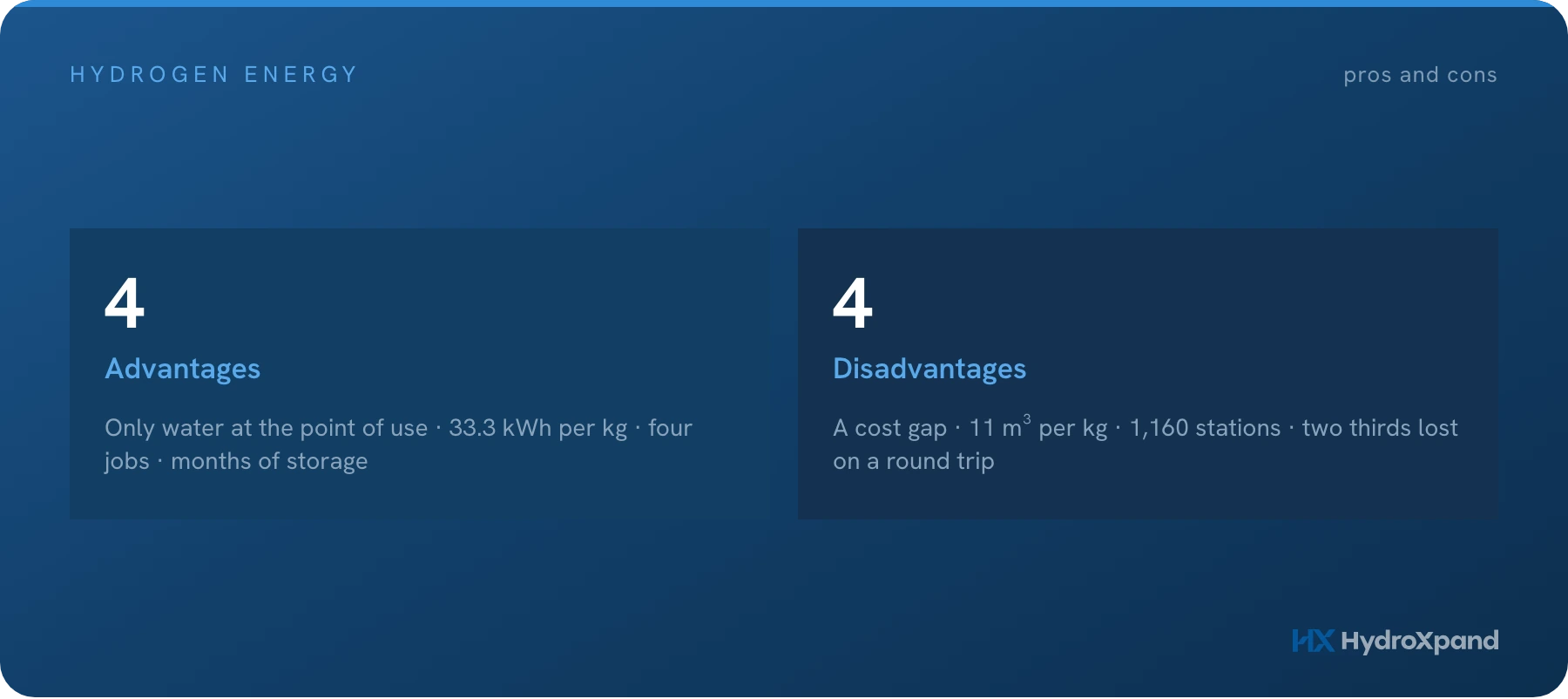
Hydrogen is not an energy source. It is a way of carrying energy that has to be made first, and every argument for or against it follows from that. Four of its eight defining points are fixed by physics and will not change. The other four are cost, infrastructure and policy, and they are moving.
Hydrogen energy means using hydrogen as a fuel to get electricity, heat or motion. Combine it with oxygen in a fuel cell or a burner and the product is water. That single reaction is the whole case for hydrogen, and also the reason the case is so often overstated.
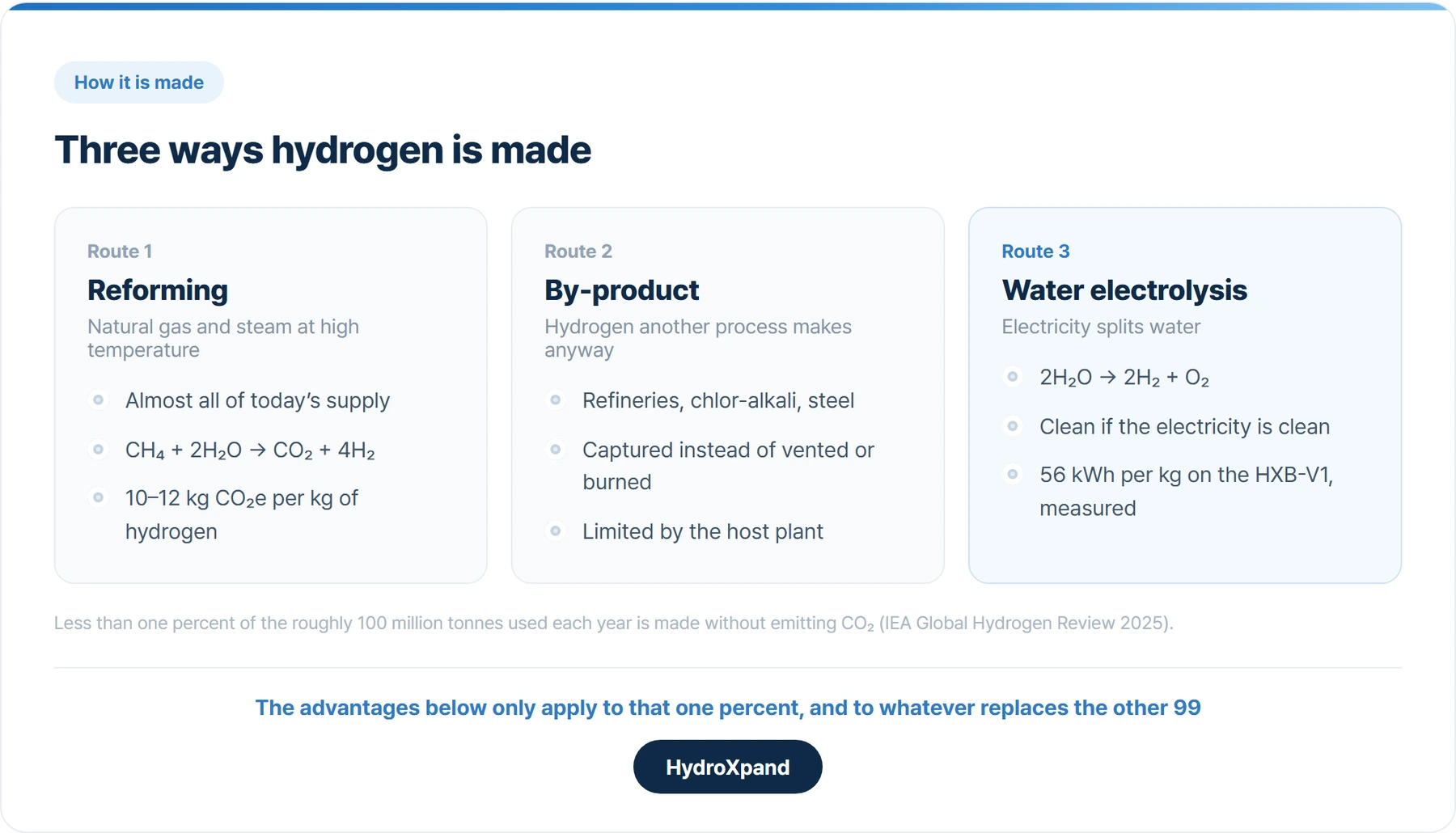
Hydrogen is not dug out of the ground. Almost all of it on Earth is bound up in water and in methane, so it has to be separated first, and that takes energy. It is a carrier, like a battery, not a source, like coal or sunlight. Today less than one percent of the roughly 100 million tonnes used each year is made without emitting carbon dioxide, according to the IEA.
So the honest question is not whether hydrogen is clean. It is clean or dirty depending on how it was made. The question is where its four real advantages outweigh its four real costs, and that is what this article sets out.
Advantage 1: nothing but water at the point of use
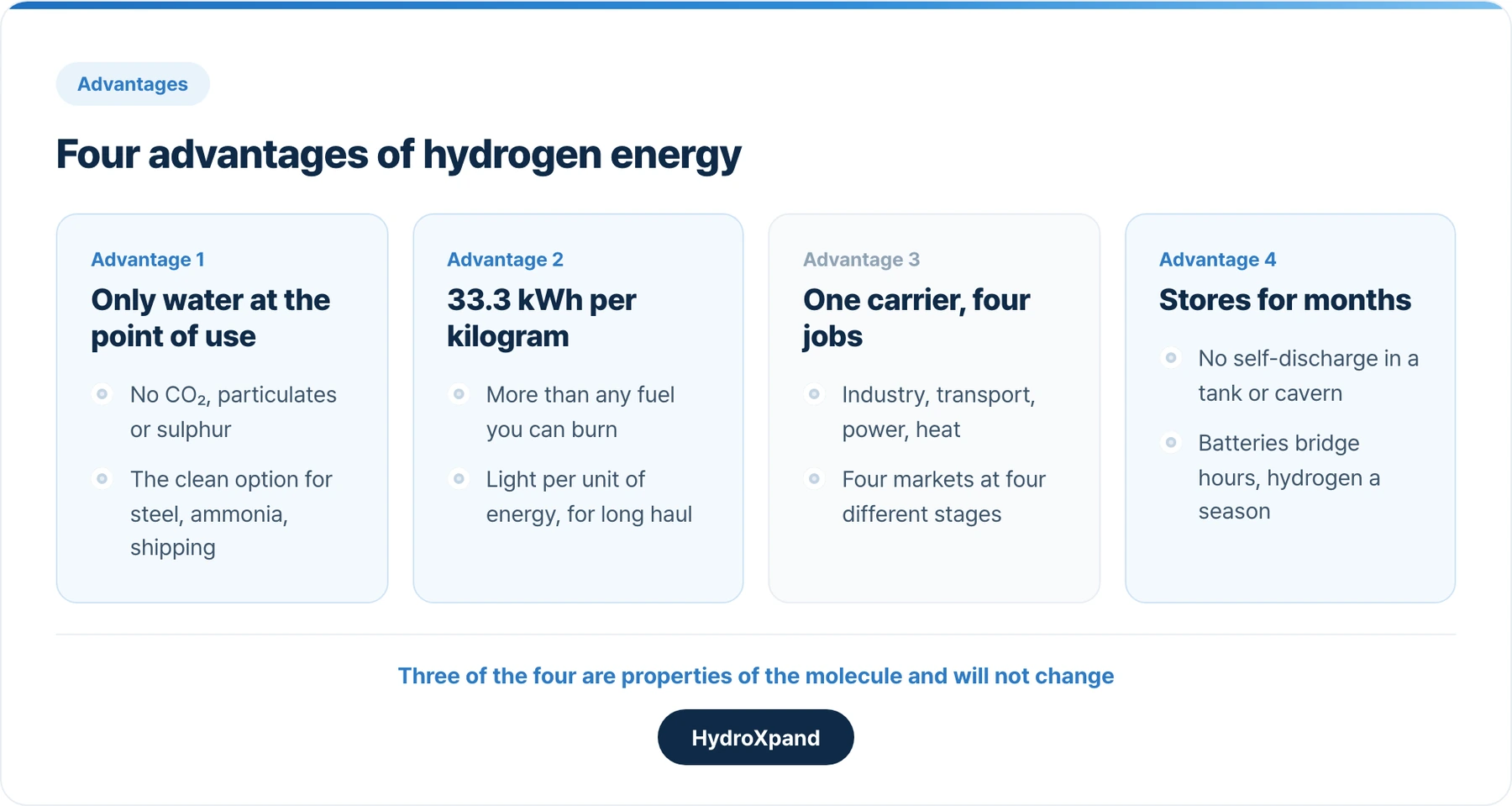
When hydrogen is used, whether in a fuel cell or a burner, the only product is water. No carbon dioxide, no particulates, no sulphur. For the sectors that cannot run on electricity directly, this is close to the only clean option there is: high-temperature industrial heat, iron ore reduction, ammonia and methanol production, long-distance shipping and aviation.
The qualification matters. If the hydrogen was made from natural gas without capturing the carbon, roughly 10 to 12 kg of CO₂ equivalent was emitted per kilogram before it ever reached the user. The advantage is real only when the hydrogen is made from clean electricity or with the carbon captured, which is the subject of the first disadvantage below.
Advantage 2: more energy per kilogram than any other fuel
A kilogram of hydrogen holds 33.3 kWh of usable energy, about 2.7 times petrol and about 2.4 times natural gas by mass. Nothing you can burn carries more energy per kilogram.
This is why hydrogen keeps coming up for long-haul trucks, trains, ships and aircraft, where the weight of a battery large enough for the range becomes the problem. A fuel that is light per unit of energy is exactly what those vehicles need.
The same property has a reverse side. Hydrogen is the lightest gas, so its energy per cubic metre is very low. High by mass, low by volume: the second half of that sentence is where two of the four disadvantages come from.
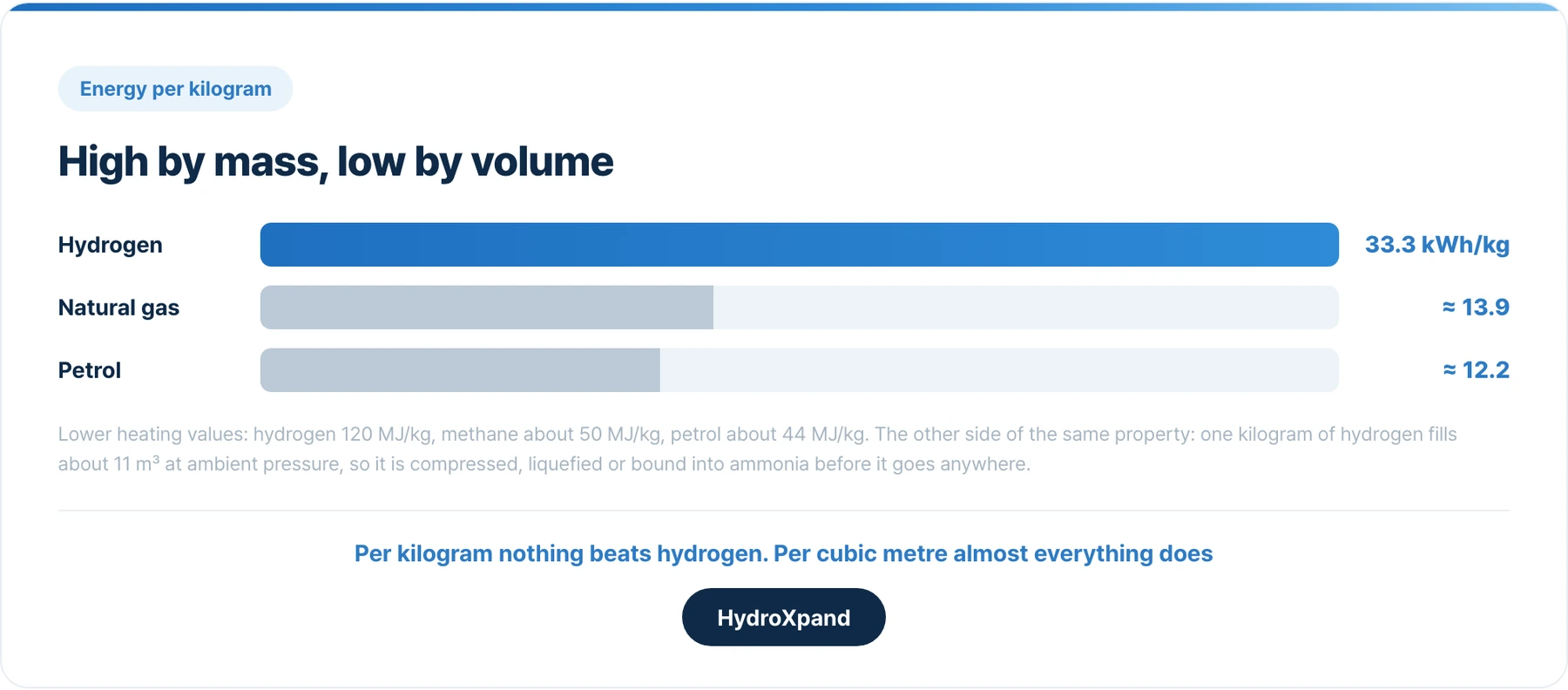
On a mass basis, hydrogen has nearly three times the energy content of gasoline—120 MJ/kg for hydrogen versus 44 MJ/kg for gasoline.
SourcesU.S. DOE: Hydrogen Storage (120 MJ/kg against 44 MJ/kg for gasoline) · U.S. DOE: Technical Targets for Onboard Hydrogen Storage (lower heating value 33.3 kWh/kg)
Advantage 3: one carrier, four jobs
Hydrogen is the only clean carrier that can do all four of the jobs energy is used for. As a feedstock and reducing agent in industry, which is where almost all of today's hydrogen already goes. As a fuel for heavy transport. As a fuel for turbines and fuel cells that make electricity. And, blended or pure, as a source of heat.
For anyone planning a hydrogen business this breadth is the point: the industry does not depend on a single market. For anyone reading a forecast it is also a warning, because the four markets are at very different stages. Industry is a hundred-million-tonne reality. Hydrogen for heat is largely a pilot.
| Job | What hydrogen does | Where it stands |
|---|---|---|
| Industry | Refining, ammonia, methanol, iron ore reduction | Almost all of today's useAbout 100 Mt a year, mostly fossil-based |
| Transport | Fuel cell trucks, buses, trains, ships | Growing, still smallUnder 1% of hydrogen use |
| Power | Turbines and fuel cells that make electricity | EarlyAuction schemes in a few countries |
| Heat | Blended into gas grids or burned directly | Pilot stageA blend by volume carries little of the energy |
Advantage 4: it stores electricity for months, not hours
Solar and wind have a defect that batteries only partly fix: they produce when the weather allows, not when the grid needs. A battery bridges hours. It cannot bridge a season.
Hydrogen can. Surplus electricity runs an electrolyzer, the hydrogen goes into a tank or a cavern, and it stays there without self-discharge for as long as the tank holds. This is the power-to-gas idea, and it is the reason grid operators in regions with high renewable shares are planning hydrogen storage alongside batteries rather than instead of them. The two are complementary: batteries for the daily cycle, hydrogen for the seasonal one.
The advantage is not that hydrogen stores electricity well. It stores electricity for a long time, which is a different thing.
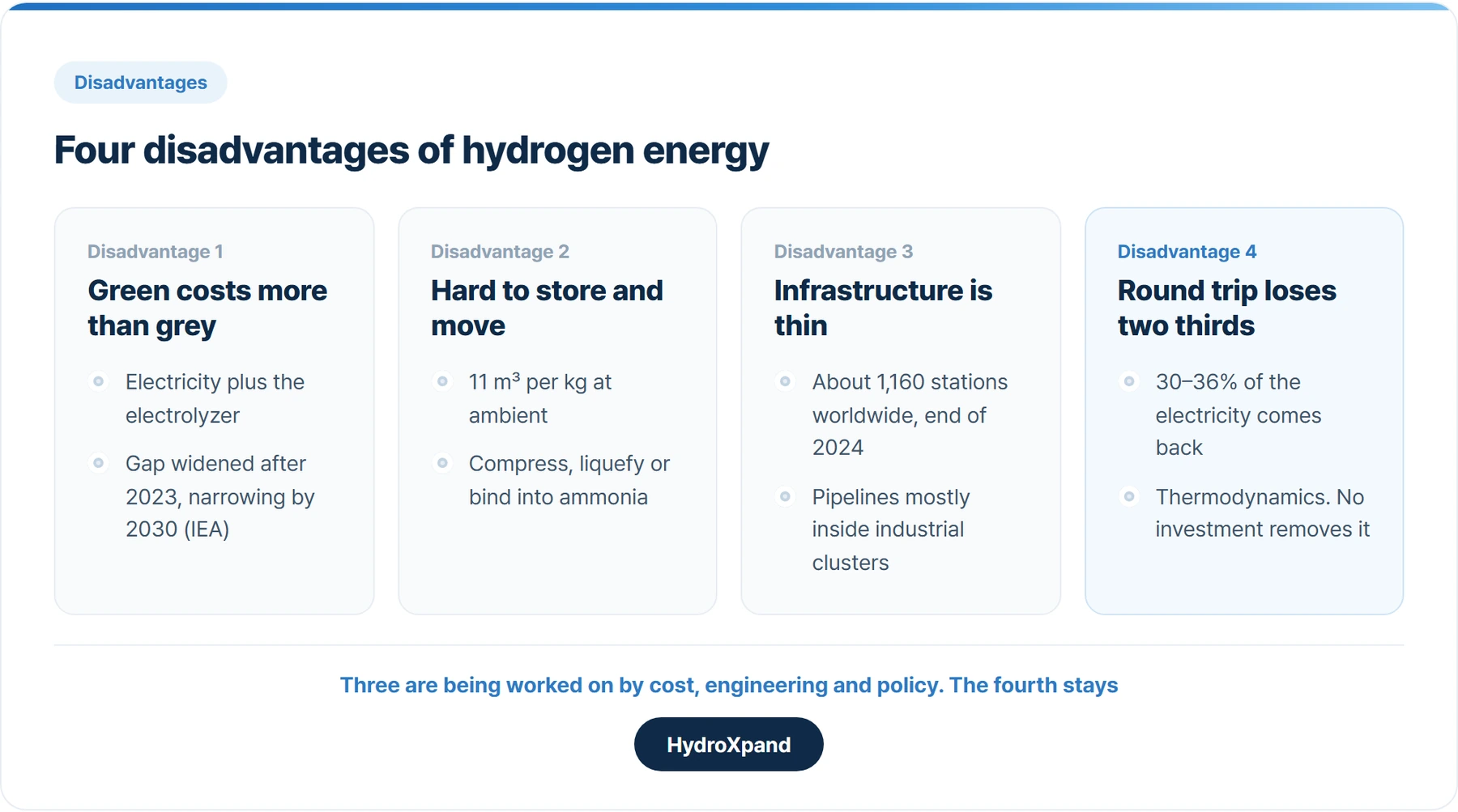
Disadvantage 1: green hydrogen still costs more than grey
The biggest disadvantage is price. Hydrogen made by electrolysis on renewable electricity costs more than hydrogen made from natural gas, and the IEA's 2025 review notes that the gap actually widened after 2023, because natural gas prices fell from their 2022 peak while electrolyzer costs rose with inflation and slower deployment.
Two things set the price of green hydrogen: the price of the electricity, which is the largest term, and the cost of the electrolyzer spread over the hydrogen it makes. Both are falling, and the IEA expects the gap to narrow substantially by 2030, with renewable hydrogen in China reaching the range of fossil-based production and parts of Latin America closing to within about half a dollar per kilogram.
Until then, low-emissions hydrogen depends on support schemes. That is the honest state of the market in 2026, and any article that tells you otherwise is quoting a forecast as a fact.
By 2030, in the STEPS, the cost of producing hydrogen using optimal conditions for renewable electricity generation in China is within the range of producing hydrogen from unabated fossil fuels.
SourceIEA Global Hydrogen Review 2025: the cost gap and where it narrows by 2030
Disadvantage 2: it is hard to store and move
A kilogram of hydrogen occupies about 11 cubic metres at atmospheric pressure. To make it useful it has to be compressed to hundreds of bar, cooled to about minus 253 °C and liquefied, or bound into another molecule such as ammonia and released again at the destination.
Every one of those routes charges a fee, paid in a fraction of the hydrogen's own energy, and every one needs equipment at both ends. Liquefaction alone costs roughly a third of the hydrogen's energy. Long-distance shipping is why imported hydrogen is usually planned as ammonia, with a cracking step at the receiving end.
The molecule is also the smallest there is. It leaks through fittings that would hold natural gas and it embrittles some steels, so hydrogen pipework and tanks are built to a different standard and cost more.
using today's technology, liquefaction consumes more than 30% of the energy content of the hydrogen and is expensive.
SourceU.S. DOE: Liquid Hydrogen Delivery (liquefaction energy)
Disadvantage 3: the infrastructure is thin
At the end of 2024 there were about 1,160 hydrogen refuelling stations in operation worldwide, according to the H2stations.org count, with roughly 750 of them in Asia and about 300 in Europe. That is a network for a few hundred thousand vehicles, not tens of millions, and it is why fuel cell cars remain a niche while battery cars are not.
Dedicated hydrogen pipelines exist mostly inside industrial clusters, where a producer and a consumer sit a few kilometres apart. The chicken-and-egg problem is real: stations wait for vehicles, vehicles wait for stations, and the same holds for pipelines and the plants that would feed them. Where the infrastructure is being built, it is being built by policy first and demand second.
Disadvantage 4: the round trip loses two thirds
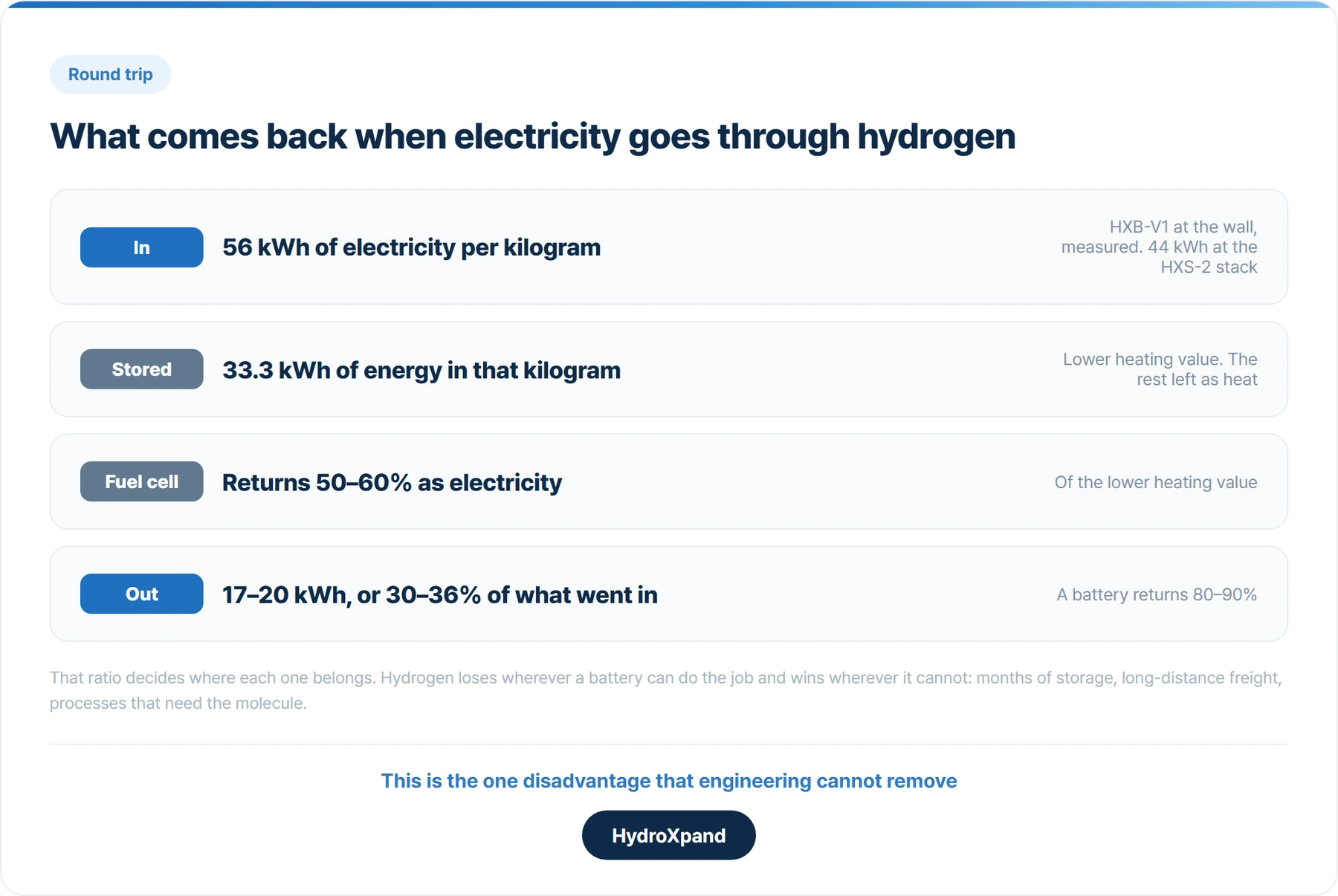
This is the disadvantage that no amount of investment removes. Turning electricity into hydrogen and back into electricity passes through two conversions, and each one loses energy.
On our own measured system, the HXB-V1 draws about 56 kWh of electricity at the wall to make a kilogram of hydrogen; 44 kWh of that is the HXS-2 stack itself and the rest is the balance of plant. The kilogram holds 33.3 kWh of usable energy. A fuel cell then returns about 50 to 60% of that as electricity. Multiply through and 30 to 36% of the original electricity comes back. A battery returns 80 to 90%.
That arithmetic is why hydrogen loses to a battery wherever a battery can do the job: short-range cars, daily grid balancing, anything that cycles every day. It is also why hydrogen wins wherever a battery cannot: months of storage, long-distance freight, and industrial processes that need the molecule rather than the electricity.
Where that leaves hydrogen
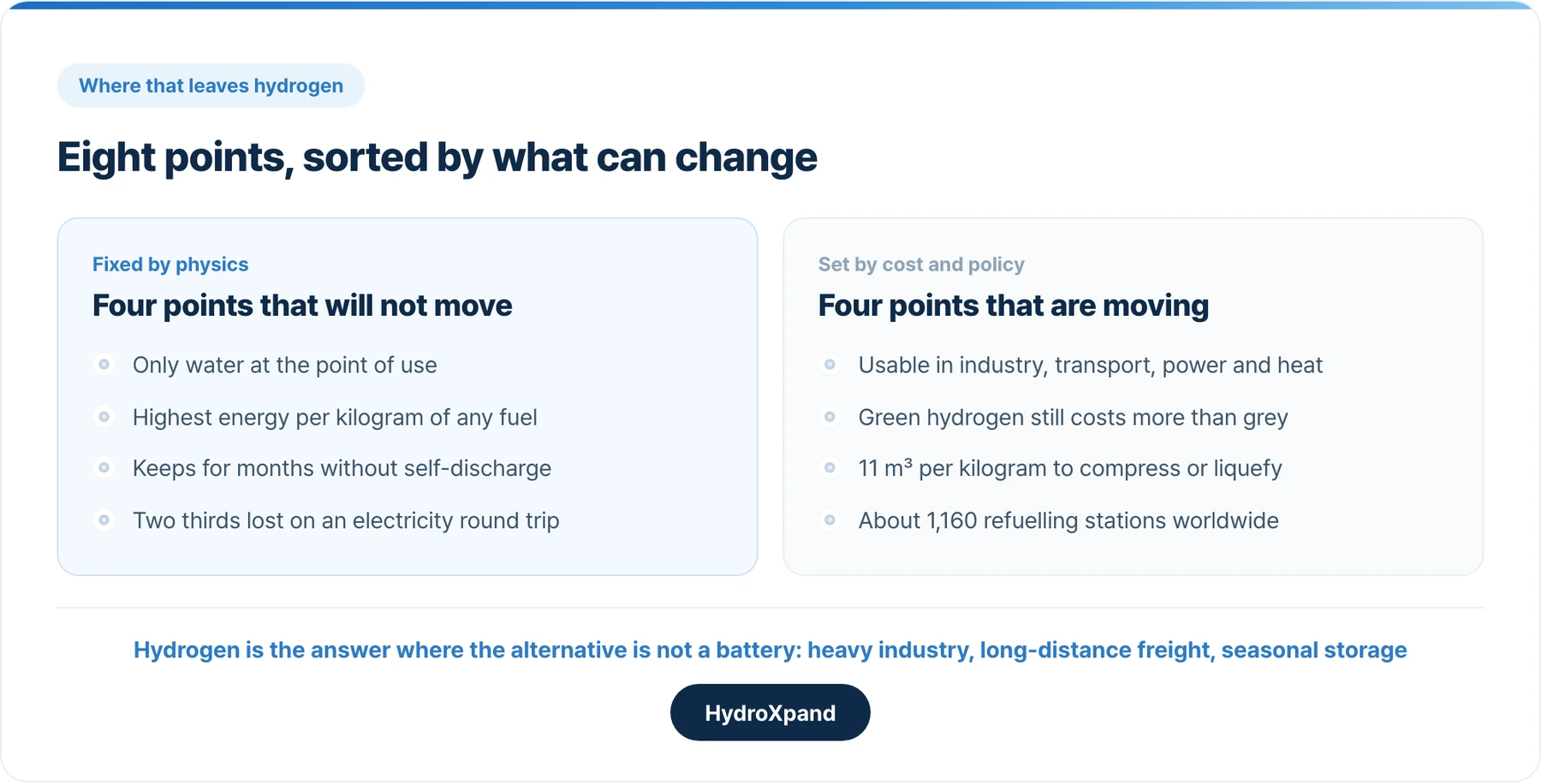
Line the eight points up and a pattern appears. Three of the advantages and one of the disadvantages are physics. Water as the only product, the highest energy per kilogram, storage across seasons and the two-thirds round-trip loss are not going to change. The remaining four are cost, volume handling, infrastructure and market maturity, and all four are moving in hydrogen's favour, at a pace set by policy and by electrolyzer prices.
So hydrogen is not the future of all energy, and it was never going to be. It is the answer for the jobs where the alternative is not a battery, and the size of that set of jobs is large: essentially all of heavy industry's molecule demand, most long-distance freight, and seasonal storage for grids that run on wind and sun.
The one variable that decides how much of that set hydrogen actually captures is the cost of making it cleanly, and that comes down to the price of clean electricity and the price of the electrolyzer. The second of those is what HydroXpand builds: AEM electrolysis stacks and systems that avoid iridium and PFAS membranes, sold today from 2 kW research and pilot units to a 30 kW stack.
- Hydrogen colours: what the names leave out→Why green, grey and blue describe the feedstock, and the one number that certification actually measures.
- Power-to-gas: what a hydrogen round trip costs→The 56 kWh out and 30 to 36% back, worked through step by step.
- Hydrogen storage: four routes→Compressed, liquid, LOHC and ammonia, and what each charges.
- What hydrogen is actually used for→The four industrial uses that are almost the whole market today.
- HXB-V1 · 2 kW system→The system the 56 kWh per kg figure belongs to.
Frequently asked questions
Is hydrogen energy really clean?
At the point of use, yes: the only product is water. Whether it is clean overall depends on how the hydrogen was made. Less than one percent of today's supply is made without CO₂ emissions, so the advantage is real only for hydrogen from clean electricity or with the carbon captured.
Why is hydrogen energy expensive?
Green hydrogen costs more than hydrogen from natural gas because the electricity and the electrolyzer both have to be paid for. The IEA notes the gap widened after 2023 as gas prices fell, and expects it to narrow substantially by 2030 as electricity and electrolyzer costs come down.
Is hydrogen better than batteries?
Neither is better; they do different jobs. A battery returns 80 to 90% of the electricity put in and suits daily cycles. Hydrogen returns about a third but stores energy for months and carries 33.3 kWh per kilogram, so it suits seasonal storage, long-distance freight and industry.
Where is hydrogen energy actually used today?
Almost all of the roughly 100 million tonnes used each year goes into refining, ammonia, methanol and iron ore reduction. Transport, power and heat together take less than one percent.
Sources
- Hydrogen Storage — U.S. Department of Energy
- DOE Technical Targets for Onboard Hydrogen Storage for Light-Duty Vehicles — U.S. Department of Energy
- Liquid Hydrogen Delivery — U.S. Department of Energy
- Global Hydrogen Review 2025 — International Energy Agency, 2025
- Global Hydrogen Review 2024 — International Energy Agency, 2024
Looking at AEM for a specific application?