A hydrogen fuel cell turns hydrogen and oxygen into electricity, heat and water, with nothing burned and nothing spinning. Its four strengths are properties of the cell. Its four limits are the cost, the refuelling network, the hydrogen it is fed and its lifetime. This article sets out all eight, and what each one depends on.
Hydrogen fuel cells power cars, buses, ships, back-up generators and stationary power plants, and they are usually described as the clean way to turn hydrogen back into electricity. That description is right about the cell and incomplete about everything around it.
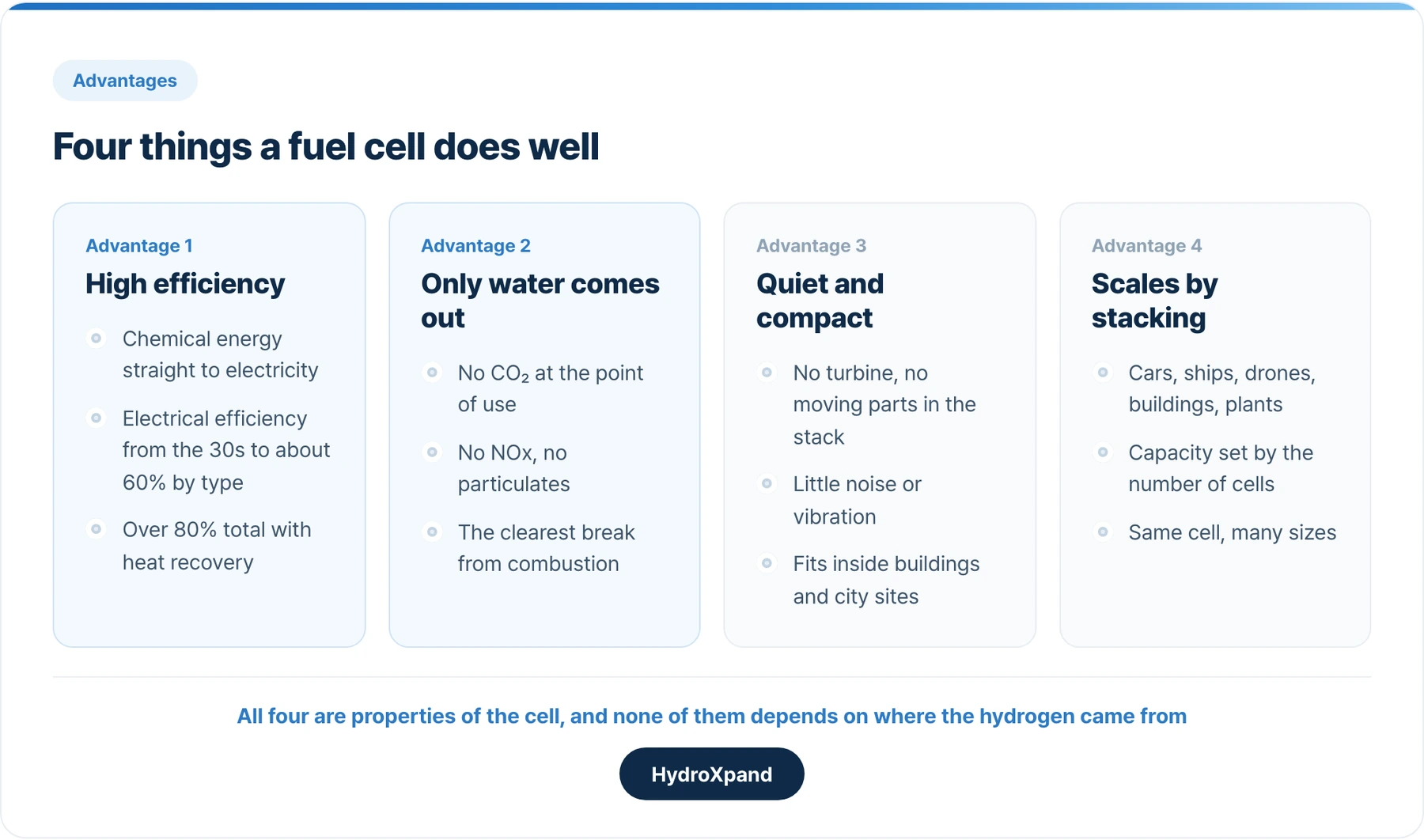
The strengths of a fuel cell are properties of the device: it is efficient, it produces only water, it is quiet, and it scales by stacking. The weaknesses are mostly outside the device: what it costs, where the hydrogen comes from, how it gets there, and how long the cell lasts. Keeping those two groups apart is the simplest way to judge any fuel cell proposal.
This article goes through the four advantages and four disadvantages, what a fuel cell actually is, what the efficiency figures mean, and why an electrolyzer company writes about a device it does not make.
What a hydrogen fuel cell is
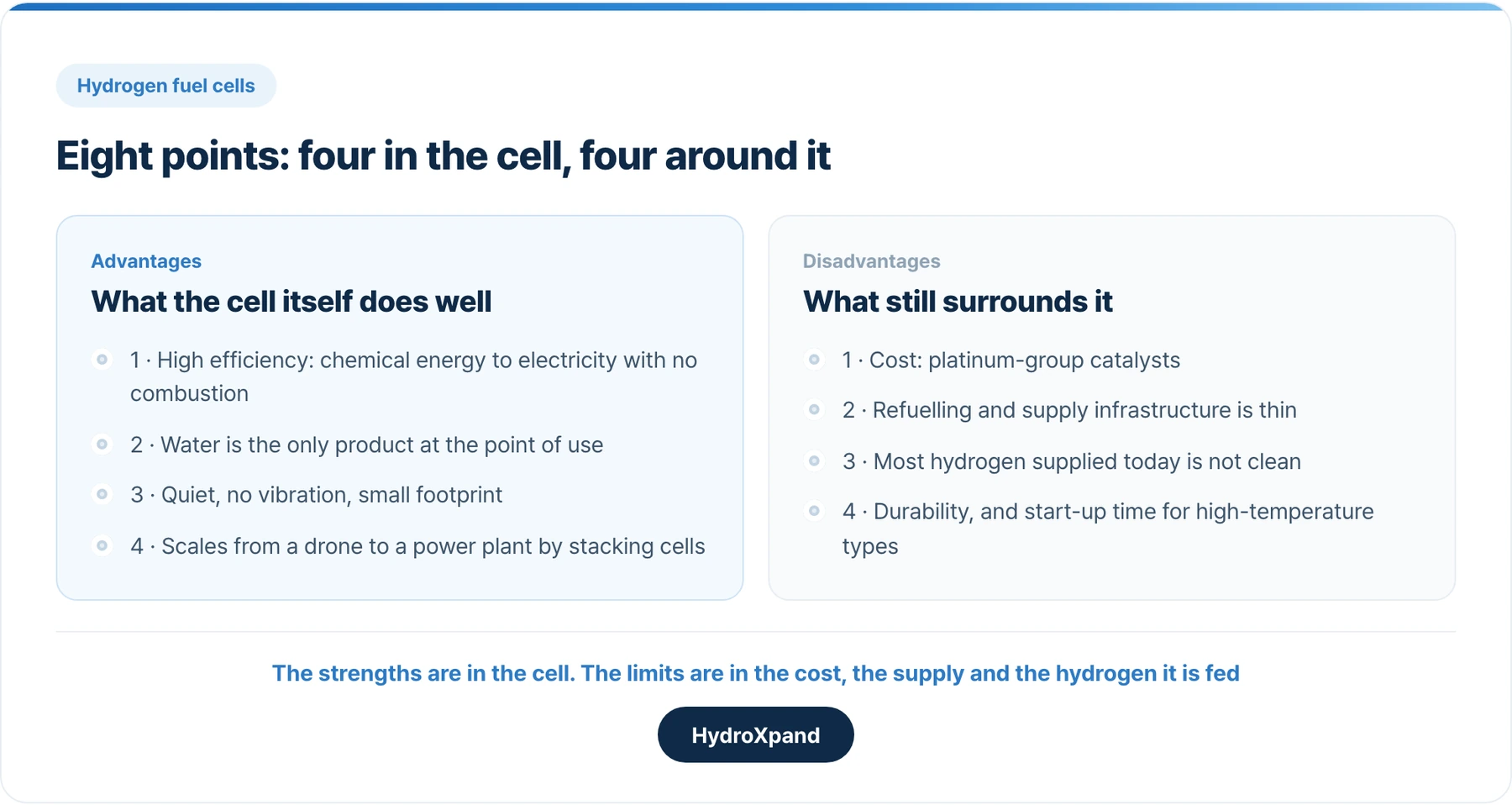
A hydrogen fuel cell is a device that makes electricity from the reaction of hydrogen with oxygen. The word cell makes it sound like a battery, and it is not one. A battery stores electricity and gives it back. A fuel cell generates electricity for as long as hydrogen is supplied to it, so it is closer to a generator than to a battery.
The way it works is simple. Hydrogen is fed to one electrode, the anode, where it gives up its electrons. Air is fed to the other electrode, the cathode, where oxygen takes the electrons back and combines with the hydrogen ions to make water. The electrons travel from one electrode to the other through an external circuit, and that current is the output. Because nothing is burned and no turbine turns, the energy losses are small compared with a combustion plant.
Fuel cells are classified by their electrolyte and operating temperature. The proton exchange membrane fuel cell, PEMFC, runs at low temperature and is the type used in vehicles. The solid oxide fuel cell, SOFC, runs hot and is used in stationary power. Others exist, and the type decides most of the differences in efficiency, start-up time and cost.
Advantage 1: high efficiency
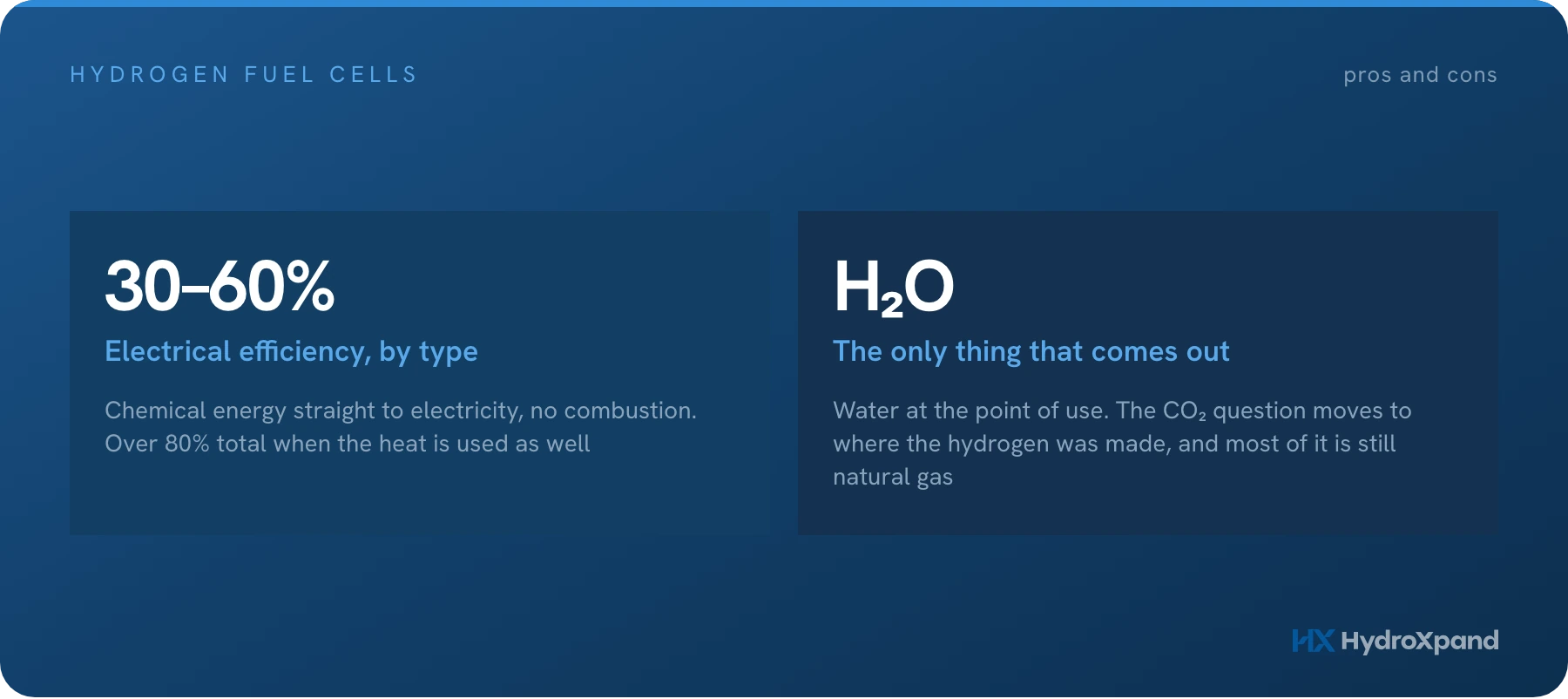
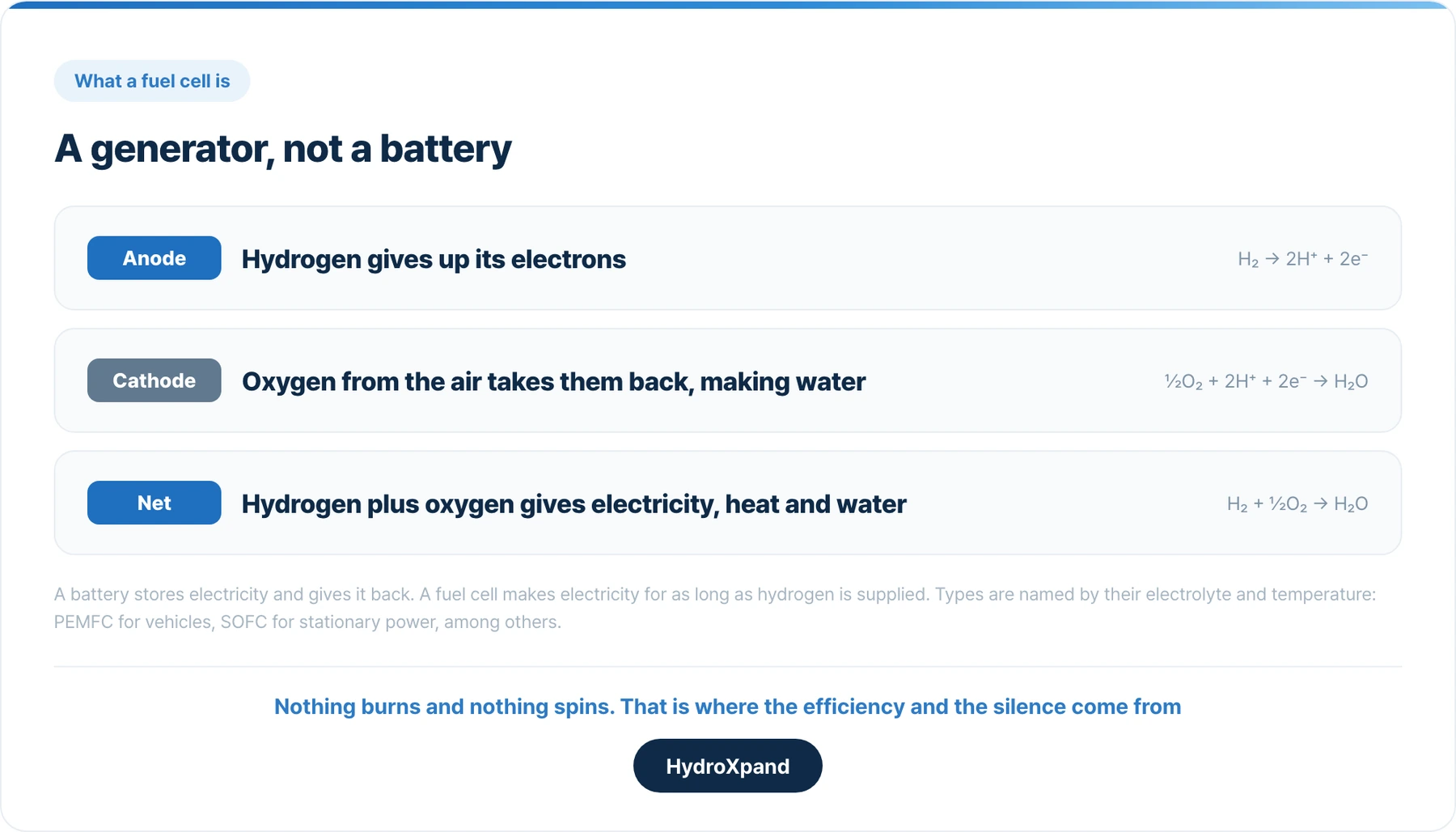
A fuel cell converts chemical energy to electricity directly, without the combustion and turbine stages of a thermal plant, so less energy is lost on the way. Electrical efficiency runs from the 30s to about 60% depending on the type of cell, according to Korea Energy Agency figures, and when the heat from the reaction is used as well, in a combined heat and power arrangement, total efficiency rises above 80%.
while fuel cell systems can easily generate electricity at efficiencies up to 60 percent (and even higher with cogeneration)
SourceU.S. DOE: Fuel Cells for Stationary Power Applications
Advantage 2: water is the only product
Hydrogen and oxygen react to give electricity, heat and water, and nothing else. There is no carbon dioxide and essentially no air pollution at the point of use. This is the clearest break from any combustion technology, and it is the reason fuel cells are counted as clean generation.
Hydrogen fuel cells emit only water with no air pollutants that create smog and cause health problems at the point of operation.
SourceU.S. DOE: Fuel Cells
Advantage 3: quiet, vibration-free and compact
There is no turbine and nothing rotating in the stack, so a fuel cell makes little noise or vibration. It takes far less land than a thermal plant of the same output, which makes it suitable for distributed generation inside buildings and on city sites where a combustion plant could not go.
Advantage 4: wide use and free scaling
The same cell serves cars, ships, drones, buildings and power plants. Because a stack is built from many identical cells, capacity is set by how many are stacked, and the same design can be sized up or down without a new technology.
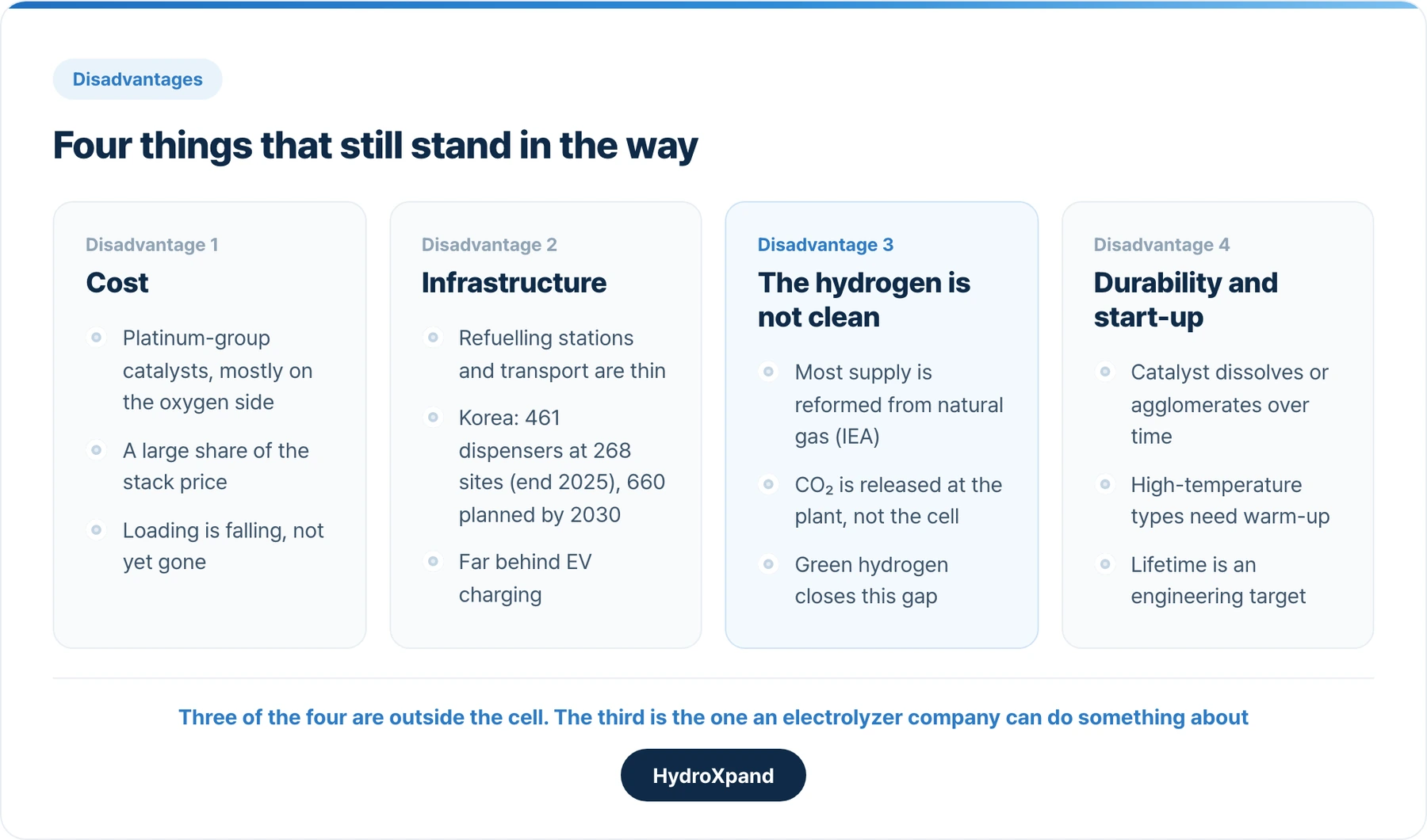
Disadvantage 1: cost
Fuel cells use platinum-group catalysts, mainly on the oxygen side, and the catalyst is a large share of the stack's price. Loadings have fallen and substitutes are being researched, but the cost of the cell is still the main obstacle to mass adoption.
Disadvantage 2: infrastructure
A fuel cell needs a hydrogen supply, and the refuelling stations and transport network are thin. Korea, one of the countries furthest along, had 461 hydrogen dispensers at 268 refuelling sites at the end of 2025, and the government's targets are more than 500 dispensers in 2026 and more than 660 by 2030. Set against electric vehicle charging, that is still a small network, and most countries have far less.
Disadvantage 3: the hydrogen is usually not clean
The cell emits only water, but the hydrogen it is fed has a history. According to the IEA, most of the world's hydrogen is made from fossil fuels, mainly natural gas, and CO₂ is released when it is made. A fuel cell running on that hydrogen has moved the emissions upstream, not removed them. It becomes genuinely clean only when the hydrogen is made from water with renewable electricity.
The supply of hydrogen continued to be dominated by fossil fuels, using 290 billion cubic metres (bcm) of natural gas and 90 million tonnes of coal equivalent (Mtce) in 2024.
SourceIEA Global Hydrogen Review 2025: hydrogen supply by fuel
Disadvantage 4: durability and start-up
Over time the catalyst dissolves or its particles agglomerate, and performance falls. Achieving a long, stable lifetime is still an engineering target. High-temperature types such as SOFC also need time to warm up before they deliver full output, which limits where they can be used.
What the efficiency figures mean
Two different efficiencies get quoted for fuel cells, and they answer different questions. The first is the cell's own efficiency: how much of the energy in the hydrogen comes out as electricity. That is the 30 to 60% figure, higher with heat recovery. It is a fair number for the device.
The second is the round trip, and it matters whenever the hydrogen was made from electricity in the first place. An electrolyzer draws about 56 kWh of electricity at the wall to make a kilogram of hydrogen on our measured HXB-V1 system. The kilogram holds 33.3 kWh of usable energy. A fuel cell returns 50 to 60% of that as electricity, so about a third of the original electricity comes back. That is not a flaw in the fuel cell. It is the price of storing electricity as a gas, and it is why hydrogen suits long-duration and seasonal storage rather than daily cycling.
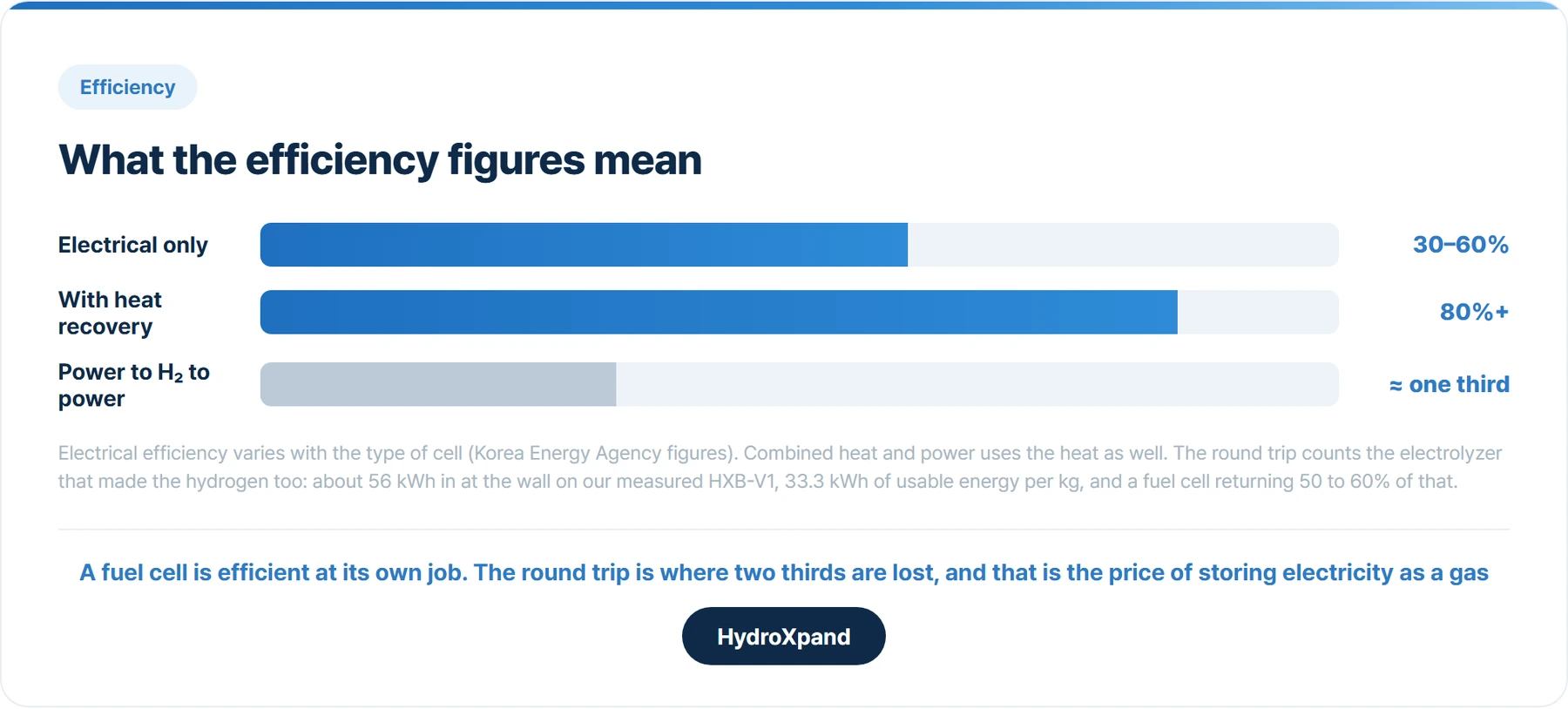
A fuel cell is efficient at its own job. The round trip is where two thirds are lost, and that is the price of storing electricity as a gas.
Why an electrolyzer company writes about fuel cells
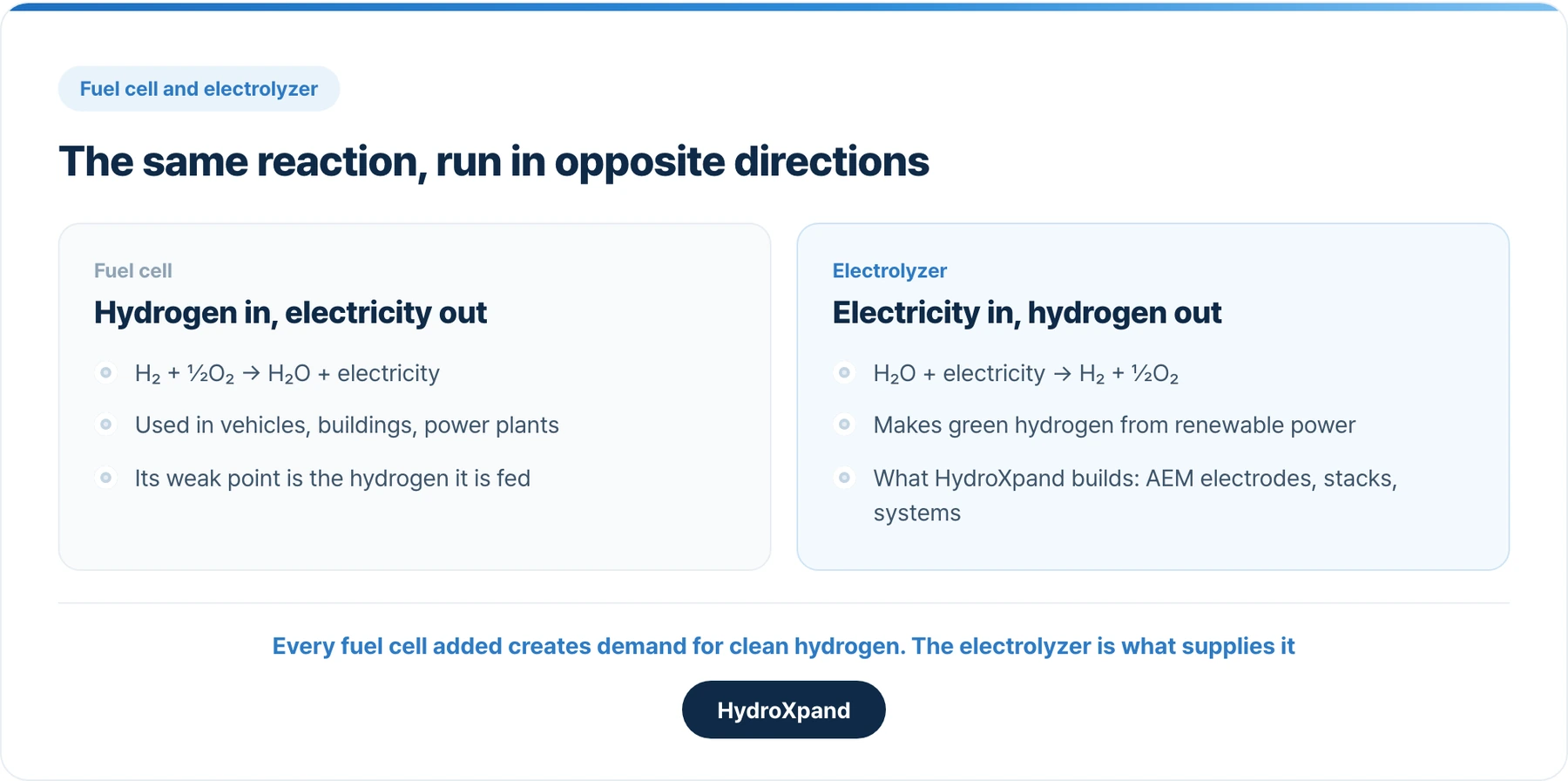
HydroXpand does not make fuel cells. We make electrolyzers, which run the same reaction in the opposite direction: electricity and water in, hydrogen and oxygen out. The two devices share their chemistry and much of their construction, and they are a pair in the market as well. Every fuel cell that is installed creates demand for hydrogen, and the third disadvantage above, that most of that hydrogen is not clean, is the problem electrolysis exists to solve.
That is the relationship. A fuel cell running on grey hydrogen is a cleaner engine with a dirty fuel. A fuel cell running on hydrogen from renewable electricity is clean end to end. The difference is made by the electrolyzer, and by the cost at which it can make hydrogen, which is what our AEM electrodes, stacks and systems are built to bring down.
What to take from this
- Judge the cell by its own numbers: electrical efficiency by type, total efficiency with heat recovery, lifetime, and the catalyst loading that sets its cost.
- Judge the project by what surrounds the cell: where the hydrogen comes from, how it arrives, and what it costs delivered.
- Ask how the hydrogen was made. Water at the tailpipe says nothing about CO₂ at the plant.
- If the hydrogen is made from electricity, count the round trip. About a third comes back, which is right for seasonal storage and wrong for daily cycling.
The supply side of that list is HydroXpand's work: AEM electrolysis electrodes, stacks and systems without iridium or PFAS membranes, sold today from 2 kW research and pilot units to a 30 kW stack, for buyers who want hydrogen made from water rather than from natural gas.
- Fuel cell vs electrolyzer: the same parts, run backwards→Why one device cannot do both jobs well, and where the energy goes in each direction.
- Hydrogen energy pros and cons→The eight points for hydrogen as an energy carrier, including the round-trip loss.
- What is grey hydrogen→Where most of today's hydrogen comes from, and what it emits per kilogram.
- What is water electrolysis→The reaction a fuel cell runs in reverse, and the four numbers fixed per kilogram.
- AEM water electrolysis: how it works→How HydroXpand makes hydrogen from water without iridium.
Frequently asked questions
Is a hydrogen fuel cell the same as a battery?
No. A battery stores electricity and gives it back. A fuel cell generates electricity on the spot from hydrogen and oxygen, and keeps generating for as long as hydrogen is supplied. It is closer to a generator than to a battery.
Are hydrogen fuel cells really clean?
The cell itself emits only water. Whether the whole system is clean depends on the hydrogen. Most hydrogen today is made from natural gas with CO₂ released at the plant, so a fuel cell is genuinely clean only when it runs on hydrogen made from water with renewable electricity.
What is the biggest disadvantage of hydrogen fuel cells?
Cost and infrastructure. Platinum-group catalysts make the stack expensive, and refuelling stations and hydrogen transport are still thin. Korea, one of the leading countries, had 461 dispensers at 268 sites at the end of 2025.
How efficient is a hydrogen fuel cell?
Electrical efficiency runs from the 30s to about 60% depending on the type, and over 80% total when the heat is used as well. If the hydrogen was made by electrolysis, the full round trip from electricity to hydrogen and back returns about a third of the electricity.
What is the difference between a fuel cell and an electrolyzer?
Direction. A fuel cell turns hydrogen into electricity; an electrolyzer turns electricity into hydrogen. They share the same chemistry run in opposite directions, and every fuel cell creates demand for the hydrogen an electrolyzer makes.
Sources
- Fuel Cells for Stationary Power Applications — U.S. Department of Energy, Fuel Cell Technologies Office
- Fuel Cells — U.S. Department of Energy
- Global Hydrogen Review 2025 — International Energy Agency, 2025
Looking at AEM for a specific application?