A kilogram of hydrogen occupies about 11 cubic metres at ambient conditions, which is why it is never stored that way. Every method of shrinking it charges a fee, and the fee is paid in a fraction of the hydrogen's own energy.
Hydrogen carries more energy per kilogram than any other chemical fuel. It also carries less energy per cubic metre than almost anything worth shipping.
That mismatch is the whole storage problem, and it is why the industry has four answers instead of one.
At 0 °C and one atmosphere, a cubic metre of hydrogen weighs 0.0899 kg. So a kilogram of it, about a day's output from a small on-site generator, fills 11 cubic metres.
Nothing useful can be done with the gas in that state. It gets compressed, chilled into a liquid, or chemically attached to something else. Each route costs energy, and the question is how much, and paid where.
Compressed gas: the default
Most hydrogen that moves today moves as compressed gas. Cylinders and tube trailers run at 200 bar and above. Vehicles and refuelling systems run at 350 or 700 bar.
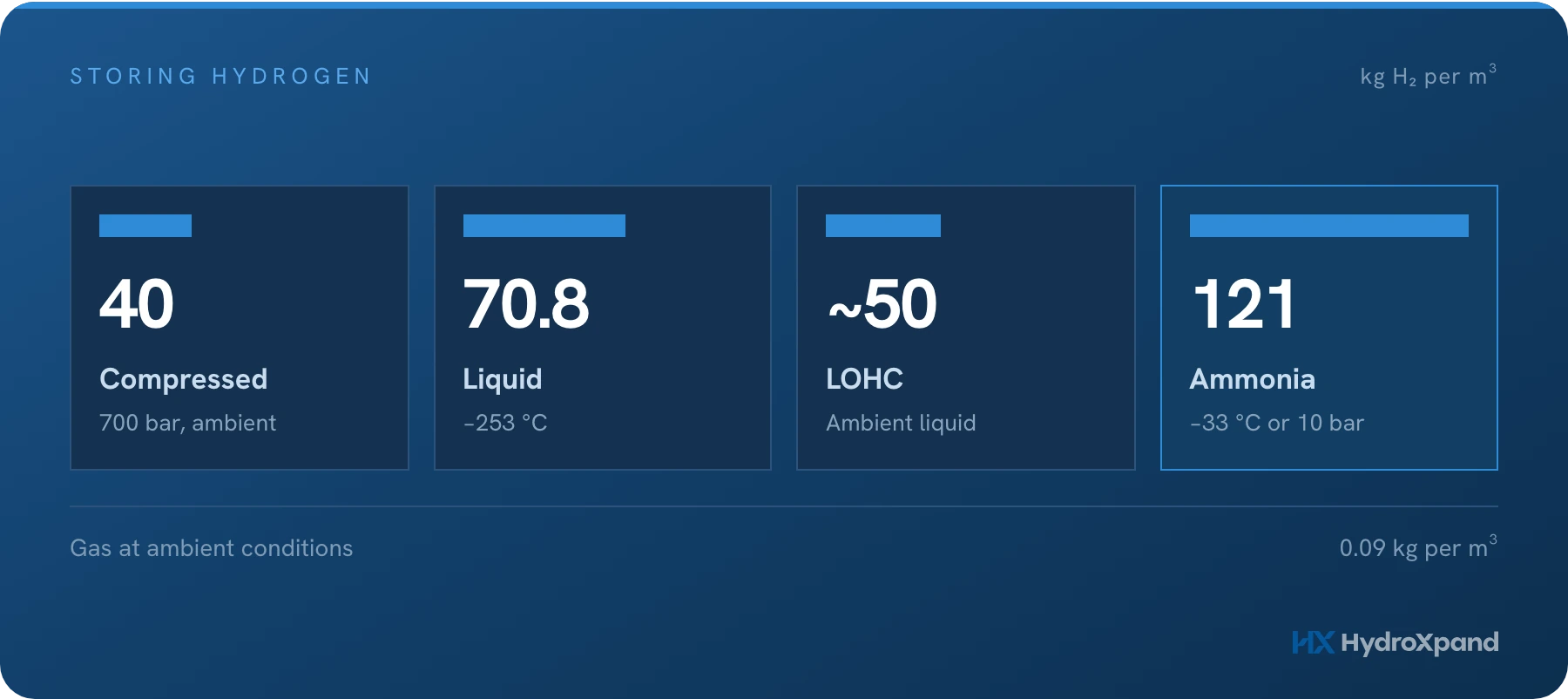
At 700 bar and room temperature the gas reaches about 40 kg per cubic metre. At 350 bar it is about 24 kg. Doubling the pressure does not double the density, because hydrogen stops behaving like an ideal gas.
The cost sits in the vessel, not the compressor. Holding 700 bar takes carbon fibre composite, and that material is most of what a high-pressure tank costs.
Compression itself is cheap by comparison. Reaching 700 bar from a moderate starting pressure takes around 3 kWh per kilogram, or about a tenth of the energy in the hydrogen. Starting from atmospheric pressure costs noticeably more.
Which is an argument for producing at pressure in the first place, and that is the electrolyzer's decision rather than the storage system's. Our HXS-2 stack and HXB-V1 system deliver hydrogen at up to 10 barg directly, chosen when ordering.
The theoretical energy to compress hydrogen isothermally from 20 bar to 350 bar (5,000 psi or ~35 MPa) is 1.05 kWh/kg H2 and only 1.36 kWh/kg H2 for 700 bar
SourceU.S. DOE Hydrogen Program Record 9013: energy requirements for compression and liquefaction
Liquid hydrogen: density bought with temperature
Liquefaction gives the highest density available to pure hydrogen: 70.8 kg per cubic metre, close to twice what 700 bar manages.
It is also handled at near-atmospheric pressure, which takes the vessel out of high-pressure regulation.
The price is temperature. Hydrogen becomes a liquid at −252.9 °C, and getting there is one of the most energy-hungry processes in ordinary industrial use.
Published plant figures run 10 to 13 kWh per kilogram. That is roughly a third of the energy in the hydrogen being liquefied, against the 3 kWh or so that compression costs.
Then there is boil-off. No insulation is perfect, heat leaks in, and the hydrogen that absorbs it evaporates and has to be vented or re-chilled. The loss runs continuously, which makes liquid a poor fit for slow turnover and a good one for large volumes that move fast.
Liquefaction buys the highest density available to pure hydrogen, and pays for it with about a third of the hydrogen's own energy.
SourcesU.S. DOE Hydrogen Program Record 9013: liquefaction 10 to 13 kWh/kg · U.S. DOE: Hydrogen Storage (boiling point at one atmosphere)
LOHC: hydrogen that behaves like diesel
A liquid organic hydrogen carrier is an oil that hydrogen is chemically bonded to at one end of the journey and stripped from at the other.
Toluene and methylcyclohexane are the best-known pair. Dibenzyltoluene is the other common choice. The carrier holds about 6% of its own mass in hydrogen, which comes to roughly 45 to 55 kg per cubic metre.
The attraction is the handling. Loaded, it is an ordinary liquid at room temperature and pressure, close enough to a petrochemical product that existing tanks, tankers and pumps work. It can sit for months without loss.
The bill arrives at the far end. Releasing the hydrogen absorbs heat: about 9 kWh per kilogram, supplied at 250 to 320 °C, which is 28% of the energy in the hydrogen you are recovering.
That step also needs a catalytic reactor at the receiving site, and the empty carrier then has to be shipped back.
SourceIEA Global Hydrogen Review 2024: import-chain assumptions, dehydrogenation heat demand of 12.2 kWh/kg for the carrier modelled there (our 9 kWh/kg is for a different carrier assumption)
Ammonia: the one with an industry already attached
Ammonia is 17.8% hydrogen by mass, and it turns liquid at −33 °C, or at about 10 bar at room temperature.
A cubic metre of the liquid holds roughly 121 kg of hydrogen. That is more than liquid hydrogen itself, under far easier conditions.
The stronger argument is that the infrastructure exists. Ammonia has been made, stored, shipped and regulated at scale as a fertiliser feedstock for a century. Terminals, carriers, tanks and safety codes are already in place, which is true of nothing else on this list.
Two costs follow it. Ammonia is toxic and corrosive, so leak detection and emergency shut-off are preconditions rather than options.
And getting the hydrogen back out absorbs heat: 4.2 kWh per kilogram, at 400 to 600 °C, which is 13% of the energy in the hydrogen recovered.
Traces of ammonia then have to be scrubbed out, because fuel cell grade hydrogen allows only 0.1 ppm. Which is why burning ammonia directly, without turning it back into hydrogen, is being taken seriously for shipping and power.
The four, side by side
| Compressed 700 bar | Liquid | LOHC | Ammonia | |
|---|---|---|---|---|
| H₂ per m³ | ≈ 40 kg | 70.8 kg | ≈ 45–55 kg | ≈ 121 kg |
| Condition | 700 bar, ambient | −253 °C, near ambient pressure | Ambientliquid | −33 °C or ≈ 10 bar |
| Energy to store | ≈ 3 kWh/kgcompression | 10–13 kWh/kgliquefaction | Loading gives off heatthen 9 kWh/kg to unload | Ammonia synthesisthen 4.2 kWh/kg to crack |
| Loss in storage | None | Continuous boil-off | None | None |
| Needed at the far end | Nothing | Cryogenic handling | Reactor at250–320 °C | Cracker at 400–600 °C,NH₃ removal |
| Infrastructure today | Widespread | Limited, growing | Demonstration | Mature, for fertiliser |
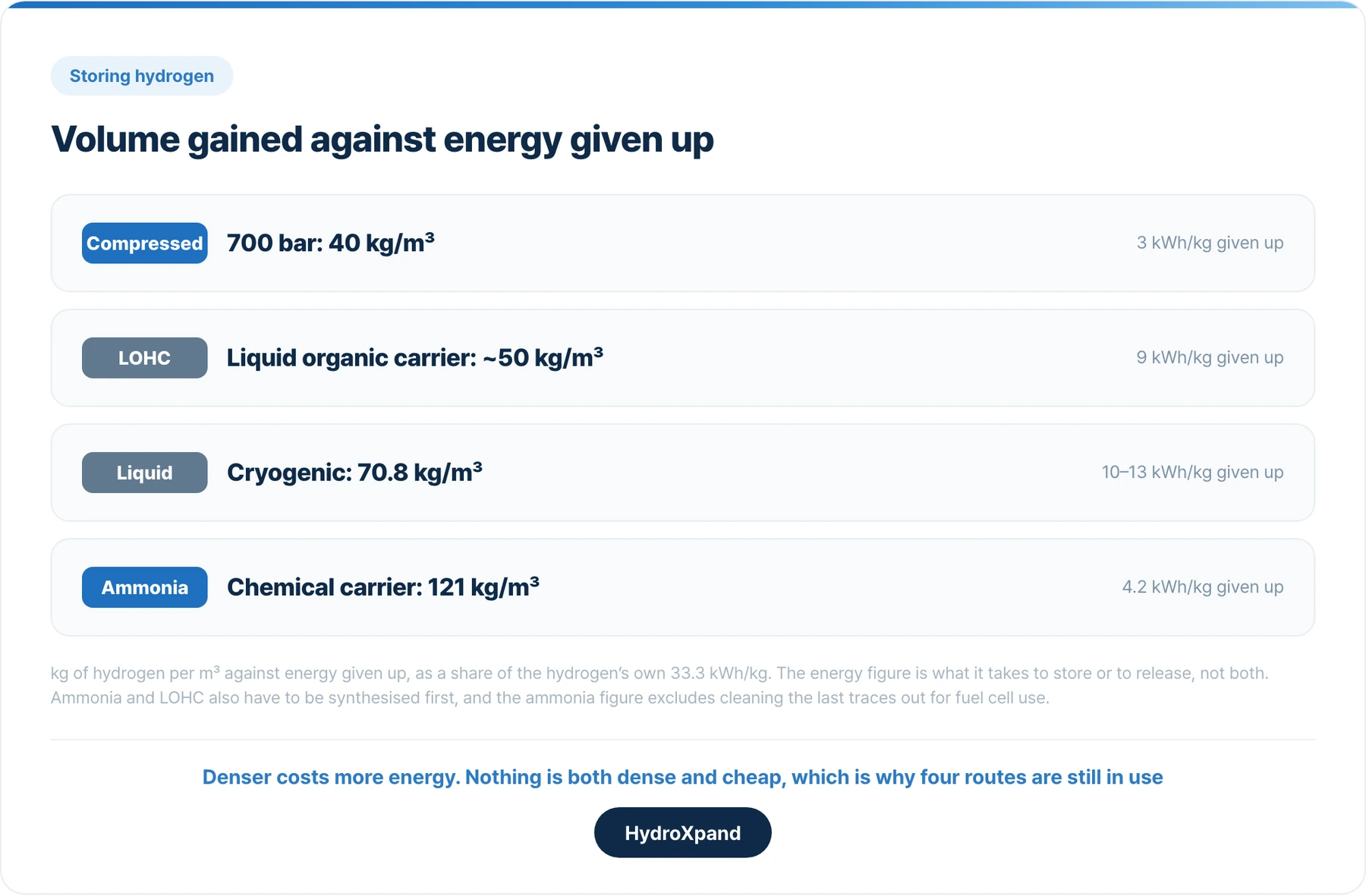
Read the table by distance and volume, not by which number looks best.
Small quantities over short distances stay as compressed gas, because no conversion step is cheaper than not converting at all.
Large quantities over long distances favour a carrier. The conversion penalty is paid once; the volume advantage is paid on every kilometre.
Studies of intercontinental supply chains tend to put the crossover somewhere above a thousand kilometres. Where exactly depends on scale, electricity price, and what the receiving site can already handle.
The case that avoids the question
There is one more variable, and it gets less attention than distance, volume and route: whether the hydrogen has to travel at all.
Storage and transport are the cost of the gap between where hydrogen is made and where it is used. Close the gap and that cost is not optimised. It stops existing.
That is the case for making hydrogen on site, at laboratory and small industrial scale. Our HXB-V1 system produces 500 L/h, about a kilogram a day, at 0 or 10 barg, from water and electricity, in the room where the hydrogen is used. Purity is 98 to 99% as it leaves the system and 99.999% or better with the optional dryer.
Against delivered cylinders the comparison is not really about kWh per kilogram. It is about the delivery schedule, the cylinder store and the pressure regulation that stop being part of the site.
This does not scale into the trade question. Steel plants, refineries and importing countries move tonnes, and for them the four routes above are the whole conversation. But a large share of hydrogen demand is small, steady and local, and that share can design the storage decision away.
- How far the hydrogen has to travel, and whether it has to travel at all.
- How much moves per delivery. The conversion penalty is paid once; the volume advantage is paid per kilometre.
- What already exists at the receiving end. A cracker, a dehydrogenation reactor or a cryogenic terminal is a capital project, not an accessory.
- How fast the stored hydrogen turns over, which decides whether boil-off is a rounding error or the main loss.
- What purity the application needs, because the clean-up step after a carrier is part of the route, not a detail.
- Hydrogen generators→How to size an on-site generator, and what the specification has to tell you.
- What water electrolysis is→Where the hydrogen comes from before any of this applies.
- Pressurised operation, measured→Our own 0 to 6 barg dataset, and what producing at pressure does and does not buy.
- HXB-V1 · 2 kW system→The system the 500 L/h and 10 barg figures belong to.
- HXS-2 · 2 kW stack→The stack inside it.
- Datasheets→Six products. No form.
- Power to gas, and back again→Storing electricity as hydrogen, and what comes back if you turn it into electricity again.
- Do you need a compressor?→Why 10 barg from the stack does not reach cylinder or fuelling pressure.
Frequently asked questions
Why is hydrogen hard to store?
One kilogram of hydrogen occupies about 11 cubic metres at ambient conditions. Every way of shrinking it, compression, liquefaction, LOHC or ammonia, charges a fee paid in a fraction of the hydrogen's own energy.
How much energy does liquefying hydrogen take?
About a third of the hydrogen's own energy. Liquefaction buys the highest density available to pure hydrogen and pays for it with temperature.
What are the four main hydrogen storage methods?
Compressed gas, liquid hydrogen, liquid organic hydrogen carriers and ammonia. Each solves the same volume problem with a different energy cost and different equipment at both ends.
Sources
- Hydrogen Program Record 9013: Energy requirements for hydrogen gas compression and liquefaction — U.S. Department of Energy, 2009
- Hydrogen Storage — U.S. Department of Energy
- Global Hydrogen Review 2024 — International Energy Agency, 2024
- Hydrogen Fuel Quality Specifications for Polymer Electrolyte Fuel Cells in Road Vehicles — U.S. Department of Energy, 2016
Looking at AEM for a specific application?