Solar and wind now make the cheapest new electricity there is, and they still cannot make it when it is needed. This article sets out the four advantages and four limits of renewable energy with the numbers behind each, compares Korea's position with the world's, and explains the two gaps electricity cannot close on its own, which is where hydrogen, and the electrolyzer, come in.
Solar and wind cut fuel use and direct emissions while they run, and they produce according to the weather rather than according to demand. Any honest account of renewable energy has to hold both facts at once. This article compares the advantages and the limits on three axes, cost, reliability of supply and siting, and then follows the limits to the point where electricity alone stops being enough and hydrogen starts to matter.
It is written from the point of view of an electrolyzer company, which sees renewable electricity as both a source of power and the raw material for green hydrogen. That view is stated openly in the final sections; the eight points themselves are the same for anyone.
What renewable energy is
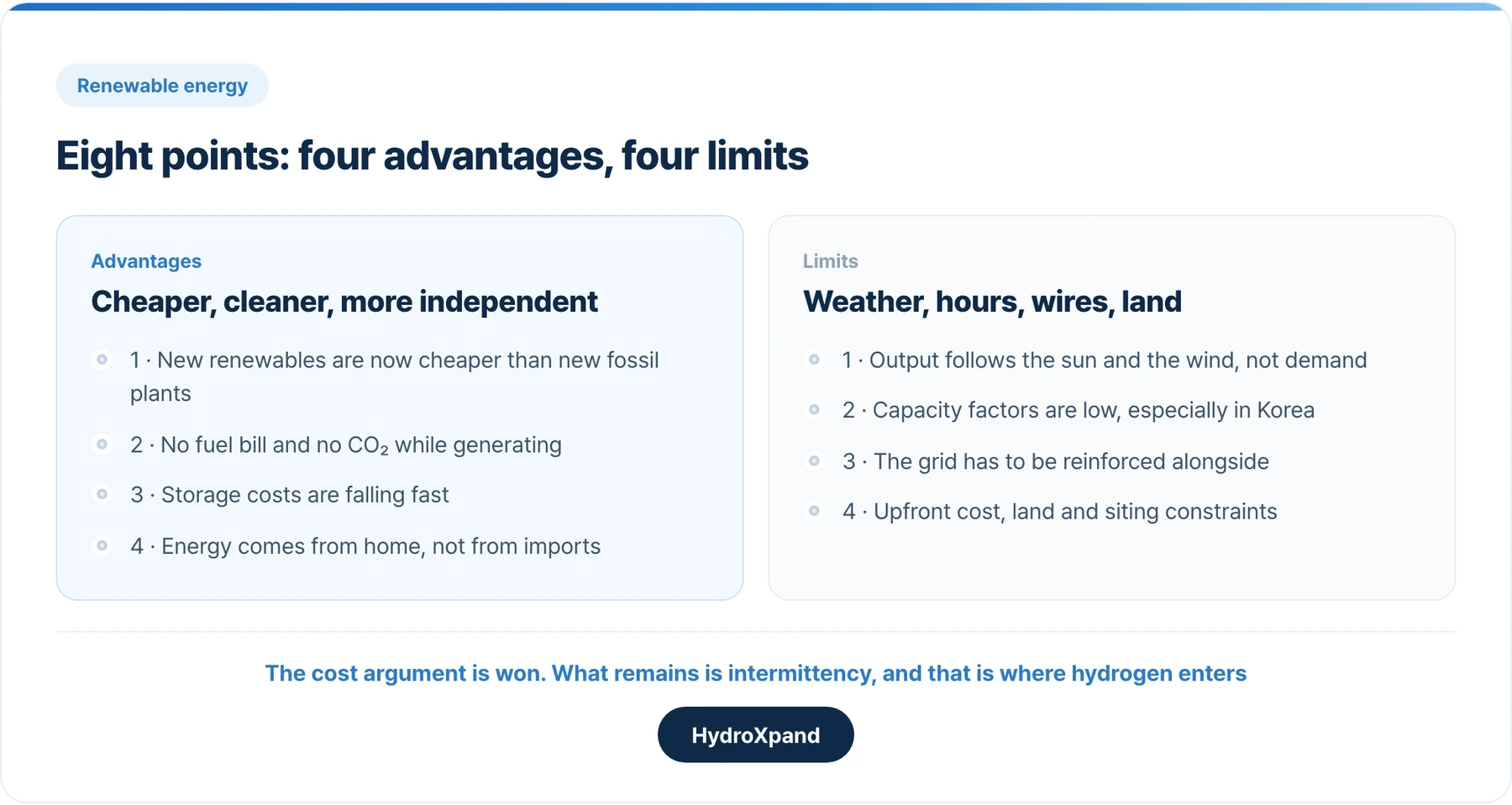
Renewable energy is electricity made from resources that nature keeps replenishing: sunlight, wind and flowing water. Solar, wind and hydro are the main three. Nothing is burned, so almost no greenhouse gas is released while generating, which is the property that separates them from every fossil plant.
Two nearby terms cause confusion. Renewable energy means the self-replenishing sources. New and renewable energy, a category used in Korean statistics, adds so-called new energy such as hydrogen and fuel cells to that list. Because the classifications differ, the renewable share of generation for the same year can vary slightly between sources. Hydrogen's place in this is worth fixing early: it is not a source at all but a carrier, which has to be made using other energy, and it is clean only when the energy used to make it was.
Advantage 1: cheaper than fossil power
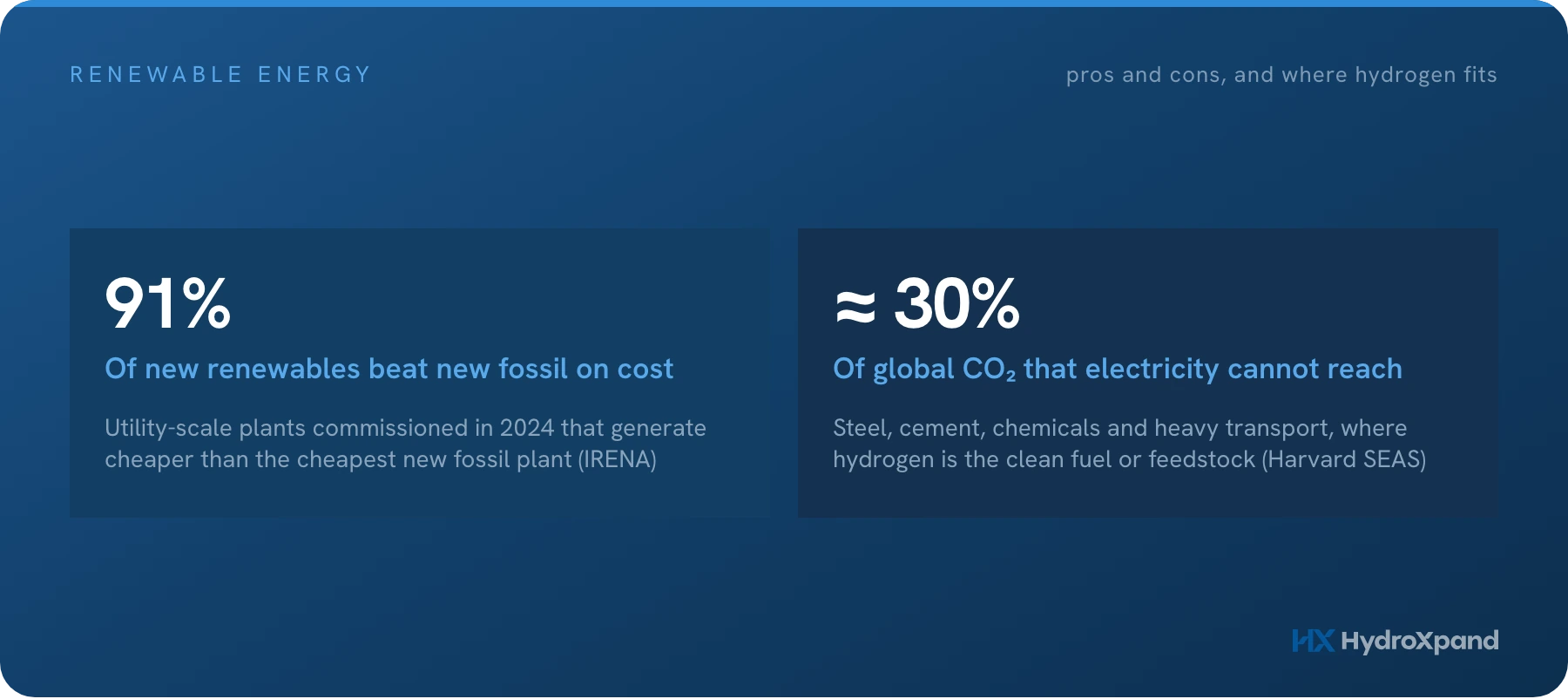
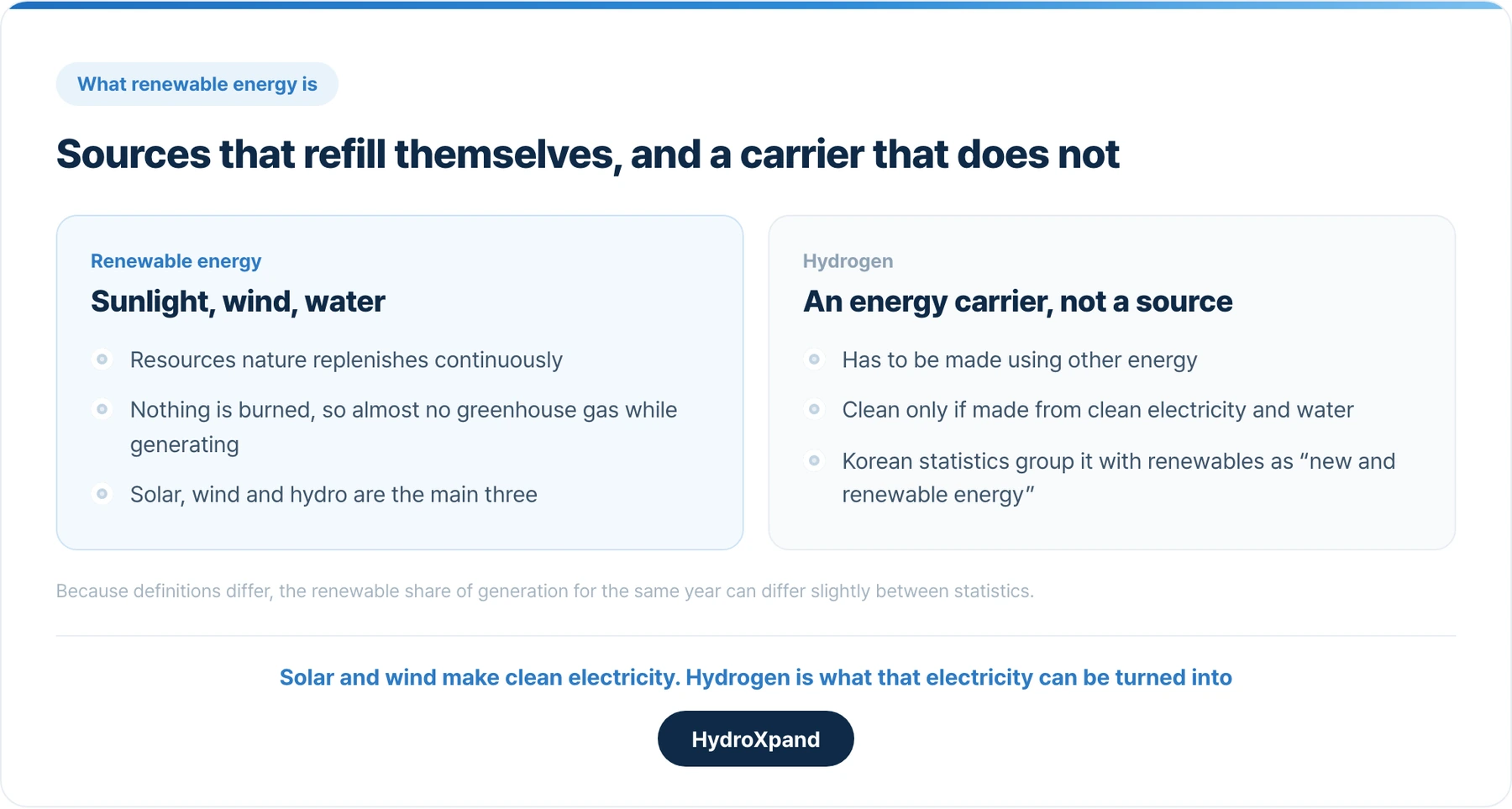
Renewables used to be the expensive option, and that has reversed. IRENA's 2024 power generation cost report puts onshore wind at USD 0.034 per kWh, the cheapest of any new source, with solar photovoltaic next at USD 0.043. The figure that settles the argument is this one: 91% of the utility-scale renewable plants commissioned in 2024 generate electricity more cheaply than the cheapest new fossil-fuel plant. On cost, new renewables have won.
91% of newly commissioned utility-scale capacity delivering power at a lower cost than the cheapest, newly installed fossil fuel-based alternative.
Advantage 2: no fuel bill, and no CO₂ while generating
The fuel is sunlight and wind. There is nothing to buy, so the cost of generation does not move when oil and gas prices do. And there is no combustion, so no greenhouse gas is released while the plant runs, which is the clearest break from fossil generation. The effect is visible at world scale: IRENA estimates that renewables avoided about USD 467 billion of fossil fuel costs in 2024 alone.
Advantage 3: storage is getting cheap too
The standard objection to renewables was that electricity is hard to keep. Batteries are the first answer, and their cost has fallen by 93% between 2010 and 2024, to USD 192 per kWh for utility-scale storage in 2024. As storage gets cheaper, supplying power through the night and through windless hours gets easier, and the weakness the objection pointed at is being engineered away.
Battery storage costs declined by 93% from 2010 to 2024, falling from USD 2571/kWh to USD 192/kWh.
SourceIRENA Renewable Power Generation Costs in 2024: battery storage cost decline
Advantage 4: energy independence
Fossil fuels are imported from the countries that have them. Sunlight and wind are domestic. Every unit of renewable generation reduces exposure to fuel imports, to geopolitics and to commodity prices, and for a country that imports nearly all of its energy, as Korea does, that is a security advantage as much as an economic one.
Limit 1: output follows the weather, not demand
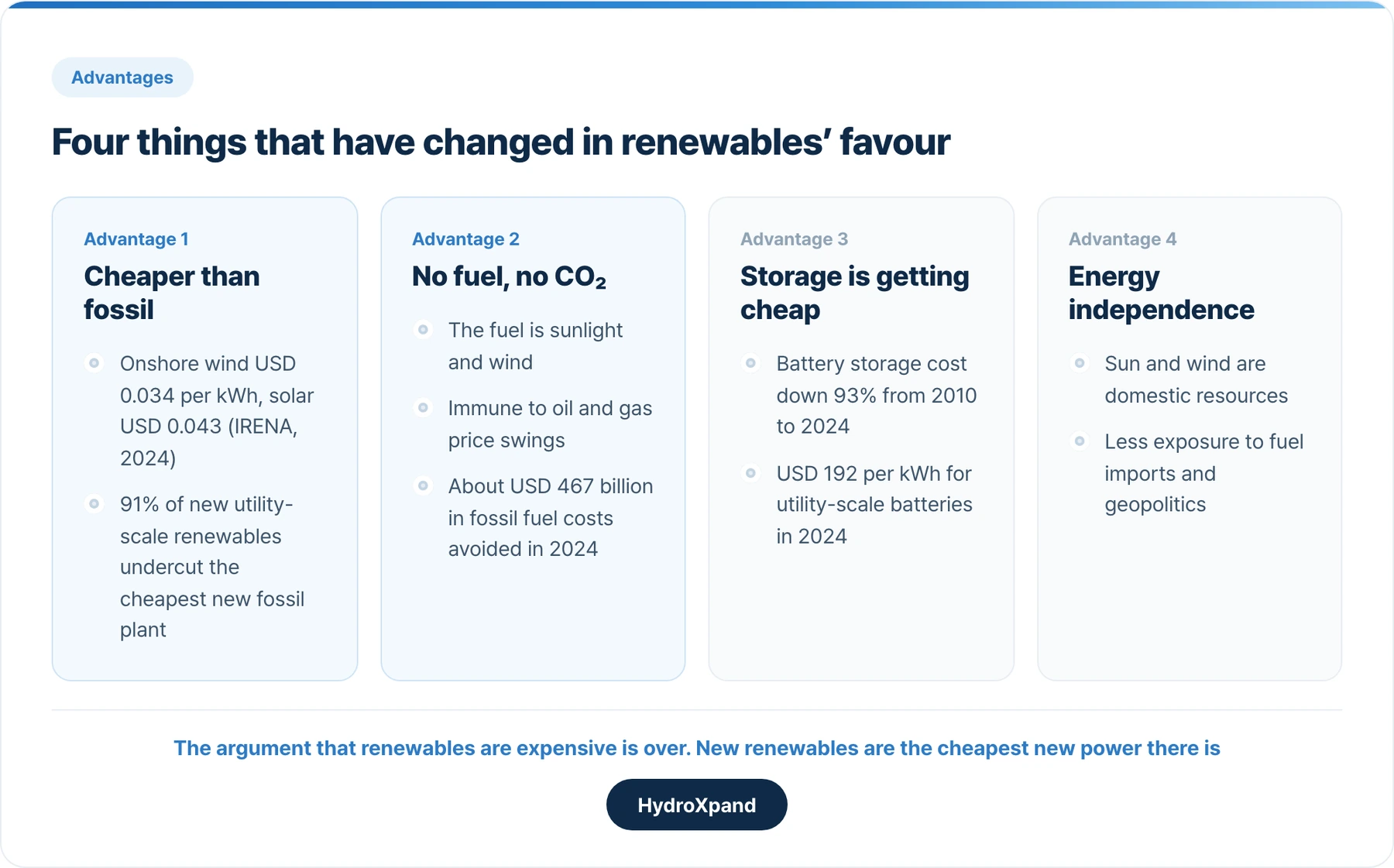
The fundamental limit of solar and wind is intermittency. Solar generates only while the sun is up; wind generates only while it blows. Neither can be turned up when people want more electricity. Demand runs around the clock while supply follows the weather, and closing that gap, by storage, by grid, or by flexible demand, is the central engineering task of a renewable system.
Limit 2: capacity factors are low, and lower in Korea
The same solar panel makes more electricity where the sun is stronger, and Korea gets less sunshine than southern Europe, the Middle East or a desert. KB Research puts a fixed solar array in Korea at 1,200 to 1,400 full-load hours a year, a capacity factor of 14 to 16%, against 1,700 hours or more in Australia or the Middle East. The same equipment simply produces less.
Deployment also lags. Korea's renewable share of electricity was 9.64% in 2023, against an OECD average of 33.49% and a world average of 30.25%. Korea has further to go than most countries and a weaker resource to do it with, which is why storage and flexible demand matter more here, not less.
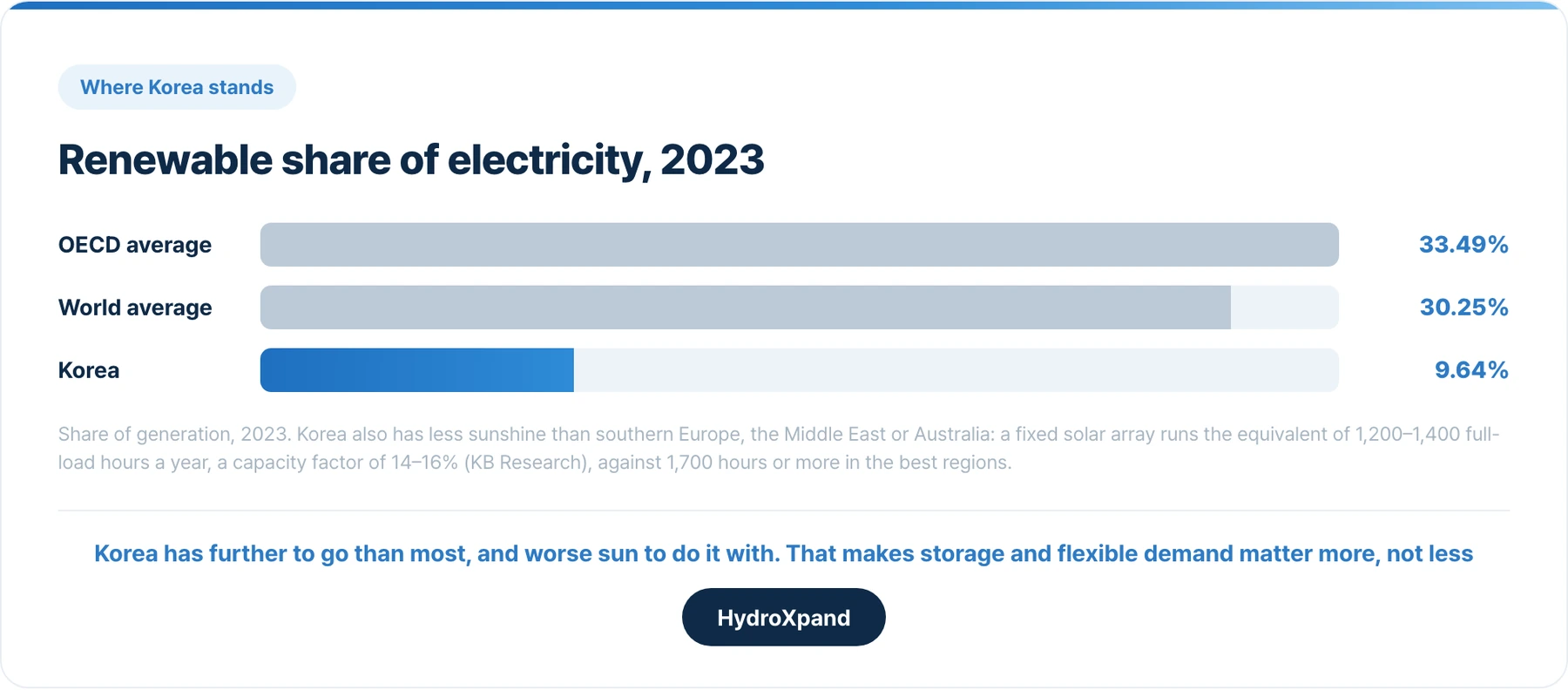
SourceKB Research: fixed solar in Korea runs 1,200 to 1,400 full-load hours a year, a 14 to 16% capacity factor (Korean) (KB Think, 2025)
Limit 3: the grid has to be reinforced alongside
Electricity that arrives intermittently is only useful if the grid can take it. Energy storage systems, high-voltage direct current transmission and smart grid control are the technologies that make variable supply usable, and without them power that was generated ends up curtailed. Renewable capacity and grid capacity have to be built together.
Limit 4: upfront cost, land and siting
The cost per kWh has fallen, but the cost of building a plant in the first place is still large. Sites with good sun and wind are limited, they need space, and the space is contested: forest loss and the acceptance of local residents are practical constraints on where a plant can go, and they slow deployment even where the economics are clear.
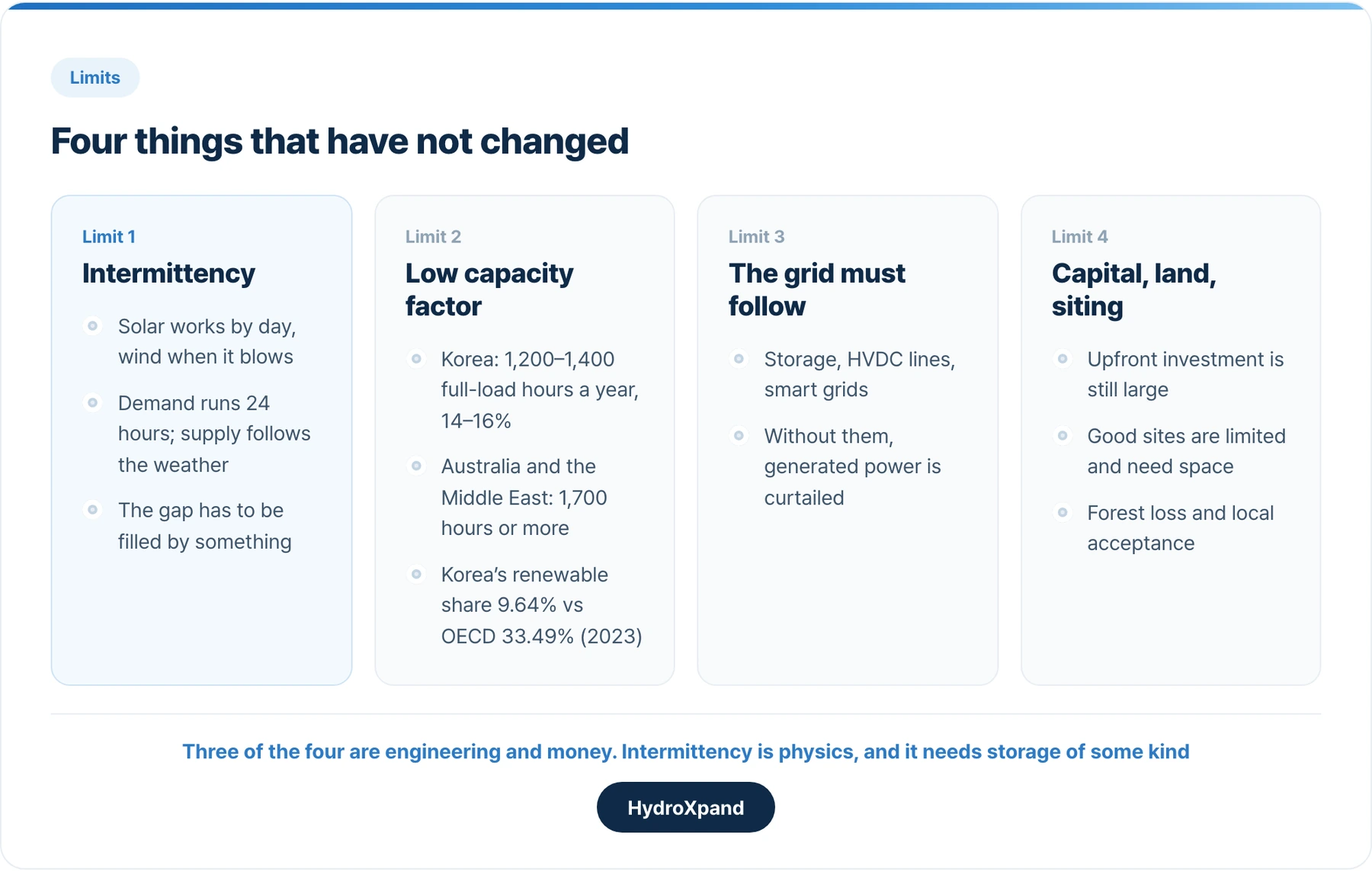
The eight points together
The advantages and the limits interlock. Generation is now cheap, but it arrives on the weather's schedule; the technologies that fix the schedule, storage and grid, are falling in cost but still have to be built. The picture is of a cost argument that has been won and a reliability argument that is being engineered, step by step. One of the tools for that engineering is hydrogen.
The cost argument is won. What remains is intermittency, and intermittency is a storage problem.
The two gaps that electricity cannot close alone
As renewables grow, two problems appear that electricity by itself does not solve. The first is the intermittency already described: sun and wind cannot be dispatched, so there are hours of surplus and hours of shortage, and the surplus has to be put somewhere it can be kept for a long time.
The second is that some uses of energy resist electrification. Steel, cement, chemicals and building materials need very high heat or use fossil fuels as a chemical feedstock, and heavy transport by truck and ship runs into the weight and charging time of very large batteries. According to analysis from Harvard's School of Engineering and Applied Sciences, these industries account for about 30% of global annual CO₂ emissions.
Hydrogen is the candidate for both gaps. Surplus renewable electricity can be turned into hydrogen and stored, which addresses intermittency at the seasonal scale where batteries fall short; and hydrogen can serve as a clean fuel or feedstock where electricity cannot reach. The relationship also runs the other way. Hydrogen production is flexible demand: an electrolyzer can run when power is in surplus and stop when it is short, and the Harvard analysis notes that this kind of flexible load helps a grid absorb renewable variability. Renewables and hydrogen cover each other's weaknesses.
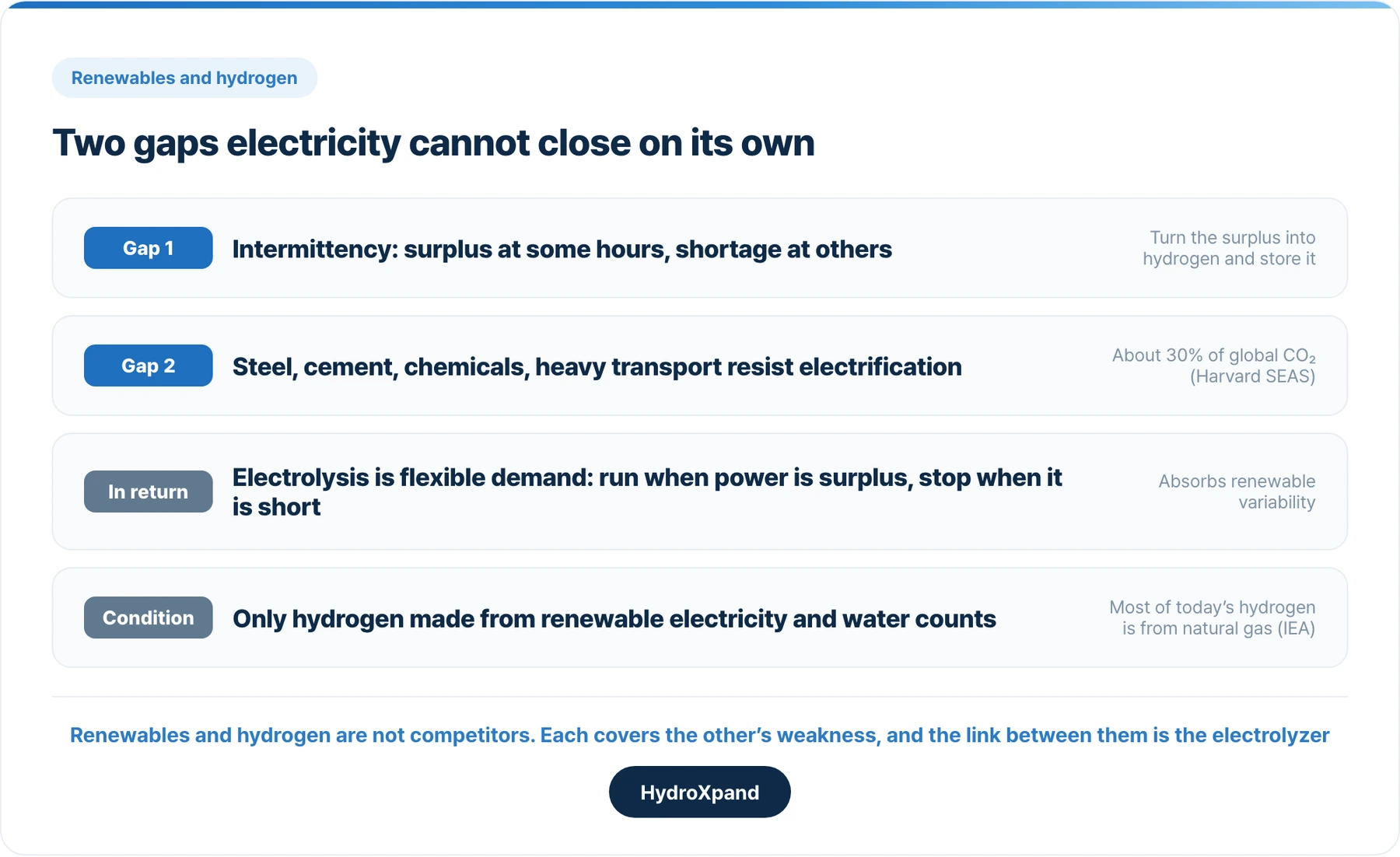
providing a comparatively flexible form of electricity demand that need not be met instantaneously, like most electricity loads.
Not all hydrogen is clean: green hydrogen and electrolysis
One qualification has to be made. Hydrogen is not itself a renewable energy. It does not exist free in nature the way sunlight and wind do; it has to be made from other energy, so whether it is clean depends entirely on what it was made from.
Hydrogen made by splitting water with renewable electricity is green hydrogen, and it is clean at the point of production as well as the point of use. Hydrogen extracted from natural gas is grey hydrogen, and CO₂ is released when it is made. According to the IEA, most of the world's hydrogen today is made from fossil fuels and carries substantial emissions. The link between renewables and hydrogen is therefore green hydrogen specifically, and the technology that makes it is water electrolysis. As renewable electricity gets cheaper and more abundant, the role of the electrolyzer that turns it into hydrogen grows with it.
What an electrolyzer company sees in renewables
HydroXpand makes electrolyzers, so we see renewable energy as a generating source and as the raw material for hydrogen at the same time. Intermittency, usually listed as a weakness, is from an electrolyzer's side a resource: electricity that would otherwise be curtailed at hours of surplus can be turned into a storable gas. The expansion of renewables is the foundation of the green hydrogen market, and the electrolyzer that converts the one into the other sits on top of it. Renewables and hydrogen are not competing options. They go together.
- When comparing renewables with fossil power, compare new plants with new plants; on that basis, renewables are cheaper almost everywhere.
- Treat intermittency as a storage question, and choose the store by duration: batteries for hours, hydrogen for weeks and seasons.
- In a country with a weak solar resource and a low renewable share, as Korea is, flexible demand such as electrolysis is worth more, not less.
- Ask how any hydrogen was made. Only hydrogen from renewable electricity and water connects renewables to the uses electricity cannot reach.
HydroXpand's AEM electrolysis electrodes, stacks and systems avoid iridium and PFAS membranes and are sold today, from 2 kW research and pilot units to a 30 kW stack, to buyers who want to turn renewable electricity into hydrogen on their own site.
- Hydrogen energy pros and cons→The same eight-point treatment for hydrogen itself: what physics fixes and what cost decides.
- Power-to-gas: what a hydrogen round trip costs→Storing surplus renewable electricity as hydrogen, and where the losses fall.
- How hydrogen energy works→The three ways hydrogen is made, and why only electrolysis is clean at scale.
- Running an electrolyzer on solar→How far the load can be turned down when the sun is the power source.
- AEM water electrolysis: how it works→How HydroXpand turns renewable electricity into hydrogen without iridium.
Frequently asked questions
Is renewable energy really cheaper than fossil fuels?
For new plants, yes. According to IRENA, 91% of the utility-scale renewable plants commissioned in 2024 generate electricity more cheaply than the cheapest new fossil-fuel plant, with onshore wind at USD 0.034 per kWh and solar at USD 0.043.
What is the biggest disadvantage of renewable energy?
Intermittency. Output follows the sun and the wind rather than demand, so a renewable system needs storage, grid reinforcement or flexible demand to match supply to a load that runs around the clock.
Is hydrogen a renewable energy?
No. Hydrogen is an energy carrier that has to be made from other energy. Hydrogen made from renewable electricity and water, green hydrogen, is clean; hydrogen made from natural gas, grey hydrogen, releases CO₂ when it is produced, and most hydrogen today is grey.
How is intermittency solved?
With storage and grid reinforcement first, and with flexible demand. Batteries cover hours; hydrogen made from surplus electricity can be stored in bulk for weeks or seasons, and the electrolyzer that makes it can itself run when power is surplus and stop when it is short.
Why is Korea's renewable share so low?
Partly resource and partly deployment. A fixed solar array in Korea runs 1,200 to 1,400 full-load hours a year, a capacity factor of 14 to 16%, against 1,700 hours or more in the best regions, and the renewable share of electricity was 9.64% in 2023 against an OECD average of 33.49%.
Sources
- Renewable Power Generation Costs in 2024 — International Renewable Energy Agency, 2025
- Clean hydrogen: a long-awaited solution for hard-to-abate sectors — Harvard John A. Paulson School of Engineering and Applied Sciences
- 태양에너지 국내 현황 (Korean solar capacity factors) — KB Research, 2025
Looking at AEM for a specific application?