OER, the oxygen evolution reaction, makes oxygen at the electrolyzer anode. Four electrons have to move one at a time, so it is slower than the hydrogen side and takes a large share of the voltage loss. How it works in acid and alkaline, how to read overpotential and Tafel slope, and why nickel-iron catalysts work in alkaline electrolysis.
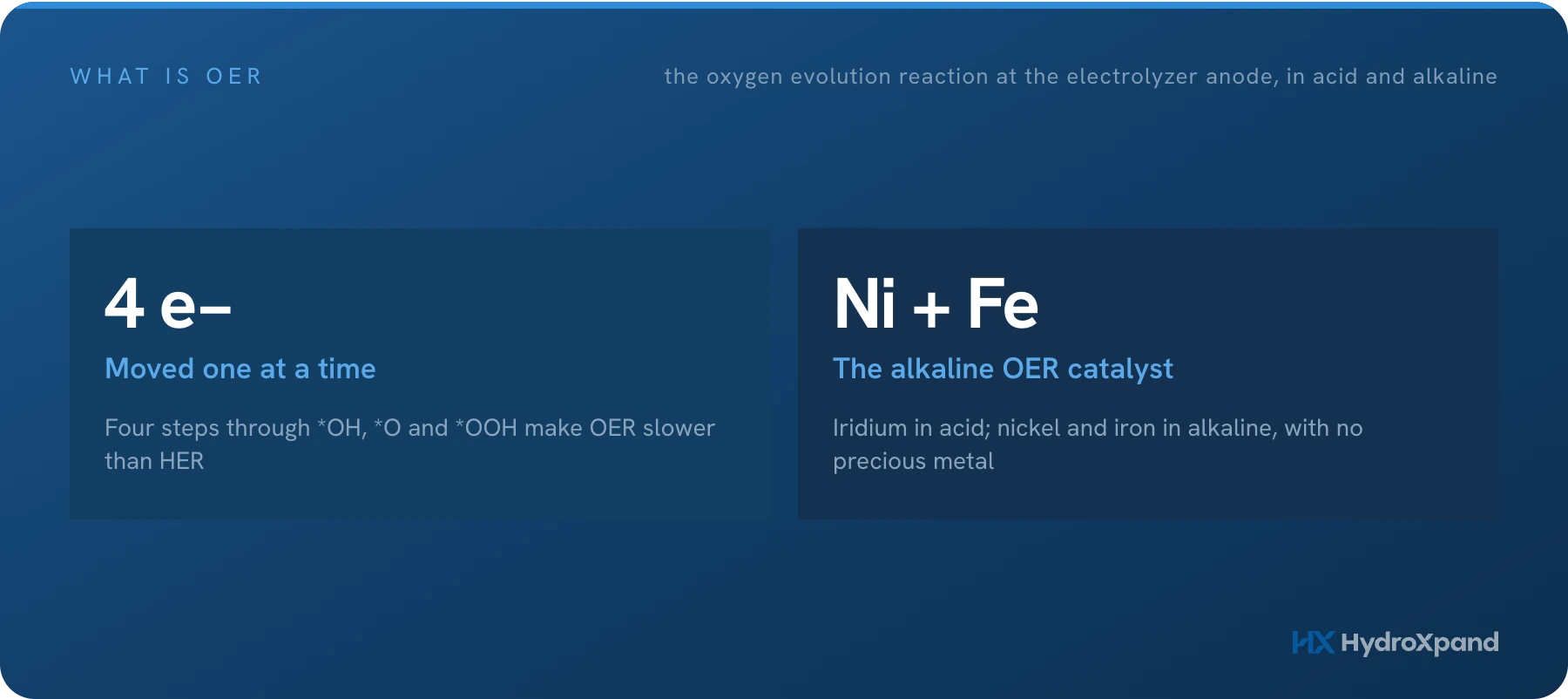
OER, the oxygen evolution reaction, is the reaction that produces oxygen at the anode of a water electrolyzer. Four electrons have to move one at a time, so it runs more slowly than the hydrogen reaction at the cathode. How much hydrogen you get from a given amount of electricity depends heavily on how easily the anode catalyst drives this reaction.
- OER happens at the anode. Hydrogen comes from the cathode (HER), oxygen from the anode (OER).
- Four electrons move in four steps. More steps mean a slower reaction and a larger voltage loss.
- Overpotential is the measure that matters: how far above 1.23 V you have to go.
- Acid electrolysis uses iridium; alkaline uses nickel and iron. The electrolyte decides which catalysts are possible.
- NiFe is the most widely used non-precious catalyst family for alkaline OER. Iron raises the activity of nickel sharply.
OER is the oxygen half of water splitting
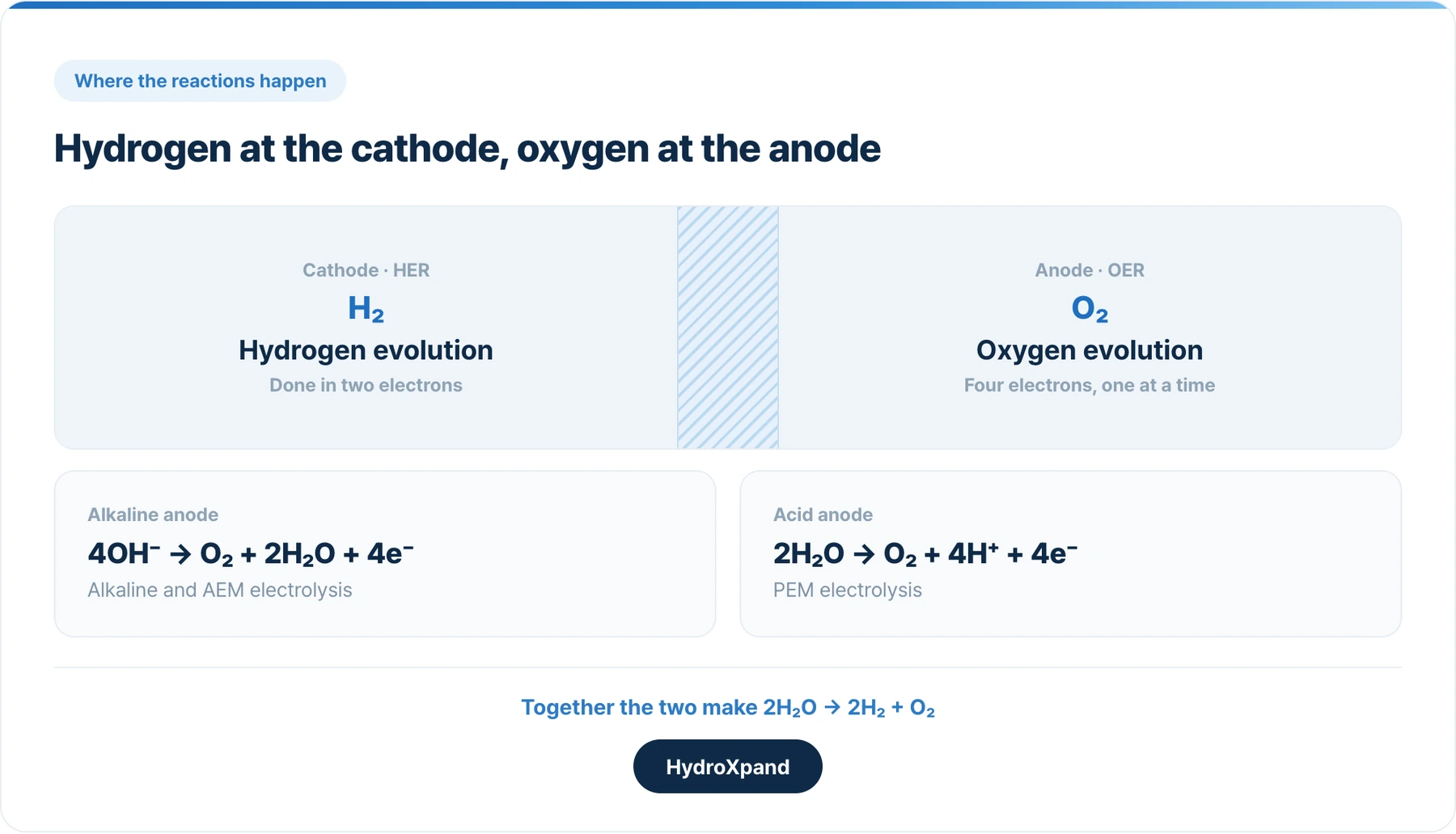
Split water with electricity and hydrogen comes off the cathode while oxygen comes off the anode. The cathode reaction is the hydrogen evolution reaction (HER); the anode reaction is the oxygen evolution reaction (OER). The equations depend on the electrolyte.
| Electrolyte | Anode (OER) | Cathode (HER) |
|---|---|---|
| Alkaline (alkaline, AEM) | 4OH⁻ → O₂ + 2H₂O + 4e⁻ | 4H₂O + 4e⁻ → 2H₂ + 4OH⁻ |
| Acid (PEM) | 2H₂O → O₂ + 4H⁺ + 4e⁻ | 4H⁺ + 4e⁻ → 2H₂ |
Either way the two add up to 2H₂O → 2H₂ + O₂. Four electrons move for every oxygen molecule, and two hydrogen molecules form in the meantime.
In alkaline electrolysis the hydroxide ions (OH⁻) made at the cathode travel through the electrolyte or the anion exchange membrane to the anode, where OER consumes them.
- What water electrolysis is→The principle, and the four numbers that describe any electrolyzer.
Why OER is slow
HER is a comparatively simple two-electron reaction. In OER the four electrons do not move at once; they move one at a time through intermediates bound to the catalyst surface. The most common description, the adsorbate pathway, has these intermediates attach to a single metal site in turn. In alkaline it is written as four steps, where * is a site on the catalyst surface:
- * + OH⁻ → *OH + e⁻
- *OH + OH⁻ → *O + H₂O + e⁻
- *O + OH⁻ → *OOH + e⁻
- *OOH + OH⁻ → * + O₂ + H₂O + e⁻
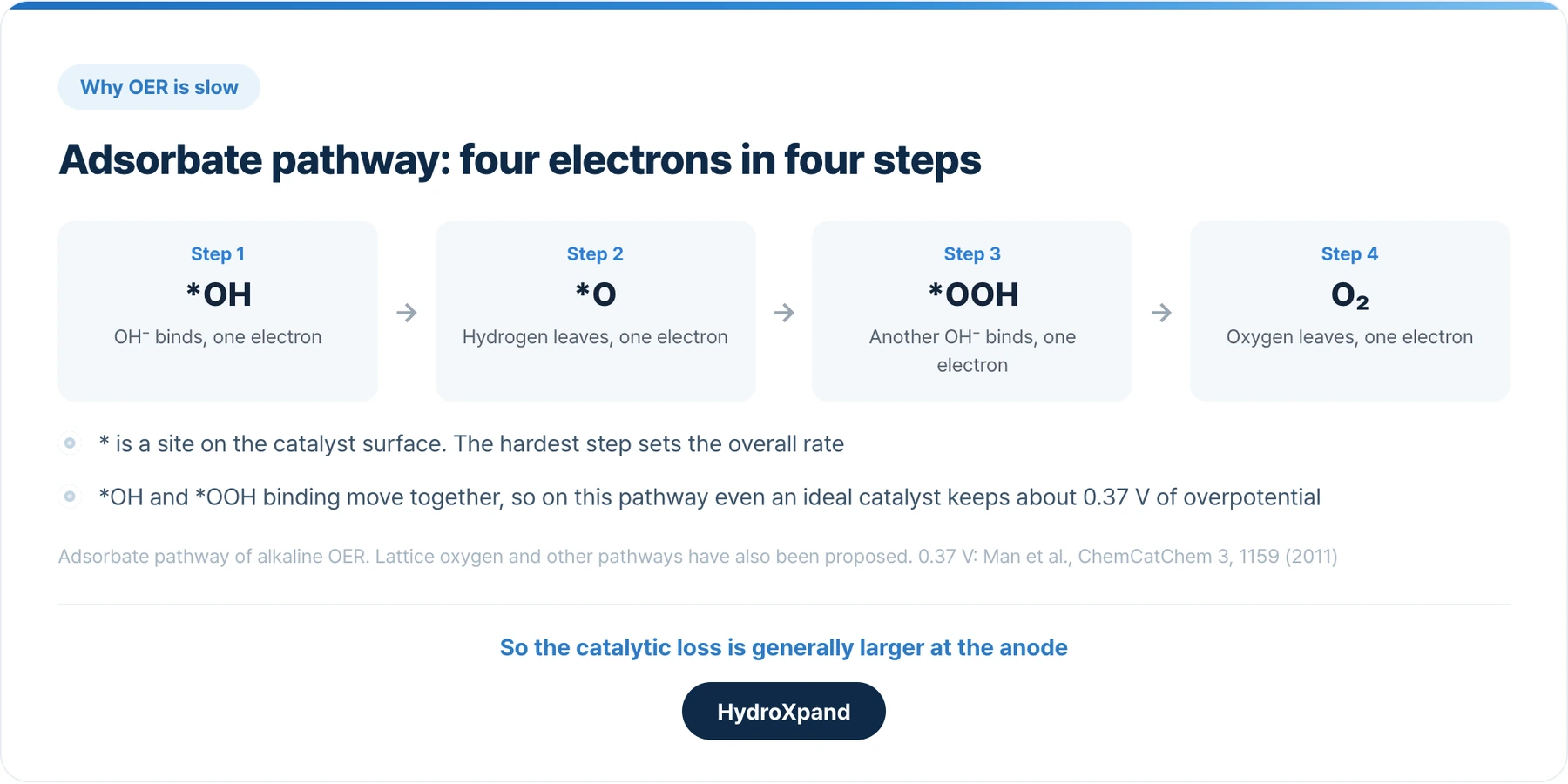
The hardest of the four steps sets the overall rate, and the steps are linked. A catalyst that holds *OH strongly holds *OOH strongly too, so making one step easier makes another harder. Calculations put the leftover overpotential on this pathway at about 0.37 V even for an ideal catalyst.
SourceMan et al., ChemCatChem 3, 1159 (2011) (Scaling relation between *OH and *OOH, and the resulting minimum overpotential.)
Acid and alkaline follow different equations
On the same adsorbate pathway, acid and alkaline use and release different species.
| Step | Acid (PEM) | Alkaline (alkaline, AEM) |
|---|---|---|
| 1 | H₂O + * → *OH + H⁺ + e⁻ | OH⁻ + * → *OH + e⁻ |
| 2 | *OH → *O + H⁺ + e⁻ | *OH + OH⁻ → *O + H₂O + e⁻ |
| 3 | *O + H₂O → *OOH + H⁺ + e⁻ | *O + OH⁻ → *OOH + e⁻ |
| 4 | *OOH → * + O₂ + H⁺ + e⁻ | *OOH + OH⁻ → * + O₂ + H₂O + e⁻ |
The intermediates are the same, and so is the equilibrium potential of 1.23 V on the RHE scale. Two things differ. In acid a proton has to be pulled off a water molecule; in alkaline a hydroxide ion is taken up directly, so different factors control the rate. The catalyst surface also changes with the electrolyte: in alkaline, nickel reacts as nickel oxyhydroxide (NiOOH); in acid, iridium reacts as a hydrated oxide. That is why different mechanisms are proposed for the same element in different electrolytes.
Other pathways have been proposed
The adsorbate pathway is not the only one. Two others come up often in recent work.
| Pathway | What happens | What it means |
|---|---|---|
| Lattice oxygen pathway | Oxygen atoms in the catalyst lattice take part directly and form the O–O bond | It skips *OOH, so overpotentials below the adsorbate-pathway limit are thought possible. As lattice oxygen leaves, the catalyst tends to dissolve or change structure |
| Direct O–O coupling | Two *O on neighbouring metal sites combine straight into O₂ | It also skips *OOH. It is mostly proposed for sites where two different metals sit side by side |
Activity that changes with pH even at the same potential on the RHE scale is cited as evidence for the lattice oxygen pathway. Which pathway dominates on which catalyst is still debated. For NiFe catalysts, reaction at the iron site, at the nickel site and at both together have all been proposed.
For a catalyst meant for real equipment, the pathway matters because of stability. A catalyst reported with unusually high activity may rely on lattice oxygen, and its structure can change over long operation. Look at long-duration measurements alongside the initial activity.
In an electrolysis cell, the voltage lost to the catalytic reactions is generally larger on the OER side than on the HER side. That is why the choice of anode catalyst weighs so heavily on electrolyzer performance.
SourceGrimaud et al., Nature Chemistry 9, 457 (2017) (pH-dependent OER activity linked to lattice oxygen.)
Reading OER performance from overpotential and Tafel slope
The minimum voltage to split water is 1.23 V at 25 °C. Taken on its own, OER is at equilibrium at 1.23 V against the reversible hydrogen electrode (RHE). To actually get oxygen you have to go higher, and the difference is the overpotential.
| Measure | Meaning | How to read it |
|---|---|---|
| Overpotential (η) | Voltage needed above 1.23 V | Lower is better. Compare at the same current density |
| Overpotential at 10 mA/cm² | A common benchmark point in papers | Useful for comparing lab catalysts; far below the current density of an operating electrolyzer |
| Tafel slope | Extra voltage per tenfold increase in current (mV/dec) | Smaller means voltage rises less as current goes up |
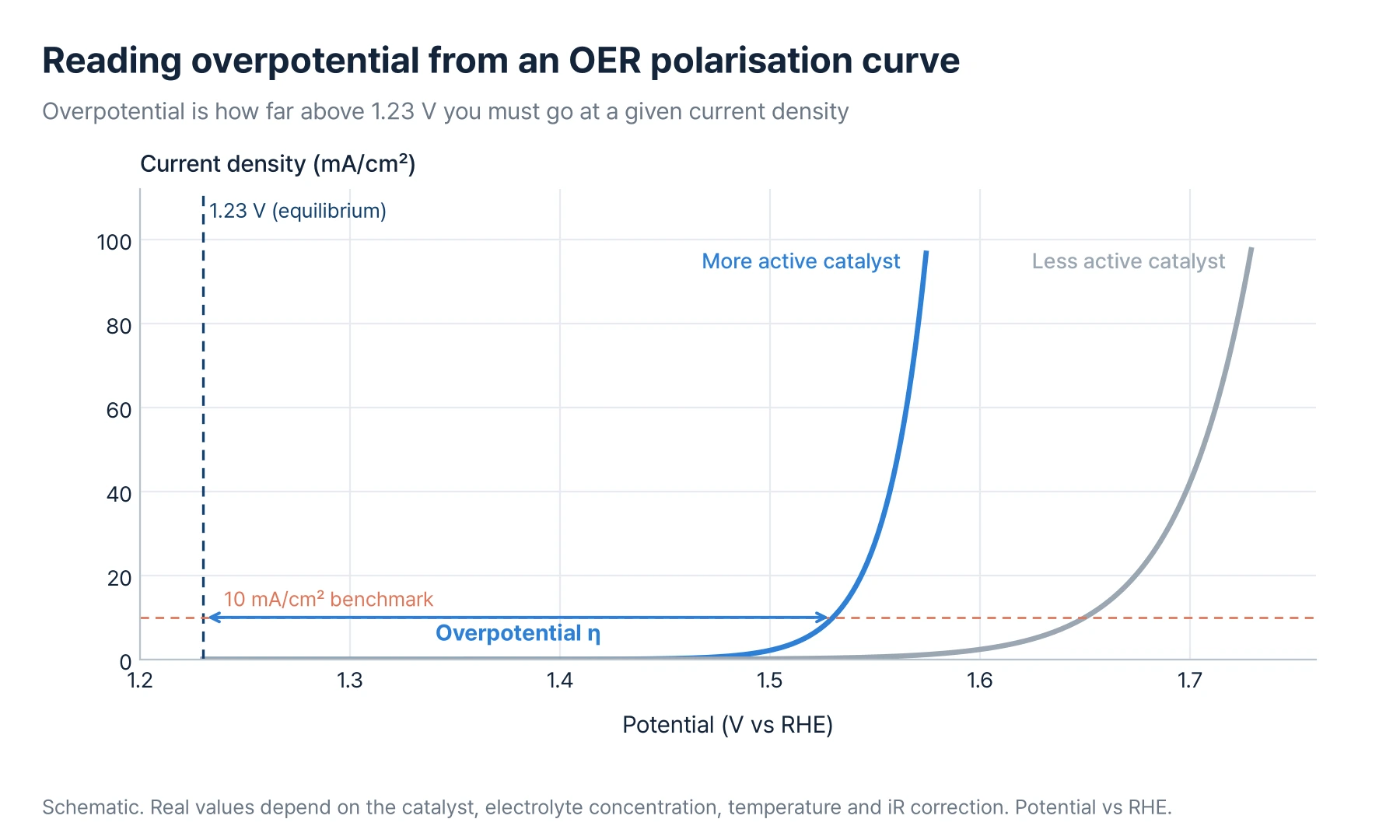
Quoting overpotential at 10 mA/cm² is a convention for comparing catalysts on equal terms. Electrolyzer stacks run at hundreds of mA/cm² and above, so a low value at that point does not guarantee the same in a stack.
The Tafel slope also needs its conditions: which current range it came from, whether solution resistance was subtracted (iR correction), and whether it is a thin-film catalyst or a full-size electrode. Comparing the numbers without the conditions leads to wrong conclusions.
SourceMcCrory et al., Journal of the American Chemical Society 135, 16977 (2013) (Benchmarking OER catalysts at 10 mA/cm².)
Iridium in acid, nickel and iron in alkaline
The anode, where OER happens, is the most oxidising place in the cell. A catalyst there has to drive the reaction well and also survive without dissolving.
| Acid (PEM) | Alkaline (alkaline, AEM) | |
|---|---|---|
| Main OER catalysts | Iridium oxide | Nickel-, iron- and cobalt-based oxides and hydroxides |
| Why | In practice only iridium-based oxides stay stable while making oxygen in acid | Nickel and iron do not dissolve in alkaline and stay stable |
| Cost | Iridium is produced in very small amounts and is expensive | No precious metal needed |
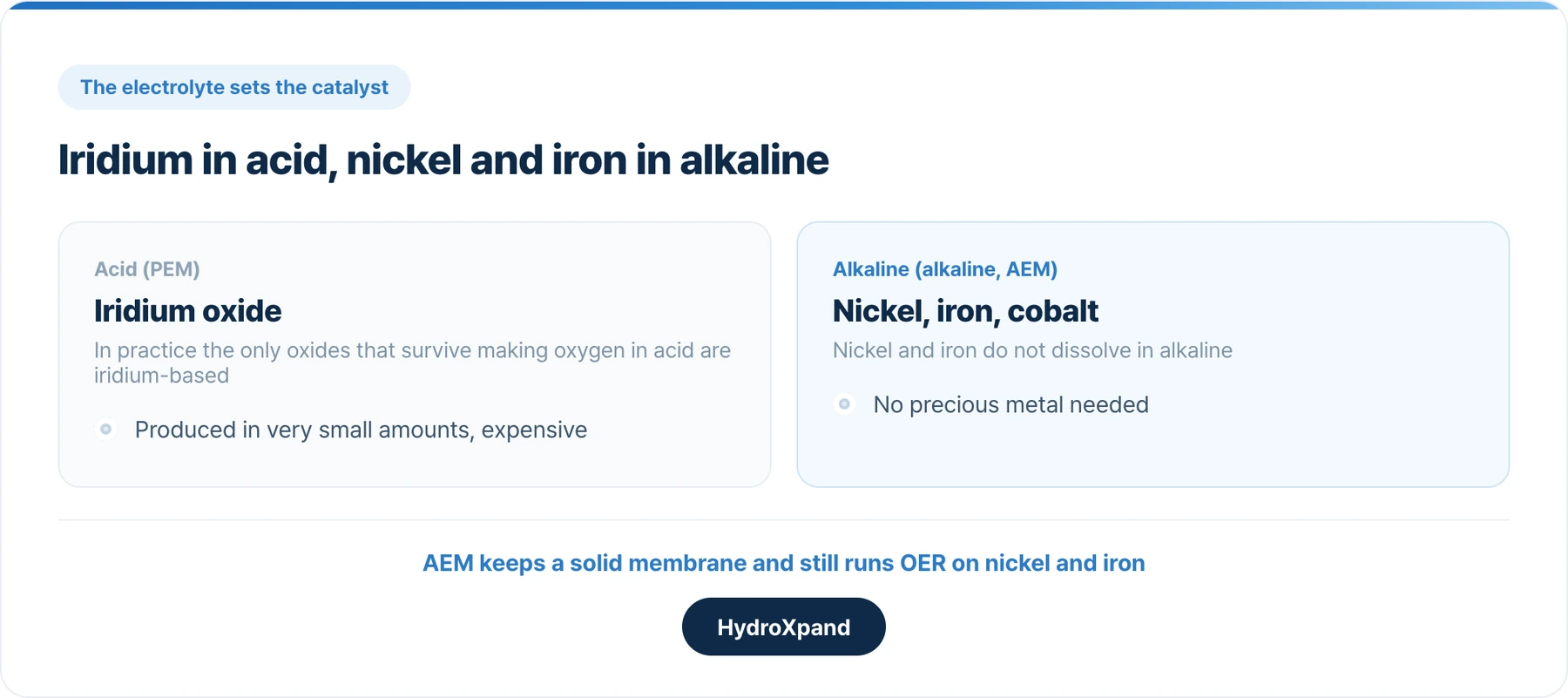
This is also why AEM electrolysis uses an alkaline environment: it keeps a solid membrane and still runs OER on nickel and iron.
- PEM water electrolysis: what the acidic membrane buys, and what it costs→Why PEM needs iridium.
- What a catalyst does→Catalyst families across electrolysis technologies.
Why NiFe works in alkaline OER
NiFe refers to catalysts that combine nickel (Ni) and iron (Fe). It is the most studied and most widely used non-precious family for alkaline OER.
In alkaline, nickel hydroxide first turns into nickel oxyhydroxide (NiOOH) as the potential rises, and OER takes place in that state. Adding a little iron raises the activity well above that of nickel alone; even trace iron in the electrolyte has been reported to boost nickel catalysts. The usual explanation is that iron changes the electronic state of the active site so the intermediates bind with a more suitable strength.
LDH, layered double hydroxide, is the name of the structure that often comes up with NiFe catalysts. Thin sheets of mixed nickel-iron hydroxide stack up with anions and water between them. The thin sheets give a large reactive surface, and ions move easily between the layers.
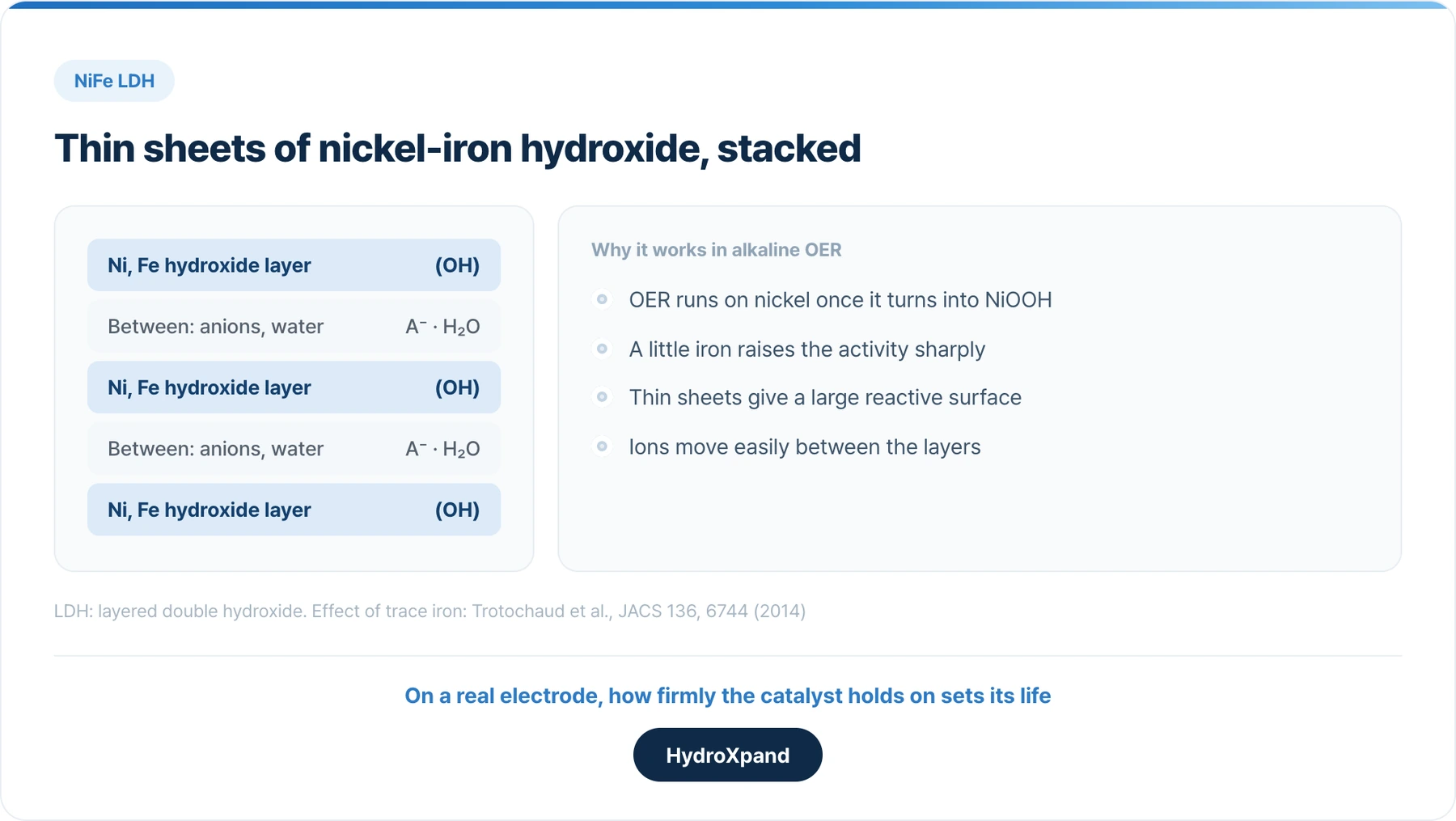
When choosing a real electrode, look at how firmly the catalyst is attached to the substrate as well as at its activity. Whether catalyst falls off or components leach out over long operation decides electrode life.
SourceTrotochaud et al., Journal of the American Chemical Society 136, 6744 (2014) (Effect of iron impurities on nickel (oxy)hydroxide OER activity.)
- Selecting an electrolyzer anode→Why initial performance is not enough, particle-coated against directly grown.
How OER performance is measured
OER performance is usually measured in a three-electrode cell: the electrode under test (working electrode), a counter electrode that carries the current, and a reference electrode that sets the potential. Because the anode is evaluated on its own, this is also called a half-cell measurement.
| Condition to check | Why |
|---|---|
| Potential scale (converted to RHE?) | Reference electrodes differ, so unconverted values cannot be compared |
| Electrolyte concentration and temperature | The same catalyst gives different overpotentials at different KOH concentrations and temperatures |
| iR correction | Subtracting solution resistance or not changes the overpotential by tens of mV |
| Area basis | Geometric area and real surface area give different current densities |
| Measurement time | The first reading and one taken hours later can differ |
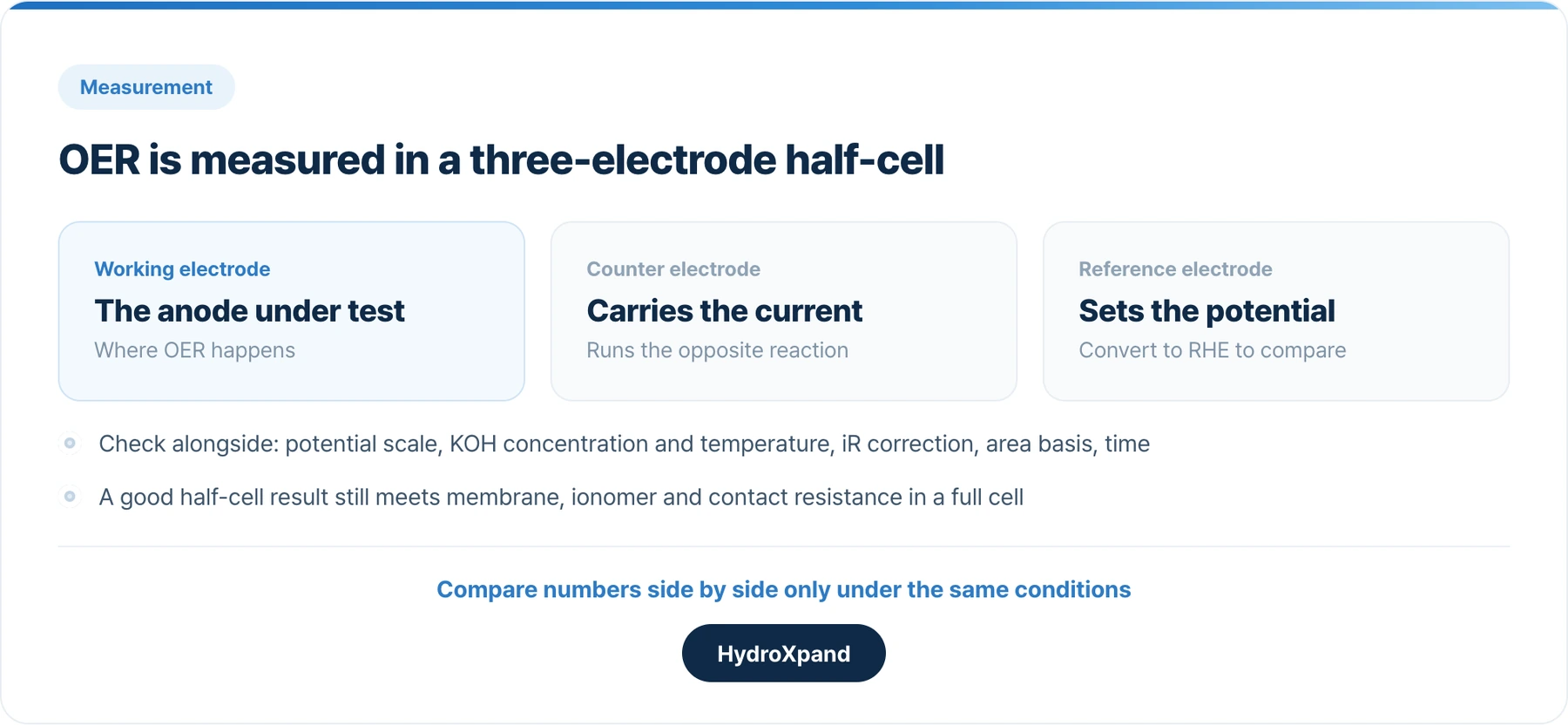
A good half-cell result does not carry straight into a full cell, where the membrane, ionomer and contact resistance add to the voltage.
Our HXP-an is an OER anode with NiFe LDH grown directly on nickel foam, with no precious metal. Its three-electrode OER polarisation curve and test conditions are on the product page.
- Why your AEM electrolyzer test does not match the datasheet→Seven things to check first.
- HXP-an→PGM-free OER anode, NiFe LDH on nickel foam.
Frequently asked questions
What is the difference between OER and HER?
OER makes oxygen at the anode; HER makes hydrogen at the cathode. OER moves four electrons in four steps, while HER is done in two and is comparatively fast. So the voltage lost to the catalytic reactions is generally larger on the OER side.
What counts as a good OER overpotential?
It depends on the conditions. Papers usually compare overpotential at 10 mA/cm², but electrolyzers operate at much higher current densities. Before comparing numbers, check that electrolyte concentration, temperature, iR correction and area basis match.
What does NiFe mean?
A catalyst that combines nickel (Ni) and iron (Fe). It is the most widely used non-precious catalyst family for alkaline OER and is often made as a layered double hydroxide (LDH).
Is there only one OER mechanism?
No. The most common description is the adsorbate pathway through *OH, *O and *OOH. A lattice oxygen pathway, in which oxygen from the catalyst itself takes part, and direct coupling of oxygen on two neighbouring sites have also been proposed. Even on the same pathway, acid and alkaline differ in their equations and in the catalyst surface.
Why can't PEM electrolysis use NiFe?
PEM is acidic, and nickel and iron dissolve. In practice only iridium-based oxides stay stable while making oxygen at an acidic anode, so PEM uses iridium.
Does a better OER catalyst alone raise electrolyzer efficiency?
Cell voltage drops by as much as the anode overpotential falls. But cell voltage also includes membrane and electrolyte resistance, contact resistance and the cathode reaction, so the catalyst alone does not set it. Check that the activity holds over long operation too.
Looking at AEM for a specific application?